
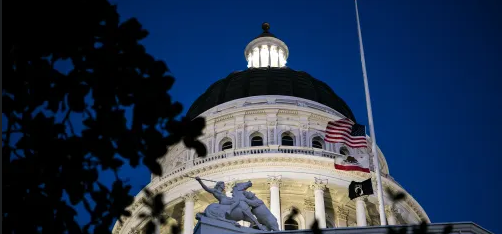
CalMatters and the Fight for California's Democratic Soul
How a scrappy nonprofit newsroom became a lifeline for civic truth in an era of collapsing journalism and weaponized media
The numbers are damning. Since 2005, the United States has lost more than 3,300 newspapers — a graveyard of shuttered mastheads that once stitched communities together with shared facts, local accountability, and civic identity. In 2024 alone, 127 newspapers closed — almost two and a half per week. As of this writing, more than 55 million Americans have limited or no access to a local news outlet. The term for what these communities become has entered the political vocabulary with brutal clarity: news deserts.
These are not abstractions. They are towns where no one covers the school board meeting, cities where the county commissioner embezzles undetected for years, states where major legislation passes with zero sustained public scrutiny. Research repeatedly confirms what common sense already suspects: where local journalism dies, voter participation declines, corruption increases, and political polarization deepens. As Northwestern University's Medill School of Journalism put it plainly, this is "a crisis for our democracy."
Into this landscape — and into the specific, sprawling challenge of covering the world's fifth-largest economy — stepped a nonprofit news organization that has, over the past decade, become one of the most important journalistic experiments in the country. Its name is CalMatters. And what it represents is not just good journalism — it is a proof of concept that democracy can still be defended, story by story, if the will and the model exist to do so.
A Vacuum Worth Filling
California is not a small problem. With nearly 40 million residents, a state budget approaching $300 billion, and a policy apparatus that routinely sets national precedent on everything from environmental law to artificial intelligence regulation, California state government touches more lives more profoundly than most national governments anywhere in the world. And yet, for years, it was being covered by a press corps that was quietly bleeding out.
The Sacramento press gallery, once thick with reporters from the Los Angeles Times, regional papers, and wire services, had been hollowing since the early 2000s. Hedge funds bought up newspaper chains and stripped newsrooms to the bone, chasing short-term profit while gutting long-term institutional knowledge. The reporters who remained were doing more with less, and the complex machinery of state government — its committees, its budget negotiations, its regulatory agencies, its legislative maneuvers — was going largely unwatched.
CalMatters was founded in 2015 explicitly to fill that vacuum. Its co-founders identified the decline in coverage of state politics in the decade prior as the primary motivation. The mission was not to create another media brand competing for clicks on celebrity gossip or national horse-race politics. It was narrower and harder: to explain how California's government works, and why it matters to the people living under it.
That focus has remained absolute. CalMatters describes itself as the only journalism outlet dedicated exclusively to covering America's biggest state — and as a 501(c)(3) nonprofit, it is structured to answer to readers and the public interest, not to advertisers, shareholders, or media conglomerates.
The Crisis It Was Born Into — And the One It Now Navigates
The threat to journalism that motivated CalMatters' founding has not abated. It has worsened, and acquired new and more alarming dimensions.
The financial collapse of commercial news has continued its grinding attrition: in 2025, 136 local news organizations vanished through closures or mergers, and as of that year, fewer than 1,000 daily print newspapers remained in the United States. Ten companies now control a quarter of all U.S. newspapers and more than half of all dailies — several of them partially or fully owned by private equity groups and hedge funds whose interest in journalism extends only as far as the quarterly return.
But beyond economics, journalism now faces something more corrosive: a wholesale attack on its legitimacy. Trust in the news media has reached historic lows. According to Gallup, public confidence in media fell below 35% for the first time in late 2025 — a catastrophic collapse from the 68–72% trust levels recorded in the 1970s. Republican confidence sits at 12%. Independents at 27%. Even among Democrats, the number has declined to 54%. When two-thirds of Americans distrust the institutions whose purpose is to inform public discourse, you have not just a media crisis — you have a crisis of the epistemological commons that democracy requires to function.
The partisan weaponization of that distrust has been deliberate and escalating. Cable news networks built profitable empires on inflaming tribal loyalties rather than informing civic debate. Social media platforms algorithmically rewarded outrage over accuracy. And at the federal level, organized efforts to delegitimize journalism — including threats against broadcast licenses, exclusion of outlets from access, and ongoing litigation against major news organizations — have created what the Committee to Protect Journalists called "a chilling effect" with "the potential to curtail media freedoms." Reporters Without Borders sounded formal alarms. A Pew Research survey from early 2025 found that seven in ten Americans were at least somewhat concerned about potential restrictions on press freedom.
In this environment, the RAND Corporation warned in 2024 that the erosion of local media represents a form of strategic disarmament — that news deserts create blind spots that foreign adversaries and domestic bad actors are already exploiting. The decline of local journalism is not a lifestyle story about struggling newspapers. It is a national security issue.
This is the world CalMatters operates in. And it is why what CalMatters does matters so urgently.
What CalMatters Actually Does
At the most basic level, CalMatters employs more than 45 experienced journalists — reporters, editors, data specialists, photographers, and documentary filmmakers — spread across California, covering everything from the Capitol in Sacramento to the effects of state policy in every corner of the state. Its journalism is free to access, distributed to more than 250 media partners across California at no cost, and reaches an average of 1 million website visitors per month, with millions more through Apple News, Patch, CapRadio, KQED's The California Report, and PBS SoCal, where CalMatters now airs five nights a week.
But the depth goes well beyond volume. CalMatters has produced the kind of accountability journalism that changes things — not just informs people, but triggers concrete action in the real world.
Consider the investigation into California's homeless shelter system. CalMatters reporters found that cities and counties across the state were systematically ignoring a state law requiring basic safety and sanitation inspections of taxpayer-funded shelters — that, of the more than 500 cities and counties required to file reports, only nine had done so. The investigation documented violence, mismanagement, and low re-housing rates inside facilities that the public was paying for and had been told were functioning. The result was Assembly Bill 750, which would add enforcement teeth to the existing law and strip state funding from jurisdictions that failed to comply. The bill passed the Assembly and advanced to the Senate. A law that might never have been written without the journalism that forced the issue into public view.
Or consider the investigation into maternity ward closures. CalMatters documented that at least 56 maternity wards had closed across California since 2012 — in rural and urban areas alike — resulting in dangerous drive times for patients in labor and overwhelmed obstetrics departments in neighboring communities. That reporting directly inspired legislation in 2024 by State Senator Dave Cortese, who cited CalMatters' findings when he introduced the bill.
Or the investigation into California's drunk driving crisis: a deep-dive that found 40,000 people had died on California roads over a defined period, and that state leaders had consistently looked away from the problem even as DUI fatalities surged. It was the kind of systemic accountability piece — data-rich, long-form, politically uncomfortable — that commercial newsrooms rarely have the resources or independence to produce.
Or the reporting on substance use treatment insurance coverage, which led directly to Assembly Bill 669, requiring health plans to authorize at least 28 days of treatment before conducting eligibility reviews — a protection for some of the state's most vulnerable people, prompted by a single CalMatters story about a man named Ryan Matlock.
Or the wage theft investigation, a 2022 series documenting long waits and low payouts for workers who reported that their employers had shorted them. That reporting prompted California lawmakers in 2025 to introduce bills aimed at clearing the backlog.
By CalMatters' own count, in 2025 alone its journalism and that of The Markup — the tech-accountability newsroom it acquired in 2024 — prompted lawmakers to introduce eight new bills and seven agencies to take action on reported issues. That is not a minor editorial footnote. That is journalism functioning exactly as a democracy requires it to function: as a mechanism of public accountability with direct legislative consequence.
Digital Democracy: Transparency as Infrastructure
Perhaps the most audacious thing CalMatters has built is not a story, but a tool.
Launched in its current form in April 2024, Digital Democracy is an AI-powered, searchable database that gives any Californian — not just journalists, not just lobbyists, not just insiders — access to every word spoken in public legislative hearings, every dollar donated to every politician, every bill introduced, every vote cast. It fuses big data, artificial intelligence, and an accessible public interface to make the inner workings of government legible to ordinary citizens.
The implications are considerable. Before Digital Democracy, understanding the full voting record of a California legislator required either expensive lobbying infrastructure or painstaking manual research. Now, any constituent can look it up in minutes. And what CalMatters' reporters found when they looked — that California Democrats vote "no" less than 1% of the time, with legislators routinely killing bills not through opposition but through quiet inaction — prompted widespread public debate about legislative accountability and procedural transparency. Critics noted that legislators were using the procedural sleight-of-hand of simply not voting as a way to dodge accountability for hard decisions. That story could not have been reported without the database. And the database would not exist without CalMatters.
Digital Democracy won General Excellence recognition from the Online Journalism Awards in 2025, with the jury specifically citing its real-world impact and its fulfilment of the democratic mission to demystify state government.
The Markup Acquisition: Technology Accountability Meets Political Accountability
In 2024, CalMatters made a move that significantly expanded its scope and ambition: it acquired The Markup, a nonprofit newsroom whose entire focus was on holding technology companies accountable to the public good.
Founded in 2020 on the premise that technology is now integrated into every aspect of daily life and that people deserve to understand how it affects them, The Markup had built a reputation for rigorous, data-driven journalism about privacy violations, algorithmic harm, and the gap between what tech companies promise and what they actually do. Multiple companies, following Markup reporting, stopped the practice of hiding data opt-out instructions from Google search results. Civil litigation against Match Group — the world's largest dating app company — cited reporting on its failure to remove serial rapists from its platforms.
Combined with CalMatters, The Markup's expertise creates a powerful and timely synthesis: as California becomes the de facto regulatory laboratory for U.S. technology policy, the merged newsroom is positioned to hold both the government and the industry accountable simultaneously. In a state that has passed more consequential AI and privacy legislation than any other, that kind of integrated coverage is not a luxury — it is a democratic necessity.
The Voice of the Readership
Statistics tell part of the story. Reader responses tell another.
In CalMatters' 2025 audience survey, 89% of respondents said they had voted in local, state, or national elections for ten or more years. After reading a CalMatters article, more than 80% said they felt better informed, and more than 20% said they had been inspired to write to a state official.
But the individual voices are more vivid. Cecilia, from Sacramento, described CalMatters as the best source she had encountered for explaining ballot measures — "excellent at distilling complicated subjects for all audiences." Omer, a government worker in Los Angeles, said he used CalMatters to stay current on developments in his own professional domain. And David, from Oceanside, offered perhaps the most pointed civic endorsement: "In a democracy, news becomes valuable when the electorate can inform their representatives about needed and proposed legislation. CalMatters' My Legislators newsletter gives me that information, and it's already helped me in a short window of time [to] contact my representatives on a variety of topics. CalMatters is bucking a dangerous trend by providing this valuable information."
That phrase — bucking a dangerous trend — deserves to sit with you for a moment. A reader, unprompted, identified what CalMatters is doing not as good journalism in a vacuum, but as a counter-force against something real and threatening. The dangerous trend is not hypothetical. It is the one described by every media researcher, every watchdog group, every First Amendment lawyer paying attention to the current moment: the progressive collapse of the independent press as a functional institution of democracy.
The Model and Its Meaning
CalMatters is funded by foundations, major donors, sponsors, and a growing base of individual members. It is a 501(c)(3), transparent about its finances and donor relationships. It distributes its journalism for free to any California media outlet that wants it — a deliberate choice that puts public information above brand competition and treats the strengthening of the broader news ecosystem as part of the mission, not a threat to it.
This model matters for reasons that go beyond CalMatters itself. The collapse of commercial journalism has not been replaced by a viable digital advertising model — that pipe dream died in the early 2010s when it became clear that the internet's advertising revenue was being captured almost entirely by Google and Meta, not by news publishers. What has emerged in the gap is a patchwork of nonprofit newsrooms, many of them affiliated with the Institute for Nonprofit News, exploring whether journalism can survive on a combination of philanthropic support, reader revenue, and institutional mission rather than profit motive.
CalMatters is one of the most successful of these experiments. Starting from average annual revenues of less than $2.2 million in its first four years, it reported total revenue of $13 million in 2022 and has continued to grow. It has published more than 11,000 stories. It has earned recognition from the National Press Club, the Online News Association, the Society of Environmental Journalists, the Edward R. Murrow Award, and the Society of Professional Journalists. It launched a Youth Journalism Initiative in 2022 to train the next generation of civic reporters — an investment not just in CalMatters' future, but in the future of the profession itself.
The Larger Stakes
It is tempting to frame CalMatters as a California story, and in one sense it is. It covers California. It employs California journalists. It produces journalism that changes California law.
But the stakes it represents are national. Every state in the union has some version of the problem CalMatters was built to address — a thinning press corps, an underreported state Capitol, a policy apparatus operating in reduced public light. The experiment CalMatters is running — can rigorous, independent, nonprofit journalism sustain itself and retain civic relevance in an era of media collapse and democratic stress? — is one every democracy in the developed world is watching.
The answers, so far, are encouraging. Legislation changed. Readers empowered. Agencies compelled to act. Corrupt practices exposed. Government made legible to the people it governs. That is not a list of editorial achievements. That is a description of democracy functioning as it is supposed to function — with a free and independent press as the connective tissue between citizens and the institutions that shape their lives.
The threat is real: the news deserts spreading, the trust in media cratering, the political weaponization of hostility toward journalism intensifying, the financial models for independent reporting still fragile and unproven at scale. Against that threat, every institution like CalMatters — every newsroom that chooses mission over profit, accountability over access, public interest over partisan service — is not just doing good journalism. It is performing an act of democratic maintenance.
Thomas Jefferson famously wrote that given the choice between government without newspapers and newspapers without government, he would choose the latter without hesitation. He did not mean entertainment or propaganda. He meant the kind of journalism CalMatters practices: patient, factual, locally embedded, structurally independent, and relentlessly focused on the question of whether power is being exercised in the public interest.
That kind of journalism is dying in America at a rate of two outlets per week.
CalMatters is one of the places it is still alive.
CalMatters is a 501(c)(3) nonprofit newsroom. Its journalism is free to read at calmatters.org. Readers can support its work at calmatters.org/donate.
Member discussion: