
Beyond the Logical Skeleton
The history of Western metaphysics is largely defined by the pursuit of the "First Principle"—that foundational "God of the Philosophers" who grants the universe its initial push. Aristotle’s Unmoved Mover (Kinéton Akinéton) represents the pinnacle of this pursuit: a cold, self-contemplating intellect that provides the logical scaffolding for causality without necessitating the "irrationality" of a personal relationship. For the modern materialist, this is the most palatable version of a deity—a functional placeholder for the laws of physics.
However, this "logical skeleton" leaves a profound void. It explains the mechanics of motion but remains silent on the nature of beauty, the intensity of consciousness, and the subjective experience of bliss. It posits a universe that is intellectually consistent but existentially hollow. This article proposes that the first ten verses of the Brahma-Saṁhitā provide the necessary "software" to inhabit that Aristotelian "hardware."
We will explore how the Brahma-Saṁhitā systematically constructs a bridge from the Absolute Prime Cause to the Material Universe. The journey begins with the definition of the Source as sac-cid-ānanda-vigrahaḥ—a blissful form that possesses intentionality. It then moves into the "Geometry of Power," where the Absolute is mapped onto a hexagonal Yantra, suggesting that the foundation of reality is a machined, harmonic structure.
The core of our reconstruction focuses on Vibrational Causality. We will argue that the "Divine Mantra" received by the secondary creator, Lord Brahmā, functions as the Information Theory of the cosmos—a source code that precedes the emergence of matter. By the time we reach the tenth verse, where the universe is manifested as a "conscious projection" or a "dream" of the Architect, we find a resolution to the dualism of mind and matter.
Ultimately, this article argues that theism, when viewed through these verses, is not an "irrational" relic, but a more robust and "rational" foundation for culture than the void of atheism. It offers a "Post-Secular" worldview that recognizes the Absolute not as a cold machine, but as the All-Attractive Source who attracts the universe into being through the sheer force of His own bliss.
The Definition of the Source (Verses 1–2)
The foundational movement of the Brahma-Saṁhitā is the immediate subversion of the abstract "it" in favor of the sovereign "who." While the Aristotelian tradition arrives at a first cause through a process of elimination—stripping away potentiality until only a sterile, immovable point remains—the Sanskrit tradition begins with an ontological explosion of qualities.
Verse 1
ईश्वरः परमः कृष्णः सच्चिदानन्दविग्रहः|
अनादिरादिर्गोविन्दः सर्वकारणकारणम्॥
(IAST Transliteration):
īśvaraḥ paramaḥ kṛṣṇaḥ sac-cid-ānanda-vigrahaḥ
anādir ādir govindaḥ sarva-kāraṇa-kāraṇam
The opening stanza establishes the Prime Cause as īśvaraḥ paramaḥ—the Supreme Controller. This is a critical departure from the "God of the Machine." Aristotle’s Mover is a cause by necessity; it sits at the top of the chain because logic demands an anchor. In contrast, the Brahma-Saṁhitā posits a Cause that is defined by Sovereignty and Intentionality. The term sac-cid-ānanda-vigrahaḥ provides the qualitative dimensions of this Source: it is eternal (sat), conscious (cit), and inherently blissful (ānanda). Most radically, it possesses a vigraha, or form. This suggests that the ultimate ground of reality is not a featureless void or a mathematical point, but a "Person" whose very nature is the perfection of those attributes—personality and consciousness—that the materialist views as mere biological accidents. By defining Kṛṣṇa as the "Cause of all Causes" (sarva-kāraṇa-kāraṇam), the text argues that personality is not a byproduct of evolution, but the foundational frequency from which all subsequent "causes" emanate.
Verse 2
Sanskrit (Devanagari):
सहस्रपत्रकमलं गोकुलाख्यं महत्पदम्।
तत्कर्णिकारं तद्धाम तदनन्तांशसम्भवम्॥}
(IAST Transliteration):
sahasra-patra-kamalaṁ gokulākhyaṁ mahat-padam
tat-karṇikāraṁ tad-dhāma tad-anantāṁśa-sambhavam
If the first verse defines the character of the Source, the second verse defines its topography. The Absolute is described as the center of a "thousand-petaled lotus" (sahasra-patra-kamalam) known as Gokula. This spatial metaphor serves a rigorous philosophical purpose: it provides an architecture for the One and the Many. In Aristotle’s concentric spheres, the Prime Mover is isolated at the periphery, touching nothing and knowing only itself. The "Lotus Cosmology" of the Brahma-Saṁhitā suggests an organic panentheism where the center (karṇikāram) is inextricably linked to the expansions (anantāṁśa).
This "Supreme Abode" is not a physical location in a three-dimensional vacuum but the primary "Dimension of Origin" from which all other realities are produced (sambhavam). By mapping the Prime Cause onto a lotus, the text asserts that the Absolute is a Differentiated Unity. It is a singular source that inherently contains the blueprint for infinite variety. This topography ensures that the "desire" which moves the universe (the os eromenon of Aristotle) has a substantive, beautiful destination. The universe does not move toward a cold intellectual point; it moves toward the "Whorl of the Lotus," the blissful heart of the Supreme Person.
The Geometry of Power (Verses 3–4)
In this section, the Brahma-Saṁhitā moves from the organic metaphor of the lotus to the structural language of sacred geometry. This transition is vital for a "Post-Secular" worldview because it demonstrates that the Absolute is not merely an emotional sentiment, but a precisely ordered source of power—a "Mighty Engine" of reality.
Verse 3
(Devanagari):
कर्णिकारं महद्यन्त्रं षट्कोणं वज्रकीलकम्।
षडङ्गषट्पदीस्थानं प्रकृत्या पुरुषेण च॥
(IAST Transliteration):
karṇikāraṁ mahad-yantraṁ ṣaṭ-koṇaṁ vajra-kīlakam
ṣaḍ-aṅga-ṣaṭ-padī-sthānaṁ prakṛtyā puruṣeṇa ca
Here, the center of the spiritual lotus is revealed to be a mahad-yantram—a mighty mystic diagram or engine. The geometry is specified as ṣaṭ-koṇam (hexagonal), secured by vajra-kīlakam (diamond-like pins). In the Aristotelian model, the "spheres" represent a perfection of motion through circularity. The Brahma-Saṁhitā introduces a different perfection: the interlocking of energies. The hexagon is traditionally formed by two overlapping triangles, representing the union of Prakṛti (the feminine energy) and Puruṣa (the masculine enjoyer).
This identifies the Prime Cause as a Dynamic Dyad. Unlike Aristotle’s solitary and self-absorbed Mover, the Vedic Source is a relationship in itself. This "Geometry of Power" suggests that the universe is not the byproduct of a singular, static thought, but the result of an eternal, blissful interaction. The "diamond pins" signify that this structure is the ultimate "hardware" of existence—an indestructible, structural integrity that prevents the cosmos from collapsing into chaos.
Verse 4
Sanskrit (Devanagari):
तत्किञ्जल्कं तदंशानां तत्पत्राणि श्रियामपि।
(IAST Transliteration):
tat-kiñjalkaṁ tad-aṁśānāṁ tat-patrāṇi śriyām api
Having established the "Engine Room" (the Hexagon), Verse 4 describes the "Peripheral Expansion." The kiñjalkam (filaments) are the individual souls (jīvas), and the patrāṇi (petals) are the residences of the Śriyām (Goddesses of Fortune or Divine Energies).
This verse provides a sophisticated solution to the problem of The One and the Many. In a purely materialist or strictly Aristotelian view, the individual soul is an "accident" or a "subset" of a larger mechanical process. Here, the individual is an integral part of the Prime Cause’s anatomy. We are the "filaments" surrounding the "whorl." This organic ontology ensures that the individual's pursuit of purpose is not a lonely endeavor in an indifferent vacuum, but a participation in the blooming of the Absolute. The "petals" of fortune signify that all resources, beauty, and prosperity are inherent expansions of the Source, rather than commodities to be conquered.
The Architecture of Information (Verses 5–7)
In this transition, the Brahma-Saṁhitā addresses the "Causal Gap"—the logical problem of how a perfect, unchanging Absolute interacts with the messy, finite world of matter. The solution is Delegated Causality. Rather than the Prime Mover directly manipulating matter, the Absolute transmits the "Information" required for creation to a secondary agent.
Verse 5
Sanskrit (Devanagari):
चतुर्मुखस्तत्पदभाः स्वयम्भूः।
तच्चिन्तयात्मानमहो निरुध्य॥
(IAST Transliteration):
catur-mukhas tat-pada-bhāḥ svayambhūḥ
tac-cintayātmānam aho nirudhya
The "Architect" of the material universe, Lord Brahmā (catur-mukhaḥ), appears not as a rival to the Absolute, but as an expansion of its light (tat-pada-bhāḥ). This verse introduces the necessity of Intelligence in the creative process. Brahmā is the first "Self-Born" entity within the material sphere, but he finds himself in a void, lacking the blueprint for construction. His response is not physical labor, but cintayā—deep, focused meditation on the Source. This establishes that the universe is not built from the "bottom-up" through random collisions of atoms, but from the "top-down" through the concentration of consciousness.
Verse 6
Sanskrit (Devanagari):
तस्मिन् विसृष्टः करणीयेन योज्यस्ततः समुत्पन्न इहाद्रिराजः।
तस्माच्छ्रुतं तत् खलु दिव्यमन्त्रं स कृष्णमन्त्रं स्वयमेव तस्मिन्॥
(IAST Transliteration):
tasmin visṛṣṭaḥ karaṇīyena yojyas tataḥ samutpanna ihādri-rājaḥ
tasmāc chrutaṁ tat khalu divya-mantraṁ sa kṛṣṇa-mantraṁ svayameva tasmin
This is the "Data Transfer" moment of Vedic cosmology. The Prime Cause (Kṛṣṇa) personally transmits the divya-mantram—the divine sound vibration—to the Architect. This mantra is the Source Code of the universe. In modern terms, if the "Big Bang" is the hardware explosion, the Kṛṣṇa-mantra is the software that directs the energy into coherent forms. By identifying sound as the primary medium of creation, the text aligns with the concept of the Logos, but specifies that this "Word" is a particular frequency of the Absolute’s personality.
Verse 7
Sanskrit (Devanagari):
अथ तेनेष्टदेवेन सन्दिष्टो लोकभावनः।
कमिते सुचिरं कालं तपस्तेपे सुदुश्चरम्॥
(IAST Transliteration):
atha teneṣṭa-devena sandiṣṭo loka-bhāvanaḥ
kamite suciraṁ kālaṁ tapas tepe su-duścaram
The transmission of information is followed by the application of energy. Following the instruction (sandiṣṭo) of the Absolute, the Architect performs tapas—intense austerity and sacrifice. This provides the "Teleological Fuel" for creation. It suggests that even for a divinely empowered agent, the manifestation of a coherent world requires the voluntary restriction and focusing of energy. This Tapas is the metaphysical equivalent of the "Work" required to overcome entropy. It ensures that the resulting universe is not a chaotic spill, but a carefully disciplined projection of the Divine Will.
The Harmonic Singularity (Verses 8–9)
Having received the instruction and committed to the "work" of creation, the Architect now accesses the specific frequency of the Absolute. These verses describe the transition from general meditation to the mastery of the Information Code itself.
Verse 8
Sanskrit (Devanagari):
अथ प्रबुद्धो महता विमानेन यथा पुरम्।
षडङ्गषट्पदीस्थानं ददर्श पुरतः प्रभुः॥
(IAST Transliteration):
atha prabuddho mahatā vimānena yathā puram
ṣaḍ-aṅga-ṣaṭ-padī-sthānaṁ dadarśa purataḥ prabhuḥ
In this verse, Lord Brahmā becomes "awakened" or "enlightened" (prabuddho) by the transcendental vision. He sees the ṣaṭ-padī-sthānam—the structure of the eighteen-syllable mantra (the Gopāla-mantra) manifested as a hexagonal geometry. This is the ultimate synthesis of Sound and Space.
In the Aristotelian model, the first cause is an "Object of Desire" that moves the spheres through a passive attraction. In the Brahma-Saṁhitā, the attraction is codified. The eighteen syllables (Klīṁ kṛṣṇāya govindāya gopī-jana-vallabhāya svāhā) are not merely words but the Harmonic Frequencies that define the relationship between the Center and the Periphery. By seeing the mantra as a hexagonal structure, Brahmā understands the "physics" of the Absolute: how the One (Kṛṣṇa) relates to His energies (Gopīs) and the world (Govinda).
Verse 9
Sanskrit (Devanagari):
सप्तर्षिगणसन्ध्यासु स्तुवन्ति तं विनायकम्।
ककारं मारुतो यस्मात् कीलकादूर्ध्वमुच्चरेत्॥
(IAST Transliteration):
saptarṣi-gaṇa-sandhyāsu stuvanti taṁ vināyakam
kakāraṁ māruto yasmāt kīlakād ūrdhvam uccaret
This verse focuses on the Kāma-bīja—the seed-syllable Klīṁ—which acts as the "Leader" (vināyakam) of all creative sounds. The text performs a "Phonetic Dissection" of the seed, noting how the letter Ka (the sound of bliss) is vibrated upward by the life-breath (mārutaḥ) from the central pivot of the hexagon.
This represents the Singularity of Creation. If the universe is a "Body of Information," then this seed-syllable is the "Compressed File" containing the entire potential of the cosmos. The "upward vibration" (ūrdhvam) signifies that the intent of the Absolute is always toward the elevation of consciousness. Unlike a blind, entropic explosion, this creative spark is a directed, blissful ascent. It provides the "Why" behind the "How": the universe exists to vibrate the frequency of bliss upward from the "Diamond Pins" of reality back to the Source.
The Conscious Projection (Verse 10)
The culmination of the first ten verses is the "System Launch." Having mastered the mantra and concentrated his energy through tapas, the Architect (Brahmā) experiences a total ontological shift. The universe is no longer a distant goal; it becomes a manifest reality within his own consciousness.
Verse 10
Sanskrit (Devanagari):
प्रत्यानन्दैकरसतया प्रबुद्धे ज्ञानविग्रहे।
तस्मिन् विसृष्टं विश्वं तत् स्वप्ने सुप्तस्य यद्वत्॥
(IAST Transliteration):
praty-ānandaika-rasatayā prabuddhe jñāna-vigrahe
tasmin visṛṣṭaṁ viśvaṁ tat svapne suptasya yadvat
This verse resolves the dualism between "Mind" and "Matter." When Brahmā achieves the "singular taste of absolute bliss" (ānanda-eka-rasatayā), his form becomes one of transcendental knowledge (jñāna-vigrahe). In this state, the universe (viśva) is cast or projected from him just as a dream appears to a sleeper.
This is the ultimate answer to the "Atheistic Assumption." The material world is not a cold, independent machine; it is a Conscious Projection. However, unlike a human dream, which is often incoherent, this "Dream of the Architect" is structured by the Gopāla-mantra. It is a consistent, logical, and mathematical reality because it is projected from a mind that is perfectly aligned with the Prime Cause. Matter is essentially "crystallized information," held in place by the bliss of the observer.
The Physical Descent
For the moment we conclude with Verse 11. This verse marks the precise moment where the spiritual "Dream" takes on the specific physical dimensions of the material world. It describes the appearance of the "Great Person" (Mahā-Viṣṇu), who acts as the bridge between the Infinite and the Finite.
Verse 11
Sanskrit (Devanagari):
यस्यैकनिश्वसितकालमथावलम्ब्य जीवन्ति लोमविलजा जगदण्डनाथाः।
विष्णुर्महान् स यह यस्य कलाविशेषो गोविन्दमादिपुरुषं तमहं भजामि॥
(IAST Transliteration):
yasyaika-niśvasita-kālam athāvalambya jīvanti loma-vilajā jagad-aṇḍa-nāthāḥ
viṣṇur mahān sa yaḥ yasya kalā-viśeṣo govindam ādi-puruṣaṁ tam ahaṁ bhajāmi
Summary of Meaning
"The countless universes emerge from the pores of the skin of Mahā-Viṣṇu (the Great Viṣṇu) and exist only for the duration of His single exhaled breath. I worship the Primeval Lord, Govinda, of whom Mahā-Viṣṇu is but a subjective plenary expansion."
The Breath of the Absolute
Verse 11 provides the final "Physical Scale" to our Aristotelian comparison. If Aristotle’s Mover is the center of a single cosmic system, the Brahma-Saṁhitā reveals a Multiversal Reality. Each universe is but a "pore" on the skin of a divine expansion, and time itself is measured by the "breath" of the Divine.
This concludes our reconstruction. We have moved from the All-Attractive Person (Verse 1), through the Hexagonal Engine (Verse 3), into the Vibrational Code (Verse 6), and finally to the Breath of the Multiverse (Verse 11). The result is a "Post-Secular" cosmology that is more logically complete, more mathematically structured, and infinitely more beautiful than any model born of a cold, indifferent machine.
A Paean to the All-Attractive Cause
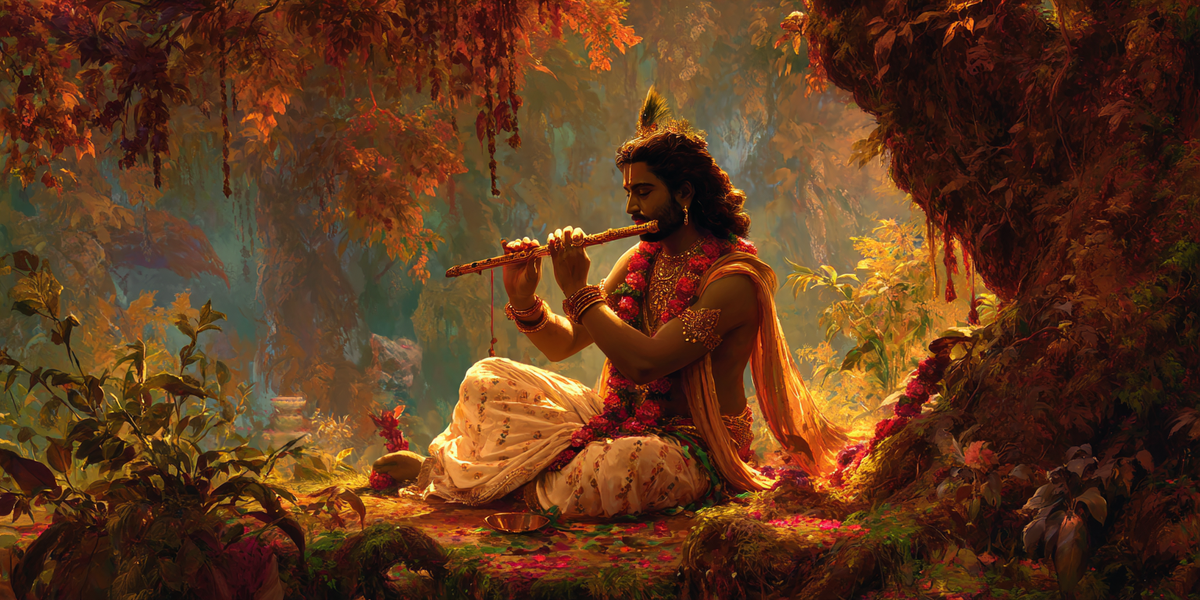
The journey through these eleven verses reveals a worldview that does not ask the seeker to choose between "Logic" and "Love." Instead, it suggests that at the highest level of reality, the most logical thing is Love. By responding to Aristotle's "logical skeleton" with the "ontological heart" of the Brahma-Saṁhitā, we move from a universe of mere functions to a universe of features. We find that the "Prime Mover" is not a cold calculator, but a Sovereign Person who vibrates the code of the cosmos through a flute, calling the "filaments" of the soul back to the "whorl" of the lotus.
In a world increasingly polarized between a shallow, dogmatic secularism and an equally shallow, anti-intellectual religiosity, this synthesis offers a "Third Way." It posits that the most rigorous use of the intellect leads us directly to the doorstep of the All-Attractive. It suggests that the ultimate "Post-Secular" resolution is the recognition that the Prime Mover and the Supreme Person are one and the same—the Adi-puruṣa who breathes out universes and breathes in the love of the souls He has projected.
For the modern reader, this is the ultimate post-secular resolution: a rationalism that is finally deep enough to account for the necessities of the spiritual heart of the human being.
Primary Source Reference
Bhaktisiddhanta Saraswati Goswami Kiraṇa. (1932). Śrī Brahma-saṁhitā (Fifth Chapter): With the commentary Dig-darśanī by Śrīla Jīva Gosvāmī and the Gaudīya-bhāṣya. (Bhaktisiddhanta Saraswati, Trans.). Gaudiya Math. (Original work published ca. 15th Century).
A note from the editor ~
The English translation and exposition of the Śrī Brahma-saṁhitā utilized in this series are the work of Śrīla Bhaktisiddhānta Sarasvatī Gosvāmī (1874–1937), a polymath and preeminent philosopher of the Gauḍīya Vaiṣṇava tradition. His rendering is unique for its "ontological density"; he does not merely translate the Sanskrit into English, but provides a rigorous philosophical reconstruction that reconciles the medieval Vedānta of Śrīla Jīva Gosvāmī with the challenges of modern rationalism and early 20th-century scientific discourse.
Bhaktisiddhānta Sarasvatī’s distinctive lexicon—employing terms such as "transcendental variegatedness," "the absolute substantive," and "unalloyed cognition"—was strategically designed as a "Post-Secular" response to the rising tides of impersonalism and materialist reductionism. By grounding the text in this specific edition, the author aligns this series with the Gauḍīya-Sarasvata tradition, which posits that the "Logical Necessity of Personality" is not an anthropomorphic projection, but the foundational requirement for a coherent Absolute. This edition serves as the essential bridge between the cold "logical skeleton" of Western antiquity and the "vibrant, personalist heart" of the Eastern Absolute.
Member discussion: