
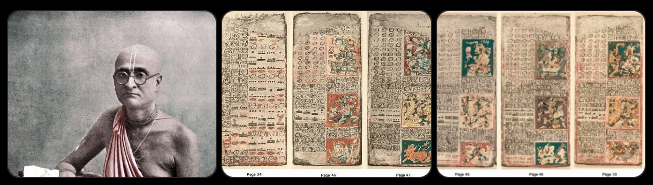
Bhaktisiddhanta Saraswati, Maya Astronomy, and the Strange Architecture of Sacred Time
The Human Construction of Cosmic Time
The study of ancient calendars occupies a unique position at the intersection of astronomy, mathematics, anthropology, religious studies, and intellectual history. A calendar is never merely a practical mechanism for counting days. In civilizations where astronomical observation developed over centuries, the calendar became a formal representation of humanity's relationship with the cosmos. It transformed observations of celestial regularities into systems capable of organizing agriculture, ritual, political authority, historical memory, and philosophical reflection.
Two of the world's most sophisticated calendrical traditions emerged in cultural environments separated by vast geographical distance: the astronomical tradition of India, preserved through Sanskrit jyotiṣa literature and later interpreted within traditions such as Gauḍīya Vaiṣṇavism, and the calendrical astronomy of ancient Mesoamerica, particularly the Maya civilization. These systems developed independently, employed different mathematical frameworks, and expressed their understanding of time through distinct religious and philosophical languages. Nevertheless, their comparison provides an important opportunity to examine how human societies respond to the same fundamental intellectual challenge: how to translate the changing patterns of the heavens into a coherent framework of time.
The comparison is particularly interesting because both traditions preserve exceptionally long chronological systems connected with cosmological beginnings. In Indian astronomical tradition, the beginning of Kali-yuga is conventionally calculated as occurring in 3102 BCE, associated within Vaiṣṇava traditions with the departure of Śrī Kṛṣṇa from earthly manifestation. In Maya chronology, the Long Count begins from an epoch conventionally correlated to 3114 BCE. The approximately twelve-year difference between these two dates has attracted attention among comparative historians and enthusiasts alike. However, a responsible scholarly examination must distinguish between coincidence, structural similarity, and historical connection. The proximity of two dates does not establish cultural transmission, and the existence of similar calendrical concepts does not necessarily imply contact between civilizations.
The more substantial question concerns the structures underlying these traditions. Both Indian jyotiṣa and Maya calendrical astronomy represent attempts to model time through multiple interacting cycles rather than through a single linear count. Both developed specialized classes of astronomers and calendar specialists whose expertise was necessary for determining ritual and social observances. Both combined mathematical precision with cosmological meaning. Both required methods for correcting the inevitable divergence between idealized cycles and observed celestial phenomena.
A particularly valuable figure for understanding the Indian side of this comparison is Śrīla Bhaktisiddhānta Sarasvatī Ṭhākura. Before becoming one of the most influential Vaiṣṇava teachers of modern India, he was known as Bimala Prasāda Datta, a scholar whose early career was devoted largely to Sanskrit learning, mathematics, and jyotiṣa. His intellectual development demonstrates that traditional Vaiṣṇava culture was not historically opposed to astronomy or mathematical inquiry. Rather, it preserved a sophisticated astronomical tradition in which the measurement of celestial phenomena was closely connected with the organization of sacred time.
The purpose of this essay is therefore not to argue for an undocumented connection between Indian and Mesoamerican civilizations. Such a claim would exceed the available evidence. Instead, it seeks to examine the genuine structural parallels between two independent astronomical traditions, review previous scholarly discussions of possible relationships between them, and consider what these comparisons reveal about the development of human knowledge, the nature of sacred time, and the role of astronomy in ancient societies.
Bhaktisiddhānta Sarasvatī Before the Gauḍīya Maṭha: The Formation of an Astronomer
Śrīla Bhaktisiddhānta Sarasvatī Ṭhākura was born Bimala Prasāda Datta in Bengal in 1874 into the family of Bhaktivinoda Ṭhākura, one of the major figures of the nineteenth-century Gauḍīya Vaiṣṇava revival. His later life would be defined by religious reform, institutional organization, publishing, and missionary activity, but his early intellectual formation occurred within the world of Sanskrit scholarship and traditional scientific learning.
From an early age, Bimala Prasāda demonstrated unusual ability in mathematics and astronomy. During the late nineteenth century, educated Indians were increasingly exposed to European scientific methods while simultaneously maintaining inherited Sanskrit intellectual traditions. Rather than viewing these two worlds as mutually exclusive, Bimala Prasāda engaged deeply with both. He studied classical Indian astronomical texts while also examining modern astronomical approaches introduced through colonial educational institutions.
His study of jyotiṣa eventually earned him the honorific title Siddhānta Sarasvatī. The title itself is significant because it reflects recognition not merely of religious learning but of technical competence within the siddhānta tradition of astronomy. In Sanskrit astronomical literature, a siddhānta was a systematic astronomical treatise concerned with mathematical models of celestial motion. Works such as the Sūrya-siddhānta addressed planetary calculations, eclipses, spherical astronomy, time measurement, and methods of determining celestial positions.
The period during which Bimala Prasāda developed his astronomical expertise was also the period in which he gained access to important scholarly resources through his association with the royal court of Tripura. Under the patronage of King Bir Chandra Manikya, he obtained access to manuscript collections and continued extensive study of Indian astronomical literature. This period was crucial in shaping the intellectual identity that later allowed him to combine traditional Vaiṣṇava theology with a rigorous engagement with Sanskrit scientific texts.
His early publications were connected with astronomical subjects rather than exclusively religious writings. He contributed to journals concerned with jyotiṣa and produced translations, explanations, and commentarial work related to classical astronomical texts. His later production of Vaiṣṇava calendars, particularly the Navadvīpa Pañjikā, continued this relationship between astronomical calculation and religious practice.
This aspect of his biography is historically important because it challenges a common modern assumption that religious traditions and scientific traditions necessarily exist in opposition. In many premodern societies, including India, astronomy developed precisely because religious and social life required accurate knowledge of celestial cycles. The determination of festivals, ritual observances, and auspicious times depended upon mathematical calculation.
Bhaktisiddhānta Sarasvatī therefore represents an intellectual tradition in which astronomy was not an external discipline imposed upon religion but an integral component of understanding cosmic order.
Jyotiṣa as an Historical Scientific Tradition
The term jyotiṣa presents difficulties when translated into English because it encompasses categories that modern intellectual culture separates more sharply than many traditional societies did. The word is often translated as "astrology," but historically jyotiṣa included several distinct fields: mathematical astronomy, calendrical calculation, observational astronomy, and various forms of astral interpretation.
The mathematical branches of jyotiṣa belong clearly within the history of science. They involved numerical computation, geometrical reasoning, astronomical observation, and predictive models capable of being compared against celestial events. The ability to calculate eclipses, planetary positions, lunar phases, and seasonal cycles required sophisticated mathematics and careful observation.
The distinction between mathematical astronomy and predictive astrology is therefore essential. The existence of astrological interpretation within a larger tradition does not negate the scientific character of its astronomical components. Modern historical scholarship on Indian mathematics, particularly the work of scholars such as Kim Plofker and David Pingree, has demonstrated that Sanskrit astronomical traditions represent genuine scientific systems with their own methods, terminology, and intellectual development.
The classical Indian astronomical tradition developed around the problem of representing celestial motion mathematically. Astronomers were required to reconcile several different cycles: the solar year, the lunar month, planetary periods, and the apparent movements of celestial bodies against the stellar background. These challenges are universal. Any civilization that attempts long-term astronomical calculation must confront them.
The importance of this mathematical tradition is particularly evident in calendrical science. Religious calendars cannot function solely through inherited convention; they must remain connected to astronomical reality. A festival determined by lunar phase requires calculation of lunar position. A solar festival requires calculation of solar motion. A calendar that continually loses correspondence with observable celestial events must eventually be corrected.
Within Gauḍīya Vaiṣṇava tradition, this relationship between astronomy and ritual time remained explicit. Observances such as Ekādaśī, Janmāṣṭamī, and Gaura-pūrṇimā depend upon astronomical conditions rather than fixed civil dates. The Gregorian calendar may assign a festival a different date each year, but the traditional calendar identifies the observance according to lunar and solar relationships.
In this sense, the pañjikā functions as both a religious document and an astronomical instrument. Its purpose is not simply to record dates but to determine moments in which particular celestial conditions exist.
This understanding places Bhaktisiddhānta Sarasvatī within a much broader history of astronomical scholarship. He was not an isolated religious figure interested in astrology as a curiosity; he was a participant in a centuries-old mathematical tradition concerned with the relationship between celestial observation and human timekeeping.
Maya Calendrical Astronomy: Mathematical Time in Mesoamerica
The Maya calendrical tradition represents one of the most sophisticated achievements of ancient American astronomy. Like Indian jyotiṣa, Maya calendrical science was not a single unified calendar but a collection of interconnected systems designed to represent different aspects of celestial and historical time. These systems included the 260-day Tzolk’in, the 365-day Haab’, the Calendar Round created by their interaction, and the Long Count, which provided a means of recording historical events across immense spans of time.
The Tzolk’in was a ritual cycle consisting of 260 named days generated through the combination of twenty day names and thirteen numerical coefficients. Although the exact origins and meaning of the 260-day cycle remain debated among scholars, it became one of the central organizing structures of Mesoamerican religious time. Each day occupied a specific position within the cycle and therefore possessed a particular identity. Time was not regarded as an empty sequence of interchangeable units; individual days existed within a larger cosmological framework.
The Haab’ functioned as a solar calendar of 365 days. It consisted of eighteen periods of twenty days, followed by a final period of five additional days. Like many ancient solar calendars, it approximated the tropical year rather than reproducing it exactly. The Maya recognized that numerical simplicity and astronomical reality were not identical. Their calendar represented a mathematical model of the solar cycle, but the relationship between that model and the actual movement of the Sun required continued observation.
The combination of the Tzolk’in and Haab’ produced the Calendar Round, a cycle of 18,980 days, or approximately fifty-two solar years. A particular combination of Tzolk’in and Haab’ dates would not recur until the completion of this cycle. This system allowed Maya societies to organize ritual and historical events within a repeating framework of sacred time.
However, the Calendar Round alone was insufficient for recording events across longer historical periods because the same date combination eventually returned. To solve this problem, Maya civilization developed the Long Count, one of the most remarkable chronological systems in world history. Unlike the cyclical Calendar Round, the Long Count functioned as an accumulated count of elapsed days from a fixed starting point.
The Long Count was structured primarily through a vigesimal numerical system. Twenty k’in formed a winal, eighteen winal formed a tun of 360 days, twenty tun formed a k’atun, and twenty k’atun formed a b’ak’tun. The modification from a strict base-twenty system at the tun level appears deliberate, creating a 360-day unit that approximated the solar year. This combination of mathematical elegance and astronomical practicality reflects the same type of intellectual problem faced by Indian calendrical astronomers: how to construct numerical systems that remain connected to observable celestial cycles.
The traditional Long Count beginning date, written as 13.0.0.0.0, 4 Ajaw 8 Kumk’u, has been correlated by most Maya scholars through the Goodman-Martínez-Thompson correlation to August 11, 3114 BCE in the proleptic Gregorian calendar. Maya inscriptions describe this distant period as a creation epoch associated with the establishment of cosmic order. It is important to note that this does not mean that a Maya civilization existed in 3114 BCE in the form known from the Classic period. Rather, later Maya astronomers and scribes preserved a cosmological chronology extending backward to a foundational moment.
This feature is one of the most fascinating aspects of Maya calendrical thought. The Long Count demonstrates that the Maya were not merely interested in repeating cycles but also in situating human history within a much larger temporal framework. The ability to record dates thousands of years removed from the present required an abstract understanding of time as something that could be mathematically extended beyond ordinary human experience.
Maya astronomical knowledge was not limited to calendar construction. The surviving codices, especially the Dresden Codex, preserve evidence of detailed astronomical observation. Among the most famous examples is the Venus Table, which records the synodic cycle of Venus. The Maya recognized that the apparent cycle of Venus did not perfectly correspond to a simple whole-number approximation and incorporated correction mechanisms to maintain long-term accuracy.
This point deserves emphasis because it demonstrates that Maya astronomy was not merely symbolic or ritualistic. The astronomers responsible for these calculations were engaged in the same fundamental activity as astronomers elsewhere in the ancient world: constructing mathematical models, comparing them with observation, and refining them when necessary.
The existence of religious meaning within Maya astronomy does not diminish its scientific character. The Maya did not separate celestial calculation from cosmology in the modern manner. Observation, mathematics, ritual, and political authority existed within a unified intellectual framework.
Comparing Two Astronomical Traditions: Methodological Considerations
Any comparison between Maya calendrical astronomy and Indian jyotiṣa must begin with caution. Similarity alone does not establish historical relationship. Civilizations separated by geography often develop comparable solutions to comparable problems because the physical universe imposes certain constraints upon human observation.
Astronomers everywhere encounter the same fundamental realities. The Sun follows an annual cycle. The Moon changes phase according to its relationship with the Sun. Venus appears and disappears according to a recurring pattern. The seasons return. Eclipses occur according to predictable relationships. Any civilization committed to long-term observation of the heavens will eventually develop mathematical methods for describing these phenomena.
Therefore, the most productive comparison is not one based upon isolated similarities. A shared interest in astronomy, for example, proves little. Nor does the use of a lunar calendar, a solar calendar, or even a sacred chronology. These are natural consequences of studying the sky.
The more meaningful comparison concerns the underlying intellectual structures of the two systems. Both Maya astronomy and Indian jyotiṣa represent attempts to organize multiple celestial cycles simultaneously. Both created specialist knowledge systems requiring mathematical expertise. Both connected astronomical calculation with ritual and social organization. Both developed methods for reconciling numerical models with observation.
These parallels do not require historical contact. They may instead represent examples of independent intellectual convergence: two civilizations arriving at similar strategies because they faced similar astronomical challenges.
Interlocking Cycles and the Architecture of Sacred Time
One of the strongest structural parallels between Maya calendrical science and Indian jyotiṣa is the use of multiple interacting cycles.
Modern Western calendars encourage the perception that time is fundamentally linear. A date is usually represented as a position on a single sequence: day, month, and year. Although the Gregorian calendar contains corrections and conventions derived from astronomical considerations, its everyday use presents time as a continuous numerical progression.
Traditional Maya and Indian systems function differently. A particular day exists simultaneously within multiple cycles. Its meaning emerges from the intersection of these cycles rather than from a single numerical position.
In Indian calendrical astronomy, a sacred date is determined through relationships among several astronomical variables. The tithi represents the angular relationship between the Moon and Sun. Nakṣatras divide the sky according to lunar motion against the stellar background. Solar position determines seasonal relationships. Weekday, lunar month, and other factors contribute to the complete calendrical identity of a moment.
A Vaiṣṇava calendar therefore does not merely ask, "What day is it?" It asks, "What astronomical configuration exists at this moment?"
The Maya system operates according to a different mathematical framework but reflects a comparable conceptual approach. A day within the Tzolk’in possesses one identity; the same day within the Haab’ possesses another. The Calendar Round emerges from their intersection. The Long Count provides another layer by locating that day within a much larger chronological sequence.
In both traditions, time is multidimensional. A moment can be located in several overlapping systems simultaneously.
This approach is not simply philosophical. It is mathematically practical. Celestial bodies move through cycles of different lengths, and a calendar capable of representing the heavens must accommodate those differences.
Sacred Time and the Meaning of Celestial Events
A second important parallel concerns the relationship between astronomical conditions and religious observance.
In modern secular societies, dates often function as administrative labels. A birthday occurs on a particular civil date because a calendar assigns that date to a particular location in the year. The astronomical relationship of that day to the Sun or Moon is generally irrelevant.
Traditional Maya and Indian systems approach time differently. Certain moments possess significance because of their position within celestial cycles.
In Gauḍīya Vaiṣṇava practice, Ekādaśī is not simply an eleventh day assigned by convention. It occurs when the Moon reaches a particular relationship with the Sun. Janmāṣṭamī is not simply the anniversary of Kṛṣṇa’s birth according to a civil calendar; it is determined through lunar and astronomical criteria.
Similarly, Maya ritual time was structured through days whose significance arose from their position within the sacred calendar. A particular day was not meaningful because humans arbitrarily declared it meaningful; rather, its meaning emerged from its relationship with the larger cosmic order represented by the calendrical system.
From a modern scientific perspective, one may distinguish between the physical properties of a day and the cultural meanings assigned to it. Yet historically, many civilizations did not separate these categories so sharply. The heavens were both measurable and meaningful.
This observation is important because it prevents an overly simplistic division between "science" and "religion." For many traditional cultures, astronomy was not pursued despite religious belief but because celestial order was itself considered worthy of understanding.
The Astronomer as Custodian of Cosmic Order
Both Maya and Indian traditions produced specialized intellectual classes responsible for maintaining calendrical knowledge. These specialists occupied an important social position because agricultural schedules, religious ceremonies, political events, and historical records depended upon accurate calculation.
Among Maya communities, specialists known as Ajq’ijab’ or Day Keepers have preserved aspects of the sacred calendar tradition into the present. Their role illustrates that calendrical knowledge was not merely technical information but a form of cultural responsibility.
India likewise developed generations of jyotiṣa scholars and pañjikā makers whose calculations determined religious observances throughout society. The preparation of a pañjikā required knowledge of astronomical principles, mathematical methods, and traditional calendrical rules.
Bhaktisiddhānta Sarasvatī represents a particularly interesting example because he united these roles within a single intellectual identity. He was simultaneously a religious teacher, Sanskrit scholar, and astronomer. His later Vaiṣṇava calendar work was not a departure from his scientific interests but an extension of them.
The Maya astronomer and the Indian jyotiṣa scholar therefore occupied comparable conceptual positions. They were interpreters of celestial cycles whose calculations connected the human community with a larger cosmic framework.
The Problem of the Epochs: 3114 BCE and 3102 BCE
The most frequently cited parallel between Maya chronology and Indian astronomical tradition concerns the proximity of their respective cosmological epochs. According to the standard correlation accepted by the majority of Maya scholars, the beginning of the Maya Long Count corresponds to a date in 3114 BCE. Within Indian astronomical and Purāṇic chronology, the beginning of Kali-yuga is conventionally calculated as 3102 BCE, associated in Vaiṣṇava traditions with the departure of Śrī Kṛṣṇa from earthly manifestation.
The numerical proximity of these dates is undoubtedly intriguing. Two independent traditions, separated geographically by more than half the globe and developing within entirely different historical contexts, preserve cosmological starting points within approximately twelve years of one another. At first glance, this appears to invite deeper investigation.
However, the proper historical question is not whether the dates are close, but what the dates represent within their respective intellectual traditions. A calendar epoch is not simply a historical date in the modern sense. It is a reference point selected for organizing a larger chronological system. The significance of an epoch lies in the function it performs within the calendar.
The Maya Long Count epoch functions as the beginning of a vast chronological framework. It provides the zero point from which elapsed days are calculated. Later Maya inscriptions could therefore locate historical events within a temporal system extending thousands of years into the past.
The Kali-yuga epoch performs a comparable chronological function within Indian astronomical tradition. Indian astronomers required fixed eras from which astronomical calculations could be made. The Kali era became one such reference system. Later astronomical texts used it as a chronological foundation for calculations extending across immense periods of time.
In both cases, therefore, the importance of the epoch is not simply that a particular event occurred on that date. The epoch creates a mathematical framework within which time can be calculated.
This distinction is essential because the apparent similarity of 3114 BCE and 3102 BCE does not by itself establish historical connection. Calendrical systems frequently select foundational dates for reasons that combine mythology, astronomy, chronology, and mathematical convenience. A shared numerical neighborhood is a reason for investigation, but not evidence of transmission.
The question that naturally follows is whether these epochs correspond to any significant astronomical configuration. Did the Maya and Indian traditions independently select dates because of observable celestial phenomena? Did both preserve, in different forms, some astronomical event or cycle? Or are the similarities primarily the result of the tendency of civilizations to construct cosmological beginnings within meaningful chronological ranges?
At present, no consensus exists that these dates correspond to a shared astronomical event. The responsible scholarly position is therefore one of cautious curiosity. The relationship deserves examination, but the evidence does not justify claims of historical identity or cultural borrowing.
Previous Scholarship on Indian and Mesoamerican Parallels
Comparisons between Indian and Mesoamerican traditions have a long and complicated history. They have attracted serious scholars, speculative writers, diffusionists, and critics of diffusionism. The history of this discussion provides an important example of the difference between identifying genuine parallels and assuming that every similarity implies contact.
One of the most significant scholarly discussions occurred in 1978 with Balaji Mundkur’s article, “The Alleged Diffusion of Hindu Divine Symbols into Pre-Columbian Mesoamerica: A Critique,” published in Current Anthropology. Mundkur examined claims that similarities between Hindu and Mesoamerican religious symbols, astronomical concepts, and calendrical patterns indicated historical transmission from India to the Americas.
The importance of this article lies not simply in its conclusion but in its methodology. Mundkur did not dismiss comparison itself. Instead, he examined whether the proposed similarities were sufficiently specific, historically plausible, and supported by independent evidence. The responses from other scholars, including specialists in anthropology and Mesoamerican studies, generally concluded that the proposed parallels were inadequate to demonstrate diffusion.
The issue was not that similarities did not exist. They did. The problem was that many similarities involved concepts likely to emerge independently in civilizations confronting comparable intellectual problems.
This is a recurring challenge in comparative history. The Sun, Moon, Venus, eclipses, agricultural cycles, and numerical patterns are universal features of human experience. Civilizations that carefully observe the heavens will often develop similar categories of thought because they are responding to the same physical realities.
For example, the existence of sophisticated Venus observations in both Maya and Indian traditions does not demonstrate contact. Venus is one of the most conspicuous objects in the sky, and any civilization engaged in systematic astronomy would have reason to study it. Likewise, lunar calendars appear in many independent cultures because the Moon naturally provides a visible and recurring temporal cycle.
The strongest evidence for cultural transmission is therefore not broad similarity but highly specific and unlikely correspondence: shared technical terminology, identical mathematical procedures, archaeological evidence, documented historical contact, or clusters of distinctive practices appearing together.
At present, such evidence does not exist for a direct relationship between Maya calendrical astronomy and Indian jyotiṣa.
This conclusion, however, should not be interpreted as meaning that comparison is pointless. On the contrary, the comparison remains valuable because it reveals how different civilizations independently developed sophisticated responses to universal astronomical challenges.
Convergence Rather Than Diffusion: A More Productive Framework
The concept of cultural convergence provides a more useful framework for understanding the parallels between Maya and Indian astronomical traditions.
In biology, unrelated organisms frequently develop similar characteristics because they face similar environmental pressures. Sharks and dolphins, for example, evolved similar streamlined forms because efficient movement through water imposes certain physical constraints. The similarity does not indicate common ancestry; it reflects adaptation to comparable conditions.
A similar principle can apply to intellectual history. Civilizations observing the same sky may independently develop comparable solutions because the underlying problems are universal.
An astronomical calendar must account for cycles of different lengths. The solar year does not divide evenly into lunar months. Planetary periods do not always correspond neatly to human numerical systems. Long-term observation reveals discrepancies between simplified models and actual celestial motion.
These problems naturally encourage the development of mathematical strategies.
The Maya developed interlocking cycles of 260, 365, and longer periods. Indian astronomers developed systems based on tithis, nakṣatras, solar months, lunar months, planetary periods, and large chronological eras. The mathematical details differ significantly, but the intellectual impulse is comparable.
Both traditions attempted to transform celestial complexity into an ordered system.
This observation has broader implications for the history of science. Human beings often imagine scientific development as a series of inventions passed from one civilization to another. While transmission certainly occurs and is historically important, independent discovery also plays a major role.
The history of mathematics provides many examples. Different civilizations independently developed counting systems, geometry, and astronomical observations because these tools emerge naturally from engagement with the world.
The Maya and Indian astronomical traditions may therefore represent not a shared origin but a shared human response to the same intellectual challenge.
The Role of Observation and Correction
One of the most significant parallels between Maya and Indian astronomy concerns the relationship between inherited models and observation.
A common misconception about traditional astronomical systems is that they were static bodies of sacred knowledge preserved without modification. Historical evidence shows the opposite. Sophisticated astronomical traditions required continual adjustment because celestial phenomena do not perfectly conform to simple numerical models.
The Indian siddhānta tradition illustrates this clearly. Astronomical texts contained calculated values for planetary motion and other phenomena, but later astronomers debated constants, revised methods, and compared inherited calculations against observation. The very existence of multiple astronomical schools reflects an ongoing intellectual process.
The same is true of Maya astronomy. The Venus Table in the Dresden Codex demonstrates that Maya astronomers recognized discrepancies between an idealized Venus cycle and actual observations. They incorporated correction mechanisms because a purely schematic model would gradually drift away from the observed sky.
This parallel is especially important because it reveals a common scientific principle: mathematical models are tools for representing reality, not replacements for reality itself.
Both civilizations created symbolic systems capable of organizing enormous spans of time, but both remained dependent upon observation. The heavens were the final reference point.
Sacred Calendars and the Integration of Science and Culture
The comparison between Maya and Indian calendrical traditions also raises broader questions about the relationship between scientific knowledge and cultural meaning.
Modern Western thought often separates scientific activity from religious interpretation. Astronomy is considered a description of physical reality, while religion is considered a system of meaning imposed upon that reality. Historically, however, many civilizations did not make such a distinction.
For Maya astronomers, the observation of Venus, eclipses, and solar cycles was inseparable from questions of ritual timing and cosmic order. The same civilization that calculated astronomical periods also embedded those calculations within religious and political structures.
Indian jyotiṣa developed in a similar intellectual environment. The calculation of lunar and solar cycles served practical purposes, but it also enabled the determination of religious observances. A Vaiṣṇava calendar was not merely a technical table; it was a means of aligning communal practice with the perceived order of the cosmos.
This does not mean that scientific and religious claims should be evaluated identically. Modern astronomy and religious interpretation operate according to different methodologies. However, historical analysis must recognize that many civilizations did not experience a sharp boundary between knowing the heavens and assigning meaning to them.
Bhaktisiddhānta Sarasvatī’s life illustrates this integrated worldview. His expertise in astronomy did not disappear when he became a religious teacher. Instead, his astronomical knowledge informed his approach to sacred time. The creation of accurate Vaiṣṇava calendars required precisely the type of mathematical expertise he had developed earlier in life.
The result was not a rejection of science in favor of religion, but an example of how scientific knowledge can function within a religious intellectual framework.
The Anthropological Significance of Comparing Calendars
The comparison between Maya and Indian astronomical traditions ultimately raises a larger anthropological question: why do human societies invest so much intellectual energy in constructing systems of time?
One answer is practical. Agriculture, taxation, navigation, and social organization all require reliable temporal frameworks. A society that understands seasonal cycles and celestial patterns possesses significant advantages.
Another answer is philosophical. Calendars provide civilizations with a way to locate human existence within a larger structure. They answer questions not only about when events occur but about where humanity exists within the order of the universe.
This may explain why ancient calendars frequently become repositories of cultural identity. A calendar preserves mathematical knowledge, historical memory, religious concepts, and philosophical assumptions simultaneously.
The Maya Long Count did not merely count days. It located Maya civilization within a cosmic history extending back to creation.
Indian astronomical eras did not merely provide numerical references. They situated human history within enormous cycles of time extending far beyond ordinary experience.
Both traditions therefore demonstrate that calendars are among the most profound intellectual artifacts produced by human societies. They are mathematical systems, but they are also expressions of humanity's attempt to understand its place in the universe.
Astronomical Possibilities and Future Research
The comparison between Maya calendrical astronomy and Indian jyotiṣa becomes most interesting when it moves beyond the identification of similarities and toward questions that can be examined through evidence. The relationship between the Maya Long Count epoch and the Kali-yuga epoch provides an excellent example. Rather than asking whether the two dates are "the same," a more productive question is whether either or both dates reflect identifiable astronomical conditions.
Modern computational astronomy makes such investigation possible. The positions of planets, phases of the Moon, solar coordinates, eclipses, stellar positions, and long-term astronomical cycles can be reconstructed for ancient periods with considerable precision. Researchers in archaeoastronomy already employ such methods to investigate the relationship between ancient monuments, calendars, and celestial events.
A comparative investigation of the years around 3114 BCE and 3102 BCE could examine several possibilities. One could investigate whether significant planetary configurations occurred during either period, whether Venus cycles or eclipse patterns corresponded with either epoch, whether solar or lunar events may have contributed to chronological traditions, or whether the dates simply represent conventional mathematical starting points selected within broader cosmological frameworks.
Such research would not necessarily resolve the question of cultural relationship. Even if both dates corresponded to unusual astronomical circumstances, this would not demonstrate that one civilization influenced the other. Human societies can independently recognize and preserve important celestial cycles. However, such research could clarify whether the apparent chronological convergence reflects astronomical reality, calendrical convention, or historical coincidence.
The important methodological point is that astronomical questions should be investigated astronomically. Numerical similarities alone are insufficient. A serious comparison requires calculations, models, and explicit criteria established before conclusions are drawn.
This approach would be entirely consistent with the intellectual character of Bhaktisiddhānta Sarasvatī himself. His engagement with astronomy was not based upon passive acceptance of inherited claims. He studied mathematical texts, compared systems of calculation, and worked within a tradition where astronomical knowledge was developed through examination and computation.
The same principle should guide modern comparative research. Ancient traditions deserve neither romantic exaggeration nor dismissive skepticism. Their claims should be examined according to the evidence appropriate to the claim.
The Question of Ancient Contact
Because of the similarities between Maya and Indian astronomical traditions, the possibility of ancient contact naturally arises. Human beings have always traveled farther than previous generations assumed possible, and archaeological discoveries continue to demonstrate the complexity of ancient exchange networks. It would therefore be inappropriate to claim that long-distance contact was impossible.
However, possibility is not evidence.
A historical diffusion argument requires more than similarities in ideas. It requires evidence of transmission. Archaeologists and historians generally look for multiple forms of support: artifacts, linguistic borrowing, technological transfer, genetic evidence, trade materials, or historically plausible pathways of exchange.
In the case of Maya calendrical astronomy and Indian jyotiṣa, such evidence has not been established. The similarities identified between the traditions are primarily structural and conceptual rather than uniquely diagnostic. Multiple independent civilizations developed lunar calendars, solar calculations, planetary observations, and sacred chronologies because these are natural consequences of systematic astronomical observation.
The strongest case for cultural transmission would involve features unlikely to arise independently. Shared mathematical algorithms, identical technical terminology, specific mythological structures combined with astronomical practices, or archaeological evidence of contact would all be more significant than general parallels.
At present, the evidence favors independent development rather than direct transmission.
This conclusion should not diminish the importance of the comparison. In fact, it may make the comparison more intellectually valuable. If two civilizations independently developed sophisticated systems of astronomical timekeeping, that reveals something fundamental about human cognition and the structure of scientific discovery.
The Broader History of Astronomical Knowledge
The comparison between Maya and Indian astronomy contributes to a larger reconsideration of how scientific knowledge develops across civilizations.
Older narratives of scientific history often presented knowledge as a progression from ancient Greece through Europe into the modern world. Contemporary scholarship has increasingly recognized that this model is incomplete. Astronomy, mathematics, medicine, engineering, and calendar science developed in many cultural centers, often through independent discovery and mutual exchange.
Indian astronomy represents one of the major historical traditions of mathematical astronomy. Its contributions include sophisticated methods of planetary calculation, trigonometric techniques, numerical systems, and calendrical computation. Maya astronomy represents another independent achievement, demonstrating remarkable observational precision, particularly in relation to Venus and long-term calendrical cycles.
Neither tradition should be viewed merely as a precursor to modern science. Each represents a complete intellectual system developed within its own cultural context.
At the same time, neither tradition should be romanticized as possessing secret knowledge beyond modern understanding. Ancient astronomers were extraordinarily capable observers and mathematicians, but they worked within historical frameworks that combined empirical observation, mathematical modeling, religious interpretation, and philosophical assumptions.
The value of studying them lies precisely in understanding this complexity.
The Maya astronomer and the Indian jyotiṣa scholar were not modern scientists in the contemporary institutional sense. Yet they engaged in activities that are central to scientific practice: observation, measurement, calculation, prediction, and revision.
Their work demonstrates that the human search for order in nature is much older and more geographically diverse than modern categories often suggest.
Implications for Anthropology and the Study of Human Time
Perhaps the deepest significance of the Maya-Indian comparison lies not in astronomy alone but in anthropology. Calendars reveal how societies conceptualize their relationship with existence itself.
A calendar answers practical questions: When should crops be planted? When should ceremonies occur? When does a political cycle begin? But it also answers philosophical questions: What kind of universe do human beings inhabit? Is time merely a sequence of events, or does it possess structure and meaning?
The Maya and Indian traditions both reject the idea that time is simply an empty container. Time has architecture.
The Indian tradition expresses this through vast cosmological cycles: yugas, mahāyugas, and larger divisions of cosmic duration. Human history exists within immense periods extending far beyond ordinary experience.
The Maya tradition similarly situates human existence within a chronology extending backward to a creation epoch and forward through immense cycles of calculation.
In both cases, the human present is not isolated. It exists within a much larger temporal order.
This perspective has implications for modern anthropology because it challenges assumptions about how societies understand history. Modern industrial societies often emphasize linear progress: the past is behind us, the future ahead, and human activity exists within a single forward-moving timeline.
Many traditional societies preserve a more complex conception of time. Cycles and linear sequences coexist. Historical events occur within larger cosmic frameworks. Repetition does not eliminate change, and chronology does not eliminate meaning.
The Maya Long Count and Indian astronomical eras therefore demonstrate that cyclical and linear concepts of time are not opposites. They can function together within highly sophisticated intellectual systems.
A Cautious Interpretation of the 3102 BCE and 3114 BCE Relationship
The chronological relationship between the Maya Long Count epoch and the Indian Kali-yuga epoch remains the most provocative element of this comparison. The approximately twelve-year difference is small enough to invite investigation but large enough to prevent simple identification.
Several interpretations are possible.
The similarity may be accidental. Given the enormous number of chronological systems created throughout human history, some numerical convergence is inevitable.
The similarity may reflect common astronomical concerns. Civilizations that developed sophisticated astronomical traditions may have selected meaningful epochs based upon observations of celestial cycles, even without any direct contact.
The similarity may reflect broader patterns in human cosmological thinking. Civilizations often locate beginnings within periods associated with renewal, transformation, or the establishment of cosmic order.
A more extraordinary explanation would require stronger evidence: that some form of ancient knowledge transmission influenced both traditions. Such a hypothesis cannot be dismissed solely because it is unusual, but neither can it be accepted without evidence beyond numerical resemblance.
The proper scholarly attitude is therefore one of disciplined curiosity.
The dates deserve examination.
They do not yet deserve conclusions.
Conclusion: The Sky as a Common Human Reference
The comparison between Maya calendrical astronomy and the Indian jyotiṣa tradition preserved within Gauḍīya Vaiṣṇavism demonstrates both the possibilities and limitations of comparative history. The two traditions are not identical, and current evidence does not support claims of direct transmission between them. Their differences in mathematics, symbolism, historical development, and cultural context remain profound.
Yet their similarities reveal something important.
Both civilizations developed methods for transforming celestial observation into systems of human meaning. Both recognized that the heavens could be measured mathematically and interpreted culturally. Both produced specialists whose knowledge connected communities with larger cosmic frameworks. Both understood time not merely as a sequence of moments but as a structured reality composed of interacting cycles.
The life of Bhaktisiddhānta Sarasvatī provides an especially valuable perspective because it demonstrates that scientific calculation and religious devotion have not always occupied opposing categories. Within the jyotiṣa tradition, understanding celestial order was itself an intellectual and cultural achievement.
The Maya astronomers who calculated Venus cycles and the Indian astronomers who developed siddhāntic models were separated by geography, language, and history. They were not necessarily sharing information. They were, however, confronting the same fundamental challenge: how to represent a universe governed by recurring celestial patterns.
The most responsible conclusion is therefore neither that these traditions were secretly connected nor that their similarities are meaningless. The stronger conclusion is that human beings, when they observe the heavens carefully enough and long enough, often discover comparable intellectual structures.
The universe provides the same evidence to every civilization.
The question is how each civilization chooses to understand it.
If you're truly intrigued by the possibilities... you can find a formal analysis of the archeoastronomical comparisons between the respective Vedic and Mayan calendrical dates of 3102 and 3114 BCE in the previous article at https://aetheriumarcana.org/the-skies-of-3114-bce-and-3102-bce/. In another previous article we explore more closely the specific parallels between Vedic and Mayan calendric cycles: https://aetheriumarcana.org/reading-the-same-sky/.
A Select Bibliography
Aveni, Anthony F. Skywatchers. Austin: University of Texas Press, 2001.
Bricker, Harvey M., and Victoria R. Bricker. Astronomy in the Maya Codices. Philadelphia: American Philosophical Society, 2011.
Dutt, Romesh Chandra. The Civilization of India. Various editions. Provides historical context for nineteenth-century interpretations of Indian intellectual traditions.
Malmström, Vincent H. Cycles of the Sun, Mysteries of the Moon: The Calendar in Mesoamerican Civilization. Austin: University of Texas Press, 1997.
Mundkur, Balaji. “The Alleged Diffusion of Hindu Divine Symbols into Pre-Columbian Mesoamerica: A Critique.” Current Anthropology 19, no. 3 (1978): 541–583.
Pingree, David. Jyotiḥśāstra: Astral and Mathematical Literature. Wiesbaden: Otto Harrassowitz, 1981.
Plofker, Kim. Mathematics in India. Princeton: Princeton University Press, 2009.
Sardella, Ferdinando. Modern Hindu Personalism: The History, Life, and Thought of Bhaktisiddhanta Sarasvati. Oxford University Press, 2013.
Šprajc, Ivan, and Pedro Francisco Sánchez Nava. “Astronomy and Architecture in the Maya Lowlands.” Journal of Skyscape Archaeology.
Suggestions for Further Reading
For readers interested in Bhaktisiddhānta Sarasvatī and Gauḍīya Vaiṣṇava intellectual history:
Sardella, Ferdinando. Modern Hindu Personalism: The History, Life, and Thought of Bhaktisiddhanta Sarasvati.
For the history of Indian mathematical astronomy:
Plofker, Kim. Mathematics in India.
Pingree, David. Jyotiḥśāstra: Astral and Mathematical Literature.
For Maya astronomy and calendrical systems:
Aveni, Anthony F. Skywatchers.
Bricker, Harvey M., and Victoria R. Bricker. Astronomy in the Maya Codices.
For comparative approaches to ancient astronomy:
Ruggles, Clive L. N. Ancient Astronomy: An Encyclopedia of Cosmologies and Myth.
Jonathan Brown for AetheriumArcana
Member discussion: