
A Computational Archaeoastronomical Investigation of the Maya Long Count and Kali-yuga Epochs
Executive finding
The two epochs do not reproduce the same sky, the same Venus phase, the same eclipse pattern, or the same seasonal stellar event. The approximately twelve-year proximity between them is therefore not explained by an obvious shared astronomical configuration.
The investigation does, however, reveal two independent and potentially significant features. The widely used Maya Long Count correlation places its era-base date extremely close to the descending solar zenith passage at the latitude of Copán and Izapa. On that date Orion and Sirius were already high in the predawn sky; the date was not their first heliacal return. The Kali-yuga epoch, by contrast, occurred during an uncommon broad gathering of the seven classical bodies—Sun, Moon, Mercury, Venus, Mars, Jupiter, and Saturn—within a 41-degree sector. It followed astronomical new moon by about 17.6 hours and preceded the closest Venus–Jupiter conjunction by about 8.7 hours. This was a genuine configuration, but not the perfect conjunction sometimes claimed: the planets were spread across more than forty degrees and most were too close to the Sun to be observed together.
These results strengthen a historically disciplined conclusion. The Kali-yuga epoch has a real relationship to a broad planetary clustering and to the idealized mean-longitude framework of Indian mathematical astronomy. The Maya era-base date has a stronger relationship to tropical solar geometry in parts of the Maya region. The skies do not disclose a common event that would connect the two chronological systems.
Dates, calendars, and assumptions
Dates this remote cannot be compared responsibly until their calendar conventions are made explicit. Astronomical calculations use astronomical year numbering, in which year 0 is 1 BCE, year −1 is 2 BCE, and so forth. Historical writing generally omits a year zero. This report translates all results back into conventional BCE notation.
The Maya calculation uses the Goodman–Martínez–Thompson correlation constant 584,283. In its usual modern rendering, Long Count 13.0.0.0.0, 4 Ajaw 8 Kumk’u corresponds to August 11, 3114 BCE in the proleptic Gregorian calendar, or September 6, 3114 BCE in the proleptic Julian calendar. “Proleptic” means that a calendar is mathematically extended backward to a period before it historically existed. A Thompson-Lounsbury variant places the date two days later. That two-day difference becomes important when solar zenith passage is considered.
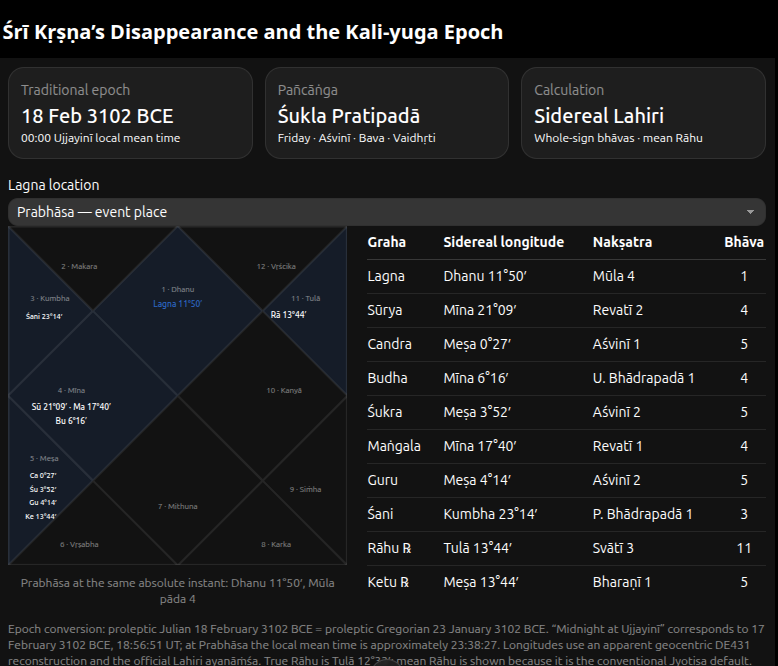
The Indian calculation uses the conventional Kali-yuga epoch at the transition from February 17 to 18, 3102 BCE in the proleptic Julian calendar, corresponding to the transition from January 22 to 23 in the proleptic Gregorian calendar. Indian astronomical sources and later scholarship do not all employ the same daily starting convention. Midnight, mean sunrise, and meridians associated with Laṅkā or Ujjain appear in different computational contexts. For the planetary comparison, this report uses midnight in local mean solar time at Ujjain, longitude 75.7885° east. That instant corresponds to approximately 18:56:51 UT on February 17 Julian. A sunrise epoch several hours later changes the Moon’s position by several degrees but does not alter the report’s central conclusions.
Under these conventions, the epoch instants are separated by 4,182.789 days, or approximately 11.452 tropical years. Calling this “a twelve-year difference” is reasonable in ordinary historical prose, but the exact interval is not twelve solar years.
Computational method and its limits
Planetary and lunar positions were calculated with Swiss Ephemeris 2.10.03 using the compressed DE431 files seplm36.se1 and semom36.se1, which cover 3601–3002 BCE. The underlying ephemeris gives highly precise dynamical positions for the Sun, Moon, and planets. Fixed-star positions use catalogued proper motions and a long-term precession model. Apparent geocentric ecliptic longitude and latitude, right ascension, declination, phase, elongation, and magnitude were calculated for each epoch.
Three kinds of uncertainty must be separated. First, the dynamical geometry of the planets relative to one another is much more secure than the corresponding local clock time. Second, ΔT—the difference between uniform Terrestrial Time and time derived from Earth’s rotation—cannot be measured directly this far in the past. The model used here gives ΔT values near 78,000 seconds, about 21.8–21.9 hours. The model value should not be mistaken for historical knowledge to the second. Third, the Maya correlation and the exact daily convention of the Indian epoch introduce historical uncertainty independent of astronomical calculation.
The consequence is crucial for eclipse interpretation. Whether an eclipse occurred, its dynamical type, and its interval from an epoch are comparatively robust. The longitude of an ancient solar-eclipse path and the question whether a specific city saw the eclipse depend heavily on ΔT. An error of one hour in Earth rotation shifts terrestrial longitude by roughly fifteen degrees. All local eclipse statements below are therefore model-based possibilities, not secure historical observations.
For local sky geometry, four illustrative sites were used: Copán and Tikal in the Maya region, Ujjain in India, and Giza in Egypt. No claim is made that the Long Count era base was invented at Copán, Tikal, or any other known Classic Maya city. The sites are reference latitudes for testing visibility and seasonal geometry.
Planetary configurations at the two epochs
Geocentric positions on the Long Count era-base date
The following positions are apparent tropical ecliptic coordinates of date at 00:00 UT on August 11, 3114 BCE, proleptic Gregorian. Solar elongation is the actual angular separation from the Sun. “Morning” or “evening” describes which side of the Sun a body occupied, not whether atmospheric conditions necessarily allowed naked-eye visibility.
| Body | Ecliptic longitude | Latitude | Solar elongation | Illumination | Magnitude | Interpretation |
|---|---|---|---|---|---|---|
| Sun | 137.958° | −0.001° | — | — | — | Northern summer Sun |
| Moon | 277.711° | −5.104° | 139.48° | 88.1% | −11.56 | Waxing gibbous |
| Mercury | 127.187° | +1.887° | 10.94° | 93.6% | −1.03 | West of Sun; difficult morning visibility |
| Venus | 128.534° | +1.424° | 9.53° | 98.7% | −3.93 | West of Sun; near glare |
| Mars | 217.316° | −2.141° | 79.36° | 85.8% | +0.23 | Evening object |
| Jupiter | 336.979° | −1.904° | 160.89° | 99.9% | −2.82 | Near opposition; dominant night object |
| Saturn | 145.465° | +2.345° | 7.86° | ~100% | +0.78 | East of Sun; effectively in glare |
No general planetary alignment occurred. The five visible planets occupied a minimum containing arc of 209.79°, more than half the ecliptic. Including the Sun and Moon did not reduce that width. Jupiter lay on the opposite side of the sky from the cluster around the Sun, while Mars and the waxing Moon occupied intermediate sectors.
There was a real but observationally weak grouping close to the Sun. Mercury and Venus were only about 1.5° apart in longitude at the reference instant, while Saturn lay about 7.5° east of the Sun. Mercury and Venus reached an actual angular separation of 0.28° on August 14, 3.39 days after the era date. Mercury approached Saturn on August 22, and Venus approached Saturn on August 25. These conjunctions occurred at small solar elongations and would have been difficult or impossible to observe directly.
The night sky was instead dominated by Jupiter. At magnitude approximately −2.8 and 161° from the Sun, it was bright and available for much of the night. Nothing in this geometry resembles a simultaneous reset of all classical planets.
Geocentric positions at the Kali-yuga epoch
The following positions apply to the Ujjain local-midnight model for the transition from February 17 to 18, 3102 BCE Julian. The corresponding UT instant is January 22, 3102 BCE, 18:56:51 in the proleptic Gregorian calendar.
| Body | Ecliptic longitude | Latitude | Solar elongation | Illumination | Magnitude | Interpretation |
| Sun | 304.516° | +0.001° | — | — | — | Northern winter Sun |
| Moon | 313.813° | +1.102° | 9.36° | 0.7% | −2.96 | Extremely thin waxing crescent |
| Mercury | 289.614° | −2.114° | 15.05° | 87.8% | −0.71 | Morning side of Sun |
| Venus | 317.227° | −1.208° | 12.77° | 97.6% | −3.89 | Evening side of Sun |
| Mars | 301.021° | −1.066° | 3.65° | ~100% | +1.19 | In solar glare |
| Jupiter | 317.594° | −1.333° | 13.14° | 99.9% | −2.00 | Evening side; close to Venus |
| Saturn | 276.588° | −1.014° | 27.94° | 99.9% | +0.99 | Morning side |
All seven classical bodies lay within a 41.01° containing arc. In a modern true-Citrā sidereal frame, their longitudes were approximately:
| Body | True-Citrā sidereal longitude |
| Saturn | 323.18° |
| Mercury | 336.21° |
| Mars | 347.62° |
| Sun | 351.11° |
| Moon | 0.41° |
| Venus | 3.82° |
| Jupiter | 4.19° |
This is the astronomical fact behind the language of a Kali-yuga planetary gathering. It was not a perfect conjunction at zero degrees. Saturn and Jupiter were separated by about 41°, while Mercury was approximately 15° from the Sun and Saturn nearly 28° away. The exact sidereal values also depend on the chosen ayanāṃśa; true-Citrā is used only as a modern star-relative diagnostic. Historical siddhāntic “mean planets” were mathematical quantities governed by a particular canon and are not identical to these reconstructed true apparent positions.
The clustering was nevertheless uncommon. A daily scan across a 200-year interval centered on the epoch found that a seven-body containing arc no wider than the epoch’s 41.01° occurred on only 31 of 73,051 sampled days, approximately 0.042% of the sample. Because consecutive days within one gathering are not independent, this is a descriptive percentile rather than a probability of chance. Eleven short runs at or below 41.1° occurred in the two-century window. A still tighter 15.7° gathering occurred about thirty-eight years later, and a comparable 40.2° gathering occurred about two years earlier. The epoch configuration was therefore unusual but neither unique nor the tightest available configuration.
Visibility further qualifies its significance. Mars was only 3.65° from the Sun and unobservable. The Moon was an exceptionally young crescent. Venus and Jupiter, though bright, were only about 13° east of the Sun and would have appeared low in evening twilight if visible. Mercury and Saturn were on the morning side. The seven bodies could not have been inspected as a single spectacular nighttime alignment. The configuration is much more intelligible as a calculated or retrospective arrangement than as a direct simultaneous observation.
The Venus–Jupiter conjunction
The most exact planetary event near either epoch was a conjunction of Venus and Jupiter. At the Indian epoch they were already close, with ecliptic longitudes differing by only 0.37°. Approximately 0.36 day later—about 8 hours 43 minutes after the modeled local-midnight epoch—their true angular separation reached about 0.13°.
This was an extremely close conjunction, but it occurred only about 13° from the Sun. Venus at magnitude about −3.9 and Jupiter about −2.0 are bright enough to be seen in twilight under favorable conditions, yet low altitude, atmospheric extinction, and the Sun’s glare would have made the observation difficult. The conjunction is astronomically real and temporally striking. No presently established historical evidence shows that it was used to select the Kali-yuga epoch, and the Indian epoch’s primary technical significance remains its role in mean-longitude reckoning.
Venus cycles
The two epoch instants are separated by 4,182.789 days. Dividing by the mean Venus synodic period of approximately 583.921 days gives 7.1633 Venus synodic cycles. Seven complete cycles account for 4,087.447 days, leaving a residual of approximately 95.34 days. The epochs therefore do not share the same Venus synodic phase.
At the Maya epoch Venus was 9.53° west of the Sun, 98.7% illuminated, and approaching superior conjunction, which occurred 38.51 days later. It belonged to the morning side of the Sun but was probably lost in glare. At the Kali epoch Venus was 12.77° east of the Sun, 97.6% illuminated, and had passed superior conjunction 51.54 days earlier. It belonged to the evening side. The two positions are superficially symmetrical—both nearly full and close to the far side of the Sun—but one precedes and the other follows superior conjunction.
The familiar near-commensurability of five Venus synodic periods with eight terrestrial years does not bridge the two epochs. The interval is about 1.433 eight-year Venus patterns, not an integer. Nor does it equal an integer number of synodic months, eclipse half-years, or Jupiter periods.
| Cycle | Epoch interval in cycles | Nearest whole cycle | Residual |
| Tropical year, 365.2422 d | 11.4521 | 11 | +165.13 d |
| Synodic month, 29.530588 d | 141.6426 | 142 | −10.55 d |
| Venus synodic period, 583.921 d | 7.1633 | 7 | +95.34 d |
| Jupiter sidereal period, 4,332.589 d | 0.9654 | 1 | −149.80 d |
| Eclipse half-year, 173.31 d | 24.1347 | 24 | +23.35 d |
| Saros, 6,585.321 d | 0.6352 | 1 | −2,402.53 d |
The interval comes closer to one Jupiter revolution than to a Venus recurrence, but it is still about 150 days short. Jupiter’s star-relative longitude differs by roughly 19.6° between the epochs. No obvious cycle resets both skies.
Lunar phases
Long Count era base
At the reference instant, the Moon was approximately 139.75° east of the Sun in ecliptic longitude. A simple phase-age conversion gives 11.46 days, and the physical illumination calculation gives 88.1%. The principal phases around the date were:
| Phase | Proleptic Gregorian date | Offset from era date |
| New Moon | July 30, 3114 BCE | −11.315 d |
| First Quarter | August 6, 3114 BCE | −4.456 d |
| Full Moon | August 14, 3114 BCE | +3.698 d |
| Last Quarter | August 22, 3114 BCE | +11.489 d |
The Long Count era date was therefore neither new moon nor full moon. It fell late in the waxing half of the lunation, a little under four days before full moon. Under a modern true-Citrā sidereal frame the Moon lay near 324.47°, within the sector later associated with Pūrva Bhādrapadā, but applying an Indian nakṣatra label to a Maya date has no historical evidentiary force.
Kali-yuga epoch
Astronomical new moon occurred approximately 0.732 day before the modeled Ujjain local-midnight epoch—about 17 hours 34 minutes earlier. At the epoch the Moon was only 9.36° from the Sun and 0.7% illuminated. The phase sequence was:
| Phase | Proleptic Gregorian date | Proleptic Julian date | Offset from epoch |
| New Moon | January 22, 3102 BCE | February 17, 3102 BCE | −0.732 d |
| First Quarter | January 29, 3102 BCE | February 24, 3102 BCE | +6.993 d |
| Full Moon | February 6, 3102 BCE | March 4, 3102 BCE | +14.824 d |
The true-Citrā sidereal Moon lay near 0.41°, while Venus and Jupiter lay near 4°. This is consistent with a broad gathering around the sidereal origin, but it is not an exact common longitude. A sunrise-based epoch several hours later would place the Moon farther east and make the discrepancy larger.
The first full moon after the epoch coincided with a partial lunar eclipse. The calculated umbral magnitude was approximately 0.636. Under the adopted ΔT model, maximum eclipse would have occurred with the Moon about 26° above the horizon at Ujjain. The eclipse itself is a robust dynamical result; visibility from Ujjain is a lower-confidence reconstruction because of ancient Earth-rotation uncertainty.
Eclipse possibilities
Nearest eclipses to the Long Count era base
No eclipse occurred on or immediately adjacent to August 11, 3114 BCE. The closest lunar event after the epoch was a modest penumbral eclipse 33.48 days later. The closest solar event was a hybrid eclipse 47.61 days later. Under the adopted ΔT model, the solar eclipse would have appeared partial from Copán and Tikal, with model magnitudes roughly 0.63 and 0.70. Because a forty-eight-day delay is too large to define the era date directly, and because local path reconstruction is uncertain, this event supplies no persuasive explanation of the epoch.
The modeled global eclipse sequence within two years on either side was:
| Solar eclipse date, proleptic Gregorian | Type | Offset |
| October 19, 3116 BCE | Partial | −660.8 d |
| April 14, 3115 BCE | Total | −483.3 d |
| May 13, 3115 BCE | Partial | −454.0 d |
| October 8, 3115 BCE | Annular | −306.8 d |
| April 4, 3114 BCE | Hybrid | −128.8 d |
| September 27, 3114 BCE | Hybrid | +47.6 d |
| March 23, 3113 BCE | Annular | +225.5 d |
| September 16, 3113 BCE | Total | +402.2 d |
| February 10, 3112 BCE | Partial | +549.9 d |
| March 12, 3112 BCE | Partial | +579.5 d |
| August 7, 3112 BCE | Partial | +727.4 d |
| Lunar eclipse date, proleptic Gregorian | Type | Offset |
| November 3, 3116 BCE | Total | −645.9 d |
| April 28, 3115 BCE | Total | −469.1 d |
| October 23, 3115 BCE | Partial | −291.2 d |
| April 18, 3114 BCE | Penumbral | −114.9 d |
| September 13, 3114 BCE | Penumbral | +33.5 d |
| October 13, 3114 BCE | Penumbral | +63.2 d |
| March 8, 3113 BCE | Partial | +210.3 d |
| September 1, 3113 BCE | Partial | +387.5 d |
| February 26, 3112 BCE | Total | +565.1 d |
Nearest eclipses to the Kali-yuga epoch
The first full moon after the Indian epoch produced the partial lunar eclipse already noted, 14.83 days after the reference instant. The following new moon produced an annular solar eclipse globally 28.74 days after the epoch. Under the adopted Earth-rotation model, that solar eclipse was not visible from Ujjain, Giza, Copán, or Tikal. Its proximity is a consequence of the epoch’s new-moon timing and the Moon’s location near an eclipse season, but it does not produce a matched Maya–India eclipse signature.
| Solar eclipse date, proleptic Gregorian | Type | Offset |
| March 14, 3104 BCE | Annular | −679.5 d |
| September 7, 3104 BCE | Total | −502.6 d |
| March 3, 3103 BCE | Annular | −325.4 d |
| August 27, 3103 BCE | Total | −148.0 d |
| February 20, 3102 BCE | Annular | +28.7 d |
| August 17, 3102 BCE | Annular | +206.5 d |
| January 11, 3101 BCE | Partial | +353.9 d |
| February 10, 3101 BCE | Partial | +383.2 d |
| July 7, 3101 BCE | Partial | +530.9 d |
| August 6, 3101 BCE | Partial | +560.6 d |
| January 1, 3100 BCE | Total | +708.6 d |
| Lunar eclipse date, proleptic Gregorian | Type | Offset |
| March 28, 3104 BCE | Total | −665.2 d |
| September 22, 3104 BCE | Partial | −487.7 d |
| February 17, 3103 BCE | Penumbral | −339.7 d |
| March 18, 3103 BCE | Penumbral | −310.4 d |
| August 12, 3103 BCE | Penumbral | −163.5 d |
| September 11, 3103 BCE | Penumbral | −133.8 d |
| February 6, 3102 BCE | Partial | +14.8 d |
| August 1, 3102 BCE | Partial | +190.9 d |
| January 26, 3101 BCE | Total | +369.1 d |
| July 22, 3101 BCE | Total | +545.5 d |
| January 15, 3100 BCE | Partial | +723.1 d |
The tables should not be read as claims that ancient observers recorded these events. They identify dynamical possibilities and the event sequence surrounding each epoch. Local observation requires separate evidence.
Solar positions and seasonal geometry
The Maya era date and solar zenith passage
At the Long Count era date the Sun’s apparent declination was approximately +15.8°. At modeled local apparent noon on the corresponding Copán civil day, solar declination was +15.59° and true solar altitude was 89.25°, only 0.75° from the zenith. At Tikal the zenith distance was approximately 1.64°. Giza and Ujjain, at higher latitudes, were much farther from a zenith passage.
The descending zenith passage—when the Sun moved southward and its declination equaled the observer’s latitude—occurred near August 13–14 at Copán under this model. The 584,285 Thompson-Lounsbury variant moves the Long Count correlation two days later, closer still to the Copán/Izapa zenith passage. At Tikal, whose latitude is farther north, the corresponding zenith passage occurred around August 6.
This is one of the strongest astronomical features associated with the 3114 BCE date. It is geographically selective: the date is nearly exact for latitudes around 15–16° north, not for the whole Maya world. It is also entangled with the correlation problem; choosing the two-day variant improves the Copán match. The result supports further investigation of solar zenith symbolism, the 260-day interval between paired zenith passages at particular latitudes, and the history of the correlation constant. It does not prove that the remote epoch was originally selected by observers at Copán, a Classic city that flourished millennia later.
The Kali-yuga epoch and the Sun
At the Kali epoch the Sun’s tropical longitude was approximately 304.52° and its declination −19.60°. At Ujjain local noon it culminated only about 47.3° above the horizon. The date was not an equinox, solstice, or zenith passage. Its solar significance lies in a star-relative and computational framework rather than in a conspicuous tropical seasonal station.
In the true-Citrā diagnostic frame the Sun lay near 351.1°, about 8.9° short of the sidereal origin. This reinforces the distinction between a historical system’s conventional mean Sun at epoch and the reconstructed true apparent Sun. The epoch may be an elegant computational zero without corresponding to an exact observed zero of every body.
Orion, Sirius, and stellar relationships
Precessional state
Precession had placed the vernal equinox close to Aldebaran in the early fourth millennium BCE. On the Maya era date Aldebaran’s tropical longitude was approximately 359.05°; at the Kali epoch it was 359.20°. The Pleiades star Alcyone lay near 349.35–349.50°. Thus Aldebaran stood less than one degree west of the equinoctial origin, and the Pleiades roughly ten and a half degrees west.
The twelve-year separation changed stellar longitudes by only about 0.15–0.17°. Precessional conditions were effectively identical for the two epochs. Precession therefore cannot explain why two independent chronological systems would select dates twelve years apart. Any long-range stellar framework based on Aldebaran, the Pleiades, Orion, or Sirius would look almost the same in both years.
| Star | Longitude in 3114 BCE | Longitude in 3102 BCE | Latitude | Declination near 3114 BCE |
| Aldebaran | 359.053° | 359.200° | −5.79° | −5.68° |
| Alcyone, Pleiades | 349.354° | 349.500° | +3.57° | −1.04° |
| Mintaka | 11.627° | 11.776° | −24.21° | −17.44° |
| Alnilam | 12.730° | 12.879° | −25.17° | −17.89° |
| Alnitak | 13.948° | 14.098° | −25.96° | −18.16° |
| Rigel | 6.025° | ~6.17° | −31.76° | −26.39° |
| Saiph | 15.654° | ~15.80° | −33.74° | −24.58° |
| Sirius | 34.241° | 34.392° | −38.50° | −22.90° |
The large negative ecliptic latitudes of Orion’s lower stars and Sirius matter. An equality of ecliptic longitude does not mean that these stars lie on the ecliptic or undergo conjunctions with the Sun in the same manner as a planet. Their heliacal visibility must be modeled with full equatorial coordinates, horizon, brightness, and extinction.
Orion and Sirius on the Maya era date
At Copán one hour before sunrise on the modeled August 11 civil day, the Orion Belt stood approximately 56° above the horizon. Sirius was about 50° high, Rigel 47°, Saiph 51°, and Betelgeuse 66°. One hour after sunset the entire region was below the horizon.
This is a clear result: Orion and Sirius were prominent predawn objects, but their heliacal returns had already occurred well before the era date. A star at 50–56° altitude an hour before sunrise is not making its first marginal appearance through dawn glare. The date may belong to the broad season of Orion’s morning visibility, but it is not accurately described as Orion’s or Sirius’s heliacal rising.
The Belt stars rose southeast of east. At Copán their modeled geometric rising azimuths were approximately 108.1° for Mintaka, 108.5° for Alnilam, and 108.8° for Alnitak, measured clockwise from true north. Sirius rose near 113.7°, Rigel 117.4°, and Saiph 115.5°. These values show why the Orion region could provide conspicuous patterned motion while also underscoring that the Belt and the triangular hearth of Alnitak–Rigel–Saiph are different geometries.
Orion and Sirius at the Kali-yuga epoch
At Ujjain one hour after sunset on the epoch date, the Belt stood about 43° high, Sirius about 44°, Rigel 35°, Saiph 40°, and Betelgeuse 52°. One hour before the next sunrise they were far below the horizon. The Orion region was therefore a prominent evening sky, not a heliacally returning dawn sky.
No exact Orion or Sirius relationship links the two epochs. In 3114 BCE the region was high before dawn because the Sun occupied its northern-summer longitude. In 3102 BCE it was high after sunset because the Sun occupied a winter longitude roughly opposite in season. The fixed-star framework was essentially unchanged; the solar position within the year produced the different visibility.
What the results establish—and what they do not
Established by the calculation
- The two epoch instants are separated by about 4,182.79 days, not an integer number of tropical years, lunations, Venus synodic cycles, eclipse half-years, Saros cycles, or Jupiter revolutions.
- The Long Count era date had no all-planet alignment. Jupiter was near opposition, Mars was widely separated from the Sun, and the Moon was waxing gibbous.
- The Kali-yuga epoch did coincide with a broad and statistically uncommon seven-body clustering inside about 41°. It also fell immediately after new moon and within hours of a very close Venus–Jupiter conjunction.
- The Kali configuration was not an exact conjunction at zero sidereal longitude. Reconstructed true positions spread across more than forty degrees.
- The Long Count date lay close to a descending solar zenith passage at latitudes near Copán and Izapa. A correlation two days later improves that local match.
- Orion and Sirius were high before dawn on the Maya date and high after sunset on the Indian date. Neither epoch marks their heliacal rising.
- The first full moon after the Kali epoch was partially eclipsed. No equally close eclipse marks the Long Count era date.
- Precessional conditions were virtually identical across the twelve-year interval, with the vernal equinox close to Aldebaran.
Reasonable historical interpretations
The planetary gathering near the Kali epoch is consistent with the later siddhāntic use of a common mean-longitude origin. It makes the epoch more than an arbitrary modern date, even though the idealized mathematical reset should not be confused with a perfect observed conjunction. The new-moon timing and actual gathering may have made the theoretical epoch astronomically plausible to later calculators.
The Long Count date’s closeness to solar zenith passage at a culturally important band of Maya latitudes merits serious investigation. Solar zenith events have well-established importance in Mesoamerican orientation and calendrical research. Yet the exact geographic origin of the era base is unknown, and the result partly depends on which correlation constant is used.
Speculation not established by the calculation
The calculations do not show that Egypt, India, and the Maya shared an epoch, a Sirius cycle, an Orion code, or a transmitted planetary table. They do not demonstrate that the Venus–Jupiter conjunction was consciously observed or used to establish Kali Yuga. They do not show that a Maya specialist selected 3114 BCE because of Orion, because Orion was already well clear of dawn glare. They do not turn a twelve-year numerical proximity into evidence of contact.
Productive next-stage research
A stronger second-stage study would reconstruct several variants rather than one date. For the Maya side, it should calculate the 584,283 and 584,285 correlations at Copán, Izapa, Tikal, and several early Long Count regions, then compare solar zenith distance, lunar phase, Venus phase, and the Three Hearthstones’ visibility. The test should be preregistered: specify the events of interest before searching additional dates so that post hoc coincidence selection does not dominate.
For India, the study should reproduce mean planetary longitudes using the revolution constants of the Āryabhaṭīya, the Sūryasiddhānta, and other relevant canons. Those historical mean positions should be placed beside DE431 true apparent positions. This would show precisely which aspects of the “zero Aries” configuration arise from each mathematical model and which correspond to the physical sky.
For eclipses, alternative ΔT models should be propagated through local visibility calculations. The report should present bands of possible longitude rather than a single eclipse path. A lunar eclipse’s dynamical magnitude can be stated with much higher confidence than a claim that a specific city saw it at a specified clock time.
Finally, any contact hypothesis must make a technical prediction. It should identify a parameter, correction scheme, table interval, or encoded configuration shared by the two systems that is sufficiently arbitrary to resist independent invention. The present calculations find no such shared configuration. Their most important positive result is instead the contrast between two different astronomical logics: a Maya epoch near tropical zenith geometry and an Indian epoch near a calculated sidereal planetary gathering.
Sources and technical references
- Aveni, Anthony F. Skywatchers: A Revised and Updated Version of Skywatchers of Ancient Mexico. University of Texas Press, 2001.
- Bricker, Harvey M., and Victoria R. Bricker. Astronomy in the Maya Codices. American Philosophical Society, 2011.
- Grofe, Michael J. “The Copan Baseline: K’atun 9.11.0.0.0 and the Three Hearthstones in Orion.” Archaeoastronomy 25 (2012–2013): 55–77.
- Kennett, Douglas J., et al. “Correlating the Ancient Maya and Modern European Calendars with High-Precision AMS 14C Dating.” Scientific Reports 3 (2013): 1597.
- Pingree, David. Jyotiḥśāstra: Astral and Mathematical Literature. Otto Harrassowitz, 1981.
- Plofker, Kim. Mathematics in India. Princeton University Press, 2009.
- Plofker, Kim. “Astronomy and Astrology in India.” In The Cambridge History of Science, vol. 1, Cambridge University Press, 2018.
- Swiss Ephemeris. “General Documentation.” Sections on DE431, long-term precession, fixed stars, eclipses, and ΔT.
- Swiss Ephemeris. “Ephemeris Information and Accuracy.” Astrodienst AG.
Reproducibility note
The principal positions were computed from Julian Day 584282.5 for August 11, 3114 BCE Gregorian at 00:00 UT and Julian Day 588465.289476 for the Ujjain local-midnight model of the Kali-yuga epoch. Planetary positions used Swiss Ephemeris flags FLG_SWIEPH | FLG_SPEED; equatorial positions added FLG_EQUATORIAL. Fixed-star coordinates used sefstars.txt with proper motion and the library’s long-term precession model. The statistical scan sampled one UT instant per day for 73,051 days centered on the Indian epoch and measured the smallest circular ecliptic arc containing the seven classical bodies.
Jonathan Brown for AetheriumArcana
Member discussion: