
Orion, Sirius, and the Astronomical Traditions of Egypt, India, and the Maya
Comparison, Convergence, and the Discipline of Evidence
Comparative archaeoastronomy begins from a simple fact that is easy to state and difficult to interpret: human societies separated by great distances observed the same heavens. Orion rose over the Nile Valley, Bengal, the Yucatán Peninsula, and the Guatemalan highlands. Sirius was the brightest star in the night sky from Egypt to India. The Moon presented every observer with the same changing phase, the Sun returned through the same annual cycle, and the motions of the visible planets demanded explanation wherever people maintained records long enough to distinguish recurrence from accident. Yet the heavens were never received as an unmediated set of physical data. They were divided, named, measured, narrated, and incorporated into institutions. A star could become a calendrical marker, a deity, a royal ancestor, a direction, or several of these things at once.
This makes comparison valuable. By placing Egyptian, Indian, and Maya astronomy beside one another, one can identify recurrent intellectual problems: how to coordinate lunar and solar time, how to recognize the seasonal return of stars, how to preserve observations across generations, and how to connect celestial regularity with social order. Comparison also reveals the range of possible cultural responses to a single conspicuous region of the sky. In Egypt, the constellation the Egyptians called Sah, substantially corresponding to Orion, entered a mortuary theology of Osiris and royal ascent. In parts of the Maya world, stars in the Orion region were interpreted through the image of a three-stone hearth and the ordering of creation. In India, stars within and around Orion were incorporated into a lunar-mansion system and into several mythic identifications, including the “deer’s head” of Mṛgaśīrṣa. The physical stimulus was shared; the resulting cosmologies were not.
The danger is equally clear. A distinctive constellation and a human propensity for pattern recognition can generate similarities without any historical connection. Three bright stars in a row invite grouping. Annual disappearance and return invite analogies with death, renewal, travel, or the restoration of order. Agricultural societies have practical reasons to connect seasonal stars with rain, flood, planting, or harvest. If every shared use of a conspicuous celestial cycle is treated as evidence of borrowing, comparative astronomy collapses into a catalogue of resemblances. Architectural pyramids, sacred calendars, divine rulers, and stellar rebirth are too widespread, and too capable of independent development, to establish contact by themselves.
The opposite error is to treat all cross-cultural parallels as meaningless or to assume in advance that ancient societies could never exchange knowledge over long distances. Ideas demonstrably did travel within the Old World. Mesopotamian, Greek, Iranian, and Indian astral sciences interacted in historically recoverable ways, and those interactions can be studied because texts, technical parameters, linguistic evidence, routes, and chronologies overlap. Contact is therefore not an illegitimate question. It is a hypothesis requiring evidence stronger than visual analogy. Comparative work is at its best when it states what is established, marks interpretation as interpretation, and reserves speculation for propositions that could in principle be tested.
The central argument of this essay follows from that discipline. Ancient civilizations with sophisticated astronomical traditions repeatedly transformed the same celestial phenomena into systems of cosmology, ritual, and chronology. Egypt, India, and the Maya provide three extraordinary examples. Their similarities disclose shared human responses to the structure of the heavens, but they do not automatically demonstrate historical contact or cultural borrowing. The most illuminating comparison is consequently not a search for a lost common doctrine. It is an inquiry into how independent traditions converted observation into meaning.
Bhaktisiddhānta Sarasvatī, Jyotiṣa, and the Indian Tradition of Sacred Astronomy
Bimala Prasāda Datta, later known as Siddhānta Sarasvatī and Bhaktisiddhānta Sarasvatī Ṭhākura, was born in 1874 into a Bengali Vaiṣṇava household of unusual literary and institutional energy. His father, Kedarnath Datta—better known by the honorific Bhaktivinoda Ṭhākura—was a colonial magistrate, theologian, author, editor, and organizer within the Caitanya Vaiṣṇava tradition. The young Bimala Prasāda therefore encountered Sanskrit learning, devotional literature, printing, and public religious debate as parts of the same intellectual environment. He attended schools associated with the modern education of the Bengali bhadralok, while also studying Sanskrit grammar and classical astronomy with pandits. Ferdinando Sardella’s critical biography, which carefully distinguishes contemporary documentation from later devotional remembrance, depicts a figure formed by both colonial institutions and traditional scholarly networks rather than by either one in isolation.
His interest in mathematics and abstract reasoning became evident early. At the Calcutta Metropolitan Institution he pursued Sanskrit and jyotiṣa beyond the ordinary curriculum, studying astronomy with Mahesh Chandra Cūḍāmaṇi and Sundara Lāla. In 1889, while still in his teens, these teachers awarded him the title “Siddhānta Sarasvatī” in recognition of his proficiency. The word siddhānta here carried a technical resonance: in Indian astral literature it designated authoritative systems or treatises, especially those that supplied mathematical procedures for determining celestial positions. “Sarasvatī,” invoking the goddess of learning, marked intellectual distinction. The title was not merely a later religious name; Bimala Prasāda used it on his early publications and thereby presented himself within a recognizable scholarly culture.
His subsequent institutional career confirms that this competence was more than a pious biographical embellishment, although some later stories require caution. He studied at Sanskrit College and worked with pandits in grammar, philosophy, and astronomy. In 1895 he accepted employment at the royal court of Tripura under Maharaja Bir Chandra Manikya, initially assisting with a history of the dynasty; after the ruler’s death he tutored a prince and later worked through the Tripura State agency in Calcutta. Later accounts emphasize his access to the royal library and describe it as a resource for wide reading in Indian and Western scholarship. That access is plausible and repeatedly reported, but the more securely documented points are his court employment, editorial responsibility, tutoring, and the financial independence that helped him establish an astronomy school. These distinctions matter because a serious biography should not treat every detail in institutional memory as equally attested.
In 1897 he founded the Sarasvata Catuṣpāṭhī at his family home, where students prepared for examinations in astronomy at Sanskrit College. He had already begun offering astronomical instruction in 1891. He edited or coedited the periodicals Bṛhaspati, also styled The Scientific Indian, and Jyotirvida, and collaborated with K. Dutt on editions, translations, or expositions of classical works. The titles associated with this phase include material connected with Bhāskara II’s Siddhāntaśiromaṇi, the Sūryasiddhānta, Āryabhaṭa, Bhaṭṭotpala, and other authors in the mathematical and astral traditions. Some of his publications also belonged to genethlialogical or predictive astrology. The corpus itself therefore warns against translating jyotiṣa as though it denoted one homogeneous modern discipline.
That warning should govern any academic account of Indian sacred astronomy. Jyotiṣa, or more fully jyotiḥśāstra, was an umbrella category for astral knowledge. David Pingree described its traditional divisions as gaṇita, mathematical astronomy; horā, astrology concerned especially with nativities and questions; and saṃhitā, a broad field of omens, mundane astrology, meteorological signs, and related prognostication. The boundaries shifted by period and author, and calendrical practice crossed them. Nevertheless, the distinctions are indispensable. A procedure for calculating a lunar eclipse is not epistemically identical to a judgment about the future of a child born under a planetary configuration, even when both appear in the same learned environment.
Within this field, siddhānta and gaṇita astronomy qualify as mathematical sciences in a historical sense. Their practitioners constructed computational models, defined periods and parameters, used arithmetic and geometry, produced sine tables, calculated mean and true planetary positions, and predicted conjunctions and eclipses. Their cosmologies were geocentric, as were most premodern astronomical systems, but geocentrism did not prevent the development of exact algorithms for apparent celestial motion. Indian astronomy was neither sealed against foreign influence nor reducible to borrowed material. The siddhāntic tradition integrated, criticized, and transformed elements from multiple sources while developing a long and technically sophisticated Sanskrit literature. Kim Plofker’s work is especially important because it situates those mathematical practices within their textual and social settings rather than extracting isolated “discoveries” for modern celebration.
Calendrical astronomy was one of the chief practical forms of this knowledge. A tithi is not simply a civil day. It is a lunar date defined by each twelve-degree increase in the angular separation, or elongation, of the Moon from the Sun, yielding thirty tithis in a synodic month. Because the Moon’s apparent motion is not uniform, a tithi can begin or end at any time of a solar day and can be shorter or longer than twenty-four hours. Ritual observance consequently requires calculation: the relevant question may be which tithi prevails at sunrise, at moonrise, or during a specified portion of the day, depending upon the rule governing a festival or fast.
The nakṣatras offer another way of organizing celestial time. In early usage they were named asterisms along the Moon’s path; systems of twenty-seven and, in some contexts, twenty-eight lunar mansions are attested. In later mathematical astronomy the twenty-seven-fold scheme could be regularized as equal segments of 13 degrees 20 minutes along the ecliptic. This abstraction made it possible to state the Moon’s sidereal longitude in a standardized framework even though the visible stars associated with a mansion did not occupy every part of its idealized arc. A lunar month could be named for the nakṣatra near which its full moon occurred, and the nakṣatra prevailing at a ritual moment formed one of the elements used in almanacs.
Indian calendrical astronomy coordinated several noncommensurate cycles. Twelve synodic lunar months fall short of a solar year, so lunisolar calendars require intercalation, most characteristically an additional month, adhikamāsa, when the relation between lunar months and the Sun’s passage through zodiacal sectors demands it. Solar months, lunar months, tithis, weekdays, nakṣatras, and other elements had to be reconciled. Sidereal calculation located bodies with respect to a stellar reference frame, while precession slowly displaced the equinox relative to the stars. Different parameters, computational canons, and choices about observational correction could therefore produce disagreements among almanac makers. “Calendrical correction” was not a single event but an enduring scholarly problem: inherited tables had to be applied, compared, and sometimes revised so that computed time remained usable for ritual and civil life.
The religious functions of these calculations do not make the mathematics unreal. Premodern astronomy was embedded in temples, courts, agricultural administration, divination, and ritual throughout much of the world. Its practitioners rarely adopted the modern institutional separation between natural science and religion, a separation that itself has a history. The appropriate critical question is not whether an observation served a sacred purpose, but how the observation was made, how the computation worked, what accuracy it achieved, and what kinds of claims were inferred from it. A precisely calculated eclipse and a horoscope could coexist without becoming the same kind of knowledge.
Bhaktisiddhānta’s almanac work provides a particularly clear example. He published the Bhakti-bhāvana Pañjikā and the Śrī Navadvīpa Pañjikā, which supplied dates for religious events according to rules of jyotiṣa. The latter was designed for Vaiṣṇavas and used names of Viṣṇu for months, fortnights, and lunar days. Its devotional nomenclature did not remove the underlying calendrical problem: festivals, appearance days, fasts, and commemorations had to be placed within a computed lunisolar year. His engagement with the calendar joined mathematical procedure to a community’s ritual memory.
A famous 1898 debate with Pañcānana Sāhityācārya, the senior astronomy professor at Sanskrit College, further indicates his reputation, though the evidence should be handled carefully. Insider accounts report that the younger scholar defended his nonstandard positions impressively; no independent account establishes an unambiguous “victory,” and Sardella properly notes the limitation. What can be said securely is that a public dispute took place under academic auspices and that students trained by Bhaktisiddhānta brought his methods into examinations. His later career centered overwhelmingly on Vaiṣṇava theology, publishing, monastic institution-building, and the Gauḍīya Maṭha, but his astronomical formation did not vanish from his intellectual identity. It exemplifies a kind of traditional scholar for whom sacred chronology, textual authority, and mathematical reasoning belonged to one disciplined life of learning.
Ancient Egyptian Astronomy—Orion, Sirius, and Cosmic Kingship
Egyptian astronomy survives in a different evidentiary form. There is no Egyptian equivalent of the extensive mathematical planetary literature preserved from later India, but there are star clocks, calendars, temple alignments, coffin diagrams, administrative dates, and mortuary texts whose celestial language is both technical and theological. The Pyramid Texts, first inscribed in royal pyramids near the end of the Old Kingdom, repeatedly imagine the deceased king entering the sky, joining divine powers, and assuming an imperishable astral existence. These texts do not provide a modern constellation chart, nor should every metaphor be converted into an observation. They do, however, establish beyond reasonable doubt that named stars and stellar groups were fundamental to Egyptian ideas of death, sovereignty, and cosmic continuity.
The Egyptian stellar figure Sah is conventionally identified with Orion or a major portion of it. The identification rests on textual associations, later representations, and Sah’s relationship with Sopdet, Sirius, in the celestial sequence. In mortuary literature the deceased king can be identified with Orion, encounter Orion, or follow an Osirian path through the sky. Over time Sah became closely associated with Osiris, the god whose murder, restoration, and continuing rule among the dead supplied Egypt with its most powerful grammar of renewed life. The association should not be simplified into the statement that “Orion was Osiris” in every Egyptian period and context. Egyptian divine identities were relational and could overlap without becoming fixed one-to-one equations. Yet the Orion–Osiris complex is textual evidence, not a modern invention.
The symbolism drew power from observable behavior. Orion is conspicuous during part of the year and then approaches conjunction with the Sun. As evening after evening it sets earlier, it is eventually lost in solar glare; after a period of invisibility it returns to the dawn sky, rising shortly before sunrise. This heliacal return is not a literal resurrection, but it offers a readily perceived celestial analogue for absence and renewed appearance. In Egypt, where royal mortuary theology treated death as transformation rather than simple extinction, a brilliant humanlike stellar figure that departed and returned could be integrated naturally into Osirian language.
The pattern also had seasonal force. A heliacal rising is local: its first visibility depends on latitude, atmospheric extinction, the altitude of the horizon, the star’s brightness, and the observer’s criteria. Precession changes the long-term relation between stars and seasons. It is therefore misleading to assign one fixed modern calendar date to Orion’s “return” throughout Egyptian history. What matters for cultural interpretation is the recurring sequence of visibility, disappearance, and reappearance, observed within an agricultural society attentive to the annual transformations of river, field, and sky.
Modern observers immediately notice Orion’s Belt: Alnitak, Alnilam, and Mintaka, respectively Zeta, Epsilon, and Delta Orionis. Their nearly straight line, similar brightness, and even spacing make them among the most recognizable naked-eye stars. The names in common international use are Arabic, not Egyptian, and the modern “belt” belongs to the Greco-Arabic Orion figure. Egyptian sources do not justify assuming that Egyptians isolated precisely the same three-star unit in precisely the same anatomical way. They unquestionably recognized Sah and could observe the three stars; what remains less certain is the internal boundary and star-by-star anatomy of Sah in every period.
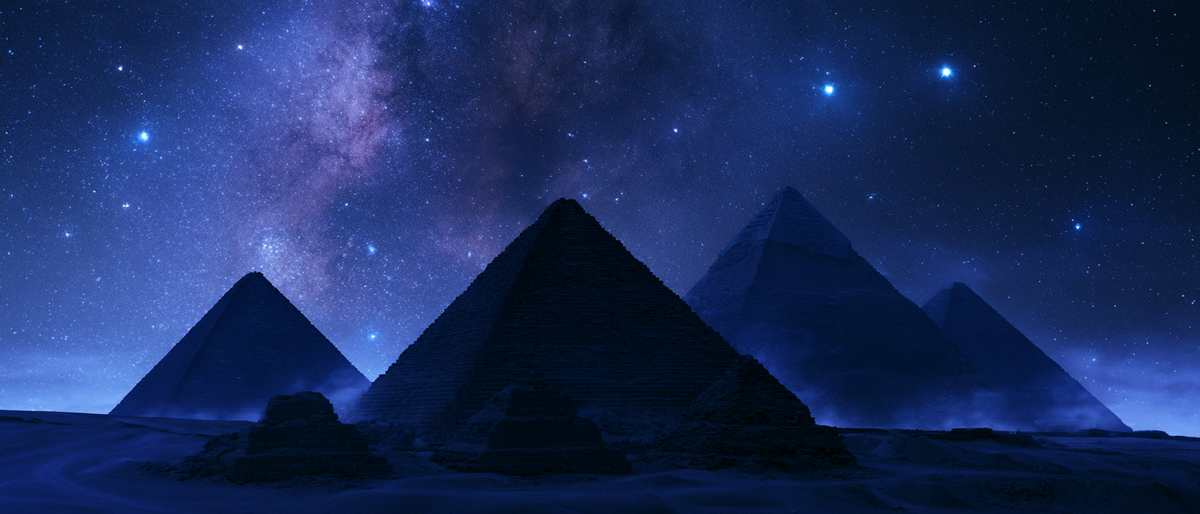
This distinction is central to evaluating Robert Bauval’s Orion Correlation Theory. First proposed in an article in 1989 and popularized in The Orion Mystery with Adrian Gilbert, the theory argues that the three principal pyramids at Giza reproduce on the ground the disposition of Alnitak, Alnilam, and Mintaka. The offset of Menkaure’s smaller pyramid from the line of the two larger pyramids appeared to resemble Mintaka’s offset from the other Belt stars. Bauval placed the proposed design within a wider “sky-ground” scheme in which the Nile corresponded to the Milky Way and used precession to argue for a particularly meaningful celestial configuration around 10,500 BCE.
The theory became famous because it joined several genuine features into one vivid image. The Egyptians did orient monumental architecture with extraordinary care. Orion had authentic mortuary importance. The pyramids belonged to kings whose posthumous transformation was imagined celestially. A resemblance between two triads is visually arresting, and computer planetarium programs made ancient skies newly accessible to a mass audience. These facts explain the theory’s appeal and prevent its central question—whether the Giza plan carried stellar symbolism—from being dismissed as absurd merely because popular treatments became sensational.
They do not, however, establish the proposed correlation. Critics have noted problems of scale, selective matching, orientation, and inversion: a ground plan can be resized and rotated, and the kink of the pyramid line does not reproduce the sky without choices about viewpoint. The 10,500 BCE date is not supported by the archaeological chronology of the Fourth Dynasty pyramids. Most importantly, no known Old Kingdom text says that the three Giza pyramids represent the three Belt stars. Statistical or visual resemblance cannot supply the missing historical link by itself. The responsible conclusion is asymmetrical: interest in Orion is strongly evidenced; a deliberate one-to-one map of the Belt at Giza remains a controversial hypothesis. Textual Orion symbolism is far stronger than the architectural correlation claim.
Sirius offers firmer ground. The Egyptians called the star Sopdet; the Greek form Sothis gave modern scholarship terms such as “Sothic.” Sirius is the brightest star in the night sky, and its heliacal rising after a period of invisibility occurred near the season when the Nile inundation began. The inundation varied in timing and magnitude, so the star did not function as a mechanically perfect flood alarm. Yet its regular reappearance made it an exceptionally effective sign of annual renewal. Sopdet was personified as a goddess and was linked with the opening of the year, fertility, and the restoration of Egypt’s productive order.
The Egyptian civil calendar contained 365 days: twelve months of thirty days followed by five epagomenal days. Without a leap day, it slipped against the tropical year by roughly one day every four years. A civil date therefore migrated through the seasons. Because the interval between heliacal risings of Sirius in Egypt was close to 365.25 days over relevant periods, the civil calendar and the Sothic year returned to approximately the same relation after 1,461 civil years, equivalent to about 1,460 Julian years. This is the Sothic cycle. It is a modern analytical term grounded partly in ancient and classical evidence, not proof that every Egyptian astronomer conceptualized the entire cycle in the same abstract form.
Recorded Sothic dates became important anchors for Egyptian chronology. If a document states that the heliacal rising occurred on a particular civil date within a regnal year, astronomical calculation can constrain the date of that reign. The method is powerful but conditional. The result depends on the assumed observation site, local visibility, calendar continuity, textual transmission, and identification of the king and regnal year. Modern Egyptian chronology therefore uses Sothic evidence alongside king lists, synchronisms, archaeology, radiocarbon dating, lunar dates, and stratigraphy. Sirius is an anchor, not a universal master key.
Sirius consequently provides a valuable comparison with India at the level of formal stellar timekeeping. Both traditions integrated named stars, lunar or solar cycles, and ritual calendars into expert practice. But the analogy must not be exaggerated: in Egypt Sirius held an unusually privileged and well-documented calendrical role, whereas Indian astronomy distributed its calendrical structure across the ecliptic, the nakṣatras, lunar phases, solar ingress, and planetary models. The comparison is strongest between systems of learned stellar chronology, not between two identical cults of Sirius.
Maya Astronomy—Orion, the Cosmic Hearth, and the Architecture of Creation
Maya astronomy developed within the literate civilizations of Mesoamerica and is documented through inscriptions, painted codices, architecture, iconography, colonial-era texts, and knowledge retained in Maya communities. The evidence is uneven because only a few pre-Columbian codices survived colonial destruction, and because “the Maya” were never a single politically or linguistically uniform society. Interpretations may vary by region and period. Even so, the surviving record demonstrates a sustained tradition of observation and computation maintained by scribes, calendrical specialists, priests, and rulers.
Maya timekeeping combined several cycles. The 260-day count, commonly called the Tzolk’in in modern scholarship, paired twenty day names with thirteen coefficients. The 365-day Haab’ joined eighteen named periods of twenty days with a final five-day interval. Because 260 and 365 return to their starting combination after 18,980 days, their interlocking sequence produced the Calendar Round of approximately fifty-two solar years. The Long Count placed days within larger positional units, allowing dates to be located across spans much longer than a human life. These were not redundant calendars. They served different divinatory, historical, political, and ritual purposes and could be written together to create highly specific temporal statements.
The astronomical content of the codices is especially impressive. The Dresden Codex contains a Venus table organized around a synodic period of 584 days and a larger corrective scheme designed to keep the table aligned with observed appearances. Its eclipse table tracks intervals within which solar or lunar eclipses could occur, rather than predicting every eclipse visible at one fixed location in the modern sense. Other pages concern lunar cycles, seasonal phenomena, and planetary behavior; Harvey and Victoria Bricker’s exhaustive study shows both the sophistication of the computations and the difficulties of reconstruction. The existence of correction intervals is crucial. Maya specialists did not merely repeat sacred numbers: they recognized that ideal cycles drifted against the sky and developed procedures to manage the discrepancy.
Architecture also encoded astronomical priorities, though interpretation demands statistical care. Many buildings and complexes were oriented toward solar rising or setting positions associated with agriculturally significant dates. Ivan Šprajc’s regional surveys demonstrate that recurrent orientation groups are more persuasive than isolated claims about a single doorway or sightline. A building may reflect astronomy, topography, political display, or several considerations. The archaeoastronomer must establish which line was intentional, whether the horizon was visible, whether the alignment recurs, and whether the proposed event mattered culturally.
Within Maya cosmology, the region that Western astronomy calls Orion acquired meanings connected with a hearth, a turtle, fire, and acts of creation. Classic Maya inscriptions refer to the setting or changing of “three stones” at the era base, the mythic beginning of the current order. Later K’iche’ traditions identify a Three Hearthstones asterism in Orion. Linda Schele, David Freidel, Joy Parker, and subsequent researchers connected this celestial hearth with the ordinary three-stone cooking hearth at the center of a Maya household. The analogy gives cosmology a domestic architecture: to establish the hearth is to establish a center where raw substance becomes food, family life becomes ordered, and habitable space is made.
A widespread popular simplification identifies the three hearthstones directly with the three stars of Orion’s Belt. The more specific ethnographic identification, however, is a triangle formed by Alnitak, Saiph, and Rigel, with the Orion Nebula or the Sword region associated with smoke or fire. Only Alnitak belongs to the Belt; Alnilam and Mintaka do not complete this triangular hearth. Michael Grofe’s work on the Copán baseline argues that Classic-period references to the Three Hearthstones may be ancestral to the later K’iche’ asterism, but he presents the identification as a hypothesis supported by converging inscriptions, orientation, and ethnoastronomy, not as a universally settled star map. The proper scholarly formulation is therefore “the Orion region” and, where warranted, “Alnitak, Saiph, and Rigel,” rather than an unqualified equation of the Belt with the hearth.
The creation symbolism is nonetheless substantial. In inscriptions commemorating the Long Count era base, gods set stones in a primordial setting, an act that centers and orders the cosmos. Iconographic and narrative associations connect the Orion region with the turtle from which the Maize God emerges, while the nebular patch in Orion’s Sword can be interpreted as hearth smoke or flame. These correspondences do not amount to a Maya version of Osiris. Egypt placed Orion within a mortuary and royal theology of transformation; Maya sources use the Orion region to articulate the establishment of a cosmic center and the conditions of creation.
The seasonal disappearance and return of Orion may have strengthened this symbolism, but the inference must be labeled as interpretation. At Maya latitudes Orion also enters solar conjunction and disappears into twilight before returning in the predawn sky. That observable cycle could support ideas of emergence, renewed fire, or restored order. Yet surviving texts do not permit a simple claim that Orion’s heliacal rising everywhere triggered a specific Maya creation rite. The astronomical cycle supplies a plausible experiential foundation; the securely established evidence lies in the three-stone creation statements, the Orion-region identifications, and the broader Maya integration of celestial time with ritual order.
Comparative Analysis—Orion Across Egypt, India, and the Maya
Orion repeatedly becomes important because it combines visual salience with temporal behavior. It contains several bright stars, occupies a large and recognizable region, and includes the unique line of Alnitak, Alnilam, and Mintaka. It rises and sets at angles that make its motion easy to follow, and its annual solar conjunction creates a period of absence followed by heliacal return. In many latitudes it dominates the evening sky during part of the agricultural year. A society does not need imported doctrine to notice it.
The three-star Belt is especially generative of cultural form. Human vision groups nearby points into lines and shapes, and three nearly aligned lights encourage images of a belt, staff, row, arrow, canoe, or group of beings. But a modern comparative study must not allow Orion’s familiar Greco-Roman outline to dictate every other culture’s constellation. Egyptians recognized Sah, but the exact stellar boundaries of Sah are not recoverable in modern cartographic detail. Indian Mṛgaśīrṣa occupies the head of the deer in the upper Orion region rather than simply denoting the Belt. The Maya Three Hearthstones, in the best-known K’iche’ identification, form a triangle including only one Belt star. The same region was cognitively prominent without being partitioned in the same way.
In Egypt, Orion’s most durable meaning was mortuary and royal. Sah participated in the deceased king’s ascent and became associated with Osiris, making stellar recurrence intelligible as transformed life. In the Maya case, the Orion region was a cosmic hearth: its stones marked a center from which ordered creation could proceed. In India, the region entered the nakṣatra framework through Mṛgaśīrṣa, the “deer’s head,” while adjacent asterisms and myths connected Orion-like figures with Prajāpati, Rudra, pursuit, and the piercing of the deer. These are not translations of one story. Resurrection, creation, and the segmentation of the lunar path answer different cultural questions.
Agriculture helps explain the recurrent attraction without reducing religion to subsistence. Seasonal stars are mnemonic instruments. Their evening or morning appearances occur in structured relation to the solar year, so they can warn that rains, heat, flood, or planting conditions are approaching. Once a star is embedded in an agricultural calendar, it can also become a sign of legitimate authority: the ruler, priest, or specialist who maintains time participates in the maintenance of order. Cosmic kingship in Egypt, Classic Maya rulership, and Brahmanical calendrical expertise differed profoundly, but each joined expert knowledge of recurrence to social power.
Death and renewal are equally understandable responses to disappearance and return, yet they are not inevitable. A star’s invisibility may be narrated as death, descent, travel, concealment, gestation, or the extinguishing of a fire. Its return may signify resurrection, birth, victory, or simple calendrical recurrence. The comparative result is therefore more precise than either diffusionism or a vague doctrine of universal myth. Humans repeatedly use conspicuous cyclical phenomena as cosmological anchors, but the meanings attached to those anchors arise within specific languages, institutions, landscapes, and histories.
The strongest conclusion is one of constrained convergence. All three traditions responded to an astronomical object possessing the same physical affordances: brightness, patterned form, annual periodicity, and seasonal usefulness. Similarities are expected because the object constrains what observers can see; differences are expected because cultures determine which stars count as a unit and what the unit means. Comparison becomes historically useful when both halves of that statement are preserved.
Sirius and the Egypt–India Comparison
Sirius initially appears to offer an even cleaner comparison. It is a single object rather than a large constellation, it is the brightest star in the night sky, and it has a highly regular annual return. Egyptian evidence assigns it an exceptional role: Sopdet’s heliacal rising was associated with the inundation season and New Year, while Sothic dates became important to modern reconstructions of royal chronology. If India possessed an equivalent Sirius-based calendrical regime, the two traditions would indeed present a striking case of formal stellar convergence.
The Indian evidence is more complicated. Sirius was known in Sanskrit stellar lore as Mṛgavyādha, the “deer hunter,” and as Lubdhaka, “hunter.” These names connect it with Rudra and with a mythic field that includes Prajāpati or the deer in the Orion region. Sirius could therefore be culturally significant without serving as the structural axis of the calendar. Indian calendrical astronomy was primarily organized through lunar-solar relations, ecliptic longitude, the nakṣatra sequence, solar ingress, and planetary cycles. No evidence gives Sirius an Egyptian-style role as the single herald of a river regime or the anchor of a civil calendar.
An important terminological correction is required here. Puṣya, also called Tiṣya in Indian tradition, is a nakṣatra associated with stars in Cancer, commonly identified with Gamma, Delta, and Theta Cancri around the Beehive Cluster. It is not Sirius. Confusion sometimes arises because the Iranian star Tištrya is identified with Sirius and because the names Tiṣya and Tištrya have been compared in Indo-Iranian studies. Whatever their linguistic or religious relationship, one cannot transfer the Iranian astronomical identification directly into the standard Indian nakṣatra list. A disciplined Egypt–India comparison must therefore distinguish Sirius as Mṛgavyādha or Lubdhaka from Puṣya/Tiṣya.
Nor is Mṛgaśīrṣa itself Sirius. Mṛgaśīrṣa, “deer’s head,” is a lunar mansion in the Orion region, often identified in later star lists with Lambda and Phi Orionis or a related group in Orion’s head. Sirius as the hunter and Mṛgaśīrṣa as the hunted or deer-associated asterism belong to a mythically connected sky, but they are astronomically separate. The distinction reveals the virtue of indigenous star maps: the Western viewer’s Orion and Canis Major do not determine how Indian observers grouped the same lights.
Sirius remains useful for comparison, but at two different levels. At the direct level, Egypt offers a strongly documented Sirius calendar while India offers named-star lore without an equivalent Sothic institution. The contrast is as important as the resemblance. At the systemic level, both civilizations developed learned stellar astronomy in which specialists related visible bodies to long cycles, ritual dates, and historical eras. Egyptian priests and administrators worked with civil, lunar, and stellar time; Indian gaṇakas and almanac makers coordinated tithis, nakṣatras, solar motion, and intercalation. The stronger comparison is between technologies of chronological order, not between identical uses of Sirius.
This result illustrates independent astronomical convergence in its proper form. A bright star predictably attracts attention in many cultures, but attention need not produce the same institution. Environmental conditions help select cultural use: the Nile inundation gave Sirius a specific annual relevance in Egypt that had no exact Indian counterpart. India’s lunisolar ritual complexity instead favored a distributed ecliptic framework. The same star entered both traditions, yet landscape and calendrical architecture directed it toward different forms of significance.
The 3114 BCE / 3102 BCE Question
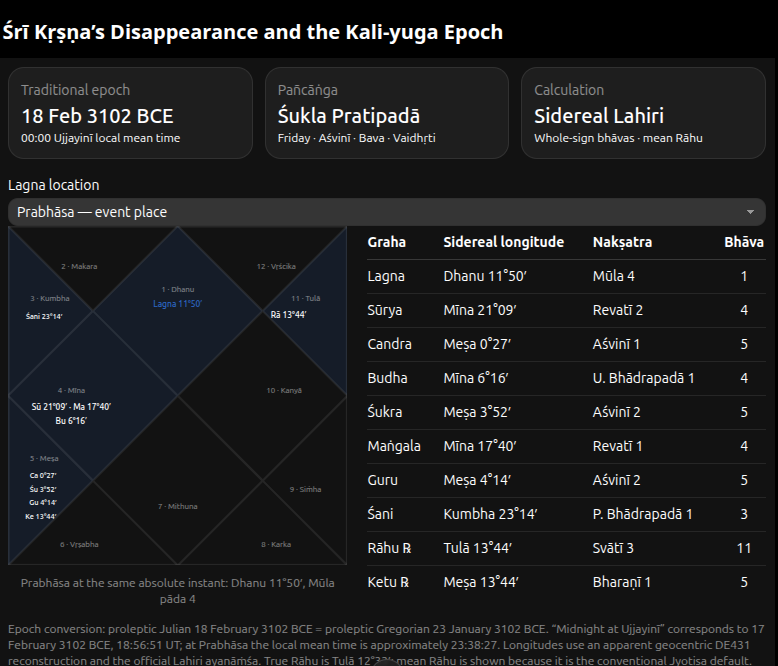
Few comparisons are more tempting than the proximity of the Maya Long Count era and the traditional epoch of the Kali Yuga. Using the widely accepted 584,283-day Goodman–Martínez–Thompson correlation, the Maya era base 13.0.0.0.0, 4 Ajaw 8 Kumk’u corresponds to August 11, 3114 BCE in the proleptic Gregorian calendar. Indian astronomical tradition places the beginning of the Kali Yuga at midnight between February 17 and 18, 3102 BCE in the proleptic Julian calendar, equivalent to late January in the proleptic Gregorian calendar. Once both are expressed in a single calendrical system and the absence of a historical year zero is handled correctly, the separation is about eleven and a half years—reasonably described as approximately twelve years.
The proximity is genuinely interesting because both dates function as remote chronological epochs in civilizations celebrated for calendrical computation. It is not, however, proof of a connection. Twelve years is small relative to five millennia but large relative to the precision with which either system counted days. If one tradition had borrowed a specific epoch from the other, the difference itself would require explanation. More importantly, the historical meanings of the epochs differ. Maya inscriptions describe era-base acts in which deities set stones and establish cosmic order. The Kali-Yuga epoch belongs to an Indian system of immense yuga cycles and served mathematical astronomers as a common origin from which mean planetary motions could be reckoned.
Both epochs are retrospective. The Long Count’s era base lies millennia before the inscriptions that preserve it; the earliest securely dated Long Count monuments appear much later, and the fully developed Classic Maya creation narratives are later still. In India, the 3102 BCE epoch is documented through astronomical systems composed long after that date. Āryabhaṭa, writing in 499 CE, located himself 3,600 years into the Kali Yuga, while siddhāntic texts used long cycles and conventional planetary positions at epoch. Neither date should therefore be treated as a surviving notebook entry made by an observer in the early fourth millennium BCE.
The Indian epoch is sometimes described as the date on which all planets physically aligned. That formulation is misleading. Siddhāntic cosmology could place planets at a common mean position at the start of a vast cycle for computational and theoretical reasons, but modern back-calculation does not show all visible planets in an exact observed conjunction in 3102 BCE. Mean planets are mathematical entities, not identical to true observed longitudes. Similarly, the Maya era-base date should not be assumed to encode a unique Orion or Sirius configuration merely because later creation texts mention the Three Hearthstones.
Computational archaeoastronomy can nevertheless test narrower hypotheses. Researchers can reconstruct geocentric apparent positions for both epochs; calculate angular separations among the visible planets; model precession, nutation, and the proper motion of Sirius; examine heliacal risings and settings of Sirius and selected Orion stars from plausible locations; and search eclipse canons for locally visible events. They can ask whether the Moon occupied a culturally significant nakṣatra, whether Venus was near first or last visibility, or whether the Orion hearth rose at a notable solar or zenith relation in the Maya region. Such tests could establish that a proposed configuration did or did not occur.
The method requires more than planetarium screenshots. A valid study must state its calendar conversion, year numbering, geographic coordinates, horizon altitude, atmospheric extinction threshold, refraction model, and uncertainty in ΔT, the difference between uniform dynamical time and Earth-rotation time. Heliacal visibility must be modeled as visibility, not merely as geometric rising. Because almost any long epoch can be associated with some celestial event, the study must also define its target before searching and compare the result against a null distribution of other dates. Otherwise the research becomes a retrospective hunt for coincidences.
Even a remarkable configuration would establish astronomical interest, not cultural transmission. To support contact, the same configuration would need to be encoded in demonstrably related ways, linked by an intelligible route and chronology, and accompanied by independent evidence. Computational astronomy can evaluate the celestial premise of a diffusion claim. It cannot manufacture the missing archaeology.
Ancient Contact, Diffusion Theory, and Scholarly Standards
Proposals connecting Egypt, India, and Mesoamerica have a long history. Early twentieth-century hyperdiffusionists, most famously Grafton Elliot Smith, treated Egypt as the primary source from which monumental architecture, solar religion, mummification, and other cultural achievements spread across the world. Later writers emphasized pyramids on both sides of the Atlantic, comparable divine symbols, or the feasibility of ocean voyages. India–Maya theories have drawn attention to calendrical numbers, lotus imagery, elephants allegedly represented in Maya art, deities with superficially similar poses, and supposed parallels between Hindu and Mesoamerican time cycles.
The attraction of these theories is understandable. Independent invention can feel less narratively satisfying than a voyage connecting distant civilizations. Demonstrations such as Thor Heyerdahl’s experimental voyages showed that travel with premodern technologies was possible under some conditions. Possibility, however, is not occurrence, and occurrence is not sustained cultural transmission. A successful modern voyage proves a route can be traveled; it does not demonstrate that Egyptians or Indians traveled it at the required date, reached a Maya community, transmitted a technical corpus, and left no securely identified trail.
Balaji Mundkur’s 1978 Current Anthropology article remains instructive because it addressed alleged Hindu–Mesoamerican parallels in a comparative forum with extensive commentary. Mundkur examined claims that Hindu nakṣatra and planetary deities resembled the twenty day signs of the Mesoamerican 260-day calendar, Maya lunar glyphs, and groups of Aztec and Zapotec gods. He concluded that the comparisons were superficial, internally contradictory, chronologically incompatible, and weakened by the great variation within Hindu iconography itself. His broader point was methodological: a thin selection of religious images can conceal rather than explain the independent development of Mesoamerican astronomical-astrological belief.
Anthony Aveni, Harvey and Victoria Bricker, and Ivan Šprajc exemplify a different approach. Aveni has insisted that astronomy be understood as cultural practice, joining observation to architecture, ritual, and power. The Brickers reconstructed Maya astronomical tables through painstaking analysis of numbers, glyphs, intervals, and corrections rather than through isolated resemblance. Šprajc’s large architectural datasets test orientation patterns regionally and statistically. Their work does not deny imagination to ancient observers; it disciplines modern imagination by requiring recurrence, context, and cultural specificity.
Kim Plofker and David Pingree have performed a comparable service for India. Plofker reconstructs the mathematical content of Sanskrit astronomy while resisting nationalist and Eurocentric simplifications. Pingree mapped texts, genres, and transmissions across Mesopotamian, Greek, Iranian, and Indian astral sciences, demonstrating that diffusion is a legitimate historical conclusion when technical and philological evidence supports it. His work is particularly relevant to transoceanic speculation: known transmission often leaves distinctive parameters, translated terminology, identifiable models, and chronological layers. “Diffusion” is not established merely because two cultures watched Venus.
Ferdinando Sardella’s study of Bhaktisiddhānta supplies another kind of caution. Religious biographies preserve valuable memory, but later devotional accounts may magnify debate victories, titles, or episodes of precocious mastery. Sardella neither rejects those accounts wholesale nor accepts them without qualification. He compares them with letters, publications, institutional history, and contemporary sources. The same hierarchy of evidence should govern archaeoastronomy: texts and artifacts with provenance rank above late analogy; repeated patterns rank above selected examples; explicit statements rank above visual resemblance.
What, then, would demonstrate ancient contact? A persuasive case would require several independent classes of evidence. Archaeologists would seek securely excavated Old World artifacts in sealed pre-Columbian contexts, or American materials in comparably secure Old World contexts, with laboratory dating and a documented chain of custody. Historians of science would look for a complex technical package: a distinctive computational parameter, table structure, correction rule, or diagram too arbitrary to be explained easily by common observation. Linguists would require loanwords obeying regular sound correspondences rather than lists of vaguely similar syllables. Biological evidence might include a securely dated transfer of a domesticate, pathogen, or genetic lineage consistent with the proposed route. Iconography would become stronger if it appeared with inscriptions, materials, and chronology pointing in the same direction.
The evidence would also need direction and mechanism. A claim of Egypt–Maya contact must specify which Egyptian period and which Mesoamerican society; “Egypt” and “the Maya” each cover long and internally varied histories. It must explain ships, intermediary ports, navigational practice, duration, and why the proposed trait appears when and where it does. India–Maya claims face the same demands. A twelve-year epoch resemblance or a shared interest in Orion cannot carry that burden.
Scholarly caution should not be confused with dogmatic isolationism. Archaeology accepts pre-Columbian Norse presence in Newfoundland because structures, artifacts, dating, and texts converge at L’Anse aux Meadows. Other contact hypotheses can be judged by the same principle: extraordinary geographic reach does not require a different epistemology, only evidence proportionate to the claim. At present, no comparable evidentiary complex demonstrates Egyptian or Indian transmission into Maya astronomy. Independent development and convergence therefore remain the strongest conclusions, not because contact is metaphysically impossible, but because the surviving evidence supports them better.
One Sky, Many Cosmologies
Egyptian, Indian, and Maya astronomers lived beneath one physical sky, but not within one cultural universe. The Nile Valley made the heliacal rising of Sirius legible as an annual sign of inundation and renewal. Egyptian mortuary theology made Sah a fitting vehicle for Osirian transformation and royal immortality. Indian specialists divided the Moon’s path into nakṣatras, calculated tithis and planetary positions, managed lunisolar correction, and placed astronomical labor in the service of ritual calendars. Maya scribes coordinated interlocking counts, corrected Venus and eclipse tables, oriented monuments, and located acts of creation in a sky whose Orion region could be understood as a primordial hearth.
The differences are not obstacles to comparison; they are its principal result. Egypt did not possess the Maya cosmic hearth, the Maya did not reproduce Egyptian Osirian kingship, and Mṛgaśīrṣa is neither the Egyptian Sah nor a Maya Belt of three stones. Even the most promising stellar comparison, Sirius, proves asymmetrical. Sopdet became an exceptional anchor of Egyptian seasonal and chronological order, whereas Indian Sirius traditions existed within a broader and differently structured system. Puṣya/Tiṣya is not Sirius, and a similarity of names across Indo-Iranian traditions cannot erase the actual star identifications.
At the same time, convergence is not a trivial verdict. To say that several societies independently selected brilliant stars, modeled lunar and solar cycles, and used celestial recurrence to organize authority is to identify a deep regularity in human intellectual history. The sky offers durable patterns beyond the scale of an individual life. It allows a community to connect yesterday’s observation with a future festival, a king’s reign with cosmic continuity, and domestic fire with creation itself. Astronomical knowledge therefore becomes more than a list of positions. It becomes a means of making society temporally coherent.
The 3114 BCE and 3102 BCE epochs capture both the promise and the peril of comparison. Their proximity invites calculation and deserves careful computational study. Yet a numerical resemblance cannot substitute for provenance, texts, technical correspondences, and routes of transmission. The right response is neither credulous proclamation nor ridicule. It is to define testable astronomical questions, model them transparently, and allow the historical conclusion to remain no stronger than the evidence.
The significance of Egypt, India, and the Maya is not that they necessarily inherited hidden knowledge from one another. It is that geographically distant societies discovered, each through its own institutions and symbolic vocabulary, that the heavens could organize time, kingship, agriculture, ritual, creation narratives, and philosophical reflection on existence. Ancient astronomers were not merely studying stars. In transforming recurring lights into calendars and cosmologies, they were studying humanity’s relationship with the universe.
If you're truly intrigued by the possibilities... you can find a formal analysis of the archeoastronomical comparisons between the respective Vedic and Mayan calendrical dates of 3102 and 3114 BCE in the previous article at https://aetheriumarcana.org/the-skies-of-3114-bce-and-3102-bce/
A Select Bibliography
Allen, James P. The Ancient Egyptian Pyramid Texts. Atlanta: Society of Biblical Literature, 2005.
Aveni, Anthony F. Skywatchers: A Revised and Updated Version of Skywatchers of Ancient Mexico. Austin: University of Texas Press, 2001.
Aveni, Anthony F. “Maya Calendar Reform? Evidence from Orientations of Specialized Architectural Assemblages.” Latin American Antiquity 14, no. 2 (2003): 159–178.
Bauval, Robert, and Adrian Gilbert. The Orion Mystery: Unlocking the Secrets of the Pyramids. London: Heinemann, 1994.
Belmonte, Juan Antonio, and Mosalam Shaltout, eds. In Search of Cosmic Order: Selected Essays on Egyptian Archaeoastronomy. Cairo: Supreme Council of Antiquities Press, 2009.
Bricker, Harvey M., and Victoria R. Bricker. Astronomy in the Maya Codices. Memoirs of the American Philosophical Society 265. Philadelphia: American Philosophical Society, 2011.
Clagett, Marshall. Ancient Egyptian Science, Volume II: Calendars, Clocks, and Astronomy. Philadelphia: American Philosophical Society, 1995.
Depuydt, Leo. Civil Calendar and Lunar Calendar in Ancient Egypt. Leuven: Peeters, 1997.
Freidel, David, Linda Schele, and Joy Parker. Maya Cosmos: Three Thousand Years on the Shaman’s Path. New York: William Morrow, 1993.s
Gautschy, Rita, et al. “A New Astronomically Based Chronological Model for the Egyptian Old Kingdom.” Journal of Egyptian History 10, no. 2 (2017): 69–108.
Grofe, Michael J. “The Copan Baseline: K’atun 9.11.0.0.0 and the Three Hearthstones in Orion.” Archaeoastronomy: The Journal of Astronomy in Culture 25 (2012–2013): 55–77.
Kennett, Douglas J., et al. “Correlating the Ancient Maya and Modern European Calendars with High-Precision AMS 14C Dating.” Scientific Reports 3 (2013): 1597.
Kitchen, Kenneth A. “The Chronology of Ancient Egypt.” World Archaeology 23, no. 2 (1991): 201–208.
Magli, Giulio. Architecture, Astronomy and Sacred Landscape in Ancient Egypt. Cambridge: Cambridge University Press, 2013.
Mundkur, Balaji. “The Alleged Diffusion of Hindu Divine Symbols into Pre-Columbian Mesoamerica: A Critique [and Comments and Reply].” Current Anthropology 19, no. 3 (1978): 541–583.
Neugebauer, Otto, and Richard A. Parker. Egyptian Astronomical Texts. 3 vols. Providence: Brown University Press, 1960–1969.
Ohashi, Yukio. “Development of Astronomical Observations in Vedic and Post-Vedic India.” Indian Journal of History of Science 28, no. 3 (1993): 185–251.
Pingree, David. Jyotiḥśāstra: Astral and Mathematical Literature. Wiesbaden: Otto Harrassowitz, 1981.
Plofker, Kim. Mathematics in India. Princeton: Princeton University Press, 2009.
Ruggles, Clive L. N., ed. Handbook of Archaeoastronomy and Ethnoastronomy. New York: Springer, 2015.
Sardella, Ferdinando. Modern Hindu Personalism: The History, Life, and Thought of Bhaktisiddhānta Sarasvatī. New York: Oxford University Press, 2013.
Sarma, K. V. “Diffusion of Astronomy in the Ancient World.” Endeavour 24, no. 4 (2000): 157–164.
Schele, Linda, and David Freidel. A Forest of Kings: The Untold Story of the Ancient Maya. New York: William Morrow, 1990.
Šprajc, Ivan. “Astronomy and Architecture in the Maya Lowlands.” Journal of Skyscape Archaeology 2, no. 1 (2016): 11–40.
Šprajc, Ivan. “Astronomical Aspects of Group E-Type Complexes and Implications for Understanding Ancient Maya Architecture and Urban Planning.” PLOS ONE 16, no. 4 (2021): e0250785.
Steele, John M., ed. Calendars and Years: Astronomy and Time in the Ancient Near East. Oxford: Oxbow Books, 2007.
Suggestons for Further Reading
- For a reliable, accessible entry into Maya astronomy, Anthony Aveni’s Skywatchers remains the best general starting point. It combines technical explanation with sustained attention to ritual, architecture, and the danger of imposing modern categories on ancient evidence.
- Harvey and Victoria Bricker’s Astronomy in the Maya Codices is the essential specialist reference for the numerical and glyphic evidence. Its scale and detail make it better suited to consultation than to a first introduction, but no serious study of Maya Venus, lunar, or eclipse tables can ignore it.
- Marshall Clagett’s Ancient Egyptian Science, Volume II provides a broad documentary foundation for Egyptian calendars, clocks, and stellar knowledge. It is especially useful for separating what Egyptian sources actually attest from later claims about pyramid astronomy.
- James P. Allen’s The Ancient Egyptian Pyramid Texts allows readers to exasmine the mortuary language behind the Orion–Osiris discussion. Reading the texts in context makes clear why the celestial association is strong while simplistic star-by-star reconstructions remain hazardous.
- Kim Plofker’s Mathematics in India offers the clearest modern account of the mathematical setting of Indian astronomy. Readers interested specifically in the genres and transmission of astral science should continue with David Pingree’s Jyotiḥśāstra.
- Ferdinando Sardella’s Modern Hindu Personalism is the indispensable critical biography of Bhaktisiddhānta Sarasvatī. Its treatment of his astronomical education, publishing, and Tripura employment is particularly valuable because it distinguishes documented history from later institutional memory.
- Clive Ruggles’s Handbook of Archaeoastronomy and Ethnoastronomy supplies the methodological background for evaluating alignments, visibility, cultural context, and comparative claims. It is the most useful resource for turning suggestive celestial parallels into properly framed research questions.
Jonathan Brown for AetheriumArcana
Member discussion: