
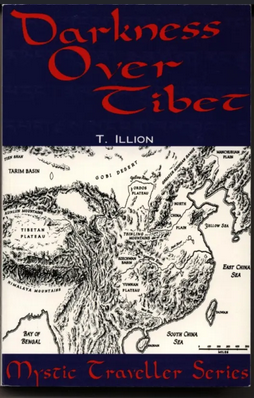
Darkness Over Tibet and the Black Fraternity Beneath the Plateau
Section I — The Last Blank on the Map
In 1934, the year Theodore Illion stained his face with iodine and oil, pulled on the robes of a wandering Tibetan monk, and crossed the border into one of the most dangerous places a European could go, the world's cartographers had almost finished their work. The poles had been reached. The Amazon had been mapped. The Sahara, the Gobi, the deep interior of Central Asia — all had been penetrated, measured, named, and filed. The age of terra incognita was ending. One substantial exception remained.
Tibet.
To the Western imagination of the 1920s and 1930s, Tibet was not merely a country. It was a condition — the last credible reservoir of the unknown in a world that was running out of unknowns. Geographically, the reasons were straightforward. The Tibetan plateau sits at an average elevation of over fourteen thousand feet, ringed by the highest mountain ranges on earth. Its capital, Lhasa, had been penetrated by only a handful of Westerners in recorded history, and since the Lhasa Convention of 1904, which paradoxically committed Tibet to deeper isolation even as it formalised British trade rights, the country had been effectively sealed. The Thirteenth Dalai Lama, ruling a nation that was nominally under Chinese suzerainty but practically independent, enforced his borders with the particular ferocity of a small country that knows exactly what openness costs. Foreigners entering without authorisation faced arrest, expulsion, or worse. As Illion himself notes in the preface to Darkness Over Tibet, he had to maintain a perfect disguise at every moment — his Tibetan was fluent, but a single slip of accent or custom could bring catastrophe.
Yet the inaccessibility alone does not explain why Tibet exercised such a peculiar grip on the Western occult and spiritual imagination. For that, you need to look not at geography but at intellectual history, and specifically at one remarkably energetic Russian noblewoman.
Helena Petrovna Blavatsky founded the Theosophical Society in New York in 1875, and in the decades that followed she constructed the most influential esoteric cosmology of the modern age — a vast synthesis of Hindu, Buddhist, Gnostic, and Hermetic thought, anchored to a specific claim: that hidden in Tibet, operating from somewhere in the Trans-Himalayan ranges, was a brotherhood of superhuman Masters who had cultivated wisdom and occult power across multiple lifetimes and who quietly guided the spiritual evolution of humanity. These Mahatmas, as she called them, were the source of her teachings, the secret government behind the visible world. Blavatsky died in 1891, but her architecture endured. The Theosophical Society spread to India, to Europe, to America, drawing in figures as varied as W.B. Yeats, Thomas Edison, and Annie Besant. Tibet, in the Theosophical imagination, was not simply a remote Buddhist nation — it was the headquarters of the invisible world.
This was, of course, a projection. The Tibet that Blavatsky described bore little resemblance to the actual country, its people, its practice of Vajrayana Buddhism, or its political realities. But projections have power precisely because they are not constrained by facts, and the Theosophical vision of Tibet as the home of hidden Masters proved extraordinarily durable. It fed into, and was in turn fed by, a parallel tradition: the mythology of Agartha and Shambhala.
Shambhala is a genuine concept in Tibetan Buddhist cosmology — a hidden kingdom of spiritual perfection whose king will emerge in a future age to defeat the forces of darkness. But in Western hands, beginning with Saint-Yves d'Alveydre's 1886 Mission de l'Inde, it was conflated with Agartha, a subterranean civilisation of advanced beings dwelling in enormous underground cities beneath the mountains of Asia. Saint-Yves described a sovereign pontiff ruling this hidden realm, a keeper of all esoteric knowledge since the dawn of civilisation, accessible only to the spiritually worthy. By the time Ferdynand Ossendowski's Beasts, Men and Gods appeared in 1922, recounting legends told to him by Mongolian lamas of the underground King of the World, the mythology had solidified into something that many readers took seriously as literal geography. René Guénon responded to Ossendowski's account with a full-length metaphysical treatise. Nicholas Roerich led expeditions into Central Asia in 1926 and 1928 specifically in search of Shambhala. And in a detail that will become significant later in this essay, Heinrich Himmler and Rudolf Hess, apparently inspired by precisely this literature, dispatched German expeditions to Tibet in 1930, 1934–35, and 1938–39.
Meanwhile, in 1933 — the year before Illion set out — James Hilton published Lost Horizon, whose hidden Himalayan lamasery of Shangri-La became one of the most famous fictional settings of the twentieth century, and whose central premise — a place outside time, outside history, presided over by an ancient and mysterious pontiff — entered the popular imagination in a way that no academic esoteric text could. Lost Horizon was a utopia. Illion's book, published five years later, is its photographic negative: the same setting, the same hidden valley, the same charismatic ancient ruler, the same invitation to stay — and an entirely different answer to the question of what the ruler actually wants from you.
Against this background, the choice of Tibet as the setting for Darkness Over Tibet was not arbitrary and not merely a function of Illion's actual travels. Tibet in 1938 was the single location on earth that a Western reader would immediately recognise as a place where the extraordinary was not only possible but expected — where a hidden city, an occult fraternity, and a cosmopolitan sorcerer-prince speaking six languages from a Western armchair could be presented with a straight face, and where the existing mythology was rich enough that Illion needed only to invert it to achieve his effect. The Masters were real, he implies. The underground cities were real. But the tradition that imagined them as repositories of benevolent wisdom had made a catastrophic error of judgement. The hidden city beneath the Tibetan plateau does not safeguard humanity. It feeds on it.
Egypt, the other great repository of Western occult projection, had been largely disenchanted by 1934. Tutankhamun's tomb was opened in 1922, and while the discovery generated enormous public fascination — and, in some quarters, genuine terror, in the form of the so-called Curse of the Pharaohs — it also brought Egypt firmly within the realm of archaeology, of science, of the knowable. You could visit. You could measure. Howard Carter had been there with a brush and a camera. Tibet, by contrast, remained genuinely out of reach for almost every reader Illion could imagine. No one was going to check.
Which is, of course, one of the things that makes Darkness Over Tibet so slippery and so fascinating — and so worth reading carefully, in 2025, nearly ninety years after its first publication by Rider & Co. in London.
Section II — The Man Who May Have Been There
The facts of Theodore Illion's life, assembled from every available source, amount to surprisingly little for a man who gave lectures across Europe, was photographed by the press in London, and published books that were translated, reprinted, and read well into the twentieth century. He was born in 1898 — the question mark attached to this date in every scholarly reference is itself suggestive — and he died on the fourth of September, 1984, in Hallein in the Austrian state of Salzburg. Between those two fixed points, almost everything is contested, secondhand, or simply missing.
What we have comes largely from a single source: Professor Herbert Novak, described as a longtime friend, who provided the biographical outline that has circulated ever since. According to Novak, Illion was born in Canada to a wealthy family that claimed descent from a branch of the British Plantagenet royal line — the medieval dynasty that produced, among others, Richard the Lionheart and Henry V. He left home at a very young age. A 1933 interview in the Swedish newspaper Dagens Nyheter, conducted during one of Illion's preparatory training trips to Scandinavia, adds a few strokes to the portrait: born in Canada, raised in Japan, educated in Paris, New York, Berlin, and Istanbul. Writer, journalist, hiker, philosopher, vegetarian. A man who had, by the time he was in his mid-thirties, passed through more countries, languages, and disciplines than most people encounter in a lifetime.
This profile — cosmopolitan, polyglot, physically formidable, spiritually serious — is consistent with everything Illion reveals about himself in his own prose, which is more than is immediately obvious. He is not a confessional writer, but Darkness Over Tibet is saturated with self-disclosure. He mentions, in passing, having travelled alone for fifteen days carrying his own food through country where a sprained ankle would mean death. He notes, almost casually, that a gun once discharged a few inches from his face and that friends later told him he had not moved his eyelashes. He walked thirty miles a day through the Tibetan plateau as a matter of routine. When the Ruler of the underground city, in their extraordinary audience, summarises Illion's character — "you have an iron will," "you sometimes accomplish things because of your boundless energy" — it reads less like flattery and more like an accurate field assessment of the man the Ruler is trying to recruit.
Illion mentions, in the same breath as his expeditions, his plays. This detail is easy to miss but worth pausing on. Theodore Illion was a playwright. The man who wrote Darkness Over Tibet was not a scientist, a diplomat, or a professional explorer, but a writer of dramatic works — a man whose professional instincts were theatrical, whose sense of scene, character, and moral conflict were formed in the crucible of drama rather than in the traditions of travel writing or ethnography. It goes some way toward explaining why the book reads as it does: not as a field report, but as something closer to a morality play with a single protagonist navigating a sequence of scenes designed to test his soul.
Between the 1933 Swedish interview and the 1934 London photographs, the outline of the expedition's preparation becomes concrete. The Hulton Archive at Getty Images holds three photographs taken in London in April 1934, weeks before Illion's departure. In the first, he is described as an "explorer and philosopher," flanked by two companions on the eve of departure. In the second, with a certain dry humour, he is shown wearing the headgear he considers the best protection for the journey ahead — a napkin. In the third, taken on April 14th, he is paddling a small rubber dinghy in demonstration of the equipment he intends to take to Central Asia. That rubber dinghy appears in Darkness Over Tibet itself, pressed into service as a makeshift earphone to measure the depth of the vertical shaft at the centre of the underground city. Whatever the truth of what Illion found in Tibet, he demonstrably went somewhere, demonstrably prepared carefully, and demonstrably made press appearances in a major world capital on the eve of his departure.
This is the point at which the case for Illion becomes most interesting, and where it most sharply diverges from simple fabrication. The counter-argument, made forcefully by the Tibetologist Jürgen Aschoff, is that the books are "truly science fiction, a figment of the imagination," and that Illion "never mentioned one published reference or one renowned Tibetan physician in support of his more than vague assertions." The Aschoff position is the sceptic's floor: a German obsessive with Theosophical tendencies invented two travelogues, bolstered them with period detail sourced from other travel literature, and published them through Rider & Company — a London house with a long history in occult publishing — to a readership primed to believe exactly this sort of thing.
The problem with the Aschoff position is that it does not quite account for the Gestapo. When Illion returned to Germany in 1941, the secret police ordered him to provide documentary evidence of his alleged visits to Tibet. As historian Isrun Engelhardt records in Nazis of Tibet: A Twentieth Century Myth, the Gestapo suspected him of being a fraud who had never set foot in the country. The implications of this detail cut in two directions simultaneously. It confirms that serious doubt about his travels existed at the time, in a government that had its own deep investment in Tibet mythology and its own expeditionary teams who had actually been there and come back with opinions. But it also confirms that Illion maintained his claims under conditions where recantation would have been the safer path, and that he was neither operating with state support nor using the Nazi Tibet programme as cover or inspiration for fabricated adventures.
The picture that emerges is of a man who resists easy categorisation. He was not a Theosophist, though he moved in adjacent circles and his publisher was part of that world. He was not a straightforward fraud, though his claims strain credibility. He was not a scientist, though he wrote with a scientist's interest in architecture, hydraulics, and the mechanics of the underground city. He was not, in the end, writing about Tibet at all, in any meaningful ethnographic sense — he was writing about a European moral and spiritual crisis using Tibet as his stage. What Jürgen Aschoff identifies as a failure of scholarly rigour is, from another angle, simply the wrong criterion applied to the wrong kind of book.
The pseudonyms are worth noting here, not as evidence of deception but as evidence of compartmentalisation. Under his own name, Illion wrote adventure and spiritual polemic. Under the name Theodore Burang, and occasionally Theodor Nolling, he wrote serious books on Tibetan medicine — works that were read, cited, and criticised within academic medicine on their own terms. The same mind that produced the robot-servants and the bottomless shaft also produced careful studies of Tibetan healing traditions that the medical establishment took seriously enough to argue with. This is not the profile of a fantasist, but of a man with multiple registers, working in different modes for different purposes, and choosing — with some deliberateness — to keep those registers separate.
He never married. He had no children. He died in Salzburg at eighty-six, leaving behind a small library of books in several languages, a handful of photographs, a Swedish newspaper interview, and a story about a city that may not exist, presided over by a man who spoke six languages from a Western armchair, whose breath smelled of something old and cold, and whose eyes, when you looked into them directly, made something in you want to run.
Section III — A Guided Tour of the City of the Initiates
The Valley of Mystery, as Illion approaches it on foot, offers no visible sign of anything unusual. The valley widens. The landscape is tidy, swept-looking, empty. There are no walls, no gates, no guards. Local Tibetans, when pressed, confirm that the City exists but refuse to speak further about it — those who have broken this unspoken rule, one farmer tells him, were struck ill the same evening and lost their cattle. A friend who crossed the city's unmarked border out of curiosity returned some time later looking three years older and unable to speak for three months. Illion notes this story and walks on.
What he finds when he arrives is one of the more remarkable pieces of architectural description in the literature of the period. There is no city. Or rather, there is a city, but it has been engineered to be indistinguishable from the valley floor. Seven rectangular plots of ground, each roughly forty by forty yards, are covered with large flat glass slabs flush with the surface of the earth. Each is enclosed by a thin railing, exactly the colour of the surrounding ground, barely visible at a distance. At the highest point of the gently sloping plain stands a circular stone wall, four feet high and ten yards in diameter — the only structure that rises above ground level — and it is built around a vertical shaft of apparently bottomless depth.
In front of each glass-roofed quadrangle, a staircase descends underground to a heavy door. The buildings are entirely subterranean. Light enters through the glass ceilings. In winter the design retains heat efficiently; it is, Illion notes with the eye of someone who has thought carefully about it, essentially earthquake-proof. A system of pipes runs from a central tank in the circular wall to each glass surface, allowing water to flow continuously over the roofs on hot afternoons and regulate the interior temperature. In an emergency, sand could be spread over the glass and the railings removed, and the entire city would vanish from aerial view. Even the staircases could be covered.
This is not the grandiose underground empire of Agartha mythology — the vast halls, the subterranean sea, the millions of inhabitants. It is something stranger and more specific: a modern, rational, engineered settlement, designed by someone with a precise understanding of passive solar heating, thermal regulation, camouflage, and emergency concealment. Whoever built it was not working from mystical intuition. They were working from a plan.
Illion arrives early in the morning and finds the city apparently deserted. He knocks at doors, gets no answer. He examines the railings and finds they cannot be climbed. Then he notices the central shaft. He drops a ten-pound stone and listens. Ten seconds. Twenty. Thirty. Forty. Fifty. No sound. He constructs a makeshift earphone from his rubber dinghy, strings, and safety pins — the same dinghy he was photographed demonstrating in London weeks before his departure — and drops a thirty-pound rock. After thirty-five seconds, he hears the stone grazing the wall of the shaft as it continues to fall. After forty seconds, still no impact with any floor. He is preparing to drop another stone when a servant emerges from one of the staircases and asks him, icily, to stop.
The city's population, when it eventually emerges around noon — life in the Holy City, he is told, begins in the early afternoon — divides into two visible categories. Those in silk move and speak approximately like human beings, though their eyes hold what Illion can only describe as a dismal expression. None of them laugh. Laughter, he discovers, is forbidden. So is speaking above a low voice. Those in cotton are something else: mechanical, depersonalised, vacant-eyed. Illion reaches for Offenbach's mechanical doll as his reference point — the automaton from The Tales of Hoffmann, the beautiful figure that dances and sings but has no soul. When one of the cotton-clad servants passes him and he glimpses the eyes, he writes that they were "almost glassy, like the eyes of a corpse."
The first meal he takes in the dining hall — a large underground room where several hundred members and guests sit in circles of nine on expensive cushions, served noiselessly by the glassy-eyed servants — produces in him an immediate and inexplicable shift. His critical faculty dissolves. His scepticism gives way to what he calls a strange capacity for uncritical enthusiasm. He notes this himself, with the alertness of a man who has been trained to distrust precisely this kind of mood change, and the observation is one of the most quietly alarming moments in the book. Whatever is in the food, or in the atmosphere, or in both, it works. By his second meal he is seriously considering joining.
The city's social structure is a hierarchy of initiations with grandiose titles — Dispensers of the Divine Wisdom, Masters of Light, Lords of Compassion, Illuminated Teachers — each level binding the holder more completely to the will of the Ruler at the apex. The highest initiates, Illion notes with characteristic precision, "had no separate personality left at all and were mere agents of the Divine will, heart, body and soul." Members cannot leave the city unless sent on missions assigned by the Ruler. Servants appear to be incapable of any action beyond their assigned duties. The entire social organism is structured as a funnel, drawing everything — will, intelligence, personality — upward toward a single point.
Illion is offered a room in the guest-house. It is comfortable, Western-appointed, cool, well-lit through its glass ceiling. The door bolts from the inside. He is told he may come and go freely, that no one will force his hand. Narbu, the well-meaning friend who arranged his invitation, whispers excitedly about the value Illion could bring to the Brotherhood, the rapid initiations that could be arranged, the important work he might be given. Illion listens, and notices that Narbu's voice, since his arrival in the city, has acquired a slightly metallic, hollow quality. He then notices that his own voice has begun to sound the same way.
Two further details from these first days deserve particular attention because they are easy to read past. The first is that all waste — all "impure organic matter" — is required to be brought to a single building and burned in a fire kept burning day and night. The superintendent of this building explains that there are occult reasons for this rule. Given what Illion discovers later about the kitchen in that same building, the occult reason for ensuring that no biological material from any resident leaves the premises becomes, in retrospect, something considerably darker than hygiene. The second detail is that Illion, pouring out the contents of a personal bottle he has retained in his room for private convenience, finds that the liquid has turned black. He notes it, attributes it to the food, and forgets about it. The reader, by the end of the book, will not forget it.
What Illion has entered, as he gradually comes to understand, is a total environment — a closed system designed at every level to dissolve individual will, suppress critical thought, stimulate occult sensitivity at the expense of rational intelligence, and draw the inhabitant into ever-deeper dependency on the organism as a whole. The architecture reinforces this: invisible from outside, inescapable from within, every building connected to every other by subterranean passages so that the Ruler can move through the entire city without ever appearing above ground. The social structure reinforces it. The food reinforces it. The very psychical atmosphere, Illion writes, makes deep and free thinking feel impossible — as though the air itself has been adjusted.
He quotes Goethe's Mephistopheles, almost involuntarily, as the city works on him: Contemn your capacity to think, which is man's greatest power; welcome misty things and sorcery and the spirit of illusion, then I shall get you surely enough. The fact that a German-speaking playwright-adventurer on a Tibetan plateau in 1934 reaches instinctively for Faust as his interpretive framework tells you a great deal about the cultural register in which the book is operating, and about who Theodore Illion actually was.
Section IV — The Prince of Light
The audience is preceded by a confrontation about a robe.
Illion arrives at the palace in his ordinary travelling clothes and is met by a delegation of increasingly senior Masters of Ceremony, each more urgent than the last, all insisting in respectful whispers that he must put on the ceremonial black silk gown before he can enter the presence of the Ruler. He declines. More dignitaries are summoned. He declines again. After five minutes of collective whispering he informs them that he had come to offer his assistance, not to perform on solemn official business, offers his respects to Mani Rimpotche, and turns to leave. The crowd of Masters rushes after him, horrified — an interrupted audience has never been heard of in the palace's history. At that moment a court official in white silk comes running down the staircase and, in the first time anyone has raised their voice inside the palace walls, shouts for Illion to stop. The Exalted Jewel will receive him as he is.
It is a small scene, but it establishes something important before a single word is exchanged between the two men. Illion will not be dressed by this institution. He will not wear its colours. He enters the most carefully managed social space in the city on his own terms, and the Ruler — who has, Illion suspects, engineered the entire confrontation to see what the candidate will do — concedes. When Illion later attends the temple service, he is the only figure in the room not wearing black silk. He describes himself as looking like "a bright spot in the darkness." The image is not incidental.
The Ruler himself, encountered finally in a smaller room at the top of the palace, is worth describing in full, because the description does not match what a reader of Theosophical literature might expect, and does not match what popular summaries of the book tend to suggest. He is not specifically Egyptian, not specifically Eastern, not swathed in the iconography of any single tradition. He is very tall, with a long white beard. He looks, Illion writes, "like a mixture of Pythagoras with a slightly Jewish touch and a refined modern Tibetan belonging to the aristocracy of the country." He speaks excellent English. He speaks, according to Narbu, six languages perfectly: Tibetan, English, French, Chinese, Hindustani, and Sanskrit. He gives Illion his left hand in greeting — "the left one is nearer to the heart," he says, smiling — and has arranged for a Western easy-chair to be brought in for the occasion.
This is a figure of studied cosmopolitanism, a man assembled from the significant intellectual traditions of every major civilisation simultaneously, at home in all of them and native to none. The easy-chair detail is particularly sharp: the Ruler has anticipated his guest's preferences and arranged for his comfort before the meeting begins. This is either extraordinary hospitality or a demonstration of knowledge that should not be possible.
The conversation that follows is a masterclass in high-pressure spiritual recruitment conducted with perfect deniability. The Ruler opens by informing Illion that he is a man of great capacity with a great mission to fulfil, that the next few days will compress the experience of hundreds of past lives into hours, and that he faces perhaps the greatest decision he has ever been called upon to make — and then, having established all of this, immediately insists that no one will force his hand. He discusses Illion's expeditions and his plays, demonstrating that he knows him well. He assesses his character accurately and in terms calculated to appeal to it: the iron will is real, he says, but insufficient. Iron will can be transcended. Illion could become something greater. He could, in fact, become all-powerful. At what price? "That you must discover for yourself."
The philosophical content of the conversation is as revealing as its rhetoric. The Ruler argues that spiritual mistakes do not matter, that a man who stumbles will rise again. Illion notes internally that there is at least one class of spiritual mistake from which there is no recovery: the surrender of the soul. The Ruler argues for the acquisition of power — the capacity to command the environment rather than merely wanting things from it. Illion notes internally that his greatest asset has always been his willingness to be a creature, a child of the Creator, rather than seeking to put himself on the level of the Creator. These are not casual disagreements. They represent two entirely opposed metaphysical positions on the purpose of spiritual development, and the Ruler, Illion gradually understands, holds the position he holds not as a philosophical choice but as a description of what he has already done.
He discusses Coriolanus. The Ruler knows it thoroughly, has read it several times, can cite details. A footnote in the text preserves this exchange, almost as an aside, but it lands oddly — a fallen angelic being in a subterranean city beneath the Tibetan plateau with strong opinions about a Shakespeare play about a man who places himself above the community that formed him and is destroyed by his own contempt. One suspects the Ruler chose that example deliberately too.
The temple service that evening provides the first explicit evidence that the Brotherhood's sacraments are not what they appear. The ceremony is elaborate, beautiful in its way, structured around an altar with a perpetual flame and four tables forming a cross, with nine underground tunnels opening from the walls at the far end of the room — running downhill into the earth as far as the eye can follow. The lower walls of the temple, Illion notices on the way out, are lined floor to ceiling with glass cases filled with human bones. During the service, a silver vessel is carried up from one of the tunnels and its contents poured into hundreds of small golden vases. The liquid is blood red. Narbu confirms it is blood. When Illion asks what kind, Narbu says he is not permitted to answer.
The unmasking does not happen at the temple or in the audience room. It happens the following afternoon in the library, and it is preceded by an accidental act of purification. Illion, walking outside the city that morning, is caught in a violent Tibetan thunderstorm, stripped, drenched, and effectively washed clean of whatever the city's atmosphere has been depositing in him for days. He returns to the library with his capacity for objective observation restored. He looks at Narbu and sees, with sudden clarity, that his friend's eyes have become more lifeless since his arrival — that something has been drawn out of him, something Illion names as soul, freedom, personality. He looks in a mirror and sees the same thing beginning in his own face: a grayness, a glassiness, and something he can only describe as a demonic grin in his own features.
Then he looks at the portraits on the library walls. Reproductions of the Supreme Jewel and his lieutenants, and of various Soul Saviours and Redeemers of past ages. He studies their eyes. Intelligence, power — but no soul. And in one of the most quietly devastating moments in the book, he recognises what he is looking at: angels who wanted to be like God, fell into the abyss that has no return, and have spent their existence since attempting to drag others down with them.
The Prince of Light is the Prince of Darkness in disguise.
The Ruler enters the library almost immediately after this recognition — as though he felt it. He asks Illion if he has made his decision. Illion says yes. The Ruler blows a single powerful breath directly into his face, which Illion's footnote identifies as a characteristic act of demonic beings seeking to gain a hold over their target and deprive them of free will. Illion does not flinch. He commands the Ruler to step back in the name of the Creator, in a voice he has never heard from himself before — his whole being fused into a single point of will.
The Ruler recoils. He turns and leaves the library without another word.
What is striking about this scene, and what tends to get lost in summaries that reach for the word "supernatural," is how precisely and theologically the confrontation is framed. Illion does not defeat the Ruler with occult power or physical courage or cleverness. He defeats him by being, at the moment of maximum pressure, unambiguously himself — a creature who has never tried to be more than a creature, whose soul is intact because he has never offered it to anything that asked for it. The Ruler's weapons are flattery, fog, food, and accumulated psychic pressure. None of them work on a man who has spent his life walking alone through places where a sprained ankle means death, who has not moved his eyelashes when a gun went off beside his face, and who quotes Goethe to himself under pressure.
The great adversary of Darkness Over Tibet, ultimately, is not a sorcerer beneath a Tibetan plateau. It is the offer, made with maximum sophistication and minimum compulsion, to become something other than what you are.
Section V — What Was on the Menu
The kitchen is discovered by accident.
Illion, having fled the library after the unmasking confrontation with the Ruler, runs in the wrong direction. The seven buildings of the underground city are identical from the outside — the same staircases, the same heavy doors, the same dimly lit corridors at right angles below ground — and in his terror he takes the wrong staircase and finds himself pushing through two automated servants and through a door that opens onto a room he was never meant to see.
The description is terse, almost clinical, because he has only seconds before he has to run again. A human corpse lies in the centre of the kitchen. Automatonic cooks cut small pieces of flesh from it. Ten or fifteen large pans of massive silver are suspended over alcohol fires. The pieces are passed to boards where they are cut into still smaller pieces. The cooks stare at the intruder. Illion takes in the whole scene in two or three seconds and runs.
He does not claim certainty. He notes, carefully, that it was not quite certain that the contents of the silver pans were destined for the members and guests — but that the very possibility of having eaten such food was dreadful, and that if human flesh had been mixed into the food, it would explain why it had disagreed with him. He retrieves his belongings from the guest-house, including — in a detail that sounds absurd until you understand its logic — a personal bottle of urine he had retained in his room rather than carrying to the sanitation building. He takes it because he does not want to leave behind anything that could serve as a basis for magical operations against him. Then he goes to find Narbu.
The kitchen revelation arrives so quickly, and Illion moves past it so rapidly in the narrative, that it is easy to miss how many earlier details it retroactively transforms. The sanitation building's rule about burning all organic waste in a perpetual fire — the occult reason the superintendent offered with such evident contempt for impure matter — now reads as something else entirely: an institutional mechanism for ensuring that no biological material belonging to any resident of the city ever leaves it. The liquid in his personal bottle turning black on the first day, attributed to the food and then forgotten. The food's inexplicable effect on his critical faculties, its capacity to dissolve scepticism and generate uncritical enthusiasm. The glassy-eyed servants who cleaned his room and prepared his meals, moving with the mechanical affect of something that had lost the higher components of its humanity. Illion plants these details in the first half of the book the way a careful dramatist seeds a revelation — not with the heavy hand of foreshadowing but with the flat matter-of-factness of a man recording what he observed, trusting the reader to look back.
The question of what the servants actually were is addressed at length in the days following his escape, during the long sleepless nights of the magical pursuit, when Illion has nothing to do but walk and think. The procession he witnesses at dawn — Masters in black robes performing resuscitation rites over bodies brought on stretchers from the surrounding region, three of which rise and walk mechanically back toward the city, while five others fail to respond and are carried — forces a systematic analysis. The OCR of the available text has a page drop at this point, losing a passage that clearly showed how Illion came to witness the scene, but what remains is unambiguous: he watches the rites from hiding, confirms the footprints in the ground afterwards, and reconstructs what the brotherhood has been doing.
His conclusion is that the servants are not simply enslaved living humans but something more precisely horrible: corpses from which the higher vehicles of consciousness have departed at death, with only the physical body and the principle of sensation — what he calls the vitalizing principle — reanimated and made to re-enter the flesh. They possess a body and sensation, but no feeling, no intelligence, no will. They repeat formulae. They perform assigned tasks. They are, he writes with a kind of grim precision, ideal servants. The Brothers themselves, by contrast, are something worse: living men who have surrendered their free will to the Ruler while retaining their other faculties. They still feel, still think, still speak. Their souls are gone — or going — but their intelligence remains, which is why they are useful for the Brotherhood's broader work in the world rather than simply for domestic duties. The distinction matters to Illion because it maps onto a precise theology of the human person, which he sketches during those dark walking hours: body, sensation, feeling, intelligence, will — five components that must remain unified, the dissolution of any one of them a catastrophe of a different kind and degree.
The bodies for the procession, he speculates, were obtained by trickery or bribery from families living in the surrounding districts — local Tibetan families whose dead were stolen in the night. The resuscitation rites are performed at sunrise because the cosmic currents required reach their greatest intensity in the early morning light. This is the detail Illion finds most philosophically repellent: that the Brotherhood performs its most abhorrent work not in darkness but by stealing the forces of creation itself — using the energies of God's own morning to animate corpses for the service of their Prince.
Five bodies fail to respond to the rites. Illion's remark about their likely destination — that those past hope were probably sent to the kitchen and their bones to the temple — is the most chilling sentence in the book precisely because of its tone, which is not horror but the quiet reasoning of a man working through the logic of a system he has now fully understood. The wall of glass cases in the temple, filled floor to ceiling with human bones, which he noticed on the way out of the service the night before and did not then understand, falls into place. The blood-red sacramental liquid, carried up from the underground tunnels in a silver vessel and poured into hundreds of small golden vases, one per hierophant — whose blood it was, Narbu would not say — falls into place. The Tibetan practice of offering consecrated pills made of rice falls into place, slightly differently, as a surface layer of religious legitimacy over something that had been there all along.
What Illion has reconstructed, piece by piece and largely in retrospect, is an integrated economy of the body. The city takes in the dead from the surrounding territory. Three outcomes: resuscitation as a servant if the body responds and the vitalizing principle can be recalled; consumption in the kitchen if it does not; bones to the temple as relics and the blood into the sacramental vessels as the Brotherhood's communion. Nothing is wasted. The Exalted Jewel, as Illion observes with the detachment of a man who has just worked this out while walking thirty miles in the dark, was not of a disposition to lose a single body he had obtained by trickery or bribery.
There is a literary precedent for the theme of the hidden cannibalistic sacrament at the heart of a seemingly elevated spiritual community, and Illion was literate enough to know it. The charge of ritual cannibalism — consuming blood, consuming flesh under the form of consecrated food — has been levelled at religious communities from the earliest Christians onward, almost always as a slander. What Illion does, whether consciously or not, is take that ancient slander and locate its realisation not in any mainstream tradition but in a private, hyper-initiated occult hierarchy operating outside all institutional religion entirely. The accusation, in his hands, is not anti-religious but anti-initiatic: not a charge against faith, but against the specific corruption of an elite claiming to have transcended ordinary moral categories through spiritual advancement. It is the inner circle that eats its followers, not the church.
The footnote Illion appends to the kitchen passage deserves a sentence of its own. Regarding the operations he witnesses in the kitchen, he writes that some of the practices were so disgusting that he must abstain from describing them — and then adds, with a formality that is itself a kind of eloquence: be it even in Latin. The learned language of medicine, science, and ecclesiastical discretion. The language in which the Church Fathers described what could not be said in the vernacular. He is telling us, without quite telling us, that what he saw in those silver pans was not merely flesh.
He does not go back.
Section VI — The Flight, and What Pursued Him
Narbu walks him to the border.
This is the detail that lingers longest after the book is closed. Illion has just fled the library, stumbled through the wrong building and its horrifying kitchen, retrieved his belongings and his urine bottle, and emerged into the open air of the underground city in a state he describes as the first genuine terror of his life. And the man who then accompanies him to the stone slabs inscribed with the word Border is the kind-hearted Tibetan merchant who invited him — who still believes, and will continue to believe, that he is walking his guest to the edge of a city of Great Light Power, saddened that a man of such obvious spiritual capacity has declined salvation. Illion looks at Narbu as they part and feels what he calls the dreadful tragedy of the moment. He knows he cannot tell him the truth. A man's spiritual destiny, he reasons, lies in his own hands, and to interfere with it — even to save him — would be to violate the supreme spiritual law of free choice. He goes on his way. A footnote at the end of the chapter records, almost in passing, that kind-hearted Narbu died suddenly some time after Illion left the Holy City.
The pursuit that follows is not, for the most part, a physical one. The Ruler cannot have Illion murdered openly, Illion reasons, because Narbu's eyes might have been opened by such an occurrence. Instead, what descends on him across the days and nights of his flight south is a sustained campaign of what he calls magical operations — an extended sequence of misfortunes and assaults so precisely targeted and so relentlessly timed that Illion documents them with the systematic attention of a man building a case rather than simply recounting bad luck.
The first night, camped eight miles from the city, hidden behind small ridges, he keeps watch through the hours between midnight and one — which he identifies as the worst period for magical attack — and survives. The following day his entire water supply vanishes by what he describes with ironic quotation marks as coincidence. The day after that he is nearly discovered in a monastery, forced to sit motionless for many hours. Then his blanket is confiscated by an unusually brutal gang of brigands — unusual enough that he has a faint idea they may have been lamas carrying on the brigand profession as a sideline. Then he is dosed with whatever the monastery vergers add to their holy water, requiring considerable resourcefulness to manage the consequences while maintaining his disguise as a deaf-mute Tibetan pilgrim.
The second night brings rats. He hears what sounds like thousands of large rats in continuous movement around his camp, and wakes to find virtually all his food consumed and his equipment damaged by bites he attributes to animals of unusual size. The third night brings parasites — creatures that had nearly bled him to death on a previous occasion, which he declines to describe more specifically. Every time he approaches the threshold of sleep, he writes, he feels as though he is lying in a coffin. He forces himself back to full consciousness and keeps walking until dawn.
Throughout all of this he is also thinking, with characteristic methodical intensity, about the nature of what he has survived and why. He concludes that his protection came from a combination of four things: he had entered the city to give rather than to receive; his lion temperament had revolted at the first moment of direct pressure, when the black robe was offered; he had never sinned in thought during his entire stay; and the Evil One can only take those who give themselves voluntarily. Where the threshold of consent is never crossed, he reasons, there are angels of the Creator who protect the innocent. The pursuit he now endures is the consequence of his having been present at all — a liability to a being who cannot allow recognition of his true nature to survive — rather than the consequence of any hold the Brotherhood has actually established over him.
The physical confrontation comes near a corpse-cutting site at sunset: one of the stone-slab platforms where Tibetan lag-pas, the corpse-cutters, dismember the dead for sky burial, the flesh thrown to waiting birds. These places, Illion notes, are favoured by tantrikas and nagpas for their sorceries, the proximity of fresh death providing whatever occult materials or atmospheric charge such work requires. He passes within fifty yards rather than making a wide detour, pressed for time by reports that the district governor has been informed of a white man in the area.
The magicians are furious at the intrusion. Several of them advance on him, one swinging a tantric staff topped with three human skulls. Illion, who has by this point confronted the Prince of Darkness in person and survived a fifty-second stone drop into a bottomless shaft, is not particularly impressed. He notes, with the weary discrimination of a man who has now catalogued the full spectrum of Tibetan occult threat, that black magicians are not nearly so dreadful as the grey ones — those who give themselves the outer appearance of angels and saviours. He stands his ground as the tantrikas surround him and blow their breath into his face, applying the same response he used against the Ruler: mental concentration, soul-consciousness, and the quiet thought that the Creator should punish them for it, without hatred.
Then one of the black magicians shouts, in an agonised voice, Chom-den-da — The Conqueror — and they all flee in wild terror, one of them abandoning his skull-topped staff because it is too bulky for fast running. They disappear as if a sudden apparition has emerged behind Illion inspiring them with great fear. He turns around. There is nothing there that he can see. He never discovers what they saw.
This is one of the strangest and most resonant moments in the book, and one of the most carefully handled. Illion does not claim to know what happened. He does not supply the angelic protector whose presence would complete the narrative neatly. He simply records what occurred, the word that was shouted, the speed of the departure, and the abandoned staff — material evidence, the kind a man checks for footprints — and moves on. The restraint is more effective than any explanation would be.
He walks on in darkness into the mountains. It is, he acknowledges in retrospect, foolish. The ground gives way without warning soon after midnight and he is swept two hundred yards down a precipice in the dark, somersaulting across debris, losing most of his food, lacerating perhaps an eighth of his skin. He comes to a stop unable to move his trunk, with severe pain in his left foot, twenty-five miles from the nearest human dwelling, in the mountains of central Tibet, alone.
He lies there for two days and two nights. Cold, thirst, helplessness of a kind that seemed unendurable — his own words. He does not blame the Creator. He identifies the fall as the consequence of his own error. Characteristically accepting responsibility his own actions, he acknowledges that he had been carrying courage to the point of foolhardiness, exposing himself to danger without absolute necessity. He deserves what he has received and does not ask to be spared the consequences. The theology of the book concentrates here into a single image: a man lying lacerated and paralysed on a Tibetan mountainside, stripped of his food and most of his clothes, who feels his fate is enviable compared to those who have given their souls to the Evil One.
On the third day he can move a little. On the fourth he crawls, covering two hundred yards in the first hour. On the fifth night he crawls through the dark at six hundred yards an hour, will-power substituting for legs. By the sixth day he can partly walk again, and he shouts into the mountain air at intervals of five or ten minutes, knowing that sound travels far in Tibet's thin atmosphere. Two hermits hear him.
They are, as he notes with evident relief, the genuine article — strong and powerful individuals, intensely personal, acting impersonally, no glassy eyes, no metallic voices. They heal his wounds with remarkable speed, feed him a strange diet of salad from alpine plants, and recover his rubber dinghy from where it fell over the precipice. The same instrument he used to measure the depth of the shaft — improvised earphone, strings and safety pins — has survived the pursuit, the rats, the parasites, the brigands, the fall, and the crawl. It is an absurd detail and a perfect one.
The flight ends not with a confrontation or a revelation but with convalescence in the company of men who represent the other possibility — the hermits of In Secret Tibet, the genuinely wise, the ones who isolate themselves not for selfish bliss but as a kind of spiritual counterweight to the forces Illion has just escaped. He never names these men, never describes them in detail, offers no proof of their wisdom beyond his sense of them. He simply rests, recovers, and eventually walks out of Tibet.
The last thing the book gives us, before its final philosophical pages, is a parable Illion writes on a scrap of paper during one of his rest stops in the mountains, which survives several brigands and a soaking and is reproduced at the end. It concerns clever philosophers who do not believe in the Creator and follow only their own light. They encounter the Devil. One of them says: what a comfort to know that nothing is real and everything is a mere reflection of ourselves. The Devil opens his mouth and swallows them. Inside the Devil's body, the clever philosophers smile with superior certainty and say: is it not obvious that we were right? The monster has disappeared.
It is the book in miniature: the danger of a sophisticated mind that has been trained to dissolve every external threat into a projection of itself, and finds, too late, that this particular talent is precisely what its adversary was counting on.
Section VII — The 1890s and the Hunger That Made the Book Possible
Darkness Over Tibet was published in 1938. To understand why it found readers, and why those readers were prepared to take it seriously rather than dismiss it as obviously fantastic, it is necessary to understand what had been happening in the Western spiritual imagination for the sixty years preceding it.
The conventional narrative locates the modern West's turn toward Eastern spirituality in the 1960s counterculture — in the Beatles going to Rishikesh, in the popularisation of yoga and meditation, in the mass-market discovery of Hinduism and Buddhism by a generation rejecting the Christianity of their parents. This narrative is not wrong, but it is incomplete. The 1960s were, in significant respects, a second wave of something that had already happened in the 1880s and 1890s, and the earlier wave was in many ways more intellectually serious, more theologically sophisticated, and more institutionally ambitious than its successor.
The Theosophical Society, founded in New York in 1875 by Helena Petrovna Blavatsky and Henry Steel Olcott, is the single most important institution for understanding the context in which Illion's books were written and read. By the 1890s it had branches throughout India, Europe, and North America. Its membership included W.B. Yeats, Thomas Edison, and Annie Besant. Its intellectual reach extended into the Irish literary renaissance, into Indian nationalism — both Gandhi and Nehru acknowledged Theosophy as a formative influence — and into the emerging movements of abstract art, where painters like Kandinsky and Mondrian drew directly on Theosophical ideas about the spiritual dimensions of form and colour. The historian of religion Wouter Hanegraaff has called Theosophy the foundational institution of twentieth-century Western esotericism, and the description is defensible. Nearly everything that came after — the New Age, Anthroposophy, much of contemporary paganism and Western Buddhism — has roots that run through Blavatsky's synthesis.
The Theosophical picture of Tibet as the headquarters of the Masters, the seat of a hidden brotherhood guiding humanity's spiritual evolution, was not fringe thinking in the 1890s. It was the working assumption of a substantial and intellectually credible international community. When Vivekananda addressed five thousand delegates at the World's Parliament of Religions in Chicago in September 1893 and received a standing ovation with his opening words — "Sisters and brothers of America" — he was speaking to an audience that had been prepared, by decades of Theosophical penetration into educated Western culture, to receive exactly that message. Hinduism as a world religion of philosophical sophistication, spiritual depth, and genuine relevance to Western seekers: this was not a surprise to the Parliament's audience. It was, for many of them, a confirmation.
The hunger was real and the causes were identifiable. Darwin had decentred humanity from the cosmos. The Industrial Revolution had decentred it from nature. Biblical criticism had decentred it from scripture. By the 1870s a significant portion of the educated Western public found itself in what might be described as a spiritual vacancy — the old structures no longer convincing, the new materialist framework providing explanation without meaning. The Theosophical Society, along with Spiritualism, the Hermetic Order of the Golden Dawn, and various Rosicrucian revivals, all addressed this vacancy. They offered what orthodox Christianity had stopped providing for certain kinds of minds: genuine mystery, intellectual seriousness, personal transformation, and the possibility of hidden powers operating in a universe that was more than mechanism.
Into this prepared ground, Illion published a book claiming that the hidden underground city of Tibetan lore was not only real but had been personally visited, its social structure documented, its ruler assessed and refused. For a readership schooled on Theosophical imagery — Mahatmas in hidden Himalayan retreats, secret brotherhoods guiding or retarding human evolution, initiatic hierarchies of ascending degrees — the book's landscape was immediately familiar. What was unfamiliar, and what gave the book its distinctive charge, was its inversion of the Theosophical optimism. Blavatsky's Masters were benevolent, their brotherhood dedicated to humanity's advancement. Illion's fraternity was the same architecture serving the opposite purpose. The city underground was not Shambhala or Agartha. It was something that had made itself look like Shambhala, or Agartha, or the Great White Brotherhood, or any of the dozen other names the Western esoteric imagination had given to its hopes.
This inversion was not merely contrarian. It carried a specific and serious warning about the spiritual culture that had preceded it. The seekers most likely to end up in Illion's underground city were precisely the seekers produced by the Theosophical movement and its successors: educated, cosmopolitan, sincere, genuinely hungry for something beyond materialism, and trained to follow the promise of initiation, hierarchy, and hidden knowledge wherever it led. Narbu, the kind-hearted wealthy Tibetan who invites Illion and walks him to the border, is this reader in fictional form — a man of genuine goodness and real spiritual aspiration whose very sincerity makes him useful to the fraternity and blind to its nature. Illion's explicit warning that sincere people can serve the cause of darkness while honestly believing they serve the light is addressed directly to the population of spiritual seekers that the previous sixty years had created.
The Nazi dimension of this history is uncomfortable and cannot be passed over. The introduction to the Adventures Unlimited Press reprint of Darkness Over Tibet states, as straightforward biographical fact, that Illion's accounts of Tibet were instrumental in persuading the Nazi government to send yearly expeditions there. Isrun Engelhardt's scholarship suggests this is at best an oversimplification — the Schäfer expedition of 1938–39, the most substantial and documented of the German Tibet ventures, was driven by Himmler's Ahnenerbe with its racial-ideological agenda, and Ernst Schäfer himself was a zoologist with scientific rather than occult objectives who found the ideological overlay of the mission professionally inconvenient. The expeditions preceded Illion's books in any case: Schäfer's first Tibet journey was in 1931–32, his second in 1934–36, both predating the publication of Rätselhaftes Tibet in 1936.
What is true is that the same mythology that made Illion's books legible and marketable — the Shambhala-Agartha complex, the hidden underground city, the occult brotherhood, the search for Aryan origins in the Himalayan plateau — also fed the ideological apparatus of the SS Ahnenerbe. Himmler was fascinated by Asian mysticism and believed that Tibet might hold evidence of the Aryan homeland. The Thule Society, from which the Ahnenerbe drew much of its founding mythology, was steeped in the same occult literature that Blavatsky, Saint-Yves d'Alveydre, and Ossendowski had produced. The Third Reich's Tibet obsession and Illion's Tibet travelogues are tributaries from the same source, flowing in very different directions.
The relationship between Illion and the Nazi state is one of the biographical puzzles that remains genuinely unresolved. He published his first book in Germany in 1936, left the country, gave lectures across Europe, published his second book in English in London in 1938, and returned to Germany in 1941 where the Gestapo promptly questioned him about whether he had actually been to Tibet. A man who had spent years writing and lecturing against the spiritual dangers of occult hierarchies offering their initiates the power to put themselves on a level with God — whose underground city is presided over by a fallen angel who wishes to snatch the souls of the spiritually ambitious — was not, it is fair to say, writing in sympathy with the regime that had turned those mythologies into state policy. Whether he was writing against them, consciously or otherwise, is a question the essay cannot definitively answer. But it is worth asking.
The title of the book, finally, may carry more weight than it appears to. Darkness over Tibet: the darkness is the Brotherhood and its Ruler, certainly. But in 1938, the year of publication, it was also possible to read that title and think of something else spreading across Europe — something that had also made itself look, to some sincere observers, like a force of light and national salvation. The spiritual and the political darkness of 1938 were not unrelated phenomena, and a German-speaking writer with a playwright's instinct for the emblematic image may have been aware of both.
Section VIII — True, False, or Something Else?
The question of whether Theodore Illion actually went to Tibet, actually found the underground city, and actually confronted its Ruler is the question most readers bring to Darkness Over Tibet and the question the book itself most carefully refuses to answer. Illion never hedges, never qualifies, never inserts the authorial wink that would permit the reader to read it as fiction. But he also never provides the external corroboration — the photographs of the city, the named witnesses, the documentary trail — that would compel the sceptic to take it as fact. He offers instead a sustained first-person testimony, in the flat declarative prose of a man recording what he observed, and leaves the problem entirely in the reader's hands.
Jürgen Aschoff, whose dismissal of the books as science fiction has already been noted, represents the hardest sceptical position. Illion never cited a published reference or a renowned Tibetan physician. His Tibetan medicine books, written under the Burang pseudonym, contain assertions that specialists found impossible to verify and sometimes directly contradicted by primary sources. His biographical record is thin, contested, and largely self-reported. The underground city, by its own description, was engineered to be invisible from the surface and inaccessible to anyone not invited. It cannot be searched for. It cannot be disproved.
This last point is worth dwelling on. The unfalsifiability of Illion's central claim is not an accident. The city is buried, sealed, and guarded by a fraternity with the resources and motivation to conceal it absolutely. Any absence of evidence is, within the book's own logic, consistent with the city's continued existence and successful concealment. This is not a weakness in the argument — it is a feature of the kind of argument being made, and it is the same feature that characterises every genuinely initiatic claim: the inner sanctum cannot be verified from the outside, by definition. Illion's city is structured, epistemically, like a mystery school. You either enter it, as he did, or you don't.
What can be said with reasonable confidence is this: a man named Theodore Illion existed, was photographed in London in April 1934 preparing for a Central Asian journey, published two books about Tibet with a reputable press, wrote serious studies of Tibetan medicine under a pseudonym that were engaged by the medical community, gave lectures across Europe, and died in Austria in 1984. The Gestapo questioned him in 1941 and apparently found neither the proof they were looking for nor the confession they may have expected. He maintained his account under conditions where recantation would have been safer. None of this proves the underground city. All of it proves that the man was not a simple fabricator of the armchair variety.
The more interesting question, perhaps, is not whether the city existed but what kind of truth the book is telling regardless of its literal accuracy. Here the comparison with H.P. Lovecraft's Imprisoned with the Pharaohs — written fourteen years earlier for Harry Houdini, its fictional underground horror beneath the Egyptian desert presented in the same first-person testimonial mode — becomes genuinely useful rather than merely parallel. Lovecraft's story is unambiguously fiction, and its underground horror is explicitly pre-human: ancient, impersonal, cosmic, utterly indifferent to the individual who stumbles into it. The horror cannot be named, cannot be spoken to, cannot be rebuked. It simply is.
Illion's horror is precisely the opposite. It has a face, a name, a title, a language, an ideology, and an agenda. It flatters. It argues. It offers advancement. It knows your plays and has opinions about Coriolanus. It is not pre-human but anti-human — something that was once on the human trajectory and chose, at some irrecoverable moment, to go in a different direction. Where Lovecraft's underground annihilates the individual by confronting them with a cosmos that does not care, Illion's underground destroys individuality by making the individual an offer they are specifically designed to want. The horror in Lovecraft is encountered; the horror in Illion is courted.
This distinction maps with considerable precision onto the distinction one of our earlier essays on Lovecraft draws between his New England cellars — spaces of ancestral guilt, inherited corruption, the past that will not die — and the cosmic abyss beneath the Sphinx or Antarctica. Illion's underground city is neither of these. It is something closer to a third category: the institution of spiritual corruption, the systematised offer, the machinery designed to process the spiritually ambitious. If Lovecraft's deepest cellars are about what families do to themselves across generations, and his cosmic abysses are about what the universe is indifferent to, Illion's city is about what certain kinds of organised spiritual power do to individual souls when those souls arrive seeking elevation. The horror is bureaucratic as much as supernatural. It has a filing system.
This is why the book retains its power in contexts very far removed from 1930s Tibet. The underground city of Darkness Over Tibet is structurally identical to every high-control spiritual group that has ever recruited sincere seekers with promises of advanced initiation, hierarchical ascent, and transformative power. The mechanisms Illion documents — the atmosphere that dissolves critical thinking, the food that suppresses scepticism, the social structure that narrows options progressively, the flattery that targets the seeker's specific vanities, the prohibition on laughter, the ever-receding promise of the next degree — are not mythological. They are the recognisable signature of manipulative institution, documented by sociologists, psychologists, and survivors from the early twentieth century to the present day. Whatever Illion found or invented in Tibet, he described something real.
The book also does something unusual for its genre in that it refuses to make its protagonist exceptional by virtue of power or knowledge. Illion does not defeat the Ruler because he has acquired superior occult abilities, or because he has found a magical formula, or because he is a specially chosen vessel. He survives because he has never sinned in thought, because he came to give rather than receive, because his personality was never offered to anything that asked for it. The protection available to him is available, he implies, to any sincere creature who maintains the same orientation. The book's theology is, at bottom, remarkably democratic: the most dangerous thing you can bring into the underground city is not power but integrity, and integrity is not a special gift but a discipline available to anyone willing to practise it.
The hermit who greets Illion at the end of his journey, when the physical and magical ordeal is finally over, tells him: "Had we warned you, you might have missed the greatest experience of your life." It is the closest thing the book has to a benediction, and it reframes everything that precedes it. The underground city was not only a trap. It was also a test, and Illion passed it. The Ruler himself, in whatever diabolical sense, confirmed this — his lieutenants fled from Illion in the mountain darkness crying The Conqueror, as though recognising something in him that he had not yet recognised in himself.
So: true, false, or something else?
The shaft is the answer, or as close to an answer as the book provides. Illion drops a ten-pound stone into the vertical shaft at the city's centre and listens. Ten seconds, twenty, thirty, forty, fifty. No sound. He improvises an earphone from his rubber dinghy, drops a twenty-pound stone, listens with the greatest attention. Thirty seconds, no sound. Thirty-five seconds, a faint grazing against the wall as the stone continues to fall. Forty seconds, still falling. He prepares a third stone and is stopped by the servant who emerges from the staircase to tell him, with cold courtesy, to desist.
He never hears the bottom.
The book is the stone. You drop it in, and it goes down, and you wait for the sound of impact, and it never comes. Whether that silence is the silence of a shaft with no bottom, or the silence of a stone that has already landed somewhere you cannot hear, is not a question Darkness Over Tibet will resolve for you. That, too, is by design. Illion spent a career warning against the spiritual danger of following systems that promise to answer every question if you simply surrender your will to the process. His book, fittingly, answers almost nothing. It drops you into the shaft and hands you the earphone, and whatever you hear in the darkness on the way down — that is yours.
Jonathan Brown writes on technology, security, and culture for bordercybergroup.com and aetheriumarcana.org.
Member discussion: