
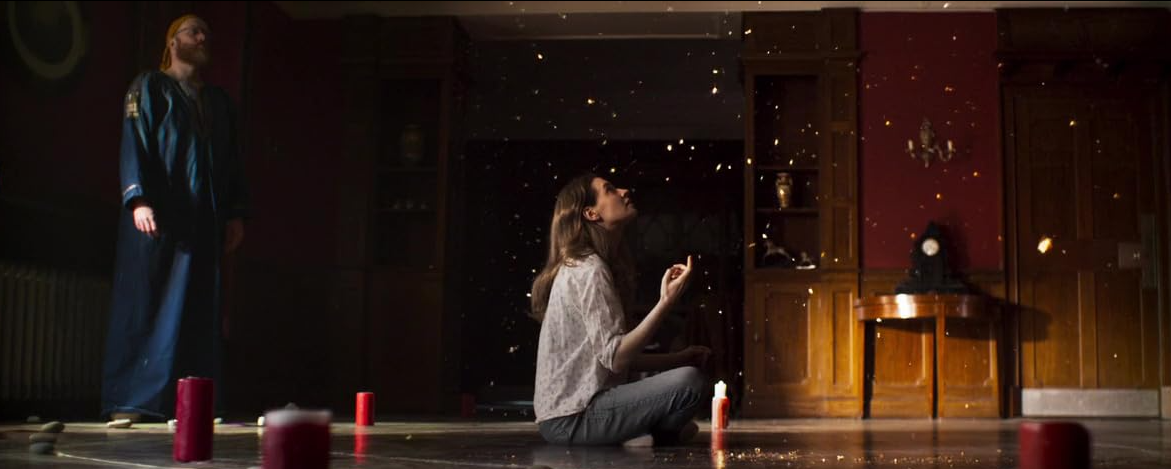
Liam Gavin’s A Dark Song is one of the rare modern occult films that understands the difference between magic as spectacle and magic as ordeal. It is not merely a horror film about ritual. It is a film about grief undergoing spiritual transmutation. Its machinery is occult, its atmosphere is claustrophobic, and its imagery belongs to the familiar vocabulary of grimoires, circles, fasts, blood, angels, demons, and unseen presences. But the true subject of the film is not occult power. The true subject is the wound that seeks power because it cannot yet imagine mercy.
That is why the ending works with such unexpected force. The protagonist, Sophia, appears to spend the film pursuing the impossible: contact with her guardian angel through a grueling ritual based loosely on the Abramelin operation. The stated motive is revenge. Her son has been murdered. She wants access to the invisible world in order to punish the guilty, or at least to gain something from beyond the ordinary human reach. She is not merely bereaved. She is possessed by bereavement. Grief has hardened into hatred, and hatred has disguised itself as spiritual seriousness.
This is the great insight of the film. Sophia does not enter the ritual as a saint. She enters as someone whose suffering is real but whose motive is corrupted. She is not wicked in the shallow sense. She is not a cartoon of vengeance. She is a mother whose child has been taken from her. The film never asks us to despise her pain. But it does ask us to see that pain, even justified pain, can become an idol. A wound can become a throne. A victim can begin to worship the wound because it gives her identity, purpose, and moral permission.
The occult structure of the film is therefore not arbitrary. Magic, in the lower sense, is the art of bending reality toward the will. It begins with the proposition: “I suffer; therefore the world must answer to me.” That can sound noble when the suffering is grievous enough. But the spiritual traditions of the world, at their most severe, have always warned that the will is not purified by intensity. Desire does not become holy merely because it has been injured. Hatred does not become justice merely because it has a human excuse.
A Dark Song dramatizes this danger with unusual patience. It refuses the usual cinematic shortcuts. Most horror films use the occult as decoration: symbols on the floor, inverted crosses, muttered Latin, blood on the walls, a demon with a marketing department. Gavin’s film is slower and stranger. It makes ritual feel exhausting, humiliating, procedural, boring, dangerous, and psychologically corrosive. The house becomes less a haunted location than a monastery built by a sadist. The ritual is not fun. It is not glamorous. It is a discipline that traps the participants with themselves.
This matters because the house is not merely a container for supernatural events. It is a furnace. Sophia enters with a demand, but the operation gradually strips that demand of its theatrical clothing. Revenge, justice, knowledge, contact with the dead, proof of the unseen world — all of these motives are exposed as secondary. Underneath them is the simpler and more terrible fact that she cannot forgive. She cannot forgive the killers. She cannot forgive the world. She cannot forgive God. She cannot forgive herself.
The film’s horror emerges from that pressure. The most frightening moments are not necessarily the most visually monstrous. The “hell people,” or demonic presences, are effective enough, but they are finally the more conventional layer of horror. The deeper horror is intimate: the voice of her dead son, the forced degradation, the cruelty between Sophia and Joseph Solomon, the possibility that the ritualist helping her may himself be spiritually diseased, and the steady collapse of all clean moral categories.
The voice of the son is especially cruel. It is not merely a supernatural trick. It is the violation of the one thing Sophia most longs for. The dead child becomes the wound through which the unseen world can touch her. That is good horror because it is not only frightening; it is morally obscene. It suggests that grief itself can become a doorway through which predatory forces enter. The dead are not being honored. They are being used. The beloved child is turned into bait.
This is why the film’s occultism feels serious even when its literal metaphysics need not be accepted. Its spiritual psychology is sound. Anyone who has seen grief curdle into obsession will recognize the pattern. Anyone who has seen someone make a religion of injury will understand the danger. The film says: even if the invisible world is real, even if the ritual works, even if angels and demons exist, you are still not excused from the purification of the heart.
Joseph Solomon is central to this purification. On first viewing, he appears to be the occult expert, the grotesque guide, the unpleasant but necessary specialist. He is arrogant, abusive, vulgar, manipulative, and possibly fraudulent. Yet he is also knowledgeable. He is not simply a con man. The ambiguity is essential. In a lesser film, he would be exposed as either a charlatan or a secret master. In A Dark Song, he is something more disturbing: a man who may possess real knowledge while remaining spiritually corrupt.
This is an important distinction. Spiritual technique does not equal sanctity. Knowledge of ritual does not equal purity of heart. The ability to navigate dangerous symbolic systems does not mean the practitioner has become good. Joseph may know the map, but he is still lost. He may understand certain mechanics of the operation, but he is not free from lust, domination, fear, pride, or despair. He is a warning against confusing occult competence with spiritual attainment.
Yet Joseph is not merely a villain. As the film progresses, he becomes the focal point of Sophia’s hatred. The ritual locks them together until abstraction becomes embodied. She can no longer hate “the boys,” “the world,” “the past,” or “God” in some vague theatrical way. Her hatred needs a face, and Joseph provides one. He is near enough, dirty enough, guilty enough, and vulnerable enough to become the living object of her contempt.
The scenes of humiliation matter here. Her pissing in his food, the verbal abuse, the escalating disgust, the magical and psychological entanglement, the blood, the stabbing — all of it moves hatred from fantasy into contact. It is one thing to fantasize about punishment. It is another to watch a damaged human being suffer and die in front of you. The film forces Sophia’s desire for vengeance to become incarnate in a body, and once it does, she can no longer preserve the clean intoxication of hatred.
This is why Joseph’s death is so important. The stabbing is sudden, ugly, and almost stupid. It does not feel like grand occult destiny. It feels like human panic and physical consequence. After so much ritual severity, the body reasserts itself. Blood is not symbolic anymore. Pain is not theoretical. Death is not an idea. Joseph, who has been guide, tyrant, possible fraud, possible accomplice, and possible scapegoat, becomes simply a dying man.
And Sophia comforts him.
That is the hinge on which the film turns.
Until that moment, she wants the ritual to validate her wound. She wants heaven, hell, angel, demon, and grimoire to agree that her suffering entitles her to vengeance. But as Joseph dies, she sees him not merely as an object of hatred but as a suffering soul. This does not absolve him. It does not make him noble. It does not erase his cruelty. But it breaks the spell of her self-enclosed pain. Mercy enters, not as sentiment, but as perception.
That is the beginning of the true operation.
The film’s final revelation is therefore not merely that the ritual “worked.” The real revelation is that the purpose of the ritual was never what Sophia thought it was. She believed she was seeking power. She believed the Abramelin operation would give her access to a celestial force capable of satisfying her wounded will. But when the angel finally appears and asks what she wishes to be granted, she does not ask for revenge. She does not ask to see her son. She does not ask for the destruction of the guilty.
She asks for the power to forgive.
This is one of the great endings in modern horror because it reorders the entire film. Everything that came before — the fasting, confinement, degradation, fear, ritual procedure, demonic attack, and psychological collapse — was not a path toward domination. It was a path toward contrition. The occult bait was power, but the hidden treasure was mercy.
Here the film becomes spiritual cinema.
The phrase “the power to forgive” is perfect because it refuses to treat forgiveness as weakness. Forgiveness is not presented as a mild emotion or a therapeutic gesture. It is a power. Indeed, it is the only power in the film that truly matters. Revenge would be easy to understand. Supernatural punishment would satisfy the lower dramatic appetite. But forgiveness requires a transformation of being. It is not something Sophia can simply decide to feel. She must receive it. She must ask for it as grace.
This places the film in the territory of the Prayer of St. Francis: “where there is injury, pardon.” That prayer does not ask to conquer enemies. It asks to become an instrument. Its greatness lies in the reversal of ordinary desire. The wounded person naturally wants to be understood, consoled, vindicated, and avenged. The higher prayer asks instead to console, to understand, to love, to pardon. It is in pardoning that one is pardoned.
A Dark Song turns that principle into drama. Sophia’s injury is real. The film does not minimize it. But the miracle is not that her injury is avenged. The miracle is that her injury ceases to be her god.
That distinction is everything.
The film’s angel is visually imperfect, even a little strange in its execution. It is enormous, armed, intimidating, and not entirely free of budgetary awkwardness. But the image is conceptually magnificent. The angel is terrible, but kneeling. It is armed, but in the posture of a servant. It is a being of overwhelming heavenly force, yet it bows.
Before what does it bow?
Not before Sophia’s ego. Not before her magical success. Not before her technical mastery of ritual. Not before her demand. It bows before the contrite heart.
This is the film’s deepest visual theology. Heaven is not sentimental. The angel is not a soft glowing comfort-object. It is vast, martial, and frightening. Grace is not cheap softness. But this terrible grace kneels before repentance, before the awakening of love, before the soul that finally asks rightly.
There is a biblical shape to this. “There is more rejoicing in heaven over one sinner who repents.” The film renders that idea cinematically. Heaven descends not because Sophia has become powerful, but because she has become broken in the right way. Not merely wounded — she was wounded from the beginning — but contrite. Her pain has opened outward instead of collapsing inward. She has ceased to enthrone hatred. She has asked for the one gift that revenge could never give.
The Arthurian resonance is also strong. In the Grail legends, the wasteland is healed not by conquest, cleverness, or force, but by asking the right question. The hero fails when he is too self-involved, too immature, too bound by social instruction or personal ambition to ask what must be asked. Healing comes when the seeker’s perception has been purified enough to inquire rightly. The question reveals the state of the soul.
Sophia’s final request functions in the same way. Throughout the film, she has been asking the wrong question: How can I punish? How can I reach the dead? How can I force the invisible world to answer me? How can I make my pain sovereign? But at the end she asks the right question: How can I forgive?
That question heals the wasteland.
From a broader spiritual perspective, this is the movement from magic to mysticism. Magic, at least in its lower and more dangerous form, begins with the will: I desire, therefore I act upon reality. Mysticism begins with surrender: I am unfit, therefore I must be changed. The two may share certain outward features — discipline, fasting, ritual, prayer, symbolic language, altered states — but their inner orientation is opposite. Magic seeks command. Mysticism seeks transformation.
This does not mean that all ritual is spiritually corrupt or that all magical systems are reducible to ego. Such a view would be too crude. Ritual can discipline the body and mind. Symbol can educate the imagination. Sacred procedure can protect the practitioner from chaos. But the decisive question remains: toward what is the ritual ordered? Does it enthrone the will, or does it purify it? Does it inflate the practitioner, or does it break open the heart?
This is where A Dark Song offers a quiet critique of the Crowleyan temptation. Aleister Crowley was not a fool, and serious readers of his work know that he cannot be dismissed as merely a decadent clown. His corpus contains genuine intelligence, poetic force, symbolic erudition, psychological candor, and useful reflections on discipline, ritual, and comparative esotericism. But Crowley’s great failure was spiritual arrogance. He often mistook transgression for liberation and blasphemy for courage. He saw real hypocrisy in organized religion, especially Christianity, and answered it with theatrical desecration. But desecration remains parasitic on the sacred. The rebel remains chained to the altar, only upside down.
The Abramelin operation, in contrast, presupposes purification, prayer, obedience, and moral seriousness. Whatever one thinks of the operation metaphysically, it is not fundamentally compatible with mere self-exaltation. It demands piety. It demands the subordination of the lower will. Crowley wanted the angel, but not the humility. He wanted attainment without surrender.
A Dark Song understands this problem. Sophia begins in a Crowleyan posture, even if she does not articulate it in those terms. She wants the invisible world to serve her will. But the operation succeeds only when that will is broken and redirected. The angel does not appear in order to ratify vengeance. The angel appears when vengeance has been renounced.
In that sense, the film is anti-Crowleyan at its core. It says: the guardian angel is not the sponsor of your self-importance. The angel is not a cosmic weapon placed in the hands of your wound. The angel comes when you are ready to stop worshiping the wound.
This also allows the film to be understood through a Vaiṣṇava lens. Śaṅkarācārya’s mission, as understood in many Vaiṣṇava readings, meets the rebellious or fearful soul by offering an elevated bait: renunciation, knowledge, liberation, release from suffering, freedom from the terror of material existence. For the soul terrified by embodiment, liberation appears as the highest mercy. For the proud intellect, nondual knowledge appears as conquest over illusion. For the world-weary, renunciation appears as power.
These are not low things. They are far higher than ordinary material absorption. But from the standpoint of bhakti, even liberation is not the final treasure. The desire to escape suffering still contains self-concern. The longing to be free from existence, when existence is perceived mainly as suffering, is understandable. It may even be spiritually progressive. But love is beyond escape. Service is beyond liberation. The heart’s highest movement is not merely to be free, but to become wholly given.
A Dark Song does not preach bhakti, but its dramatic movement is compatible with that hierarchy. Sophia begins with a desire rooted in suffering. She wants relief, justice, and power. But the grace she receives is not escape from relation. It is the restoration of relation. Forgiveness is not withdrawal into impersonal peace. It is the painful reopening of the heart toward another.
That is why the final gift is greater than vengeance, greater than knowledge, and even greater than contact with the dead. To forgive is to re-enter relation without demanding that the wound be erased first. It is to allow love to awaken where hatred had every worldly right to remain. This is not moralism. It is miracle.
The film’s greatness lies in its refusal to make this easy. Forgiveness is not presented as a social slogan. It is not cheap reconciliation. Sophia does not forgive because the crime was small. She asks for the power to forgive because the crime was unbearable. The greater the injury, the more supernatural forgiveness becomes. In that sense, forgiveness is more miraculous than any apparition in the film.
This is also why the movie’s rough edges do not destroy it. The budget shows. The angel risks looking goofy. Some of the demonic imagery is less profound than the emotional horror. But the film has something many more polished works lack: moral imagination. It knows what its images mean. It understands that ritual horror without spiritual consequence is merely aesthetic. It understands that demons are less frightening than the corruption of the heart, and that angels are less comforting than the demand to be transformed.
The first-film nature of A Dark Song may even contribute to its power. It feels made by someone who had one severe idea and pursued it without sanding off all its strangeness. There is no franchise logic here, no smoothing committee, no need to keep the protagonist likable in the usual way. The film is awkward where it is awkward, brutal where it is brutal, and sincere where it counts. That sincerity is rare.
Its central dramatic arc can be stated simply: a grieving mother enters a house to summon power and leaves having asked for mercy. But that simplicity contains a great deal. It contains the temptation of occultism, the danger of spiritual technique without purity, the transformation of grief into hatred, the embodiment of hatred in a scapegoat, the collapse of vengeance before suffering, the Arthurian necessity of asking rightly, the Franciscan reversal from injury to pardon, and the descent of grace before the contrite heart.
The image of the kneeling angel finally gathers all of this into one moment. The angel is vast because grace is not trivial. It is armed because heaven is not weak. It kneels because the awakened heart is precious beyond measure. The pearl of great price is not power over spirits, not vengeance over enemies, not even proof that the unseen world exists. The pearl is the rebirth of love in a soul that had become organized around hatred.
For this, grace descends.
For this, heaven rejoices.
For this, the angel kneels.
And that is why A Dark Song deserves to be remembered not simply as an excellent occult horror film, but as one of the few modern films to grasp the true terror and majesty of spiritual transformation. Its final answer is not that magic works. Its final answer is that the heart must be changed. The ritual circle, the blood, the fasting, the house, the demons, the dead child’s voice, the dying occultist, and the terrible angel all exist to bring Sophia to the only request that could save her:
the power to forgive.
Jonathan Brown writes on technology, security, and culture for bordercybergroup.com and aetheriumarcana.org.
We are reader-supported. If you enjoy our work... Subscribe or buy us a coffee! Thanks
Member discussion: