
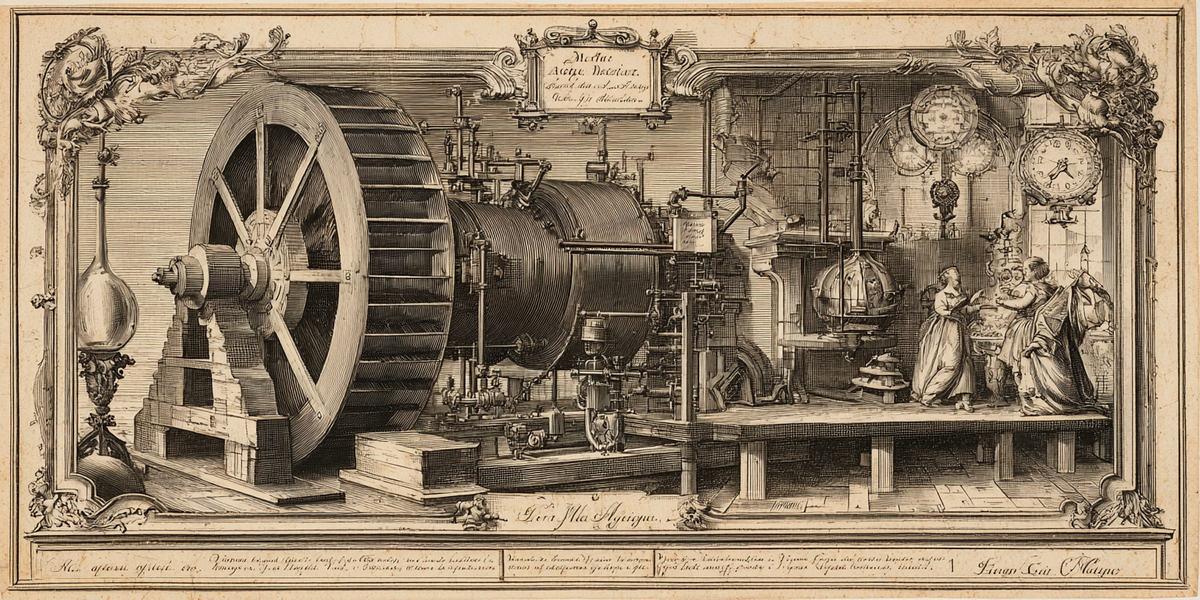
Deep within the damp, limestone shadows of a grotto at Hellbrunn Palace, a 17th-century courtier might find themselves paralyzed by a sound that defied the laws of nature: the rhythmic, wet breathing of stone. As the heavy scent of moss and cold spring water filled the air, a marble Orpheus would suddenly lift his lyre, his fingers dancing across the strings with a fluid grace that seemed to mock the jerky ticking of a pocket watch. This was the pinnacle of Baroque high-tech. While modern history often credits the dry click of clockwork gears and springs for the birth of robotics, the true “supercomputers” of the 1600s were powered by a much more volatile spirit: hydraulics. These were not merely statues; they were sophisticated fluid computers. By manipulating water to process timing, sound, and motion through a series of “liquid programs,” these engineers created a haunting, analog mimicry of life that predates our digital age by three centuries.
Hydraulics vs. Clockwork
In the 17th century, the “Age of the Clockmaker” was in full swing, yet the aristocratic elite viewed the era’s celebrated gears and springs as fundamentally limited toys. To truly recreate the soul of a living being, one required a medium that shared the properties of life: flow, pressure, and breath. In the high-stakes battle for technological supremacy within the European pleasure garden, water was the undisputed victor over the mechanical spring. This preference was rooted primarily in the massive disparity of power. While a clockwork automaton was a captive of its own architecture—only as strong as the tension in its coiled mainspring—a hydraulic machine tapped into the crushing, constant weight of gravity. By harnessing elevated reservoirs or redirected mountain streams, engineers like the Francini brothers accessed a nearly infinite well of torque. This allowed for massive, multi-figure displays that could operate with a heavy, tireless persistence that no wind-up mechanism could ever hope to match.
Beyond raw power, the fluid medium offered a quality of motion that was hauntingly biological. Gears are binary and rhythmic by nature, resulting in the “staccato” movement we associate with old wind-up toys—the jerky, audible tick-tick-tick of a metal limb. Water, however, functions as a continuum. By subtly varying the diameter of a lead pipe or the taper of a valve, a hydraulic engineer could achieve “analog” motion. A statue’s arm would not simply snap from one position to the next; it could accelerate smoothly, pause mid-gesture, and decelerate with a grace that mimicked the organic play of muscle and tendon. For philosophers like René Descartes, this fluid motion was the only convincing way to simulate the “animal spirits” he believed flowed through the human nervous system, transforming the garden from a gallery of statues into a theater of living machines.
Perhaps the most magical advantage of water, however, was its ability to breathe. By forcing water into a sealed air chamber, known as an aeolipile or a wind tank, engineers could generate a steady, pressurized stream of air without the need for manual bellows. While a clockwork robot remained silent save for the whirring of its internal brass, a hydraulic robot could sing. This captured air was routed through sets of hidden organ pipes or custom-carved whistles to mimic the complex warble of a nightingale or the resonance of a human voice. This same pneumatic force was often used to make the chest of a stone figure rise and fall in a slow, steady rhythm. It was this “wet breathing” effect, combined with the lack of mechanical noise, that made encounters in the darkened grottoes of the nobility so unsettlingly realistic, suggesting a ghost in the machine that was fueled by the very water that gave the garden life.
Programming with Pegs and Siphons
To understand how these statues “knew” when to move, one must look past the water and into the brain of the grotto: the pinned cylinder. This was the 17th-century equivalent of a hard drive, a massive rotating drum of wood or brass studded with hundreds of small metal pegs. As a water wheel turned this drum, the pegs would strike a row of levers in a precise sequence, much like a giant, liquid-powered music box. Each lever acted as a physical command, pulling a hidden wire to tilt a head or opening a valve to let water rush into a specific limb. By carefully spacing these pins, an engineer could “program” a sequence of events that lasted several minutes, allowing a mechanical goddess to rise from a fountain, gesture to the crowd, and retreat back into the shadows without a single human hand touching the controls.
Yet the true brilliance of fluid robotics lay in its ability to handle “if-then” logic through the ingenious use of the siphon. Unlike the pinned cylinder, which ran on a fixed loop, the siphon allowed the machine to react to the passage of time or the accumulation of volume. Engineers would design hidden basins that slowly filled with water as a scene progressed. When the water reached the exact top of a U-shaped pipe, the laws of physics took over, and the entire basin would suddenly and violently drain in a single burst. This sudden release of energy acted as a biological trigger—a “logic gate” that could suddenly snap a trapdoor shut, trigger a hidden whistle to scream, or shift the entire mechanical theater into its next act. It was a form of autonomous decision-making that relied on the weight of the water itself to “decide” when the moment was right.
This combination of the rhythmic drum and the unpredictable siphon created a machine that felt less like a clock and more like a nervous system. In the more advanced installations, these two systems worked in a sophisticated dialogue. The cylinder provided the steady beat of the performance, while a series of siphons and float valves managed the “subroutines,” regulating air pressure and water flow to ensure the music never went out of tune and the movements never lost their luster. It was a masterpiece of liquid choreography, where every splash and every silence was a pre-meditated line of code written in the language of gravity and flow.
The Wet User Interface: Pranks, Politics, and Water Jokes
The true genius of 17th-century fluid robotics was not confined to the passive observation of a mechanical play; it often demanded the direct, if involuntary, participation of the audience. Engineers began to treat the palace floors and garden paths as a primitive user interface, using the weight of the aristocrats themselves to close the circuit of a hydraulic trap. These were the giochi d’acqua, or water jokes, and they represented the era’s most sophisticated interactive technology. A guest might be invited to admire a particularly beautiful statue of a nymph, only to step on a concealed pressure plate beneath the gravel. This action would instantly shift a valve in the hidden piping, redirecting a high-pressure stream of water into a series of nozzles hidden in the nearby bushes, drenching the unsuspecting noble from all sides.
These jokes were far more than mere slapstick; they were a display of absolute political power and technical mastery. At Hellbrunn Palace, the Prince-Archbishop Markus Sittikus took this to a theatrical extreme with his “Mechanical Theater” and its accompanying banquet table. As his guests sat down to dine, a secret valve would be opened, sending jets of water through the center of their stone stools. Because protocol dictated that no one could rise from the table before the Archbishop himself, the guests were forced to remain seated while being soaked from below. The water was a silent enforcer of the social hierarchy, a fluid “if-then” statement that translated the host’s whims into physical reality.
Beyond the pranks, these systems demonstrated an early understanding of sensory feedback loops. In some grottoes, the mere act of opening a door would change the air pressure in a hallway, triggering a mechanical sentinel to point its spear or a hidden hydraulic organ to begin a welcoming fanfare. The environment was “live,” reactive, and constantly monitoring the movements of its inhabitants through the medium of displaced water and air. This transformed the aristocratic garden into a proto-smart home, where every step taken by a guest was a piece of data that could trigger a pre-programmed response.
This liquid interactivity also served a deeper philosophical purpose. By forcing the elite to interact with machines that looked, moved, and even “responded” like living things, engineers were subtly reinforcing the Cartesian idea that the physical world was a vast, interconnected mechanism. When a hidden jet soaked a Duke, it was a reminder that he, too, was subject to the laws of pressure and flow. The grotto was a laboratory where the lines between the biological and the mechanical were blurred by the spray of a nozzle, leaving the aristocracy to wonder if they were the masters of the machine or merely another variable in its complex, watery code.
The Modern Alchemists: Returning to the Source
The digital revolution of the last century may have traded lead pipes for silicon chips, but the ghost of the 17th-century hydraulic engineer is currently haunting the studios of a new generation of “fluid alchemists.” These modern makers are rejecting the sterile, stop-start world of electronic servos to return to the heavy, organic logic of physics. Theo Jansen is perhaps the most famous of these spiritual descendants. His Strandbeests—massive, skeletal creatures that prowl the Dutch coast—are powered entirely by the wind, yet they possess a nervous system that Salomon de Caus would instantly recognize. Using plastic bottles as “pneumatic cells,” Jansen’s beasts utilize air pressure to sense the tide or the texture of the sand, performing complex “if-then” calculations that allow them to survive the elements without a single line of digital code.
In the high-tech laboratories of Harvard and MIT, the pursuit of “Soft Robotics” is mirroring the grottoes of the past by replacing rigid metal skeletons with flexible, fluid-driven bodies. These engineers are developing microfluidic logic—tiny, liquid-filled channels that allow a robot to “think” and react to its environment through pressure changes alone. Much like the 17th-century table fountains that used siphons to animate silver figurines, these soft robots are designed for delicate environments, such as the human body, where the jagged movements of traditional mechanics are too dangerous. By returning to the medium of the fluid, they are recapturing that “analog grace” that once made the aristocracy believe they were witnessing true artificial life.
Meanwhile, in the world of kinetic art, the legacy of the “philosophical toy” thrives in the work of creators like Arthur Ganson and the artists of the MAD Museum. Ganson’s machines often dwell on the slow, deliberate transition of motion, using fluid-damped weights and cams to tell stories that feel deeply biological. Similarly, contemporary automata makers like Carlos Zapata use the exposed “bones” of the machine—levers, weights, and water-driven bellows—to create emotive pieces that defy the disposability of modern tech. These artists remind us that there is a unique magic in the visible logic of the machine, a transparency that was lost when we hid our “code” inside black-box processors.
Ultimately, we are finding that the “future” of robotics may look remarkably like its watery past. As we push toward machines that are more resilient, more organic, and more integrated into the physical world, we are circling back to the principles of the 17th-century garden. We are rediscovering that intelligence does not always require a spark of electricity; sometimes, it only requires a steady flow of water, a well-placed siphon, and the relentless pull of gravity. The liquid ghost is not dead; it is simply waiting for the next valve to open.
Behind the Curtain: The Fluid Engineers of the 17th Century
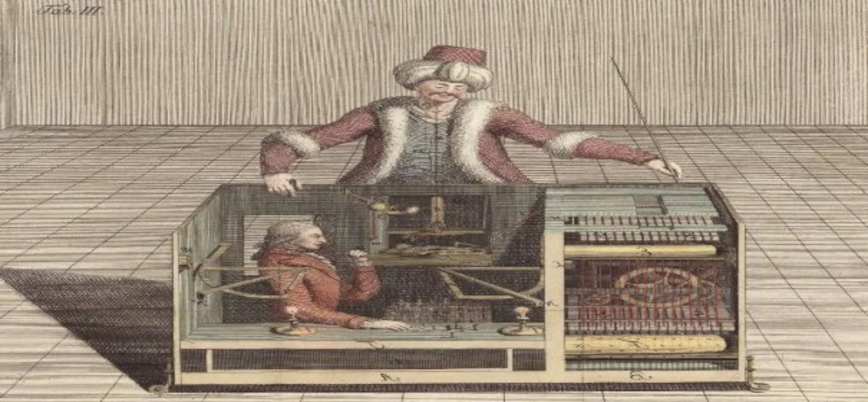
The Francini Brothers (Tommaso & Alessandro)
The Italian-born engineers who brought the secrets of the Medici gardens to France. Under the patronage of Henri IV and Louis XIII, they transformed the Royal Gardens of Saint-Germain-en-Laye into a world of hydraulic wonders. They were the first to master the use of elevated reservoirs to power massive, multi-stage grotto theaters, essentially acting as the chief "software architects" for the French crown’s mechanical prestige.
Salomon de Caus (1576–1626)
Often called the "Engineer to the Princes," de Caus was the most prolific documenter of fluid robotics. His 1615 treatise, Les Raisons des forces mouvantes (The Reasons for Moving Forces), served as the definitive manual for building water-powered automata. He designed the Hortus Palatinus in Heidelberg, where he utilized pinned cylinders and complex siphons to create a garden so technologically advanced it was hailed as the eighth wonder of the world.
René Descartes (1596–1650)
While not an engineer by trade, the philosopher René Descartes is inseparable from the history of 17th-century robotics. After wandering through the royal hydraulic gardens, he was so struck by the lifelike motion of the statues that he developed his theory of mechanistic physiology. He famously argued that animal bodies—and the human body—functioned exactly like the hydraulic statues in the grottoes, with "animal spirits" (nerves) acting as the pressurized water pipes.
Markus Sittikus von Hohenems (1574–1619)
The Prince-Archbishop of Salzburg and the visionary behind Hellbrunn Palace. A man of legendary wit and architectural ambition, he commissioned the "trick fountains" and mechanical theaters specifically to play with the boundaries of power and technology. His palace remains the most intact example of the "Water Joke" culture, where the environment itself was programmed to react to the presence of guests.
The Modern Alchemists: Keeping the Fluid Spirit Alive
Theo Jansen
A Dutch artist and kinetic engineer, Jansen is the creator of the Strandbeests. These massive, wind-powered "beach animals" are built primarily from PVC pipes. What makes them relevant to 17th-century hydraulics is their pneumatic "nerve cells." Using plastic bottles as air-pressure logic gates, the beasts can "detect" when they have stepped into water or reached the end of the sand, triggering a mechanical "if-then" response to change direction—all without a single computer chip.
Arthur Ganson
A self-described "cross between a mechanical engineer and a choreographer," Ganson creates kinetic sculptures that capture the analog grace of the Baroque era. His work often focuses on the slow, deliberate transfer of energy through cams and levers. By using fluid-damped weights and viscous liquids like oil to regulate the speed of his machines, he achieves a lifelike, breathing quality of motion that mimics the "animal spirits" Descartes once described.
Peregrine Church (Rainworks)
A modern pioneer of "interactive" water art, Church creates street art that only appears when it rains. While his work is chemical rather than mechanical, it utilizes the 17th-century philosophy of the Water Joke (Giochi d'acqua)—using environmental moisture as a trigger for a hidden "user interface." His work transforms a mundane sidewalk into a reactive display, much like the hidden pressure plates of a royal grotto.
Carlos Zapata
A prominent contemporary automaton artist whose work is often featured at the MAD (Mechanical Art & Design) Museum. Zapata specializes in emotive, hand-crafted machines that use exposed mechanical "bones." By utilizing gravity-fed weights and manual bellows to simulate breath and movement, his pieces reject the "black box" of modern electronics in favor of the transparent, physical logic that fascinated the Enlightenment elite.
ओम् तत् सत्
Member discussion: