
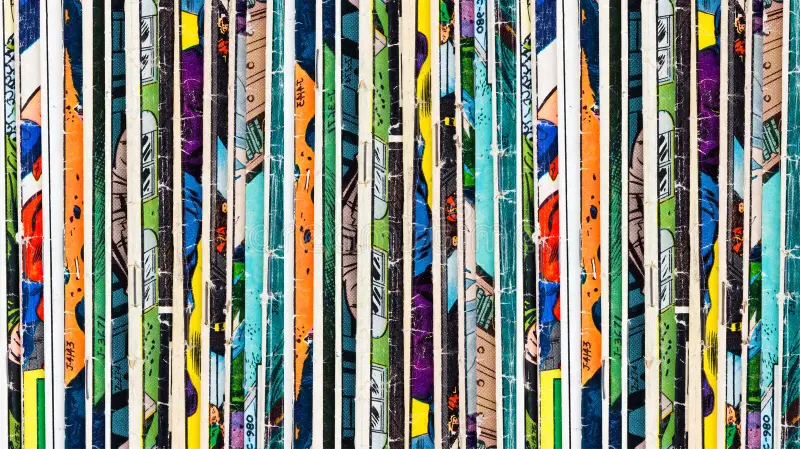
How a disposable children's medium became a nine-figure asset class — and what it cost along the way
Part One in A three-part investigation into the comic book as cultural artifact, financial instrument, and crime scene ~
The Dime Novel Economy
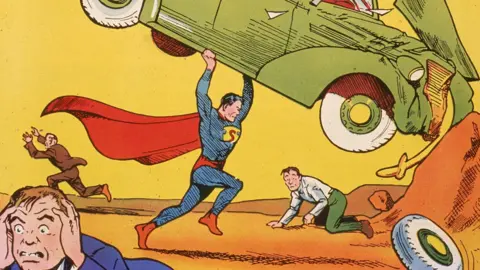
In the spring of 1938, a copy of Action Comics #1 cost ten cents at a newsstand and was expected, by everyone involved in its production and distribution, to be destroyed within the month. This was not negligence. It was the system working exactly as designed.
The American comic book as a commercial form was built on an infrastructure inherited from pulp magazines and dime novels — a distribution apparatus whose entire logic was predicated on disposability. The dominant wholesaler of the era, the American News Company, operated what the industry called a "returnable" model: newsstands and drugstores received comics on consignment, sold what they could, and returned the unsold copies — or, more precisely, returned the stripped covers, which served as proof of destruction and triggered a credit against the next shipment. The interior pages went to the pulping mill. This was not an edge case or an occasional outcome. It was the contractual expectation built into every transaction in the supply chain, from publisher to distributor to retailer. The cover of a comic book was worth more dead than alive.
Print runs for Golden Age titles were substantial by any reasonable measure. Action Comics #1 came off the presses in an estimated run of somewhere between 200,000 and 900,000 copies — the precise figure remains disputed, in part because nobody at Detective Comics thought it worth recording carefully, and in part because the printing records, like nearly everything else from this period, did not survive. What is not disputed is the result: fewer than one hundred copies of Action Comics #1 are known to exist today, in any condition. If the conservative print-run estimate of 200,000 is correct, that is a survival rate of roughly one in two thousand. If the higher estimate is closer to accurate, the fraction becomes almost too small to usefully express. The overwhelming majority of copies of the most valuable comic book in the world were converted into paper pulp before the summer of 1938 was out, as a matter of routine commercial practice, and nobody gave it a second thought.
The ten-cent cover price placed comics firmly within the economy of impulsive, low-stakes consumption. In 1938, a dime bought a candy bar, a bus transfer, or a comic book — objects in the same psychological category, subject to the same casual relationship with permanence. The medium was explicitly and deliberately positioned as children's entertainment, which served the dual purpose of capturing a reliable demographic and insulating publishers from the expectation that their product would be taken seriously by anyone who mattered. This was, in retrospect, a commercially rational strategy that happened to carry catastrophic implications for the historical record. Adults collected things. Children consumed them and moved on.
The consequences compound when you account for what happened to the copies that survived initial distribution. A child who bought Action Comics #1 in June of 1938 read it, probably more than once. It was folded, creased, possibly passed to a sibling or traded to a friend. It was left in a bedroom, a garage, a trunk. A significant portion of the surviving Golden Age inventory was then consumed by a second systemic destruction event that arrived four years later in the form of wartime paper drives — federally organized scrap collection campaigns that framed the recycling of paper goods as a patriotic contribution to the war effort. Comics were specifically and repeatedly cited in promotional materials as appropriate items to donate. Entire collections were bundled and handed over to collection points across the country. The drives were successful enough that historians of the medium treat them as a distinct catastrophic event in the archaeology of Golden Age publishing, a second mass extinction following the first one built into the distribution model itself.
What survived, then, was not preserved by intention. It was preserved by accident — the copy forgotten in a box in a closet, the collection tucked into an attic by a mother who hadn't gotten around to throwing it out, the dealer's file copy left in a back room for forty years. The single most consequential act of comic book conservation in the twentieth century was a Colorado schoolteacher named Edgar Church leaving approximately 22,000 comics in careful, undisturbed storage in his Denver home from the 1930s through the 1970s, not because he anticipated their future value but simply because he was, by temperament, a methodical keeper of things. The "Mile High Collection," as it became known after its discovery in 1977, produced some of the highest-graded Golden Age copies ever certified, because they had been stored flat, in a dry climate, and left entirely alone. Church's fastidiousness — a private habit, never intended for public consequence — is responsible for a meaningful fraction of what the serious end of the modern comic book market has to sell.
The irony threaded through all of this is structural rather than incidental. The scarcity that now drives nine-figure auction prices was not created by rarity of production. It was created by the thoroughness of a disposal system that worked exactly as its architects intended. The comic book became valuable in almost precise proportion to how aggressively the industry that produced it assumed it was worthless. The ten-cent cover price on Action Comics #1 is not a quaint historical footnote. It is the original document of a chain of assumptions about disposability whose final entry, eighty-seven years later, reads: $15,000,000.
The Genre Factory
The lesson that Detective Comics drew from the success of Action Comics #1 was not, in the first instance, artistic. It was industrial. Superman had proven that a costumed figure with extraordinary abilities could move units — extraordinary numbers of units — and the correct response to that proof was to produce more costumed figures with extraordinary abilities as rapidly as the available labor supply permitted. What followed between 1938 and 1941 was less a creative renaissance than a manufacturing surge, and understanding it as such is essential to understanding everything that came after, including the current market for the artifacts it produced.
The infrastructure that made this surge possible was the comics "packager" — an entity that occupied a peculiar and largely forgotten position in the early industry. Packagers were independent studios that hired writers and artists on flat-fee or page-rate contracts, produced complete comic books, and sold them as finished products to publishers who wanted content without the overhead of an in-house creative operation. The most significant of these was the Eisner-Iger Studio, founded in 1937 by Will Eisner and Jerry Iger, which at its peak employed dozens of young artists and writers producing material for multiple publishers simultaneously. A creator working for Eisner-Iger in 1939 might produce pages that appeared under half a dozen different mastheads without ever meeting the nominal publisher of any of them. The byline, when it appeared at all, was often a house pseudonym.
The page rate for this work ranged from roughly three to seven dollars per page depending on whether the creator was writing, penciling, inking, or some combination of all three. A productive artist could complete three to five pages per day, which placed the ceiling of weekly earnings somewhere around thirty-five dollars — a figure that was, it should be noted, reasonably competitive with other forms of commercial illustration in Depression-era New York, and that attracted a specific demographic: young, often immigrant or first-generation American, disproportionately Jewish, with artistic ambition and no access to the more prestigious and better-compensated venues of advertising illustration or gallery work that required connections they did not have. The founding generation of American comic book artists was drawn from exactly the same cultural and economic circumstances as Siegel and Shuster, and they entered the industry through the same narrow gate: they needed the money, and nobody else was hiring people like them for this kind of work.
The contracts they signed, to the extent that formal contracts existed at all, were instruments of near-total assignment. The work-for-hire doctrine as practiced in comics publishing of this period did not merely claim the specific pages produced under contract. It claimed the characters those pages introduced, the concepts they established, the fictional universes they initiated, and any commercial exploitation of any of the above in any medium, in perpetuity, throughout the universe. This language, or language substantially equivalent to it, was standard. It was also, for a twenty-two-year-old artist grateful to be employed, essentially non-negotiable. The publishers understood what they were acquiring. The creators, operating in a medium so new that nobody had yet demonstrated what it might eventually be worth, frequently did not.
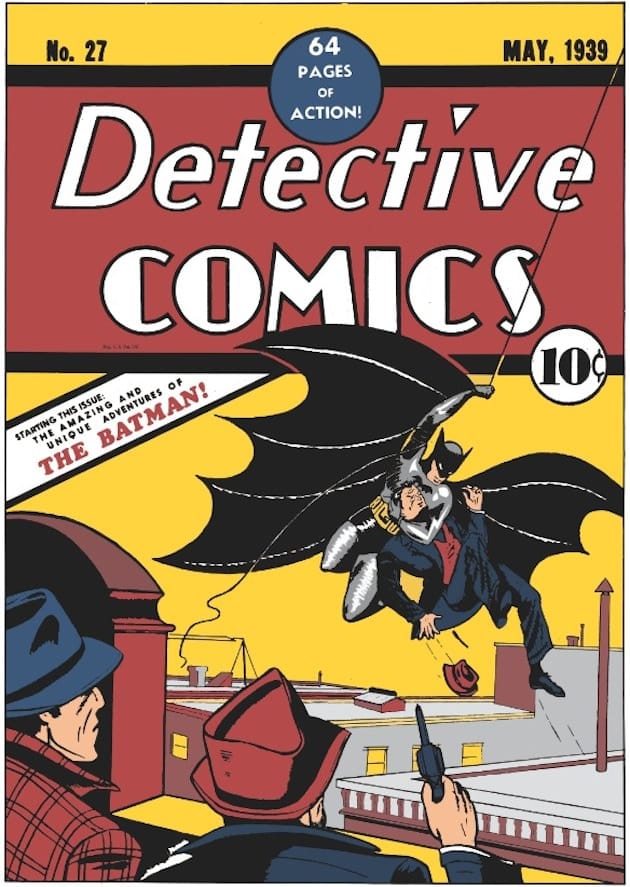
The velocity of character creation in this period was remarkable and almost entirely disconnected from any individual creative vision. Batman arrived in Detective Comics #27 in May 1939, thirteen months after Superman, the product of a deliberate editorial directive to Bob Kane — and, less officially acknowledged, his uncredited collaborator Bill Finger — to produce a Superman competitor. The Flash, Green Lantern, Wonder Woman, Captain America, the Sub-Mariner, the Human Torch, Hawkman, Aquaman, the Spectre, and dozens of others who have not survived into cultural memory all appeared within roughly a three-year window, most of them generated under deadline pressure by creators working in shared physical spaces — bullpens, literally — on assignment from editors who needed product for next month's cover date. The superhero was not invented so much as it was extruded.
What this process produced, at the level of the physical artifact, was an enormous volume of material of wildly variable quality, printed on cheap newsprint with water-based inks that faded and yellowed under ordinary atmospheric conditions, distributed through a system designed to destroy most of it within thirty days, and sold to an audience that was not expected to keep it. The publishers maintained file copies as a matter of basic operational practice — proofs, reference copies, legal records — but systematic archival preservation was not a concept that would have occurred to anyone running a comic book company in 1940. These were not cultural institutions. They were small manufacturing operations producing a low-margin consumer product in a competitive market, and they operated accordingly.
The characters that survived this process into lasting cultural significance did so not because the system was designed to identify and protect valuable creative work, but despite a system designed with no such capacity. Superman endured because children responded to him with an intensity that the sales figures made impossible to ignore. Batman endured for similar reasons, amplified by a tonal distinctiveness — the darkness, the gothic urban atmosphere, the detective procedural elements — that differentiated him sufficiently from the template. The others who endured did so through some combination of timing, adaptation, and the eventual intervention of editors and writers talented enough to develop what the original conditions had only sketched. The much larger number who did not endure — the Crimson Avengers, the Dollmen, the Blue Beetles of the first iteration — vanished along with nearly all the physical evidence of their existence, and the market has registered its verdict on their absence by not noticing it.
The genre factory of 1938 to 1941 was, in this sense, a massive and uncontrolled experiment in cultural selection, running at speed, under financial pressure, with no curatorial intelligence and no preservation ethic, producing both the founding documents of a medium that would eventually be worth billions and the conditions that guaranteed most of those documents would not survive to be worth anything at all. The publisher who owned the rights to everything paid the artist who created it three dollars a page, retained no serious archive, and never once considered that the ten-cent pamphlet currently shipping to newsstands across the country might someday require a temperature-controlled room near the Geneva airport. This failure of imagination was entirely universal. It was also, for everyone involved except the artists, entirely costless.
The War and the Purge
The Golden Age of American comics died twice. The first death was slow, distributed, and logistical — the aggregate consequence of a wartime paper recycling apparatus that consumed the physical archive of the medium with the quiet efficiency of an industrial process that had no idea what it was destroying. The second death was loud, public, theatrical, and deliberate — a moral panic engineered with sufficient political skill to achieve in three years what simple entropy had failed to accomplish in fifteen. Together they produced the conditions that define the market today: a radical scarcity of surviving artifacts from the medium's founding era, and a creative void in the decade that followed that effectively severed the industry from its own history. Both catastrophes were, in their different ways, entirely avoidable. Neither was avoided.
The wartime paper drives of 1942 through 1945 were among the most successful mass mobilization campaigns in American domestic history, which is a distinction that carries a specific cost for anyone interested in what the 1940s actually looked like on the printed page. The federal government's War Production Board, working through a network of local collection points, civic organizations, and school programs, framed the recycling of paper goods as a direct contribution to the war effort — the pulp went to packaging, to military documentation, to the cardboard used in ammunition crates. The campaigns were accompanied by the full apparatus of wartime propaganda: posters, radio announcements, celebrity endorsements, and the social pressure of community participation that made non-compliance feel vaguely treasonous. Children were a primary target audience, and comic books were explicitly identified in promotional materials as ideal donation items — cheap, plentiful, already read, and taking up space that could be put to patriotic use. The logic was impeccable. The consequences for the historical record were irreversible.
Precise quantification of what the paper drives destroyed is, by definition, impossible — you cannot inventory what no longer exists. What collectors and archivists have established through decades of painstaking reconstruction is a negative space: the issues that bibliographies document but that no known copy of has ever surfaced, the runs that exist in file copies only, the titles for which a single heavily worn survivor represents the entirety of the available evidence. The drives did not discriminate between a coverless reading copy and a pristine file copy. They consumed whatever was presented, processed it, and returned it to the economy as something useful. The comic books of the early 1940s were, by this mechanism, converted into the ammunition boxes of the mid-1940s, which is either a grim irony or a perfectly coherent expression of a society's priorities, depending on your disposition.
The comics that survived the drives did so through the same mechanisms that had preserved the earlier Golden Age material: geographic luck, individual temperament, the specific character of neglect. Rural areas, where the drives were less efficiently organized, produced disproportionate numbers of surviving copies. Collectors who held their material back — a socially fraught decision in the climate of the time — preserved isolated pockets of the archive. Publishers' file copies, maintained for operational rather than historical reasons, became by default the most complete surviving records of what had been published. The Library of Congress, which under copyright law received deposit copies of published works, retained a significant collection that scholars have only recently begun to fully exploit, stored in conditions that were adequate rather than ideal and catalogued with an incompleteness that reflects the era's assessment of the material's cultural significance.
The second destruction was longer in the making and, in its way, more damaging — because it attacked not the physical artifacts but the industry's capacity to produce new ones worth preserving.
Fredric Wertham was a German-born psychiatrist who had built a genuine and largely admirable career in American public health, working with underprivileged populations in Harlem and developing what were, for the early 1950s, relatively progressive views on the relationship between social environment and mental health outcomes. His 1954 book Seduction of the Innocent was a different kind of document entirely: a prosecutorial brief against the comic book industry, marshaling case studies, reader testimony, and interpretive analysis to argue that comics were a primary cause of juvenile delinquency, sexual deviance, and the general moral degradation of American youth. The methodology was, by any rigorous standard, a catastrophe — cherry-picked examples, invented correlations, research that subsequent scholars have demonstrated was actively falsified in places, with Wertham manipulating interview transcripts and misrepresenting his subjects' ages to strengthen conclusions the data did not actually support. None of this was known in 1954. What was known in 1954 was that a credentialed psychiatrist had written a bestselling book telling American parents that the comic books their children were reading were making those children into criminals and deviants, and that Senator Estes Kefauver of Tennessee had convened Senate subcommittee hearings to investigate the matter on national television.
The hearings were a masterpiece of political theater. Kefauver, who had built his national profile prosecuting organized crime and harbored presidential ambitions that required him to be seen doing something about the decline of American values, presided over sessions that placed comic book publishers in the position of defending content that, extracted from narrative context and displayed on a Senate dais, was genuinely difficult to defend in the overheated moral atmosphere of McCarthy-era America. The publisher William Gaines of EC Comics — whose titles, including Tales from the Crypt and Weird Science, represented the most artistically ambitious and commercially successful work being produced in the medium at the time — appeared before the committee and performed what remains one of the more spectacular acts of self-destruction in the history of American publishing, engaging in a debate about the definition of "good taste" that he could not win in that room under any circumstances, having walked into it apparently unaware of that fact.
The industry's response was preemptive surrender. The Comics Magazine Association of America, a newly formed trade group, adopted the Comics Code Authority in 1954 — a self-regulatory censorship apparatus whose seal of approval was required by most major distributors and retailers as a condition of carrying a title. The Code's specific prohibitions read, in their totality, as a document designed to make meaningful storytelling in the medium functionally impossible: no sympathetic portrayals of criminal behavior, no disrespect for established authority, no "excessive" violence, no horror, no "illicit sex," no divorce presented approvingly, no "ridicule or attack" on any religious or racial group, and a sweeping requirement that "good shall triumph over evil" in any narrative that touched on their conflict. EC Comics, whose entire catalog was built on the ironic inversion of exactly that last requirement, was effectively destroyed. William Gaines pivoted to a small black-and-white magazine format that fell outside the Code's jurisdiction and called it Mad. The rest of the EC line — the horror titles, the crime books, the science fiction anthologies that represented the most sophisticated narrative work the medium had produced — simply ceased to exist.
What the Code accomplished, beyond the destruction of EC, was a decade-long creative lobotomy. The comics of the late 1950s are, with scattered exceptions, a wasteland of sanitized superhero stories, anodyne romance comics, and neutered westerns produced by an industry that had been so thoroughly intimidated that it had internalized the censors' logic and was now applying it preemptively. The creative talent that had animated the Golden Age had aged out, died, moved to other fields, or been absorbed into the packager system's least ambitious registers. The readers who had grown up with the medium in the 1940s had grown up themselves and were not being offered anything that suggested they should continue. Sales declined through the late 1950s to a fraction of their wartime peak. A medium that had been selling 45 million copies per month in 1953 contracted toward irrelevance, and the publishers who survived did so by cutting costs, reducing page counts, and producing material that satisfied the Code's requirements while making essentially no demands on its readers.
The dual catastrophe — physical destruction followed by creative suppression — produced a gap in the record that the market now prices with extraordinary specificity. A high-grade Golden Age comic from the period before 1942 commands prices that reflect both its objective scarcity and the violence done to the archive that should have contextualized it. The books that survived the paper drives and the Code's aftermath are not merely old. They are the remnants of a more complete cultural record that no longer exists, artifacts of a creative moment that was interrupted before it could fully understand itself, and then suppressed before it could recover. The ten-cent cover price looks different when you understand what it cost to produce the object it was printed on, and what it cost again to destroy most of them, and what it cost a third time when the survivors were scattered through attics and storage units and the occasional carefully maintained private collection, waiting for a market to arrive that would assign them values that the people who made them could not have imagined and did not live to see.
The Silver Age Reinvention and the Marvel Revolution
The comic book did not recover from the Comics Code Authority so much as it was rescued from it, accidentally, by a middle-aged editor at a failing publisher who was trying to save his job. The circumstances of that rescue were sufficiently improbable that, reconstructed in detail, they read less like the founding myth of a cultural institution than like the kind of thing that happens when desperation and talent occupy the same room at the right moment. The Silver Age of comics — the period roughly bracketed by the revival of the Flash in Showcase #4 in 1956 and the first stirrings of the collector market in the late 1960s — was not planned. It was improvised, under financial duress, by people who were making it up as they went and who would have been astonished to learn that what they were producing would eventually be worth more per page than virtually anything else in the history of print.
DC Comics moved first, tentatively and without apparent awareness of what it was initiating. Editor Julius Schwartz, assigned to rehabilitate a line of superhero titles that had gone dormant during the Code years, began in 1956 to reintroduce Golden Age characters in modernized form — new costumes, new secret identities, new pseudo-scientific rationales for powers that the original versions had simply asserted. The Flash was no longer Jay Garrick, a college student struck by hard water vapors; he was Barry Allen, a police scientist struck by lightning and bathed in electrified chemicals, his powers explicable — barely, but explicable — in terms that gestured toward the postwar fascination with science and technology. Green Lantern underwent a similar transformation, from mystical railroad lantern to intergalactic police organization. The approach was cautious, almost clinical, designed to satisfy the Code while delivering enough novelty to recover a readership that had largely given up on the medium.
It worked, modestly, and DC's modest success was observed across town by Martin Goodman, the publisher of a collection of undistinguished genre titles operating under the Atlas Comics banner — westerns, monster stories, romance comics, science fiction anthologies — that had survived the Code era by producing material so thoroughly inoffensive that it had also become thoroughly unreadable. Goodman's response to DC's superhero revival was characteristically reactive: he instructed his editor, a man named Stanley Lieber who had been working in comics since 1941 under the name Stan Lee and who had spent most of the intervening two decades convinced he was marking time before a real writing career materialized, to produce a superhero team. The result, in November 1961, was Fantastic Four #1.
What Lee and his collaborator Jack Kirby produced in Fantastic Four and in the torrent of titles that followed it over the next five years was not, strictly speaking, a new genre. It was the same genre — costumed figures with extraordinary abilities fighting extraordinary threats — running on a fundamentally different set of assumptions about what the reader was owed. The DC heroes of the Silver Age were essentially the Golden Age heroes with updated aesthetics: aspirational, morally uncomplicated, living in a world where the correct action was always identifiable and the consequences of heroism were reliably positive. The Marvel heroes were something else: neurotic, financially stressed, socially awkward, prone to arguing with each other at tactically inconvenient moments, operating in a world that was explicitly identified as the actual world — New York City, with real street addresses, observed with something approaching sociological specificity. Peter Parker could not afford his rent. Reed Richards's colleagues resented his arrogance. Tony Stark was an arms manufacturer experiencing something that a later era would recognize as moral injury. The X-Men were, with a transparency that required no interpretive effort, a metaphor for the experience of minority identity in a society that feared and excluded difference.
The sophistication of this was not accidental. Lee and Kirby, and their collaborator Steve Ditko, who co-created Spider-Man and Doctor Strange and whose philosophical commitments gave those characters an interior complexity that the medium had not previously attempted, were working from a shared cultural background — Jewish, urban, formed by the Depression and the war — that gave them both the material and the motivation to make something that felt true to a kind of American experience that mainstream entertainment was not, in 1961, particularly interested in representing. They were also, it must be said, working under conditions not substantially improved from those of the Golden Age packager studios: page rates, work-for-hire contracts, no participation in the profits generated by the characters they created, and editorial oversight that became increasingly complicated as Lee's public persona — the self-promoting, alliterative-nickname-assigning "Stan the Man" — diverged from the more private and contentious reality of his relationships with the artists whose work he was scripting, dialoguing, and in some cases substantially redirecting.
The question of creative credit at Marvel in this period remains one of the most contested in the history of American popular culture. The "Marvel Method" — in which Kirby or Ditko would receive a brief plot summary or sometimes no brief at all, produce a complete penciled story, and return it to Lee for dialogue — placed the primary narrative and visual invention squarely with the artists while assigning the public-facing authorial identity squarely to the editor. Kirby, who by any reasonable accounting co-created or solely created Captain America, the Fantastic Four, Thor, the X-Men, the Avengers, the New Gods, and an architecture of fictional cosmology that the entertainment industry is still actively mining fifty years after his departure from Marvel, received no royalties, no ownership stake, and spent the last decades of his career in legal battles to recover original artwork that Marvel had retained as a matter of course. Ditko, who created Spider-Man and Doctor Strange and whose idiosyncratic visual vocabulary defined the psychedelic register of 1960s Marvel as completely as Kirby defined its cosmic one, left the company in 1966 under circumstances he never publicly explained and spent the following decades in deliberate obscurity, refusing interviews and continuing to produce work for smaller publishers that the mainstream market largely ignored. He died in 2018, alone in his studio, and was not found for several days.
What this creative revolution produced at the level of the physical artifact was a new category of object whose value the market would not fully recognize for another decade. The first issues of the Marvel Silver Age titles — Fantastic Four #1, Amazing Fantasy #15, Journey into Mystery #83, The Incredible Hulk #1, The X-Men #1, The Avengers #1 — were printed in runs comparable to the Golden Age material, distributed through the same returnable system, read by the same demographic of children who treated them with the same casual disregard for their future monetary significance, and pulped in the same proportions. A near-mint copy of Amazing Fantasy #15, the issue that introduced Spider-Man and that sold at Heritage Auctions in 2021 for $3.6 million, was at the moment of its publication in August 1962 a fifteen-cent periodical expected to be destroyed within thirty days. The child who bought it, read it, and then left it undisturbed in a closet for sixty years did not know they were preserving a cultural artifact. They had simply forgotten about it, which is the closest thing to a preservation strategy that the comic book market has ever reliably produced.
The collector market that would eventually assign these objects their contemporary values began to emerge, tentatively and self-consciously, in the late 1960s — driven by a cohort of readers who had grown up with the Silver Age material and were old enough to experience nostalgia for it, combined with a smaller group of genuine antiquarians who had begun to recognize the Golden Age books as historically significant objects rather than children's ephemera. The first systematic price guide for comics — The Overstreet Comic Book Price Guide, produced by Robert Overstreet in 1970 — is the founding document of the modern collector market, in the sense that it established for the first time a shared language for assessing and communicating value. Before Overstreet, comic book trading was purely local and informal, conducted at conventions that were themselves only a few years old, priced according to individual negotiation between parties who had no common reference point. After Overstreet, the market had infrastructure. Infrastructure, in collectibles as in finance, is the precondition for the kind of price appreciation that transforms a hobby into an asset class.
The conventions of the early 1970s — held in hotel ballrooms and civic centers, attended by hundreds rather than thousands, devoted primarily to the exchange of reading material among people who were interested in the stories rather than the investment theses — are almost unrecognizable as ancestors of the current market. The dealers of that period were overwhelmingly collectors themselves, buying and selling to fund the acquisition of books they actually wanted to read, pricing on the basis of condition and scarcity without any particular expectation that what they were selling would appreciate substantially. The idea that a copy of Action Comics #1 might someday be worth more than a house would have struck most of them as science fiction of the least plausible variety. They were, in this assessment, wrong by a factor that the most recent auction results place somewhere in the neighborhood of ten thousand.
What they could not have accounted for was the degree to which the characters created in those hotel-room bullpens and Depression-era studio apartments would come to anchor the most commercially successful entertainment franchise in the history of the medium — and, eventually, in the history of film. The Marvel Cinematic Universe, which between 2008 and 2026 generated somewhere north of thirty billion dollars in global box office revenue, is built almost entirely on characters created by Kirby, Ditko, Lee, and their collaborators between 1961 and 1970, under page-rate contracts, with no royalties and no residuals and no equity participation of any kind. The first appearance of each of those characters — the specific issue of the specific comic in which they were introduced — has appreciated in value in almost direct proportion to their prominence in the franchise. Iron Man #128 is worth more after Iron Man (2008) than it was before. Guardians of the Galaxy #1 is worth more after Guardians of the Galaxy (2014). The market has developed a reliable mechanism for converting cinematic investment into back-issue demand, and the back-issue market has responded by pricing that demand with the specificity of a financial instrument tracking an underlying index.
The creators who generated the underlying index are, with rare exceptions, dead. Their estates, where they exist and where the legal structures permit, have pursued compensation claims against corporations whose current market capitalizations make the sums in dispute look like rounding errors. The readers who preserved the physical artifacts of that creative moment by the simple expedient of not throwing them away have, in some cases, realized returns that their financial advisors would have dismissed as fantasy. And the books themselves — the fifteen-cent pamphlets produced under deadline pressure by underpaid artists in New York walk-up apartments, telling stories about outsiders with secret powers who used those powers to protect the vulnerable — now sit in temperature-controlled vaults, serving as collateral for loans extended to people who have never read them and have no intention of doing so.
The Silver Age reinvention of comics produced, among other things, the financial conditions for this outcome. It also produced, among other things, some of the most inventive visual storytelling of the twentieth century. The market has found it straightforward to price the former. It has found the latter considerably harder to account for, which is perhaps the most honest statement that can be made about the relationship between cultural value and financial value in the comic book industry, or in any other.
The Grading Industrial Complex
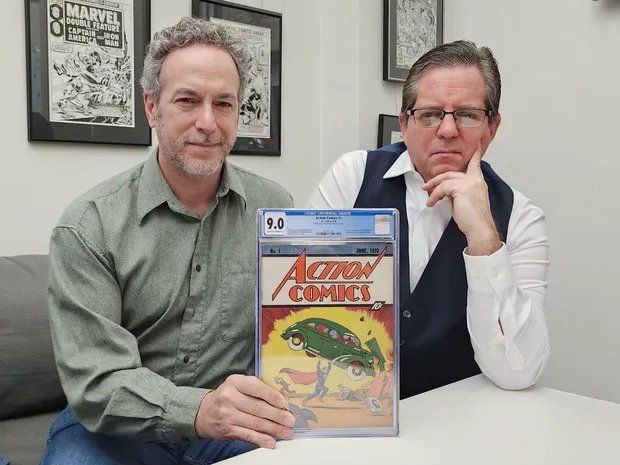
In the summer of 2000, a company called Certified Guaranty Company — CGC, as it would come to be universally known — began accepting comic books for professional third-party grading and encapsulation at its facility in Sarasota, Florida. The service it offered was straightforward in description and radical in implication: submit a comic book, pay a fee scaled to the book's estimated value and the desired turnaround time, and receive it back sealed in a tamper-evident hard plastic case with a label affixed to the interior documenting the issue's identity, its census registration number, and its condition expressed as a number on a ten-point scale rendered to one decimal place. A 9.8 was Near Mint/Mint. A 9.6 was Near Mint+. A 1.0 was Fair. A 0.5 was Poor. Everything in between was parsed with a granularity that the grading notes accompanying each assessment justified through the enumeration of specific defects: corner blunting, color breaking creases, spine stress lines, tanning, foxing, the precise taxonomy of physical deterioration that distinguishes a comic book that has been read from one that has not.
The market's response was not immediate enthusiasm. The collector community of 2000 was populated largely by people who had spent decades developing their own condition assessment skills, who trusted their eyes and their experience, and who regarded the idea of paying someone else to tell them what they already knew as either redundant or insulting. The early CGC submissions came primarily from dealers seeking to establish verifiable grades for high-value transactions, and from a smaller group of collectors who recognized, before most of their peers, that the subjectivity of ungraded condition assessment was the single largest source of friction — and fraud — in the existing market. A seller's "Very Fine" and a buyer's "Very Fine" were frequently not the same thing, a discrepancy that generated disputes, returns, damaged relationships, and a persistent background level of outright misrepresentation that the market had normalized because it had no alternative.
CGC provided the alternative. Within five years of its founding, the professional grading of high-value comics had shifted from an eccentric option to an expected practice. Within ten years, a significant segment of the serious collector market had come to treat ungraded raw comics with active suspicion when offered at prices commensurate with high-grade examples — the absence of a CGC label on a book being sold as Near Mint was, in an increasing number of transactions, read as evidence of something the seller preferred not to document. The grading company had, in a remarkably short period, inserted itself as a mandatory intermediary in the upper tier of the market, a position it has not subsequently relinquished and that its competitors — CBCS, founded in 2014, being the most significant — have made only limited inroads against.
The ten-point scale deserves examination as a financial instrument, which is what it functionally became. The difference in market value between a CGC 9.4 and a CGC 9.6 copy of a significant key issue is not linear. For a book like Amazing Fantasy #15 or Action Comics #1, the premium commanded by each incremental grade point is exponential — a 9.6 may be worth two or three times a 9.4, a 9.8 may be worth two or three times a 9.6, and a numerically perfect 10.0, awarded to fewer than a handful of comics in the company's history, occupies a category so rarefied that its relationship to the grades below it is more theological than mathematical. The CGC census — a publicly accessible database recording every book the company has graded, organized by title, issue, and grade — functions as a real-time scarcity map of the certified market. A collector researching a potential acquisition can determine not merely that high-grade copies of a given issue are rare, but precisely how rare: there are four copies graded 9.8, one graded 9.6, twelve graded 9.4, and so on down the scale, with each population number informing the price that the top of the grade range commands at the next auction.
This transparency is genuinely useful and represents a meaningful improvement over the opacity of the pre-CGC market. It is also, in the hands of sophisticated financial actors, a mechanism for identifying and cornering scarce inventory. If the census shows two copies of a key issue graded 9.8 and you can acquire both of them, you have effectively established a private monopoly on the highest certified grade of that book, with the ability to set the market price at the next sale. This is not a theoretical observation. It is a documented practice among the most aggressive collectors and dealers at the top of the market, and it represents a degree of financial sophistication that the hobby's self-image as a passion-driven pursuit has been slow to fully absorb.
The encapsulation itself — the "slab," in collector parlance, a term whose connotations of weight and inertness were apparently not considered when it was coined — completed the object's transformation in a manner that is worth dwelling on. A slabbed comic book cannot be read. This is not a minor inconvenience or a surmountable technical limitation. It is a physical fact: the book is sealed in hard plastic, its pages inaccessible, its contents visible through the case's window only as a static image of the front cover and, if you turn it over, the back. The stories inside — the reason the object was created, the reason anyone cared about it in the first place — are present in the same sense that a fly is present in amber: encased, preserved, and permanently beyond reach. The slab does not merely protect the comic book. It completes its conversion from a thing to be experienced into a thing to be owned, a process that the market had been moving toward since the first price guide appeared in 1970 but that required the physical intervention of the encapsulation case to render fully and irrevocably.
The irony that the highest-graded copies are almost invariably copies that were never read has been noted by collectors themselves, usually with a rueful acknowledgment that stops well short of examining its implications. A CGC 9.8 exists because a child bought a comic book in 1962, opened it to check that it had arrived undamaged, and then set it aside without reading it — an act of inadvertent conservation that the market now rewards with a premium of several hundred percent over the otherwise identical copy that was read. The content is identical. The story, the art, the specific fusion of Kirby's spatial imagination and Lee's vernacular energy that made the Silver Age material worth preserving in the first place — all of it is present in both copies, equally accessible in the raw reading copy and equally inaccessible in the slab. The market has determined that the unread copy is worth multiples of the read one. This is a coherent financial position. It is also, considered from the perspective of what comic books are actually for, a statement of values whose full absurdity tends to reveal itself only when you say it plainly.
CGC's revenue model has evolved in ways that track the financialization of the market it helped create. The company charges grading fees that scale with declared value — submitting a book you believe is worth $10,000 costs considerably more than submitting one you believe is worth $100 — and offers tiered service levels whose premium options deliver assessments within days rather than weeks. It offers pressing services, in which a comic is subjected to controlled heat and humidity to relax stress lines and minimize the appearance of defects before grading — a practice whose ethical status within the collector community remains contested, occupying a gray zone between legitimate conservation and cosmetic manipulation. It offers signature series certification, in which a CGC representative witnesses a creator signing the encapsulated book and adds a yellow label attesting to the signature's authenticity, a service that commands a substantial premium in the market and that has the side effect of making the inaccessible object slightly more inaccessible, since the signature is now also sealed inside the case. It is, by any measure, a well-constructed business.
The company's position in the market is now so thoroughly entrenched that it functions less like a service provider and more like an infrastructure operator — the equivalent of a credit rating agency for a financial market whose participants have agreed, without any formal process of agreement, that its assessments are authoritative. The parallel with Moody's and Standard & Poor's is imperfect but instructive. Both CGC and the major credit rating agencies occupy positions of institutionalized trust that they did not inherit but constructed, that serve genuine market functions while also creating conflicts of interest and single points of failure that the markets depending on them have chosen, for reasons of convenience, not to examine too carefully. The difference is that the failure modes of comic book grading, while occasionally spectacular — the periodic scandals involving trimmed pages, restored copies submitted as unrestored, and cases that have been cracked open and resealed — are unlikely to trigger a systemic financial crisis. The stakes are high for the individuals involved and negligible for everyone else, which is perhaps the most honest summary of the comic book market's relationship to the broader financial system: a near-perfect replica of that system's structures and pathologies, operating at a scale that makes it picturesque rather than dangerous.
What CGC ultimately accomplished, beyond the considerable achievement of building a profitable and durable business, was to provide the final piece of infrastructure required to complete the comic book's transformation into a fully financialized asset. The price guide had established common valuation language. The auction houses had established price discovery mechanisms. The collector conventions had established a market for physical exchange. CGC provided the standardized, authenticated, tamper-evident unit — the financial instrument in its completed form — that institutional and ultra-high-net-worth money required before it could enter the market with confidence. The slab is, in this reading, not merely a protective case. It is the moment at which the comic book stopped being a comic book and became, definitively and without remainder, something else entirely. What that something else is, and who it serves, and at whose expense, are questions that the market has answered with great precision and the culture has barely begun to ask.
The Asset Class Inflection
The transformation of the comic book from collectible into financial instrument did not happen on a single identifiable date, which is itself instructive — genuine market inflection points rarely announce themselves in real time, presenting instead as a series of data points that only acquire their narrative coherence in retrospect. What can be said with reasonable precision is that the market that exists in 2026, in which a single comic book commands a price in excess of the gross domestic product of several small nations, is not a linear extension of the collector market that existed in 2000. Something changed, somewhere in the decade between 2008 and 2018, and the record prices of the subsequent years are the trailing indicators of a structural shift whose causes are multiple, whose consequences are still unfolding, and whose relationship to the actual content of the books being sold has become, with each successive auction record, more attenuated and more difficult to take seriously as the primary driver of value.
The first cause is the most obvious and has been most extensively documented: the Marvel Cinematic Universe. When Iron Man opened in May 2008 to $585 million in global box office revenue and established beyond reasonable doubt that Marvel's catalog of characters constituted a commercially exploitable franchise of essentially unlimited duration, it initiated a feedback loop between cinematic investment and back-issue demand that the market had never previously experienced at that scale or velocity. The mechanism was straightforward: a film announcement drove awareness of a character among a population that had not previously been collectors; awareness drove demand for first-appearance issues among new entrants to the market; demand drove prices; rising prices generated media coverage; media coverage drove further awareness among further non-collectors; and the cycle repeated with each new entry in the franchise. Tales of Suspense #39, the first appearance of Iron Man, was a moderately sought Silver Age key before 2008. It is a different category of object after it.
The MCU effect is real, well-documented, and quantifiable in the auction records. It is also, as a complete explanation of the market's behavior since 2008, insufficient — because it accounts for the appreciation of Silver Age Marvel keys but does not fully explain the concurrent and equally dramatic appreciation of Golden Age material whose characters have not appeared in any MCU film and are unlikely to. Action Comics #1 does not owe its $15 million valuation to the Robert Downey Jr. franchise. Something else is driving the apex of the market, and that something else sits at the intersection of macroeconomic conditions, tax policy, and the specific psychology of ultra-high-net-worth wealth accumulation in the second decade of the twenty-first century.
The macroeconomic context is the extended period of near-zero interest rates that followed the 2008 financial crisis and persisted, with interruptions, through the early 2020s. When the risk-free rate of return on capital approaches zero, the opportunity cost of holding non-yielding assets approaches zero with it, and the relative attractiveness of appreciating tangible assets — art, wine, rare books, comic books, anything whose supply is fixed and whose demand is driven by genuine scarcity rather than production decisions — increases correspondingly. The institutional and ultra-high-net-worth money that entered the comic book market in the 2010s was not entering because its owners had developed a sudden passion for the adventures of Jerry Siegel and Joe Shuster's creation. It was entering because the alternative uses of that capital were generating returns that made a high-grade Action Comics #1 look like a reasonable store of value, and because the market's recent appreciation curve provided a track record that could be presented to a wealth manager without embarrassment.
The entry of this money changed the market in ways that the existing collector community experienced as disorienting and that the auction houses experienced as straightforwardly profitable. Heritage Auctions, the dominant player in the American comic book auction market, reported total comics sales of approximately $5 million in its largest auction of 2011. By 2021 a single Heritage auction had cleared $26.5 million. By 2025 individual lots within single auctions were exceeding the total value of the entire 2011 event. The price curve is not the curve of a hobby market maturing into an established collectibles category. It is the curve of a market experiencing a capital inflow event — a sudden and substantial increase in the pool of money competing for a fixed supply of high-grade material, driving prices to levels that have no meaningful relationship to any intrinsic valuation metric and every meaningful relationship to the relative abundance of billionaire capital seeking non-correlated appreciating assets.
The auction house infrastructure accommodated and amplified this influx with considerable skill. Heritage and its competitors developed dedicated comics specialists, produced increasingly sophisticated catalog essays that framed comic books explicitly in the language of art market investment — provenance, condition reports, comparable sales, conservation history — and cultivated relationships with the wealth management community that positioned comic books alongside fine art, rare wine, and classic automobiles in the alternative assets conversation that wealth managers were having with clients whose portfolios required diversification beyond conventional financial instruments. The language of the auction catalog shifted perceptibly over this period: where 2005 Heritage catalog copy described a comic book in terms a collector would recognize — grade, census population, historical significance — 2020 catalog copy layered onto that foundation a financial framing that spoke directly to a buyer whose primary relationship to the object was as a store of value rather than a cultural artifact. The books had not changed. The audience being addressed had.
The COVID-19 pandemic of 2020 and 2021 produced what appeared in the moment to be a speculative bubble in modern comics — variants, first appearances of characters with MCU potential, books that had been available at cover price months earlier selling for multiples of a thousand dollars — but whose more durable effect was on the Golden Age market, where the combination of stimulus-fueled liquidity, zero interest rates, and a population of suddenly homebound collectors with time to research and money to spend produced a series of auction results that reset price expectations for top-tier material at levels that persisted after the modern comics speculation cooled. The $3.25 million sale of a CGC 9.0 Action Comics #1 in 2021 was a pandemic-era result. The $6 million sale of a CGC 8.5 copy in 2024 confirmed that the pandemic prices were not an aberration but a new floor. The $15 million private sale of Nicolas Cage's copy in early 2026 suggests that the floor, too, was temporary.
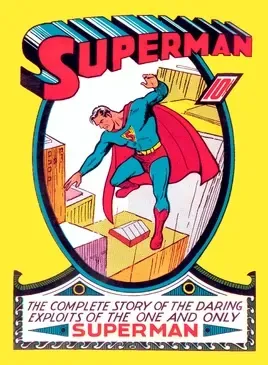
The private sale market deserves particular attention as an indicator of where the apex of the comic book market has arrived. Public auctions, whatever their other characteristics, are transparent: the hammer price is a matter of record, the competing bids establish the market, and the result is available to anyone who wants to understand what a given book is worth at a given moment. Private sales conducted through dealers like Metropolis Collectibles or ComicConnect share none of these characteristics. The price is negotiated between parties with no obligation of disclosure. The buyer is anonymous. The seller may or may not be identified. The transaction leaves no public record beyond whatever the parties choose to announce, and even that announcement is subject to their editorial preferences regarding the details. The February 2026 private transaction in which a CGC 9.4 Batman #1 and a CGC 8.5 Superman #1 changed hands for a combined $13 million was disclosed because Heritage Auctions, which brokered the deal, chose to issue a press release. There is no mechanism that would have compelled disclosure if they had chosen otherwise.
The shift of apex transactions from public auction to private sale is a reliable indicator that a collectibles market has been colonized by the same actors and the same logic that operate in the private art market — a market whose defining characteristic is the systematic elimination of price transparency as a protection for buyers and sellers who are sophisticated enough to prefer opacity. In the private art market, opacity serves multiple functions simultaneously: it allows sellers to achieve prices that public auction competition might not support; it allows buyers to acquire assets without triggering the demand increase that public knowledge of their interest would produce; and it allows both parties to conduct transactions whose tax implications benefit from a degree of ambiguity that public record-keeping would foreclose. The comic book market, in migrating its highest-value transactions to private channels, has imported all of these functions along with the financial profile of the actors driving them.
What the asset class inflection has produced, at its apex, is a market whose top tier is now effectively decoupled from the collector community that created and sustained it. The person who paid $9.12 million for a CGC 9.0 Superman #1 at Heritage Auctions in November 2025 may be a passionate comics collector. The available evidence — specifically, the complete absence of any public statement from that buyer about their acquisition, their intentions for the book, or their relationship to the medium — does not support that inference. The available evidence supports the inference that the buyer is someone for whom $9.12 million is a rational allocation of capital to a non-correlated appreciating asset, and for whom the Superman on the cover is incidental to the investment thesis in the same way that the grapes are incidental to the investment thesis of the person who paid $500,000 for a case of 1945 Pétrus. The grapes are still there. The wine is still, technically, wine. But nobody is drinking it.
The collector community's response to this situation has been a complex mixture of pride and unease that maps fairly precisely onto the ambivalence of any community that has watched its passionate niche interest be colonized by money. Prices are higher than anyone imagined possible, which is gratifying if you hold inventory and alienating if you were hoping to acquire. The cultural visibility of comics as a medium has never been greater, which is satisfying in the abstract and irrelevant in practice when the books driving that visibility are sealed in plastic in undisclosed locations. The characters whose first appearances now command eight-figure prices are simultaneously more famous than they have ever been and more inaccessible, in their original physical form, than at any previous point in their history. The Golden Age books that survived the paper drives and the Code years and the decades of attic storage have survived all of it only to arrive at a final condition that the paper drives, whatever their other faults, did not impose: they are present in the world but absent from it, owned but not experienced, valued beyond any previous imagining and encountered by essentially no one.
This is what the asset class inflection has produced. It is, considered purely as a financial outcome, a remarkable success story. It is, considered as the conclusion to the story of a medium created by underpaid artists to be read by children for ten cents a copy, something rather harder to categorize.
What the Market Has Actually Produced
There is a version of this story that ends in triumph. A medium dismissed for most of its existence as disposable children's entertainment has been recognized, at last, as a legitimate cultural form worthy of serious scholarly attention, institutional preservation, and market valuations commensurate with its historical significance. The artists who pioneered it — Siegel and Shuster, Kirby and Ditko, Eisner and Finger and the dozens of others who built something enduring out of cheap newsprint and deadline pressure — have been inducted into a canon whose existence they could not have anticipated and whose financial expressions they did not live to see. The ten-cent pamphlet has been rehabilitated. The medium has arrived.
This version of the story is not false. It is simply incomplete in ways that matter enough to examine before accepting it as a conclusion.
The comic book market of 2026 has produced, with remarkable efficiency, the following outcomes. It has generated record auction prices that function primarily as press releases, establishing the cultural cachet of the medium while moving the objects that embody that cachet into private hands from which they will not return to public view. It has created a grading and encapsulation infrastructure that has standardized the language of value while completing the physical transformation of the comic book from an object of experience into an object of ownership. It has attracted capital from actors whose interest in the medium is purely financial and whose entry has driven prices to levels that have effectively excluded the passionate collector — the person who loves comics, who has read them, who understands what makes a given issue significant beyond its census population and its MCU adjacency — from meaningful participation in the market for the most historically important material. And it has done all of this while the creators whose work underlies every dollar of that appreciation have been, with the rarest of exceptions, either dead or compensated at a level that the current auction results render grotesque by comparison.
The specific numbers are worth sitting with. Jack Kirby, who by any serious accounting co-created or solely created the characters and concepts that underlie a substantial fraction of the Marvel Cinematic Universe's thirty-billion-dollar revenue total, died in 1994 having spent his final years fighting Marvel in court for the return of his original artwork — pages he had produced under page-rate contracts in the 1960s and that the company had retained as a matter of course, selling them through dealers as the original art market developed without any participation by the man who had drawn them. The settlement terms were confidential. His estate continued the fight after his death, reaching a further confidential settlement with Marvel in 2014. The specific figures are unknown. The general magnitude is suggested by the fact that neither the Kirby estate nor Marvel has ever indicated that the outcome was anything other than a negotiated resolution of a legal dispute — language that, in the context of intellectual property litigation, typically means that the party with the weaker legal position received something and the party with the stronger legal position retained most of what it was defending.
Steve Ditko, who co-created Spider-Man — a character whose first appearance now sells for $3.6 million in high grade and whose film franchise has generated billions in revenue — spent the last decades of his life in a one-room office in Midtown Manhattan, producing work for small publishers, declining interviews, living with a deliberate modesty that may have reflected philosophical conviction, financial necessity, or both. When he died in June 2018 at the age of ninety, he was not found for two days. The New York City medical examiner determined that he had died of natural causes. There was no public memorial. Marvel issued a statement. Stan Lee, who had shared credit for Spider-Man's creation and who had, unlike Ditko, maintained a public profile and a financial relationship with Marvel that generated considerably more comfortable circumstances, died five months later to considerably more public mourning. The disparity in their final circumstances is not incidental to the story of what the comic book market has produced. It is, rather, one of its most precise expressions.
The institutional response to the medium's belated recognition has been uneven in ways that reflect the difficulty of applying traditional cultural preservation frameworks to objects whose market values have outpaced the acquisition budgets of the institutions best positioned to preserve them. The Library of Congress holds significant comics collections, primarily through copyright deposit, and has undertaken digitization projects that make some of this material accessible in ways the original physical objects are not. The Smithsonian Institution has collected comics-related material with variable consistency across different curatorial periods. The Billy Ireland Cartoon Library and Museum at Ohio State University maintains what is arguably the most serious scholarly archive of comics and cartoon art in the country, with a collection that is genuinely accessible to researchers and that is curated with an intelligence and a commitment to the medium's full history that the auction market does not replicate. These institutions exist, do important work, and are chronically underfunded relative to both the cultural significance of the material they preserve and the market values that the same material commands when it passes through Heritage Auctions.
The gap between institutional capacity and market price is not merely a funding problem, though it is that too. It is a structural consequence of the asset class inflection. When Action Comics #1 was worth $317,000 — the record price that Heritage's Barry Sandoval cited as the benchmark of a decade ago — it was theoretically acquirable by a well-endowed museum with a serious commitment to the medium. At $15 million, it is not. The market has moved the most historically significant artifacts of American comics history permanently beyond the reach of the public institutions whose function is to hold culturally significant objects in trust for the culture that produced them, and it has done so as an unintended consequence of a financial dynamic that was not designed with any cultural outcome in mind and that will not be modified by appeals to cultural responsibility. The billionaire who paid $15 million for Nicolas Cage's Action Comics #1 did not deprive the Smithsonian of an acquisition. The Smithsonian was never in the bidding. The market had already moved past them, years earlier, and the distance has only grown.
What the market has not produced — and this absence is worth naming clearly — is any mechanism for ensuring that the cultural artifacts it has valorized remain available to the culture. There is no right of public access attached to the ownership of a historically significant comic book. There is no heritage designation that restricts the export or private sale of a first-edition Superman. There is no legal obligation on the owner of a CGC 9.0 Superman #1 to loan it to an exhibition, to make it available to scholars, to disclose its location, or to do anything at all with it beyond paying whatever storage and insurance costs its physical maintenance requires. The owner may, of their own volition, choose to be generous with the object — to lend it, to display it, to donate it eventually to an institution. Some owners of significant comics have made exactly these choices, and they deserve credit for it. The point is that the choice is entirely theirs, unconstrained by any public interest framework, and that the financial logic of the market — in which the book's value is inversely correlated with its accessibility, since a book that has been handled and displayed and studied is a book that has accumulated the wear that depresses its CGC grade and therefore its price — cuts consistently against generosity and consistently toward the vault.
The people who made these objects are, almost without exception, gone. The companies that own the intellectual property those objects introduced have been consolidated, through decades of acquisition, into two entertainment conglomerates — Warner Bros. Discovery and Disney — whose relationship to the founding creative work of the medium is purely extractive and whose obligations to the artists who produced it have been resolved, to the corporations' satisfaction if not always to the artists' heirs', through litigation and negotiated settlement. The readers who preserved the physical artifacts through the accidents of neglect and geography have, in some cases, been rewarded beyond any rational expectation, and in other cases never discovered what they had or died before the market reached the values that would have transformed their circumstances. The collectors who built the market through decades of passionate engagement have watched it be colonized by financial actors who have driven prices past any point at which passion alone can compete.
And the books themselves — the specific physical objects at the center of all of this — are, in the cases that matter most, simply gone. Not destroyed, as the paper drives destroyed them. Not suppressed, as the Comics Code suppressed the work of EC and its contemporaries. Simply removed, through the operation of a market that has valued them more highly than any previous market in history, into a condition of private custody so complete and so permanent that their existence is, for all practical cultural purposes, equivalent to their absence. The $15 million Action Comics #1 is somewhere. The $9.12 million Superman #1 is somewhere. The $13 million Batman #1 and companion Superman #1 are somewhere. Nobody outside the immediate circle of their owners and custodians knows where, and nothing in the structure of the market that produced these prices requires that anyone ever find out.
Jerry Siegel and Joe Shuster created Superman in Cleveland in the early 1930s as a fantasy of power for people who didn't have any — a figure who was secretly more capable than everyone around him, who used that capability in the service of those who needed it, who stood, in the specific cultural grammar of two Jewish teenagers in Depression-era America, for the possibility that the vulnerable might be protected and the powerful held to account. The character has since become the most commercially exploited fictional entity in the history of American popular culture, the foundation of an intellectual property portfolio worth billions, the subject of a market in physical artifacts that has produced auction results his creators could not have imagined on the largest canvas their imaginations could project. The most valuable surviving copy of his first solo appearance sold, in November 2025, to an anonymous buyer for $9.12 million and has not been seen in public since.
This is what the market has actually produced. The question of whether it is also what the market was for is one that the market itself is not designed to answer, and that the rest of us have been too distracted by the prices to ask with any sustained seriousness. The ten-cent cover price on Action Comics #1 was, among other things, a statement about who the book was intended for. The $15 million private sale price is, among other things, a statement about who it belongs to now. The distance between those two numbers is not merely financial. It is the distance between a culture's founding myths and the mechanisms by which that culture has chosen to manage them — which is to say, it is a portrait of the culture itself, rendered with an accuracy that no artist, however talented, could have achieved deliberately, and with an indifference to its own meaning that only a market could sustain.
Jonathan Brown writes about cybersecurity infrastructure, privacy systems, the politics of AI development, religion, magic, philosophy, literature and many other topics at bordercybergroup.com and aetheriumarcana.org. Border Cyber Group maintains a cybersecurity resource portal at borderelliptic.com
If you wish to support our work, feel free to buy us a coffee! https://bordercybergroup.com/#/portal/support
Member discussion: