
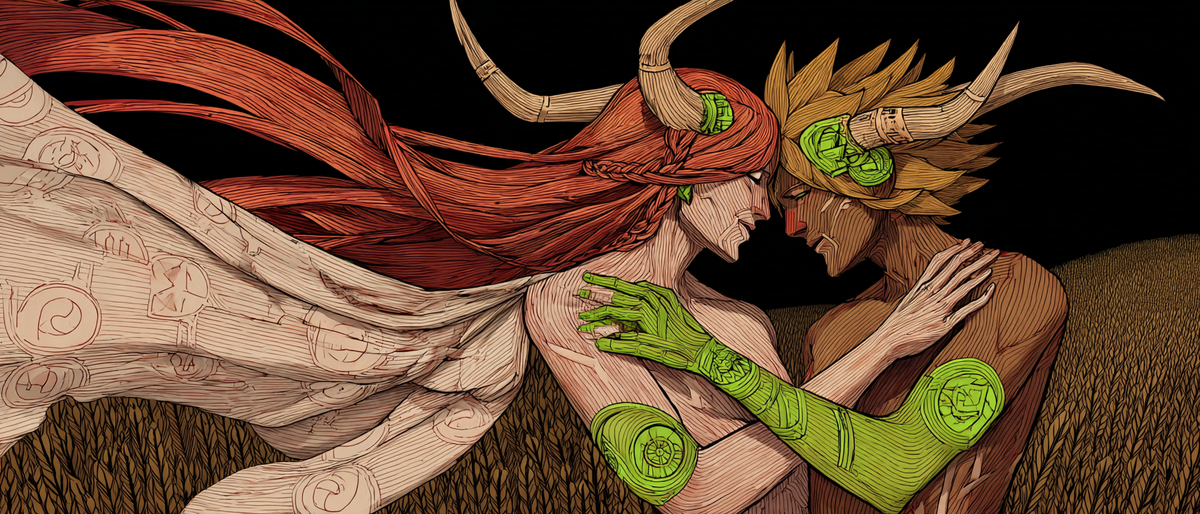
Essay Thirteen, Which Completes Our Series A History of the Hero's Journey
The Grief the Schema Cannot Hold
Somewhere in the middle of the oldest heroic narrative available to us, the hero stops being the point.
It happens in Tablet VIII of the Standard Babylonian Version, in the passage that begins after Enkidu has spent twelve days dying — slowly, from a divine illness sent as punishment for what the two friends accomplished together — and Gilgamesh, who was not present at the death and arrives to find it accomplished, sits beside the body and will not let it be buried. He addresses Enkidu directly. He calls on the elders of Uruk, on the wilderness where Enkidu was formed, on the animals who ran with him before the world of the city claimed him, on the rivers and the mountains and the cedar forest they crossed together. He tears his fine clothing. He shears the hair from his head. He ranges through the wild places like an animal himself, wearing a lion skin, unable to stop moving and unable to go anywhere that matters. He mourns for seven days and seven nights, and only when a worm falls from the body's nostril does he finally release Enkidu to the earth.
No framework organized around the hero's transformation has a category for what this passage is doing. The monomyth's stages — the call, the crossing, the ordeal, the supreme test, the return — are stages in the hero's becoming: each one advances the arc, refines the protagonist, brings him closer to the elixir he will carry home. Grief, in the schema's economy, is either an obstacle to be overcome on the way to the real business, or a consequence of the hero's incomplete transformation, resolved when the journey is completed and the wound healed. What the lamentation for Enkidu is not, and cannot be made to be without distortion, is a stage. It is a rupture. It breaks the epic in two, and the second half is not a resumption of the first half's journey but a different journey entirely, undertaken by a different man in response to an event the monomyth cannot fully register.
The reason the framework cannot register it is precise, and stating it precisely is the business of this essay. Gilgamesh does not grieve the way a hero grieves an ordeal. He grieves the way a person grieves another person — with a completeness, a disorientation, a refusal of consolation that the text presents not as weakness to be overcome but as the appropriate response to what has happened. What has happened is not that the hero has lost an instrument of his journey. What has happened is that one of two protagonists has died, and the surviving one must now carry the weight of a narrative that was always, from the beginning, shared between them. The monomyth has room for one hero. The Epic of Gilgamesh has two. The lamentation in Tablet VIII is where that structural difference becomes impossible to ignore.
Andrew George, whose two-volume critical edition of the Standard Babylonian Version is the most authoritative scholarly treatment the text has yet received, describes the lamentation as one of the most formally elaborate mourning sequences in ancient literature — a passage whose length and emotional intensity are not incidental to the epic's structure but constitutive of it. The grief is the argument. It is the text's insistence, made at the register of feeling rather than statement, that Enkidu was not a subordinate figure, not a threshold guardian, not a shadow that the hero had to meet and integrate on his way to something else. He was the other half of a narrative that required two centers of gravity to hold its shape, and without him the shape collapses into something that must be rebuilt from the ground up.
This is where the series arrives, in its final movement: at the text that the Western comparative tradition used, and read selectively, and could not fully see. Campbell encountered the Epic of Gilgamesh and found in it what the monomyth's architecture was built to find. He was not wrong about what he found. He was limited, as every reader is limited, by the questions the framework allowed him to ask. The questions this essay asks are different, and the text, read with those questions in view, looks different — not because the text has changed but because the tradition that formed the framework has now been traced back far enough to stand at the point before the framework existed, in the oldest available narrative, before the choices that would eventually produce the monomyth had been made.
What Gilgamesh contains, and what the lamentation for Enkidu announces with a directness nothing else in the ancient literary record quite matches, is the evidence of a moment before the clarification hardened — before the Western literary tradition had committed itself to the single-axis architecture that would, across three thousand years, progressively refine the hero and progressively simplify everything the hero was not. The text held complexity the tradition would later separate into distinct categories: the co-protagonist and the protagonist, the adversary with interiority and the shadow without it, the goddess with autonomous power and the goddess positioned as reward. In the seventh century BCE, when the Standard Babylonian Version reached approximately its current form, those categories were not yet fixed. The mourning that Gilgamesh performs in Tablet VIII is the oldest available evidence of what it cost, over the long subsequent history of heroic narrative, to fix them.
The Oldest Archive, Read Twice
Campbell came to Gilgamesh well prepared and with his conclusions already forming. By the time The Hero with a Thousand Faces appeared in 1949, he had been reading across comparative mythology, depth psychology, and the literary modernism of Joyce and Mann for nearly two decades, and the framework he brought to any individual text was not a neutral instrument but a shaped one — refined by everything he had read, committed in advance to finding the pattern it had been built to find. This is not a criticism. It is a description of how comparative reading works, and it applies to every scholar this series has examined. The question is never whether the reader brings a framework — every reader does — but what the framework allows the reader to see and what, by the same operation, it prevents.
What Campbell's framework allowed him to see in Gilgamesh was considerable. In The Masks of God: Occidental Mythology, published in 1964, he engaged the epic at greater length than the treatment available in The Hero with a Thousand Faces and demonstrated, with his characteristic combination of breadth and assurance, the structural parallels between the Gilgamesh narrative and the monomyth's architecture. The opening of the epic — Gilgamesh as the two-thirds divine king of Uruk, restless and oppressive, whose excess provokes the gods to create Enkidu as his counterpart — reads, in Campbell's account, as the call to adventure and the first threshold crossing: the ordered world disrupted, the hero's ordinary condition revealed as insufficient, the catalyst for transformation introduced from outside. The cedar forest expedition — the two friends' journey to kill Humbaba and take the forest's timber — reads as the road of trials, the descent into the territory of danger where the hero's qualities are tested. The death of Enkidu and the subsequent journey to find Utnapishtim, the immortal survivor of the flood, reads as the supreme ordeal, the encounter with death that initiates the deepest level of the hero's transformation. And Utnapishtim himself — the figure at the world's edge, in possession of a knowledge the hero has traveled across the waters of death to reach — reads as the inmost cave, the source of the elixir, the point of the journey's maximum penetration into the territory of the sacred.
The reading is not wrong. The structural parallels Campbell identified are real, and this series has been arguing since its first essay that real structural parallels require explanation rather than dismissal. The monomyth found something genuine in the Epic of Gilgamesh, because there is something genuine to find — a narrative organized around a protagonist who departs from his ordinary world, crosses into a territory of danger and supernatural encounter, faces the fact of death, and returns changed to the community he left. The pattern is there. Campbell found it. The problem is not that the reading is inaccurate. The problem is that it is incomplete in a specific and consequential way: it reads the epic as a document of the monomyth's pattern rather than as a text with its own structural logic, and in doing so it imports the monomyth's hierarchies into a text that does not share them.
The most direct demonstration of the import's consequences is the treatment of Enkidu. In the monomyth's reading, Enkidu is a threshold figure — the wild man who crosses into civilization, who fights Gilgamesh and becomes his companion, and whose death triggers the second half of the hero's journey. The description is accurate as far as it goes. The problem is where it stops. A threshold figure, in the monomyth's architecture, derives his significance entirely from what he contributes to the hero's arc. His own interiority, his own transformation, his own relationship to the narrative's meaning are not the framework's concern, because the framework has only one center of gravity and everything else orbits it. Read this way, Enkidu is intelligible as the catalyst for Gilgamesh's confrontation with mortality — and nothing more, or nothing more that the framework is equipped to register.
The text is equipped to register considerably more. The epic's opening tablets spend as much narrative space on Enkidu's formation and initiation as on Gilgamesh's restless governance of Uruk, and the parallel opening is not incidental: it is the text's structural announcement that two figures will share the narrative's weight. Enkidu is created from clay by the goddess Aruru at the request of the gods, who intend him as a counterbalance to Gilgamesh's excess — not as a supplement to the hero's journey but as its structural equivalent, a second protagonist whose arc will run alongside the first rather than subordinate to it. His initiation into human civilization through Shamhat — which this essay will examine in its own right — is presented with the same formal attention the text brings to Gilgamesh's divine lineage and kingly power. When the two figures finally meet and fight in the streets of Uruk, the combat is not a threshold crossing for Gilgamesh alone: it is a mutual recognition, the moment at which two centers of narrative gravity find each other and the epic's real subject — their friendship, the thing that will break in Tablet VIII and take the rest of the narrative to come to terms with — becomes possible.
This structural feature of the text is not available to the monomyth's reading, because the monomyth does not have a category for it. A framework organized around a single protagonist's transformation cannot accommodate a narrative that requires two protagonists to generate its meaning — not because the two figures are interchangeable, but because what the epic is about is the relationship between them, and a relationship requires two subjects, neither of which can be reduced to an instrument of the other's arc without losing precisely the thing the text is most interested in. The monomyth reads Gilgamesh and finds a hero. The text contains two heroes and is about what it costs to lose one of them.
The selective reading of Gilgamesh is, in miniature, the selective reading this series has been tracing across three thousand years of intellectual history. The pattern was real; the account of the pattern was a construction; and the construction reflects the questions the framework was built to ask. Campbell asked: what is the shape of the hero's journey? The Epic of Gilgamesh answered, partially, because a partial answer was available to the question asked. The question this essay asks is different: what is the shape of the text, on its own structural terms, before the monomyth's hierarchy is imposed? Asking that question of the oldest available heroic narrative in the Western tradition is not a corrective to Campbell's reading. It is the completion of the intellectual project the series has been pursuing from its opening pages — the project of following the pattern back to its source and finding, at the source, something older and more complex than the pattern's later
Two Heroes, One Framework
The transformation of Enkidu begins not with combat or divine intervention but with six days and seven nights in the company of Shamhat, the temple servant sent from Uruk to bring the wild man within the orbit of civilization. The text is explicit about what passes between them and unembarrassed about its significance: Shamhat offers herself to Enkidu, and Enkidu, who has lived among the animals of the steppe and known no human contact, accepts, and in the accepting is changed in ways the epic presents as total and irreversible. When he rises and returns to the herd, the gazelles flee from him. The animals of the wild, who were his companions, will no longer approach. He has crossed a threshold that cannot be recrossed, and the crossing was accomplished not through heroic action, not through combat or divine ordeal or the exercise of will, but through intimacy — through what was given and received between two people in an encounter the epic treats as the most fundamental of human initiations.
The monomyth has no stage for this. The hero's journey is organized around action: the departure the hero chooses, the ordeals he endures and survives, the return he accomplishes. The transformation Shamhat accomplishes in Enkidu requires none of these. It requires presence, and time, and the willingness to be changed by another person's proximity — a mode of transformation that the active schema cannot map because it produces no movement across a threshold the hero controls. Enkidu does not decide to become human. He becomes human because Shamhat is there, and the becoming is the consequence of encounter rather than the achievement of effort. The framework that would be needed to follow this transformation is not the monomyth's. It is closer to the one Tatar traced in the patient protagonists of the fairy tale corpus — the account of transformation undergone rather than accomplished — and it is present, in the Western narrative tradition's oldest available text, before either framework existed to describe it.
What Shamhat does for the epic's structural argument is as important as what she does for Enkidu. Her presence at the narrative's opening, and the formal weight the text assigns to her role, is the epic's first indication that the agents of transformation in this story will not be exclusively those who act in the monomyth's sense. She is not a threshold guardian in Campbell's use of that term — the figure who tests the hero and is overcome or propitiated before the crossing can proceed. She is a transformer: a figure whose significance lies not in what she blocks or permits but in what she enables by being fully, actively present. The distinction matters because it locates her in a different structural category than the monomyth provides for female figures at the narrative's opening — not the hero's obstacle, not his supernatural aid, not the goddess who waits at the journey's end, but an agent of transformation in her own right, operating according to a logic the hero-centered schema cannot quite follow.
She is also, as the text makes clear, operating under instruction. Shamhat was sent by the hunter, who was sent by his father, who was advised by Gilgamesh. There is a chain of male initiative behind her presence on the steppe, and the epic does not conceal it. What the text also makes clear is that once she is there, the transformation she accomplishes is entirely her own — that the instruction that sent her cannot account for what she does, that no one who dispatched her could have specified or controlled the six days and seven nights that follow, and that the Enkidu who rises and finds the gazelles fleeing from him is a consequence of Shamhat's presence in a way that exceeds the purposes of anyone who arranged that presence. She was sent to fetch a wild man for Uruk. She initiated a human being into the human. These are not the same thing, and the text knows the difference.
Enkidu arrives in Uruk already transformed, already human enough to understand what the city is and to contest it. The contest with Gilgamesh — which the text stages with formal elaboration, the two figures grappling in the street until the walls shake and the doorposts tremble — is not a defeat for either of them. It ends when Gilgamesh throws Enkidu and Enkidu, from the ground, acknowledges him. The acknowledgment is mutual: Gilgamesh recognizes in the figure he has thrown an equal, someone whose strength is the measure of his own, and the friendship that follows is presented by the epic as the thing Gilgamesh had been lacking without knowing it — the counterweight that his two-thirds divine nature could not provide for itself, the human completeness that required another human to become available.
The nature of what passes between them is not left ambiguous by the text, and the scholarship of the last three decades has largely stopped pretending otherwise. Before Enkidu arrives in Uruk, Gilgamesh dreams of him twice — dreams in which a figure of irresistible attraction falls from the sky like a meteor, and Gilgamesh finds he cannot leave it, and takes it to his mother, and embraces it, in the text's own formulation, as a man embraces a woman. Ninsun interprets both dreams without hesitation: a companion is coming, one who will be Gilgamesh's equal and his beloved, and the love between them will be as deep as the love for a wife. The word the text uses, in George's translation, is the word for erotic love. It is not a different word that scholars have subsequently decided to read erotically. It is the word the text chose, and the interpretive tradition's long reluctance to take it at face value reveals something about the tradition's own investments rather than about the text's intentions.
The erotic dimension of the Gilgamesh-Enkidu relationship is not incidental to the essay's structural argument. It is central to it. The monomyth's architecture has a place for the male bond as motivating structure: the companion who accompanies the hero, whose presence sustains the hero through the ordeal, whose loss deepens the hero's commitment to the journey's completion. What the architecture does not have — what it cannot have, given the single axis of agency around which it is organized — is a relationship that constitutes its own meaning independent of the journey's purposes, a love that is not instrumental to the hero's transformation but is itself the thing of greatest value, the thing whose loss the second half of the epic exists to come to terms with. The friendship between Gilgamesh and Enkidu is not a stage in either figure's individual development. It is the epic's subject. The monomyth's framework can find stages in it; it cannot find the subject.
The mother of Gilgamesh, the goddess Ninsun, understands this before her son does. She adopts Enkidu formally, making the friendship a kinship, giving the relationship the structural weight that the epic will need it to carry when Tablet VIII arrives and the weight becomes grief. The adoption is not a bureaucratic gesture. It is the text's recognition that the bond between the two figures requires the sanction of the sacred — that what exists between them is not adequately described by any of the categories the social world of Uruk already has available, and that a new category must be improvised from the materials of existing ones. A goddess adopts a wild man so that the king can love him with the full weight of a civilization's blessing. The text finds this unremarkable. It is the frameworks that came after, not the text itself, that found it difficult.
The cedar forest expedition that follows — the two friends' journey to kill Humbaba and take the timber of the sacred grove — is organized, at the level of motivation, around Gilgamesh's desire for a name that will outlast mortality. He articulates this explicitly: he knows he will die, he wants to accomplish something that will survive his death, and the killing of Humbaba is the form that ambition takes. Enkidu is reluctant. He has heard of Humbaba, knows the creature's power, does not share Gilgamesh's appetite for the expedition. He goes because Gilgamesh goes, and because the relationship between them has become the structuring fact of his existence in a way that supersedes his own judgment about the wisdom of the enterprise. The distinction is between a character who exists to serve the plot and a character who acts from his own interior — and the text, with a precision that the monomyth's framework cannot reward, maintains it throughout.
What the two figures constitute together is something the Western heroic narrative tradition has very rarely allowed itself: a protagonist that is genuinely dual. The Iliad has Achilles and Patroclus, but Patroclus is definitively the lesser figure, present primarily to motivate Achilles' return to battle and given no independent arc. The friendship between David and Jonathan in the Hebrew Bible carries some of the same emotional register as the Gilgamesh-Enkidu relationship, but the narrative in which it appears is organized around David's destiny rather than the friendship's meaning. The Epic of Gilgamesh is unusual in the ancient literary record — unusual enough that the comparative tradition, working from frameworks built on the assumption of a single protagonist, has consistently found ways to accommodate the friendship within a hero-centered reading rather than confronting what the friendship structurally requires.
What it requires is a framework capable of holding two centers of gravity simultaneously, of attending to both figures as subjects rather than organizing one as the instrument of the other's development. The epic does not argue that Enkidu is a co-protagonist. It treats him as one, with a consistency that becomes undeniable only when the lamentation of Tablet VIII arrives and the text's accumulated investment in Enkidu is suddenly, catastrophically, called due.
The grief is proportional to the investment. It cannot be explained by a reading in which Enkidu was always primarily a function of Gilgamesh's arc, because grief of this magnitude is not the response to losing a function. It is the response to losing a person — a specific, irreplaceable person whose presence was the condition of a kind of life that cannot be recovered, and whose love was the kind the text took the unusual step of having a goddess sanction and a king's dreams announce. Gilgamesh will spend the epic's second half looking for what Enkidu's death has made him need: the proof that something survives, that the fact of a life and a love and a shared history is not simply cancelled by the worm in the nostril. He will not find the proof. The text will not give it to him. What he will find, and what the epic will ask the reader to recognize as sufficient, is something the monomyth — organized around the successful return with the elixir — was never built to accommodate.
What the Adversary Said
In the sixth tablet of the Standard Babylonian Version, at the moment of Humbaba's defeat, the guardian of the Cedar Forest speaks. He has been overpowered — Gilgamesh and Enkidu have used the winds sent by the sun god Shamash to immobilize him, and he stands now before the two friends, bound and helpless — and what he says is not a curse or a supernatural threat but an appeal. He addresses Gilgamesh directly. He acknowledges his situation. He speaks of his own history in the forest, his long tenure as its guardian, the life he has lived in the service of the god Enlil who appointed him. He asks, with a directness the text does not undercut, to be spared. And then, when Enkidu argues for the killing and Gilgamesh moves to act, Humbaba turns to Enkidu — the former wild man, the creature of the steppe who knows what it is to live outside the city's walls — and accuses him of betrayal. You know what it is to live as I live, Humbaba says, in the terms the text provides. You of all figures understand what is being taken.
The accusation lands because the text has made it credible. Humbaba is not a monster in the sense the monomyth's shadow-figure requires — a projection of the hero's unintegrated darkness, defined entirely by negation, present in the narrative to be overcome so that the hero's light can be confirmed. He is a figure with a history, a role, a position he occupies with genuine authority. The Cedar Forest is under his protection not because he seized it but because a god assigned it to him, and his tenure there has the character of a genuine vocation rather than a predatory occupation. When he pleads for his life, the plea is not empty — not the formulaic appeal of a villain seeking temporary advantage — but an argument, grounded in his actual situation, that the killing is unjust. The text does not resolve the argument. It records the killing and moves on. But it has given Humbaba enough voice, enough specific presence, enough of what can only be called interiority, that the moving on costs something. The reader who has been attending knows that something real was lost in the cedar forest, and that the loss was not the text's inadvertence but its intention.
This is the oldest available instance in the Western narrative tradition of what the monomyth later made structurally impossible. The schema requires the adversary to be legible primarily as an obstacle — the force of opposition against which the hero's qualities are defined and tested, whose defeat confirms the transformation the hero has undergone. An adversary given enough interiority to make a credible argument complicates this function, because a credible argument cannot be defeated in the same way an obstacle can be overcome. It can only be refused, and refusal is a different moral act than triumph. Gilgamesh and Enkidu do not triumph over Humbaba. They refuse his argument and kill him, and the text marks the difference by giving Enkidu a moment of unease in the aftermath — a premonition that the gods who appointed Humbaba will not regard the killing as cleanly as the monomyth's schema would require a hero's victory to be regarded. The premonition is accurate. Enkidu's death, in Tablet VII, is the gods' response to the cedar forest expedition, and among the specific charges against the two friends is the killing of Humbaba.
The consequences ripple forward, and their forward motion is the text's structural argument: an adversary with interiority is not an obstacle that can be overcome and left behind. He is a figure whose killing introduces a moral complexity that the narrative must carry, and that the framework organized around the hero's triumph has no mechanism for carrying. Campbell's monomyth can accommodate the supreme ordeal and the return; it cannot accommodate the discovery, after the ordeal, that the victory was not clean — that the adversary spoke, and the speech was not without force, and the act of refusing it has consequences that the hero-centered schema does not know how to register as consequences rather than as the next stage of the journey.
✦
Ishtar's arrival in the sixth tablet, immediately following the cedar forest triumph, brings the problem of autonomous female power into the same structural territory. The goddess comes to Gilgamesh at the height of his strength and beauty — he has washed the blood of the battle from himself, dressed in his finest clothes, placed his crown on his head — and proposes marriage. The proposal is direct, unambiguous, and made from a position of genuine divine authority: Ishtar is among the most powerful figures in the Babylonian pantheon, the goddess of love and war, whose blessing is the foundation of royal legitimacy and whose displeasure is lethal. The proposal is not a temptation in the monomyth's sense — the dangerous attraction that would deflect the hero from his journey's true purpose — because the journey, at this point, has reached what the monomyth would recognize as a triumphant pause. Gilgamesh has accomplished the cedar forest expedition. He is at the apex of his power. Ishtar is not offering him a detour. She is offering him herself, which is something closer to the world.
Gilgamesh refuses. The refusal is one of the most remarkable passages in the epic, and not only for its content: its form — a sustained, rhetorically elaborate catalogue of Ishtar's previous lovers and their fates, delivered with a directness that shades into contempt — is the formal equivalent of a claim. Gilgamesh does not simply decline. He indicts. He names, one by one, the figures who have loved Ishtar and suffered for it: Tammuz, condemned to an annual underworld descent; the bird whose wing she broke; the lion trapped in pits; the horse driven to exhaustion and the whip. The catalogue is long, and its length is the text's way of establishing that Gilgamesh knows exactly what he is doing and chooses to do it anyway. He is not a hero failing a test of self-control. He is a king making an argument — about the nature of divine love, about the cost of divine favor, about the terms on which he is and is not willing to enter into relationship with the sacred.
The argument is not wrong, as far as it goes. Ishtar's track record with lovers is, by the text's own account, catastrophic, and Gilgamesh's inventory of her former beloveds is accurate. But the text's presentation of the refusal is more complex than a simple vindication of the hero's judgment. Ishtar's rage at the refusal is not presented as the petulance of a figure whose narrative function has been frustrated. It is presented as the anger of a figure with genuine power who has been genuinely insulted — who offered something of real value and was met with contempt, and whose response to that contempt is proportionate to the magnitude of what was refused. She goes to her father Anu, the sky god, in tears. She demands the Bull of Heaven as retribution. She threatens, if denied, to break open the gates of the underworld and release the dead to outnumber the living. Anu, recognizing the threat as credible, gives her the Bull.
The Bull of Heaven's rampage through Uruk, and the subsequent killing of the Bull by Gilgamesh and Enkidu, is the cedar forest expedition's structural echo — another act of heroic violence against a creature of divine appointment, another moment of triumph that the text immediately complicates by registering its cost. When Enkidu tears the haunch from the fallen Bull and throws it in Ishtar's face, the gesture is a deliberate desecration, and the text presents it as such. The gods convene. One of the two friends must die for the cedar forest killing and for the Bull of Heaven's death. They choose Enkidu.
What the text has constructed, across the sixth and seventh tablets, is a causal chain of a kind the monomyth cannot follow: the adversary's interiority generates consequences, the goddess's autonomous agency generates consequences, and the consequences compound in ways that cannot be resolved by the hero's subsequent actions. The second half of the epic is not a continuation of the first half's journey. It is the result of what the first half did — of the specific moral choices Gilgamesh and Enkidu made, in the cedar forest and in the streets of Uruk, when they refused what asked to be refused differently. The monomyth's logic moves through consequences toward resolution. The epic's logic accumulates consequences that resist resolution, that remain in the narrative as weight rather than being discharged through the hero's transformation.
This resistance is what makes the ending possible, and what the ending means is what the next section turns to. But the mechanism of the resistance — the fact that an adversary who spoke and a goddess who acted have left marks on the narrative that the hero's subsequent journey cannot erase — is the text's most direct challenge to the monomyth's claim to structural completeness. A framework in which the adversary is a shadow and the goddess is a threshold cannot account for what Humbaba's speech and Ishtar's anger set in motion. It can only account for the hero's response to what they set in motion, which is a different story, and a thinner one, than the epic is telling.
V. The Ending That Refused
Before Gilgamesh reaches Utnapishtim, he meets Siduri.
She appears in Tablet X, at the edge of the world, keeping a tavern by the shore of the sea that separates the living from whatever lies beyond. She is not a major figure by the comparative tradition's accounting — Campbell gives her little attention, and the scholarly literature has generally treated her as a way station, a minor supernatural encounter on the road to the figure who matters. The text disagrees. It gives her a speech that is, in philosophical terms, the most compressed and precisely argued passage in the entire epic, and it places that speech at the moment when Gilgamesh is most desperate and therefore most capable of hearing what he is not yet ready to receive.
Gilgamesh arrives at Siduri's door wearing a lion skin, his face harrowed by grief and exposure, looking, as the text notes with characteristic specificity, like a man who has traveled very far and slept very little and eaten almost nothing. Siduri, seeing him approach, bolts her gate. He shouts through it that he is Gilgamesh, the king of Uruk, the man who killed Humbaba and the Bull of Heaven. She opens the gate. He tells her about Enkidu. Then he tells her what he is looking for: Utnapishtim, the one man who escaped death, the survivor of the flood, the figure who was granted immortality by the gods and who lives, somewhere beyond the waters of death, in possession of the secret Gilgamesh needs.
Siduri listens. Then she tells him what the epic knows and Gilgamesh does not yet know he knows. When the gods created humanity, she says, they assigned death to humanity and kept eternal life for themselves. The life that Gilgamesh is seeking he will not find. When he sees that the appointed time has come, let him be full of joy, let him delight in the pleasures of each day, let him look at the child who holds his hand, let him embrace his wife. This, Siduri tells him, is the task of a human being. This is what there is.
Gilgamesh does not hear her. He asks again for the way to Utnapishtim, and she tells him, and he goes. The text does not comment on his failure to hear. It does not need to. The structure of the epic — the journey that follows, the encounter with Utnapishtim, the loss of the plant, the return to Uruk — is the comment. Everything that happens after Siduri's gate is the demonstration of what it costs to refuse the counsel she offered, and the ending of the epic is what Gilgamesh finds when he has exhausted every alternative to accepting it.
The comparative tradition's underreading of Siduri is a version of the same selective attention this essay has been tracing throughout. A framework organized around the hero's active pursuit of the journey's goal cannot find the philosophical center of the narrative in a figure who counsels the hero to stop pursuing. Siduri's argument is not a temptation or an obstacle — it is not a siren song or a detour from the real business — but a genuine philosophical position, grounded in an account of what human life is and what the appropriate response to that account looks like, delivered by a figure who has, presumably, been sitting at the edge of the waters of death long enough to have earned the authority to deliver it. The monomyth's reading passes through her on its way to Utnapishtim. The text has placed her where it has placed her because she is the answer, and the journey to Utnapishtim is what happens when the answer is refused.
✦
Utnapishtim receives Gilgamesh at the end of an almost impossible crossing — the waters of death, which no living person has ever navigated, traversed with the help of the ferryman Urshanabi, using punting poles that must be discarded one by one so that the dead waters do not touch the living hand. The elaborateness of the crossing is the text's measure of how far Gilgamesh has gone from the world of the human, and how far he will have to return. Utnapishtim himself is not what the journey's logic seems to promise. He is not a figure of supernatural grandeur or divine radiance. He is an old man, sitting quietly, who has survived something no one else survived and who received, as a consequence of that survival, the gift he was given — a gift not earned by heroism but granted by divine decision, arbitrarily, outside the logic of any schema that connects transformation to accomplishment. He tells Gilgamesh, with a directness that echoes Siduri's, that there is no permanence. He asks Gilgamesh how long he expects the mighty to endure. The mighty do not endure, he says. The dead and the sleeping are alike. The face of death is never seen.
The conversation between Gilgamesh and Utnapishtim is the epic's most extended philosophical exchange, and its texture is unlike anything the monomyth's description of the inmost cave prepares the reader for. The cave, in Campbell's schema, is the site of the supreme ordeal — the place of maximum danger and maximum transformation, where the hero faces death and emerges with the elixir. Utnapishtim's dwelling is not dangerous. It is clarifying. The danger was never Utnapishtim. The danger was the question Gilgamesh brought to him, because the question — how do I escape death? — has no answer that Gilgamesh is going to find satisfying, and Utnapishtim knows this before Gilgamesh arrives. The flood story that Utnapishtim tells — the tale of divine decision, arbitrary survival, and a gift granted once and never again — is not a map to immortality. It is the demonstration that there is no map. The gods decided once, for reasons of their own, to preserve one man. They will not decide again. What Gilgamesh is looking for does not exist in the form he is looking for it.
And yet Utnapishtim, or more precisely Utnapishtim's wife — another female figure the comparative tradition has not attended to with the seriousness the text warrants — takes pity on Gilgamesh and extracts from her husband the revelation of a plant that grows at the bottom of the sea. It is not immortality. It is something more modest and more human: a plant that restores youth, that returns the old to the condition of the young. Gilgamesh dives for it, finds it, cuts his hands on its thorns, and holds it. He has something. Not what he came for, but something. He begins the long journey home.
He stops to bathe in a pool. While he sleeps beside it, a snake rises from the water and takes the plant. The snake, shedding its skin as it departs, disappears back into the pool. It is one of the oldest explanations of why snakes shed their skins in the ancient literary record, embedded in the narrative with a casualness that is itself a kind of cruelty: the thing that will live forever takes the one object that might have restored youth to a man, and does so while the man sleeps, without drama, without malice, as simply as an animal acts on its nature. Gilgamesh sits down on the ground and weeps. The text gives him a lament that is, in its brevity and its specificity, among the most desolate passages in ancient literature: he worked for nothing. The sea lion will get the benefit of what he found. He cannot recover it. The current has already carried it back to where it came from.
The monomyth's return-with-the-elixir requires the hero to bring something home. Campbell's schema is explicit: the return is not a retreat but a restoration, the hero re-crossing the threshold carrying the boon that the journey's suffering has earned, offering to the ordinary world the transformation the ordeal has made possible. The elixir can take many forms — a physical object, a knowledge, a capacity, a spiritual authority — but its function is invariant: it justifies the journey, ratifies the suffering, makes the departure and the descent meaningful by establishing what they were for. An ending in which the elixir is lost does not fit the schema. It cannot be made to fit without redefining what an elixir is in ways that the schema's logic does not actually support.
What Gilgamesh returns with is not an elixir. He returns with his life, and his ferryman, and the knowledge — which Siduri told him at the edge of the world and which the entire second half of the epic has been demonstrating at great cost — that what he was looking for was not available in the form he was looking for it. He arrives back at Uruk and does something the text presents as the epic's final gesture: he shows Urshanabi the city's walls. He describes them, with a specificity and a pride that the text clearly endorses, as the thing that was built and will endure: the wall of Uruk, the sacred Eanna precinct, the palm garden, the temple. Look at the wall, Gilgamesh says to the ferryman who has crossed the waters of death with him. See if its brickwork is not the finest. See if its foundation was not laid by the seven sages.
The walls were there before Gilgamesh left. They will be there after he is gone. This is not a consolation that the monomyth's schema can recognize as the return's genuine achievement, because the monomyth's achievement is personal — the hero's transformation, the elixir the hero carries — and the walls of Uruk are not personal. They are communal. They are the city, the human project, the thing that outlasts any individual life and that constitutes the only form of immortality actually available to the living: the work that survives the worker, the community that persists beyond any of its members, the walls that stand when the man who built them and the man who looked at them and the man who wrote about both of them have all become what Utnapishtim said they would become — indistinguishable from the sleeping.
Siduri knew this. She said it at the gate. Gilgamesh had to travel to the edge of the world and back, losing the only thing he found there to a snake in a pool, before he could stand before his own city's walls and understand what she meant.
The ending the epic offers is not the monomyth's ending. It is something older, and in certain respects more honest: an account of transformation in which the hero returns not with what he sought but with the understanding that the seeking was necessary and the finding was always going to be this — not the prize, but the capacity to recognize, at last, what was worth having, and to find it waiting in the place he started from. The walls of Uruk were always the elixir. Gilgamesh needed the entire journey to be able to see them.
The monomyth cannot use this ending because the monomyth requires the hero to bring something back that the world did not have before he left. The Epic of Gilgamesh proposes, in its final tablet, that the most a hero can bring back is the ability to see what was already there. This is a structurally different account of what the journey is for, and it was available, in the tradition's oldest surviving text, three thousand years before Campbell assembled the schema that could not accommodate it.
VI. The Archive and Its Readers
The Epic of Gilgamesh was in the archive the entire time. It was not a text the comparative tradition overlooked or had to wait to discover: the first cuneiform tablets were excavated from Nineveh in the 1840s and 1850s, translated by George Smith in 1872, and available to comparative mythologists within a generation of Frazer's first fieldwork and two generations before Campbell's synthesis. Max Müller knew of it. Frazer used it. Campbell used it at length, in The Hero with a Thousand Faces and across all four volumes of The Masks of God. The text was not hidden. What was hidden — or rather, what was made invisible by the frameworks through which the text was read — was everything this essay has been examining: the co-protagonist and the grief proportional to his loss, the adversary who spoke and complicated his own killing, the goddess whose autonomous agency set consequences in motion that the hero's subsequent journey could not resolve, the tavern-keeper at the world's edge whose counsel was the journey's answer delivered before the journey was taken, the ending that returned the hero to his own city's walls and called that sufficient.
These were not invisible because they were absent from the text. They were invisible because the frameworks brought to the text were organized around a single axis of agency, a single type of transformative subject, a single account of what a journey is for — and the text, which predates those frameworks by centuries, was not organized around any of them. The Epic of Gilgamesh was composed before the Western literary tradition had committed itself to the choices that would eventually produce the monomyth, and it shows. It shows in Enkidu's independent arc and in the love the text does not suppress. It shows in Humbaba's speech and in the moral weight the text assigns to refusing it. It shows in Ishtar's anger and in the consequences that anger sets in motion without the narrative's apology. It shows in Siduri's argument and in the structural irony of placing the journey's answer at the journey's beginning. It shows in the snake and the pool and the weeping, and in the walls of Uruk that close the text without triumph, without elixir, without anything the monomyth recognizes as a return except the fact of the returning.
The series' first governing argument closes here. Campbell synthesized rather than discovered — this the preceding twelve essays have established through the accumulated weight of historical evidence, tracing the independent convergence of four disciplines over three millennia on a pattern none of them fully recognized as the same pattern until Campbell named it in 1949. The naming was an achievement, and the series has said so without apology at every stage. But synthesis is also selection, and selection leaves things out, and what gets left out reflects the questions the synthesizer was equipped to ask. Campbell asked: what is the shape of the hero's journey? The question was genuine and the answer was real and the framework that organized the answer was built, over seventeen years of extraordinary reading, from the materials available to a particular scholar in a particular institutional position in a particular cultural moment. The framework found what it was built to find. What it was not built to find was present in the oldest available text, waiting with the patience of three thousand years.
The series' second governing argument closes here as well, though its closing is quieter than the first's. The tradition most attentive to what the monomyth could not see — Tatar's structural analysis, Murdock's feminist critique, Hall's lunar counter-figure, Heilbrun's account of the narrative forms unavailable to women's lives — was developed disproportionately by scholars who occupied positions the monomyth's architecture classified as instrumental rather than central. This distribution is not a coincidence the series has noted in passing and set aside. It is the second governing argument's final exhibit: the framework's blind spots and the conditions under which the framework was constructed are the same subject, approached from two directions, and the oldest available heroic narrative is where those two directions converge. Gilgamesh contains co-protagonists, autonomous goddesses, adversaries with interiority, and an ending organized around endurance rather than triumph — the precise structural features that the monomyth cannot accommodate and that the scholars positioned outside the monomyth's central subject were best equipped to notice. The text was waiting for readers who knew what to look for because they had been looking for it from the beginning, from the positions the framework assigned them.
✦
The Western comparative tradition has now been followed to its oldest available text and found there what it could not see from within its own later development. What remains is the acknowledgment of a limit — not a failure, but a boundary, the place where one intellectual tradition reaches the edge of what its questions can generate and stands facing the territory that a different tradition, organized from different commitments, has been mapping all along.
The antagonist's arc, the co-protagonist's independence, the interiority of the figure the schema positions as obstacle — these are not absent from the narrative archive. They are present from the beginning, in the oldest text, before the tradition's choices hardened. What is absent is the analytical framework that would attend to them with the seriousness the Western comparative tradition brought to the hero. That framework exists. It was developed in a different place, across an immense body of narrative and philosophical reflection — in the epics and Puranic literature of ancient India, where the figure the Western tradition simplified into the hero's shadow was given a complete cosmological arc, a full philosophical treatment, a complexity that the monomyth reserved exclusively for the protagonist and distributed, in that other tradition, without the same hierarchy. The second series will go there. This series has reached its threshold, and stops, as every honest inquiry must stop, at the boundary of what it can see.
The walls of Uruk are still standing. The text said so at the end, and the text was right: what is built with sufficient care outlasts the builder, and the reader who arrives at those walls after the full journey of thirteen essays arrives at them changed — not by what the series found but by what the finding required, the sustained attention to complexity that resists schema, the willingness to follow the pattern back to the place before the pattern hardened, and to find there, in the oldest available story, not a simpler version of what came later but something that the later tradition, in achieving its clarity, had quietly learned not to see.
Principal Figures
Gilgamesh — King of Uruk, two-thirds divine and one-third human by the epic's own accounting, restless and excessive and in need of the counterweight the gods will send him. The Epic of Gilgamesh is organized around his transformation, but the transformation the text records is not the monomyth's: he returns from the farthest reach of the known world having lost the one thing he found there, and stands before his own city's walls and calls that sufficient. He is the hero who fails to bring back the elixir and is changed, more thoroughly than any successful return could have changed him, by the failure.
———
Enkidu — Created from clay by the goddess Aruru, initiated into the human by Shamhat, brought to Uruk as Gilgamesh's equal and beloved, and dead by Tablet VIII in the event that breaks the epic in two. Enkidu is not a threshold figure or a supernatural aid or a shadow to be integrated. He is a co-protagonist, with his own arc, his own reluctance, his own dreams and premonitions, and the text's investment in him is measured by the length and formal elaboration of the grief his death occasions. The monomyth has room for one hero. The epic requires two.
———
Shamhat — The temple servant whose six days and seven nights with Enkidu on the steppe constitute the epic's first and most compressed account of transformation — accomplished not through heroic action or divine ordeal but through intimacy, presence, and the willingness to be changed by another person's proximity. She is dispatched by a chain of male instruction and accomplishes something entirely beyond that instruction's scope. The comparative tradition has consistently underread her. The text has not.
———
Humbaba — Guardian of the Cedar Forest, appointed by the god Enlil, killed by Gilgamesh and Enkidu in the expedition whose consequences will drive the epic's second half. Humbaba speaks before he dies — a genuine appeal, grounded in his actual situation, carrying the force of a credible argument — and the text does not resolve the moral complexity of refusing it. He is the oldest available instance in the Western narrative tradition of an adversary given enough interiority to complicate his own killing, and the complication is the text's intention rather than its inadvertence.
———
Ishtar/Inanna — Goddess of love and war, one of the most powerful figures in the Babylonian pantheon, who proposes marriage to Gilgamesh at the height of his triumph and is refused with a contempt that has narrative consequences she is fully equipped to act on. She is not a temptation or an obstacle in the monomyth's sense. She is a figure of autonomous divine power who initiates, retaliates, and drives the narrative forward according to her own logic — the oldest available evidence that the goddess-as-threshold-figure was a later construction, not a structural inevitability.
———
Siduri — The tavern-keeper at the edge of the world, keeper of the shore that separates the living from whatever lies beyond, who delivers to Gilgamesh, through a gate he has demanded she open, the most philosophically precise speech in the epic: an account of what human life is and what it asks of those who live it. She tells him to stop looking for what he is looking for. He does not hear her. The entire second half of the epic is what it costs to refuse her counsel, and the ending is what it looks like to finally accept it.
———
Utnapishtim — The one man who escaped death, survivor of the flood that the gods sent to diminish humanity, granted immortality by divine decision as arbitrary as the flood itself. He sits at the world's farthest reach and tells Gilgamesh, with a quietness the text carefully maintains, what Siduri already told him: there is no permanence. The secret he eventually reveals — the plant of restored youth at the bottom of the sea — is not immortality, and its loss to a snake in a pool is the text's final demonstration that the thing Gilgamesh traveled across the waters of death to find was never available in the form he was seeking it.
———
Joseph Campbell — Present in this final essay as he has been throughout the series: the synthesizer whose achievement was genuine and whose framework was shaped by the questions it was built to ask. Campbell read Gilgamesh carefully and found in it what the monomyth's architecture was equipped to find. What the architecture was not equipped to find was present in the text the entire time — the co-protagonist, the adversary's interiority, the autonomous goddess, the ending that refuses resolution — and the distance between what Campbell found and what the text contains is the distance the series has spent thirteen essays learning to measure.
———
Andrew George — Assyriologist and professor at the School of Oriental and African Studies, University of London, whose two-volume critical edition The Babylonian Gilgamesh Epic (2003) is the most authoritative scholarly treatment the text has yet received, and whose Penguin Classics translation (1999) is the standard for general-reader citation. George is this essay's primary interlocutor on philological and textual questions — the scholar whose meticulous reconstruction of the Standard Babylonian Version from fragmentary tablets across multiple collections makes the close reading this essay undertakes possible.
The Recurring Pattern A History of the Hero's Journey from Ritual to Monomyth Essay Thirteen Before the Clarity: Gilgamesh and What the Tradition Left Behind Glossary of Terms
The following terms appear in this essay and are defined here for the general reader. Terms defined in earlier essays in this series — including archetype, collective unconscious, individuation, and monomyth (Essay 1); anagnorisis, catharsis, hamartia, and peripeteia (Essay 3); katabasis (Essays 3 and 4); psychomachia (Essay 5); parallelomania (Essay 6); eniautos daimon, dying-and-rising god, and comparative method (Essay 7); and agency, morphology, patient, shadow, solar arc, and trickster (Essay 12) — are not repeated here.
———
Akkadian (ancient Semitic language)
The language of the Standard Babylonian Version of the Epic of Gilgamesh and the principal literary and diplomatic language of ancient Mesopotamia from approximately 2400 BCE onward. Akkadian is a Semitic language written in cuneiform script, related to later Semitic languages including Aramaic, Hebrew, and Arabic, though not ancestral to them in any direct line. The Standard Babylonian Version of the epic is composed in a literary dialect of Akkadian that differs in register from the vernacular language of its period — a feature that indicates the text's status as a prestige literary object, copied and transmitted by scribal professionals across several centuries. Earlier versions of the Gilgamesh stories exist in Sumerian, a linguistically unrelated language, and the relationship between the Sumerian sources and the Akkadian synthesis they eventually produced is among the central questions of Assyriological scholarship.
———
Assyriology (disciplinary term)
The scholarly discipline concerned with the languages, literatures, histories, and material cultures of the ancient civilizations of Mesopotamia — the region of the Tigris and Euphrates river valleys corresponding roughly to modern Iraq — including Sumer, Akkad, Babylon, and Assyria. Assyriologists work primarily with cuneiform texts, which requires specialized training in the decipherment and interpretation of a writing system that fell out of use in the early centuries of the Common Era and was not recovered until the nineteenth century. The field's tools are philological and archaeological rather than those of literary criticism in the conventional sense, and the standard scholarly editions of the Epic of Gilgamesh — including Andrew George's two-volume critical edition, which this essay treats as authoritative — are products of Assyriological rather than literary scholarship.
———
cuneiform (from Latin cuneus, wedge)
The writing system used throughout ancient Mesopotamia from approximately 3200 BCE to the early centuries of the Common Era, produced by pressing a reed stylus into wet clay tablets to create wedge-shaped impressions. Cuneiform is not an alphabet but a logosyllabic script — a system in which signs represent both whole words and syllabic sounds — and was used to write multiple languages, including Sumerian, Akkadian, Elamite, and Hittite, in adapted forms. The tablets on which the Epic of Gilgamesh was preserved were scattered across multiple sites in the ancient Near East, buried under the debris of collapsed structures for millennia, and recovered in varying states of preservation from the mid-nineteenth century onward. Gaps in the surviving tablet series — places where the clay has been broken, lost, or not yet excavated — mean that the Standard Babylonian Version is necessarily a scholarly reconstruction, and the text's editors work with uncertainty about certain passages in a way that literary historians of better-preserved traditions rarely must.
———
etiological narrative (from Greek aitia, cause)
A story or passage within a longer narrative that explains the origin of a natural phenomenon, a cultural practice, or an observed feature of the world. The term comes from the Greek for cause, and etiological narratives are among the oldest functions of storytelling across human cultures: they account for why the snake sheds its skin, why the raven is black, why death came into the world. The snake that takes the plant of immortality from Gilgamesh while he sleeps and departs shedding its old skin is one of the ancient literary record's earliest etiological narratives — an explanation of the snake's apparent capacity for renewal embedded in the epic's closing movement with a casualness that is itself part of the point. The snake is not symbolic in the text's primary register; it is an animal acting on its nature. That an animal acting on its nature can take from a human being the one thing that might have restored youth is the etiology's sardonic edge.
———
philology (from Greek philos, loving, and logos, word)
The discipline concerned with the historical study of written languages and literary texts — with the recovery, editing, dating, and interpretation of texts in their original languages, using the full apparatus of linguistic, historical, and manuscript scholarship. In the context of ancient Near Eastern studies, philology is the primary scholarly tool: the reconstruction of what a cuneiform text says, in the absence of an unbroken scribal tradition that might clarify ambiguous passages, requires the careful comparison of multiple tablet fragments, the analysis of linguistic forms against the known grammar and vocabulary of the relevant language, and the exercise of informed scholarly judgment about readings that the physical evidence does not definitively resolve. Andrew George's critical edition of the Epic of Gilgamesh is, among other things, a monument of philological labor — the product of decades of work with tablets distributed across collections in London, Baghdad, Berlin, Philadelphia, and Istanbul.
———
recension (from Latin recensio, review, examination)
A particular version or edition of a text, produced by the editing or compilation of available source materials at a specific time and place. The term is used in textual scholarship to distinguish between different versions of a work that share a common origin but differ in content, scope, or form as a result of the choices made in their compilation. The Standard Babylonian Version of the Epic of Gilgamesh is a recension — a specific editorial achievement, attributed by scholarly convention to a scribe named Sîn-lēqi-unninni, who is credited in the ancient tradition with having organized the disparate Gilgamesh stories into the twelve-tablet form that the Standard Babylonian Version approximates. Earlier recensions exist in Old Babylonian and Sumerian, and they differ significantly from the Standard Babylonian Version in scope, emphasis, and the inclusion or exclusion of specific episodes. The version this essay discusses is not the only Gilgamesh; it is the one the scribal tradition regarded as authoritative.
———
Standard Babylonian Version (textual designation)
The scholarly designation for the recension of the Epic of Gilgamesh that served as the canonical literary text across the ancient Near East from approximately the twelfth century BCE onward, preserved in the library of the Assyrian king Ashurbanipal at Nineveh and in smaller collections at other sites. The Standard Babylonian Version is organized across twelve tablets and represents the fullest and most literarily sophisticated form of the Gilgamesh tradition available — the product of a scribal editorial tradition that drew on earlier Sumerian and Old Babylonian materials and shaped them into the narrative that George Smith translated in 1872 and that Andrew George's critical edition has reconstructed with the greatest scholarly precision currently achievable. The term "standard" is a scholarly convention indicating canonical status within the ancient tradition rather than completeness or uniformity: the surviving tablets contain gaps, variant readings, and passages whose interpretation remains genuinely uncertain.
———
seven sages (Akkadian: apkallu)
In Mesopotamian tradition, the seven wise figures sent by the god Ea before the great flood to bring the arts of civilization — including writing, architecture, and the crafts — to humanity. The apkallu are associated in the literary tradition with the founding of the great cities of Sumer and Akkad, and the claim that a city's walls were laid by the seven sages is a claim to the deepest possible antiquity and the highest possible civilizational authority. When Gilgamesh, at the epic's close, directs Urshanabi to observe that the foundations of Uruk's walls were laid by the seven sages, the text is doing something precise: it is identifying the human community, the city built and left behind, as the product of the civilization's oldest and most sacred wisdom. The walls of Uruk are not merely old. They are, in the tradition's own terms, as old as civilization itself — which is to say, as old as anything the living have built that is worth returning to.
———
The terms monomyth, archetype, collective unconscious, and individuation are defined in the glossary accompanying Essay 1. Readers encountering the dying-and-rising god, eniautos daimon, and comparative method for the first time are directed to the Essay 7 glossary. Agency, patient, shadow, solar arc, and trickster are defined in the glossary accompanying Essay 12.
Primary Sources
Campbell, Joseph. 1949. The Hero with a Thousand Faces. New York: Pantheon Books.
The central text of this series. A new edition with introduction by Bill Moyers was published by Princeton University Press in 2004; a Commemorative Edition appeared in 2008. The 1949 Pantheon first edition is the citation used throughout this series.
Campbell, Joseph. 1959–68. The Masks of God. 4 vols. New York: Viking Press.
Primitive Mythology (1959); Oriental Mythology (1962); Occidental Mythology (1964); Creative Mythology (1968). The four volumes constitute Campbell's most sustained comparative treatment of world mythological traditions. Occidental Mythology contains his most extended engagement with the Gilgamesh epic beyond the treatment available in The Hero with a Thousand Faces, and is the volume most directly relevant to this essay's examination of Campbell's reading of the text.
Dalley, Stephanie, trans. 1989. Myths from Mesopotamia: Creation, the Flood, Gilgamesh, and Others. Oxford: Oxford University Press. Oxford World's Classics.
The standard alternative to George's translation for scholarly citation — covering a wider range of Mesopotamian mythological texts than George's Penguin edition, with a reliable introduction and notes. Dalley's translation of the Gilgamesh tablets appears alongside the Atrahasis epic, the Enuma elish, and other Akkadian texts, making the volume particularly useful for readers who want to situate the Gilgamesh narrative within the broader corpus of Mesopotamian mythological literature.
George, Andrew R., trans. 1999. The Epic of Gilgamesh: The Babylonian Epic Poem and Other Texts in Akkadian and Sumerian. London: Penguin Books. Penguin Classics.
The standard general-reader translation by the leading scholarly authority on the text, and the basis for all direct quotation in this essay. George's introduction runs to over a hundred pages and constitutes the most accessible scholarly account of the epic's textual history, its principal figures, and the state of Assyriological research available to the non-specialist reader.
George, Andrew R. 2003. The Babylonian Gilgamesh Epic: Introduction, Critical Edition and Cuneiform Texts. 2 vols. Oxford: Oxford University Press.
The authoritative scholarly edition — the product of decades of work with cuneiform tablets distributed across collections in London, Baghdad, Berlin, Philadelphia, and Istanbul. George reconstructs the Standard Babylonian Version from fragmentary sources with full philological apparatus, identifies variant readings, and provides detailed commentary on the text's compositional history. The standard citation for Assyriological scholarship on the epic and the edition on which the Penguin translation is based.
Sandars, N.K., trans. 1960. The Epic of Gilgamesh. London: Penguin Books. Revised edition 1972.
The older popular translation that introduced the epic to several generations of general readers — a prose rendering rather than a verse translation, composed without reference to some of the textual sources George's edition incorporates. Sandars's version is mentioned here for historical orientation: it was the translation most widely available to Campbell's readers and to the comparative mythology tradition through the 1960s and 1970s, and its rendering of key passages differs at several points from George's more philologically precise version. George's 1999 Penguin translation supersedes Sandars for all scholarly purposes.
Secondary Sources
Foster, Benjamin R., ed. and trans. 2001. The Epic of Gilgamesh: A Norton Critical Edition. New York: W.W. Norton and Company.
A comprehensive scholarly edition presenting the full Gilgamesh narrative tradition — including Sumerian poems and Hittite versions alongside the Standard Babylonian text — with translations by Foster, Douglas Frayne, and Gary Beckman. The critical essays gathered in the volume include contributions by Thorkild Jacobsen, William L. Moran, and Rivkah Harris, whose work on gender and the Gilgamesh narrative is directly relevant to this essay. A second edition with expanded translation and additional essays was published by Norton in 2019.
Jacobsen, Thorkild. 1976. The Treasures of Darkness: A History of Mesopotamian Religion. New Haven: Yale University Press.
The most comprehensive and literarily sophisticated treatment of Mesopotamian religion available in English — organized not by period or deity but by the successive "metaphors" through which the Mesopotamian religious imagination apprehended the divine across four millennia. Jacobsen's chapter on the Gilgamesh epic, titled "And Death the Journey's End," remains among the most philosophically serious engagements with the epic's account of mortality in the scholarly literature. The treatment of Gilgamesh and Enkidu throughout is attentive to the relationship's emotional register in ways that complement and predate the more explicitly gender-conscious scholarship that followed.
Tigay, Jeffrey H. 1982. The Evolution of the Gilgamesh Epic. Philadelphia: University of Pennsylvania Press.
The pioneering and still-foundational scholarly study of the Gilgamesh epic's compositional history — tracing its development from the earliest Sumerian sources through the Old Babylonian version to the Standard Babylonian Version, with systematic attention to the stylistic, thematic, and theological changes that accompanied each stage of the text's evolution. Tigay's methodology, which grounds its conclusions in documented textual evidence rather than critical hypothesis, established the standards of comparative textual analysis that subsequent Assyriological scholarship has worked within. Essential for any reader who wants to understand what the Standard Babylonian Version is and how it relates to the earlier materials it draws on.
For Further Reading
The following works extend the essay's argument in productive directions. Each is accompanied by a brief note on its particular relevance and angle of approach.
Jacobsen, Thorkild. 1987. The Harps That Once...: Sumerian Poetry in Translation. New Haven: Yale University Press.
Jacobsen's translations of Sumerian poetry — including the Sumerian Gilgamesh poems that predate the Akkadian synthesis and the Inanna-Dumuzi hymns that illuminate the religious world out of which the Standard Babylonian Version grew. Reading the Sumerian materials against George's translation of the Standard Babylonian Version makes visible the specific choices the Akkadian synthesis made in shaping the narrative it inherited — which episodes it expanded, which it compressed, which figures it developed and which it reduced. Invaluable for readers who want to press behind the version this essay has examined into the older materials it drew on.
Leick, Gwendolyn. 1994. Sex and Eroticism in Mesopotamian Literature. London: Routledge.
The most thorough scholarly treatment of sexuality and gender in the Sumero-Akkadian literary corpus, examining the cuneiform evidence for Mesopotamian attitudes toward erotic love, gender roles, and sexual identity across more than fifteen centuries of literary production. Leick's analysis of the Gilgamesh-Enkidu relationship, and of the Shamhat episode and Ishtar's proposal, provides the most detailed scholarly grounding available for this essay's argument about those passages — establishing, from within the Assyriological literature, that the erotic dimensions of the epic's central relationship are present in the text and require engagement rather than circumvention.
Moran, William L. 1995. "The Gilgamesh Epic: A Masterpiece from Ancient Mesopotamia." In Civilizations of the Ancient Near East, edited by Jack M. Sasson, 2327–36. New York: Scribner's.
One of the most compact and penetrating scholarly introductions to the Gilgamesh epic available — Moran's essay distills decades of engagement with the text into an account of its literary achievement that is both philologically grounded and accessible to the general reader. Particularly valuable for its treatment of the epic's narrative structure and its account of what makes the Standard Babylonian Version a literary masterpiece rather than simply an important historical document.
Wolkstein, Diane, and Samuel Noah Kramer. 1983. Inanna: Queen of Heaven and Earth: Her Stories and Hymns from Sumer. New York: Harper and Row.
The most accessible presentation of the Sumerian Inanna texts — the mythological cycle of the goddess who appears in the Gilgamesh epic as Ishtar, here encountered in her own literary tradition, as a figure of sovereign authority, erotic power, and transformative descent. Kramer's philological expertise and Wolkstein's gifts as a storyteller produce a translation that is both scholarly and readable. Reading the Inanna cycle alongside the Gilgamesh epic makes visible what the Akkadian text preserves and what it suppresses of the goddess's mythological character — and in particular clarifies how much autonomous power and narrative agency the Standard Babylonian Version's Ishtar retains from her Sumerian predecessor.
Jonathan Brown for Aetherium Arcana ~ ओम् तत् सत्
Member discussion: