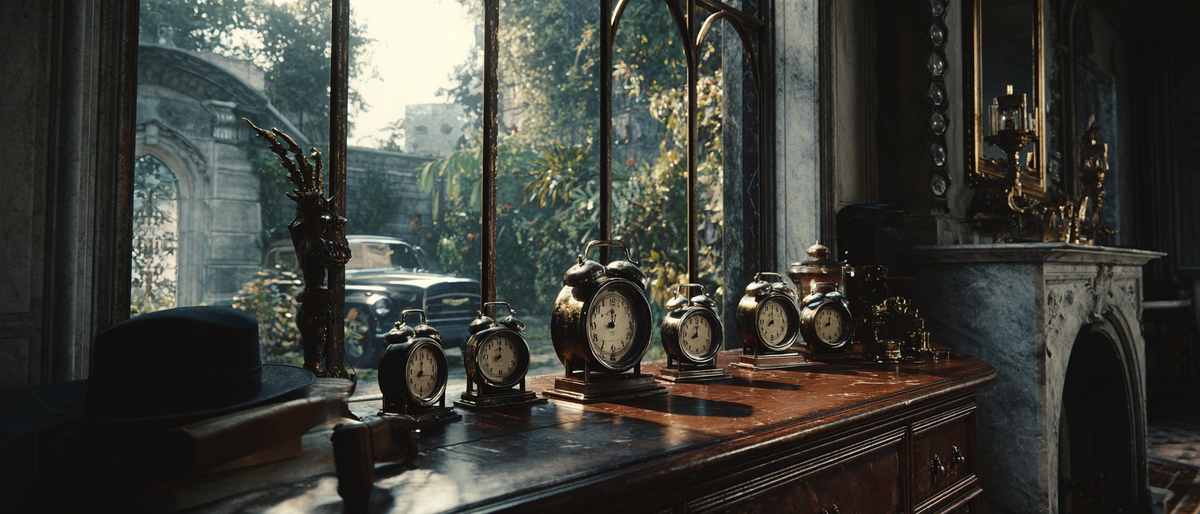
In the annals of the Golden Age, there exists a persistent, perhaps even wilful, delusion that the detective novel represents a clean break from the superstitious shadows of the past—a triumph of the electric light over the guttering candle. Yet, to observe the Queen of Crime in her full, formidable power is to witness not a rejection of the Gothic, but a masterful sublimation of it. When The Seven Dials Mystery arrived in 1929, the critics at the Times Literary Supplement were quick to sense a shift in the wind, noting with a mixture of surprise and intrigue that Agatha Christie had seemingly abandoned the "methodical procedure" of the analytical puzzle for the "romance of universal conspiracy." They caught the scent of the eighteenth century’s midnight oil; they recognized that beneath the roar of the Bright Young People’s motor cars lay the ancient, crumbling foundations of the Gothic romance.
Christie’s brilliance lies in her realization that the "whodunnit" is fundamentally a ghost story that refuses to stay dead. In The Seven Dials Mystery, she does not merely write a thriller; she constructs a modern Abbey of Udolpho within the manicured hedges of the English countryside. The "universal conspiracy" of which the TLS spoke is the direct descendant of the shadowy inquisitions and secret brotherhoods that once haunted the imagination of Ann Radcliffe. By populating her narrative with masked figures and the rhythmic, ritualistic placement of seven clocks upon a mantelpiece, Christie invokes a sense of the uncanny that borders on the preternatural. She understands that for the eventual solution to satisfy, the atmosphere must first be thick with a dread that defies the rational mind.
This "immersion" in the Gothic is not a regression, but a profound carry-forward of the genre’s most potent qualities. The 18th-century Gothic benefited the mystery by teaching it the art of the "oppressive environment"—the idea that a house, or a society, can be a malevolent participant in the crime. Christie takes this inheritance and polishes it until it gleams. In Seven Dials, the mystery of the secret society isn't merely a plot point; it is a psychological haunting. The reader is plunged into a world where identity is fluid, where every masked face is a "double," and where the truth is buried beneath layers of ancestral silence and modern deception.
Thus, Christie stands as the great bridge-builder. She took the "nod" to the Gothic—the scream in the night, the hidden passage, the sense of an inescapable past—and wove it into the very fabric of the detective’s logic. She proved that one could be a child of the Enlightenment, as Hercule Poirot or Superintendent Battle surely are, while still dwelling in a world where the shadows are long and the secrets are ancient. The Seven Dials Mystery is our primary evidence that the "whodunnit" did not kill the Gothic; it simply gave the monster a motive, a name, and a seat at the dinner table.
From Otranto to Oxford: The Lineage of the Locked Room
To understand the structural integrity of the Christie manor, one must first look to the ruins of the eighteenth-century imagination. The "Locked Room" and the "Closed Circle"—those foundational pillars of Golden Age detection—are not inventions of the twentieth century, but are rather the refined, architectural descendants of the Gothic dungeon. When Horace Walpole unleashed The Castle of Otranto upon a startled public, he established the primacy of the "Enclosed Space" as a theater of moral and physical peril. The castle was a labyrinth of trapdoors and subterranean passages where the laws of the outside world ceased to apply. By the time we reach the nineteenth century, this architectural dread had begun its slow migration from the supernatural to the cerebral.
The evolution of the genre saw the "Cursed Abbey" undergo a fascinating process of domestication. In the hands of Joseph Sheridan Le Fanu and Wilkie Collins, the high-vaulted terrors of the continent were brought home to the English estate. The fog-choked streets of Sherlock Holmes’s London represent the penultimate stage of this transformation; here, the "Great Detective" acts as a secular exorcist, entering the "sinister crime scene"—that modern proxy for the haunted chamber—to drive out the demons of confusion with the cold iron of deduction. Yet, even Holmes, for all his violin-playing and chemical analysis, could never quite escape the Gothic atmosphere. The moor in The Hound of the Baskervilles is as much a character of ancient, irrational malice as any specter in a Radcliffean forest.
Christie’s brilliance lies in how she perfected this lineage by making the "Labyrinth" psychological as much as physical. In the traditional Gothic, the protagonist is lost within a stone maze; in the Christie mystery, the reader is lost within a maze of social etiquette and false appearances. The "Locked Room" is no longer just a chamber with a bolted door; it is a metaphor for the human heart, barricaded by secrets and ancestral shame. She understood, perhaps better than any of her contemporaries, that the "clue" is merely a rationalized version of the Gothic "omen." Where the 18th-century hero might see a bleeding statue as a sign of impending doom, Christie’s heroine sees a misplaced teaspoon or a stopped watch—the supernatural herald has been replaced by the domestic anomaly, yet the sense of profound, cosmic "wrongness" remains identical.
Furthermore, Christie carried forward the Gothic obsession with "Mortmain"—the dead hand of the past reaching into the present. The mystery genre benefited immeasurably from this Gothic infusion of history. Without the weight of the "ancestral secret," the whodunnit risks becoming a mere game of logic. By infusing her puzzles with the spirit of Otranto—the sense that an old sin has finally ripened into a new murder—Christie ensured that her work possessed a gravity that transcends the mere turning of pages. She took the skeletal remains of the Gothic tradition and clothed them in the tweeds and silks of the 1920s, proving that while the castle may have been exchanged for an Oxford college or a country house, the terror of being trapped with one’s history remains the most potent tool in the storyteller’s kit.
The Mechanical Ghost and the Seven Clocks
In the quintessential Gothic romance, the "supernatural" is a heavy, velvet curtain draped over the world, threatening to smother the light of reason. Ann Radcliffe, however, pioneered a revolutionary aesthetic—the explained supernatural—wherein the ghostly tolling of a bell or the vanishing specter is eventually revealed to be the work of human hands and hidden pulleys. It is within this specific tradition that The Seven Dials Mystery operates with such nimble grace. The image of the seven clocks, meticulously arranged in a grim, silent row following a death, is a masterstroke of Radcliffean theater. It possesses the shivering quality of a ritualistic curse, a symbolic haunting that momentarily paralyzes the characters with its eerie absurdity. Yet, Christie’s genius lies in her refusal to let the shadow linger; she uses the Gothic to arrest the heart, but the Whodunnit to satisfy the mind.
This movement from dread to logic is personified in the character of Lady "Bundle" Brent. In the 18th-century prototype, the "Distressed Damsel" was often a creature of high-strung nerves, navigating the subterranean passages of a ruin with a flickering candle and a propensity for fainting. Bundle, however, is the Gothic heroine reimagined for the age of the internal combustion engine. She navigates the labyrinthine corridors of Chimneys—a house that is itself a character of ancient, sprawling secrets—not with a sigh of despair, but with a firm grip on the steering wheel of her Hispano-Suiza. She represents the evolution of the seeker: one who still finds herself in the "perilous situation," spying upon masked conspirators and infiltrating the seedy underbelly of the Seven Dials district, but who treats the "masked inquisitor" not as a demon, but as a puzzle to be solved.
The secret society of the Seven Dials serves as the modern incarnation of the monastic orders and occult brotherhoods that once haunted the pages of The Monk or The Italian. Christie brilliantly recognizes that the fear of the "Anonymous Collective" is a perennial Gothic trope. By stripping the villains of their names and replacing them with numbers—Number One through Number Seven—she taps into the primal anxiety of being observed by an unseen, faceless power. Yet, true to the "explained" tradition, she eventually unmasks these figures, revealing that their power lies not in the mystical, but in the political and the predatory. The "Mechanical Ghost" is thus exorcised; the clocks are revealed to be not omens of fate, but tools of a very human, very calculated deception.
By wedding this 18th-century sense of high drama to the 20th-century espionage thriller, Christie demonstrates how the mystery genre carried forward the "Fine Qualities" of its predecessor. She understood that logic alone is a cold comfort; for a mystery to truly resonate, it must first invite us into the darkness. In Seven Dials, she invites us into a world of secret chimneys and silent timepieces, allowing us to feel the cold breath of the Gothic on our necks before she finally turns on the lights and shows us that the monster is merely a man with a motive.
Shadows Across the Canon
While The Seven Dials Mystery utilizes the Gothic as a playful masquerade, Christie’s broader oeuvre reveals a more profound, almost elemental immersion in the genre's darker waters. As her career matured, she moved beyond the "explained supernatural" into a territory where the atmosphere of the Gothic becomes indistinguishable from the psychology of the crime. In And Then There Were None, we see the "Closed Circle" mystery elevated to a state of pure, high-Gothic isolation. Soldier Island is the modern equivalent of the precipice-bound castle; cut off by the elements, its inhabitants are not merely suspects in a sequence of murders, but souls trapped in a purgatorial space where their past sins—those classic Gothic "hauntings"—manifest as a relentless, rhythmic retribution. Here, Christie proves that the "Old Sin" is the most terrifying ghost of all.
In the later masterwork Endless Night, Christie executes a brilliant inversion of the "Gothic Romance." She presents us with the quintessential tropes: a "cursed" piece of land known as Gypsy’s Acre, a beautiful heiress, and a sense of impending doom that hangs over the landscape like a shroud. However, in a stroke of literary genius that would have left the 18th-century masters breathless, she reveals that the "Gothic Villain" is not an outsider or an ancient specter, but the very narrator through whose eyes we have viewed the romance. This is the psychological Gothic at its most potent—the realization that the "haunted house" is actually the human mind, and the "monster" is the person standing right beside you.
We see this synthesis further refined in Hallowe'en Party, where the festive trappings of a village gathering are slowly stripped away to reveal a landscape of sacrificial groves and watery graves, echoing the folkloric Gothic tradition of Sheridan Le Fanu. Christie’s brilliance lay in her ability to recognize that the "fine qualities" of Gothic literature—its preoccupation with the macabre, its use of the pathetic fallacy, and its focus on the grotesque—could be used to heighten the emotional stakes of a puzzle. By grounding her murders in these deep-seated cultural fears, she transformed the "whodunnit" from a temporary diversion into a lasting exploration of the darkness that resides within the domestic sphere.
Whether it is the oppressive, humid dread of the Nile or the snow-blinded claustrophobia of the Orient Express, Christie’s settings consistently function as Gothic "liminal spaces." They are places where the rules of civilization are suspended, and the characters are forced to confront the primal truth of their own natures. In doing so, she did not merely "benefit" from the Gothic; she became one of its most sophisticated modern practitioners ensuring that the genre’s legacy of suspense and psychological depth would continue to thrive within the sturdy, logical frame of the English mystery.
The Unmasking of the Century
As we draw the velvet curtains upon our analysis, we find that Agatha Christie’s true legacy is not merely that of a clever puzzle-maker, but that of a master alchemist who transmuted the leaden dread of the eighteenth century into the glittering gold of the Golden Age. The "Unmasking" of the murderer in the final chapter is, in essence, the ultimate Gothic resolution. It is the moment when the "Otranto-esque" shadow—the inexplicable terror that has loomed over the manor—is finally subjected to the unrelenting light of human reason. Christie stands as the ultimate keeper of the keys, the one who understands that for the light of the detective's lantern to be truly dazzling, the darkness of the cellar must first be absolute.
In The Seven Dials Mystery, and indeed across her storied canon, Christie demonstrated that the mystery genre did not survive by "outgrowing" its Gothic roots, but by deepening them. She understood that the human psyche craves the "nod" to the supernatural; we desire the thrill of the masked figure and the omen of the midnight clock, provided we are eventually granted the safety of a logical explanation. By carrying forward the Gothic’s emphasis on atmosphere, the burden of the past, and the isolation of the setting, she ensured that the whodunnit would remain more than a mere game of "cluedo." She gave it a soul—a dark, trembling, and profoundly human one.
The 18th-century masters—Radcliffe, Walpole, and Lewis—would surely recognize their own fingerprints upon Christie’s work. They would see their "Distressed Heroines" in the plucky, motor-driving Bundle Brent; they would see their "Sinister Inquisitors" in the masked Number One of the Seven Dials; and they would recognize their "Ancestral Curses" in the hidden motives that stretch back through decades of family history. Christie’s brilliant achievement was to take these wild, sprawling briars of romantic terror and prune them into the elegant, lethal hedges of the English country garden.
The "Queen of Crime" reigned over a kingdom that was as much Gothic as it was modern. She demonstrated that the most terrifying ghosts are not those that rattle chains in the attic, but those that sit quietly in the drawing room, sipping tea and waiting for the clock to strike. In the hands of Agatha Christie, the Gothic did not die; it simply removed its mask, revealed its motive, and solidified its place as one of the most resilient and enduring literatures of the modern age.
Selected Bibliography
Primary Works: Agatha Christie Christie, Agatha. And Then There Were None. London: Collins Crime Club, 1939. ———. Endless Night. London: Collins Crime Club, 1967. ———. Hallowe'en Party. London: Collins Crime Club, 1969. ———. The Seven Dials Mystery. London: William Collins & Sons, 1929.
Foundational Gothic Texts (18th Century) Lewis, Matthew Gregory. The Monk: A Romance. London: J. Bell, 1796. Radcliffe, Ann. The Italian, or the Confessional of the Black Penitents. London: T. Cadell Jun. and W. Davies, 1797. ———. The Mysteries of Udolpho: A Romance. London: G. G. and J. Robinson, 1794. Walpole, Horace. The Castle of Otranto: A Gothic Story. 2nd ed. London: William Bathoe and Thomas Lownds, 1765.
Nineteenth-Century Lineage & Detection Collins, Wilkie. The Moonstone. London: Tinsley Brothers, 1868. ———. The Woman in White. London: Sampson Low, Son, & Co., 1860. Doyle, Arthur Conan. The Hound of the Baskervilles. London: George Newnes Ltd, 1902. Le Fanu, Joseph Sheridan. Uncle Silas: A Tale of Bartram-Haugh. London: Richard Bentley, 1864.
Contemporary Reviews & Secondary Sources The Times Literary Supplement. Review of The Seven Dials Mystery, by Agatha Christie. April 4, 1929.
ओम् तत् सत्
Member discussion: