
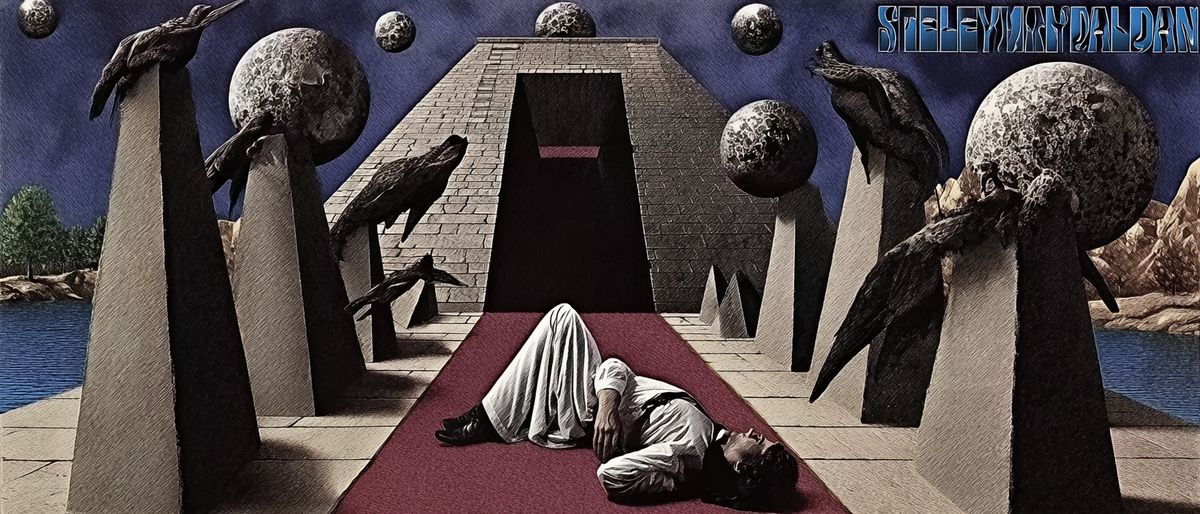
Responding to Kid Charlemagne
by Jonathan Brown
"This has been a novel about some people who were punished entirely too much for what they did. They wanted to have a good time, but they were like children playing in the street; they could see one after another of them being killed—run over, maimed, destroyed—but they continued to play anyhow." – Philip K. Dick, Epilogue to "A Scanner Darkly"
The Song
There is a guitar solo — sixteen bars, Larry Carlton, 1976 — that knows more about a particular American decade than most books written about it. It arrives just over half-way through Kid Charlemagne, slides in over a groove that has no business being as joyful as it is given the subject matter, and says everything the lyric has been circling.
I have been listening to that solo, on and off, for the better part of forty years. It still does what it did the first time — which is to say it grieves and exults simultaneously, without resolving the tension between those two states, without suggesting that resolution is either possible or desirable. Donald Fagen and Walter Becker understood something about irony that most writers who reach for it do not: that it is not a form of distance. It is a form of precision. The raised eyebrow is often a more effective response than blunt declaration.
The song is about Owsley Stanley, almost certainly — Augustus Owsley Stanley III, Bear, the man who synthesized an estimated five million doses of LSD in the mid-sixties, who built the Grateful Dead's Wall of Sound, who understood that the music and the chemistry were aspects of the same project. He was, in the most literal sense, a synthesizer — bringing together technology, art, chemistry and a genuinely utopian social vision into something that briefly cohered into what felt, to those inside it, like a civilization. A counter-civilization, granted, but one with its own laws, its own currency, its own emperor. Kid Charlemagne. The name is perfect: the imperial grandeur slightly deflated by the "Kid" prefix, the boy emperor, the dreamer who unified something briefly extraordinary and then had to run for it when the dream collapsed. Which it did. The Haight utopia in particular had the relative lifespan of a hypothetical mayfly despite reflecting on a tiny scale the ambition of Charlemagne's actual empire — which is to say it dissolved in single generation, into warring successor states, leaving behind a legend disproportionate to its duration.
I became entangled in the tattered edges of that legend, much later, at a remove of geography and a decade. The empire was gone. What remained were its artifacts, circulating through residual networks — through arts communities and university towns, through the connective tissue of people who had been there and people who knew people who had. By then, Owsley himself had largely withdrawn. He was working on what would turn out to be his last alchemical project. And it was, characteristically, a statement as much as a product.
The Perceptual Record
The clinical vocabulary that attempts to describe the subjective psychedelic experience — "hallucination," "psychosis," "break from reality" — carries embedded assumptions that obscure more than they illuminate, but I speak as someone for whom this is not an academic question.
An LSD "trip" does not, in its most fundamental aspect, generate false perceptual content. Rather it amplifies the perceptual field. Dramatically, sometimes terrifyingly, but the mechanism is expansion rather than fabrication. The visual and auditory acuity that the drug produces is real acuity — you are not seeing things that aren't there, you are seeing more of what is there than the nervous system, in its ordinary filtering function, would ordinarily permit. The patterns in a surface, the overtones in a sound, the layered emotional content in a face — these are genuinely present in the environment. The sober brain suppresses them as noise, because attending to everything at full amplitude simultaneously would make functional navigation of ordinary life impossible. What the drug does is temporarily disable the filter.
Huxley called it the reducing valve — the brain's mechanism for constraining the totality of available experience to a manageable trickle. I arrived at essentially the same formulation independently, before reading him, because the experience more or less demands it. Once you understand that you are not hallucinating but misreading a dramatically expanded perceptual field, a certain quality of panic — the fear that you have lost contact with reality — begins to subside. You have not lost contact. You have, in some sense, gained it. The question of whether that gain is sustainable, or whether the ordinary filtering function serves purposes beyond mere convenience, is one the experience does not answer for you.
There is another piece of this that gets systematically overlooked in both the clinical literature and the cultural mythology, and it matters: LSD is, at its neurochemical core, a stimulant. The most powerful stimulant ever synthesized, I would argue, with — and this is not a minor qualification — the worst half-life of any stimulant known, barring perhaps coffee or chocolate. Within hours, the 5-HT2A receptors it works on begin dramatically down-regulating, which is why you cannot simply redose your way back to the peak. The molecule contains its own limiting mechanism, which is more than can be said for methamphetamine in its modern iterations — a substance that has been progressively refined, across successive generations, to engineer around the body's defensive responses, to extend duration, to raise the ceiling, to eliminate the mercy of a natural terminus.
I have, over the years, had considerable experience at both ends of this spectrum. And the phenomenological overlap between a high-dose LSD experience and the particular perceptual state produced by amphetamine — not at the recreational end, but deeper in — is striking enough that I have come to think of them as related instruments playing different registers of the same fundamental note.
Philip K. Dick was on prescription amphetamines for most of his adult life. The sheer volume of the work is, partly, a pharmacological phenomenon. So is the quality of attention the best of it pays to surfaces, to the texture of ordinary objects and transactions, to the question of what is real and what is a sufficiently convincing simulation of real. A Scanner Darkly is the book where he stopped fictionalizing the question and started reporting it — and the epilogue, which is not fiction at all, is among the most devastating things he ever wrote. A list of names. "Dana, permanent neurological damage. Donna, permanent psychosis... and so forth", without excepting himself. "These were comrades whom I had." The past tense does all the work.
I have my own version of that list. I will not reproduce it here. But I know it by heart, and the names on it inform everything that follows.
Travel with me in your imagination to Bard College, (Simon's Rock satellite campus), 1981 or thereabouts. The pastorally stunning Berkshire foothills of the ancient Adirondack mountains. A campus that had always operated significantly outside the ordinary academic gravity field — tiny classes, highly paid, world-class professors, self-selected students, astronomical tuition, with the arts at the center rather than the periphery, an institutional culture with a higher tolerance than most for radical departures from convention. The kind of place that had produced, (at Bard a decade earlier), two unusually literate young men named Donald Fagen and Walter Becker, who, like me and my compadres-in-crime, had departed under some duress, yet went on to produce some of the most precisely intelligent lyrics and music of the American century. A node, in other words, in a network whose threads ran clear back to the sixties yet were still, if thinning, faintly operational.
What arrived through that network, in the early eighties, was a final dispatch from the emperor. Black 8x8" sheets perforated into 100 .8x.8" squares. Samurai clan symbols on each square, 10 designs. Pure (we would say "glowing") crystal-LSD in brown, UV-protective bottles, which we mixed into an ethanol base and dutifully brushed onto the Samurai blotter in preparation for distribution to the aesthetically adventurous student bodies of several small, regional liberal arts colleges. Bear's (Owsley's) signature product — the aesthetic as deliberate as everything he had ever produced, because the container was always part of the message with him. The matte-black background and the crisp, white warrior symbol spoke of discipline, of the correct relationship to extremity, of — perhaps — the appropriate psychological preparation for what you were about to undertake. Whether the preparation was adequate is a question I am still, in certain respects, working out.
Without belaboring the inevitable story, suffice to say that my friends and I were summarily escorted off the campus before the academic year concluded. The Steely Dan song lyrics, telling the story of intrigue, departure and adventure that concluded their own "tenure" at Bard, when I eventually heard them, produced a recognition that was almost comic in its precision. "Never goin' back to my old school." Indeed.
The Prior Hallucination
Here is the irony that presents itself with a clarity so sudden it is almost funny: you discover, in the midst of what the clinical literature will later call a "break from reality," that the reality from which you have broken was itself merely a construct. Not an accident. Not a failure of sufficient sophistication. A construction, collectively maintained, functioning precisely because the people inside it experience it not as a construction but as the world as it simply and, by collective agreement, self-evidently is.
Money is a fiction that works because everyone agrees to treat it as real. National identity is, as Benedict Anderson observed, an imagined community — which is not a dismissal of it but a description of its actual architecture. The social hierarchies that organize daily life, the conventions that structure every interaction, the values that feel self-evident and therefore universal — these are inherited arrangements, historically contingent, maintained by a form of collective agreement so thoroughgoing that questioning it reads, to those inside it, as pathology.
This is not an original observation. It is there in the Upanishads, in Plato's cave, in the Zhuangzi's butterfly dream — the ancient and recurring suggestion that the ordinary waking state may be its own kind of sleep, that what we take for reality is a particular, culturally specific, extremely well-maintained dream. Baudrillard made a career of elaborating it. Foucault spent several hundred pages on its institutional enforcement mechanisms. Durkheim called the collective energy that sustains it "effervescence" and studied its ritual maintenance with the care of an engineer examining load-bearing structures.
The psychedelic experience does not introduce this idea as a philosophical proposition — you can read all of the above, nod, then return to your life essentially unchanged, because the intellect can hold a subversive idea without being destabilized by it. What it does is make it viscerally, perceptually, inescapably apparent. Not as a thought. As a direct encounter. The scaffolding becomes visible. The particular experience of freedom that often follows from that visibility is not a delusion. It is in fact a more accurate perception of the situation than the one it temporarily replaces. This is why the experience is so often described, by those who move through it without being destroyed by it, as liberating.
The problem is not the liberation. The problem is what happens next.
Because Odysseus has changed, not Ithaca. The people waiting there — the family, the former friends, the institutional structures, the whole apparatus of ordinary life — are still inside the construction, experiencing it as reality itself, and here you are, saltwater-drenched, trying to describe the geography outside the well-defined confines of harbor and coastline. There is no shared language for this. The language is part of the construct. The very grammar of rational discourse is inflected by the assumptions of a consensus reality, which means that every attempt to describe what you've seen either sounds like poetry — comfortably aestheticized, harmlessly beautiful, filed under "interesting experience" and left there — or sounds like symptoms.
It sounds, specifically, like schizophrenia. And at that point the machinery engages.
The Return
There are two ways to come back, and society has a prepared response for each of them.
You can come back shattered. Weeping, disoriented, unable to account for yourself, haunted by residues of the expanded perceptual field that won't resolve back into the ordinary filtering mode. This response can be accommodated. It confirms the available narrative perfectly: you went somewhere dangerous, it broke you, and we will now manage your brokenness in ways that serve as a demonstration of our own sanity. The psychiatric facility, the Thorazine, the Haloperidol, the careful erasure of whatever you came back knowing — these are presented as treatment, and in a limited, functional sense they are, because the goal is reintegration into the consensus and neuroleptic psychaitry reliably produces something that resembles, from the outside, a person who has stopped arguing with the consensus.
What Thorazine (to address one example in a plethora of chemical restraints) actually does — chlorpromazine, to use its proper name — is aggressively block dopamine receptors, enforcing a perceptual narrowing, a pharmacological reimposition of the reducing valve. It does not treat anything in any meaningful clinical sense. It sedates. It corrects. The message it carries, beneath the clinical language, is precise: your perception is deviant and we will adjust it with chemistry until it conforms. The irony, which is not a small one, is that this is exactly what MKUltra was attempting from the other direction — the use of chemistry to manage what people perceive and report, the state as the administrator of perceptual experience. The polarity of the intervention is reversed. The intention is identical.
The second way to come back is lucid.
Not undamaged — that distinction matters, and I'll return to it. But clear. Possessed of a perception that, whatever its cost, has genuinely seen something, and that retains, in the aftermath, the capacity to see it. To look at the machinery of the consensus reality — the money, the hierarchy, the organized violence dressed in institutional clothing, the vast and intricate apparatus for not noticing what is actually happening — and to name it with accuracy and without sentimentality.
This response is not accommodated. This response produces the truly punitive reaction, because it cannot be managed through pity. A shattered person can be pitied, and pity is a mechanism of control — it positions the pitier as sane and the pitied as the proof of sanity's value. A clear person cannot be pitied. A clear person must be discredited.
The schizophrenia diagnosis is conveniently available. So is the more informal apparatus — the withdrawal of employment, of housing, of relationship, of community, the quiet and cumulative removal of everything that makes ordinary life navigable. The Soviet Union ran a formal version of this: "punitive psychiatry," the diagnosis of "sluggish schizophrenia" applied to political dissidents whose perception of the Soviet system was accurate and whose accuracy made them dangerous. The West has always preferred the deniable version, where the enforcement is social and economic rather than overtly state-directed, where no one has to sign an order because the mechanism is distributed across a million small and individually defensible decisions. I no longer know what to do with you. You make people uncomfortable. You've changed. It's probably better if —
And then the silence. Not even the dignity of rupture. Simply the gradual, undramatic cessation of relationships that turned out to have been contingent on your remaining inside the shared dream. The moment you step outside it, you discover their actual structural basis, which was not affection or history or any of the things you believed it was, but rather a mutual investment in a particular version of reality that you have now, unilaterally and without adequate consultation, abandoned.
In a social sense, you have died. The informal gulag of the expelled is populated entirely by people who made this discovery at various velocities.
I returned from my own Odyssey by something less than the cleanest possible route. The cost was real and extended and I carry parts of it still. What I will not do is present that cost as evidence for the prosecution, because the prosecution's case is exactly what I've been describing, and its evidence is always the damage, never the wisdom that the damage purchased. The damage and the insight are not separable. That is the thing that is not articulated in the available clinical vocabulary. That is what Kid Charlemagne manages to say.
The Casualties and the Survivors
Dick's epilogue to A Scanner Darkly is one of the most poignant and visceral responses to this era that I know, and its honesty consists precisely in the absence of the literary devices that make the rest of his work so extraordinary. No unreliable narrators. No reality-bending conceits. No ironic distance. Just the names, and what happened to them, rendered in the flat declarative of a man who has given up on making it mean something beyond what it simply, tragically is.
He includes himself. "These were comrades whom I had." The past tense is doing more work than most writers achieve with entire paragraphs. He knew what he was part of, and he knew what it cost, and he did not exempt himself from the accounting.
The question the epilogue raises and cannot answer is the one I find myself returning to: what was the difference? Not a moral difference — the casualties were not weaker, or less careful, or less intelligent than the survivors. Not a pharmacological difference, necessarily, though dosage and frequency and the specific chemistry of individual nervous systems are real variables that the mythology tends to flatten into irrelevance. Something more contingent than any of those. Something closer to luck, in its most stripped-down and philosophically uncomfortable sense — the thing that happens to you rather than the thing you do.
What I know, from the inside of this rather than from the literature, is that the damage tends to arrive not in the experience itself but in the return, and not from the perceptual expansion but from the collision. The expanded perception, in itself, is not destructive — it is disorienting, certainly, and at high enough doses or in psychologically unprepared individuals it can produce acute crises, but the acute crisis is usually survivable. What is less survivable is the sustained pressure of a social environment that reads your perception as pathology and responds accordingly, over months and years, with the full apparatus of diagnosis and marginalization and the quiet withdrawal of everything that makes life navigable. The damage that Dick catalogs in his epilogue is downstream, in many cases, not of the drug but of the return.
This does not excuse the misguided lives. It locates the injury more accurately.
The amphetamine thread is worth naming here, because it runs through too much of the century's significant creative work to be dismissed as coincidence or romantic mythology. Dick's extraordinary productivity — fifty novels, hundreds of stories, the sheer impossible volume of it — is partly a pharmacological fact. Kerouac's On The Road was written in three weeks on a benzedrine roll and reads like it, which is not a criticism, because the benzedrine metabolism is built into the book's actual syntax, its breathless accumulation, its refusal to stop. Auden took Benzedrine every morning for twenty years. The postwar American literary acceleration has an amphetamine engine, (one that was, ironically, engineered in the pharmacology of wartime Germany and the subsequent emulation of the Allied powers during WWII) underneath it that the literary histories tend to politely omit.
Gibson is more inferential — he has not, to my knowledge, discussed his pharmacological history with anything like Dick's devastating candor — but the early Sprawl novels have a phenomenology that feels chemically informed in a way that is difficult to account for otherwise. The hypersaturated sensory field, the prose perpetually finding detail at the edge of perception, the sense that the pattern recognition is running at maximum and finding signal in everything — these are not descriptions produced from outside a particular kind of cognitive state. They are reports from inside it. The map has the texture of the territory.
What survives all of this — the casualties, the institutionalization, the damage, the long trail of consequence — is the work. This is not consolation. It is simply a fact, and a complicated one. Carlton's solo on Kid Charlemagne is not consolation for anything. It is proof that something real happened — that a creative culture, however brief and however violent in its final accounting, engendered a chemistry, a vision, and a quality of attention that otherwise would not have existed. You cannot unhear it. You cannot institutionalize it or correct it with Thorazine or remove it from the record of what human beings have made when they were fully, dangerously, inimitably alive to what they were doing.
The emperor is dead, his ashes scattered on a soundboard in Chicago. His empire lasted maybe a few decades, but the songs that documented it will outlast us all.
What the Song Knows
My intention is not merely to write an essay about a song by Steely Dan. Crucially I am writing about Steely Dan in the same sense that Kid Charlemagne tells a story about Owsley: using a specific, datable, richly particular subject as the instrument through which something larger and less easily articulated can be approached without falsifying it.
What Fagen and Becker understood, and what the song demonstrates rather than argues, is that irony is not the enemy of feeling. It is one of its most available registers, when the subject is one that bluntness would either sentimentalize or condemn. The history I've been tracing here is one that has been damaged, in roughly equal measure, by both of those responses. The sentimentalized version — the Summer of Love as innocent golden age, the casualties as brave explorers, the whole soft-focus mythology that the sixties engendered— is a lie of omission that serves the living at the expense of the dead. The condemnatory version — the War on Drugs narrative, the clinical vocabulary of pathology and deviance, the pharmacological correction of perception that dares to call out the scaffolding — is a lie of commission that serves the consensus at the expense of the truth.
The song holds both without resolving them, which is a starkly honest position. A magnificent groove weaves through images of ruin like a fantastic, brilliantly colorful phoenix. Carlton's solo grieves and exults simultaneously. The lyric is sardonic and the music is alive and neither cancels the other out but the harmonic whole tells a tale that either part on its own could not.
I cannot bring into perfect focus precisely what I survived or what it cost me or what, if anything, it gave me in return. The accounting is ongoing and the books don't balance cleanly. What I do know is that I heard the song, and I understood it, and the knowing was not theoretical.
There is an emotional register, not nostalgia, not quite grief, but something more complex and less domesticated than either — that arises in me when the Carlton solo begins. It is the recognition of someone who is being told, in a language that bypasses the available clinical vocabularies, that what happened to me and to so many others was real. That the cultural phenomenon, brief and costly as it was, was real. That the perception, however socially inconvenient, was not pathology. That the dream, even as a ruined thing, even as a cautionary tale, even as a list of names on a dedication page that reduces grown men to silence — held within it something genuine and irreducible and worthy of an honest telling.
Those San Francisco nights. The gentle people, scattered. Kid Charlemagne, suitcase in hand, running.
A solo begins. Sixteen bars. Telling a story that words were not meant to carry alone.
Jonathan Brown writes on technology, security, and culture for bordercybergroup.com and aetheriumarcana.org.
Member discussion: