The Life and Vision of Ramón Medina Silva
by Jonathan Brown
A Wixárika artist, pilgrim, storyteller, healer and defender of his people who taught the wider world to see sacred history in a strand of colored yarn
Ramón Medina Silva lived only about forty-five years. He was born in poverty in the mountains of western Mexico, survived a devastating childhood illness, worked as a migrant laborer, became a husband and father, learned the demanding religious disciplines of his people, guided pilgrims across hundreds of miles of Mexican landscape, spoke publicly in defense of Wixárika culture, and helped create one of the twentieth century’s most immediately recognizable Indigenous art forms.
His life was brief, but it was anything but small.
Today Ramón’s yarn paintings reside in distinguished museums. Scholars reproduce his accounts of creation, death, pilgrimage and the powers of sacred plants. His pictures have helped people far beyond Mexico apprehend something of a universe in which fire is an ancestor, deer and peyote disclose one another, maize is life made edible, and geography is inseparable from memory and prayer. Yet the renown of the art has often obscured the man who helped bring it into being.
Ramón was not merely an “informant” standing behind the books of foreign anthropologists. He was an artist and intellectual in his own right: a narrator of enormous memory, a religious experimenter, a cultural mediator, a performer, a social advocate and a thinker with his own distinctive interpretations. Nor did he work alone. His wife, Guadalupe de la Cruz Ríos—Lupe—was an accomplished weaver, artist and ceremonial practitioner whose contribution belongs at the center of this story.
To celebrate Ramón properly is therefore to do more than admire his colors. It is to approach the living world of relationships from which those colors came.
Young Arrow
Ramón was probably born in 1925 or 1926 at a small ranch called Las Cuevas, within the orbit of San Sebastián Teponahuaxtlán in the Sierra Madre Occidental. His Wixárika name is generally rendered Ürü Temai, “Young Arrow Person” or simply “Young Arrow.” The people to whom he belonged have long been called Huichol in Spanish and in older anthropological writing; Wixárika is their own name and is now increasingly preferred. The plural is Wixaritari.
The Sierra homeland extends through rugged portions of Jalisco, Nayarit, Durango and Zacatecas. Its steep canyons helped Wixárika communities preserve unusual continuity through centuries of colonial pressure, although remoteness never meant isolation. Ramón’s own life embodied the movement between Sierra and surrounding society.
His paternal grandfather was remembered as a respected mara’akáme, a ritual specialist whose work could include healing, divination, dreaming, ceremonial singing and communication with divine ancestors. Ramón’s mother possessed extensive ceremonial knowledge and had reportedly traveled repeatedly to Wirikuta, the sacred desert far to the east. His father left the household or was absent for long periods, and Ramón grew up amid severe material hardship.
One childhood episode later assumed the significance of a vocation. A coral snake bit him, leaving his legs paralyzed for months and bringing him close to death. His grandfather eventually healed him. Ramón understood the ordeal as a summons through illness and reportedly pledged himself to complete his preparation before Tatewarí, Grandfather Fire, and Tayaupá, Father Sun. A biomedical account explains his suffering; Ramón’s religious account explains what survival came to require of him.
What a Mara’akáme Must Know
The English word shaman is convenient but dangerously flattening. A mara’akáme is not simply a person who consumes peyote, enters a trance or performs cures. The role is grounded in knowledge, service, discipline and reciprocal relations maintained over years.
A mara’akáme learns extended ritual songs and sacred narratives; interprets dreams; diagnoses affliction; conducts ceremonies; carries offerings; knows sacred places; and helps sustain proper relations among people, ancestors, animals, plants, weather and land. Authority must be demonstrated through endurance, competence, service and community recognition.
Sources differ over the exact stage Ramón had reached. Fernando Benítez called him an exceptional apprentice singer-shaman; Peter T. Furst wrote that his fifth pilgrimage in 1968 culminated his self-training as a mara’akáme and that he subsequently led two more. This should not become a trial of “authenticity.” Ceremonial authority is not a Western diploma conferred on a universally agreed date. Ramón guided pilgrimages, bestowed ritual names, narrated sacred history, accepted healing obligations and instructed others. He was an active practitioner completing the demanding path of the mara’akáme.
What impressed those who worked with him was not a title but the range of his ability. Furst remembered a charismatic man gifted across Wixárika art, craft and performance. In a later assessment he emphasized Ramón’s talent for philosophical speculation as well as his restless search for new modes of expression. The editors of People of the Peyote credited him with something like literary genius: he supplied Furst and Barbara Myerhoff with enough mythological and philosophical material for a book while giving Benítez more than one hundred pages of substantially different narratives.
Ramón was not reciting a memorized catechism. He inhabited a tradition deeply enough to think creatively from within it.
A World Made of Relationships
The religious universe visible in Ramón’s work cannot be reduced to a list of “gods.” Wixárika sacred beings are intertwined with places, species, natural forces and ancestral events. A spring can be location, water source, divine presence and point of communication. Fire is flame, ceremonial center, elder and guide. Deer, maize and peyote are distinct, yet their identities enter one another through myth and ritual.
Tatewarí—Our Grandfather Fire—is the primordial mara’akáme who guides the ancestral beings. Tayaupá, Our Father Sun, illuminates and orders the world. Kauyumári, often understood as Elder Brother Deer, acts as messenger, guide and trickster. The female powers associated with rain, water, earth, maize and fertility are not ornamental additions to a male cosmos; they are indispensable to its fecundity and balance.
Ramón’s religious vocabulary was therefore ecological. Sacred life meant rain, cornfields, deer, springs, desert cactus, mountains, birds and fire. Religion was not a compartment called “belief”; it was worked into food, land, kinship, seasonal time and bodily endurance.
In 2025 UNESCO inscribed the Wixárika Route through Sacred Sites to Wirikuta on the World Heritage List: a braid of routes and twenty sites extending more than five hundred kilometers across five Mexican states. Its mountains, wetlands, caves, springs, plants and animals form a moving map of the Wixárika moral and spiritual universe—a truth Ramón helped outsiders perceive more than half a century earlier.
Going to Find One’s Life
Ramón led the peyote pilgrimages in which Furst and Myerhoff participated in 1966 and 1968. Myerhoff’s experience became the foundation of her celebrated book Peyote Hunt: The Sacred Journey of the Huichol Indians. Furst later thanked Ramón, Lupe and their companions for permitting the researchers to witness what it meant to be Wixárika—an unusually humble acknowledgment of how much the visitors had been given.
The journey to Wirikuta is sometimes misunderstood as a quest for an intoxicating plant. That misses nearly everything. Hikuri, or peyote, is approached ceremonially as a teacher, medicine and manifestation of sacred life. The pilgrimage re-enacts the primordial journey of the ancestors to the place where the sun was born. Participants do not simply remember an origin story; through discipline and ritual they return to it.
Ramón narrated a time when the ancestral beings were ill and the world had lost its proper vitality. Tatewarí gathered them and directed them toward Wirikuta, where they could encounter the Deer-Peyote and recover their lives. The pilgrimage repeats that restoration. It renews people, agriculture, community and cosmos together.
Preparation can require fasting and abstention from salt, chile and sexual relations. A purification rite requires disclosures to be received without jealousy. Ordinary names may be replaced by reversed, humorous or visionary ones: morning becomes evening and arrival departure. Such reversals loosen the apparent permanence of the everyday world and return pilgrims toward primordial possibility.
The peyote is “hunted.” Arrows mark the first cactus as the sacred deer, and harvesting traditionally leaves its root capable of regeneration. Pilgrims eat, pray, sing, keep vigil and await instruction. Visions occur within obligation, community memory and reverence—not detached from desert, ancestors, deer or maize.
Mexico’s National Institute of Anthropology and History succinctly identifies the central relations as maize, deer, peyote, eagle and fire. Maize is the body and life of the people; deer opened the way to Wirikuta and becomes peyote; feathers carry associations of elevation and mediation; Tatewarí guides and purifies. The INAH account of the sacred route is especially valuable because it presents the pilgrimage as a union of territory, cultural memory and spiritual practice rather than an exotic drug ceremony.
Ramón’s own formulation was simpler and deeper. Peyote, deer and the five colors of maize were beautiful, he said, “because they are right.” Beauty here is not prettiness. It is the visible quality of things standing in their proper relations.
Ramón and Lupe
Ramón met Guadalupe de la Cruz Ríos while they were working as migrant laborers in Nayarit. Their marriage joined two people of unusual artistic and ceremonial ability. Lupe was already an accomplished weaver. She understood fiber not as a neutral material but as a bearer of pattern, identity, memory and sacred form.
The couple eventually moved toward Guadalajara, settling there around the beginning of the 1960s. At the Basilica of Zapopan they encountered the Franciscan priest Ernesto Loera, who provided Wixárika artists with a place to offer their work. Ramón and Lupe made objects for sale while maintaining connections to ceremonial life and the Sierra.
Foreign anthropologists did not “discover” Ramón and invent his importance. Ramón and Lupe were already artists negotiating difficult economic conditions and deciding how to communicate with outsiders. Their 1965 meeting with Furst and Myerhoff created a two-way collaboration: the scholars gained access, knowledge and publications; Ramón and Lupe gained patrons, audiences and a new arena for asserting Wixárika knowledge.
Lupe’s importance continued after Ramón’s death. She became recognized as a mara’akáme, healer, singer, artist, family matriarch and cultural teacher. Smithsonian archival photographs from the 1990s show her blessing pilgrims, working with prayer arrows, teaching younger relatives and continuing the journey to Wirikuta. They record not the fading remnant of Ramón’s career but a woman sustaining and extending the ceremonial life they had shared. The Smithsonian’s Guadalupe de la Cruz Ríos collection helps restore her independent stature.
Any celebration of Ramón that leaves Lupe in the margins reproduces an old distortion. Their art arose from a household, a marriage, extended kin and a community—not from a solitary male genius sealed inside his visions.
From Ornament to Narrative
Ramón is frequently called the inventor of Wixárika yarn painting. That description honors his importance but erases the older history from which he worked.
Wixaritari had long employed colored fiber, wax, woven patterns and symbolic designs in offerings and ceremonial objects. Traditional nierikate could take the form of small votive disks or tablets that mediated vision and communication. Artists in the Guadalajara orbit were already applying yarn to wax-covered surfaces and producing decorative pieces for sale before Ramón made his decisive experiments.
His innovation was not the existence of yarn or wax. It was the conversion of the commercial board into an expansive narrative field.
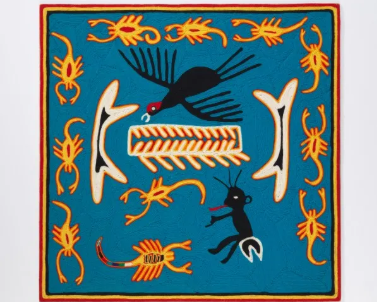
Furst recalled asking Ramón in 1965 why he did not use yarn to depict the stories and visions he described. Ramón was initially puzzled. Within days he produced a picture of the soul arriving in the village of the dead. Something fundamental had happened: a medium associated with decoration and compact sacred objects had become capable of holding an entire journey, populated by human figures, ancestors, animals, plants, paths, powers and events.
The technique is materially direct. A board is coated with beeswax or wax-resin adhesive. Yarn is pressed into it and guided by the artist’s fingers into outlines, figures and fields of color. Meaning accumulates strand by strand.
Simplicity of means is not simplicity of thought. A Ramón picture can be narrative, map, dream record and theological reflection simultaneously. A deity may appear as person, flame, animal or emblem; different moments coexist; the background becomes the charged atmosphere of revelation.
The Fowler Museum at UCLA calls Ramón a master at translating ritual and belief into spun fiber. That verb—translating—is exactly right. The paintings do not give outsiders unmediated possession of a vision. They carry something across: from dream to waking memory, from voice to image, from ceremony to portable object, from Wixárika experience to viewers who may possess none of its language or preparation.
Pictures That Think
Several surviving works show the range of Ramón’s imagination.
Tatewarí, Our Grandfather Fire does not merely provide a portrait of a god. Fire is presented as radiance, ancestral intelligence and the power around which ceremonial space becomes ordered. Colored flames and sparks allow the viewer to feel that personhood need not be limited to a human body.
The Life Force of Peyote, held by the Fine Arts Museums of San Francisco, makes vitality almost tactile. Its subject is not chemical spectacle but the power by which hikuri joins perception, medicine, land and instruction. The museum dates it to approximately 1965–1971, the concentrated final period of Ramón’s career.
How One Person Received a Huichol Name records visionary recognition. A pilgrim could receive a temporary sacred identity dreamed by the mara’akáme, placing that person within the journey’s mythic company. The picture preserves a particular encounter among dreamer, pilgrim, deity and place. The Fine Arts Museums preserve the work.
Other pictures address the soul after death, peyote in Wirikuta, the colors of maize, Father Sun, Kauyumári’s battle with the dangerous Kieri, and pilgrimage names for Furst and Myerhoff. Some are startling or humorous because their world includes bodily life without Victorian concealment.
The National Museum of Anthropology offers an indispensable warning: Ramón’s pictures communicate his own versions and visions, not a universally binding Wixárika creed. Different narrators and mara’akáte may tell sacred histories differently. Far from diminishing him, that observation restores his authorship. He was neither an anonymous specimen of “tribal mentality” nor a stenographer copying fixed tradition. He was Ramón, thinking within a tradition that allowed inspired variation. The museum’s study of his naming picture explicitly honors that individuality.
Storyteller, Musician and Public Advocate
The pictures were only one channel of Ramón’s expression. He was an exceptional oral narrator. He dictated extensive accounts of the journey of the dead, the primordial peyote quest, sacred plants, ceremonial transformations and the conduct of pilgrimage. One of his explanations, “How the Names Are Changed on the Peyote Journey,” later entered anthologies of ethnopoetics and university courses as a work of verbal art.
He was also a ritual musician. Recordings preserve him playing a mouth-resonated musical bow: the hunting weapon became an instrument addressing sacred beings and joining deer, peyote, music and pursuit.
Nor was he politically silent. After moving toward Guadalajara, he appeared on radio and spoke vigorously in defense of Wixárika interests. Benítez reported that these interventions made him admired among fellow migrants from the Lerma settlement. He later accompanied Benítez through the Sierra as guide, translator and consultant, but “consultant” hardly captures the relationship. Ramón determined what could be understood, corrected outside assumptions and supplied the intellectual substance from which others wrote.
Benítez emerged from their travels impressed by Ramón as a multitalented artist and storyteller and as an outstanding apprentice mara’akáme. Furst described him as charismatic and gifted, firmly committed to the validity of Wixárika religion even after living at the margins of the traditional subsistence economy. Myerhoff entrusted the central journey of her early career to his leadership. The Fowler Museum, looking back across the art that followed him, credits Ramón with a major role in the worldwide recognition of the nierika.
Together these judgments describe a person of presence. Ramón made outsiders listen, using the encounter to insist that Wixárika history, religion and interpretation possessed their own validity.
The Meaning of Balance
One of the most memorable accounts of Ramón concerns a waterfall in the mountains. He brought Furst, Myerhoff, Lupe and Wixárika companions to a place above a tremendous drop. After removing his sandals and making gestures toward the directions, he began leaping among the wet rocks. He landed close to the edge, disappeared behind boulders, reappeared unexpectedly and crossed rushing water with a freedom that terrified the visiting anthropologists.
The following day he asked whether they thought he had merely been showing off or had drunk too much beer. He then explained that he had wanted them to understand balance.
The physical demonstration translated a spiritual requirement. A mara’akáme journeys across a narrow and dangerous boundary between the ordinary world and a realm crowded with powers. Fear, vanity, confusion or loss of inner orientation can destroy him. The leap beside the abyss made an invisible discipline visible.
Later retellings claim that Ramón levitated or manipulated gravity. That does him no service. The documented event joins extraordinary human capability with religious meaning. He acted not to advertise a supernatural stunt but to teach through the body: courage became metaphor, and metaphor action.
The episode reveals theatrical intelligence. Knowing explanation might not cross the distance between Wixárika experience and his visitors’ assumptions, he created an event they would carry for life—the act of a teacher and performance artist as much as a ritual specialist.
A Life Without a False Halo
Respect does not require making Ramón flawless. Furst wrote sympathetically of his “all-too-human frailties” and inner turmoil. Ramón lived under considerable pressure: poverty, migrant work, the demands of family and ceremonial training, the dislocations of city life, and the expectations placed upon a gifted Indigenous man by scholars, collectors, officials and his own community.
His death was violent and painfully ordinary. In June 1971, during a fiesta at his Sierra ranch connected with preparing a new maize field, drinking contributed to a quarrel and gunfire. Ramón died at about forty-five. The circumstances should neither be concealed nor allowed to devour the life that preceded them. His death was a tragedy, not a key explaining away his religion, art or character.
There is nevertheless a piercing contrast in it. A man who had devoted himself to balance died during a moment in which human balance was lost. A singer of agricultural renewal was killed at a gathering connected to the preparation of the maize field. These facts are moving without being converted into supernatural irony.
The World After Ramón
Ramón’s artistic career in its mature form occupied scarcely six years. Yet the path he opened widened rapidly.
His cousin and onetime apprentice José Benítez Sánchez carried narrative yarn painting toward increasing scale, density and compositional complexity, ultimately becoming one of the most honored Wixárika artists of the twentieth century. Lupe continued creating pictures, including versions of subjects associated with Ramón, while developing her own authority as artist and mara’akáme. Later generations transformed yarn painting and beadwork again, responding to new markets, materials, political causes and environmental threats.
International demand has provided income and visibility for Wixárika families, but also imitation, middlemen, counterfeit “Huichol-style” merchandise and sacred imagery consumed as psychedelic decoration. Outsiders may admire deer, peyote and radiant color while ignoring land rights, poverty, mining pressure and Wixárika authority over sacred places.
Ramón’s example offers a better way to look. His art did not isolate beautiful symbols from the obligations that made them meaningful. Deer, maize, peyote, fire and rain belonged to a system of reciprocity. The picture could travel, but it continued to point back toward pilgrimage, community and place.
His legacy lives materially in museums, aesthetically in the flourishing of yarn painting, intellectually in preserved narratives, genealogically through Lupe and later artists, and politically whenever Wixárika people insist that their sacred world is not a picturesque remnant but a continuing civilization.
The World Heritage recognition of the route to Wirikuta gives international form to something Ramón spent his life expressing: a people’s culture cannot be separated from the paths, waters, mountains, species and ceremonial responsibilities through which that culture is renewed.
Beautiful Because They Are Right
It would be easy to conclude by calling Ramón Medina Silva a bridge between worlds. He was—but the metaphor can imply that Indigenous people exist chiefly to carry knowledge toward outsiders. Ramón’s life had meaning before foreign scholars arrived, and Wixárika religion does not require external recognition to become real.
Perhaps it is better to think of him as an arrow.
An arrow joins intention to direction. It can hunt, defend, designate a sacred center, carry feathers and prayers, or stand in the earth as a sign. Ramón’s name, Young Arrow, seems uncannily suited to the life he made. He moved between Sierra and city, oral narrative and museum object, ceremonial secrecy and public advocacy, ancestral form and artistic invention. He did not remain untouched by those crossings. Neither did the people who encountered him.
His greatest pictures are not windows through which we obtain effortless access to a mysterious culture. They are invitations to recognize that vision requires relationship and that beauty carries responsibilities. They ask us to slow down before a field of yarn and understand that every line has been pressed into wax by a human hand; every figure belongs to a narrated world; every sacred plant grows in actual soil; every pilgrimage consumes the strength of actual bodies; and every tradition persists because communities labor to renew it.
Ramón’s life deserves celebration not because it conforms to a fantasy of the flawless holy man. It deserves celebration because he made so much from conditions that offered him so little. He survived illness and poverty, mastered multiple arts, assumed religious responsibilities, defended his people publicly, welcomed serious listeners, taught through story and daring action, and helped devise a visual language capacious enough to carry a cosmos.
The strands he laid down more than half a century ago still lead somewhere. Follow them and they do not end at Ramón alone. They lead to Lupe and their family, to other artists and mara’akáte, to the Sierra communities, to the maize field, to Grandfather Fire, and eastward along the ancient braid of trails to Wirikuta.
They lead, finally, toward Ramón’s profoundly Wixárika measure of beauty: not novelty, luxury or fame, but right relationship.
The deer, the peyote and the maize of five colors are beautiful because they are right. Ramón Medina Silva spent his short, astonishing life helping others see why.
Principal sources and further reading
- Peter T. Furst, Visions of a Huichol Shaman (University of Pennsylvania Museum of Archaeology and Anthropology, 2003).
- Barbara G. Myerhoff, Peyote Hunt: The Sacred Journey of the Huichol Indians (Cornell University Press, 1974).
- Stacy B. Schaefer and Peter T. Furst, editors, People of the Peyote: Huichol Indian History, Religion, and Survival (University of New Mexico Press, 1996).
- Hope MacLean, The Shaman’s Mirror: Visionary Art of the Huichol (University of Texas Press, 2012).
- Museo Nacional de Antropología: “Cuadro de estambre de Ramón Medina Silva”.
- Fowler Museum at UCLA: The Spun Universe: Wixárika (Huichol) Yarn Paintings.
- UNESCO: Wixárika Route through Sacred Sites to Wirikuta.
- Smithsonian Institution: Guadalupe de la Cruz Ríos and family photographic archive.
Jonathan Brown for AetheriumArcana
© 2026 AetheriumArcana. All rights reserved.
Member discussion: