
Flock Safety, the New Politics of Surveillance Destruction, and What “Wireless Attack” Research Actually Proves
August 28, 2026 | Jonathan Brown
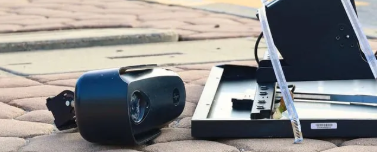
Along American roadsides, a peculiar insurgency has become visible in negative space. A pole is standing but its camera is gone. A lens is painted over. A solar panel lies shattered in the grass. Elsewhere, the disappearance is administrative rather than physical: city workers cover a camera, a council cancels a contract, or a police chief decides that an uprooted network will not be rebuilt. The machines in question are usually automatic license-plate readers, and the brand at the center of the revolt is Flock Safety.
Flock’s cameras are not simply traffic cameras. Its roadside license-plate readers capture passing vehicles, extract plate and vehicle characteristics, associate the observation with a place and time, and transmit the resulting evidence to a searchable platform. Flock says its system assists investigations and locates stolen vehicles and missing people; civil-liberties advocates answer that it records the movements of overwhelmingly innocent drivers without individualized suspicion. With roughly 120,000 Flock cameras reported across 49 states, the dispute is no longer about a few conspicuous boxes. It concerns the emergence of a privately operated, nationally interoperable layer of police surveillance.
During 2026, public opposition escaped the council chamber and became a wave of property destruction. Yet two different stories are often collapsed into one. The first is the well-documented physical campaign against roadside cameras. The second is the idea that Flock devices can be destroyed wirelessly—perhaps jammed, hacked, switched off, or permanently “bricked” from a distance. The first is demonstrably happening. The second contains a real core of security research surrounded by exaggeration. A careful reading of the evidence reveals proven local wireless compromise and temporary denial-of-service capabilities, but no publicly validated, touch-free method for physically destroying or permanently disabling arbitrary Flock license-plate cameras at range.
Counting a Revolt: What FlockStats Can and Cannot Tell Us
FlockStats is the most ambitious public attempt to count the damage. The site describes itself as a tracker of confirmed Flock camera destruction, vandalism, and removal in the United States, drawing on news reports and police records. Its body text, retrieved on August 28, reports more than 74 incidents across 27 states and more than 148 communities that have cancelled, rejected, paused, deactivated, or banned automatic license-plate readers. Its search-indexed headline gives a known minimum of more than 209 damaged or destroyed cameras against a national network of about 120,000.
Those numbers are useful, but they are not a scientific census. The page itself exposes the difficulty of maintaining a fast-moving volunteer ledger: its indexed summary still says 67-plus incidents while its narrative has advanced to 74-plus. Some entries have no disclosed camera count. One is a reader-submitted report with its date and exact location withheld. Other entries concern generic license-plate readers whose manufacturer is not confirmed. A Columbia County, Georgia, case combines two Genetec devices with two Flock devices, while a Montgomery County, Maryland, entry says five county police readers were vandalized even though the county police had no direct Flock contract. A brand-specific total can therefore absorb incidents that are part of the broader ALPR backlash but are not all demonstrably Flock hardware.
The site’s footer names a large collection of national and local outlets, but individual incident cards do not consistently provide a visible source link. That makes FlockStats an excellent lead generator and movement chronicle, not a substitute for the underlying police record or local report. Its “148 communities” figure also measures several different political acts and should not be described as 148 cancellations. Nor should every act of damage be assumed to be ideological. Some motives remain unknown; accidental collisions and ordinary theft can resemble political sabotage until an investigation establishes otherwise.
These limitations do not erase the pattern. They define its evidentiary boundaries. A narrower Guardian investigation, published July 25, identified at least 33 incidents across 23 states that bore an explicit anti-surveillance message. By August, The Washington Post, WIRED, The Verge, and numerous local newsrooms had independently documented a nationwide series of cameras being cut down, stolen, smashed, painted, burned, or obstructed. FlockStats captures the breadth of that reporting even when its totals require qualification.
Scale matters, too. Even 209 damaged units would represent less than two-tenths of one percent of a 120,000-camera network. The physical campaign is not close to dismantling Flock’s national infrastructure by attrition. Its significance is political and symbolic: the hardware has become a legible object on which anger at an otherwise invisible data system can be expressed.
The American Wave
The incidents differ in method, motive, and consequence. In Winona, Minnesota, all eight police-operated Flock cameras were cut from their poles and stolen on August 1; two more cameras owned by a neighboring jurisdiction disappeared from a Mississippi River bridge. The estimated loss was about $24,000. Police subsequently said they would not reinstall their eight units, citing the larger crisis of trust. In Burnet County, Texas, officials removed the remaining cameras after two destructive incidents. Those cases show how a small number of attacks can have an effect disproportionate to the hardware lost: they can force a jurisdiction to reconsider whether replacement is politically or operationally worthwhile.
Elsewhere, destruction has produced replacement rather than retreat. Dallas recorded attacks on at least 25 cameras between March and August, according to the FlockStats compilation. Lincoln, California, reported repeated waves affecting 12 cameras. In Houston’s Old Braeswood neighborhood, four poles were neatly severed in late July, with the cameras carefully lowered and left behind. The choice not to steal them made the event look less like opportunistic theft than a statement against their presence.
Other cases demonstrate why romantic descriptions of “vigilantes” are inadequate. In Page County, Virginia, a man accused of setting cameras on fire allegedly fired a rifle at a pursuing deputy, striking a police cruiser. In South Carolina, three teenagers allegedly beat a downed unit until its lithium battery exploded and caught fire. Several reported attacks involved gunfire beside public roads. Whatever one thinks of the surveillance system, these acts create risks for motorists, bystanders, utility workers, and first responders that are not contained by the political target.
The public response is nevertheless striking. The Verge reported that a Georgia sheriff’s plea for help identifying whoever destroyed a camera drew tens of thousands of comments, many mocking the device or praising its removal. An Air Force engineer charged in Virginia received substantial crowdfunding for his defense. In Ohio, a grand jury declined to indict a man accused of toppling and destroying a Flock unit. None of this makes destruction lawful, but it reveals a legitimacy problem deeper than ordinary vandalism. A large audience does not see the damaged camera as neutral public-safety equipment. It sees the camera itself as an unauthorized intrusion.
Not Worldwide Flock—But a Worldwide Pattern
Calling the phenomenon “worldwide Flock camera destruction” would be misleading. The documented Flock network and the FlockStats dataset are overwhelmingly American. The international comparison is instead a history of attacks on other automated enforcement and surveillance systems.
France supplied the most dramatic numerical precedent. During the Yellow Vest uprising, the French interior minister said that roughly 60 percent of the country’s 3,200 speed cameras had been neutralized, attacked, or destroyed; by March 2019, the government estimated that as many as 75 percent were out of action. In London, opponents of the expanded Ultra Low Emission Zone organized under the “Blade Runners” label. By mid-August 2023, police said 387 ULEZ cameras had been damaged, stolen, or obscured. Italy’s “Fleximan” became a folk figure after speed cameras were cut down in multiple regions. Hong Kong protesters dismantled a “smart lamppost” in 2019 amid fears that the sensor network could support identification and political repression.
The comparison is illuminating but imperfect. French and Italian campaigns often arose from resentment of fines and speed policy. London’s dispute combined air-quality regulation, cost-of-living pressure, and opposition to camera enforcement. Hong Kong’s protesters feared an authoritarian identification apparatus. Flock does not issue speeding tickets; it builds searchable records for policing. The common thread is not a single ideology or technology. It is the moment when automated observation becomes materially visible and people who believe ordinary politics has failed begin to attack its physical interface.
Why Flock Became the Symbol
Public-interest journalism has supplied much of the answer. In 2025, 404 Media documented thousands of searches performed by local and state agencies for federal or immigration-related purposes, even when the federal requester lacked direct access. The Electronic Frontier Foundation used audit logs to show searches associated with protests and activists, including queries labeled simply “Protest.” In August 2026, The Washington Post reported at least 50 law-enforcement officers charged with or accused of misusing ALPR systems, often to monitor partners, former partners, or romantic interests. Later reporting raised the broader known total and showed that some departments had not been auditing their own officers until journalists identified suspicious searches.
These investigations transformed an abstract civil-liberties argument into a series of recognizable harms: stalking with official credentials, wrongful stops after erroneous or misinterpreted alerts, surveillance of protest activity, and informal “side-door” searches for outside agencies. The underlying objection is architectural. A plate scan that seems innocuous in isolation becomes sensitive when billions of observations are retained, pooled, and queried as a movement history.
Flock disputes the characterization that it operates an unaccountable dragnet. It says customers own their data, controls can limit sharing, and its cameras help solve crimes and recover missing people. On August 13, the company announced new guardrails, including a recommended seven-day default retention period, required case codes, mandatory audit assistance, misuse detection, and new sharing controls. Critics at the ACLU and Institute for Justice called the reforms inadequate because local agencies can retain exceptions and because the system still lacks a general warrant requirement.
The important point is that destruction did not arise in an informational vacuum. It followed years of records requests, local organizing, litigation, security research, and investigative reporting. The cameras became targets after the public learned that the database could be used in ways many councils had never openly debated.
Can a Flock Camera Be “Destroyed Wirelessly”?
The phrase must be divided into several technically distinct claims.
Passive detection is proven, but it destroys nothing. Hardware examinations have found cellular, Wi-Fi, Bluetooth, and GPS components in some Falcon generations. Open-source projects can identify certain Flock devices by listening for characteristic Wi-Fi probe traffic or Bluetooth telemetry. That permits mapping and proximity alerts. It does not provide control of the camera, interrupt its LTE backhaul, or erase captured data.
Radio jamming is technically plausible as temporary interference, not demonstrated destruction. Flock describes its standard roadside cameras as solar-powered and LTE-connected. Sufficient interference in the relevant cellular band could prevent or delay real-time uploads within the affected area; Wi-Fi or Bluetooth interference could disrupt maintenance functions when those radios are in use, and GPS interference could affect location or timing features. But the public record does not establish how every hardware generation buffers observations during an outage, how quickly it fails over, or whether queued data is later transmitted. No credible Flock-specific study located for this essay demonstrates that ordinary RF jamming permanently damages a camera, reliably erases its evidence, or keeps it disabled after the interference ends. In the United States, intentional interference with cellular, GPS, or Wi-Fi communications is also prohibited; the FCC warns that jammers can disrupt emergency communications and are unlawful to operate, market, or sell.
A genuine adjacent Wi-Fi compromise has been demonstrated. Independent researcher Jon “GainSec” Gaines tested lawfully acquired Falcon/Sparrow/Flex and related Flock hardware in an isolated lab. His versioned white paper, Examining the Security Posture of an Anti-Crime Ecosystem, documented 51 findings in its November 2025 release, with further work presented at DEF CON 34 in August 2026. The most relevant chain joined an exposed maintenance hotspot, shared or recoverable wireless credentials, and an unauthenticated administrative service.
The critical flaw recorded as CVE-2025-59403 affected the Collins Android application used on tested Falcon, Sparrow, and related devices. On the same local wireless network, the application exposed administrative functions without authentication. The research demonstrated operations capable of rebooting the unit, toggling the live camera feed, retrieving diagnostic information, changing battery or shutdown behavior, enabling wireless debugging, and obtaining a command shell. Chained with other findings, the researcher reported system- and root-level execution. CVE-2025-59409 separately documented development Wi-Fi credentials stored in production firmware.
That is a proof of concept for wireless device control, software denial of service, and potentially serious compromise. It is not proof of a magic drive-by kill. In the principal published demonstration, the maintenance hotspot had to be activated through brief physical interaction with the device, unless a hotspot had already been left exposed. The attacker then needed local wireless proximity. The work did not demonstrate a nonrecoverable brick, destruction of electronics, battery ignition by radio, or compromise of the entire Flock cloud. The white paper contains no claim of permanent physical damage; its demonstrated availability impacts are reboots, shutdown-related manipulation, feed disablement, and code execution.
Patch status is also contested. Flock said the tested unit had not been properly provisioned or receiving normal updates, characterized the practical customer risk as low, and said the reported issues were fixed or scheduled for remediation. In its broader response to the compiled research, the company argued that exploitation required physical access and specialized hardware knowledge. The researcher, however, demonstrated that once the maintenance network was reachable, the software portion of the chain was wireless and repeatable. Public CVE records do not identify a clear fixed version for the central Collins flaw. Responsible analysis should therefore neither assume that every deployed camera remains vulnerable nor accept an unverifiable claim that every affected unit has been remediated.
Remote internet exposure has been proven on a different Flock product line. In December 2025, 404 Media and researchers found at least 60 Flock Condor pan-tilt-zoom cameras with live streams and administrative panels exposed on the public internet without credentials. The accessible controls reportedly allowed viewing and downloading archives, changing settings, running diagnostics, and deleting footage. Flock called it a limited misconfiguration, said it was fixed, and disputed that the interface could control cameras or modify recordings. This was authentic remote access, but it concerned internet-exposed Condor video cameras, not a proven universal exploit against LTE-connected Falcon ALPRs. Again, remote control and data deletion are not physical destruction.
Optical evasion is a separate and increasingly credible field. At DEF CON 34, Bill Swearingen publicly tested an adversarial pattern intended to confuse object-detection models. TechCrunch reported that a patterned vehicle passed a Flock camera without triggering the expected automated detection, although the camera could still record footage. Similar research explores adversarial plate surrounds and illumination. These techniques attempt to evade machine interpretation; they do not wirelessly disable or destroy the camera. Claims that consumer gadgets, infrared light, or lasers can universally “kill” Flock devices are not supported by a comparable Flock-specific validation. High-powered lasers also create obvious eye and road hazards.
No public proof of permanent wireless destruction was found. A sufficiently privileged software attacker could theoretically corrupt storage or firmware, while specialized directed-energy equipment can damage electronics in general. But theoretical capability is not Flock-specific evidence. As of the verification cutoff, no peer-reviewed paper, CVE proof of concept, DEF CON demonstration, vendor advisory, or well-documented field incident located for this essay shows an arbitrary deployed Flock ALPR being permanently destroyed from a distance solely through a wireless signal. “Wireless RCE,” “temporary jamming,” “camera feed disabled,” “footage deleted,” and “hardware destroyed” describe different outcomes. Reporting that treats them as synonyms overstates the research.
What Going Dark Really Means
The most effective attacks on the Flock network have not been radio-frequency attacks. They have been legitimacy attacks. Public-records journalism revealed how the network was queried. Security researchers showed that devices entrusted with police evidence did not always meet the security assumptions surrounding them. Residents mapped deployments that had arrived with little public notice. Councils then cancelled contracts, imposed pauses, covered cameras, or declined to rebuild them.
Physical destruction can accelerate that reckoning, as Winona and Burnet County demonstrate. It can also endanger people, generate felony prosecutions, consume public money, and give officials an excuse to substitute a competing vendor while leaving the underlying surveillance architecture intact. The Guardian has already documented cities replacing Flock with Axon readers after celebrating a nominal “de-Flocking.” A broken camera is therefore an ambiguous political victory: the pole may be gone while the database model survives.
FlockStats deserves attention because it records the moment mass surveillance became tangible enough to provoke a mass reaction. Its figures should be cited as provisional known minima, checked against original reporting, and separated from cancellation data and non-Flock incidents. The international precedents show that automated cameras can become focal points for broad social anger. The American experience adds something new: a private company has linked thousands of local deployments into a searchable national system, while independent journalists and researchers have built their own counter-network of maps, audit logs, incident trackers, and security disclosures.
The wireless research sharpens, rather than weakens, the political critique. There is verified evidence that tested Flock devices exposed dangerous local administrative functions and that a separate group of cameras was remotely accessible through the public internet. Those findings raise serious questions about procurement, patch verification, evidence integrity, and independent security audits. But they do not establish a secret radio weapon capable of burning out the roadside fleet. The camera-destruction movement is real. Wireless compromise is real. Wireless physical destruction remains unproven. Keeping those propositions separate is the difference between public-interest analysis and folklore.
Jonathan Brown for AetheriumArcana
If you would like to support our work — useful, well-researched, ad-free cybersecurity intelligence — subscribe, comment, or buy us a coffee! Thanks.
Member discussion: