
What the Horoscopes of Śrī Rāma and Śrī Caitanya Mahāprabhu Can—and Cannot—Demonstrate
Two charts, two kinds of historical problem
The birth horoscopes associated with Śrī Rāma and Śrī Caitanya Mahāprabhu occupy the same religious universe but present almost opposite problems to the historian of astronomy. Rāma’s birth is described in the Vālmīki Rāmāyaṇa through an extraordinarily auspicious arrangement: Caitra navamī, Punarvasu nakṣatra, Cancer rising, the Moon conjoined with Jupiter, and five planets in exaltation. Within the literal Purāṇic chronology, however, Daśaratha’s Rāma belongs to the twenty-fourth Tretā-yuga, approximately eighteen million years ago. No modern ephemeris can reconstruct a particular planetary sky, lunar phase or terrestrial horizon at that depth. Rāma’s horoscope can therefore be studied primarily as a sacred cosmogram: a technical-looking configuration that expresses royal perfection, dharma, martial power and divine incarnation through the established symbolic vocabulary of jyotiṣa.
Mahāprabhu’s case is profoundly different. His appearance is placed in a documented historical year and at a known location. The traditional date coincides with a real total lunar eclipse. The transmitted time, signs, nakṣatras and pañcāṅga factors can be recalculated against the physical sky and prove astronomically coherent. Here the scholar can ask not only what the chart means within Gauḍīya theology, but whether its astronomical data are correct, whether its clock time agrees with the eclipse narrative, and how much of the claimed destiny follows from classical horoscopic rules rather than retrospective devotional interpretation.
The contrast is valuable because it prevents two opposite errors. A devotional horoscope should not be dismissed merely because it carries theological meaning: Mahāprabhu’s chart contains genuine and highly accurate astronomical information. Yet astronomical accuracy does not scientifically validate astrological interpretation, much less prove divinity. Jyotiṣa converts measurable celestial positions into a culturally established symbolic language. The calculations may be objectively testable while the meanings assigned to them remain interpretive. In the case of Rāma, where the physical sky is unrecoverable and the received configuration is internally problematic under later standardized definitions, symbolic and theological functions necessarily dominate. In Mahāprabhu’s case, calculation and interpretation can be separated much more rigorously.
What jyotiṣa does with astronomical data
The Sanskrit term jyotiṣa covers several related but distinguishable intellectual practices. Siddhānta and gaṇita astronomy calculate planetary longitudes, lunar and solar motions, eclipses, rising and setting, and calendrical quantities. Pañcāṅga computation determines such factors as weekday, tithi, nakṣatra, yoga and karaṇa. Horā or jātaka interprets a nativity. Muhūrta selects times for action, while saṁhitā literature interprets collective omens, weather, eclipses and other terrestrial or celestial phenomena. David Pingree consequently described jyotiḥśāstra as “astral and mathematical literature,” and Kim Plofker’s work similarly demonstrates that mathematical astronomy, calendar making and astrology developed in sustained interaction rather than as sealed modern disciplines.
For the present study, the calculations are astronomy; the reading of character and destiny is astrology. Calling the whole system “astronomy” would obscure its divinatory purpose. Calling it nothing but superstition would conceal the sophistication of the mathematics required to produce a correct chart. A horoscope begins with astronomical inputs but does not end with an astronomical conclusion.
The principal symbolic elements can be summarized as follows. A graha is an astral agent or “seizer,” not simply a modern physical planet. The category includes the Sun and Moon as well as Rāhu and Ketu, the ascending and descending lunar nodes. A rāśi is one of twelve thirty-degree zodiacal signs. The lagna is the degree of the zodiac rising on the eastern horizon; it anchors the twelve bhāvas or houses, which signify domains such as body and identity, wealth, siblings and communication, home, intelligence and children, illness and service, partnership, death and transformation, religion and pilgrimage, occupation, gains and loss or seclusion. A nakṣatra is one of twenty-seven lunar mansions, each conventionally spanning 13°20′. Tithi is determined by Moon–Sun elongation in twelve-degree units and therefore belongs to mathematical lunar astronomy rather than to visual phase naming alone.
Jyotiṣa then assigns a symbolic condition to each graha. A planet may be in its own sign, exalted (ucca), debilitated (nīca), friendly, hostile or otherwise strengthened and weakened. Dṛṣṭi, usually translated as aspect, expresses a structured relationship between planets and houses. All classical planets possess a seventh-sign aspect; Mars, Jupiter and Saturn receive additional special aspects in standard Parāśarī practice. A yoga is a meaningful configuration formed by lordship, placement, dignity or relationship. Divisional charts or vargas subdivide the zodiac for finer interpretation, while aṣṭakavarga assigns points to signs according to planetary relationships. Daśā systems use the natal configuration to organize periods of life.
None of these meanings is read from brightness or gravitational force in the manner of modern physics. They belong to a traditional semiotic system built over centuries of textual interpretation. Within that system, Jupiter signifies learning, counsel, expansion and dharma; the Sun signifies sovereignty, authority and the organizing self; the Moon signifies mind, responsiveness and public or embodied life; Mars signifies force, courage, conflict and decisive action; Venus signifies attraction, beauty, pleasure and relational or devotional refinement; Saturn signifies limitation, endurance, time, suffering and renunciation; Mercury signifies speech, analysis, commerce and adaptable intelligence. Rāhu and Ketu mark disruption, appetite, severance, obscuration and unusual or liminal experience. These are established traditional associations, but they are not experimentally demonstrated causal properties of celestial bodies.
The houses further alter the meanings, as do sign lordships. Mars in Capricorn is not interpreted merely as “Mars near certain stars.” Capricorn is the sign of Mars’s exaltation, so martial energy is considered disciplined and effective. If Mars also rules auspicious houses for a particular ascendant, its significance changes again. The horoscope is therefore not a list of isolated symbols but a relational grammar. Different schools can weigh that grammar differently, and a skilled interpreter can find both constructive and difficult indications in almost any powerful chart. This flexibility is especially important when claims of “divine destiny” are evaluated.
Rāma’s horoscope as a sacred royal configuration
The relevant passage occurs in Vālmīki Rāmāyaṇa, Bālakāṇḍa 1.18.8–10. It places Rāma’s birth in Caitra, on the ninth lunar day, under the nakṣatra governed by Aditi—Punarvasu—with five planets in svocca positions, Cancer rising, and Jupiter conjoined with the Moon. The passage also associates the child with universal lordship and auspicious bodily marks, joining jyotiṣa to sāmudrika, the interpretation of bodily signs. The textual claim is therefore already more than a timestamp: celestial dignity and bodily perfection mutually announce an extraordinary being.
The familiar later chart unpacks the five exalted planets as the Sun in Aries, Mars in Capricorn, Jupiter in Cancer, Venus in Pisces and Saturn in Libra. The Moon is in its own sign, Cancer, with exalted Jupiter, and Cancer is the ascendant. Mercury is the only visible classical graha not assigned maximum or near-maximum dignity. Whether every detail of this standardized chart was intended in precisely its later horoscopic sense by all textual layers is a historical question, but the five-exaltation structure is not a modern invention; the epic passage itself supplies its basis.
For Cancer lagna, the configuration is a nearly ideal grammar of divine kingship. The Moon, ruler of Cancer, occupies the first house and symbolizes an embodied, responsive and publicly resonant personality. Jupiter is exalted in Cancer in the first house. Because Jupiter signifies dharma, wisdom, counsel, protection and sacred learning, its exaltation directly in the house of the person makes righteousness appear incarnate rather than merely advised from outside. The Moon–Jupiter conjunction can also be read through the family of Gajakeśarī interpretations, while exalted Jupiter in a kendra supports the Hamsa mahāpuruṣa pattern. Such classifications vary in detail among texts and schools, but the general symbolism is unmistakably elevated.
The exalted Sun in Aries occupies the tenth house of rule, public action and authority. It is difficult to imagine a more economical astrological emblem for the solar dynasty’s righteous king. Mars is a yogakāraka for Cancer because it rules the fifth and tenth houses; exalted in Capricorn in the seventh, it represents exceptional courage, strategy and the ability to confront enemies. In a kendra and its exaltation sign, it supplies the Rucaka mahāpuruṣa pattern. Venus exalted in Pisces in the ninth house places refinement, compassion, beauty and relational grace in the house of dharma, teachers and pilgrimage. Saturn exalted in Libra in the fourth can signify endurance, public responsibility and disciplined rule, although it also allows a darker retrospective reading: sorrow connected with home, kingdom, motherland and enforced separation.
The chart thus contains not only triumph but the narrative architecture of Rāma’s life. Mars in the seventh can signify the formidable opponent and the necessity of conflict; Saturn in the fourth can be connected to exile and the burden placed upon home and throne; an exalted Sun in the tenth depicts kingship elevated into duty; Venus in the ninth supports fidelity to sacred order; Jupiter and the Moon in the first embody moral and emotional nobility. These correspondences are compelling within jyotiṣa because the epic’s central themes occupy their expected symbolic houses.
They are not, however, independent proof. The chart is preserved inside the literary tradition that also preserves the life whose meanings the chart is used to explain. We cannot establish that an astrologer ignorant of the Rāmāyaṇa would reconstruct Rāma’s complete biography from the configuration. Nor is “incarnation of Viṣṇu” a standard planetary diagnosis that can be applied blindly. What the horoscope establishes within the text is superlative auspiciousness, royal potency and dharmic purpose. The theological identification of that purpose with the Supreme Lord comes from the epic and Vaiṣṇava tradition, not from celestial longitude alone.
The eighteen-million-year barrier
The Rāmāyaṇa passage does not number the mahāyuga. More specific Purāṇic notices do. Vāyu Purāṇa 70.47–48 places the destruction of Rāvaṇa by Daśaratha’s Rāma in the twenty-fourth Tretā-yuga of the present Vaivasvata manvantara. Matsya Purāṇa 47.245 supplies a parallel assignment. Since the current Kali-yuga belongs to the twenty-eighth mahāyuga, the literal interval is not approximately 5000 BCE, nor even the Tretā immediately preceding the present Dvāpara. Using the standard yuga durations, the twenty-fourth Tretā extends approximately from 19,443,102 BCE to 18,147,102 BCE.
The arithmetic is straightforward within the traditional chronology. From the end of the twenty-fourth Tretā to the beginning of the present Kali lie the twenty-fourth Dvāpara and Kali, three complete mahāyugas numbered twenty-five through twenty-seven, and the Kṛta, Tretā and Dvāpara of the twenty-eighth cycle:
[
864{,}000+432{,}000+3(4{,}320{,}000)+3{,}888{,}000
=18{,}144{,}000\text{ years}.
]
Adding the 1,296,000 years of Tretā places its beginning 19,440,000 years before the conventional Kali epoch of 3102 BCE. These proleptic Gregorian labels are arithmetic translations of sacred durations, not archaeological dates.
At this depth, a physical horoscope cannot be reconstructed. JPL DE431 reaches only to 13,200 BCE. Long integrations such as La2010 model secular orbital elements across geological time, but they cannot recover a unique daily configuration of the Moon and planets eighteen million years ago. The terrestrial planets have a Lyapunov time on the order of five million years. Lunar tidal evolution makes the accumulated phase of more than two hundred million ancient lunations unrecoverable. Earth’s rotational history prevents the calculation of a particular ascendant. Castor and Pollux, the modern stellar representatives of Punarvasu, would have moved hundreds of parsecs relative to their present sightlines. “Sidereal” does not mean that stars remain physically fixed for geological ages.
The classical Sūryasiddhānta can calculate formal mean positions indefinitely because it is cyclic. Its revolution constants produce a common planetary mean-motion period of 1,080,000 years. The corresponding parts of the twenty-fourth and twenty-eighth mahāyugas are separated by 17,280,000 years, exactly sixteen such periods. The formal siddhāntic sky therefore repeats by construction and cannot independently determine which mahāyuga is represented. This is not a failure of the model’s religious or calendrical purpose; it is a reason not to mistake a periodic mathematical cosmos for a uniquely integrated physical ephemeris.
A deliberately crude numerical stress test made the problem concrete. Circular coplanar orbits, fixed modern sidereal periods, a fixed J2000 zodiac and the traditional five exaltation signs were carried through the complete 1,296,000-year span of the literal Tretā. The baseline model produced 5,470 qualifying daily samples grouped into 450 episodes. Altering the adopted planetary periods by only one part in one hundred million produced 477 and 473 episodes. The terminal nominal episode moved from 18,149,173 BCE to 18,148,556 BCE or 18,151,178 BCE, a spread exceeding 2,600 years.
| Surrogate variant | Qualifying days | Episodes | Final nominal episode |
|---|---|---|---|
| Fixed modern periods | 5,470 | 450 | 18,149,173 BCE, June 27–July 14 |
| Period perturbation A, ±10⁻⁸ | 6,169 | 477 | 18,148,556 BCE, April 20–23 |
| Opposite perturbation, ±10⁻⁸ | 6,165 | 473 | 18,151,178 BCE, July 26–August 5 |
These are not proposed dates. They demonstrate that the five-sign configuration is recurrent and that nominal dates become radically model-dependent. Rāma’s chart cannot be rescued as physical history by selecting one recurrence from an unstable surrogate.
An internal difficulty in the standardized Rāma chart
The complete later-standardized configuration also contains a geometrical contradiction that does not depend on eighteen million years of dynamical uncertainty. In the equal twenty-seven-nakṣatra system, Punarvasu occupies sidereal longitude 80°00′–93°20′. Its fourth pāda, the portion in Cancer, occupies 90°00′–93°20′. Śukla navamī requires the Moon to be 96°–108° east of the Sun. An exalted Sun must occupy Aries, 0°–30°.
The greatest possible elongation occurs if the Sun is at 0° Aries and the Moon is at the very end of Punarvasu:
[
93^\circ20'-0^\circ=93^\circ20'.
]
That is 2°40′ short of the beginning of navamī. No date in any epoch can simultaneously satisfy Punarvasu Moon, śukla navamī and an Aries Sun if those later equal-sector definitions are imposed literally. A Punarvasu Moon can form navamī with a Sun in late Pisces, but that Sun is not exalted in Aries.
At least one assumption must therefore change. “Ninth day” may be nontechnical or governed by a different calendrical convention; svocca may have been understood differently; the asterism may not have been an equal 13°20′ sector; the passage may combine categories from different textual strata; or the configuration may be an ideal royal horoscope whose purpose is symbolic rather than observational. None of these possibilities can presently be proved. The responsible conclusion is that Rāma’s horoscope functions most securely as a theological representation of perfect kingship and dharma. Its very perfection is its message.
Mahāprabhu: a chart exposed to historical testing
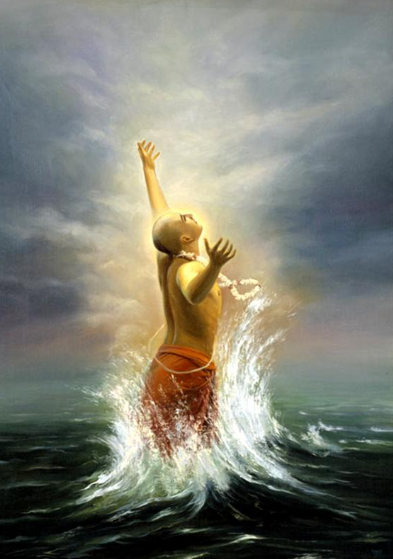
Śrī Caitanya Mahāprabhu’s birth tradition supplies a far denser evidence chain. Vṛndāvana Dāsa Ṭhākura’s Śrī Caitanya-bhāgavata Ādi 1.95 states that the Lord appeared on Phālguna Pūrṇimā during an eclipse at night: phālguna-pūrṇimā śubha-dine / avatīrṇa hailā prabhu niśāya grahaṇe. Verses 1.95–96 connect the appearance with the chanting of Hari’s names. The extended narrative in Ādi 2.197–209 describes the inhabitants of Navadvīpa seeing the eclipse, proceeding to the Gaṅgā while chanting, and Śacīnandana appearing “at that very moment.” As literature, the text intends simultaneity among eclipse, public nāma-saṅkīrtana and birth.
Kṛṣṇadāsa Kavirāja’s Śrī Caitanya-caritāmṛta supplies the year and compact astrological description. Ādi 13.20 places the birth on the evening of Phālguna Pūrṇimā during a lunar eclipse. Ādi 13.89 specifies Śaka 1407 and the full-moon evening. Ādi 13.90 reads: siṁha-rāśi, siṁha-lagna, ucca graha-gaṇa / ṣaḍ-varga, aṣṭa-varga, sarva sulakṣaṇa. The Moon was in Leo, Leo was rising, the planets were strongly or highly placed, and the varga and aṣṭakavarga indications were auspicious.
The numerical record printed in the Bhaktivedanta purport to Ādi 13.89 comes through Bhaktivinoda Ṭhākura’s nineteenth-century Amṛta-pravāha-bhāṣya. Its heading, śaka 1407/10/22/28/45, is conventionally interpreted as year, elapsed month, elapsed civil days, and 28 daṇḍas 45 palas after sunrise. One daṇḍa equals twenty-four minutes and one pala twenty-four seconds, so the time component equals eleven hours thirty minutes after sunrise. The table also identifies Saturday, Pūrṇimā, Pūrvaphalgunī and Dhṛti yoga, while the accompanying explanation supplies planetary signs and nakṣatras. Because this numerical precision is transmitted through a much later commentary, its provenance must be distinguished from the earlier biographical statements. The exact degree table circulated in a 2010 Gauḍīya article was explicitly generated with Jagannatha Hora software; it is a useful modern realization of Bhaktivinoda’s data, not itself a fifteenth-century or demonstrably nineteenth-century degree record.
The civil date is nevertheless independently secure. A total lunar eclipse occurred on Saturday, 18 February 1486 in the Julian calendar, equivalent to 27 February 1486 proleptic Gregorian. Modern eclipse catalogues use Julian dates before the Gregorian reform, so the common unqualified phrase “18 February 1486 Gregorian” is erroneous. The calculations here use an approximate Māyāpur/Navadvīpa location of 23.423° north, 88.388° east and ten metres elevation. Local mean time is approximately UT plus 5 hours 53 minutes 33 seconds.
Reconstructing the moonrise horoscope
Swiss Ephemeris 2.10.03 gives sunrise at approximately 06:24:43 local mean time under the adopted coordinates and refraction assumptions. Adding eleven hours thirty minutes places the transmitted moment at 17:54:43 LMT, or 12:01:10 UT1. Published Gauḍīya calculations commonly give approximately 17:58 LMT; the few minutes of difference arise from coordinates, refraction, solar-limb conventions and ayanāṁśa. Apparent moonrise occurred at approximately 17:48:59 LMT and apparent sunset at 18:02:37. The transmitted moment therefore depicts the full Moon newly risen in the east while the Sun touches the western horizon—an exceptionally exact physical realization of Phālguna-pūrṇimā-sandhyā.
Using Lahiri sidereal longitudes produces the following comparison. The middle column is the modern Jagannatha Hora realization published from the transmitted data, not an independent ancient table. The final column is the present Swiss Ephemeris reconstruction. Geocentric positions are standard for the planets; the topocentric Moon is separately shown because lunar parallax approaches one degree at the horizon.
| Body or point | Published modern degree table | Independent reconstruction at 17:54:43 LMT |
| Ascendant | approximately 22°11′ Leo | 21°13′ Leo |
| Sun | 22°12′ Aquarius, Pūrvabhādrapadā | 22°11′46″ Aquarius, Pūrvabhādrapadā |
| Moon | 20°48′ Leo, Pūrvaphalgunī | 19°50′34″ geocentric; 20°47′22″ topocentric, Pūrvaphalgunī |
| Mercury | 10°15′ Pisces, Uttarabhādrapadā | 10°15′10″ Pisces, Uttarabhādrapadā |
| Venus | 4°58′ Aries, Aśvinī | 4°58′13″ Aries, Aśvinī |
| Mars | 11°11′ Capricorn, Śravaṇa | 11°10′27″ Capricorn, Śravaṇa |
| Jupiter | 20°20′ Sagittarius, Pūrvāṣāḍhā | 20°20′35″ Sagittarius, Pūrvāṣāḍhā |
| Saturn | 24°40′ Scorpio, Jyeṣṭhā | 24°40′08″ Scorpio, Jyeṣṭhā |
| Mean Rāhu | 26°36′ Aquarius, Pūrvabhādrapadā | 26°36′55″ Aquarius, Pūrvabhādrapadā |
| Mean Ketu | 26°36′ Leo, Uttaraphalgunī | 26°36′55″ Leo, Uttaraphalgunī |
The match between the two modern computations is much stronger than a sign-level approximation. The Sun and five planets reproduce the published software-generated degrees to approximately one arcminute. This verifies the reproducibility of the chosen date, time and sidereal framework; it does not independently prove that arcminute longitudes were preserved from Mahāprabhu’s birth or by Bhaktivinoda. The apparent lunar discrepancy is almost perfectly explained by topocentric parallax: the geocentric Moon is 19°51′ Leo, while the Moon as seen from the Navadvīpa horizon is 20°47′, essentially the published 20°48′. This strongly suggests that the modern degree table is calibrated specifically to a horizon-time chart and employs a topocentric lunar correction or its equivalent. More importantly, the historically transmitted sign and nakṣatra placements themselves agree with the physical sky.
The ascendant differs by approximately one degree, readily attributable to several minutes of time, the precise birth-site longitude or ayanāṁśa. The sign and nakṣatra do not change. One error in a circulated secondary table should also be corrected: Ketu at 26°36′ Leo lies in Uttaraphalgunī, not Pūrvaphalgunī.
The pañcāṅga factors reproduce as well. The weekday is Saturday. The Moon–Sun elongation at the transmitted moment is approximately 177.647°, placing it late in Pūrṇimā tithi. The Moon occupies Pūrvaphalgunī. The sum of the sidereal solar and lunar longitudes falls in the eighth nitya-yoga, Dhṛti. The table’s vāra, tithi, nakṣatra and yoga are accurate descriptions of the calculated sky, not arbitrary auspicious labels.
The eclipse problem remains real
Astronomical full-moon syzygy is an exact opposition, not the entire Pūrṇimā tithi. The DE406 eclipse solution places ecliptic opposition at 16:44:06 UT1, approximately 22:37:39 LMT. Greatest eclipse followed at approximately 22:41:53 LMT. The total eclipse belonged to Saros 105 and had an umbral magnitude of approximately 1.147.
The full local sequence is:
| Event | UT1 | Navadvīpa LMT | Sidereal ascendant |
| Transmitted 28-daṇḍa-45-pala moment | 12:01 | 17:55 | Leo 21°13′ |
| Leo ascendant ends | 12:40 approximately | 18:33 | Virgo begins |
| Penumbral contact P1 | 13:56:46 | 19:50:19 | Virgo 17°43′ |
| Visible partial eclipse U1 | 15:03:48 | 20:57:21 | Libra 3°03′ |
| Totality begins U2 | 16:19:13 | 22:12:46 | Libra 20°03′ |
| Ecliptic opposition | 16:44:06 | 22:37:39 | Libra 25°35′ |
| Greatest eclipse | 16:48:20 | 22:41:53 | Libra 26°31′ |
| Totality ends U3 | 17:17:24 | 23:10:57 | early Scorpio |
| Partial eclipse ends U4 | 18:32:48 | 00:26:21, next civil day | Scorpio |
| Penumbral eclipse ends P4 | 19:39:59 | 01:33:32, next civil day | Sagittarius |
The penumbra is usually imperceptible at first contact. The Moon did not begin entering the dark umbra until 20:57 LMT, about three hours after the transmitted birth time. Leo was the sidereal ascendant from approximately 16:20 to 18:33 LMT, ending one hour seventeen minutes before penumbral contact and two hours twenty-four minutes before the visibly partial eclipse. Reasonable changes in ΔT, coordinates, refraction, ayanāṁśa or ephemeris cannot eliminate this gap.
Four interpretations remain possible. The biographies may compress the moonrise birth and later eclipse into a single sacred evening. Grahaṇa may designate the broader ritual eclipse occasion, during which people assembled and chanted before physical contact; this explains anticipation but not literally seeing an already darkened Moon. The 28-daṇḍa-45-pala time may be a later rectification designed to satisfy the older requirements of evening, Leo Moon and Leo lagna. Finally, one can prioritize the Caitanya-bhāgavata’s visible-eclipse narrative and move the birth to 20:57–23:11 LMT, but the ascendant then becomes Libra or early Scorpio, contradicting Caitanya-caritāmṛta Ādi 13.90. The date is secure; the exact minute cannot satisfy every transmitted statement simultaneously.
What Mahāprabhu’s horoscope signifies in jyotiṣa
The astronomical chart is therefore real and unusually well preserved. The harder question is whether it “actually shows” a divine destiny. The answer depends upon the standard being applied. It certainly presents an extraordinary religious and public personality under traditional jyotiṣa. It does not contain an objective marker labeled “God,” and several of its most conspicuous features are conventionally difficult as well as powerful.
With Leo rising, the houses are occupied as follows: the full Moon and Ketu are in the first; Saturn is in the fourth; Jupiter in its own Sagittarius is in the fifth; exalted Mars is in the sixth; the Sun and Rāhu are in the seventh; debilitated Mercury is in the eighth; and Venus is in the ninth. The first–seventh axis is the eclipse axis: Moon and Ketu face Sun and Rāhu across the horizon.
Leo lagna gives the chart a solar grammar of visibility, dignity, authority and centrality. The lagna lord Sun occupies the seventh house, placing identity in direct relationship with the public, opponents, followers and the social world. At moonrise the full Moon occupies the first house, producing an immediately visible, emotionally resonant and charismatic presence. In ordinary classical interpretation, however, Ketu with the Moon and Rāhu with the Sun are not automatically auspicious. They describe eclipse, obscuration, disruption and an identity marked by unusual separation from ordinary worldly patterns. Devotional interpretation transforms the same obscuration into the cosmic pretext for universal chanting.
The first house receives an exceptional concentration of aspects. The Sun aspects it from Aquarius. Exalted Mars in Capricorn casts its special eighth aspect upon Leo. Jupiter in Sagittarius casts its ninth aspect upon Leo. Saturn in Scorpio casts its tenth aspect upon Leo. Thus the body, personality and visible life are simultaneously acted upon by authority, force, wisdom and discipline. This can be read as a person of extraordinary impact whose identity becomes the meeting point of powerful and conflicting imperatives. It is not a placid horoscope.
Jupiter is in its own sign, Sagittarius, in the fifth house. The fifth signifies intelligence, learning, students, sacred recitation, counsel, creativity and pūrva-puṇya. Strong Jupiter there is the clearest conventional indication of exceptional scholarship, religious teaching and the capacity to generate a lineage of students. Jupiter also aspects the ninth house of dharma and the first house, connecting sacred intelligence to identity and religious purpose. This placement makes Nīlāmbara’s prediction that the child would surpass Bṛhaspati in learning entirely intelligible within the system.
Mars is especially important. For Leo ascendant it rules the fourth and ninth houses and is therefore a yogakāraka, joining a kendra lordship with a trinal lordship. It is exalted in Capricorn in the sixth house. The sixth signifies service, labor, enemies, debate, illness and the overcoming of obstacles. The configuration can describe disciplined religious service, formidable disputation and victory over opposition. It can also signify conflict, bodily strain and an uncompromising mode of action. Mars’s aspect to the lagna intensifies rather than softens the personality.
Venus occupies Aries in the ninth house of dharma, pilgrimage, teachers and higher meaning. For Leo it rules the third and tenth houses, connecting communication, performance and vocation with religion. Jupiter aspects Venus and the ninth house. A Gauḍīya reading naturally associates this relationship with beauty, devotion, sacred emotion, music, poetry and the public vocation of saṅkīrtana. Such an interpretation is symbolically coherent, but it becomes specific to Caitanya’s later career only when biography supplies the vocabulary of bhakti and congregational chanting.
Saturn in Scorpio occupies the fourth house of home, mother, inward security and homeland. Its special tenth aspect falls upon the lagna. Saturn can signify seriousness, endurance, renunciation and the burden of time, but also sorrow and separation. Retrospectively, it readily evokes Mahāprabhu’s departure from Navadvīpa, acceptance of sannyāsa, and the pain imposed upon Śacīdevī and his household. Because Saturn is almost—but not actually—at its Libra exaltation, claims that it is “exalted” should be qualified. Its placement is powerful through angularity and aspect, not literal exaltation.
Mercury is debilitated in Pisces in the eighth house. The eighth signifies secrecy, transformation, crisis, hidden knowledge, inheritance and the crossing of ordinary boundaries. Some devotional astrologers invoke cancellation of debility through Jupiter’s strength or other relational rules, but the applicable nīcabhaṅga criteria vary among schools and should not be asserted casually. The placement can be read positively as intelligence directed toward hidden theological meaning and transformative speech; it can equally be read as difficulty with conventional analytic categories. Mahāprabhu’s historical brilliance as a scholar is better supported astrologically by strong fifth-house Jupiter than by pretending Mercury is unambiguously strong.
The phrase ucca graha-gaṇa in Caitanya-caritāmṛta 13.90 also needs discipline. Only Mars is literally in its classical exaltation sign. Jupiter is strong in its own sign. Venus and Saturn are not exalted, although later Gauḍīya commentary describes them as nearly exalted or otherwise strengthened. Translating the phrase as “all the planets were exalted” overstates the physical chart. “The planets were highly or powerfully situated” is more defensible and agrees with the verse’s larger appeal to ṣaḍvarga and aṣṭakavarga strength.
Does the chart itself announce divinity?
The Caitanya-bhāgavata provides a surprisingly careful answer. In Ādi 3.9–14, Nīlāmbara Cakravartī examines the houses, sees extraordinary or kingly indications, wonders whether the child might fulfill a prophecy that a brāhmaṇa would become king in Bengal, declares the qualities beyond those of an ordinary king, and predicts learning greater than Bṛhaspati. These are recognizably horoscopic judgments: status, intellect, qualities and exceptional destiny.
The explicit declaration of divinity occurs through a different speaker. In Ādi 3.15–19 another great brāhmaṇa says that the child is directly Nārāyaṇa, will reestablish religion, preach in an unprecedented manner, deliver the world and distribute love of God. The narrative therefore does not simply claim that a mechanical horoscope calculation outputs “Supreme Personality of Godhead.” Astrological inference and theological recognition are dramatically adjacent but not identical.
That distinction is methodologically decisive. Mahāprabhu’s chart supports, within jyotiṣa, an exceptional teacher, public figure, religious innovator, powerful controversialist and person marked by renunciation and transformative influence. Its full Moon on the ascendant gives visibility and public resonance; strong fifth-house Jupiter gives learning and discipleship; the exalted yogakāraka Mars gives force and victory through service or conflict; Venus in the ninth, aspected by Jupiter, supports an aesthetic and devotional vocation; Saturn’s influence supplies austerity and separation; the eclipse nodes turn the self–world axis into a scene of disruption and collective response.
None of those indications logically distinguishes an avatāra from an extraordinary human religious leader. The nodes could be judged afflictive; Mercury is debilitated; Saturn burdens the home; Mars occupies the sixth. A hostile astrologer could emphasize crisis, conflict and instability, while a devotional astrologer emphasizes world transformation, renunciation and the conversion of affliction into grace. The chart is powerful enough to sustain the Gauḍīya reading, but the reading is guided by knowledge of the life and by theological commitment.
This does not render the interpretation meaningless. Sacred biography frequently operates through recognition rather than laboratory proof. For a believer, the chart’s significance lies in congruence: the sky of the appearance embodies the mission that subsequently unfolds. The eclipse provokes the chanting Mahāprabhu will later propagate; the full Moon rises in the royal sign; Jupiter strengthens learning and dharma; the first house receives multiple planetary aspects; the chart simultaneously signifies charisma, renunciation, opposition and public transformation. The horoscope becomes a compressed icon of the life.
For historical scholarship, however, “divine destiny” belongs to theology, not to a falsifiable astronomical variable. The astronomer can confirm the eclipse, longitudes, topocentric Moon, tithi and horizon. The historian can trace the conventions by which those data acquire meaning. The astrologer can argue that the configuration signifies extraordinary religious destiny. The theologian can recognize Caitanya as Kṛṣṇa in the mood and complexion of Rādhā. These statements occupy related but distinct levels of discourse.
Rāma and Mahāprabhu compared
| Question | Śrī Rāma | Śrī Caitanya Mahāprabhu |
| Primary birth data | Epic description: Caitra navamī, Punarvasu, Cancer lagna, Moon–Jupiter conjunction, five exalted planets | Phālguna Pūrṇimā, eclipse, Śaka 1407, Leo Moon and lagna; later numerical horoscope |
| Literal traditional age | Twenty-fourth Tretā, approximately 19.443–18.147 million BCE | Historical 1486 CE |
| Physical ephemeris possible? | No unique daily sky is recoverable | Yes; planets, horizon and eclipse can be calculated precisely |
| Agreement with physical sky | Unverifiable; surrogate recurrences are unstable | Transmitted signs, nakṣatras and pañcāṅga agree; independent computation reproduces the later software degree table |
| Internal technical issue | Punarvasu + navamī + exalted Aries Sun are incompatible under later equal-sector definitions | Leo lagna ends before physical eclipse contact; chart time and visible-eclipse narrative cannot be exactly simultaneous |
| Dominant astrological image | Ideal divine king: nearly every major graha maximally dignified | Extraordinary teacher and world-transforming ascetic: strong but mixed chart organized around eclipse and public destiny |
| How divinity is established | The chart symbolically amplifies an identity supplied by epic theology | The chart indicates greatness; a separate brāhmaṇa explicitly identifies the child as Nārāyaṇa |
| Strongest scholarly conclusion | Sacred royal cosmogram, not recoverable physical horoscope | Historically anchored and astronomically coherent chart tradition with theological interpretation layered upon it |
Rāma’s horoscope is almost too perfect. Five exalted planets, the Moon in its own sign, exalted Jupiter in the ascendant and a royal solar placement produce an icon of complete dharmic sovereignty. Since the sky cannot be recovered and the standardized categories contain an internal contradiction, the chart’s primary evidentiary value is literary and theological. It tells the reader what Rāma is.
Mahāprabhu’s horoscope is more historically vulnerable and therefore more impressive where it succeeds. Its transmitted categories reproduce a real fifteenth-century sky, while independent computation also reproduces the later software degree table, including its otherwise puzzling topocentric Moon. Yet it is not a simple catalogue of benefic perfection. Eclipse nodes afflict the luminaries, Mercury is debilitated, Saturn burdens the fourth and exalted Mars occupies the sixth. Its power comes from tension: visibility and obscuration, kingship and renunciation, learning and ecstasy, home and departure, self and public world. That complexity resembles an actual horoscope more than an ideal royal template.
The eclipse discrepancy is also instructive. Devotional narrative synchronizes cosmic event and divine appearance, while astronomical calculation separates the moonrise chart from physical eclipse contact by nearly two hours even at the penumbral limit. The tradition has preserved two meaningful moments on the correct night. The historian need not choose between cynical dismissal and forced harmonization. The moonrise horoscope is astronomically exact; the eclipse narrative is cosmologically and ritually exact in a broader sense; their minute-by-minute simultaneity is not supported.
Confirmation, symbolism and the limits of the chart
The comparison between Rāma and Mahāprabhu demonstrates why sacred horoscopes must be studied on several levels at once. Jyotiṣa is not merely astronomy because its purpose is to interpret. It is not merely free symbolism because its interpretations depend upon calculated longitudes, horizon geometry, calendrical divisions and inherited technical rules. Its astronomical foundation can be correct even when its claims about character and destiny remain outside modern empirical validation.
Rāma’s chart belongs chiefly to the symbolic pole. Literal Purāṇic chronology places it beyond recoverable celestial history, a formal siddhāntic model repeats rather than preserves a unique sky, a recurrence experiment produces hundreds of unstable candidates, and the standardized navamī–Punarvasu–Aries combination is geometrically inconsistent. What remains is nevertheless significant: a highly organized jyotiṣa image of the perfect king, warrior, exile and embodiment of dharma. The chart does not date Rāma, but it interprets him.
Mahāprabhu’s chart belongs much closer to the historical pole. The date is confirmed by a real total lunar eclipse; the weekday, tithi, nakṣatra, yoga and transmitted sign placements agree; and an independent ephemeris reproduces the later software-generated longitudes to extraordinary precision. The topocentric Moon identifies how that modern degree table was constructed and reinforces the intended horizon moment. The received chart genuinely describes the sky over Navadvīpa near 17:55–17:58 local mean time on 18 February 1486 Julian, even though the provenance of its most exact clock notation remains a separate historical question. Its one major chronological tension—the later physical eclipse—can be stated exactly rather than hidden.
Does that chart prove a divine birth? No astronomical calculation can do so. Within classical jyotiṣa it does show a remarkably forceful configuration for learning, religious vocation, public influence, conflict, renunciation and transformative leadership. The Caitanya-bhāgavata itself preserves the proper distinction: Nīlāmbara reads kingly and extraordinary destiny from the horoscope, while another brāhmaṇa announces Nārāyaṇa and the restoration of religion. Astronomy establishes the sky; jyotiṣa interprets the pattern; theology identifies the person.
The enduring importance of both charts lies in that layered act of interpretation. Ancient and early modern Vaiṣṇava authors did not use the heavens merely to record when a sacred person appeared. They used the ordered sky to state what kind of appearance had taken place. Rāma’s perfect dignities make cosmic kingship visible. Mahāprabhu’s eclipsed full Moon rising in Leo turns obscuration itself into the occasion for the holy name. In neither case are the stars neutral scenery. They are made into a language through which history, destiny and revelation are read together.
Select Bibliography and Suggestions for Further Reading
- Bhatt, G. H., ed. The Vālmīki Rāmāyaṇa: Critical Edition. Volume I: Bālakāṇḍa. Baroda: Oriental Institute, 1960. Digital edition.
- Bhaktivinoda Ṭhākura. Amṛta-pravāha-bhāṣya, commentary on Śrī Caitanya-caritāmṛta, especially Ādi 13.89.
- Burgess, Ebenezer, trans. “Translation of the Sûrya-Siddhânta: A Text-book of Hindu Astronomy.” Journal of the American Oriental Society 6 (1860): 141–498.
- Espenak, Fred. “Total Lunar Eclipse of 1486 Feb 18.” EclipseWise, DE406 eclipse solution.
- Folkner, William M., et al. “The Planetary and Lunar Ephemerides DE430 and DE431.” JPL Interplanetary Network Progress Report 42-196 (2014).
- Kṛṣṇadāsa Kavirāja Gosvāmī. Śrī Caitanya-caritāmṛta, Ādi 13.20 and 13.89–92.
- Laskar, Jacques, et al. “La2010: A New Orbital Solution for the Long-Term Motion of the Earth.” Astronomy & Astrophysics 532 (2011): A89.
- NASA/GSFC. Five Millennium Catalog of Lunar Eclipses: 1401–1500.
- Pingree, David. Jyotiḥśāstra: Astral and Mathematical Literature. A History of Indian Literature, vol. 6, fasc. 4. Wiesbaden: Otto Harrassowitz, 1981.
- Plofker, Kim. Mathematics in India. Princeton: Princeton University Press, 2009.
- Tagare, G. V., trans. The Vāyu Purāṇa. Delhi: Motilal Banarsidass.
- Varāhamihira. Bṛhajjātaka. Various Sanskrit editions and translations.
- Vṛndāvana Dāsa Ṭhākura. Śrī Caitanya-bhāgavata, Ādi 1.95–96, 2.197–209 and 3.9–19.
- Matsya Mahāpurāṇa, chapter 47, especially verses 240–246.
- Vāyu Mahāpurāṇa, chapter 70, especially verses 47–48.
- Vālmīki Rāmāyaṇa, Bālakāṇḍa 1.18.8–10.
Jonathan Brown for AetheriumArcana
© 2026 AetheriumArcana. All rights reserved.
Member discussion: