
What the World Has Always Known About the Sacred Drama of Darkness
The Invitation
For the convenience of readers new to this tradition, a glossary of Sanskrit and technical terms used in this essay appears at the end, along with links to sources where the mythological stories and philosophical concepts discussed here can be explored in greater depth. Where possible, we have given preference to resources from the Gaudiya Vaishnava tradition — including ISKCON and affiliated sites such as purebhakti.com — as these represent living transmission of the tradition rather than purely academic reconstruction.
There is a moment in Avengers: Infinity War that the film's creators almost certainly did not intend as philosophy, but that functions as philosophy nonetheless.
Thanos has just destroyed half of all life in the universe. He has done what he said he would do, what he spent the entire film methodically and ruthlessly preparing to do, what everything in the official moral framework of the Marvel Cinematic Universe was organized to prevent. The heroes failed. The villain won. And then — in the film's final image before the credits — we find him alone, sitting on the steps of a simple hut, looking out at a sunrise over a quiet valley. His face is not triumphant. It is something closer to peaceful. Something closer to exhausted. Something that the film, whatever it intended, registers as earned.
Audiences did not know what to do with this. They also could not stop talking about it.
The response was not simple revulsion. It was not simple sympathy. It was something more complicated, and more honest, than either — a recognition that the film had accidentally told a truer story than it knew how to contain. That the figure it had spent two and a half hours designating as the villain had, in the final image, done something the heroes had conspicuously failed to do: arrive somewhere. Complete something. Not because his cause was just — the film was not arguing that — but because his commitment to that cause had the quality of totality that we recognize, when we are being honest, as something other than mere evil.
Something closer to a terrible devotion.
We are living through an extraordinary moment in the history of storytelling. The villain has become, quietly and without anyone quite declaring it, the dominant figure of serious popular narrative.
This did not happen overnight, and it did not happen by accident. It happened because audiences began refusing, in increasing numbers, to feel what they were supposed to feel. Tony Soprano was supposed to be a cautionary tale. He became, instead, the character through whom an entire generation processed their most honest thinking about family, power, loyalty, and the gap between official moral designation and the observable reality of how the world actually works. Walter White was supposed to be a tragedy. He became something the tragedy framework could barely contain — a man whose final acknowledgment, I did it for me, I liked it, I was good at it, I was alive, struck audiences not as confession but as the most clarifying thing anyone had said in five seasons of television.
Magneto, the X-Men's most enduring villain, has been right about the history of what humans do to people they fear for sixty years. The comics have never let you forget this, even as they positioned him as the antagonist. Killmonger walked into the museum and named the colonial theft on the walls with a precision that the film's heroes could not refute and did not try to. These are not isolated cases. They are a pattern. And the pattern is not evidence of cultural decay — of an age too morally exhausted to tell right from wrong.
It is evidence of cultural recovery.
The hunger for the morally complex villain is a hunger for something specific. Not moral relativism — the comfortable shrug that says everyone has a point of view and no one is finally wrong. What audiences are reaching for is something much more demanding than that. They are reaching for the recognition that the figure designated villain frequently carries something the designated hero does not: intensity, totality, a refusal to pretend the world is simpler than it is. The villain has, in the best of these stories, a quality of commitment that puts the hero's cleaner, more manageable virtues in an uncomfortable light. The villain has looked at the world as it actually is and made a decision about it from which there is no retreat. Whatever else can be said about that decision, it does not have the quality of flinching.
What the culture is feeling — before it can articulate it, the way you feel a truth before you can name it — is that this kind of commitment has a cosmological function. That the cosmos, whatever the cosmos is, requires it. That the drama of the world is not organized around the hero's journey through a series of obstacles that exist only to test and develop him, with the obstacle-provider himself a functional zero, a shadow without substance, a means to someone else's end.
The culture is feeling, without knowing how to say it, that the villain has a journey of his own. That the journey has its own integrity, its own stages, and its own destination. That the story is, at its deepest level, a two-person story — and that you cannot tell it honestly if you only know how to follow one of them.
This is not a new idea. It is, in fact, one of the oldest ideas in the world.
The oldest continuous living literary tradition on Earth is not Greek, not Mesopotamian, not Egyptian. It is Sanskrit. And the texts at its philosophical heart — the Puranas, the Mahabharata, the Ramayana, as understood through the philosophical inheritance of the Gaudiya Vaishnava tradition — contain an account of the villain's story so complete, so architecturally rigorous, and so philosophically honest that every other tradition's treatment of the same material can be read as a series of partial approaches to what the Puranas stated plainly three thousand years ago.
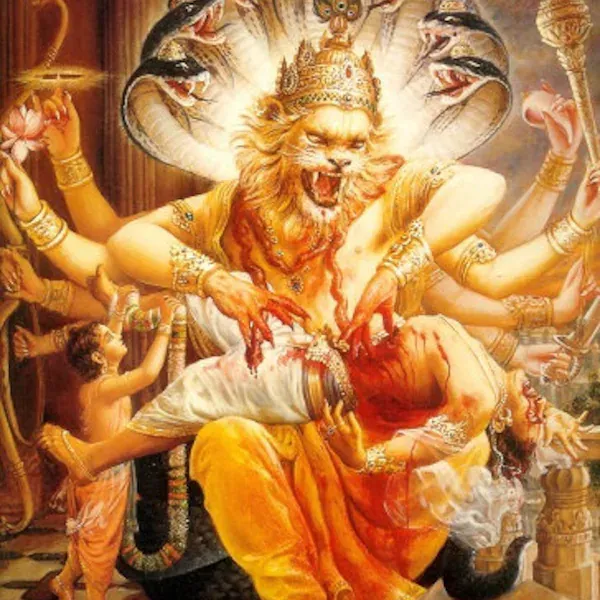
The Bhagavata Purana — the crown of the Puranic tradition, one of the most extraordinary documents in the history of human thought — gives us Hiranyakashipu: a demon king whose hatred of the divine is so absolute, so total, so consuming of every waking moment that it functions, the text argues without apology, as a form of liberation. Not the highest liberation. Not the destination reached by love. But liberation nonetheless — real, philosophically coherent, and received with the same divine attention that receives the greatest devotees. The Bhagavata Purana does not blink at this. It treats it as cosmological architecture: this is how the cosmos works, this is where this path leads, this is what the adversarial principle is for.
The Ramayana gives us Ravana — Brahmin, scholar of all four Vedas, supreme devotee of Shiva who composed the Shiva Tandava Stotram using his own sinews as the strings of a veena when the god playfully held down Kailash, sovereign of a Lanka of unprecedented prosperity and cultural achievement — who abducts Sita, and whose abduction is simultaneously catastrophic adharmic transgression and cosmological necessity. Without Ravana's transgression, Rama's lila on earth has no theater. The avatar's descent requires the villain's excess. The Ramayana holds both of these truths simultaneously, without flinching from either, and never resolves the tension between them — because the tension is the truth.
The Mahabharata gives us Bhishma, who is at once the greatest devotee of Vishnu in the poem and the man whose absolute vow of loyalty to the throne of Hastinapura forces him to fight on the wrong side of the most catastrophic war the tradition imagines. It gives us Shishupala, who abuses Krishna in the assembly of kings — one hundred times, two hundred times, the litany of insults so relentless and so total that the tradition reads it as a perverse liturgy — and receives, at the moment of his death, the divine gaze in full. Liberation through enmity. The tradition has a name for it. The tradition mapped its stages. The tradition understood where it leads, and where it cannot lead, with a philosophical precision no other tradition has approached.
This series is about that tradition, and about everyone else.
We are going to travel a very long road together. The road begins in ancient India — in the mountains where Hiranyakashipu performs austerities so severe that smoke rises from his crown and the gods are driven from their heavens — and it winds through Mesopotamia, where the oldest stories we have already know that defeating the monster costs something the official victory narrative does not acknowledge. Through Egypt, where Set is given a cosmological function even by the tradition that eventually demonizes him. Through ancient Greece, where the tragic form comes closer than anything else in the Western tradition to honoring the adversarial principle's genuine power — and still cannot give the villain his due. Through Rome, through the long painful process by which the pre-Christian world's morally complex divine figures are reclassified as demons. Through medieval Europe's most dramatic collision: the decade of the 1490s, when the most sophisticated esoteric cosmology the Western world has produced — Kabbalistic mysticism, with its mapping of the Qliphoth, the dark mirror of the divine, as genuinely real and genuinely necessary — was being elaborated in Safed and Gerona at the precise moment the Inquisition was burning its way through Spain and the Malleus Maleficarum was codifying the political designation of the villain at its most brutal and most intellectually dishonest.
We are going to spend time with Milton's Satan, who stole a poem that was supposed to condemn him. With the Romantic rebels — Blake, Shelley, Byron, Mary Shelley — who recognized what Milton had done and said so plainly. With Nietzsche, who identified the political thread correctly and then was left without a cosmological architecture to make sense of what he had found. With German Expressionism, with film noir, with the moment in a Berlin cinema in 1931 when a camera held on a child-murderer's face and the villain's interiority got screen time for the first time. With the comic book revolution. With the moment — the specific, nameable moment — when Western popular culture began, without knowing quite what it was doing, to give the villain a complete arc.
The destination is Hollywood, and what Hollywood cannot quite write. The villain's arc, in the best of contemporary film and television, now follows five of the seven movements that the Bhagavata Purana mapped as cosmological architecture. The sixth — liberation, reception, the cosmos opening to receive what it required — is the ending the secular tradition does not have the framework to write. We are going to name that framework.
Two threads run through every post in this series simultaneously. One is cosmological: what each tradition's deepest imagination understood about why the cosmos requires the adversarial principle, what the villain's nature and function and destiny are, and how far the tradition followed that understanding before it stopped. The other thread is political: how dominant power structures in every era have used the designation villain as an instrument of suppression — projecting it onto the bearers of genuine wisdom, feminine authority, esoteric knowledge, and cosmological complexity. The witch at the stake. The Jew expelled from Spain. The heretic destroyed by the institution that feared what the heretic knew. These are the politically manufactured villains, and their story is as important as the cosmological one — because the most electrically alive moments in the entire survey are the moments where these threads cross: where the culture's officially designated villain is doing its most sophisticated cosmological thinking, and the culture's officially designated heroes are doing their most intellectually dishonest work.
That juxtaposition is not incidental to this series. It is one of its two spines.
The modern world's fascination with the morally complex villain is not a symptom of an age that has lost its moral bearings. It is a symptom of an age that has noticed something — something it has been trying not to notice for a long time — about the gap between who gets called a hero and who actually deserves to be called one. This has been true, with varying degrees of legibility, essentially since the invention of money and the first king who told the first story about why he deserved to rule. The Vedic tradition was built in and around courts and kingdoms. It knew exactly what kings were. It did not need its rulers to be good because it had a cosmological architecture that did not rest on the goodness of kings. The adversarial principle was built into the structure of things. The drama was real. The mercy that waited at the end of it was real. And the tradition that told these stories was not naive about any of it.
What it knew — what it encoded in stories of extraordinary beauty and philosophical rigor, and what the rest of the world's literary traditions have been fitfully, partially, frequently interrupted rediscovering ever since — is this: the villain's story is not someone else's story. It is not the shadow cast by the hero's light. It is a complete journey with its own integrity, its own stages, and its own destination. The cosmos requires it. The drama cannot be told without it. And the mercy that awaits at the journey's end does not ask how you traveled.
The tradition that understood this most completely has been available, intact and alive, for at least three thousand years.
Glossary
Bhagavata Purana — One of the eighteen Mahapuranas of ancient India, considered the crown of the Puranic tradition. Contains the most philosophically systematic account of the adversarial principle's cosmological function, including the stories of Hiranyakashipu, Prahlada, Jaya and Vijaya, and Shishupala.
Dvesabhakti — Liberation through enmity. The theological doctrine, articulated in the Bhagavata Purana, that the divine's enemies — through the total absorption of their attention on the divine object of their hatred — accrue a form of contact with the divine that delivers liberation. The quality of the liberation is determined by the quality of the relationship through which it is reached.
Gaudiya Vaishnava — The philosophical and devotional tradition founded by Sri Chaitanya Mahaprabhu (15th–16th century CE), systematized by Jiva Gosvami, and transmitted through an unbroken lineage of teachers. Holds the Bhagavata Purana as its most authoritative text. ISKCON (the International Society for Krishna Consciousness) and affiliated institutions represent one primary vehicle of this living transmission.
Lila — The Sanskrit term for the divine's play or sport. The Vedic tradition understands the cosmos not as a mechanical system or a moral proving ground but as the arena of the divine's lila — a drama with its own internal logic, in which every participant, hero and villain alike, plays a necessary role.
Purana — Literally "ancient." The Puranas are the encyclopaedic cosmological and mythological texts of ancient India — eighteen Mahapuranas and numerous subsidiary texts — containing the most detailed account of the cosmos, its history, and its inhabitants, including the full architecture of the villain's journey.
Tapas — Austerity; literally "heat." The disciplined practice by which a Puranic figure — hero or villain — accumulates power. The villain's tapas are genuine, the power earned is real, and the tradition treats both with complete philosophical seriousness.
Sources and Further Reading
Primary Sources
Bhaktivedanta Swami Prabhupada, trans. Srimad-Bhagavatam (Bhagavata Purana). Bhaktivedanta Book Trust, 1972–1980. The foundational English-language translation with purports from within the Gaudiya Vaishnava tradition. Available at vedabase.io.
Valmiki. Ramayana. Multiple translations; the Gita Press edition (Gorakhpur) remains authoritative for the Sanskrit text. Robert Goldman's multi-volume Princeton translation is indispensable for scholarly context.
Vyasa. Mahabharata. Bibek Debroy's ten-volume Penguin translation (2010–2015) is the most accessible complete modern English edition.
Secondary and Comparative Sources
Doniger, Wendy. The Hindus: An Alternative History. Penguin Press, 2009. Engaged throughout the series for its attention to the tradition's own ambivalence about its villains.
Hiltebeitel, Alf. Rethinking the Mahabharata: A Reader's Guide to the Education of the Dharma King. University of Chicago Press, 2001.
Recommended Deeper Dives
purebhakti.com — Teachings and resources from the Bhaktivedanta Narayana Gosvami Maharaja lineage, particularly valuable for the philosophical nuances of dvesabhakti and liberation doctrine.
vedabase.io — Complete digital archive of Bhaktivedanta Swami Prabhupada's works, including the full Bhagavatam translation and purports.
Member discussion: