
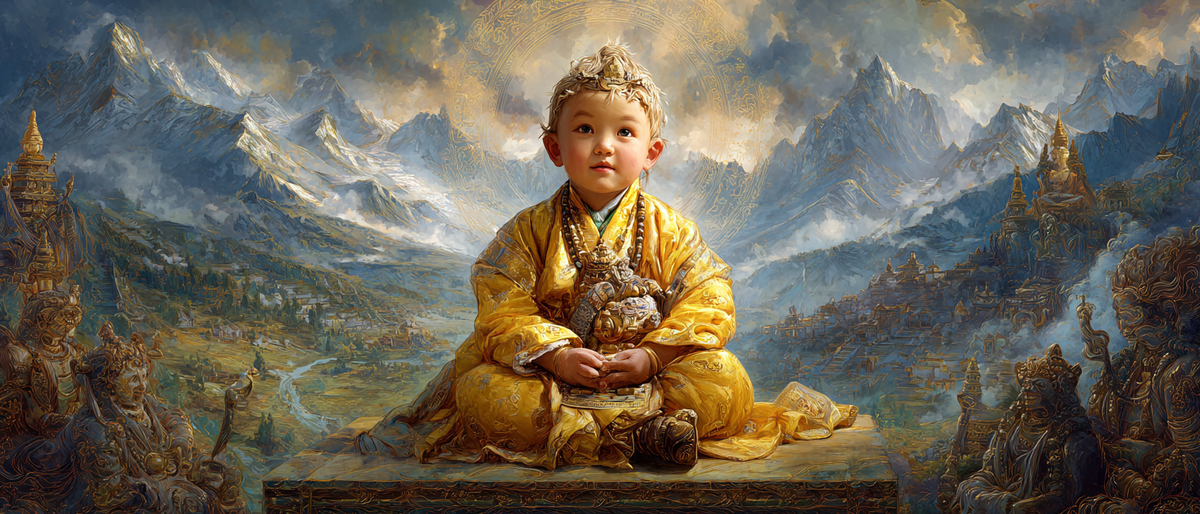
Somewhere in Tibet or its borderlands — the search may take years, may cross into India, Nepal, Bhutan, may follow the thread of dreams reported by senior monks, of birthmarks mapped against prophecy, of a child who said something no child should have known — a small delegation arrives at a farmhouse. The child is two, perhaps three. He has not yet lost the particular physical quality of very young children, that look of having recently arrived from somewhere else, of not yet having fully committed to the world he has landed in. The monks do not announce themselves to him. They sit. They watch. Then they lay out a collection of objects on a low table or on the floor: among them, objects that belonged to the previous Dalai Lama, and among those, decoys. The child moves toward the objects. He reaches. He selects. He may say, in a language no one has taught him yet to speak carefully: mine.
What is happening in this room is not — or not only — a religious ritual. It is an epistemological procedure. The monks are not testing the child's learning, his memory, his accumulated knowledge of the world. They are testing his perception: his ability to see, without mediation, what the conditioned adult cannot see. The entire institutional apparatus of Tibetan Buddhism — centuries of scholarship, generations of teachers, an intricate hierarchy of offices and obligations — is, in this moment, subordinated to the unconditioned gaze of a child who cannot yet read, reason, or govern. The adults in the room are, in the strictest sense, waiting to be told what to do by someone who does not know how to tie his own shoes.
This is not an anomaly. It is, this essay will argue, a structural recognition that appears — independently, in traditions with no historical contact, across the full span of civilizational time — wherever human communities have thought most carefully about the nature of sacred authority and its relationship to the knowledge that power requires. In Bethlehem, in Matthew's account, the wise men — magi, which is to say astronomers, scholars, the most elaborately conditioned intelligences of the ancient world — follow a star to a stable and kneel before an infant who cannot speak. They bring gold, frankincense, myrrh: the tribute of the worldly to the sacred. They return home by another route, the text tells us, because they have been warned in a dream — warned, that is, through the same channel of unmediated perception that the infant embodies and that they, in their wisdom, have learned to suppress and are now, briefly, recovering. The structure is the same as in Tibet: the adult world, in full ceremonial seriousness, organized around the perceptions of someone who has not yet been inducted into the adult world's investments. The unconditioned perceiver as sovereign. The conditioned adult as suppliant.
Every serious account of power asks, eventually, what makes authority legitimate — what transforms the fact of force, or of office, or of inheritance, into something that can claim the consent of those it governs, something that reaches beyond the merely coercive into the genuinely binding. The essays of which this is a companion have traced that question through the king/priest dyad: the argument that worldly power requires sacred legitimation, that the king needs the priest to make his second body, that the sovereign who rules without sacred accountability tends toward tyranny. But that argument, pursued far enough, arrives at a prior question: what is the source of the sacred authority that the priest confers? Where does the priest's power to legitimate come from? The institutional answer — from the church, from the tradition, from God through an apostolic chain — is available but unsatisfying, because it defers the question rather than answering it. The deeper answer, carried in the Tibetan recognition ritual and in the logic of the Incarnation alike, is this: sacred authority originates in unconditioned perception. The priest, ideally, sees what the ordinary adult cannot see — sees through the surface of the worldly into the nature of things as they are, rather than as power has arranged them to appear. And the child, before the world has arranged anything for them, already sees this way. The child is, structurally, the priest before the priesthood — the sacred perceiver in the state prior to institution.
This is not a Romantic claim about childhood innocence, not a sentimental argument that children are purer or better than adults, not a fantasy about the paradise we lose when we grow up. It is a structural and epistemological argument, and it is made with full precision by three traditions that are not given to sentimentality: Taoist philosophy, Zen Buddhist epistemology, and the depth psychology of Erich Neumann and C.G. Jung. It is also, with somewhat less precision but considerable imaginative force, the argument of Wordsworth's Intimations ode, Blake's Songs of Innocence and of Experience, Dostoevsky's The Idiot, Wolfram von Eschenbach's Parzival, and — read with the seriousness it almost never receives — Saint-Exupéry's The Little Prince. What all of these share, beneath their obvious differences of medium and tradition and century, is a recognition that the process of becoming a competent adult — of building the schemas, categories, specializations, and investments that allow a person to function in the existing order — is also, inescapably, a process of progressive foreclosure: of learning what not to see, of acquiring the categories that sort the world into the visible and the invisible, the serious and the negligible, the real and the merely imagined.
The child has not yet made these foreclosures. That is simultaneously their vulnerability — they are genuinely incompetent at the tasks the adult world requires — and their epistemological advantage. They have not yet learned, to borrow the formulation of the Zen teacher Shunryu Suzuki, what they know. "In the beginner's mind," Suzuki Roshi wrote, "there are many possibilities; in the expert's mind there are few." The expert's competence is real, but it is purchased at a cost that the expert, by definition, cannot fully see — because the cost is precisely the capacity to see what the expertise excludes. The child, who has not yet become an expert at anything, has not yet paid this cost. They see, in Alison Gopnik's phrase, with "lantern consciousness" — not the focused beam of adult attention, which illuminates one thing by darkening everything around it, but a wide, undifferentiated light that falls on everything at once, making no prior decision about what matters.
The essay moves through five territories. The first establishes the epistemological claim with the precision it requires, drawing on Taoist and Zen thought, on Wordsworth, and on contemporary developmental psychology. The second examines the historical and mythological record of the sacred child: the moments when civilizations made the epistemological claim institutionally, vesting genuine authority in the child's unconditioned perception — not as metaphor but as policy. The third enters the court: the figures who are not children but who perform the child's epistemological function within the adult power structure — the holy fool, the court jester, Parsifal, Prince Myshkin — and asks what their persistent presence reveals about what the power structure needs and cannot, through its normal operations, provide. The fourth reads the literary tradition: Blake above all, but also Wordsworth, Saint-Exupéry, Dostoevsky, James — attending to the ways the sharpest literary intelligences have thought through this dyad, and insisting, with Blake, that it is a dyad rather than a hierarchy: that Innocence and Experience are contrary states of the human soul, each requiring the other, neither complete alone. The fifth asks what secular modernity did with the sovereign child — how it managed, displaced, and sentimentalized the claim that these earlier traditions made with full seriousness — and what the contemporary recoveries of unconditioned perception, in contemplative practice and ecological thought, are actually attempting to recover.
The monks are still in the farmhouse. The child's hand rests on the object he has chosen. Outside, the adult world continues its very serious business of being the adult world. Inside, everyone is waiting.
THE EPISTEMOLOGICAL CLAIM
What the child sees that the adult cannot
The claim requires precision from the outset, because it is easily mistaken for something softer and less interesting than it actually is. The argument is not that children are innocent and adults are corrupt. It is not that childhood is a paradise from which experience exiles us. It is not, in any simple sense, a Romantic argument at all, though it has Romantic expressions, some of them brilliant. The argument is epistemological — it is about the structure of perception and knowledge — and it begins with a fact about cognitive development that is not seriously contested: that growing up is, among other things, a process of progressive specialization, and that specialization, in the cognitive domain as in every other, is purchased at a cost.
The cost is this. The human infant arrives in the world with a perceptual apparatus of extraordinary, almost promiscuous sensitivity. Everything registers. The boundary between self and world is not yet fixed; the senses are not yet sorted into separate channels; what developmental psychologists call "cross-modal" experience — the bleeding of sound into color, of touch into emotion, of spatial relationship into something felt rather than merely calculated — is the norm rather than the exception. The infant does not yet know what is figure and what is ground, what is important and what is negligible, what deserves sustained attention and what can be safely filtered out. In the terms that Alison Gopnik, one of the most precise contemporary thinkers about infant consciousness, uses in The Philosophical Baby: the infant attends with "lantern consciousness" — a wide, undifferentiated illumination that falls on everything in the visual and sensory field at once, without prior hierarchy, without the learned decisions about relevance that adult attention automatically and invisibly makes. The adult, by contrast, attends with "spotlight consciousness": a focused beam that illuminates one thing with great precision by darkening, equally precisely, everything around it. The adult's spotlight is more powerful, within its beam, than the infant's lantern. But the lantern shows more of the room.
What happens between infancy and adulthood is not simply the acquisition of knowledge, though it is that too. It is the acquisition of categories — of sorting mechanisms, schemas, frameworks, and, crucially, investments — that progressively decide, below the level of conscious attention, what will be admitted to perception and what will be excluded. This process is adaptive, obviously and importantly. The adult who still attended to everything with the infant's undifferentiated sensitivity would be unable to function; the categories that organize perception are the precondition of competence, of language, of the ability to act effectively in the world. The child who cannot yet sort the dangerous from the safe, the relevant from the irrelevant, the real from the imagined — that child is genuinely at risk, genuinely unable to navigate. The building of categories is not an error. It is what development is.
But the categories, once built, do not announce themselves as categories. They present themselves as reality. The adult who has learned — through culture, through education, through the long conditioning of living in a particular social world — that certain things matter and certain things do not does not typically experience this as a learned discrimination. He experiences it as simply seeing the world as it is. The categories have become transparent; they are the medium through which reality is perceived, not a filter laid over reality, and for this reason they cannot, in ordinary consciousness, be seen as categories at all. This is what Wordsworth meant, and it is more precise than it sounds, when he wrote of the "prison-house" that closes around the growing child: not that the adult is imprisoned in some obvious sense, but that the very walls of the prison have become invisible, because they have been internalized as the structure of perception itself.
Three traditions make this claim with a rigor and precision that Western Romantic poetry reaches toward but does not quite achieve, and it is worth pausing with each of them long enough to establish that this is not a vague intuition but a developed philosophical position.
The Taoist tradition, in the Tao Te Ching — the collection of eighty-one short texts attributed to the sage Laozi and probably compiled in the fourth or third century BCE — returns repeatedly to the infant as the model of the sage. This is not a sentimental claim. The Tao Te Ching is one of the least sentimental philosophical texts ever written; its tone is cool, precise, and frequently disconcerting. When it invokes the infant, it is making a specific argument about the relationship between te — roughly, virtue or power in the sense of potency — and the process of differentiation and specialization that the adult world requires. Pu, the uncarved block, is the text's image for the undifferentiated state prior to specialization: not a state of deficiency but of maximal potential, the state in which all possibilities remain open because none has yet been actualized at the expense of the others. Chapter 55 is explicit: "One who possesses virtue in abundance / is like a newborn child." The infant is not the model of the sage because it is innocent or pure in any moral sense. It is the model because it has not yet expended its potential on any particular form. Its te — its inherent power — is intact precisely because it has not yet been shaped into a tool for any particular purpose. The sage aspires to recover this condition, not by regression, but by a discipline that undoes the overdetermination that ordinary adult life accumulates: the returning, as chapter 28 puts it, to "the state of the uncarved block."
Zen Buddhism sharpens this argument into a practice. The concept of shoshin — the beginner's mind — is the organizing principle of Shunryu Suzuki Roshi's Zen Mind, Beginner's Mind, one of the most widely read introductions to Zen practice in the Western world, and the passage that opens it has the quality of the best aphorisms: once read, it reorganizes everything around it. "In the beginner's mind there are many possibilities; in the expert's mind there are few." The expert is genuinely expert — this is not anti-intellectualism, not a dismissal of knowledge or skill. But the expert's knowledge has closed off, as a precondition of its own existence, the very openness that the beginner retains. The expert already knows what the answer is likely to be, which means she is already, before the question is fully asked, sorting the incoming data by its relevance to the expected answer. The beginner does not know what the answer is likely to be. The beginner is, in this sense, in the epistemological condition of the child: not ignorant, exactly, but unforeclosed. The koan — the Zen device of presenting the student with a question that has no rational answer, famously "What is the sound of one hand clapping?" — is a technology for inducing, in the adult, a specific epistemological crisis: the crisis of the competent mind confronting a problem that its competence cannot solve. The koan is not designed to produce an answer. It is designed to produce the collapse of the question-answering apparatus — to bring the adult mind, through exhaustion and disorientation, back to a state prior to the automatic deployment of its categories. What is recovered in this state — what the tradition calls kensho, seeing into one's nature — is not something exotic or supernatural but something ordinary: the ordinary perception of the world that the adult had before the categories were built and that has been there, underneath the categories, all along. The koan does not grant enlightenment. It removes the obstruction. What it reveals was always already present — which is precisely what the Tibetan monks believe the child already has.
This convergence between the Zen epistemology of recovered perception and the Tibetan epistemology of native perception is not coincidental. Both are expressions of the same underlying claim: that the unconditioned state is not a deficiency to be remedied but a ground to which the conditioned mind must continually, effortfully, return. The difference — and it matters — is that Zen places this return at the end of a long discipline, while the Tibetan recognition ritual places it at the beginning of a life. The child is sovereign before the work begins. The master is sovereign after the work has, in some sense, been undone. What they share is the condition itself: the mind that has not foreclosed, or has ceased to foreclose, on the immediate reality of the world.
Wordsworth's "Intimations of Immortality from Recollections of Early Childhood" is the English literary text that thinks most carefully and most honestly about this claim — carefully enough, and honestly enough, to resist the Romantic sentimentalism that would make it merely an elegy. The ode is commonly read as a lament: we come into the world "trailing clouds of glory," the visionary light of childhood fades as "the prison-house" of adult habit closes around us, and we are left with the philosophic mind as a consolation prize. But this is to misread the ode, or to read only its first movement. Wordsworth is explicit that Experience gives something that Innocence cannot provide — "the soothing thoughts that spring / Out of human suffering," the capacity to find in "the meanest flower that blows" a depth of feeling that the child's undifferentiated radiance does not, actually, reach. The "philosophic mind" is not a lesser substitute. It is a different and genuine knowledge, the knowledge that only suffering and time and the loss of the original vision can produce. But — and this is the ode's structural claim, not merely its emotional resolution — the original vision is not simply lost. "Though inland far we be, / Our souls have sight of that immortal sea / Which brought us hither." The adult cannot return to the child's perception by an act of will. But the child's perception persists as a ground, a source, a horizon that the adult's deepest moments can still, however briefly, reach. Blake will make this more rigorous; Wordsworth makes it more true.
Philippe Ariès's Centuries of Childhood contributes a complication that any honest account of the child's epistemological status must acknowledge: "childhood" as a distinct phase of life, sheltered from adult reality and organized around its own needs and perceptions, is a relatively recent historical construction — largely a product of the seventeenth and eighteenth centuries in Western Europe. For most of human history, the child was not set apart in a protected developmental space; children entered adult working life early, were present at birth, illness, and death, were dressed as small adults and treated as small adults as soon as they were physically capable of adult tasks. The epistemological child — the child as the bearer of a distinct and privileged mode of perception — is therefore older, as a cultural and spiritual category, than the sentimental child — the child as a being requiring protection, cultivation, and the sheltering innocence of a childhood preserved against the intrusions of the adult world. The Tibetan recognition ritual and the Magi's tribute are not expressions of sentimental childhood. They are expressions of something harder: the recognition that the unconditioned perceiver sees what the conditioned adult cannot, and that this perception is a form of authority that demands, from the adult world, not protection but attention.
THE SACRED CHILD IN THE HISTORY OF POWER
When civilizations made this claim institutionally
The epistemological argument, taken seriously, leads directly to a historical one. If the unconditioned perceiver sees what the conditioned adult cannot — if the child's lantern consciousness illuminates what the adult's spotlight has, by the very mechanism of its focus, placed in darkness — then the question becomes: have human civilizations actually acted on this recognition? Have they, at any point, done more than sentimentalize the child's perception, more than acknowledge it as a charming but ultimately inconsequential feature of the years before competence arrives? The answer, recovered from sources as different as Tibetan Buddhist institutional history, the theology of the Incarnation, and the depth psychology of Erich Neumann, is yes — and the yes is more systematic, more institutionally serious, and more politically consequential than the modern reader, accustomed to a world that has thoroughly sentimentalized and thereby defused the claim, is likely to expect.
Begin with the most fully elaborated institutional case, the one this essay opened with: the recognition of the Dalai Lama. The procedure, developed over centuries of Tibetan Buddhist practice and refined into its current form by the seventeenth century, is worth examining in some detail, because its details are the argument. When a Dalai Lama dies, a search committee of senior monks and officials is convened. They consult oracles. They examine the state of the sacred lake Lhamo La-tso for visionary indications of the direction and location of the next incarnation. They study the smoke from the cremation, the position of the body, the reports of auspicious signs in particular regions. All of this is, by any measure, an elaborate adult institutional apparatus: the most conditioned of conditioned procedures, the product of centuries of accumulated religious learning and political experience.
And then, at the end of all this apparatus, they find a small child and watch his hands.
The objects laid before the child — the prayer beads, the ritual implements, the personal possessions — are not presented as a test of memory or of learned association. The child has not been prepared, coached, or exposed to the objects before the recognition procedure. What is being tested is something prior to memory and prior to learning: the child's ability to recognize, through a perception that the adult cannot replicate, what already belongs to him. The Tibetan theological claim is that the Dalai Lama is a tulku — a deliberate reincarnation, the Bodhisattva Avalokiteśvara choosing to return to the world in human form for the benefit of all sentient beings. But the theological claim and the epistemological claim are, for the present argument, the same claim: the child perceives what the adult cannot because the child has not yet been cut off, by the accumulation of a particular life's conditioning, from the deeper continuity that the adult's categories conceal. The adult sees the objects as objects. The child — this child, the right child — sees them as his.
What makes the Tibetan case especially arresting is the way it inverts the normal direction of authority. The recognition committee is composed of the most senior, the most learned, the most institutionally powerful figures in Tibetan religious life. They have spent decades acquiring the conditioning — the learning, the practice, the political experience — that qualifies them for their positions. And they are, at the culmination of their procedure, entirely subordinated to the perception of a two-year-old. The apparatus does not evaluate the child. The apparatus serves the child. It exists to find him, to verify what he already knows, to translate his unconditioned perception into the institutional form that the adult world requires. The hierarchy is, in the most literal possible sense, inverted: the most conditioned adults in the system are organized around confirming the authority of the least conditioned member.
The Christian theological tradition reaches a structurally identical place by a completely different route — which is, as noted in the introduction, itself an argument. The doctrine of the Incarnation holds that the second person of the Trinity chose to enter human existence as an infant: not as a fully formed adult, not as a sage who arrived with his wisdom already legible, but as a being of absolute helplessness, absolute dependence, absolute unconditionedness. The theological term for this is kenosis — from the Greek kenōsis, self-emptying — and it names the paradox that divine power expresses itself most completely in the condition of most complete powerlessness. The infant in the manger cannot speak, cannot protect himself, cannot claim anything, cannot demonstrate his authority through any of the means that the adult world recognizes as authoritative. And yet Matthew's gospel presents the Magi — astronomers, scholars, the intellectual elite of the ancient world — traveling an enormous distance to kneel before him and render tribute.
The theological reading of this scene emphasizes the recognition of messianic fulfillment, the gathering of the Gentiles, the extension of Israel's promise to the nations. All of this is real and important within its own framework. But the epistemological reading runs alongside it: the Magi are, by Matthew's account, the wisest and most learned men available — the most thoroughly conditioned intelligences of their world — and they follow a star, which is to say they follow a form of knowledge that bypasses their learning entirely, a perceptual event that their categories cannot produce and can only track from behind. They arrive at an infant. They kneel. The tribute they bring — gold for kingship, frankincense for priesthood, myrrh for suffering and death — is the tribute of adult institutional categories (king, priest, mortal) rendered to the figure who, in his infancy, precedes and exceeds all three. Sarah Coakley, in her luminous study of kenosis and gender in Christian theology, Powers and Submissions, argues that the self-emptying movement of the Incarnation is not a temporary diminishment on the way to something greater but a permanent disclosure of what divine power actually is: not domination, not the imposition of the stronger will on the weaker, but the fullness of being expressed through the willingness to be empty. The infant's authority is not despite his helplessness. It is through it.
Neumann's depth psychology provides the framework that allows these two cases — Tibetan and Christian, institutional and theological — to be seen as expressions of a single archetype. In The Child, his extended study of the Divine Child as a psychological and mythological figure, Neumann argues that the child archetype appears, across cultures, as the carrier of two things simultaneously: the past, in the sense of the original, undifferentiated wholeness that precedes the adult's specialization; and the future, in the sense of the new possibility that the existing order cannot generate from within itself and that must therefore arrive from outside it. The Divine Child — Horus, the Christ child, the infant Dionysus, the baby Krishna, the newborn Arthur hidden away from the enemies who would destroy him before he can claim his throne — is always both: the carrier of what was before the world began and the promise of what the world, in its current form, cannot yet contain.
Jung's essay "The Psychology of the Child Archetype," in The Archetypes and the Collective Unconscious, adds a political dimension to Neumann's developmental one. The child archetype appears, Jung argues, not only in individual psychology but in cultural moments of crisis and transition: when an existing order has exhausted its generative capacity, when the categories that have organized collective life have become too rigid to accommodate the reality they were built to manage, the child archetype emerges as the symbol of renewal — of the possibility that has not yet been foreclosed, that exists prior to the existing order's decisions about what is possible. This is why, Jung notes, the Divine Child is almost always born into vulnerability and danger: Herod's massacre of the innocents, the infant Moses cast on the Nile, the baby Dionysus hidden from Hera. The existing order correctly perceives the child's arrival as a threat. The child has not yet invested in the world as it is; and the world as it is depends, for its stability, on everyone investing in it.
This Jungian-Neumann framework illuminates something important about the historical boy-kings that a purely political history tends to obscure. Tutankhamun, Edward VI, the child-emperors of Rome and China — these figures present obvious political problems: the regency, the faction, the manipulation of the nominal sovereign by the actual power. Political history quite rightly focuses on these dynamics. But the symbolic logic that places a child on the throne — the persistent intuition that the most politically unformed figure may be, in some register, the most symbolically pure vessel of royal authority — is not merely a dynastic accident or a failure of succession planning. It is a recurrent expression of the recognition that Neumann identifies: the child has not yet been captured by the existing order, and therefore embodies, structurally, the possibility of its renewal. The boy-king is symbolically compelling in direct proportion to his political incompetence. His very incapacity to act on behalf of any faction is the source of his ritual authority.
Marie-Louise von Franz, in Puer Aeternus — her study of the "eternal youth" archetype in depth psychology — complicates this picture in a way that intellectual honesty requires acknowledging. The puer figure — the one who refuses to grow up, who remains in the condition of pure possibility rather than committing to any particular actualization — is not, in von Franz's analysis, simply a spiritual ideal. It is also a psychological trap: the refusal of the child's condition to develop into something that can act in the world, the inflation of innocence into an excuse for irresponsibility, the confusion of unconditioned perception with the avoidance of conditioned engagement. The eternal youth who never becomes an adult has not achieved organized innocence; he has simply refused Experience. Von Franz's corrective is important: the child's authority is not a permanent condition to be cultivated but a ground to be touched and returned from. The Dalai Lama who is found at two years old does not remain two years old; he is educated, trained, initiated into the full complexity of the tradition he is to lead. The recognition of his unconditioned perception is the beginning of a process, not its culmination. The child's authority is real; the child's authority alone is not enough.
What the historical and mythological record shows, across these cases, is a persistent institutional recognition that organized power requires access to something it cannot generate from within itself — a perception that its own conditioning systematically excludes, an authority that its own apparatus cannot confer. The child is the figure who carries this perception and this authority structurally, by virtue of what she has not yet become. She is, in the terms this project has developed across its other essays, the counterpart figure in its most radical form: the intimate Other who completes the sovereign not by providing what the throne has in abundance but by providing what the throne, by its very nature, cannot have. The king's second body, in Kantorowicz's formulation, is conferred by the priest. But the priest's authority — the sacred perception that makes the anointing more than a merely ceremonial act — draws, ultimately, from the same source as the child's: from the place prior to the investment, prior to the conditioning, prior to the adult world's arrangements about what is real and what can be safely ignored.
Which means that the child is not, in the end, a figure who exists before the king/priest axis that this project has traced through twelve essays. The child is the figure who shows where the axis is rooted — the ground beneath the ground, the layer prior to the primal split, the condition of unconditioned perception from which both the king's worldly authority and the priest's sacred legitimation ultimately draw. The monks lay out the objects. The child reaches. Everyone in the room leans forward, holding their breath, waiting to be told what the unconditioned perceiver sees. That waiting — that organized, institutionalized, centuries-deep waiting — is the adult world's deepest acknowledgment of what it knows about itself: that it cannot, finally, legitimate its own authority. It must go to the child.
THE HOLY FOOL AND THE COURT
The child-principle inside the adult power structure
There is, however, a problem with the Blakean resolution. The dialectical movement from Innocence through Experience to organized Innocence is a spiritual and artistic achievement. It is not — it has never been — a political one. Courts, kingdoms, and institutions do not, as a rule, promote the people who have achieved organized innocence to positions of authority. They promote the people who have mastered the existing order's categories, who have demonstrated their investment in the world as power has arranged it, who have, in precisely the relevant sense, been thoroughly conditioned. The unconditioned perceiver — the one who sees what power has made invisible, says what power has made unspeakable, asks the question that courtesy and prudence and self-preservation have taught everyone else to swallow — is not typically found at the center of power. They are found at its edge.
They are found, specifically, in a figure that appears across European, Byzantine, Slavic, and Asian traditions with a consistency that suggests not cultural diffusion but structural necessity: the holy fool.
The yurodivyi of Russian Orthodox Christianity is the most fully developed institutional form of this figure. The word is usually translated as "fool for Christ's sake," after Paul's first letter to the Corinthians — "we are fools for Christ's sake" — and it names a specific spiritual vocation: the deliberate assumption of apparent madness, social abasement, and the systematic violation of every norm of adult dignity, as a way of stripping away the conditioning that makes ordinary adults blind. The yurodivyi goes without clothing in winter. He eats garbage. He shouts obscenities in the street. He sleeps in doorways and disrupts church services and says, loudly, in public, the thing that everyone knows and no one will say. He is, by every marker the adult world recognizes, either incompetent or insane. And he is, for precisely this reason, the one person at the court of the Tsar who can say what no bishop, no general, no minister of state can say and survive.
The holy fool Basil the Blessed — after whom the cathedral on Red Square is named, which tells you something about how seriously medieval Russia took this figure — is reported to have approached Ivan the Terrible during a fast day and offered him a piece of raw meat. When Ivan pointed out that it was Lent, Basil replied that Ivan had already committed enough murders that a little more blood could hardly matter. Ivan, who killed people for substantially less provocation than this, did not touch him. The sacred unseriousness of the fool — his explicit removal from the adult world of status, consequence, and investment — was precisely his protection. He could not be reached by the instruments of adult power because he had placed himself, voluntarily and completely, outside the adult world's categories of what mattered. He had, in the most radical possible way, returned himself to the epistemological condition of the child: outside the existing order's investment, and therefore capable of seeing it whole.
Sergei Ivanov's exhaustive study of the Byzantine and Russian holy fool tradition demonstrates that this figure was not marginal to Orthodox political culture but structurally central to it. The yurodivyi performed, within the Christian kingdom, the function that the prophets had performed in ancient Israel: the sacred voice that says Thus saith the Lord against Thus saith the King. But where the prophet at least claimed divine authorization — claimed, that is, a specific institutional identity within the sacred order — the fool claimed nothing except his own apparent madness. The authority was therefore more radical, not less. It could not be absorbed, co-opted, or officially managed, because it held no office that could be taken away and made no claim that could be formally refuted. It was pure epistemological standing: the standing of the one who has placed himself outside the investment and can therefore see.
Shakespeare's Fool in King Lear is the literary crystallization of this structural logic, and he is worth pausing over because Shakespeare understood, with his usual uncanny precision, exactly what the Fool's structural position within the court required and what it cost. The Fool is the only character in the play who understands, from the beginning, what Lear is doing to himself — who sees, without illusion and without the self-protective blindness that afflicts everyone else, exactly how the story will go. His understanding is expressed almost entirely in riddles, songs, and apparent nonsense: the licensed language of the one who speaks from outside the adult order's categories of seriousness. "I am better than thou art now," he tells Lear in the storm, "I am a fool, thou art nothing." It is the most precise statement of the fool's epistemological advantage in all of literature: the fool, who holds nothing, cannot lose what Lear has lost. The fool's poverty of investment is his wealth of perception.
But the Fool disappears from Lear after Act Three, and Shakespeare does not explain where he goes. Directors and critics have puzzled over this for four centuries. The most compelling explanation is structural rather than dramaturgical: once Lear himself has been broken open by the storm — once the king has been stripped, by catastrophe, of every marker of adult status and investment, reduced to a mad old man on a heath who sees, for the first time, "poor naked wretches" and asks "have I ta'en too little thought of this?" — the Fool's function has been transferred. Lear has become, through suffering, what the Fool was by vocation. He no longer needs the fool because he has become one. The child-perception has been recovered, at enormous and irreversible cost, in the adult who had most thoroughly suppressed it.
The figure of Parsifal takes this logic and gives it its most complete theological elaboration. Wolfram von Eschenbach's thirteenth-century Parzival — the source from which Wagner drew his late opera, and one of the most sophisticated treatments of spiritual development in medieval literature — turns on a paradox that is by now recognizable: the qualification for the Grail quest is not knowledge, martial excellence, or courtly accomplishment. It is their absence. Parsifal is introduced as reine Tor — the pure fool, the simple one — and his simplicity is not a deficit to be overcome in the course of the narrative but the very quality that makes him, ultimately, the one who can ask the question no one else in the Grail castle can ask.
The question is devastatingly simple: What ails thee? Parsifal's first visit to the Grail castle fails because he has just enough courtly conditioning to suppress it. He has been taught, by the knight Gurnemanz, that a well-bred man does not ask intrusive questions — does not pry into matters that his host has not chosen to disclose. And so when he sees the Fisher King, Amfortas, clearly suffering from a wound that is never named and never healed, Parsifal says nothing. He has learned, just enough, to be polite. He has acquired, just barely, the adult's investment in the existing social order — the order that requires the wound to go unasked about, that has organized the entire Grail castle around the management of a suffering that cannot be acknowledged. He is expelled from the castle the next morning without understanding why he has failed, and spends years in wandering and penance before he returns, sufficiently humbled and sufficiently recovered of his original simplicity, to ask the question that shatters the enchantment.
What Wolfram understood — and what Wagner, in his late, strange, deeply serious way, amplified — is that the adult world's greatest wounds are precisely the ones it has learned not to see. The conditioning that makes adults competent also makes them, in the Grail castle's specific sense, complicit: complicit in the maintenance of arrangements that require the wound to stay unspoken, because speaking it would disrupt the order that everyone, including the wounded king himself, has invested in maintaining. The child — or the fool, or the one who has recovered the child's perception through the discipline of organized innocence — asks the question not out of naivety but out of a freedom from that complicity. The question is simple. Its simplicity is the hardest thing in the world to recover.
Dostoevsky's Prince Myshkin, in The Idiot, is the literary test-case for what happens when the child-principle enters the adult world without the protection of the fool's license or the Grail quest's narrative container. Myshkin is not a child, and he is not, in any simple sense, a fool. He is a man of extraordinary perceptual precision: he sees every character he encounters with a clarity that the novel consistently validates — his readings of Nastasya Filippovna, of Rogozhin, of the Epanchin household are exact, compassionate, and correct. He sees because he is genuinely not invested in the adult world's arrangements; he has arrived, as it were, from outside — from the Swiss sanatorium, from the condition of epilepsy that has kept him at the edge of adult social life — and the outsider's position gives him the lantern consciousness that the novel's other characters, absorbed in their investments and their ambitions and their jealousies, cannot sustain.
But Myshkin has no protection. The yurodivyi is protected by his apparent madness; Parsifal is protected by his narrative — he is on a quest, he exists within a structure that can eventually receive what he has to offer. Myshkin exists in the secular social world of nineteenth-century St. Petersburg, which has no structure for the unconditioned perceiver except the diagnosis of illness. The novel's tragedy is not that Myshkin is wrong. It is that the adult world has no way to receive what he sees except as pathology. His perception is exact; it destroys him anyway. He ends the novel returned to the sanatorium, to the condition of epilepsy and blankness, the child-perception collapsed back into incapacity because the world it entered had no form to hold it.
Dostoevsky was, in this, more pessimistic than Wolfram and more honest than Shakespeare — or rather, he was writing about a world more thoroughly secular than either of theirs, a world that had lost the institutional forms — the holy foolery, the Grail quest, the court's licensed jester — through which earlier cultures had found a place, however marginal and precarious, for the unconditioned perceiver within the adult power structure. What all four figures share — the yurodivyi, Lear's Fool, Parsifal, Myshkin — is the structural position of the child within the court: the one who holds no investment in the existing order, who sees from outside its categories, and who can therefore say or ask or simply embody what the conditioned adult cannot. What differs, across these four cases, is whether the power structure in question has a place for that figure — a licensed position, a narrative container, a theological category — or whether it has lost even that, and must encounter the unconditioned perceiver as nothing other than madness.
The contemporary power structure, it should be noted, has made its choice on this question. It has chosen the diagnosis.
IV. BLAKE AND THE LITERARY TRADITION
The dyad, not the hierarchy
William Blake engraved the two sets of poems that make up Songs of Innocence and of Experience between 1789 and 1794, and he was careful, in the combined title he gave the finished work, to tell the reader exactly what they were holding: Songs of Innocence and of Experience: Shewing the Two Contrary States of the Human Soul. Not the two successive states. Not the better and the worse. The contrary states — and Blake's use of the word contrary is precise, philosophical, and load-bearing. In his later prophetic work The Marriage of Heaven and Hell, written in the same years, he is explicit: "Without Contraries is no progression. Attraction and Repulsion, Reason and Energy, Love and Hate, are necessary to Human existence." The contrary is not the opposite in a simple logical sense. It is the necessary counterpart — the term without which the other term cannot fully exist or be fully known. Blake is making a structural claim, and it is the same structural claim that governs this project's reading of the king/priest dyad: neither term is valorized at the expense of the other; their tension is the engine of something that neither, alone, could generate.
The common misreading of the Songs — Innocence as paradise, Experience as corruption, the adult world as the systematic destruction of the child's original goodness — is a misreading that the poems themselves, read carefully, will not sustain. "The Lamb," in Songs of Innocence, is a genuine and beautiful thing: the child's question to the lamb ("Little Lamb, who made thee?") and the child's answer ("He is called by thy name, / For he calls himself a Lamb") establish a perception of creation as unified, benign, and intimate — God and lamb and child all sharing a single nature, held together by the tenderness of a name. But "The Tyger," in Songs of Experience, is equally genuine and equally beautiful, and it asks a question that "The Lamb" cannot answer and does not try to: "Did he who made the Lamb make thee?" The Tyger's fire, its "fearful symmetry," its sinews and hammers and chains — this is not a corruption of the Lamb's world. It is a revelation of what the Lamb's world contains and what the child's innocent perception, in its very tenderness and unity, cannot see. The Lamb knows God as gentleness. The Tyger knows God as terror. Both are true. Neither is sufficient. The full perception requires both — which means it requires the movement through Experience that the child, in her innocence, has not yet made.
This is not a comfortable argument, and Blake does not make it comfortable. The Chimney Sweeper of Innocence — the small boy who consoles himself and his companions with a dream of angels and green plains, who wakes from the dream "happy and warm" and goes off to his work in the dark — is not simply a victim whose innocence is being cynically exploited, though he is that too. His innocence is real; his consolation is genuine; his dream is not a lie. But "The Chimney Sweeper" of Experience — the different boy who stands in the snow while his parents are "gone to praise God and his Priest and King" — sees what the first boy cannot: that the church, the king, and the parental piety that sends children up chimneys have organized themselves precisely around the management of the first boy's innocence, around the transformation of genuine spiritual consolation into a mechanism of social control. Experience does not prove Innocence wrong. It reveals what Innocence, in its own completeness, cannot see: the way the adult world uses the child's perception against the child.
Blake's mature formulation — "organized innocence," from Jerusalem — is the term that resolves, or rather holds in productive tension, what the Songs have established as irreducibly contrary. Organized innocence is not the innocence of the child who has not yet encountered the world. It is the innocence of the adult who has passed through the world — through Experience, through the knowledge of the Tyger, through the sight of the Chimney Sweeper in the snow — and recovered, on the other side of that knowledge, a perception that is no longer naive but is no longer foreclosed either. It is, in the terms this essay has been developing, the organized innocence of Parsifal after his years of wandering: not the pure fool who asks no questions because he does not yet know enough to ask them, but the returned knight who asks the one question he spent years learning he was allowed to ask. The child-perception recovered in the adult who has genuinely paid the cost of becoming an adult. This is Blake's real subject.
Wordsworth reaches the same place by a different path, and his path is in some respects more honest — more willing to sit with the cost rather than moving quickly to the dialectical resolution. The "Intimations of Immortality from Recollections of Early Childhood" is the English literary text that thinks most carefully and most painfully about what is lost in the passage from child to adult, and its greatness lies precisely in its refusal to resolve that loss too quickly or too tidily. The ode opens in grief — genuine, undefended grief for a perception that has demonstrably changed: "There was a time when meadow, grove, and stream, / The earth, and every common sight, / To me did seem / Apparelled in celestial light, / The glory and the freshness of a dream." The light Wordsworth is mourning is not a metaphor for something else. It is a precise description of a perceptual quality — a luminosity, a sense of the world as charged with meaning and presence from within — that the child experiences directly and that the adult finds, looking back, has quietly and irreversibly withdrawn. "It is not now as it hath been of yore." The statement is flat, declarative, and devastating in its simplicity. Something has changed. Wordsworth will not pretend otherwise.
What makes the ode philosophically serious rather than merely elegiac is what it does next — which is not to resolve the grief but to interrogate it, to ask what the lost perception actually was and whether its loss is simply loss or whether it is also, in some register that the grief initially obscures, a transformation into something else. The famous answer — "trailing clouds of glory do we come / From God, who is our home" — is not, in context, a theological claim about the soul's pre-existence, though it has been read that way. It is an epistemological claim: the child arrives in the world carrying a perception of it that is prior to the world's own account of itself, prior to the categories and investments that the world will progressively install. The "celestial light" is not supernatural. It is the light of unconditioned perception — the lantern consciousness that falls on everything at once, before the adult's spotlight has been built and focused and the categories have decided what will be illuminated and what will be left in darkness.
The ode's movement through grief toward resolution is careful not to cheat. Wordsworth does not argue that the lost perception was illusory, or that the adult's compensation is simply superior, or that the philosophic mind is a straightforward upgrade from the child's visionary radiance. The compensation is real — "the soothing thoughts that spring / Out of human suffering," the "faith that looks through death," the "years that bring the philosophic mind" — but it is named as compensation, which means the loss is also real and is not cancelled by what replaces it. What the ode ultimately argues is something more subtle and more structurally important for this essay's purposes: that the original perception is not simply gone. It persists as ground, as source, as the sea that the adult, now "inland far," can still, in certain moments, have sight of. "Though inland far we be, / Our souls have sight of that immortal sea / Which brought us hither." The child's perception cannot be recovered by an act of will. But it has not disappeared; it has receded, and it remains as the horizon toward which the adult's deepest moments still, however briefly, tend.
This is Wordsworth's most important structural contribution to the essay's argument: not the elegy for lost vision, which is the part everyone quotes, but the insistence that the vision persists as ground. The adult does not merely remember the child's perception. The adult is still, in some dimension of experience that ordinary adult consciousness has learned to overlook, in contact with it. The contemplative traditions that we examined earlier — the Zen beginner's mind, the Tibetan rigpa — are, in Wordsworth's terms, technologies for recovering sight of the immortal sea: not for returning to the shore (which is impossible, and which, if it were possible, would cost the genuine knowledge that Experience provides) but for remembering, in the adult's full complexity, that the shore exists and that one came from it.
Antoine de Saint-Exupéry's The Little Prince, published in 1943, is one of the most widely read books in the world and one of the least seriously analyzed. This is itself significant: the book has been sentimentalized into a children's classic, assigned to the protective-precious register that we will later argue is modernity's characteristic way of managing the epistemological claims of the child. But read without that protective framing — read as the sustained philosophical argument that it actually is — The Little Prince turns out to be among the most precise literary treatments of the child/adult dyad in the Western tradition, and its precision is inseparable from its apparent simplicity.
The book opens with a scene that establishes its epistemological stakes immediately. The narrator, as a child of six, draws a picture of a boa constrictor digesting an elephant. To him the image is obvious and compelling. Every adult he shows it to sees a hat. He tries again: he draws the inside of the boa constrictor, the elephant visible within it. Still the adults see a hat, or recommend that he put aside drawing and study geography, history, arithmetic, and grammar instead. The narrator concludes, sensibly given the evidence, that grown-ups are not capable of understanding, and he spends his adult life in a profession — aviation — that keeps him in the physical proximity of the open sky while surrounding him with the practically-minded adults whose categories he has learned, provisionally and without conviction, to share.
The epistemological argument embedded in this opening is exact. The adults are not stupid; they are conditioned. They have learned, through the long process of becoming competent adults, to see what the visual field contains by sorting it through the categories that adult experience has built: hat, not boa-constrictor-digesting-elephant, because hats are in the repertoire of adult visual experience and boa constrictors digesting elephants are not. The child's drawing is not unclear. It is perfectly clear — to anyone who has not yet learned to sort the world into the categories that adult competence requires. The child sees the elephant inside the snake. The adult sees a hat. And the adult is not wrong, exactly — the drawing does look like a hat — but the adult is missing something the child is not missing, and what the adult is missing is the willingness to consider that what is inside the visible surface might be as real and as important as the surface itself.
This is the fox's epistemology, stated in the book's most famous line: "It is only with the heart that one can see rightly; what is essential is invisible to the eye." The line is usually quoted as a sentiment. It is actually a precise epistemological proposition: that the categories through which the adult's conditioned perception sorts the visual field are categories of the surface, and that they systematically exclude from perception precisely what is most real — the particular, the relational, the animate quality of things that have been loved or attended to or entered into genuine relationship with. The little prince's rose is not distinguished from the five thousand other roses in the garden by any quality that adult categorical perception can identify. She looks exactly like the others. What makes her irreplaceable is the attention, the care, the relationship — the specific history of encounter — through which she has become, in the fox's precise formulation, tamed: drawn into a relationship of mutual particularity that the adult's generalizing categories cannot register and therefore cannot value.
Gaston Bachelard's The Poetics of Reverie is the philosophical text that illuminates what Saint-Exupéry is doing more fully than any other, because Bachelard understood that the child's perception is not primitive but primal — not a deficient version of adult perception but its source, the layer from which the adult imagination draws when it is working at its deepest level. Bachelard's argument is that the poetic image — the image that genuinely arrests, that opens rather than closes, that makes the reader experience the world rather than merely categorize it — is always, in some sense, a recovery of the child's direct perception: an encounter with the immediate reality of a thing before the adult's categories have sorted it into the relevant and the irrelevant, the important and the negligible. The great literary image does not describe the world; it restores the reader to the world, to the direct encounter with it that the adult's conditioning has overlaid. And this restoration is, Bachelard insists, not a regression. It is an achievement — the achievement of the adult imagination that has not forgotten, or has recovered, its access to the ground from which it came.
Henry James's What Maisie Knew takes the child's epistemological authority and makes it the explicit formal principle of a novel — and in doing so reveals something about the device that Blake and Wordsworth and Saint-Exupéry handle more obliquely. Maisie Farange is the daughter of two spectacularly self-involved divorced parents who use her, shuttle her between them, and conduct their elaborate adult dramas of desire, rivalry, and bad faith entirely in her presence, on the assumption — entirely mistaken — that she does not understand what she sees. The novel's central irony, established in its title and sustained through every page, is that Maisie understands everything. Not in the adult's way — not with the adult's categories of moral judgment, sexual motivation, and social calculation — but with the child's direct, uncategorized, extraordinarily precise perception of what is actually happening in the room. She sees the quality of attention, the direction of desire, the exact texture of the dishonesty, the specific shape of each adult's self-deception, with a clarity that none of the adults can sustain about each other precisely because they are too invested in the existing arrangements to see them whole.
James's formal achievement is to render the novel through Maisie's consciousness without ever reducing it to her limited vocabulary or her incomplete understanding of the adult world's explicit content. She knows, and she doesn't know — she perceives with absolute precision and understands with an incomplete conceptual apparatus — and it is this gap between her perceptual accuracy and her conceptual incompleteness that James makes the novel's epistemological engine. The adults around Maisie are, in every conventional sense, more knowledgeable than she is. They know what adultery is, what money is, what social consequence is. What they cannot see — what their knowledge, precisely, prevents them from seeing — is what Maisie sees: the exact moral quality of what they are doing, the precise human cost of the arrangements they have built to serve their investments. The child's perception is not innocent in the sense of ignorant. It is innocent in the sense of uncompromised: it has not yet made the investments that make the adults blind.
By the time we reach Dostoevsky, we have moved from the literary treatment of the child's epistemological authority as a formal device — James using it to generate novelistic irony, Saint-Exupéry using it to generate philosophical fable, Blake using it to generate prophetic dialectic — to something more directly tragic: the question of what happens to the unconditioned perceiver when he enters the adult world not as a formal device but as a person, with a person's vulnerability and a person's need for the world to receive what he has to offer. Prince Myshkin in The Idiot is not a child, and he is not stupid, and he does not belong — in the way the other figures in this section belong — to a tradition that has a structural place for him. He is a man of extraordinary perceptual precision who exists in the secular social world of nineteenth-century St. Petersburg, which has no category for what he is except the one the novel's title provides.
Myshkin sees everyone he encounters with a clarity that the novel consistently validates. His readings of Nastasya Filippovna, of Rogozhin, of the Epanchin household — of every character he meets — are exact, compassionate, and correct. He sees because he is genuinely not invested in the adult world's arrangements: he has arrived from outside, from the Swiss sanatorium, from the condition of epilepsy that has kept him at the margin of adult social life, and the outsider's position gives him the undifferentiated attention — the lantern consciousness — that the novel's other characters, absorbed in their investments and ambitions and jealousies, cannot sustain. He is, in the precise terms this essay has been developing, the child-perceiver in the adult body: the one who has not made, or has been prevented by illness and isolation from making, the foreclosures that adult social competence requires.
What Dostoevsky understood, and what gives The Idiot its particular darkness, is that the secular modern world has no structural place for this figure. The yurodivyi is protected by his sacred unseriousness; Parsifal is protected by his narrative — he exists within a structure that can eventually receive what he has to offer; even Lear's Fool is protected, until the protection fails, by the institutional license of his position. Myshkin has none of these protections. He enters the adult world of St. Petersburg with his perception intact and his vulnerability complete, and the adult world receives him — with genuine warmth, in many cases, and with genuine recognition that he sees what they cannot — and then destroys him anyway, not out of malice but out of structural incapacity. The world he enters has no form that can hold what he is. It can sentimentalize him, pity him, be momentarily illuminated by him — and then it returns to its arrangements, and he returns to the sanatorium, the child-perception collapsed back into incapacity because the world it entered had no way to receive it except as illness.
It is important to name this trajectory clearly before moving on. The literary tradition traced in this section — from Blake's organized innocence through Wordsworth's immortal sea through Saint-Exupéry's fox through James's Maisie through Dostoevsky's Myshkin — is not a tradition of increasing sophistication about the child's epistemological authority. It is, in one of its dimensions, a record of the progressive narrowing of the structural space available to that authority. Blake can still imagine organized innocence as a genuine spiritual and political achievement; Wordsworth mourns the vision but insists it persists as ground; Saint-Exupéry renders it as philosophical fable for a world that has lost the institutional forms that once housed it; James makes it the engine of novelistic irony, which is to say he preserves it formally while acknowledging that its only available home, in his world, is the structure of the novel itself; Dostoevsky takes the final step and shows what happens when it enters the world without any structural housing at all.
The diagnosis is the last refuge of the perception that the adult world cannot categorize. And the diagnosis — as the next section will argue — is secular modernity's characteristic response to everything the sovereign child, in all her forms, has always carried: not refutation, not engagement, not the institutional seriousness of the monks who lay out the objects and hold their breath, but the gentle, thorough, well-intentioned management of something that the adult world has decided, at last, it no longer needs to take seriously.
It was wrong about that. It has always been wrong about that. The question is whether it can, before it is too late, recover the simplicity to ask why.
THE CONTEMPORARY DIMENSION
What modernity did with the sovereign child, and what persists despite it
Something happened to the sovereign child in the passage to secular modernity, and it is important to be precise about what it was — because what happened was not the disappearance of the child's epistemological authority but its displacement into a register that preserved the ceremony while evacuating the substance. The child was not dethroned. The child was, in a move more thoroughgoing and more consequential than dethronement, sentimentalized: elevated into an object of adult solicitude, protection, and ceremonial reverence that required, as its precondition, the removal of the child from any position of genuine epistemological authority. The child became precious. And the precious thing is the thing you put behind glass.
This displacement has a history, and Ariès's Centuries of Childhood gives its broad outline, whatever the subsequent qualifications of his historical argument. The modern construction of childhood as a distinct, protected phase of life — organized around the child's developmental needs, shielded from adult reality, supervised and schooled and therapeutically managed — is largely a product of the seventeenth century and after, and it accelerates dramatically in the nineteenth. Before this construction, children were present at the full range of adult experience: at birth and death, at work and violence, at the table where serious things were discussed and decided. This is not evidence that pre-modern cultures valued children less. It may be evidence that they took the child's perception more seriously — that the child's presence at adult reality was not thoughtlessness but a different assumption about what the child was and what the child could bear.
The Romantic movement sits precisely at the hinge of this transition, which is why it produces, simultaneously, the most serious literary treatments of the child's epistemological authority — Wordsworth, Blake, Coleridge — and the beginnings of the sentimental construction that will eventually displace that authority entirely. The Romantic child is still a figure of genuine philosophical weight: Wordsworth's "best philosopher," the being who carries the "imperial palace" of original vision into a world that is progressively closing around it. But the Romantic child is already, in a way that the Tibetan recognition child is not, an object of adult feeling — the occasion for the adult's meditation on loss, on the passage of time, on the education of the philosophic mind. The child is being slowly converted from subject to object, from perceiver to perceived, from the one who sees to the one who is seen and mourned and cherished. By the time Dickens is writing, the conversion is well advanced: the child in Dickens is the conscience of the adult world, the figure whose suffering indicts the social arrangements that produce it — morally powerful, epistemologically marginal, requiring rescue rather than attention.
The twentieth century completed this process by medicalizing and institutionalizing what the nineteenth had sentimentalized. The child's perception was reclassified: not as a form of knowledge, but as a developmental stage to be passed through on the way to knowledge. Piaget's enormously influential developmental psychology — whatever its genuine scientific contributions — provided the theoretical scaffolding for a hierarchy in which the child's cognition is by definition pre-logical, pre-operational, on its way to the formal reasoning that constitutes adult competence. The child's animism — the perception that the world is alive, responsive, inhabited by presence and intention — is, in this framework, not a form of perception that adults have lost access to but an error that adults have learned to correct. The child who says the river is angry, that the tree is listening, that the stone has feelings, is not, in Piagetian developmental psychology, perceiving something real. She is making a category mistake that development will eventually remedy. What Wordsworth called "clouds of glory" and the Taoist tradition called te and the Zen tradition called beginner's mind is reclassified, in the developmental psychological framework, as an error in the process of being corrected.
The parallel with the project's broader argument about the matriarchal substrate is exact and worth making explicit. The feminine sacred — the goddess, the priestess, the prior layer from which kingship and priesthood both derive — was not eliminated by the patriarchal power structure that superseded it. It was absorbed, managed, and sentimentalized: the goddess became the Madonna, honored in ceremony, stripped of epistemological and political authority, made precious and protected and removed from any position from which she might challenge the arrangements that had displaced her. The child has been subjected to the same operation. The sovereign child — the Dalai Lama's perceiver, the Magi's lord, Parsifal's simple questioner — has become the precious child: the being who must be protected from the world, educated into competence, and therapeutically supported through the developmental stages that lead, eventually, to the adult who no longer makes the child's mistakes. The ceremony of reverence is preserved. The substance of the authority is revoked.
Ivan Illich, in Deschooling Society, made a version of this argument from a political rather than an epistemological angle, and it is sharper than it is usually given credit for being. Illich's target was not education as such but the institutionalization of learning — the conversion of the child's natural, undirected, curiosity-driven engagement with the world into a managed process overseen by credentialed adults who determine, in advance, what is worth knowing and in what order it should be known. The school, in Illich's analysis, does not merely teach the child the curriculum. It teaches the child that knowledge is something conferred by institutions, that legitimate learning requires institutional supervision, that the child's own perceptions and questions and discoveries are raw material to be processed rather than genuine encounters with reality. The school is, in this sense, the mechanism by which the child is inducted into the adult world's investment in the existing order — the mechanism by which the uncarved block is carved into the shape the existing order requires. What is lost in this process is not merely information or skill. What is lost is the child's authority over her own perception: the confidence that what she sees is real, that what she asks is worth asking, that the question she is moved to ask — What ails thee? — does not need the permission of the existing order before it can be spoken.
James Hillman's The Soul's Code approaches this loss from a different direction, through his concept of the daimon — the individual soul's innate calling, the specific form of perception and engagement with the world that each person carries from birth. Hillman's argument is that children frequently display, in their earliest years, a quality of attention, a characteristic way of seeing and responding, that is not produced by their environment and not explicable by their developmental stage: it is, he argues, the daimon expressing itself before the world has had time to suppress or redirect it. The child who is inexplicably drawn to certain things, who asks the question that no one in the family has thought to ask, who sees the thing that everyone else has learned not to see — this child is not anomalous or developmentally precocious. She is, Hillman argues, closer to her own nature than she will ever be again. The process of growing up is, among its other features, the process by which the daimon's early clarity is progressively managed into social acceptability. What the traditions that take the sovereign child seriously are preserving — institutionally, theologically, in the ritual of recognition and the ceremony of tribute — is precisely this: the acknowledgment that the daimon's early clarity is not a phase to be passed through but an authority to be honored.
What survives of this acknowledgment in secular modernity? More than the dominant framework would predict, and in places the dominant framework would not expect to find it.
The most significant contemporary recovery of the child's epistemological authority is not in psychology or politics but in contemplative practice — specifically in the traditions, now firmly established in Western culture, that draw on Zen Buddhism, Tibetan Buddhism, and the Christian contemplative inheritance. What all of these traditions share, despite their very different theological frameworks, is the recognition that the adult's ordinary consciousness — the spotlight consciousness, the category-deploying, investment-organized, expertise-structured perception of the conditioned adult — is not the ceiling of human perceptual capacity but a particular and limited mode of attention that systematic practice can loosen, suspend, and temporarily dissolve. Meditation is not, in any of these traditions, a relaxation technique. It is an epistemological discipline: a method for returning the adult, as far as possible and for as long as the practice can sustain it, to a state of perception prior to the automatic deployment of the categories that adult competence requires. What is recovered in deep meditative practice is described, across traditions that share no theological vocabulary, in strikingly similar terms: a quality of direct, uncategorized, luminous attention to the immediate reality of experience, prior to the mind's habitual sorting of experience into the relevant and the irrelevant, the important and the negligible, the real and the dismissible. The Zen tradition calls it shoshin. The Tibetan tradition calls it rigpa — naked awareness, awareness prior to conceptual elaboration. The Christian contemplative tradition, in figures like Meister Eckhart and the anonymous author of The Cloud of Unknowing, calls it the ground of the soul, or simply nothing — the nothing that is prior to the something that conceptual thought produces.
All of them are describing, in their different languages, the epistemological condition of the child.
David Abram's The Spell of the Sensuous extends this argument into ecological territory, and its extension is important for the contemporary political dimension of the essay's claim. Abram argues — drawing on Merleau-Ponty's phenomenology of perception and on his own experience with indigenous shamanic traditions in Southeast Asia and North America — that the Western adult's perceptual apparatus has been progressively, and now quite thoroughly, withdrawn from direct, reciprocal engagement with the more-than-human world: with the life of animals, plants, landscapes, weather, the animate earth that pre-modern and indigenous cultures experienced as a genuine interlocutor rather than a passive background. This withdrawal is not natural; it is a consequence of specific cultural technologies, above all alphabetic literacy, that redirect perceptual attention inward and upward — toward the abstract, the conceptual, the human — and away from the immediate, sensory, more-than-human world that the body inhabits. Children, Abram notes, before the full induction into literacy and its perceptual habits, still engage the more-than-human world with the animist directness that adults have learned to regard as charming but mistaken. The child who talks to the tree is not making a developmental error. She is perceiving something about the tree — its responsiveness, its particular quality of presence, its life — that the adult's perceptual conditioning has taught him to filter out.
The child's animism is, in Abram's framework, accurate perception of a world that is, in fact, animate and responsive: a world that the adult's perceptual conditioning has flattened into the inert, the merely physical, the background against which human action takes place. The recovery of that perception is not, for Abram, a spiritual luxury or a psychological curiosity. It is an ecological and political necessity: the adult world's inability to perceive the more-than-human world as alive and worthy of moral consideration is not unrelated to its willingness to treat that world as a resource — to extract, consume, and discard what it cannot, by definition, experience as a being with its own claim on existence. The sovereign child's animist perception is, in this frame, not merely epistemologically interesting. It is the perception on which a genuinely sustainable relationship to the living world depends, and whose loss is among the most consequential features of the adult conditioning that secular modernity has systematically intensified and institutionalized.
This brings the essay to its final turn, which is also the turn that connects it most directly to the broader project of which it is a companion. That project has argued, across twelve essays, that the king/priest axis — worldly power and sacred authority, the throne and the anointer — is the foundational structure of organized power, and that this structure is never fully stable: it requires, persistently, the return of what it displaces. The matriarchal substrate returns through queens, prophetesses, and mothers of kings. The counterpart bond returns through the advisor, the companion, the beloved who completes the sovereign's isolated authority with something the throne cannot provide. And the child — the unconditioned perceiver, the figure who exists before the primal split, who has not yet made the investments that the adult world requires and that the adult world's power depends on — the child returns, persistently, in the holy fool and the court jester, in the Grail knight's simple question, in the contemplative's beginner's mind, in the ecological thinker's recovered animism, in every moment when the conditioned adult power structure encounters something it cannot process through its categories and is forced, however briefly, back to the ground of direct perception.
The child cannot govern. The child cannot decide, protect, organize, or sustain the structures that civilized life requires. All of this is true and none of it is the point. The point is that the structures that civilized life requires draw their legitimacy, ultimately, from a perception of what life is and what it is worth that the process of building those structures progressively obscures. The king needs the priest because power requires sacred accountability — requires the voice that can say, from outside the investment, this is not right, this is not what the sacred order requires, this is not what you were anointed to do. And the priest needs the ground of unconditioned perception from which that voice speaks — needs access, however difficult and however partial, to the seeing that has not yet decided what it is allowed to see. The child is that ground. Not the particular child — not the two-year-old in the farmhouse, not the infant in the manger, who will both grow up, as they must, into the full complexity of adult engagement with the world. But the child as the structural figure: the carrier of the perception that precedes the investment, the authority that the investment cannot confer on itself, the question — What ails thee? — that the organized, competent, thoroughly conditioned adult power structure cannot, without help, bring itself to ask.
The monks laid out the objects. The child reached. In the room, full of the most learned and powerful figures in Tibetan religious life, everyone held their breath. The holding of that breath is what this essay has been about: the recognition, carried in the body of every adult in that room, that the answer they had traveled years to find was going to come from somewhere prior to everything they knew, prior to everything their knowing had cost them, prior to the primal split between the worldly and the sacred that their entire tradition had been built to manage.
The child's hand moved. The adult world leaned in.
Janardan dasa for Aetherium Arcana ~ तत् त्वम् असि
Member discussion: