
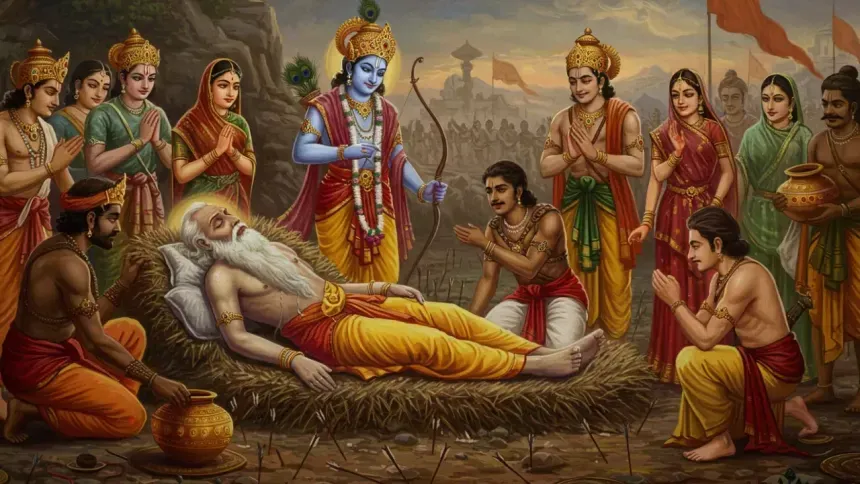
Vedic Astronomical Tradition, the Historicity of the Mahābhārata, and the Philosophical Problem of the Personal Absolute
A Calendrical Fact as Point of Departure
On the morning of April 27, 2026, a practitioner of Gauḍīya Vaiṣṇavism in Alachua, Florida will observe a fast for Mohinī Ekādaśī. The fast will begin at sunrise — calculated at 6:51 AM Eastern Daylight Time — and the determination that this particular day is the correct day for the observance depends on a precise calculation: the eleventh lunar day (Ekādaśī tithi) must be present at the moment of local sunrise, uncontaminated by the residual presence of the tenth lunar day (Daśamī). The calendar — a pañjikā, computed for the specific latitude and longitude of Alachua (29°N 45', 082°W 25') — records that Daśamī ended the previous morning at 8:39 AM and that Ekādaśī will persist until 8:48 AM on the 27th. Since sunrise occurs at 6:51, the Ekādaśī tithi is cleanly present at the relevant moment. The fast is therefore classified as śuddha — pure, uncontaminated — and is observed on this day without alteration.
This is not an approximation. The tithi, which represents the time required for the moon to advance exactly twelve degrees in angular separation from the sun, has been computed to the minute for the observer's precise location. The nakṣatra — the lunar mansion, indicating the moon's position against the fixed sidereal backdrop — is simultaneously computed: Pūrva Phalgunī, ending at 11:50 AM. The sunrise and sunset times are calculated from standard solar positional astronomy adjusted for local horizon. The entire determination is, in the strict sense of the term, an exercise in positional astronomy: the angular positions of the sun and moon at a given moment, as observed from a given point on the earth's surface, determine whether a religious observance occurs on this day or the next.
What is remarkable about this calculation is not its accuracy, which is empirically testable and holds up against modern ephemeris data. What is remarkable is the system from which it is derived.
The computational methods that produce this pañjikā descend from the siddhāntic tradition of Indian mathematical astronomy — a tradition whose foundational texts include the Sūrya Siddhānta, the Āryabhaṭīya of Āryabhaṭa (5th century CE), and the subsequent works of Brahmagupta, Bhāskara, and others. These texts contain spherical trigonometric methods, values for the sidereal year that are accurate to within seconds of the modern measurement, lunar period calculations of comparable precision, and sophisticated models for the computation of eclipses, planetary conjunctions, and precession. The tradition represents, by any dispassionate assessment, one of the major achievements of pre-telescopic observational science in human history.
But here is the fact that creates an epistemological problem which neither Western Indology nor the history of science has adequately addressed: the computational scaffolding within which this astronomy operates — the framework from which mean planetary positions are calculated, and against which all ephemeris tables are calibrated — is the yuga-kalpa cosmological system. The mean longitudes of the planets in the Sūrya Siddhānta are calculated from the beginning of the present kalpa — one day of Brahmā, comprising one thousand mahā-yugas, each consisting of four ages (Satya, Tretā, Dvāpara, and Kali) in a 4:3:2:1 ratio of duration, with a total cycle length of 4,320,000 human years. The epoch from which the present Kali Yuga is counted — 3102 BCE, correlated with the departure of Kṛṣṇa — is the same epoch that anchors the astronomical calculations. The calendar being used today in Alachua, Florida to determine a fasting day is counting from a cosmological event that mainstream Western scholarship classifies as mythological.
The standard academic response to this situation is to partition: the mathematics is real, the cosmology is decorative. The computational techniques were genuine achievements of human ingenuity; the yuga framework in which they are embedded is a cultural overlay that can be stripped away without loss. The astronomical outputs are empirically valid; the cosmological inputs are mythological scaffolding that happened to serve as a convenient coordinate system but carries no truth-value of its own.
This partitioning is convenient. It is also philosophically incoherent. One does not ordinarily regard a theoretical framework as fictitious when it continues to generate accurate empirical predictions after several thousand years of continuous use. In the history of Western science, the capacity of a theoretical framework to produce correct observational results is treated as evidence — defeasible, certainly, but real evidence — for the framework's approximation to reality. Newtonian mechanics is considered to describe something true about the physical world precisely because its predictions are accurate, even though those predictions are now known to be embedded within a framework (absolute space, absolute time) that is itself only approximately correct. The standard of evidence has not been that a framework must be metaphysically final to be taken seriously; the standard has been that predictive success is epistemically significant.
The yuga-kalpa framework meets this standard. It has generated accurate lunisolar predictions, continuously, for a period longer than the entire history of Western observational astronomy from Hipparchus to the present. Its epoch — 3102 BCE — is not an arbitrary coordinate origin chosen for computational convenience; it is a date with specific historical and theological content within the tradition, and it is the date from which the system's predictive accuracy has been maintained. To accept the outputs while dismissing the framework is not a neutral methodological decision. It is a decision that requires justification, and that justification has rarely been offered with anything approaching the rigor that would be demanded if the framework in question were European in origin.
This essay does not propose to argue that the yuga-kalpa system must be accepted as literally true on the basis of its astronomical track record alone. The relationship between computational utility and cosmological truth is genuinely complex, and the tradition itself distinguishes between different orders of knowledge (pramāṇa) appropriate to different orders of inquiry. What this essay does propose is that the dismissal of the system's cosmological content — and, by extension, the historical, philosophical, and theological claims embedded within that content — has been neither methodologically sound nor culturally innocent. The partitioning of Indian astronomical tradition into "acceptable science" and "dispensable mythology" is itself a cultural artifact, produced at a specific historical moment (the encounter between European colonialism and Indian civilization), serving specific ideological functions (the subordination of Indian knowledge systems to European categories), and perpetuated by institutional inertia long after its original justifications have ceased to be intellectually respectable.
The purpose of what follows is to trace a line from the technical achievements of jyotiṣa-śāstra — achievements that are not in serious dispute — through the chronological and historical claims those achievements support, into the philosophical and theological content of the texts situated within that chronology. The argument is not that Western scholarship must accept Vaiṣṇava theology in order to read the Bhagavad Gītā. The argument is that Western scholarship has systematically refused to engage with the Bhagavad Gītā — and with the broader Mahābhārata tradition of which it is the philosophical center — on terms adequate to the material, and that this refusal has been enabled by a set of prior commitments about what kinds of conclusions are academically permissible. Those commitments deserve examination. The evidence — astronomical, archaeological, textual, philosophical — deserves to be considered whole, rather than pre-sorted into categories of the acceptable and the embarrassing.
A calendar that correctly computes tomorrow's sunrise-tithi intersection from an epoch established five thousand years ago is not, by itself, proof of anything beyond the precision of Indian mathematical astronomy. But it is an invitation to take seriously the possibility that the civilization which produced that precision also possessed, in its textual and philosophical traditions, forms of knowledge that deserve something better than the condescension they have so far received.
———
Jyotiṣa as Positional Astronomy: What the Tradition Actually Does
The word jyotiṣa derives from jyoti — light. It is conventionally translated "astrology," and this translation has done more damage to Western comprehension of the discipline than perhaps any other single act of linguistic carelessness in the history of Indology. The term encompasses what the modern West divides into at least three distinct enterprises: mathematical astronomy (siddhānta or gaṇita jyotiṣa), calendrical science (pañjikā construction and the determination of auspicious times), and the interpretive or predictive art (phalita jyotiṣa) that corresponds most closely to what English speakers mean by "astrology." Of these three, the first is foundational, the second is its most consequential practical application, and the third — the one that dominates Western popular awareness — is architecturally dependent on the other two and cannot function without them.
To understand what the tradition actually achieves, it is necessary to examine the mathematical core on its own terms, stripped of the associations that the word "astrology" inevitably conjures in a Western reader's mind.
The Sūrya Siddhānta — literally "The Sun's Established Conclusions" — is the most influential single text in the Indian astronomical tradition. Its date of composition is itself a matter of scholarly dispute: the tradition attributes it to a revelation from the solar deity at the end of the Satya Yuga; Western scholars have proposed dates ranging from the 4th to the 6th century CE for the text in its current recension, while acknowledging that it likely incorporates much older material. Whatever its compositional history, its content is unambiguous. It presents a complete system of positional astronomy: methods for computing the mean and true longitudes of the sun, moon, and five visible planets; procedures for the prediction of solar and lunar eclipses; values for the sidereal year, the synodic and sidereal periods of the moon, and the orbital parameters of the planets; and the trigonometric apparatus necessary to execute these computations.
The mathematical methods involved are not trivial. The Sūrya Siddhānta employs sine tables (jyā) computed to high precision, uses epicyclic models to account for the apparent irregularities of planetary motion, and applies spherical trigonometric corrections to translate between geocentric celestial coordinates and local horizon-based observations. Āryabhaṭa, in his Āryabhaṭīya (499 CE), refined and in some cases corrected these methods, providing a value for the sidereal year of 365 days, 6 hours, 12 minutes, and 30 seconds — an error of approximately three minutes and twenty seconds against the modern value. His value for the sidereal rotation period of the earth was accurate to a comparable degree. He understood the earth to be a rotating sphere and correctly attributed the apparent motion of the stars to terrestrial rotation rather than celestial revolution — a point worth emphasizing, since the claim that pre-modern Indian astronomers believed in a flat earth is still occasionally encountered in popular Western writing and is simply false.
Brahmagupta (7th century), Bhāskara I and Bhāskara II (7th and 12th centuries respectively), and the Kerala school of Mādhava (14th–16th centuries) further developed these methods. The Kerala school, in particular, produced results that are remarkable by any standard: Mādhava derived infinite series expansions for trigonometric functions — what the West would later call Taylor series — several centuries before Taylor, Gregory, or Leibniz. These were not abstract curiosities; they were developed in the service of more precise astronomical computation, specifically for the construction of more accurate calendars and eclipse predictions.
The point of rehearsing these achievements is not nationalist self-congratulation, which is a temptation the subject frequently induces and which serves no analytical purpose. The point is to establish, factually, that jyotiṣa as a computational tradition represents mathematical astronomy of a caliber that the Western history of science has been slow to acknowledge and slower to integrate into its standard narratives. When a Western textbook on the history of astronomy moves from Ptolemy to Copernicus with perhaps a passing mention of "Arab" intermediaries — themselves often transmitting and extending Indian methods — it is not describing the actual history of the discipline. It is describing the history of the discipline as seen from Europe, which is a different and considerably less interesting story.
Now, the feature of this astronomical tradition that is most relevant to the present essay — and most inconvenient for the standard Western partition between "real science" and "mythological framework" — is the coordinate system within which all of these calculations are performed. The Sūrya Siddhānta does not compute mean planetary positions from an arbitrary epoch chosen for mathematical convenience. It computes them from the beginning of the present kalpa — the current day of Brahmā — through the elapsed mahā-yugas, down to the present position within the current Kali Yuga. The number of revolutions each planet completes in a mahā-yuga (4,320,000 years) is given as a fixed parameter, and the planet's mean position at any moment in history is derived by calculating how many revolutions and fractional revolutions have elapsed since the start of the cycle.
This is not an incidental feature of the system. It is the system. The yuga-kalpa framework is not a mythological wrapper around a secular astronomical core; it is the coordinate grid. The mean longitude of the moon on the morning of April 27, 2026, as computed by siddhāntic methods, is derived from the number of lunar revolutions elapsed since the beginning of the kalpa, modulated by the planet's known anomalies and corrected for the observer's terrestrial position. Remove the yuga framework and you do not have a leaner, more rational version of the same astronomy. You have no astronomy at all — no epoch, no revolution counts, no basis for mean motion computation.
Western historians of science have generally handled this situation in one of two ways. Some have argued that the large yuga numbers are purely conventional — that Indian astronomers adopted them as a computationally convenient fiction, a large common multiple into which the observed planetary periods could be neatly fitted, without any commitment to the cosmological content of the framework. Others have simply ignored the framework and focused exclusively on the computational methods, treating the trigonometry, the epicyclic models, and the observational values as the "real" contribution and the cosmological embedding as irrelevant.
Both responses are inadequate. The "computational convenience" argument fails because the yuga system is not the most convenient possible framework for astronomical calculation — simpler epoch systems are readily available and were known to Indian astronomers, who chose not to use them for this purpose. The system's structure is not dictated by computational necessity; it is dictated by cosmological commitment. And the "ignore the framework" approach fails for the more fundamental reason already stated: the framework is not separable from the computation. The planetary parameters are defined in terms of yuga revolutions. The epoch is the start of the kalpa. The system's accuracy — its demonstrable, testable accuracy — is achieved not despite the cosmological framework but through it.
This is the situation that confronted Bimalaprasāda Datta, a young Bengali scholar, in the late 19th century — the man who would later be known to the Gauḍīya Vaiṣṇava world as Bhaktisiddhānta Sarasvatī Ṭhākura. His engagement with the siddhāntic tradition was not casual. He earned the honorific "Siddhānta Sarasvatī" through demonstrated mastery of the Sūrya Siddhānta and related texts — a mastery that involved not merely reading them but performing the calculations, verifying the methods, and constructing a working calendar from them. His subsequent creation of the Navadvīpa Pañjikā — the Gauḍīya Vaiṣṇava calendar system, which is the direct ancestor of the calendar consulted in Section I of this essay, and which counts its years in Gaurābda (the era of Śrī Caitanya Mahāprabhu, currently year 540) — was not an act of religious sentiment dressed in astronomical clothing. It was a practical demonstration that the traditional framework, taken whole, without partition, without apology, produces results.
The Navadvīpa Pañjikā computes tithis, nakṣatras, sunrise and sunset times, eclipse predictions, and planetary positions for any location on earth. It does so using siddhāntic methods embedded within the yuga-kalpa cosmology. And it is accurate. Not approximately accurate, not "accurate for a pre-modern system," but accurate in the sense that its outputs can be checked against modern ephemeris data and found to correspond. The calendar currently published at purebhakti.com for Alachua, Florida — the one that tells a practitioner that Mohinī Ekādaśī falls on April 27, 2026, that the tithi ends at 8:48 AM, that sunrise occurs at 6:51, and that the nakṣatra Pūrva Phalgunī concludes at 11:50 — is a living instance of this tradition. It is not an antique. It is not a cultural performance. It is a working astronomical instrument, calibrated from the Kali epoch of 3102 BCE, computing real celestial positions in real time.
The significance of Bhaktisiddhānta Sarasvatī's achievement in this domain is not primarily technical — although the technical competence is genuine and documented. The significance is methodological. He refused the partition. Where Western-trained scholars and, increasingly, Western-influenced Indian scholars were learning to separate the "scientific" content of jyotiṣa from its "religious" framework — to salvage the trigonometry while discarding the theology — he insisted that the system is one thing. The cosmology is not an embarrassing appendage to the mathematics. The mathematics is an expression of the cosmology. And the fact that the expression is accurate is not a coincidence to be explained away but a datum to be taken seriously.
This insistence was not obscurantism. It was, if anything, a more rigorous empiricism than the partitioning approach, because it refused to discard data — in this case, the datum of the framework's own predictive success — in order to preserve a prior theoretical commitment (the commitment to the proposition that yuga cosmology cannot be real). The question of whether the yuga-kalpa system describes the actual structure of cosmic time is a question that admits of legitimate debate. But the debate cannot be conducted honestly if one side begins by stipulating that the system's demonstrated accuracy is irrelevant to the question of its truth. That is not skepticism. It is the opposite of skepticism — it is the protection of a predetermined conclusion from the inconvenience of evidence.
———
The Distortion Field: Western and New Age Appropriations
If the academic partition of jyotiṣa into acceptable mathematics and dispensable cosmology represents one form of distortion, there exists a second and in some ways more damaging form: the popular Western appropriation of Vedic cosmological categories, stripped of their computational foundations and recombined with alien frameworks to produce a body of received wisdom that is neither Vedic nor scientific nor internally consistent, but which has achieved such cultural penetration in the English-speaking world that it now constitutes, for millions of people, the primary point of reference for what "Vedic astrology" and "the yugas" mean.
This appropriation operates at several distinct levels, and it is worth distinguishing them, because they represent different kinds of error and have produced different kinds of confusion.
The Yukteswar Revision
The most intellectually consequential distortion of the yuga system in modern times originates not from the West but from within the Indian tradition itself — though its subsequent influence has been overwhelmingly Western. In 1894, Swami Sri Yukteswar Giri, a Bengali teacher in the Kriya Yoga lineage who would later become the guru of Paramahansa Yogananda, published The Holy Science (Kaivalya Darśanam), a short treatise proposing a radical revision of the traditional yuga chronology.
Sri Yukteswar's central claim was that the true Mahā-yuga is not 4,320,000 years but approximately 24,000 years — a figure chosen to correspond roughly with the precession of the equinoxes. In his model, the four yugas ascend and descend in a symmetrical wave: Kali (1,200 years) rises into Dvāpara (2,400), then Tretā (3,600), then Satya (4,800), then descends back through the same sequence. The full ascending-descending cycle completes in 24,000 years. Sri Yukteswar argued that the larger Purāṇic numbers were the product of a computational error introduced during a dark age by astronomers who mistakenly applied the "divine year" multiplier (one divine year equals 360 human years) to figures that were already expressed in human years.
The implications of this revision are dramatic. If the ascending-descending model is correct, then Kali Yuga ended around 1700 CE, and humanity is currently in ascending Dvāpara Yuga — an age of increasing electrical and atomic understanding, which Sri Yukteswar correlated with the scientific and technological developments of the modern era. The worst is behind us. We are on the way up.
This thesis achieved enormous circulation through Yogananda's Autobiography of a Yogi (1946), which remains one of the most widely read books on Indian spirituality in the English language. Through the Self-Realization Fellowship and its global network of centers, the Yukteswar yuga model has become, for a large segment of Western yoga culture, simply what "the yugas" means. It is now common to encounter, in yoga studios and spiritual bookshops from Santa Monica to Stockholm, confident assertions that "we are in Dvāpara Yuga" or that "the Kali Yuga ended centuries ago" — delivered with the serene authority of people who believe they are transmitting ancient wisdom and who have no idea that they are transmitting a late 19th-century revision of it.
The problems with Sri Yukteswar's model are numerous and, from the standpoint of the tradition he claimed to represent, fundamental.
First, the Purāṇic durations are not ambiguous. The Bhāgavata Purāṇa, the Viṣṇu Purāṇa, the Mārkaṇḍeya Purāṇa, the Manu Smṛti, and multiple other texts state the yuga durations explicitly, consistently, and without apparent confusion about units. The Kali Yuga is 1,200 divine years, which is 432,000 human years. The ratio of divine to human years is also explicit: one divine year is 360 human years. The multiplication is not an error introduced by confused later scribes. It is the system as stated in the primary sources.
Second, the ascending-descending wave model has no basis in any śāstric text. The Purāṇic yugas descend — from Satya through Tretā and Dvāpara to Kali — and then the cycle ends in dissolution (pralaya) or renewal, after which it begins again from Satya. There is no upswing. The idea of a symmetrical oscillation is entirely Sri Yukteswar's innovation, and he provides no textual basis for it beyond his own interpretive authority.
Third, the identification of the yuga cycle with the precessional period is astronomically problematic. The actual precessional period, as measured by modern astronomy, is approximately 25,772 years — not 24,000. Sri Yukteswar appears to have used a rounded approximation that was current in 19th-century popular astronomy, and his model does not account for the discrepancy. More fundamentally, the precessional cycle is a phenomenon of the earth's axial wobble relative to the fixed stars — it is a change in celestial coordinates, not in the physical or spiritual condition of terrestrial civilization. The siddhāntic tradition was well aware of precession (ayanāṁśa) and accounted for it in its calculations without ever correlating it with yuga transitions. Sri Yukteswar's correlation is not drawn from the astronomical tradition; it is imposed upon it.
Fourth, and most decisively for anyone who takes the Bhāgavata Purāṇa seriously as a source, the text provides extensive descriptions of the progressive degradation of human society during Kali Yuga — descriptions that are presented as prophetic and that correspond, with uncomfortable specificity, to observable features of the modern world. The twelfth canto's account of Kali's characteristics — the deterioration of truthfulness, cleanliness, mercy, and austerity; the reduction of lifespan; the corruption of political authority; the displacement of genuine spiritual practice by superficial performance — reads, to a contemporary observer, less like an ancient fantasy about a distant age and more like a clinical diagnosis of the present. If Kali Yuga ended in 1700 and we are now in ascending Dvāpara, one must explain why the symptoms of Kali are intensifying rather than receding. Sri Yukteswar's thesis requires the reader to believe that the modern era — the era of mechanized warfare, environmental devastation, institutional corruption, and the industrialization of distraction — represents a spiritual improvement over the 17th century. This is not self-evident.
The appeal of the Yukteswar model is, however, entirely understandable. It is optimistic. It tells its audience that the darkest period is past and that humanity is ascending toward greater light. For a Western audience already inclined toward progressive teleology — the Enlightenment narrative of history as continuous improvement — this message resonates deeply. It allows the yuga concept to be adopted without its most uncomfortable implication: that things are getting worse, that the decline is real and ongoing, and that it has roughly 427,000 years left to run. The traditional framework does not flatter the modern listener. Sri Yukteswar's revision does. This may explain its popularity more adequately than its merits.
The Theosophical-New Age Amalgam
If the Yukteswar revision represents a specific, traceable, internally argued (if ultimately unpersuasive) reinterpretation of the yuga system, the broader New Age appropriation of Vedic cosmological categories represents something considerably less disciplined: a syncretic amalgam in which terms and concepts from fundamentally unrelated systems are cross-bred to produce a body of pseudo-knowledge that is, strictly speaking, meaningless — not in the pejorative sense of "worthless," but in the precise sense of "lacking determinate semantic content."
The most familiar instance of this amalgamation is the identification of the yugas with the Greco-Roman Ages (Gold, Silver, Bronze, Iron, as described by Hesiod in the Works and Days) and with the Western zodiacal Great Year (the precession of the vernal equinox through the twelve signs of the tropical zodiac, producing "ages" such as the Age of Pisces and the Age of Aquarius). In popular spiritual literature, it is now routine to encounter formulations like "we are leaving the Kali Yuga / Iron Age / Age of Pisces and entering the Satya Yuga / Golden Age / Age of Aquarius" — a sentence in which three distinct systems, originating in three distinct civilizations, operating on three entirely different astronomical and mythological bases, are treated as synonymous.
They are not synonymous. The Hesiodic Ages are a literary-mythological schema with no astronomical content whatsoever — Hesiod does not correlate his ages with any celestial cycle, and the sequence (which, notably, is not strictly linear in his telling; he inserts a Heroic Age between Bronze and Iron) is a moral taxonomy, not a chronological computation. The zodiacal Great Year is a Western astrological concept based on the precession of the vernal equinox through the tropical zodiac — the twelve equal thirty-degree divisions of the ecliptic measured from the vernal point. This is a fundamentally different coordinate system from the Indian sidereal zodiac, which measures from a fixed star reference point. The two zodiacs diverge by roughly one degree every 72 years and are currently offset by approximately 24 degrees. An "Age of Aquarius" defined by the tropical zodiac and an "Age of Aquarius" defined by the sidereal zodiac begin at entirely different dates — a discrepancy that the amalgamating literature never addresses because it does not know it exists.
The Indian yuga system, as we have established, is neither mythological decoration nor zodiacal age-reckoning. It is a cosmological framework with specific numerical parameters, anchored to a specific astronomical epoch, and operationally embedded in a computational tradition that produces testable results. It has nothing to do with Hesiod and nothing to do with the precession of the vernal equinox through Western constellation boundaries. To treat these three systems as interchangeable expressions of a single underlying truth is not synthesis. It is confusion — confusion made possible by ignorance of the technical content of all three systems being conflated.
The Theosophical movement of the late 19th century (Blavatsky, Olcott, Besant, Leadbeater) bears significant responsibility for this conflation. Theosophical cosmology drew selectively from Hindu, Buddhist, Egyptian, and Western esoteric sources to construct a grand evolutionary narrative involving "root races," planetary chains, and cosmic cycles of descent and ascent. The yugas were incorporated into this narrative as one element among many, stripped of their specific computational context and merged with precessional cycles, Platonic Great Years, and various neo-Gnostic schemas. The result was a system that used Indian terminology — yuga, manvantara, pralaya — while meaning something entirely different from what those terms mean in the tradition from which they were extracted. This Theosophical vocabulary subsequently passed into the broader New Age movement, where it has been further diluted by each successive generation of popular writers, until the original terms have become essentially empty signifiers — words that evoke a feeling of ancient cosmic wisdom while conveying no specific, testable, or even internally consistent content.
The Pop-Astrology Flattening
At the most popular level, the appropriation takes the form of what might be called the astrological flattening: the reduction of jyotiṣa to a system of personality typology and fortune-telling based on birth charts, Sun signs, Moon signs, and planetary transits. "Vedic astrology" has become, in the Western spiritual marketplace, a product — a consultation you purchase, a reading you receive, a chart you frame and hang on your wall. Websites and apps offer "Vedic horoscopes" computed by software that may or may not use sidereal coordinates (some simply apply a fixed ayanāṁśa correction to Western tropical charts, producing a hybrid that corresponds to no actual tradition). The consumer is typically unaware that the system generating their "Vedic birth chart" rests on a mathematical tradition of extraordinary sophistication, or that the cosmological claims of that tradition extend far beyond personality analysis into a comprehensive account of the structure and duration of cosmic time.
The irony is acute. Jyotiṣa has never been more visible in the West and has never been less understood. The computational tradition that can correctly determine the angular separation of the sun and moon to the arcminute for any date in the last five millennia is now popularly represented by Instagram accounts offering daily horoscope updates based on which rāśi the moon is transiting. The system that embeds its calculations in a cosmological framework spanning billions of years is consulted primarily to answer questions about career prospects and romantic compatibility. The reduction is so complete that most Western consumers of "Vedic astrology" would be genuinely surprised to learn that the tradition has anything to say about the age of the universe, the duration of human civilization, or the date of the Mahābhārata war.
The Common Error
What unites all three forms of distortion — the Yukteswar revision, the Theosophical-New Age amalgam, and the pop-astrology flattening — is a single structural error: the detachment of conclusions from the system that generates them. Sri Yukteswar detaches the yuga concept from the Purāṇic texts that define it, retaining the terminology while substituting entirely different numerical values and a fundamentally different cyclical structure. The New Age amalgam detaches terms like yuga, kali, and satya from the Indian cosmological system and reattaches them to Western zodiacal and mythological frameworks with which they have no organic connection. The pop-astrology industry detaches the predictive and interpretive layer of jyotiṣa from the mathematical and cosmological foundation on which it rests, producing a consumer product that has roughly the same relationship to the original tradition as a fortune cookie has to Chinese philosophy.
In each case, the result is a body of claims that cannot be evaluated, because the system capable of evaluating them has been discarded. The pañjikā tradition does not do this. It operates as a unified whole: the cosmological framework generates the computational parameters, the computational methods produce the astronomical outputs, and the astronomical outputs determine the calendrical and ritual applications. Every element is connected to every other element. A prediction can be checked. A tithi can be verified. An eclipse either occurs or does not. The system is, in the deepest sense, accountable — answerable to observation, falsifiable in practice, and continuous in application across millennia.
It is against this standard of accountability that the various Western and New Age appropriations of Vedic cosmological vocabulary should be measured. And it is from this standard that they uniformly fall short — not because they are insufficiently reverential toward the tradition (reverence is not the issue), but because they are insufficiently serious about it. They want the vocabulary without the mathematics, the conclusions without the computations, the mystique without the rigor. The tradition offers all of these things together, as a single integrated body of knowledge. The refusal to accept them together — to take only what is comfortable and discard what is demanding — is not eclecticism. It is a failure of intellectual honesty, and it has produced a discourse about "Vedic astrology" and "the yugas" that the tradition itself would barely recognize.
———
The Chronological Claims: What the System Says About History
Having established what the jyotiṣa tradition actually does, and having cleared away the more prominent distortions of what it claims, we are now in a position to state plainly what the system, taken whole, asserts about the chronological structure of human history — and to examine whether those assertions deserve the dismissal they have routinely received.
The framework, as presented in the Purāṇic and Smṛti literature and operationally embedded in the siddhāntic astronomical tradition, is as follows. Cosmic time is organized in nested cycles. The fundamental unit is the mahā-yuga, consisting of four ages in a ratio of 4:3:2:1: Satya Yuga (1,728,000 human years), Tretā Yuga (1,296,000), Dvāpara Yuga (864,000), and Kali Yuga (432,000) — a total of 4,320,000 human years per cycle. Each yuga includes transitional periods (sandhyā and sandhyāṁśa) at its beginning and end, proportional to the yuga's duration and included within the stated totals. One thousand mahā-yugas constitute one kalpa, a single day of Brahmā, lasting 4,320,000,000 human years. An equivalent period constitutes Brahmā's night, during which the manifest cosmos is withdrawn. Brahmā's lifespan comprises 100 years of such days and nights, after which the entire cycle dissolves and eventually recommences.
These numbers are large. They are supposed to be. The tradition is not embarrassed by them, and it does not present them tentatively. They are stated as facts about the structure of time, derived from revelation (śruti and smṛti), and they constitute the temporal grid within which all subsidiary historical claims are situated.
The subsidiary claim most relevant to the present discussion is precise: the current Kali Yuga began on the day of Kṛṣṇa's departure from the manifest world, which the tradition dates to 3102 BCE. This is the date that Āryabhaṭa adopted as the epoch of the Kali era, and it is the date from which all subsequent Indian astronomical computation has been calibrated. It is not a vague mythological assertion. It is a date — a specific moment in time, tied to a specific event, and used as the zero-point for a computational system that remains operational today.
The Mahābhārata war, which the tradition treats as the climactic event of the Dvāpara-Kali transition, is dated to approximately 36 years before the Kali epoch — roughly 3139–3138 BCE. Kṛṣṇa's role in the war (as charioteer and counselor to Arjuna, and as the speaker of the Bhagavad Gītā), His subsequent return to Dvārakā, the internecine destruction of the Yadu dynasty, and His departure — all of these are narrated as historical events occurring within a specific genealogical and political context, involving named individuals with traceable lineage connections to both earlier and later figures in the Purāṇic king-lists.
Vyāsadeva — Kṛṣṇa Dvaipāyana, the compiler of the Vedas, author of the Mahābhārata, and narrator of the Bhāgavata Purāṇa — is situated within this same genealogical matrix. He is the son of the sage Parāśara and Satyavatī, the grandfather of both the Pāṇḍavas and the Kauravas (through his sons Dhṛtarāṣṭra, Pāṇḍu, and Vidura, born by niyoga), and thus a direct participant in the events he narrates. The tradition does not treat him as a literary convention or a collective authorial persona. He is a specific ṛṣi, born at a specific time, who performed specific acts of literary and spiritual composition — including the division of the one Veda into four, the compilation of the Purāṇas, and the composition of the Brahma-sūtra — as a response to the anticipated degradation of human capacity in the coming Kali Yuga. His work is presented as a deliberate act of preservation: the knowledge that could previously be held in oral memory would need to be written down, organized, and made accessible in multiple forms, because the people of Kali would lack the cognitive and spiritual capacity to receive it in its original undivided form.
This account of Vyāsadeva's compositional activity is itself a chronological claim: it asserts that the major texts of the Vedic corpus were organized into their current form at a specific historical moment — the Dvāpara-Kali transition — by a specific individual, for a specific reason. Western Indology has spent two centuries arguing that these texts were composed over many centuries by many authors, and that the attribution to Vyāsadeva is a literary fiction. The tradition's response is not to deny that the texts have complex compositional histories (the Mahābhārata itself acknowledges multiple recensions and varying lengths), but to insist that the organizing intelligence behind the corpus is singular and historically real. The question of which account is correct is not resolvable by the methods currently under discussion. But it is worth noting that the tradition's account is internally consistent, genealogically situated, and chronologically specific in a way that the academic alternative — "various anonymous authors over many centuries" — is not. The academic account explains the texts' diversity but not their coherence. The traditional account explains both.
Now, the chronological framework just described places us at a specific point in cosmic time: approximately 5,128 years into a Kali Yuga that will last 432,000 years. We are, by this reckoning, barely past the opening of the age. The vast majority of Kali — with its progressive deterioration of dharma, its shortening of human lifespan, its intensification of conflict, ignorance, and hypocrisy — lies ahead, not behind. This is not a comfortable position for the modern reader, and the discomfort is compounded by the recognition that the tradition's descriptions of Kali's characteristics, composed (by its own account) more than five thousand years ago, read as an increasingly accurate description of contemporary civilization with each passing decade.
The Bhāgavata Purāṇa's twelfth canto is particularly striking in this regard. Its catalogue of Kali's symptoms includes: the reduction of dharma to mere ritual performance devoid of inner content; the equation of wealth with virtue and social standing; the dissolution of marriage into mutual convenience; the corruption of justice by the interests of the powerful; the replacement of learning with credentials and of wisdom with information; the ascendancy of those who are bold and loud over those who are truthful and measured; the decline of charity into public spectacle; the disappearance of sacred bathing places; the reduction of beauty to cosmetic manipulation; and the pervasive experience of anxiety, scarcity, and drought. One need not accept the metaphysical framework of the yugas to observe that this description has aged remarkably well as social commentary. The question of whether its accuracy constitutes evidence for the framework's truth, or whether it is merely the kind of pessimistic cultural criticism that any civilization's conservative voices might produce, is a question the reader must answer for themselves. But the specificity of the description — its attention to institutional decay, epistemic degradation, and the precise mechanisms by which a society loses contact with its own deepest values — exceeds what generic pessimism typically produces.
There is, however, a critical qualification within the tradition's own account of Kali Yuga, and it is one that the popular discourse around the yugas almost never mentions — an omission that is as damaging, in its way, as the Yukteswar revision, because it removes the element that makes the traditional framework spiritually habitable rather than merely bleak.
The Brahma-vaivarta Purāṇa records a conversation between Kṛṣṇa and Gaṅgā-devī in which Kṛṣṇa states that within the Kali Yuga, there will be a period of ten thousand years during which the bhakti movement — the congregational chanting of the holy names, the dissemination of devotional practice, the appearance of great teachers and the establishment of temples and communities of practitioners — will flourish as a special dispensation of divine mercy within the larger degenerative arc. The Gauḍīya Vaiṣṇava tradition identifies the inauguration of this period with the appearance of Śrī Caitanya Mahāprabhu in 1486 CE (Gaurābda year 1; the current year is 540). By this reckoning, the golden period within Kali has been underway for approximately 540 years, with roughly 9,460 years remaining.
The theological precision of this claim deserves attention. It does not say that Kali Yuga has ended. It does not say that the degenerative trajectory has reversed. It does not offer the progressive optimism of the Yukteswar model or the millenarian excitement of the New Age amalgam. What it says is something considerably more nuanced: that within an age of genuine and ongoing decline, a specific form of spiritual practice has been made available by an act of divine grace that operates within the age, not by abolishing it. The darkness is real. The light within the darkness is also real. And the light does not depend on the darkness lifting — it depends on the mercy of the source of light.
This is a fundamentally different kind of historical claim from anything the Western progressive narrative or the New Age cyclical narrative can accommodate. It is neither linear progress nor cyclical return. It is a theological intervention within a cosmological structure — grace operating within time, not by overriding time's structure but by introducing a possibility that the structure alone would not generate. The tradition compares it to a lamp lit in a dark room: the room remains dark in the sense that it has no intrinsic source of illumination, but the lamp makes vision possible for those who turn toward it.
For the purposes of this essay, the significance of the ten-thousand-year golden period is primarily methodological. It demonstrates that the tradition's cosmological claims are not monolithic, not crudely deterministic, and not reducible to a simple narrative of decline. The yuga framework contains within itself the categories necessary to account for apparent counter-evidence — the existence of genuine spiritual movements, extraordinary teachers, and communities of authentic practice within an age supposedly defined by their absence. This is not ad hoc rationalization; it is a structural feature of the cosmology as stated in the source texts. A critic might argue that any framework flexible enough to accommodate counter-evidence is unfalsifiable. A defender might respond that a framework capable of predicting both the general trajectory (decline) and the specific exception (a delimited period of spiritual possibility within the decline) has made two claims, not one — and that both can be evaluated against observation.
What cannot be honestly done — though it is done constantly — is to ignore the framework's specific claims while treating its general vocabulary as available for appropriation. The tradition does not offer "the yugas" as a free-floating concept to be attached to whatever cyclical model the user finds appealing. It offers a specific cosmological structure with specific numerical parameters, a specific historical epoch, a specific account of the present age's character, and a specific theological qualification of that account. To engage with "the yugas" while ignoring all of this specificity is not engagement. It is decoration.
The chronological claims of the Vedic tradition are, taken at face value, extraordinary. They assert that the present age of human civilization began more than five thousand years ago with the departure of a specific historical figure; that the event which immediately preceded this transition was a dynastic war of enormous scale, fought at a specific location in northern India, involving participants whose genealogies are extensively documented; that the principal texts of the civilization — the Vedas, the Mahābhārata, the Purāṇas — were compiled at this transitional moment by a specific author; and that the civilization's astronomical tradition has been computing celestial positions from this epoch, accurately, ever since.
These claims are either true, approximately true, or false. They are not meaningless. They are not metaphorical. They are not "mythological" in the sense of being immune to evaluation. And the next section of this essay will examine the physical, textual, and astronomical evidence that bears on their evaluation — evidence that is more extensive, more specific, and more corroborative than the standard Western academic narrative has generally been willing to acknowledge.
———
The Evidentiary Landscape: Archaeology, Epigraphy, and Text
The claim that the Mahābhārata narrative reflects historical events involving real people at real places is not, in principle, an unusual claim. Scholars routinely accept that the Iliad reflects, however distantly, actual conflicts in the late Bronze Age Aegean. The historicity of the Trojan War — once dismissed as pure myth — became a respectable scholarly position after Schliemann's excavations at Hisarlik in the 1870s, and it is now broadly accepted that some form of conflict between Mycenaean Greeks and the inhabitants of a fortified settlement in northwestern Anatolia underlies Homer's narrative, even if the details have been elaborated beyond recognition. No one considers it naive to investigate the historical substrate of the Iliad. The question is why an equivalent investigation of the Mahābhārata's historical substrate is so frequently treated as an exercise in credulity.
The answer, as this essay has been arguing, lies not in the quality of the evidence but in the cultural admissibility of the conclusions. Nevertheless, the evidence exists, and it deserves to be surveyed on its own terms.
Dvārakā
The Mahābhārata and the Bhāgavata Purāṇa describe Dvārakā as a fortified island city on the western coast of India, constructed by Kṛṣṇa for the Yādava clan after their departure from Mathurā, and subsequently consumed by the sea after Kṛṣṇa's departure and the destruction of the Yadu dynasty. The texts are specific: the city was built on the coast of Saurāṣṭra (modern Gujarat), it was surrounded by the ocean, it possessed elaborate fortifications and harbor works, and it was inundated within days of its abandonment.
In 1981, S.R. Rao of the Archaeological Survey of India began systematic underwater excavations off the coast of modern Dwarka in Gujarat. What he found was a submerged settlement of considerable extent: stone walls, bastions, what appeared to be a jetty or harbor structure, and associated artifacts including pottery, stone anchors of a type consistent with late Bronze Age maritime technology, and triangular three-holed anchors that Rao identified as similar to types found in Cyprus and Syria dating to the second millennium BCE. The structures showed evidence of having been built on land and subsequently submerged — not constructed underwater — consistent with the textual account of a coastal city lost to the sea.
Thermoluminescence dating of pottery from the site produced dates in the range of the late second millennium BCE, which is considerably later than the traditional date of 3102 BCE. This discrepancy has been cited by critics as evidence against the identification of the submerged structures with the Dvārakā of the Mahābhārata. Defenders of the traditional chronology have responded that thermoluminescence dating of underwater pottery is subject to significant uncertainties, that the excavated structures may represent later phases of occupation at a site with a much longer history, and that deeper layers remain unexcavated. The site has not been excavated to anything approaching completion — underwater archaeology is expensive, technically demanding, and dependent on government permits that have not always been forthcoming.
What is not in dispute is that a substantial fortified settlement existed at this location, that it was inundated by the sea, and that its submersion is consistent with the geological evidence for relative sea-level changes and tectonic subsidence along the Saurāṣṭra coast. The correlation between the textual account (a fortified coastal city of the Yādavas, consumed by the sea after their departure) and the physical evidence (a submerged fortified settlement at the location specified by the text) is, at minimum, striking. It does not constitute proof. But it constitutes exactly the kind of evidence that, in any other archaeological context, would be considered grounds for further investigation rather than dismissal.
The Sarasvatī River
The Mahābhārata describes the Sarasvatī as a great river flowing through the Kurukṣetra region — a living, navigable waterway, not a dry riverbed or a mythological abstraction. The Ṛg Veda, in its famous nadī-stuti (Hymn of the Rivers, 10.75), celebrates the Sarasvatī as the greatest of rivers — naditamā — surpassing even the Indus. The Brāhmaṇa literature describes sacrificial rituals performed on its banks. The tradition treats the Sarasvatī as a real river in a real landscape, and its course is described with sufficient geographical specificity to allow identification.
For much of the 19th and 20th centuries, Western scholars treated the Vedic Sarasvatī as either a mythological invention or, at best, a minor seasonal stream that had been poetically exaggerated. This position has become untenable. Satellite imagery (initially from LANDSAT and later from Indian Space Research Organisation platforms), geological fieldwork, and paleochannel studies have established beyond serious dispute that a major river system once flowed through the region described in the Vedic texts — following, in broad outline, the course of the modern Ghaggar-Hakra channel through Haryana, Rajasthan, and into the Rann of Kutch. Borehole data, sediment analysis, and isotopic studies have confirmed that this channel carried glacially fed, perennial water — not merely seasonal monsoon runoff — at some period in the past.
The critical question is when the river dried up. The geological consensus, supported by multiple independent lines of evidence, is that the Sarasvatī lost its major glacial tributaries — probably the paleo-Sutlej and possibly the paleo-Yamunā — through a process of river capture and tectonic displacement, and that this process was substantially complete by approximately 1900 BCE, with the river reduced to a seasonal or intermittent flow by the early second millennium BCE and effectively dry in its lower reaches by the mid-second millennium.
The implications for the dating of texts that describe the Sarasvatī as a mighty, flowing river are significant. If the Ṛg Veda describes the Sarasvatī as naditamā — the mightiest of rivers — then the tradition within which that description was composed must date from a period when the river was still a major perennial waterway. This pushes the relevant oral tradition back to at minimum the third millennium BCE, and possibly considerably earlier. The Mahābhārata's description of the Sarasvatī as a living river flowing through the Kurukṣetra region carries the same implication: either the narrative was composed when the river flowed, or it preserves, with remarkable fidelity, geographical knowledge from that period.
This does not prove that the Mahābhārata war occurred in the fourth millennium BCE. But it establishes that the geographical framework within which the narrative is set corresponds to a real and datable physical landscape — a landscape that ceased to exist in its described form by the early second millennium BCE. Any account of the text's composition must reckon with this fact.
Kurukṣetra and Hastinapura
The Kurukṣetra region — the area between the old Sarasvatī and Dṛṣadvatī rivers in modern Haryana — is not a mythological landscape. It is a specific, identifiable region with extensive archaeological remains. Hundreds of sites belonging to the Painted Grey Ware (PGW) cultural horizon have been identified throughout the area, dating (by conventional archaeological chronology) to approximately 1200–600 BCE. The PGW culture is broadly associated with the late Vedic period, and its geographical distribution corresponds closely to the political geography described in the Mahābhārata — the Kuru-Pañcāla heartland of the Gaṅgā-Yamunā Doab and the upper Ghaggar-Hakra basin.
Hastinapura — the Kaurava capital in the Mahābhārata — was excavated by B.B. Lal of the Archaeological Survey of India in 1950–52. Lal identified five major occupation periods, of which Period II corresponded to the PGW horizon. Critically, Period II showed evidence of a major flood — a thick deposit of river-laid clay and sand interrupting the habitation sequence — after which the site was partially abandoned. This corresponds to the Purāṇic account, preserved in the Matsya Purāṇa and other texts, that Hastinapura was abandoned due to flooding of the Gaṅgā during the reign of King Nicakṣu, a descendant of the Pāṇḍavas several generations after the war, and that the capital was subsequently relocated to Kauśāmbī.
Lal, who was trained in the British archaeological tradition and operated within its methodological conventions, was cautious in his conclusions but acknowledged the correlation. The flood stratum at Hastinapura matches the Purāṇic account in event (flood), in consequence (abandonment), and in relative chronological position (several generations after the Mahābhārata period). This does not prove that the Pāṇḍavas existed. It does demonstrate that the narrative's account of post-war dynastic history at a specific site corresponds to a specific, dateable stratigraphic event at that site — which is, again, exactly the kind of evidence that archaeology routinely uses to corroborate historical traditions in other civilizations.
The conventional dating of the PGW horizon to 1200–600 BCE has been used by Western scholars to place the Mahābhārata war (if it occurred at all) in the early first millennium BCE — far later than the traditional date. However, the PGW dating is itself based on a set of assumptions — principally the cross-correlation of Indian pottery sequences with better-dated sequences in West Asia — that are not beyond challenge. The earlier occupation levels at these sites have not been as thoroughly excavated or dated, and the possibility that PGW represents a later phase of a much longer cultural sequence at these sites has not been ruled out. More fundamentally, the dating of the war to the PGW period is an argument from the pottery, not from the texts; the texts themselves place the war considerably earlier, and the question of which chronology to privilege — the textual or the ceramic — is a methodological decision, not a factual discovery.
Epigraphic and Textual Evidence
The physical inscriptions and external textual references to Kṛṣṇa and the Vṛṣṇi-Yādava tradition are earlier and more extensive than is commonly acknowledged.
Megasthenes, the Greek ambassador to the court of Candragupta Maurya (c. 300 BCE), recorded in his Indika that the Indians in the region of Mathurā worshiped a figure he identified as Herakles — a standard Greek practice of interpretatio graeca, identifying foreign deities with their nearest Greek equivalent. The figure described by Megasthenes is associated with the Śūrasena people (the clan of Kṛṣṇa's grandfather Śūrasena), is located at Mathurā (Kṛṣṇa's birthplace), and is described in terms consistent with the Kṛṣṇa-Balarāma tradition. This establishes that organized worship of a divine figure identifiable with Kṛṣṇa, centered at Mathurā, was well established by the late 4th century BCE and was prominent enough to attract the attention of a foreign diplomat.
The Heliodorus pillar at Vidisha (Besnagar), Madhya Pradesh, dated to approximately 110 BCE, is perhaps the single most significant epigraphic datum. The inscription records that Heliodorus, a Greek ambassador (yavana-dūta) from the Indo-Greek king Antialkidas to the court of the Śuṅga king Bhāgabhadra, erected the pillar as a Garuḍa-dhvaja (a column topped with Garuḍa, the vehicle of Viṣṇu) and declares himself a Bhāgavata — a devotee of Vāsudeva (Kṛṣṇa). The inscription is significant for several reasons: it demonstrates that Vāsudeva-worship was sufficiently established and prestigious by the 2nd century BCE that a Greek diplomat would publicly declare his adherence to it; it confirms that the Bhāgavata tradition — the devotional worship of Kṛṣṇa as the Supreme Person — was already a recognized and formalized religious path, not a later development; and it establishes that this tradition had transcended ethnic and cultural boundaries, attracting non-Indian adherents.
The Mora Well Inscription, found near Mathurā and dated to the 1st century BCE or CE, refers to the installation of images of the pañca-vīra — the "five heroes" of the Vṛṣṇi clan. This has been connected to the Vṛṣṇi-vīra tradition, which venerates five members of Kṛṣṇa's immediate family, and it provides further evidence for organized Vṛṣṇi-Yādava worship at Mathurā in the centuries immediately before and after the common era.
Pāṇini, the great grammarian whose date is conventionally placed in the 5th–4th century BCE (though some scholars argue for considerably earlier), mentions Vāsudeva in his Aṣṭādhyāyī in a grammatical context that implies established worship — the formation of a word denoting a devotee of Vāsudeva, which would be unnecessary if Vāsudeva-worship did not already exist as a recognized social phenomenon.
Taken together, this epigraphic and textual evidence establishes a firm terminus ante quem: by the 4th century BCE at the latest, and probably considerably earlier, a tradition of devotional worship centered on Kṛṣṇa-Vāsudeva was established at Mathurā, was recognized across northern India, had developed its own theological vocabulary (Bhāgavata), and was sufficiently compelling to attract adherents from outside Indian culture. The question of how far back before this attested date the tradition extends — whether it reaches to the 4th millennium BCE, as the tradition claims, or merely to the early first millennium, as minimalist scholarship prefers — is a question the epigraphic evidence alone cannot resolve. But the evidence is consistent with great antiquity, and it is inconsistent with the thesis that Kṛṣṇa was a "minor chieftain" gradually divinized in the common era. The divinization, if that is what it was, was already complete by the time our earliest external witnesses encountered it.
Astronomical Dating
The Mahābhārata contains numerous astronomical references — descriptions of planetary positions, eclipses, cometary appearances, and seasonal conditions at the time of the war and surrounding events. Multiple researchers, beginning in the 19th century and continuing with increasing computational sophistication into the present, have attempted to use planetarium software and modern ephemeris calculations to identify dates at which the described configurations actually occurred.
The results, it must be honestly stated, are not unanimous. Different researchers, selecting different sets of verses and applying different interpretive assumptions, have arrived at dates ranging from 3067 BCE (close to the traditional date, argued by P.V. Vartak, S.P. Veda, and others) through 2449 BCE (P.V. Holey), approximately 1793 BCE, around 1478 BCE (S. Balakrishna), and down to approximately 900 BCE (the range preferred by scholars who correlate the war with the PGW horizon). The dispersion is significant and reflects genuine methodological difficulties: the astronomical verses in the Mahābhārata are embedded in a poetic narrative, some descriptions may be formulaic rather than observational, and it is not always clear which verses are original to the oldest recension and which may be later additions.
Nevertheless, certain features of the astronomical evidence are worth noting. The description of a series of eclipses occurring within a thirteen-day interval around the time of the war — a solar eclipse followed closely by a lunar eclipse — corresponds to a known astronomical possibility, and the specific combination described has been computed by several researchers to match configurations occurring in the late 4th millennium BCE. The positions of Saturn and Jupiter described at the time of the war have been analyzed by multiple investigators and found to be consistent with dates in the 3100–3000 BCE range, though not exclusively so. The description of the autumnal position of the star Abhijit (Vega) in a specific relationship to the ecliptic has been used by some researchers to argue for a very early date, since Vega's position relative to the north celestial pole changes over the precessional cycle in a dateable way.
None of these individual data points is conclusive. Taken as an ensemble, they present a picture in which the weight of the astronomical evidence favors a date in the late 4th to early 3rd millennium BCE — the range consistent with the traditional chronology — more strongly than it favors the early first millennium date preferred by the PGW-based archaeological chronology. This does not settle the question. But it does mean that the traditional date cannot be dismissed as astronomically impossible or as a product of uncritical piety. It is a date for which a non-trivial body of astronomical evidence can be adduced — evidence that, in any other context, would be considered worthy of serious investigation.
The Genealogical Record
The Purāṇas preserve extensive genealogical lists — king-lists with reign lengths — for the dynasties that ruled northern India from the Mahābhārata period through the historical period that overlaps with Greek, Chinese, and other independently datable records. These lists have been analyzed by multiple scholars, most notably F.E. Pargiter in his Ancient Indian Historical Tradition (1922), and they present a broadly consistent picture: approximately 95–100 generations of kings between the Mahābhārata war and the Nanda dynasty (c. 4th century BCE), yielding a date for the war in the range of 3100–3200 BCE when a standard generational interval of approximately 25–30 years is applied.
The Western scholarly response to this evidence has been to dismiss the Purāṇic king-lists as unreliable, inflated, or interpolated. This dismissal would be more persuasive if comparable king-lists from other civilizations were held to the same standard. The Egyptian king-lists (preserved by Manetho and in inscriptions such as the Turin Canon and the Abydos King List), the Sumerian King List, and the Chinese dynastic genealogies all present similar methodological challenges — varying manuscript traditions, suspiciously long reigns in early entries, gaps and overlaps — and yet they are treated as fundamentally historical documents whose problems are to be resolved, not as fabrications to be discarded. The Purāṇic lists have received no such charitable treatment. The asymmetry is methodological, and it deserves acknowledgment.
Cumulative Force
No single item in the evidentiary landscape surveyed above constitutes proof that the Mahābhārata war occurred in the late 4th millennium BCE, that Kṛṣṇa was a historical figure, or that Vyāsadeva compiled the Vedic corpus at the Dvāpara-Kali transition. Proof, in the sense of logically irrefutable demonstration, is not a standard that any ancient historical claim can meet — including the historicity of the Trojan War, the existence of King David, or the reality of the Buddha's life as described in the Pāli Canon. The standard applied in practice to all of these other cases is not proof but cumulative plausibility: does the evidence, taken as a whole, make the tradition's historical claims more likely or less likely to reflect actual events?
By this standard — the standard that is actually applied in every other branch of ancient historiography — the Mahābhārata tradition fares considerably better than it is given credit for. The city described in the text is underwater at the location specified by the text. The river described as mighty in the text was, geological evidence confirms, once mighty and has since dried up. The capital city described in the text shows archaeological evidence of the specific post-war events the text describes. The worship of the central figure is attested epigraphically at the locations specified by the text, and at dates earlier than any proposed "late" origin for the tradition. The astronomical references in the text, while not unanimous, cluster around the date the tradition claims. The genealogical records, while imperfect, produce a chronology consistent with the traditional date when analyzed by the same methods applied to comparable records from other civilizations.
This is not proof. It is a pattern. And the pattern points in one direction rather than the other. The intellectually honest response to this pattern is not uncritical acceptance and not continued dismissal. It is the recognition that the Mahābhārata tradition's historical claims are serious claims, supported by a non-trivial body of corroborating evidence, and deserving of the same quality of scholarly engagement that is extended to the foundational narratives of every other major civilization on earth. That this recognition has been so slow in coming says more about the scholars than about the evidence.
———
The Philosophical Problem: Accounting for the Text's Most Extraordinary Feature
The preceding section examined the physical, textual, and astronomical evidence bearing on the historicity of the Mahābhārata's narrative framework — the war, the places, the people, the dates. But the survey, however necessary, leaves untouched the most important question that the Mahābhārata poses to modern scholarship. That question is not archaeological. It is philosophical. And it can be stated simply: what is the Bhagavad Gītā, and where did it come from?
This is the question that the "mythologized chieftain" thesis — the standard Western academic account of Kṛṣṇa's historicity — must answer, and it is the question it has most conspicuously failed to address. The thesis proposes that a historical figure of modest political significance was gradually elevated, through centuries of oral tradition and literary elaboration, into a divine being. Grant the thesis for the sake of argument. There remains the problem of the text that this supposedly composite, gradually elaborated tradition produced.
The Bhagavad Gītā is not a miscellany. It is not a collection of wise sayings loosely attributed to a revered figure, as the Analects are attributed to Confucius or the Dhammapada to the Buddha. It is not a compilation of teachings assembled by disciples after the master's death, as the Gospels were assembled after the death of Jesus. It is a single, unified philosophical discourse of extraordinary architectonic precision, presented as spoken by one person, in one dramatic moment, to one interlocutor, in response to one specific crisis — and its internal coherence is such that removing any major section damages the structural integrity of the whole.
Consider what the text actually accomplishes in eighteen chapters and approximately seven hundred verses. It opens with a specific ethical crisis — Arjuna's refusal to fight — that is not a generic moral dilemma but a precisely constructed philosophical problem: the conflict between particular duty (sva-dharma) and universal moral intuition (the prohibition against killing one's kinsmen, teachers, and elders). It then proceeds, through a series of interconnected teachings, to present a comprehensive metaphysical framework within which the crisis can be resolved.
The framework includes: an ontology of the self (ātman) as distinct from the body and the mind, indestructible, unborn, and transmigrating through successive embodiments (Chapter 2); a theory of action (karma-yoga) in which the binding force of action is located not in the act itself but in the agent's attachment to its fruits, allowing for vigorous action in the world without existential bondage (Chapter 3); an account of divine incarnation (avatāra) as the periodic intervention of the Absolute in human history for the restoration of dharma (Chapter 4); a taxonomy of renunciation that distinguishes genuine inner renunciation from mere external abandonment of activity (Chapter 5); a practical method of meditation (dhyāna-yoga) with specific postural, attentional, and intentional instructions (Chapter 6); a metaphysics of manifestation distinguishing the lower material nature (aparā prakṛti) from the higher spiritual nature (parā prakṛti), both dependent on the speaker as their source (Chapter 7); a cosmology encompassing creation, dissolution, and the relationship between the manifest and unmanifest domains (Chapter 8); a soteriology distinguishing different modes of worship and their respective destinations, culminating in the claim that devotion to the speaker personally transcends all other paths (Chapter 9); a theology of divine opulence (vibhūti) identifying the speaker's presence in all extraordinary manifestations of power, beauty, and intelligence throughout creation (Chapter 10); a theophany in which the speaker reveals His universal form (viśva-rūpa) and then, critically, reasserts the primacy of His intimate, two-armed personal form over the cosmic display (Chapter 11); a detailed comparison of the relative merits of personal devotion versus impersonal meditation (Chapter 12); an analysis of the field of experience (kṣetra) and its knower (kṣetra-jña), establishing the distinction between matter, soul, and the Supreme (Chapter 13); a detailed account of the three modes of material nature (guṇas) and their binding effect on the conditioned soul (Chapter 14); a metaphysical taxonomy distinguishing the perishable (kṣara), the imperishable (akṣara), and the Supreme Person (puruṣottama) who transcends both (Chapter 15); a practical classification of faith, food, sacrifice, austerity, and charity according to the three modes (Chapter 16–17); and a concluding synthesis in which all paths converge on the single instruction to abandon all secondary dharmas and surrender exclusively to the speaker (Chapter 18).
This summary, compressed as it is, should make one thing evident: the Gītā is not a text that could have been assembled incrementally. Its argumentative structure is progressive — each chapter builds on the foundations established by the preceding chapters, and the climactic instruction of Chapter 18 (sarva-dharmān parityajya mām ekaṁ śaraṇaṁ vraja — "abandon all varieties of dharma and surrender unto Me alone") is intelligible only in light of the entire preceding development. The speaker must have established who He is (Chapters 7, 9, 10, 11, 15), what the self is (Chapter 2, 13), what action is (Chapters 3, 4, 5), what bondage is (Chapter 14), and what the alternatives to surrender are and why they are ultimately insufficient (Chapters 12, 17) before the final instruction carries its full weight. This is not collage. It is composition — and composition of a very high order.
The Western scholarly tradition has, by and large, declined to engage with this compositional unity. The dominant academic approach has been to treat the Gītā as a layered text — an original "Ur-Gītā" (perhaps consisting of the martial-ethical crisis and a basic karma-yoga teaching) onto which successive layers of Sāṃkhya metaphysics, Yoga practice, bhakti theology, and Vedāntic synthesis were grafted by different hands over several centuries. This approach has the advantage of making the text conform to the general model of Indian textual transmission that Western scholarship applies to most Sanskrit literature: multiple authors, long compositional periods, editorial accumulation.
The difficulty is that the evidence for these layers is almost entirely absent from the text itself. The Gītā does not read like a layered text. Layered texts — and the Mahābhārata as a whole provides abundant examples — exhibit characteristic features: repetitions, contradictions, tonal shifts, passages that interrupt the narrative flow, sections that can be removed without affecting the surrounding argument. The Gītā exhibits essentially none of these features. Its terminology is consistent throughout. Its speaker maintains a single voice and a single personality. Its philosophical positions do not contradict each other but develop cumulatively. The transitions between topics are organic rather than abrupt. Scholars who have attempted to identify the "seams" between supposed layers have produced mutually contradictory results — one scholar's "original core" is another scholar's "late interpolation" — which suggests that the seams are being projected onto the text rather than discovered within it.
The alternative — that the Gītā is the work of a single extraordinary intelligence, composed (or spoken) as a unified whole — is the tradition's own claim. That claim is, in principle, the simpler hypothesis. It posits one author rather than many, one compositional act rather than centuries of accretion, and it explains the text's most salient feature — its coherence — directly rather than as an improbable accident of editorial accumulation. The reason this simpler hypothesis has not been adopted by Western scholarship is not that it has been weighed and found wanting. It is that it has been excluded a priori, because the tradition's identification of that single intelligence as Kṛṣṇa — as Svayaṁ Bhagavān, the Supreme Person — is a conclusion that falls outside the range of academically permissible conclusions.
This exclusion is the crux of the matter, and it deserves to be named for what it is: a methodological prejudice, not a methodological principle. The question of who composed the Gītā is an empirical question. The text's compositional unity is an observable feature. The hypothesis that best explains that feature — single authorship — should be evaluated on its merits, regardless of who the tradition identifies as the author. If the tradition said that the Gītā was composed by an anonymous 4th-century-BCE philosopher of extraordinary genius, Western scholarship would have no methodological objection to the claim. The objection arises only because the tradition says the author is God — and God is not an admissible explanatory category in the modern academy. This is an institutional constraint, not an intellectual one, and it should be acknowledged as such rather than disguised as scholarly rigor.
The Dramatic Structure as Philosophical Argument
The compositional unity of the Gītā becomes even more striking when it is examined not in isolation but in its dramatic context within the Mahābhārata. The Gītā is not inserted into the narrative at an arbitrary point. It is delivered at the precise moment of maximum dramatic and philosophical tension — the moment between the two armies, after all diplomacy has failed, after all alternatives have been exhausted, at the instant when action is required and yet action appears impossible.
And the crisis that occasions the discourse is not a generic moral dilemma. It is a specifically constructed philosophical problem — constructed, that is, with such precision that the Gītā's particular teaching becomes the only possible resolution.
Arjuna's opponents are not strangers. They are not foreign invaders. They are not even mere political rivals. They are his grandfather Bhīṣma — the patriarch who embodies institutional dharma itself, who sacrificed his own happiness for the sake of dynastic continuity, who is fighting on the wrong side not out of wickedness but out of loyalty to the throne he swore to serve. They are his teacher Droṇa — the master who gave him his skills, who represents knowledge and pedagogical authority, and who has placed his expertise in the service of a cause he knows to be unjust because his personal obligations have overridden his moral judgment. They are his cousins the Kauravas — who possess a legitimate (if secondary) claim to the throne and whose leader, Duryodhana, is not without courage, generosity to his allies, or a kind of terrible integrity in his refusal to yield what he believes is his.
Every one of these relationships is calibrated to make the ethical problem insoluble by any ordinary framework. Arjuna cannot appeal to the prohibition against killing — because his duty as a kṣatriya is precisely to fight when dharma requires it. He cannot appeal to family loyalty — because loyalty to the family is exactly what prevents him from fulfilling his duty. He cannot appeal to respect for elders and teachers — because those elders and teachers have aligned themselves against dharma. He cannot appeal to compassion — because compassion for the aggressors means abandoning the victims. Every conventional ethical principle Arjuna invokes is met by an equally valid counter-principle. The crisis is, by design, beyond the resolving power of any human ethical system.
This is not accidental. This is architectural. The dramatic structure exists to create the exact conditions under which the Gītā's teaching becomes not merely interesting but necessary. Only a teaching that transcends the human ethical plane — that operates from a metaphysical standpoint beyond the dualities of right and wrong as conventionally conceived — can resolve the crisis. And that is precisely what the Gītā provides: a soteriology grounded not in ethical calculation but in the identity of the speaker, who claims to be the ground of all existence, the source of all dharma, and the ultimate refuge beyond all secondary moral categories. The instruction to "surrender unto Me alone" is not an arbitrary devotional sentiment appended to a philosophical discourse. It is the only logically adequate conclusion to the specific problem the discourse was constructed to address.
The question, again, is explanatory. If the Gītā and its dramatic context were composed by committee over several centuries — the war narrative by one set of authors, the philosophical discourse by another, the devotional theology by a third — then the extraordinary precision of the fit between the dramatic crisis and the philosophical resolution is an accident. A very large, very fortunate accident, produced by the random convergence of independent literary traditions onto a single point of structural perfection. This is possible. It is not the most economical explanation.
The Reductive Fallacy
The methodological error that underlies the entire Western academic approach to the Mahābhārata can now be named precisely. It is the error of explaining the higher by the lower — of taking the most extraordinary feature of the phenomenon and subordinating it to the most ordinary possible explanation.
The most extraordinary feature of the Mahābhārata is not the war. Wars are common. The most extraordinary feature is not the genealogies, the political intrigues, the dynastic rivalries, or the geographical details — all of these have parallels in the epic traditions of many civilizations. The most extraordinary feature of the Mahābhārata is the Bhagavad Gītā: a philosophical discourse of unparalleled scope, coherence, and depth, delivered by a character who claims to be the Absolute, within a dramatic structure of perfect precision, at a narrative moment engineered to make the discourse both necessary and sufficient.
Any adequate explanation of the Mahābhārata must account for this feature. It is the text's defining characteristic. It is what distinguishes the Mahābhārata from every other epic in world literature. And the standard academic explanation — tribal politics, literary accretion, gradual mythologization of a local hero — does not account for it. It does not even attempt to account for it. It dissolves the text's most extraordinary feature into its most ordinary elements and then announces that the explanation is complete.
This is equivalent to explaining a cathedral by describing the quarrying of its stones. The quarrying is real. The stones are real. The labor is real. But the cathedral is not a pile of stones, and no account of the quarrying process explains the flying buttress, the rose window, or the theological program encoded in the sculptural scheme. To explain the cathedral, you must engage with the cathedral — with the intelligence that organized the stones into a structure that transcends the sum of its materials. To explain the Mahābhārata, you must engage with the intelligence that organized the narrative, the philosophy, and the theology into a structure that transcends the sum of its literary components.
The tradition identifies that intelligence as Vyāsadeva — a specific individual, divinely empowered, composing under divine inspiration. Western scholarship has rejected this identification without providing an alternative that accounts for the same data. "Anonymous authors over many centuries" is not an alternative explanation. It is the absence of an explanation — a confession that the question of the text's compositional intelligence has been abandoned rather than answered.
The Gītā exists. Its philosophical content is what it is. Its structural unity is what it is. Its dramatic placement is what it is. These are not matters of faith. They are observable features of a text that anyone can read. And the simplest, most economical explanation of these features — that the text is the product of a single extraordinary intelligence, operating with a comprehensive philosophical vision — is the one explanation that the modern academy has decided, in advance, it will not consider. The reasons for that decision are cultural, not evidential. And it is to those cultural reasons that we now turn.
———
Relational Transcendence: The Theological Evidence Internal to the Text
The preceding section argued that the Bhagavad Gītā's philosophical content and compositional unity constitute a form of evidence — evidence of an ordering intelligence that the reductive academic model cannot adequately explain. But the Gītā, extraordinary as it is, represents only one register of the Mahābhārata's theological achievement. There is another register — quieter, less systematic, but in some ways more revealing — that operates not through formal philosophical argument but through the depiction of relationships between specific characters and the divine person at the center of the narrative.
This register might be called relational transcendence: the capacity of a text to reveal theological truths not by stating them propositionally but by dramatizing them — by showing what it looks like when a particular kind of person encounters a particular kind of God in a particular set of circumstances. It is a form of evidence that Western academic methodology has no established category for, because it is neither propositional (and therefore not philosophy, by the academy's lights) nor empirically verifiable (and therefore not history) nor formally structured (and therefore not systematic theology). It falls into the cracks between the disciplines. And yet, for a reader who is actually paying attention to what the text does, it is among the most powerful arguments the Mahābhārata makes for the reality and personality of its central figure.
The argument is simple in principle, though its implications are far-reaching: the Mahābhārata's depiction of its characters' relationships with Kṛṣṇa exhibits a degree of psychological specificity, theological precision, and relational depth that is incompatible with the hypothesis that Kṛṣṇa is a literary confection — a divinized chieftain onto whom successive generations of poets projected increasingly elaborate attributes. Fictional divine figures, however skillfully rendered, exhibit characteristic limitations: they tend toward consistency of type, predictability of interaction, and a certain flatness that betrays the human imagination behind them. The Kṛṣṇa of the Mahābhārata and the Bhāgavata Purāṇa does not exhibit these limitations. His relationships with different characters are not variations on a single template. They are radically distinct — each one shaped by the specific psychology, spiritual disposition, and life circumstances of the human partner — and they converge on a theological portrait of the divine person that is richer, more internally differentiated, and more psychologically convincing than any single human author, let alone a committee of anonymous poets, would be likely to produce.
Three examples will illustrate the point. They are drawn from the Bhāgavata Purāṇa's first canto — the section of the text most directly concerned with the aftermath of the Mahābhārata war — and from the Mahābhārata itself.
The Prayers of Kuntī
Queen Kuntī, the mother of the Pāṇḍavas, offers her prayers to Kṛṣṇa in the first canto of the Bhāgavata Purāṇa (1.8.18–43) at the moment of His departure from Hastinapura after the war. These prayers are not liturgical formulas. They are not generalized devotional sentiments. They are the theological reflections of a specific woman in a specific situation — a woman who has suffered enormously (widowed young, exiled with her sons, forced to watch her children endure humiliation, war, and the death of their own kin) and who is now watching the one person whose presence made her suffering bearable prepare to leave.
What Kuntī says is theologically extraordinary. She does not ask for the cessation of suffering. She asks for more of it — or rather, she asks that the conditions which brought Kṛṣṇa into her life not be removed, even though those conditions were conditions of distress. Her reasoning is precise: when the Pāṇḍavas were comfortable, prosperous, and secure, Kṛṣṇa was not present. It was precisely in their moments of greatest danger — the poisoning of Bhīma, the house of lac, the exile, the disrobing of Draupadī, the battlefield — that Kṛṣṇa appeared. Prosperity produces forgetfulness of God. Distress produces dependence on God. Therefore distress, rightly understood, is not a misfortune but a grace — not despite the suffering it involves, but because the suffering creates the conditions for divine encounter.
The mood crystallizes in a single verse (Bhāgavatam 1.8.25) that has become one of the most commented-upon lines in the entire Gauḍīya canon:
vipadaḥ santu tāḥ śaśvat tatra tatra jagad-guro bhavato darśanaṁ yat syād apunar bhava-darśanam
Let all those calamities happen again and again, O Lord of the universe — because in the midst of those calamities we saw You, and seeing You means we will never again see the cycle of birth and death.
The verse is devastating in its logic. She is not requesting suffering as penance. She is not romanticizing pain. She is stating, with the precision of someone who has lived through the full catalogue of human catastrophe — widowhood, exile, attempted murder of her children, the public humiliation of her daughter-in-law, fratricidal war — that the presence of Kṛṣṇa, which came only through those calamities, is worth more than any prosperity that might have prevented them. This is not a woman who has failed to understand her situation. This is a woman who has understood it completely and drawn a conclusion so radical that it inverts every ordinary human calculation of gain and loss.
This is not pious sentimentality. It is a rigorous soteriological argument, conducted through the medium of personal testimony. Kuntī is reasoning from her own experience to a general theological principle — the principle that the divine person is most accessible to those who have no other refuge — and the reasoning is sophisticated enough that the Gauḍīya ācāryas have found inexhaustible theological content in these verses across centuries of commentary. Śrīla Bhaktivinoda Ṭhākura, Bhaktisiddhānta Sarasvatī Ṭhākura, and their successors have all drawn extensively on Kuntī's prayers as foundational texts for the theology of śaraṇāgati (surrender) — not because the prayers are doctrinally convenient but because they contain, in experiential form, the very structure of the devotional relationship that the Gītā presents in philosophical form.
Now: could an anonymous poet have composed these prayers? In principle, yes. A sufficiently brilliant writer can put profound words into a character's mouth. But consider what the anonymous poet would have had to accomplish. He would have had to construct a character whose entire life narrative — from her accidental invocation of Sūrya and the birth of Karṇa, through her marriage to Pāṇḍu, through decades of widowhood, exile, and persecution — creates the exact experiential conditions from which the theological insight of the prayers can emerge organically, without any sense of imposition. The prayers do not feel like a philosophical tract inserted into a character's mouth. They feel like what this particular woman, having lived this particular life, would actually think and say at this particular moment. The theological content arises from the characterization, and the characterization arises from the narrative, and the narrative extends across thousands of pages of the Mahābhārata. The unity of voice, theology, and dramatic situation across this enormous span is either the product of a compositional intelligence of staggering scope — or it is, as the tradition claims, a truthful account of what a real woman actually said.
Bhīṣma on the Bed of Arrows
Bhīṣma's death scene in the Mahābhārata is one of the most remarkable episodes in world literature, and its implications for the question of the text's compositional intelligence are considerable. But to understand the full depth of the deathbed scene, one must first understand the event that preceded it on the battlefield — an event that reveals the true nature of Bhīṣma's relationship with Kṛṣṇa and exposes the inadequacy of any reading that treats him merely as a tragic political figure caught on the wrong side of a dynastic war.
On the ninth day of the battle at Kurukṣetra, Bhīṣma fights with a ferocity that surpasses anything he has displayed in the preceding eight days. His arrows devastate the Pāṇḍava forces. Arjuna, despite being the supreme archer, cannot contain him. The Pāṇḍava army begins to break. Kṛṣṇa — who has taken a solemn vow at the war's outset that He will not fight, that He will serve only as Arjuna's charioteer — watches the destruction, and something extraordinary happens. He drops the reins. He leaps from the chariot. He seizes a broken chariot wheel from the ground — not a divine weapon, not the Sudarśana cakra, but a splintered wheel from the wreckage of battle — and He rushes at Bhīṣma on foot, His upper cloth falling from His shoulders, His eyes blazing, the wheel raised to strike.
And Bhīṣma's response is not terror. It is not even surprise. It is ecstasy. He drops his own weapons. He folds his palms. He welcomes the Lord rushing toward him with a radiance that the text describes as transcendently beautiful — the Lord's hair flying, His garments in disarray, His body glowing with the exertion of combat, the wheel raised above His head like a second sun. Bhīṣma says: come, come, O Lord of the universe. Strike me down. To die at Your hands is the perfection of my life. Let the whole world see that You have broken Your vow for my sake.
This is the moment that collapses every reductive reading of the Mahābhārata into irrelevance. What has happened is not a battlefield incident. It is a revelation — a revelation of the nature of Bhīṣma's entire conduct in the war. Bhīṣma has been fighting on the side of the Kauravas not out of moral confusion, not out of tragic institutional loyalty alone, but out of a devotional strategy so audacious that only a mahājana of his stature could conceive it: he has been fighting with all his transcendent power precisely in order to compel Kṛṣṇa to break His own vow — to draw the Lord out of His self-imposed restraint and into direct, personal engagement. His violence is an act of love. His ferocity on the battlefield is the mechanism by which he brings the Supreme Person running toward him — not seated in majesty, not presiding in detachment, but disheveled, passionate, furious, utterly present, with a broken wheel in His hands. Bhīṣma has, by the sheer intensity of his martial devotion, provoked God into the most intimate possible encounter: the encounter in which all formality is abandoned, all vows are forgotten, and the Lord comes as He is.
The scene is recorded in the Bhāgavatam's first canto (1.9.37) when Bhīṣma, on his deathbed, meditates on this very image as the form of Kṛṣṇa he wishes to see at the moment of death — not the serene four-armed Viṣṇu, not the cosmic viśva-rūpa, but the Lord as He appeared on that ninth day: rushing forward with the chariot wheel, His face fierce with transcendent anger, His beauty made more beautiful by the urgency of love that compelled Him to break His own word.
This is the Bhīṣma who now lies on the bed of arrows. And understanding the chariot wheel scene transforms the deathbed scene entirely.
Bhīṣma — the grand patriarch, the son of Gaṅgā, the lifelong celibate who renounced the throne for his father's sake, the warrior who could not be killed except by his own consent — lies pierced by Arjuna's shafts (guided, the text makes clear, by Kṛṣṇa's strategic counsel). He does not die. He has the boon of choosing the moment of his death, and he chooses to wait for uttarāyaṇa — the period when the sun moves northward, considered auspicious for departure from the body. During this waiting period — which the text presents as lasting fifty-eight days — he delivers the Śānti Parva and Anuśāsana Parva: two of the longest books of the Mahābhārata, comprising extended discourses on rāja-dharma (the duties of kingship), āpad-dharma (ethics under extreme circumstances), mokṣa-dharma (the path of liberation), dāna-dharma (the ethics of giving), and numerous other topics.
The scene is extraordinary on multiple levels simultaneously. At the level of narrative, it presents a dying patriarch transmitting the accumulated wisdom of a lifetime to the next generation — a motif found in many cultures, but here executed at a scale and with a philosophical depth that has no parallel. At the level of characterization, it presents a man whose entire life has been defined by his vow — his voluntary renunciation of personal happiness for the sake of institutional continuity — delivering teachings on dharma from a position that embodies dharma's most painful paradox: Bhīṣma fought on the side he knew to be wrong, out of loyalty to a throne he had sworn to serve regardless of who occupied it. His teachings on righteousness are delivered by a man whose own life illustrates the agonizing insufficiency of righteousness conceived as rule-following rather than as responsive relationship with the divine. And at the level of theology, the scene reaches its climax when Bhīṣma, having discoursed for thousands of verses on every conceivable aspect of dharma, turns to Kṛṣṇa — who is standing beside his deathbed — and offers his final prayers not to an abstract principle but to the person before him, describing Kṛṣṇa's form, qualities, and activities with the intimate specificity of a man who has known the divine person directly for decades.
The convergence is exact. The astronomical precision of Bhīṣma's chosen death-moment (uttarāyaṇa) connects to the jyotiṣa tradition discussed in Section II. The philosophical scope of his teachings connects to the compositional intelligence discussed in Section VI. The theological content of his final prayers — directed not toward impersonal liberation but toward the person of Kṛṣṇa — connects to the argument about the personal Absolute that will be examined in Section VIII. And the dramatic situation — a man who served the wrong side, dying on a bed made by the weapons of those he loved, choosing the moment of his departure by astronomical calculation, and using his final days to transmit knowledge that will outlast his own errors — encodes, in narrative form, a theological claim about the relationship between dharma, failure, grace, and the supremacy of personal devotion over institutional obligation.
This is not something that literary accretion produces. Literary accretion can produce great length. It can produce variety. It can produce richness of incident and texture. What it does not produce is this kind of convergence — the kind in which the astronomical framework, the philosophical content, the dramatic characterization, and the theological vision all arrive at the same point simultaneously, from different directions, and illuminate each other.
The Pāṇḍavas and Draupadī
The characterization of the Pāṇḍavas and Draupadī presents a final and in some ways decisive challenge to the accretion model, because it exhibits a feature that anonymous committee authorship essentially never produces: the consistent portrayal of flawed protagonists whose flaws are not narrative liabilities but theological instruments.
The Pāṇḍavas are not idealized. Yudhiṣṭhira, the eldest, the "Dharma-rāja," gambles away his kingdom, his brothers, himself, and his wife in a game of dice — an act of catastrophic moral failure that the text does not excuse, minimize, or explain away. Arjuna, the supreme warrior, is paralyzed by indecision at the moment of greatest need. Bhīma's rage is frequently excessive and his conduct in battle sometimes crosses the line into savagery. Nakula and Sahadeva are marginal figures whose contributions to the narrative barely register. These are not the characteristics of mythologized heroes. Mythologized heroes are brave, wise, unfailing, and morally exemplary. The Pāṇḍavas are brave and sometimes foolish, wise and sometimes blind, devoted and sometimes faithless. They are, in short, human — recognizably, painfully human — in a way that idealized literary constructs are not.
And yet each of these flawed figures maintains a relationship with Kṛṣṇa that is specific to their character. Arjuna's relationship is that of intimate friendship (sakhya) — he relates to Kṛṣṇa as an equal, teases Him, rides with Him, fights beside Him, and receives the Gītā from Him precisely because their intimacy permits the kind of direct questioning that a more formal relationship would not. Yudhiṣṭhira's relationship is that of respectful dependence — he turns to Kṛṣṇa for counsel and protection but maintains a certain formality, a consciousness of Kṛṣṇa's divine status, that Arjuna's friendship transcends. Draupadī's relationship is the most theologically charged of all: her cry to Kṛṣṇa during the disrobing — when she has exhausted every human means of protection, when her husbands have failed her, when the court has failed her, when dharma itself appears to have failed her — is the paradigmatic act of śaraṇāgati (surrender) precisely because it comes not from a woman inclined to helplessness but from a woman of fierce intelligence, volcanic anger, and unyielding pride. Draupadī does not surrender because she is passive. She surrenders because she has tried everything else, and everything else has failed. The theological point — that genuine surrender presupposes the exhaustion of all autonomous alternatives — is made not through didactic statement but through the characterization of a woman whose entire personality militates against surrender and who is therefore the most compelling possible vessel for the act.
This kind of characterization — in which the specific psychology of each figure serves a specific theological function, without the characterization being reduced to a mere vehicle for the theology — is the hallmark of a literary intelligence operating at the highest level. The characters are not allegorical. They are not types. They are individuals whose individuality is the medium through which the theological content is expressed. Kuntī's theology of distress-as-grace could not come from any other character in the Mahābhārata, because no other character has lived the specific combination of suffering, nobility, and intimacy with Kṛṣṇa that generates those prayers. Draupadī's surrender could not come from any other character, because no other character combines the specific qualities — intelligence, pride, outrage, and absolute refusal to accept injustice — that make her surrender mean what it means.
The accretion model asks us to believe that this web of psychologically specific, theologically precise, dramatically integrated characterization emerged from the anonymous contributions of many hands over many centuries. It is possible that it did. It is also possible that the Mona Lisa was painted by a committee. In both cases, the hypothesis is technically irrefutable and practically absurd. The simpler explanation — that these characters were conceived by a single intelligence, for a unified purpose, within a comprehensive vision of the divine-human relationship — accounts for the data more economically and more honestly. And the tradition's claim that this intelligence was Vyāsadeva, composing under the direct inspiration of the divine person who stands at the center of the narrative, is not an appeal to faith against reason. It is the explanation that best fits the observable features of the text — features that include a quality of relational depth and theological precision that committee authorship does not produce, has never produced, and has no known mechanism for producing.
———
The Advaita Filter and Its Colonial Function
The preceding three sections have argued that the Mahābhārata — and, at its philosophical center, the Bhagavad Gītā — presents a body of evidence for the personality of the Absolute that is compositional, dramatic, relational, and theological in character. The text's unified philosophical architecture, its precisely constructed dramatic framework, and its psychologically differentiated portrayal of divine-human relationships all converge on a single claim: that the speaker of the Gītā is who He says He is — a divine person, not an impersonal principle; the Supreme Being, not a temporary manifestation of a higher, formless reality; the ultimate object of devotion, not a provisional symbol to be discarded when the aspirant reaches a more advanced understanding.
This is the claim that the text makes. It makes it repeatedly, explicitly, and without ambiguity. And it is the claim that the dominant tradition of Western engagement with Indian philosophy has labored, for more than two centuries, to neutralize.
The instrument of that neutralization has been the selective adoption of Advaita Vedānta — specifically, Śaṅkarācārya's commentary tradition — as the normative interpretive lens through which all of Indian philosophy is read, evaluated, and ranked. Understanding how this adoption occurred, what cultural function it served, and what it has cost in terms of genuine philosophical engagement with the Indian tradition is essential to understanding why the Gītā's most direct and most important claim has been so systematically evaded by the very scholars who profess to study it.
The Orientalist Selection
When European scholars first engaged seriously with Sanskrit philosophical literature in the late 18th and early 19th centuries, they did not encounter Indian thought as a blank slate. They encountered it through the lens of their own philosophical formation — a formation shaped by the Reformation, the Scientific Revolution, the Enlightenment, and the post-Kantian idealist tradition. These intellectual developments had, over the preceding three centuries, progressively dethroned the personal God of Christian theism from the center of European philosophical discourse. The trajectory ran from Luther's critique of institutional religion through Descartes' rationalization of theology, through Spinoza's identification of God with impersonal Nature, through the Deists' reduction of God to an absent clockmaker, through Kant's demolition of the classical proofs of God's existence, to Hegel's sublation of the personal God into the self-unfolding of Absolute Spirit. By the time Friedrich Schlegel, Arthur Schopenhauer, and Paul Deussen turned their attention to Indian philosophy, the educated European intellectual was predisposed — by training, by cultural formation, by the entire weight of his civilization's recent intellectual history — to regard the impersonal Absolute as philosophically superior to the personal God.
Advaita Vedānta, as these Europeans read it, confirmed this predisposition with gratifying precision. Here was an ancient Eastern tradition that appeared to have arrived, independently, at the same conclusion that European philosophy had reached through its own long development: the ultimate reality is impersonal (nirguṇa Brahman), the personal God (saguṇa Brahman, Īśvara) is a lower-order manifestation accommodated to the limitations of ordinary consciousness, the phenomenal world is a kind of illusion (māyā), and the highest spiritual attainment consists in the recognition of the individual self's identity with the impersonal Absolute (tat tvam asi, "thou art that"). This was a philosophy that a post-Kantian German professor could take seriously — indeed, could admire — because it mirrored his own philosophical commitments in exotic and therefore intellectually stimulating dress.
Schopenhauer's enthusiasm was representative. He declared the Upaniṣads (read through an Advaita lens, via Anquetil-Duperron's Latin translation of a Persian rendering) to be the greatest consolation of his life. Paul Deussen, a friend of Nietzsche and a professor of philosophy at Kiel, wrote extensively on Śaṅkara's system and argued that Advaita Vedānta and Kantian transcendental idealism were essentially the same philosophy arrived at by different routes. Max Müller, the most influential Indologist of the Victorian era, adopted a similar position, treating Advaita as the culmination of Indian philosophical development and the bhakti traditions as popular devotional movements of secondary intellectual significance.
The consequence of this selective adoption was the construction, within Western academic Indology, of a hierarchy of Indian philosophical traditions that bore no relationship to the traditions' own self-understanding or to their actual historical influence within India. Śaṅkara was installed at the summit — "the greatest Indian philosopher," a characterization that persists in introductory textbooks to this day. Below him were ranged the other Vedāntic ācāryas — Rāmānuja, Madhva, Nimbārka, Vallabha — classified as "theistic" or "devotional" commentators whose systems represented less rigorous, more concessive approaches to the same material. The Gauḍīya Vaiṣṇava tradition — the tradition of Śrī Caitanya Mahāprabhu, the Six Gosvāmīs of Vṛndāvana, Viśvanātha Cakravartī Ṭhākura, Baladeva Vidyābhūṣaṇa, and Bhaktisiddhānta Sarasvatī Ṭhākura — was, when it was noticed at all, filed under "sectarian devotionalism" and treated as an object of anthropological rather than philosophical interest.
This hierarchy is indefensible on any grounds other than the cultural prejudice that produced it. The philosophical rigor of the Gauḍīya tradition — its systematic analysis of sambandha (ontological relationship), abhidheya (the means of realization), and prayojana (the ultimate goal); its sophisticated epistemology of śabda-pramāṇa (scriptural testimony) as a valid and irreducible means of knowledge; its precise taxonomy of devotional moods (rasas) developed by Rūpa Gosvāmī in the Bhakti-rasāmṛta-sindhu; its metaphysics of acintya-bhedābheda (inconceivable simultaneous oneness and difference) articulated by Jīva Gosvāmī in the Ṣaṭ-sandarbha — is at least equal to, and in several respects more comprehensive than, Śaṅkara's system. The Gauḍīya tradition was marginalized in Western scholarship not because it was intellectually inferior but because its conclusions were culturally inadmissible. It concludes that the Absolute is a person. Worse, it concludes that the Absolute is a specific person — Kṛṣṇa, the cowherd of Vṛndāvana, the speaker of the Gītā, the beloved of the gopīs. And worst of all, from the standpoint of post-Enlightenment European intellectual culture, it concludes that the highest possible relationship with the Absolute is not cognitive (the recognition of identity, as in Advaita) but affective — a relationship of love, characterized by intimacy, reciprocity, and emotional intensity.
To the European philosophical mind, trained by three centuries of progressive abstraction to regard the personal, the emotional, and the relational as lower-order categories transcended by the rational and the impersonal, this conclusion was not merely wrong. It was embarrassing. It was the kind of thing that "primitive" religion does — and the entire apparatus of Orientalist scholarship was constructed, in part, to distinguish between the "philosophical" elements of Indian thought (those that resembled European rationalism) and the "devotional" elements (those that did not). The Advaita filter was, in this sense, not an innocent scholarly tool. It was a sorting mechanism — a way of extracting from the Indian tradition precisely those elements that confirmed European intellectual self-regard, while classifying the remainder as material for the ethnographer rather than the philosopher.
The Gītā Against Its Own Filter
The Advaita reading of the Bhagavad Gītā provides the clearest illustration of the violence this filtering operation requires. Śaṅkara's commentary on the Gītā is a work of formidable intellectual power — no serious scholar of any tradition has ever denied this. But it is a commentary that must systematically override the text's most direct statements in order to arrive at its conclusions.
The Gītā's speaker says man-manā bhava mad-bhakto mad-yājī māṁ namaskuru (9.34) — "Fix your mind on Me, become My devotee, worship Me, offer your homage to Me." The first-person pronoun is unambiguous. The instruction is relational: fix your mind on Me, a person, not on an impersonal reality that I represent. Śaṅkara's commentary must argue that the "Me" to whom Kṛṣṇa refers is not the historical, embodied person speaking on the chariot but the nirguṇa Brahman — the attributeless Absolute — of which the embodied Kṛṣṇa is merely a temporary phenomenal expression. The personal form is real only provisionally; what is ultimately real is the formless ground behind the form.
The Gītā's speaker says sarva-dharmān parityajya mām ekaṁ śaraṇaṁ vraja (18.66) — "Abandon all varieties of dharma and surrender unto Me alone." This is the text's climactic instruction — the final, definitive teaching toward which the entire discourse has been building. "Me alone" — mām ekam. The instruction specifies a person as the exclusive object of surrender. Śaṅkara must read mām not as the person speaking but as the impersonal Absolute — a reading that requires the word "Me" to mean something other than what "Me" means in every other context in every language ever spoken.
The Gītā's speaker, in Chapter 11, reveals the universal form (viśva-rūpa) — the cosmic manifestation of His totality — and Arjuna is overwhelmed, terrified, and awed. He begs Kṛṣṇa to withdraw the cosmic form and return to His familiar, gentle, two-armed appearance. And Kṛṣṇa says (11.52) that this two-armed form — not the cosmic form, not the impersonal Brahman — is su-durdarśam, the most difficult of all to see, rarer than any other vision of the divine. The passage is devastating to the Advaita reading, because it explicitly subordinates the cosmic and the impersonal to the personal and the intimate. The two-armed Kṛṣṇa is not a concession to limited understanding. He is the highest revelation — higher than the viśva-rūpa, higher than the formless Absolute. The text says this in direct, propositional language. The Advaita commentary must argue that the text does not mean what it says.
The cumulative effect of these interpretive maneuvers is a commentary that, for all its brilliance, reads the Gītā against its own grain. The text says "Me." The commentary says "not Me — something behind Me." The text says "surrender to a person." The commentary says "realize your identity with the impersonal." The text says "the personal form is the highest." The commentary says "the personal form is provisional." At every critical juncture, the commentary and the text pull in opposite directions — and the Western scholarly tradition has consistently sided with the commentary against the text.
This is, on its face, an extraordinary methodological decision. In every other field of textual scholarship — in the study of Homer, of the Hebrew Bible, of Plato, of the Pāli Canon — the presumption runs in favor of reading the text on its own terms before imposing an external interpretive framework. The first question asked of any ancient text is: what does this text say? The second question is: what does this text mean by what it says? Only after these questions have been addressed does the scholar introduce external frameworks — later commentarial traditions, philosophical presuppositions, comparative analyses — that may complicate or qualify the text's apparent meaning. In the case of the Gītā, Western scholarship has reversed this order: it begins with Śaṅkara's framework and reads the text through it, rather than reading the text first and then evaluating Śaṅkara's framework against it.
To read the Gītā without the Advaita filter — to read it, as one prominent translation's title suggests, "as it is" — requires no interpretive gymnastics. The speaker says who He is. He says what He wants. He says what the highest attainment is. The text means what it says. The extraordinary thing is not that the Gauḍīya tradition reads the Gītā this way — the extraordinary thing is the amount of intellectual labor that has been expended, over centuries, to read it any other way.
Śaṅkara Against Himself
There is a final dimension to this question that deserves mention, because it bears directly on the Gauḍīya tradition's understanding of Śaṅkarācārya's historical role — an understanding that is considerably more nuanced and, in its own way, more respectful than the Western academy's uncritical admiration.
Śaṅkara's own corpus contains elements that sit awkwardly within his impersonalist system. His Bhaja Govindam — a devotional poem composed, according to tradition, upon encountering an old grammarian memorizing Pāṇini's rules on his deathbed — is a direct, urgent, personal appeal to worship Govinda (Kṛṣṇa). "Worship Govinda, worship Govinda, worship Govinda, you fool — at the moment of death, the rules of grammar will not save you." This is not the language of a man who believes that the personal God is a provisional concession to lower understanding. It is the language of a devotee.
His commentary on the Viṣṇu Sahasranāma (the Thousand Names of Viṣṇu) accepts Viṣṇu's supremacy in terms that are difficult to reconcile with a strict Advaita position in which all personal forms of the divine are equally provisional manifestations of nirguṇa Brahman. Within his own Gītā-bhāṣya, there are moments — particularly in the commentary on Chapters 9 and 11 — where the force of the text's personalism compels concessions that his system cannot comfortably absorb. These moments have been noted by Vaiṣṇava commentators for centuries, and they have been interpreted in two ways: either as evidence that Śaṅkara's system is internally incoherent, or as evidence that Śaṅkara himself knew better than his system — that his personal understanding of the text exceeded what his philosophical program permitted him to say.
The Gauḍīya tradition holds the latter view, and it grounds this view in a specific theological claim: that Śaṅkarācārya is an incarnation of Lord Śiva, sent into the world at the Lord's direct instruction to perform a specific function — the promulgation of a philosophical system that would redirect the intellectually proud away from the Vedic path by offering them a sophisticated framework that preserves Vedāntic terminology while negating Vedānta's personalist conclusions. The Padma Purāṇa's characterization of māyāvāda as pracchanna bauddham — "covered Buddhism" — expresses the tradition's assessment: Śaṅkara's system resembles Vedānta in vocabulary and scriptural reference but resembles Buddhism in its ultimate conclusion (the negation of the personal Absolute). The system is designed to capture brilliant minds — and it works, as the entire history of Western Indological engagement with Indian philosophy abundantly demonstrates.
This is a theological claim, not a historical argument, and this essay does not ask the reader to accept it. But it is worth noting what the claim implies about the Gauḍīya tradition's assessment of Śaṅkara: he is not regarded as a fraud, an incompetent, or an enemy. He is regarded as an empowered agent performing a divinely commissioned task with consummate skill. His commentaries are brilliant because they are supposed to be. They must be brilliant enough to capture the most powerful intellects and redirect them — and they have done exactly that, for twelve centuries and counting. The Western academy's adoption of Śaṅkara as the definitive voice of Indian philosophy is not, from the Gauḍīya perspective, an error that needs to be corrected by better scholarship. It is a prediction that has been fulfilled — a confirmation that the system does what it was designed to do.
What the Gauḍīya tradition offers as an alternative is not a competing commentary tradition to be placed alongside Śaṅkara's in a scholarly handbook. It is a fundamentally different orientation toward the text — an orientation that takes the text's most direct statements as its starting point rather than as obstacles to be overcome. When Kṛṣṇa says "Me," the Gauḍīya tradition hears "Me." When He says "surrender," it hears "surrender." When He says that His two-armed form is the rarest and highest vision of the divine, it takes Him at His word. This is not naiveté. It is the methodological decision to let the text speak before deciding what it is permitted to say.
The consequences of this decision extend beyond textual interpretation into the domain of lived practice — into the communities that chant the Hare Kṛṣṇa mahā-mantra, observe Ekādaśī according to the pañjikā, celebrate the appearance days of the ācāryas, study the Bhāgavatam as a living guide rather than a historical artifact, and orient their entire lives around the proposition that the speaker of the Gītā is a real person who can be known, served, loved, and surrendered to. Whether these communities are right is a question that each individual must answer for themselves. That they represent a coherent, intellectually rigorous, and experientially grounded response to the text — a response at least as defensible as the Advaita reading, and considerably more faithful to the text's own explicit statements — is a proposition that honest scholarship cannot deny.
The irony of the present situation is acute. The most widely read English translation of the Bhagavad Gītā — A.C. Bhaktivedanta Swami Prabhupāda's Bhagavad-gītā As It Is — is a Gauḍīya Vaiṣṇava text. It has been in continuous print since 1968. It has sold tens of millions of copies. It has been translated into more than eighty languages. It is, by any quantitative measure, the most successful single transmission of Indian philosophical thought to the non-Indian world in history. And it is almost entirely ignored by the academic establishment that claims to study Indian philosophy — not because it is unscholarly (its Sanskrit commentary draws on the full depth of the Gauḍīya commentarial tradition), not because it is inaccurate (its translations, while occasionally interpretive, are consistently defensible), but because it reaches conclusions that the academy has decided, on cultural rather than evidential grounds, are inadmissible.
The text says what it says. The question is whether scholarship will read it.
———
The Unified Field
This essay began with a calendar. A pañjikā, computed for Alachua, Florida, indicating that Mohinī Ekādaśī falls on April 27, 2026, that the tithi ends at 8:48 AM, that sunrise occurs at 6:51, and that the observance is śuddha — uncontaminated. A small fact. A routine calculation. The kind of thing a practitioner checks on a website before deciding whether to eat breakfast.
Behind that small fact stands the entire structure that this essay has attempted to make visible.
The sunrise time is derived from solar positional astronomy. The tithi — the angular separation between the sun and moon, advancing twelve degrees per lunar day — is computed by methods descending from the Sūrya Siddhānta and the siddhāntic tradition. The epoch from which those computations are calibrated is 3102 BCE — the Kali Yuga epoch, the date of Kṛṣṇa's departure from the manifest world. The cosmological framework within which that epoch is situated — the yuga-kalpa system, with its mahā-yugas of 4,320,000 years, its kalpas of 4,320,000,000 — is the same framework that the tradition uses to date the Mahābhārata war, to situate the compilation of the Vedas, to describe the progressive characteristics of the present age, and to locate within that age a ten-thousand-year window of spiritual possibility inaugurated by Śrī Caitanya Mahāprabhu. The war whose dating the system encodes is narrated in a text whose philosophical center — the Bhagavad Gītā — presents a unified argument for the personality of the Absolute, delivered within a dramatic structure of extraordinary precision, by a speaker whose identity the text asserts in language that admits of no honest misreading. The text containing that discourse also contains prayers, teachings, and characterizations — Kuntī's theology of distress, Bhīṣma's deathbed synthesis, Draupadī's paradigmatic surrender — that exhibit a quality of relational specificity and theological depth incompatible with the hypothesis of anonymous, incremental composition. And the tradition that preserves, studies, and lives by these texts has maintained, for five centuries since Śrī Caitanya and for millennia before Him, that the speaker of the Gītā is not a symbol, not a literary device, not a mythologized chieftain, and not a provisional manifestation of a higher impersonal reality — but a person. The Supreme Person. The origin of all emanations, the ground of all existence, the object of all devotion, and the speaker of His own introduction.
This is one system. The astronomical precision and the theological claim are not separate domains awkwardly joined. They are expressions of a single, integrated understanding of reality — an understanding in which the structure of cosmic time, the mechanics of celestial motion, the events of human history, the content of philosophical discourse, and the possibility of a personal relationship with the Absolute are all aspects of one coherent whole. The tradition does not offer its astronomy to the scientist, its history to the historian, its philosophy to the philosopher, and its theology to the devotee as separately packaged products to be evaluated in isolation. It offers all of them together, as a unified account of what is real, and it has been offering them together — without interruption, without apology, and without significant internal contradiction — for longer than any other continuous intellectual tradition on earth.
The Western scholarly establishment has spent more than two centuries attempting to disassemble this unity. It has accepted the mathematics while rejecting the cosmology. It has admired the philosophy while dismissing the narrative. It has praised the ethical content of the Gītā while systematically evading its theological conclusions. It has adopted the impersonalist commentary tradition as normative while marginalizing the personalist traditions that the text itself supports more directly. It has treated the physical evidence — Dvārakā underwater at the specified location, the Sarasvatī dried up as the geological record confirms, Hastinapura flooded as the Purāṇas report, Kṛṣṇa worship attested at Mathurā by the earliest available epigraphy — as interesting but inconclusive, while applying considerably more generous evidentiary standards to the foundational narratives of other civilizations. And it has done all of this while maintaining, with remarkable consistency, the posture of neutral, dispassionate, methodologically rigorous inquiry.
This essay has argued that the posture is false. Not dishonest in the sense of conscious deception — the individual scholars involved have, for the most part, operated in good faith within the assumptions of their training. But false in the deeper sense that the assumptions themselves are not neutral. The partition of Indian knowledge into acceptable science and dispensable mythology is not a discovery. It is a decision — a decision made at a specific historical moment, under specific cultural pressures, in the service of specific ideological commitments. The privileging of the impersonal over the personal Absolute is not a conclusion reached by philosophical argument. It is a prejudice inherited from the post-Enlightenment European intellectual tradition and imported into Indological scholarship as though it were a universal standard of rationality. The dismissal of the Gauḍīya Vaiṣṇava tradition as "sectarian devotionalism" rather than systematic philosophy is not a judgment based on comparative analysis of the traditions' respective arguments. It is a refusal to engage with arguments whose conclusions are culturally inadmissible.
None of this means that the tradition's claims must be accepted. Intellectual honesty does not require assent. It requires engagement — genuine engagement, on terms adequate to the material, with a willingness to follow the evidence wherever it leads, including into territory that the investigator's cultural formation has taught him to regard as beneath serious consideration. The Bhagavad Gītā's claim that the Absolute is a person is not a claim that can be evaluated by a methodology that excludes personal divinity a priori. The Mahābhārata's historical claims are not claims that can be evaluated by a historiography that treats Indian textual evidence as categorically less reliable than Greek or Chinese textual evidence of comparable vintage. The yuga-kalpa system's cosmological claims are not claims that can be evaluated by a philosophy of science that stipulates in advance that only post-Enlightenment European conceptual frameworks are capable of describing reality.
The challenge the tradition poses to modern scholarship is not that it asks scholars to believe in God. Millions of scholars across many disciplines hold theistic commitments of various kinds without those commitments disqualifying their work. The challenge is more specific and more uncomfortable: it asks scholars to take seriously the possibility that a civilization possessed, thousands of years before the invention of the telescope, a unified understanding of cosmology, astronomy, history, philosophy, and theology that is internally coherent, computationally precise, archaeologically corroborated at multiple points, textually sophisticated beyond anything the disassembling tradition has produced as a replacement, and oriented toward a conclusion — the supremacy of the personal Absolute, known and loved in a specific form, by specific persons, in specific relationships — that the modern academy has categorically refused to consider.
The discomfort this possibility generates is itself data. It tells us something — not about the tradition, which has been serenely consistent in its claims for millennia, but about the scholarly culture that finds those claims so threatening that it has built an elaborate institutional apparatus for the purpose of not hearing them.
A man in Alachua, Florida checks his calendar. The tithi is śuddha. He will fast today. The calculation that tells him so was calibrated from an epoch five thousand years old, using methods embedded in a cosmological framework that describes the structure of time across billions of years. The same framework dates a war, names its participants, identifies its philosophical narrator, preserves the discourse spoken on its battlefield, and asserts that the speaker of that discourse is the Supreme Person — the source of all worlds, the friend of all beings, the ultimate refuge of the soul.
The calendar works. The question this essay has posed, from its first paragraph to its last, is whether the civilization that produced it deserves to be taken at its word — or at least to be taken seriously enough to be argued with, rather than merely catalogued, historicized, and set aside.
The tradition is not going anywhere. It has survived the Moghuls, the British, the Orientalists, the Theosophists, the New Age, and the modern university. It will survive whatever comes next. The pañjikā will be computed again tomorrow, from the same epoch, by the same methods, for the same purpose. The Bhāgavatam will be read again tomorrow, in the same language, with the same commentaries, by people who believe that what it describes is real.
The only question that remains is whether the rest of the world will find the courage to read it with them — not as believers, necessarily, but as honest inquirers, willing to discover that the most ancient continuous intellectual tradition on earth may have understood something that the newest and most confident has not yet learned to see.
Bibliography
Primary Scriptural and Commentarial Sources
Prabhupada, A.C. Bhaktivedanta Swami. Bhagavad-gītā As It Is. Los Angeles: Bhaktivedanta Book Trust, 1972; revised edition 1983.
Prabhupada, A.C. Bhaktivedanta Swami. Śrīmad Bhāgavatam (18 vols.). Los Angeles: Bhaktivedanta Book Trust, 1972–1977.
Narayan Goswami Maharaja, Srila Bhaktivedanta. Śrīmad Bhagavad-gītā, with the Sārārtha-varṣiṇī commentary of Śrīla Viśvanātha Cakravartī Ṭhākura. Mathura: Gaudiya Vedanta Publications, 2015.
Kaviraja Goswami, Krishnadasa. Śrī Caitanya-caritāmṛta. Translated by A.C. Bhaktivedanta Swami Prabhupada (9 vols.). Los Angeles: Bhaktivedanta Book Trust, 1975.
Goswami, Srila Rupa. Bhakti-rasāmṛta-sindhu. Translated by David L. Haberman as The Bhaktirasamritasindhu of Rupa Gosvamin. New Delhi: Indira Gandhi National Centre for the Arts / Motilal Banarsidass, 2003.
Goswami, Jiva. Ṣaṭ-sandarbha. Translated and edited by Satya Narayana Dasa. Vrindavan: Jiva Institute, 2012–2018.
Vyāsadeva. Mahābhārata (Critical Edition). Edited by V.S. Sukthankar et al. 19 vols. Pune: Bhandarkar Oriental Research Institute, 1933–1966.
Vālmīki. The Rāmāyaṇa of Vālmīki: An Epic of Ancient India. Translated by Robert P. Goldman et al. 7 vols. Princeton: Princeton University Press, 1984–2017.
Astronomical and Siddhāntic Sources
Sūrya Siddhānta. Translated by Ebenezer Burgess. Edited and revised by Phanindralal Gangooly. Delhi: Motilal Banarsidass, 1989. First published 1860.
Āryabhaṭa. Āryabhaṭīya. Translated by Walter Eugene Clark as The Āryabhaṭīya of Āryabhaṭa. Chicago: University of Chicago Press, 1930.
Brahmagupta. Brāhma-sphuṭa-siddhānta. Edited by Ram Swarup Sharma. 4 vols. New Delhi: Indian Institute of Astronomical and Sanskrit Research, 1966.
Bhaktisiddhānta Sarasvatī Ṭhākura. Śrī Navadvīpa Pañjikā. Mayapur: Sri Chaitanya Math, early 20th century.
Plofker, Kim. Mathematics in India. Princeton: Princeton University Press, 2009.
Pingree, David. Jyotiḥśāstra: Astral and Mathematical Literature. A History of Indian Literature, vol. VI, fasc. 4. Wiesbaden: Otto Harrassowitz, 1981.
Joseph, George Gheverghese. The Crest of the Peacock: Non-European Roots of Mathematics. 3rd ed. Princeton: Princeton University Press, 2011.
Yuga Chronology and the Revisionist Challenge
Sri Yukteswar Giri, Swami. The Holy Science (Kaivalya Darśanam). Los Angeles: Self-Realization Fellowship, 1949. First published 1894.
Yogananda, Paramahansa. Autobiography of a Yogi. Los Angeles: Self-Realization Fellowship, 1946.
Blavatsky, Helena P. The Secret Doctrine. 2 vols. London: Theosophical Publishing Company, 1888.
Godwin, Joscelyn. The Theosophical Enlightenment. Albany: State University of New York Press, 1994.
Archaeological and Historical Evidence
Rao, S.R. The Lost City of Dvārakā. New Delhi: Aditya Prakashan, 1999.
Rao, S.R. Marine Archaeology in India. New Delhi: Publications Division, Ministry of Information and Broadcasting, 2001.
Lal, B.B. Historicity of the Mahābhārata: Evidence of Literature, Art and Archaeology. New Delhi: Aryan Books International, 2013.
Lal, B.B. The Sarasvatī Flows On: The Continuity of Indian Culture. New Delhi: Aryan Books International, 2002.
Lal, B.B. "Excavation at Hastinapura and Other Explorations in the Upper Gangā and Sutlej Basins." Ancient India, nos. 10–11 (1954–55): 5–151.
Gupta, S.P. (ed.). The Lost Sarasvatī and the Indus Civilization. Jodhpur: Kusumanjali Prakashan, 1995.
Mughal, M. Rafique. "The Decline of the Indus Civilization and the Late Harappan Period in the Greater Indus Valley." Lahore Museum Bulletin 3, no. 2 (1990): 1–22.
Pargiter, F.E. Ancient Indian Historical Tradition. London: Oxford University Press, 1922. Reprint Delhi: Motilal Banarsidass, 1962.
Astronomical Dating of the Mahābhārata
Vartak, P.V. The Scientific Dating of the Mahābhārata War. Pune: self-published, 1986.
Achar, Narahari. "On Exploring the Vedic Sky with Modern Computer Software." Electronic Journal of Vedic Studies 5, no. 2 (1999).
Balakrishna, S. "Dating the Mahābhārata War: Scientific Perspectives." In Itihāsa: The Journal of the Indian Council of Historical Research, 2003.
Holey, P.V. "Astronomical Evidence of the Date of the Mahābhārata War." In Bulletin of the Astronomical Society of India, 1991.
Western Indology and Colonial Reception
Deussen, Paul. The System of the Vedānta. Translated by Charles Johnston. Chicago: Open Court, 1912. Originally published as Das System des Vedânta, 1883.
Müller, F. Max. A History of Ancient Sanskrit Literature. London: Williams and Norgate, 1859.
Müller, F. Max. India: What Can It Teach Us? London: Longmans, Green, 1883.
Halbfass, Wilhelm. India and Europe: An Essay in Understanding. Albany: State University of New York Press, 1988.
King, Richard. Orientalism and Religion: Postcolonial Theory, India and 'the Mystic East'. London: Routledge, 1999.
Inden, Ronald. Imagining India. Oxford: Blackwell, 1990.
Nicholson, Andrew J. Unifying Hinduism: Philosophy and Identity in Indian Intellectual History. New York: Columbia University Press, 2010.
Advaita Vedānta and Vaiṣṇava Philosophical Sources
Śaṅkarācārya. Brahma-sūtra-bhāṣya. Translated by Swami Gambhirananda. 2 vols. Calcutta: Advaita Ashrama, 1965.
Śaṅkarācārya. Bhagavad-gītā-bhāṣya. In Śrīmadbhagavadgītā with Eight Commentaries, edited by Wāsudevśāstri Paṇśikar. Bombay: Nirṇaya-sāgar Press, 1936.
Baladeva Vidyābhūṣaṇa. Govinda-bhāṣya (Commentary on Brahma-sūtra). Translated by Hari Parshad Das. Vrindavan: Tattva Sandarbha Research Institute, 2016.
Sheridan, Daniel P. The Advaitic Theism of the Bhāgavata Purāṇa. Delhi: Motilal Banarsidass, 1986.
Gupta, Ravi M., and Kenneth R. Valpey, eds. The Bhāgavata Purāṇa: Sacred Text and Living Tradition. New York: Columbia University Press, 2013.
Epigraphic References
Salomon, Richard. "The Heliodorus Pillar Inscription at Besnagar." In Indian Epigraphy: A Guide to the Study of Inscriptions in Sanskrit, Prakrit, and the Other Indo-Aryan Languages. New York: Oxford University Press, 1998.
Lüders, Heinrich. Mathurā Inscriptions. Edited by Klaus L. Janert. Göttingen: Vandenhoeck & Ruprecht, 1961.
Jonathan Brown writes about cybersecurity infrastructure, privacy systems, the politics of AI development and many other topics at bordercybergroup.com and aetheriumarcana.org. Border Cyber Group maintains a cybersecurity resource portal at borderelliptic.com
If you wish to support our work, feel free to buy us a coffee! https://bordercybergroup.com/#/portal/support
Member discussion: