
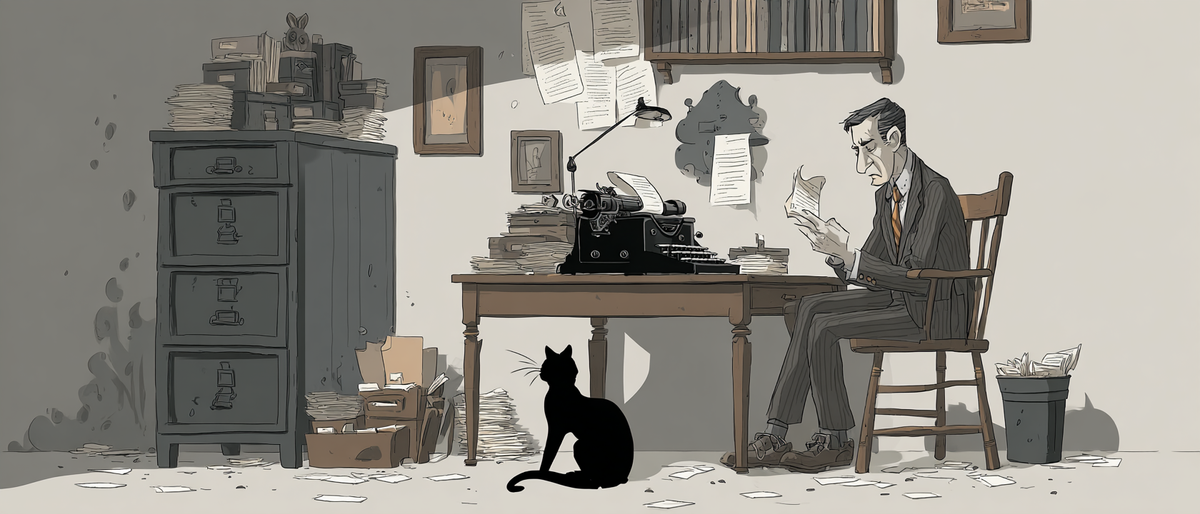
On Motive, the Book of Job, and What Lovecraft Needed to Kill...
No Conventional Motive
Our first essay in this series on Lovecraft's "The Shunned House" established that his story sustains a psychological reading — that the text yields, for a reader equipped to receive it, a narrative in which something other than a cosmic horror may have occurred in that Providence cellar. The case was built carefully, across multiple independent layers of evidence, and the conclusion was precise: not that the narrator is a murderer, but that the story contains a murderer as one of its available readings, permanently and without resolution.
Which raises the question that literary detection always raises next. If a crime, then a motive. And on motive, the investigation appears to collapse immediately.
Elihu Whipple is presented throughout as the narrator's most intimate companion — uncle, mentor, collaborator, the one figure who shares both the intellectual project and the long approach to its terrible conclusion. There is no inheritance dispute in the record. No rivalry, no documented grievance, no prior conflict of any kind. The relationship is described with a warmth that the narrator, not given to emotional display, extends to almost no one else in the story. On the conventional detective's checklist — means, motive, opportunity — motive is simply absent.
It is worth pausing here to concede a related point. The behavioral evidence that Essay One marshaled — the narrator's composure, the phone call, the untroubled sleep — proves rather less than it might appear to. A man of Lovecraft's cast, or his narrator's, would be composed in genuine grief too. In the words of one reader, "Providence does not scream. It itemizes." The emotional register of a New England antiquarian bachelor confronting catastrophic loss is not obviously distinguishable from the emotional register of a man concealing one. Composure is not criminal pathology. It is, in this cultural and literary context, "just another Thursday".
So. No conventional motive. Behavioral evidence that cuts both ways. A story that sustains the psychological reading without compelling it.
Case closed, it would seem.
Except that the narrator of "The Shunned House" has never told us his name.
The Man From Providence
This is not an oversight. Lovecraft's named characters are named with precision and purpose — the names in his fiction carry genealogical weight, ethnic significance, the accumulated freight of Providence history and colonial inheritance. Elihu Whipple is not a name someone reaches for casually. Neither is the narrator's anonymity accidental, coming from a writer as deliberate as Lovecraft about what he puts on the page and what he leaves off it.
The narrator offers, in place of a name, a portrait so specific it functions as one. He is a scholarly bachelor of indeterminate middle age, Providence-rooted, antiquarian by disposition and vocation, who approaches the strange and the terrible with methodical rationalism and records what he finds in careful, precise, slightly formal prose. He has no wife, no professional obligations that intrude on the investigation, no social world that exists outside the intellectual one. He grew up in proximity to the house. He knows its history the way a man knows the history of his own street — personally, devotedly, with the particular intimacy of someone for whom the past of a place is as alive as its present.
He is, in every particular that matters, indistinguishable from his author.
This is not a novel observation about Lovecraft's fiction generally. The scholarly antiquarian narrator appears throughout the canon, and the autobiographical resonance of that figure has been documented extensively in the critical record — by Joshi, by Cannon, by others who have traced the geography of Lovecraft's imagination back to the streets he walked and the houses he catalogued and the Providence he carried with him as a kind of spiritual interior even when he was physically elsewhere. Lovecraft wrote himself into his narrators the way certain painters put their own face in the corner of a crowd scene. It is not hidden. It is simply not announced.
What is slightly more unusual — and what the story's alternative reading makes suddenly, pressingly significant — is that this particular narrator, in this particular story, is not only recognizably Lovecraft in temperament and geography and vocation. He is also the sole witness to the disappearance of a figure who carries, in his name, the most personal possible weight.
The narrator has no name because he does not need one.
We already know who he is. The name that matters is the uncle's.
Whipple
This name is not local colour. Whipple Van Buren Phillips was Lovecraft's maternal grandfather — the man who read him Gothic tales by firelight, who first opened the door to the weird and the strange, who made of a solitary and unusually bookish child something more than merely isolated. He died when Howard was fourteen. Lovecraft described the loss in terms he rarely permitted himself — as the first great catastrophe of his inner life, the wound from which the others followed. And follow they did, almost immediately: the family fortune collapsed, the house on Angell Street was sold, the library dispersed, the life that had been built around a strange and gifted child and that had depended entirely on one man's presence to hold its shape — that life simply ended. The grandfather's death did not merely grieve Lovecraft. It dissolved the world.
Peter Cannon, in the critical record, confirms what the biographical evidence makes plain: the uncle in "The Shunned House" is a composite drawn from the men closest to Lovecraft's intellectual formation, with the grandfather's name — Whipple — placed at the figure's center.¹ Whether this was a conscious act of memorial or something that rose from below the threshold of intention, the effect is the same. The most intimate, most formative, most irreplaceable figure in Lovecraft's actual life is present in the story — not as himself, exactly, but as the shape of himself, wearing his name, occupying the role of beloved mentor and intellectual companion, positioned at the center of an investigation that will not end well for him.
Elihu Whipple. The grandfather's name on the uncle's face.
The narrator who is Lovecraft watches the figure who carries his grandfather's name dissolve into the cellar floor.
This is where the conventional motive question stops being the right question. We have been asking why the narrator might have harmed his uncle. We should have been asking why Lovecraft needed to destroy this figure at all — and what, precisely, the figure's name tells us about what was being destroyed.
Elihu
In the Book of Job, after God has permitted Satan to strip Job of everything — children, wealth, health, the coherent world — three friends arrive to offer comfort. They fail. Their arguments are too tidy, their theology too convenient, their insistence that suffering must reflect some prior transgression too easily demolished by a man who knows his own conscience. Job does not crack under their pressure. He demands, instead, an audience with God directly. He wants the universe to account for itself.
It is at this point that a fourth figure steps forward. He has been silent until now — younger than the others, waiting his turn. His name is Elihu.
Elihu does not argue that Job has sinned. He does not insist that suffering is punishment. His argument is more sophisticated and, in its way, more devastating than anything the three friends managed: that God's silence is not absence but transcendence. That the universe's refusal to explain itself is the appropriate and awe-inspiring expression of its nature. That the demand for a divine accounting — for a God who sees everything, records everything, and dispenses justice in terms a suffering human can recognize and verify — is itself the error. It isn't God's refusal to respond to his challenge in which Job errs... It is in his demand that God dispense 'justice' on his limited, human terms.
Elihu is the theological voice of cosmic submission. The argument that the universe is ordered, purposeful, and — rightly and humbly perceived — merciful. He is the one figure in Job who comes closest to what God will eventually say from the whirlwind: that the question itself misunderstands the questioner's position. That the archivist exists. That everything is seen. That the silence is not indifference but a mystery too large for the categories brought to bear on it.
Now consider a formulation offered in response to Essay One by a correspondent whose cosmicist credentials are, whatever else one might say about her, impeccable. "The cellar is clean," she wrote, "because existence is not an archivist."
She meant this as a rebuttal. She was defending the story against the psychological reading — arguing that in a Lovecraftian universe, dissolution requires no motive, that evidence once erased is simply gone, not suppressed or deferred or narratively concealed, and that the clean cellar is the universe's indifference made literal rather than a narrator's practicality made suspicious. It is a strong argument, cleanly stated, and it has the considerable virtue of being entirely consistent with Lovecraft's cosmicism as a philosophical system.
It is also, stated that precisely, the exact position that Elihu — in the Book of Job — exists to refute.
Elihu's God is the supreme archivist. Everything is recorded. Nothing is lost. The silence is not the absence of record-keeping but its most exalted form. Our correspondent's universe — the universe Lovecraft built story by story across his career, the universe in which the clean cellar is the natural condition of a reality too vast and too indifferent to bother preserving human evidence — is the direct, systematic, and total annihilation of the position Elihu argues.
Lovecraft named the uncle Elihu.
Then he fed him into the mechanism that makes that argument impossible.
The dissolution is not incidental to the name. It is the name's meaning, enacted. You do not merely defeat the argument for a personal and record-keeping God by marshaling counter-evidence. You dissolve the figure who carries it — without remainder, without trace, without anything left over for the celestial archivist to find — and you send the narrator home to sleep and return in the morning with acid. The refutation is architectural. It is built into the story's structure the way the Poe tribute is built into its dedication — operating at a level that does not require announcement because the story's machinery enacts it regardless of whether anyone notices.
Whether Lovecraft knew precisely what he had done in choosing that name — whether the Elihu-Job connection was a conscious act of philosophical provocation or something that surfaced from the deep substrate of a man who had read everything of Poe (and, we suspect, the Bible) and forgotten nothing — the name does its work either way.
Elihu Whipple, who by his name argues that the universe keeps faith and record and ultimately accounts for suffering, meets the Shunned House.
He does not walk out.
The Philosophical Murder
What happens to Elihu Whipple in "The Shunned House" is not, in the most precise sense, a death. Characters die in Lovecraft's fiction with some regularity, and death — even violent, inexplicable death — leaves something. A body, or the memory of one. A name on a grave. The legible trace of a person who existed and then stopped existing, which is at minimum a kind of record.
Elihu Whipple leaves nothing.
He dissolves. Merges with the entity in the cellar, loses coherent selfhood, disappears into something that wears his face at the moment of consumption and then absorbs even that. By the time the narrator returns the following morning with his equipment, there is nothing to find, nothing to mourn over, nothing that could be examined by anyone arriving afterward and asking what became of an elderly Providence antiquarian who went into a cellar one summer night and did not come out. The acid completes what the night began. The cellar is clean. The theological position carried by the name — that the universe sees, records, and ultimately accounts for everything — is not rebutted. It is not even engaged. It is simply made to disappear.
This is the distinction that matters. A defeated argument leaves something to argue against. A refuted position can be reconstructed, re-examined, defended again by the next person willing to take it up. What Lovecraft does to the Elihu position is not defeat. It is erasure. And erasure — permanent, traceless, acid-assisted erasure — is the only form of refutation adequate to an argument Lovecraft could not afford to leave standing in any recoverable form.
The Dungeon Master of Providence rolls the dice and consults his table of cosmic outcomes: dissolved by quantum vampire and rendered into unrecoverable sludge, or murdered by unwitting nephew in psychotic frenzy induced by hallucinogenic basement mold. Either way, Elihu does not walk out. Either way, the argument for a personal and merciful universe — the argument that the silence is transcendence rather than absence, that the archivist exists and sees everything and will account for all of it — does not survive the basement. The table has no outcome column in which Elihu emerges intact and the argument holds. Lovecraft has not designed one. The dice have no face that lands that way.
This is cosmicism not merely as a philosophical position but as an act. The story does not argue against the Elihu proposition. It performs the argument's impossibility — enacts, in the machinery of narrative, the universe in which such a proposition cannot be sustained. Feed the theological voice of cosmic submission into the mechanism of cosmic horror and what returns is nothing. No remainder. No trace for the archivist to recover, because there is no archivist, because Lovecraft grants Elihu the transcendence and simply removes the mercy — leaving the cosmos Elihu described, stripped of the only element that distinguished it from horror.
The acid sees to that.
And then the narrator goes home, and sleeps, and returns in the morning.
Whether he is a man who witnessed a cosmic horror or a man who committed a very human one, the universe — as our correspondent correctly observed — declines to say. Both readings remain available. Both produce the same clean cellar. In this, and only in this, the cosmicist reading and the psychological reading are in complete agreement: the Elihu argument does not survive the basement. The dissolution was, one way or another, inevitable. In a universe Lovecraft built, with a narrator Lovecraft inhabited, carrying a name Lovecraft chose, it could not have gone otherwise.
The question is why Lovecraft needed it gone.
The Motive
By 1924, when Lovecraft wrote "The Shunned House," he had watched four people he loved dissolve.
His father first. Winfield Scott Lovecraft was institutionalised at Butler Hospital when Howard was three years old — committed for erratic and increasingly alarming behaviour that the family attributed, in the way families attributed things in 1893, to a nervous breakdown brought on by overwork. The diagnosis the medical record eventually settled on was general paresis of the insane, the late neurological consequence of syphilis. He died there five years later, when Howard was eight. This was not a death with the dignity of suddenness. It was a protracted erasure — a man losing coherent selfhood by degrees, the personality consumed from within by something that wore his face until it didn't anymore. The child who visited, if he visited, would have watched his father become progressively less his father. The man in the institution and the man in the memory were not, by the end, the same person. Something had replaced him. Something had been wearing him.
The grandfather died when Howard was fourteen. The wound this left — and Lovecraft described it as a wound in letters that Joshi has documented and that the scholarly record preserves — was not only the loss of a person. It was the loss of the entire structure built around that person. Whipple Van Buren Phillips had been the family's centre of gravity. His death meant the dissolution of the household on Angell Street, the dispersal of the library, the collapse of the financial arrangements that had made the life of a strange and bookish and not particularly robust child possible. The world did not merely become sadder. It became unrecognisable. The grandfather's death was a door closing on everything that had made sense, and it closed, as doors do in Lovecraft's fiction, on something that would not open again.
Between the grandfather's death and the mother's unraveling, there was another figure, and another loss. Dr. Franklin Chase Clark — physician, scholar, husband to Lovecraft's aunt Lillian — had stepped, after 1904, into the vacancy the grandfather left. Not by design, but by proximity and temperament: an educated, older man in the household, one who took the young Howard's writing seriously enough to improve it. When Clark died in April 1915, Lovecraft did what he would do again, nine years later, in a Providence cellar: he converted the loss into language. An elegy, published in the Providence Evening News — formal, considered, already slightly distanced from the rawness of the grief. The writing as the first available instrument. The pattern was already established long before he named a physician-scholar after his grandfather and put him in a basement.
Then his mother. Sarah Susan Phillips Lovecraft spent the years between her husband's institutionalization and her own doing what she could — which was considerable, and which cost her considerably. By 1919 she was in Butler Hospital herself, in the same institution where Winfield had died, committed for what the record describes as a nervous collapse. She died there in 1921, two years after her admission. She was, by the accounts available to us, a complicated figure — devoted to Howard with an intensity that the biographical record suggests was not always easy to live inside, brilliant in her own right, undone by a combination of grief and financial pressure and the particular exhaustion of a woman who had held everything together for two decades by force of will alone. Lovecraft's feelings about her were, by his own admission in letters, not simple. But she was his mother. And she dissolved, as his father had dissolved, as his grandfather had in his way dissolved, into something institutional and unreachable and finally absent.
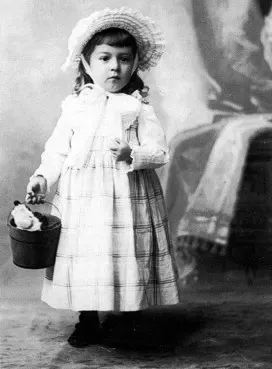
Four beloved minds. Four dissolutions. The thing in the family cellar that wears the faces of people you love and then stops wearing them.
To hold the Elihu position against this record — to maintain that the universe sees everything, records everything, and will account for all of it in terms that make the suffering legible and the silence meaningful — would require a particular kind of faith that Lovecraft simply did not have the biographical raw material to construct. Not because he had examined the argument and found it philosophically wanting, though he had done that too, exhaustively, in letters and essays that constitute one of the more rigorous lay engagements with cosmicism in American literary history. But because the argument had been tested against his actual life, at ruinous and repeated cost, and the universe had returned the same answer every time.
There is no archivist. The silence is not transcendence. The losses do not resolve into meaning. The beloved minds dissolve and what remains is a clean institutional room and a man who has learned, by long practice, to be extraordinarily functional in the aftermath of things that should, by conventional emotional accounting, be devastating.
Lovecraft believed — and said so, in letters Joshi has documented — that his writing was the instrument by which he kept himself on the right side of the abyss his family had fallen into. The discipline of making sentences, of giving form to formlessness, of submitting the unbearable to the methodical work of narrative construction — this was not merely expression. It was survival. The writing was what the acid pump was: the means by which a man who has witnessed dissolution returns the following morning with the proper equipment and renders what remains into something that can be lived with.
So here, finally, is the motive the narrator does not have and Lovecraft does.
Elihu Whipple carries the grandfather's name and the roles played by both the grandfather and the uncle in Lovecraft's formative years — beloved mentor, intellectual companion, figures whose presence makes the investigation possible and whose absence the narrator will have to survive. He also carries, in his first name, the theological argument that the universe is ordered and merciful and keeps perfect record of everything that occurs within it — the argument that would require, if taken seriously and held against the biographical record, that the four dissolutions meant something. That Winfield's erasure was legible within a larger design. That Whipple Phillips' death served a purpose that a grieving fourteen-year-old could not perceive but that existed nonetheless. That Sarah Susan's years in Butler Hospital were not simply what they appeared to be — a brilliant woman consumed by circumstances that could not be managed and a universe that did not notice — but part of an account being kept by something that sees and records and will eventually, in its own time and in terms adequate to the scale of the thing, make it all make sense.
Lovecraft could not embrace that argument. It would have required him to trust a universe that had given him no reason to trust it and considerable reason to fear it. And so he dissolved the argument instead — encoded its destruction in the name of a character, fed that character into the machinery of cosmic horror, and sent the narrator home afterward to fetch his tools and finish the job.
The fictional, nameless narrator has no motive. The narrator is nevertheless Lovecraft's creature in the most precise sense: built in his image, furnished with his obsessions, sent into the cellar in his place. And Lovecraft has every motive there is.
The case, which appeared to close on the absence of conventional motive, opens again — wider, and onto something considerably darker than a crime.
Two Readings. One Conclusion.
It is worth being precise, at this late stage of the argument, about what has and has not been claimed.
The essay has not argued that the narrator of "The Shunned House" is definitively a murderer. It has not argued that Lovecraft consciously engineered the destruction of a theological position when he named his character Elihu, or that he sat down in 1924 with the Book of Job open on one side of his desk and a biographical inventory of his family's dissolutions on the other. The claim has been consistently narrower in its implications than either of those positions. It is that the text sustains a psychological reading, that the name does its devastating work whether or not anyone intended it to, and that the life deeply influenced the manner in which the story was constructed.
What the biographical argument adds to the literary one is not proof. It is explanation. It explains why the irresolution is structural rather than accidental — why the story that sustains two readings simultaneously was written by someone for whom the cosmicist reading and the psychological reading converge on the same unbearable conclusion. Whether the cellar is clean because a narrator methodically removed the evidence, or because existence is not an archivist and dissolution requires no motive and the universe simply does not bother preserving what it consumes — Elihu Whipple does not walk out. The argument for a personal and merciful God does not survive the basement. The name is erased along with the man who carries it, and what remains is a clean cellar and a narrator who will go on, as survivors do, with the work that remains.
The cosmicist reading and the psychological reading are not, finally, adversaries. They are two descriptions of the same outcome, arrived at by different routes, through different coordinate systems, mapping the same terrain. Mrs. Trevett's universe and our narrator's share their most important feature: neither produces an Elihu who walks out intact. Neither produces an argument for cosmic mercy that survives contact with what is in that cellar. The disagreement between the reading-for-concealment and the reading-for-indifference is real, and it will not be resolved here, because the story does not resolve it, and the story is right not to.
What both readings share is the conclusion. The theological position requires a universe that keeps faith and record. This is not that universe. It never was — not in the story, not in the fiction, not in the life that generated both.
Elihu Whipple carries the argument into the basement.
The basement wins.
The Acid Pump
Lovecraft said, in letters that the scholarly record preserves, that his writing was what kept him on the right side of the abyss. Not metaphorically. He meant it as a practical description of a psychological arrangement — that the discipline of making sentences, of submitting the formless and the unbearable to the methodical work of narrative construction, was the instrument by which a man with his particular inheritance stayed functional. The writing did not merely express the horror. It managed it. Contained it. Rendered it into something that could be lived alongside without destroying the person doing the living.
The acid pump is that instrument, made literal.
The narrator returns the morning after with his equipment and completes the work the night began. He dissolves what remains. He removes it. He renders the cellar clean and the account complete and the case closed — not because the universe has provided an answer, but because the survivor requires a livable space and has learned, by long necessity, to create one in the absence of answers. The dissolution is the work. The morning return is the discipline. The clean cellar is what the writing produces when the writing is doing what it must.
This is not resolution. It is management. It is the thing Lovecraft knew how to do, the thing his fiction performed over and over across a career spent in the company of dissolutions he could neither prevent nor explain nor, finally, grieve in any way that conventional grief would recognise. You go home. You sleep, or you do not sleep. You return in the morning with the proper equipment. You finish what the night began and you write it down afterward with whatever precision and care you can bring to bear, because the writing is the pump, and the pump is the only instrument available, and the cellar will not clean itself.
Whether the narrator of "The Shunned House" is a bereaved man or a guilty one, he is, in this final image, recognisably his author — the person who comes back in the daylight, with the right tools, and does what needs doing. The person for whom the work of making sense is indistinguishable from the work of survival.
The story's sheets went unbound for thirteen years. They sat in W. Paul Cook's workshop, set in type, never distributed, while Lovecraft went on writing letters and stories and critical essays in the thousands — went on running the pump, in other words, while this particular product of it waited in the dark for a readership that would not arrive in his lifetime. Whether he left it unbound because he considered it minor, or because he recognized in it something too exposed to release, the biographical record does not say. The universe, as always, declines to adjudicate.
What it left behind is a clean cellar, a dissolved argument, a narrator who never gives his name, and a character named for the one voice in scripture that insists the archivist exists and sees everything and will account for all of it.
The Shunned House was published in 1937, the year Lovecraft died.
Elihu was not available for comment.
Notes:
¹ S. T. Joshi and David E. Schultz, An H. P. Lovecraft Encyclopedia (Westport, CT: Greenwood Press, 2001), s.v. "Clark, Franklin Chase, M.D."
Member discussion: