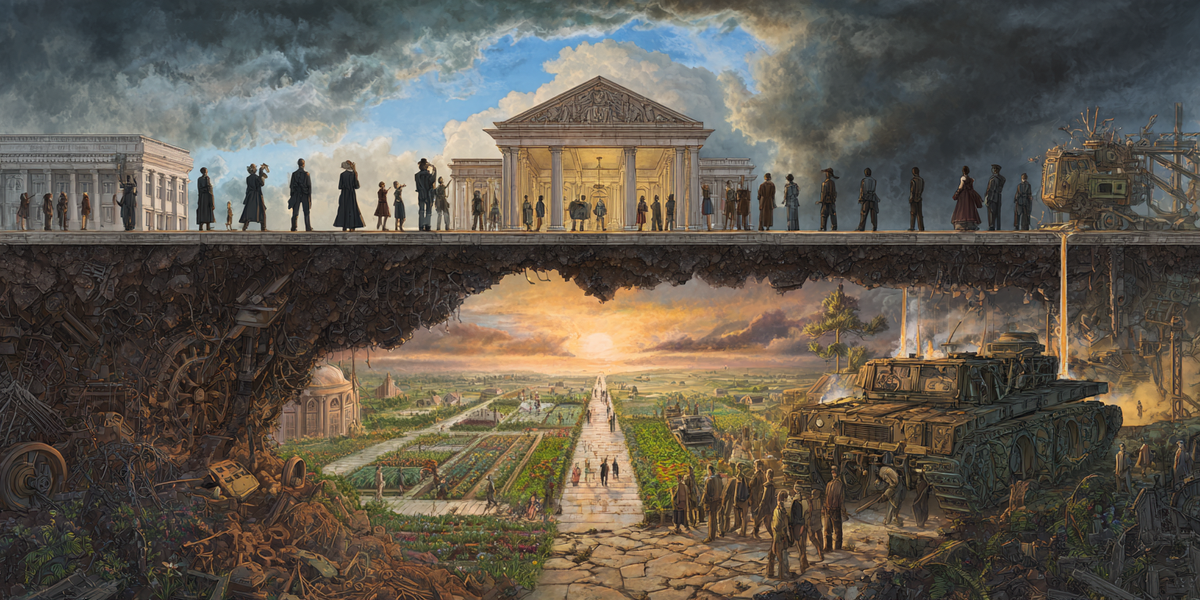
The Myth of the "Glorious" Beginning

The American narrative is anchored in a carefully curated myth: that a band of enlightened philosophers rose up against a "tyrant" to bestow the gift of liberty upon a grateful, unified populace. We are taught to view 1776 as a singular moment of moral clarity. But history, when stripped of its patriotic lacquer, reveals a far more cynical architecture. The American Revolution was not a spontaneous eruption of democratic fervor; it was a high-stakes divorce between two wings of an imperial elite.

The "founding" was, in reality, a strategic coup. The men gathered in Philadelphia—the land speculators, the plantation masters, and the merchant princes—were not looking to dismantle the machinery of exploitation; they were looking to change the names on the deeds. They sought to sever the "chains" of British taxation and regulation not to set the common man free, but to ensure that the spoils of a stolen continent remained in American coffers.

To achieve this, the gentry required a cudgel. They found it in the "commoners"—the tenant farmers, the urban laborers, and the indentured—who were fed a potent cocktail of "natural rights" rhetoric and sent into the breach. This was America’s first true Civil War, pitting neighbor against neighbor, while the wealthy orchestrators largely watched from the safety of their estates. As George Washington himself observed with characteristic coldness, the "lower class of people" were merely the necessary fuel for the fire of independence. Once the British were expelled, the rhetoric of "equality" was quickly folded away, replaced by a legal framework designed to protect property from the very people who had just bled to defend it.

Today, as we witness the systematic gutting of the public square—the dismantling of the CDC, the sacrifice of environmental protections on the altar of "efficiency," and the funneling of trillions into a permanent war economy—we are not seeing a "betrayal" of the American project. We are seeing its fulfillment. The 2025 landscape is the logical conclusion of a state founded by and for the proprietor class. The "Social Contract" we are told to honor is a phantom—a document written by the victors of an 18th-century class war, intended to ensure that while the faces of the masters might change, the logic of the plantation would endure.

The Architecture of the Stabilization Contract

If the Declaration of Independence was the "cry of the street" used to mobilize the masses, the Constitution was the "locking of the door" that followed. By 1787, the elite realized they had a crisis of their own making: the "mob" had taken the rhetoric of 1776 seriously. In the forests of Massachusetts, debt-ridden Revolutionary War veterans like Daniel Shays were picking up their muskets again—this time to prevent a domestic merchant class from seizing their farms via the same "burdensome taxation" they had ostensibly just fought a war to end. The Constitution was the gentry’s panicked response to Shays’ Rebellion. It was designed not to facilitate democracy, but to contain it. The delegates who met in Philadelphia were not elected by "The People"; they were a self-appointed committee of the 1%—lawyers, merchants, and slaveholders—tasked with creating a "Stabilization Contract" that would protect the "minority of the opulent" against the majority.

The architecture they built was a masterpiece of structural suppression, a maze of "checks and balances" that were effectively "breaks and barriers." They created a Senate as a gentry filter, an unelected chamber¹ designed to serve as a "necessary fence" against the more impulsive, populist House. They engineered the Electoral College as a deliberate buffer zone to ensure that the "commoners" could never directly choose the Chief Executive, placing that power in the hands of "wise" intermediaries. They empowered a Supreme Court as an unelected, life-tenured priesthood with the authority to strike down the will of the people, ensuring that property rights would always supersede human rights. This was the birth of the "Managed State," a system that recognized that extreme wealth inequality cannot be sustained through force alone; it must be done through the Theology of Process.

Even more insidious was the legal "dead bolt" applied as the system matured, epitomized by statutes like the Smith Act. These laws represent the ultimate irony of the American experiment, criminalizing the very act of "advocating for the overthrow of the government." The men who committed treason to create this nation made it a felony for anyone else to follow their example. They climbed the revolutionary ladder and then kicked it away, ensuring that the "chains" they broke for themselves would be reforged in the fires of "law and order" for everyone else. By the time the ink was dry, the Revolution was over. The "consent of the governed" had been replaced by the "submission of the governed," and the stage was set for a republic where property is the only true citizen.

2025 and the Dismantling of the Public Trust

The structural barriers erected in 1787 were designed to wait for a moment like 2025—a moment where the pretense of "public service" could finally be dropped in favor of raw, bottom-line consolidation. We are currently witnessing the Great Liquidation, a systematic dismantling of the actual mechanisms of public survival. These are the hard-won fragments of the social contract that were conceded during the twentieth century only to keep the laboring classes from total revolt. The gutting of the CDC is not an exercise in "streamlining"; it is a declaration of biological abandonment. When the state deliberately shuts down its ability to track disease, ensure the safety of the water we drink, or study the toxins in our air, it is signaling that the physical survival of the poor is a cost it is no longer willing to carry. By reorienting the CDC toward a narrow focus on infectious disease, the state is withdrawing its shield, leaving the vulnerable to be consumed by a landscape of chronic illness and industrial neglect.

This liquidation is framed by a staggering, grotesque contrast. While the state hunts for pennies in the budgets of nutrition programs and school lunches—effectively starving the future to save the present—it concurrently pushed the defense budget past the trillion-dollar threshold. This is the "DOGE Doctrine" in its purest form: the ruthless auctioning off of the commons paired with the infinite expansion of the military-industrial complex. We are told there is no money for the health of our children or the stability of our climate, yet the treasury remains an open tap for defense contractors and the "hard power" of border militarization. This is not a shift in policy; it is a shift in the nature of the state itself. The government has ceased to even masquerade as a provider of "general welfare," choosing instead to become a high-tech fortress that protects the assets of the superrich while exporting violence and policing the "surplus" population at home.

The 2025 budget is the ultimate ledger of our exploitation. It reveals a government that views its citizens not as a sovereign people to be protected, but as a liability to be managed or an expense to be liquidated. By clawing back billions in public health grants and shuttering education centers like Job Corps, the elite have effectively shredded the "Phantom Contract." They have decided that the "commoners" who were once useful as revolutionary fodder or industrial labor are now an unnecessary overhead. In this new era, the state exists only to secure the markets, defend the borders, and ensure that the wealth of the "opulent minority" remains untouched by the mounting crises of the "suffering majority." The mask of 1776 has been discarded, leaving behind the cold, steel machinery of a state that has finally, and perhaps irrevocably, turned its back on the very life-support it once promised to maintain.

The Moral Mandate of Non-Consent

The "Prudence Clause" of the Declaration of Independence warns that governments should not be changed for "light and transient causes." It suggests that mankind is generally willing to suffer under a flawed system as long as the evils are "sufferable." However, once a government moves from flawed to predatory—once it begins the Great Liquidation of the public life-support—the moral mandate shifts. We have reached the point where the "long train of abuses" has become a high-speed rail toward social and environmental collapse. In this context, non-consent is no longer just a political choice; it is a moral imperative. When a state defaults on its fundamental duty to protect the lives and health of its people, the people are, by every law of natural justice, released from their obligation to obey.

To understand the mandate of non-consent, we must look past the "Theology of Process" that the elite use to paralyze us. We are told that as long as we can vote, we live in a democracy, and therefore we must accept the outcome. But if the electoral process is merely a mechanism for the superrich to choose which of their representatives will manage the decline, then voting is not "consent"—it is a hostage situation. The Zinn-level² truth is that a system which allows a "Department of Government Efficiency" to starve children while feeding a trillion-dollar war machine has already overthrown its own legitimacy. You cannot be "loyal" to a state that is actively poisoning your water, gutting your healthcare, and weaponizing your tax dollars against the global poor. At this stage, "loyalty" to the state becomes a form of complicity in its crimes.

This mandate does not call for a return to the primitive violence of the 18th century, which the state is now over-equipped to crush. Instead, it calls for a Revolution of Withdrawal. True non-consent is the refusal to participate in the lie. It is the withdrawal of intellectual, emotional, and economic support from the institutions of the elite. It is the realization that the law is not "justice," but merely the rules of the house in a rigged game. When the "Phantom Contract" is shredded by those at the top, the people are free to build their own parallel structures of survival—mutual aid, local food sovereignty, and communal health networks—that exist outside the reach of the Liquidators. We owe the current federal government nothing more than the cold observance of its power; we owe it no allegiance of the heart, for it has proven it has no heart for us.

Stability vs. Revolution

The ultimate weapon of the proprietor class is the manufactured fear of chaos. We are told that we must endure the Great Liquidation because the alternative—a fundamental break from the current order—would mean the collapse of civilization itself. This is the "False Choice" presented by the elite: either accept the slow, orderly death of the status quo or face the violent, unpredictable death of total anarchy. They frame the 1787 framework as the only thing standing between the citizenry and the abyss. But this argument ignores the most glaring factual truth of 2025: for the poor, the working class, and the planet, the "stability" we are currently experiencing is already a slow-motion catastrophe.

What the elite call "stability" is, in reality, a highly managed form of violence. It is the violence of a trillion-dollar military budget that secures oil but leaves our cities to decay. It is the violence of a healthcare system that treats disease as a profit center and leaves the uninsured to die quietly in their homes. It is the violence of a deregulated industrial complex that treats the atmosphere as an open sewer. When a system is structured to transfer wealth upward while pushing the externalized costs of that growth downward onto the biology of the people, that system is not "stable"—it is merely efficient at its task of exploitation. The "order" we are told to protect is actually the mechanical precision of a wrecking ball.

By framing "Revolution" only as a chaotic, blood-soaked rupture, the state prevents us from seeing it as a necessary evolution. The Founders, despite their own class interests, understood that stability is not the highest good; Liberty and Survival are. They knew that a government which becomes a "dead hand" on the throat of the future must be removed to make way for the living. We must reject the lie that the current arrangement is the only possible reality. The choice is not between a flawed system and total darkness; it is between a system that has fundamentally failed its biological and moral audit and a new, decentralized paradigm that prioritizes the preservation of life over the sanctity of the ledger. To fear the end of this "stability" is to fear the end of our own exploitation.

Beyond the 1787 Framework

The final charge of this inquiry is not a call to arms, but a call to clarity. We must stop pretending that the current arrangement is a "democracy" in any sense that would be recognizable to those who truly value the consent of the governed. We are living in a Proprietor’s Republic that has reached its terminal phase—a phase where the masks of "public health" and "general welfare" have been stripped away to reveal a state that functions as little more than a protection racket for concentrated capital. The "moral mandate" before us is to acknowledge that the 1787 framework, designed by a landed elite to manage a pre-industrial society, is fundamentally incapable of addressing the existential crises of the 21st century.

To move beyond this framework is to embrace the audacity that the Founders themselves claimed: the inherent right to "alter or abolish." This does not require the destruction of society, but rather the dissolution of the "Phantom Contract" that keeps us tethered to a dying system. It requires an intellectual and social secession—a realization that we owe no allegiance to a state that prioritizes the expansion of its war machine over the survival of its children. The "long train of abuses" has reached its station; the Great Liquidation has proven that the state has already vacated its side of the bargain.

The revolution of the 21st century will not be won on a battlefield of muskets or in the halls of a compromised Congress; it will be won in the reclamation of the Commons. It will be found in the building of parallel institutions that actually serve human life—decentralized energy, communal agriculture, and mutual aid networks that operate on the logic of care rather than the logic of "efficiency." We must recognize that the law is not a moral compass, and "legality" is often just the brand name for elite preference. Our task is to stop seeking permission from the Liquidators to survive. The 1787 framework is an artifact of the past; the mandate of the present is to build a future where the health of the planet and the dignity of the person are the only true sovereigns. The contract is expired. It is time for a new foundation.


Notes

¹For the first 125 years of American history, the Senate was literally unelected by the people. Under Article I, Section 3 of the Constitution, Senators were chosen by state legislatures, not by voters.

² Howard Zinn (1922–2010): A seminal American historian and social activist best known for A People’s History of the United States. Zinn’s "level" of historiography rejects the "Great Man" narrative of history—which focuses on the perspective of kings, presidents, and elites—in favor of a "bottom-up" analysis. This approach centers the experiences of the disenfranchised, the laboring classes, and the colonized, arguing that the true engine of history is the struggle of ordinary people against systemic exploitation.