
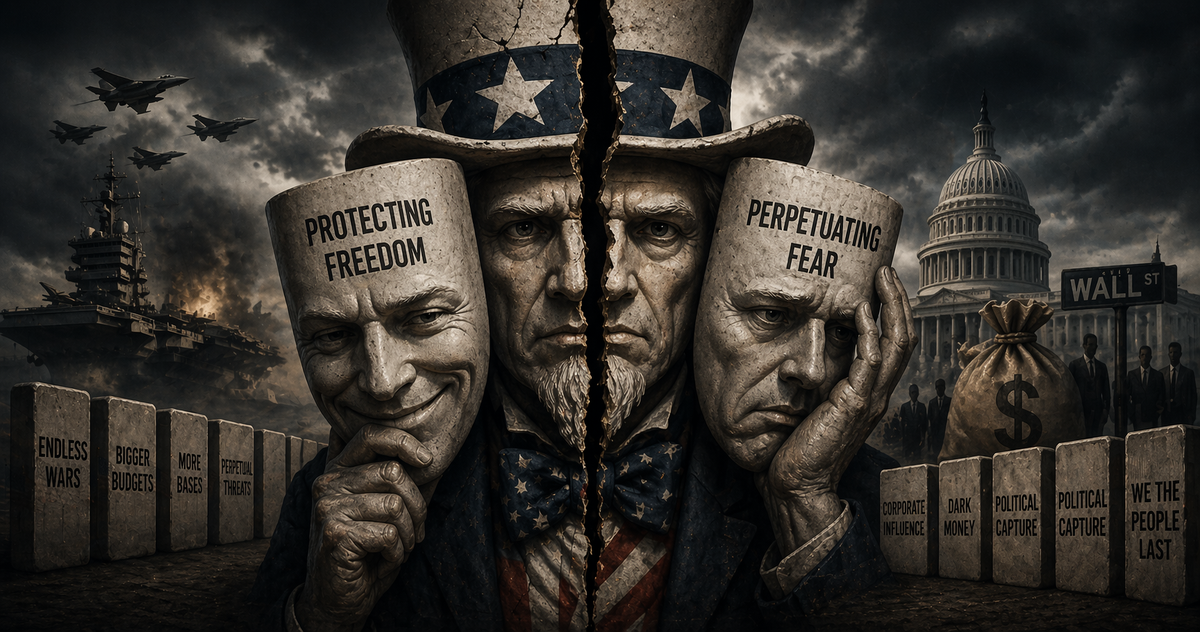
How Failed Interventions, Nuclear Incoherence, Campaign Finance Corruption, and Economic Self-Contradiction Built an Empire That Can't Stop Looking Over Its Shoulder
There is a persistent asymmetry in how the United States understands itself and how it is perceived from outside. The country maintains the largest military apparatus in modern history, spends more on defense than the next ten nations combined, operates nearly 750 military bases in at least 80 countries, and has intervened in the internal affairs of foreign nations almost continuously since 1945 — yet its political discourse frequently frames the nation as precariously exposed, economically vulnerable, strategically encircled, and under perpetual threat.
Individually, none of these positions is incoherent. A global power may reasonably maintain extensive capabilities while remaining attentive to emerging risks. The question is whether, taken together, these patterns form something more than a series of discrete policy choices — whether the system that produces them exhibits a deeper structural tension, one in which institutional incentives sustain the very posture of threat that justifies their continuation.
The case for such a tension is stronger than most Americans would like to admit. It does not require conspiracy. It does not require malice. It requires only that we take seriously a pattern that spans multiple domains of policy, persists across administrations, and resists democratic correction — and ask what structural conditions might explain it.
The Intervention Record: Expanding Ambitions, Diminishing Returns
The postwar record of American military intervention reveals a consistent trajectory: widening objectives accompanied by declining success. A 2024 analysis published in Foreign Affairs by RAND Corporation researchers examined the full history and found that before World War II, the United States intervened primarily to conquer territory or defend its own. Afterward, its objectives expanded to include regime change, nation-building, counterterrorism, and the promotion of global norms. The researchers found that heightened ambitions systematically lowered the success rate: despite having the most powerful military on the planet, the United States often met with failure.
The scale is worth noting. A Carnegie Mellon University study documented 81 US interventions in foreign elections between 1946 and 2000, the majority conducted covertly. A 2021 academic review of the broader literature found that foreign interventions since World War II overwhelmingly failed to achieve their stated objectives. RAND calculated that the pace of major foreign policy achievement fell from roughly once per year during the 55 years following the war to once every four years after 2001 — a period the institution characterized as a "lost generation in American foreign policy."
This does not imply that intervention is uniformly misguided. The Marshall Plan, Operation Desert Storm, and certain Cold War deterrence strategies achieved measurable results. But a 2023 study by researchers at the University of Pennsylvania, the University of Freiburg, and the WZB Berlin Social Science Center, published in The Economic Journal, found that higher levels of US military aid actually produced more anti-American terrorism in recipient countries, while contributing to increased political exclusion and corruption rather than enhanced military capacity. The relationship between capability and outcome is more contingent than commonly assumed — and the persistence of large-scale intervention despite mixed results raises a question the record alone cannot answer: what incentives sustain this pattern?
Nuclear Policy: When Rationale Expands Faster Than Threat
A similar tension appears in nuclear posture. The United States maintains approximately 5,500 nuclear warheads and is undertaking a modernization program estimated to cost in excess of $1.5 trillion over three decades. Every Nuclear Posture Review since the end of the Cold War has expanded the rationale for maintaining and upgrading the arsenal, even as the original adversary — the Soviet Union — ceased to exist in 1991.
The 2018 Nuclear Posture Review, issued by the first Trump administration, introduced a notably more pessimistic assessment of the international security environment, using it to justify sidelining arms control measures and developing new low-yield nuclear capabilities. Defense scholars at the Carnegie Endowment for International Peace argued that the justification for these programs was questionable and warned they could trigger a renewed arms race. Researchers at Princeton's Program on Science and Global Security described current nuclear warfighting postures as anachronistic holdovers from the Cold War, noting that adversarial postures carry an inherent risk of intentional or accidental use.
The contemporary justification centers increasingly on China, which the Department of Defense now designates as a "nuclear peer" alongside Russia — despite the fact that China's arsenal, while growing, remains a fraction of the American stockpile. The 2024 Report on the Nuclear Employment Strategy stated that the United States confronts "multiple nuclear competitors" and may need to adapt its posture accordingly.
The issue here is not whether deterrence serves a purpose — there are reasonable arguments that it does. The issue is what it means when the rationale for maintaining extreme capabilities expands rather than contracts in response to changing conditions. When that happens consistently, it becomes difficult to distinguish between adaptive strategy and institutional inertia — between genuine preparedness and the self-perpetuation of the apparatus that provides it.
The China Contradiction: Integration and Antagonism on Parallel Tracks
Nowhere is the tension between justification and structure more visible than in the US-China relationship. Over the past several decades, the two countries have developed one of the most deeply interdependent economic relationships in modern history. American consumers and corporations rely extensively on Chinese manufacturing for electronics, pharmaceuticals, rare earth minerals, and countless industrial inputs. China controls the processing of the vast majority of rare earth elements critical to American defense systems — a dependency that experts warn could cripple US military capability if supply chains were severed.
Simultaneously, China has held as much as $1.3 trillion in US Treasury debt at its peak and, though its holdings have declined to approximately $761 billion, remains among the largest foreign holders of American sovereign obligations. The CSIS ChinaPower Project notes that China's large Treasury holdings reflect US power in the global economy as much as any feature of Chinese strategy — the dollar's reserve currency status makes American debt an attractive, liquid asset.
Yet the same government that depends on Chinese capital and manufacturing has designated China as its primary strategic adversary, expanded military deployments across the Indo-Pacific, and imposed tariffs that its own research institutions describe as economically damaging.
This may be understood charitably as the complexity of globalization — great powers have always managed mixed relationships. But it may also be understood as a form of strategic disjunction in which different sectors of policy operate according to partially incompatible logics. Short-term economic incentives encourage continued integration. Long-term security frameworks encourage decoupling. The system accommodates both but reconciles neither, and the incoherence is sustained because no single institution bears the cost of the contradiction.
Campaign Finance: The Structural Insulation of Policy From Accountability
The question of why these contradictions persist invites attention to the domestic structures that shape political incentives — and here the evidence is disquieting.
The Supreme Court's 2010 ruling in Citizens United v. Federal Election Commission struck down century-old restrictions on corporate political spending, holding that limits on independent expenditures violated the First Amendment. The Brennan Center for Justice reports that in the 2022 midterms, just 21 of the wealthiest donor families contributed $783 million, and billionaires provided 15 percent of all federal election financing. The Brennan Center further observes that federal campaign finance rules are now more porous than at any time since Watergate.
A 2025 Roosevelt Institute study found that states forced to remove bans on independent spending after Citizens United saw outside money surge by roughly double the increase observed elsewhere, with GOP candidates' electoral success jumping by 4 to 11 percentage points — despite no corresponding shift in voter ideology. These states subsequently enacted more extreme gerrymandering and intensified barriers to voting.
The empirical research of political scientists Martin Gilens and Benjamin Page found that economic elites and organized interest groups have substantial independent influence on US government policy, while average citizens have little to no independent influence. This finding does not invalidate democratic institutions wholesale, but it complicates any simple account of policy accountability. If political actors are structurally incentivized to prioritize donors and institutional stakeholders over the broader electorate, then the durability of large-scale defense spending, interventionist postures, and expansive security frameworks becomes easier to explain — not as democratic choices, but as outcomes that democratic processes have been insufficiently equipped to correct.
The Present Moment: Tariffs, Trust, and the Cost of Credibility
Recent economic policy provides a sharp contemporary illustration of these dynamics. The April 2, 2025 "Liberation Day" tariffs raised effective tariff rates to levels not seen since 1909. The Tax Foundation estimates they represent the largest US tax increase as a percentage of GDP since 1993, amounting to an average burden of $1,500 per household in 2026. A New York Federal Reserve study found Americans bore 94 percent of tariff costs, while the Yale Budget Lab found consumer pass-through rates as high as 100 percent for durable goods.
The Peterson Institute for International Economics modeled the effects and found that under the worst-case scenario — high tariffs with retaliation and increased risk premium on US assets — real GDP falls 2.1 percent relative to baseline by 2026, with durable manufacturing production declining nearly 12 percent and agricultural employment dropping almost 5 percent.
The international response has been consequential. The Zeitschrift für Außen- und Sicherheitspolitik characterized the current administration's approach as an abandonment of established diplomatic norms in favor of transactional, national-interest-focused choices marked by economic nationalism and crude material power. Allied nations have begun actively decoupling from American digital infrastructure, financial messaging systems, and supply chains — not because they want to, but because they have concluded that dependence on American systems now constitutes a strategic liability.
These adjustments do not amount to a wholesale rupture. But they indicate a recalibration of trust and risk that may prove more durable than any single tariff schedule.
The Pattern and Its Interpretation
Taken together, these domains — military intervention, nuclear policy, economic strategy, and domestic political structure — do not point to a single, simple diagnosis. The term "paranoid," while evocative, is analytically imprecise when applied to a nation-state. A more grounded interpretation is that the American system has difficulty distinguishing between necessary preparedness and self-reinforcing escalation. When multiple institutions benefit — materially, politically, or ideologically — from the maintenance of a high-threat environment, the threshold for defining what counts as a threat shifts accordingly.
President Eisenhower warned of exactly this dynamic in his 1961 farewell address, cautioning against the "acquisition of unwarranted influence" by the military-industrial complex. More than six decades later, the influence is no longer unwarranted in the technical sense — it has been legalized, institutionalized, and constitutionally protected.
This interpretation does not negate the reality of external dangers. The international system remains contested. Russia's invasion of Ukraine represents a genuine violation of the European security architecture that the United States helped build. China's military expansion and assertiveness in the South China Sea present legitimate strategic concerns. Nuclear deterrence, whatever its costs, has coincided with the longest period without great-power war in modern history. And the US economy, despite policy disruptions, remains the world's largest and most innovative.
But acknowledging these realities does not require ignoring the structural tensions that shape how American power is exercised. The coexistence of expansive capability with persistent perceptions of vulnerability, the alignment of institutional incentives with policies that reinforce those perceptions, and the insulation of those policies from meaningful democratic correction — these are not features of a system operating in rational response to external conditions alone. They are features of a system in which internal structures play a decisive and under-examined role.
Whether the United States can subject those structures to sustained self-examination — rather than merely projecting its anxieties outward — may be the most consequential question of 21st-century geopolitics.
Sources: RAND Corporation; Foreign Affairs; WZB Berlin Social Science Center / The Economic Journal; Carnegie Endowment for International Peace; Princeton Program on Science and Global Security; CSIS ChinaPower Project; Brennan Center for Justice; Roosevelt Institute; OpenSecrets; Tax Foundation; Council on Foreign Relations; Peterson Institute for International Economics; Yale Budget Lab; New York Federal Reserve; Zeitschrift für Außen- und Sicherheitspolitik; US Congressional Research Service.
Jonathan Brown for AetheriumArcana
Member discussion: