A Newly Discovered Correspondence Concerning H. P. Lovecraft, the Editorial Prudence of Weird Tales, and Mrs. Della Trevett’s Views on Literary Plumbing
What follows is pure speculative fiction, written for amusement. No such rejection letter is known to exist; no evidence suggests that H. P. Lovecraft submitted “The Outsider” in the circumstances imagined below, that the editors of Weird Tales rejected it for the reasons attributed to them here, or that Mrs. Della Trevett intervened with such effect that the magazine capitulated before her. The actual story was written in 1921 and appeared in Weird Tales in 1926. We are inventing an alternative episode in literary history, not claiming to have discovered one.
There are works whose faults are easy to forgive because their virtues are slight, and others whose imperfections become almost personally irritating precisely because the central conception is so good. H. P. Lovecraft’s “The Outsider” belongs, for me, decisively to the latter category. Its essential revelation remains one of the finest things he devised: a solitary being, deprived of ordinary human society and educated principally through books, longs for companionship, escapes from a world of darkness, enters a brightly illuminated gathering, watches the assembled guests recoil in horror from some monstrous apparition, and only gradually discovers that the thing from which they have fled is himself. The final encounter with the mirror is simple, cruel, memorable, and charged with a form of alienation more intimate than the cosmic immensities for which Lovecraft later became famous.
Unfortunately, before we are permitted to reach the mirror, we must negotiate the property.
The narrator inhabits what he understands to be an ancient castle. He knows little or nothing of ordinary human companionship, though some vague memory suggests that a decrepit old being may once have tended him. Outside the castle lies a moat; beyond or around it stand enormous trees. He can leave the building, wander beside the moat, proceed beneath the trees, and even attempt to escape through the surrounding forest before fear drives him back. He possesses books, and those books have furnished almost his entire conception of the human world. Above the castle rises a tower which he has never successfully ascended, a tower extending beyond the trees and apparently offering the one possible route toward whatever brighter existence may lie outside his narrow universe.
Eventually he climbs it. The ascent is difficult and protracted; the staircase fails, the darkness persists, and he continues upward through what he naturally takes to be the interior of an immense tower. At last he reaches the uppermost chamber, forces his way through an opening, and discovers, not a dizzying height, battlement, mountain summit, rooftop, or elevated prospect, but level ground in a graveyard.
The implication is difficult to avoid: the castle, or whatever the structure actually is, lies underground.
At which point the reader who has been paying attention may reasonably cease contemplating existential alienation for a moment and begin asking about civil engineering. Where, precisely, was the forest? What were the trees growing in? How large was the subterranean cavity required to contain them? Where was its roof? What was the moat? How does a creature who has apparently never seen ordinary civilization nevertheless possess a library? Who preserved the books? Who supplied whatever light was necessary to read them? Who taught the narrator to read? Who was the mysterious old man? And if the narrator is ultimately revealed to possess a countenance so ghastly that the sight of him empties a crowded room, how did he spend years imagining himself comparable to the human figures in his books without discovering the difference simply by putting his hands on his own face?
A charitable reconstruction is not difficult to imagine. Perhaps the “trees” are the enormous roots of trees descending into some ancient subterranean cavity. Perhaps the “moat” is a subterranean stream or channel of groundwater. Perhaps the “castle” is really the buried remnant of an ancestral structure, crypt, foundation, or necropolis. Perhaps the narrator has learned words from books but has never possessed the experience required to apply them correctly. What he calls a tree is not a tree; what he calls a tower is not a tower; what he calls a castle is not a castle; and, most importantly, what he calls himself is not human.
That interpretation is excellent. Unfortunately, Lovecraft never quite commits it to the page. The reader can repair the architecture, but the reader has to perform rather more of the masonry than seems entirely fair.
It was this irritation, rather than any desire to diminish the story, that suggested the present exercise. Suppose, then, that somewhere among the forgotten editorial papers of Weird Tales there had survived an initial rejection of “The Outsider,” written by an editor who admired the ending, understood the symbolism, and nevertheless found himself incapable of overlooking the subterranean forest, the unexplained education, the suspiciously well-stocked library, and the apparently touch-insensitive ghoul. Suppose further that Lovecraft, distressed by the criticism, forwarded the letter to his formidable friend and defender Mrs. Della Trevett, whose response proved sufficiently emphatic to alter the course of publication.
The documents might have read something like this.
The Supposed Rejection Letter
Editorial Offices
Weird Tales
Chicago, Illinois
October 17, 1925
Mr. H. P. Lovecraft
Providence, Rhode Island
Dear Mr. Lovecraft,
We have now considered your manuscript, “The Outsider,” with considerable interest and no small degree of admiration. Its central conception is arresting, its atmosphere is sustained with great effectiveness, and the concluding revelation possesses exactly that combination of horror and melancholy which distinguishes the best examples of the form. Several members of this office have independently described the final scene as excellent; one, whose praise is ordinarily less temperate in vocabulary than in sentiment, pronounced it “damned unpleasant,” which in the present context should be understood as an endorsement.
We regret, nevertheless, that we cannot accept the story in its present form.
The difficulty is not one of supernaturalism. This is Weird Tales. We are prepared to accommodate revenants, necromancers, ancestral curses, prehistoric intelligences, spectral visitants, living shadows, malformed survivals, and such additional violations of natural law as may arrive before the close of business. Our difficulty is more modest and, we fear, more embarrassing: we cannot determine where the castle is.
Your narrator describes an ancient structure surrounded by trees and a moat. He leaves the castle, wanders outside it, moves beneath the trees, crosses or skirts the water, and attempts on at least one occasion to escape by traveling farther through the surrounding forest. The natural conclusion is that the castle stands outdoors in the conventional manner, however ancient, decayed, isolated, or otherwise disagreeable its circumstances may be. This impression is strengthened by the high tower which extends above the surrounding trees and which the narrator regards as his possible means of reaching a broader world.
He eventually ascends this tower. The climb is arduous and apparently considerable. Yet when he finally emerges from its uppermost chamber, he finds himself upon level ground in a cemetery.
At this point the office became unusually quiet. One editor reread several preceding pages, another attempted a diagram, and a third inquired whether a portion of the manuscript had been misplaced. We found no evidence of missing pages. We are therefore left with the apparent implication that the castle, moat, forest, and tower are all situated below ground.
This presents certain difficulties. If the trees are underground, what sustains them, and how large is the subterranean chamber in which they grow? If what the narrator calls trees are actually the roots of trees descending from the surface, the conception is an excellent one, but the manuscript does not indicate it. If the moat is a subterranean stream, flooded excavation, or channel of groundwater, the same observation applies. If the castle is in truth an ancestral crypt, buried foundation, ruined substructure, or other remnant lying beneath the later estate, such an arrangement would make the final emergence not only intelligible but considerably more effective. At present, however, the narrative first asks us to imagine a recognizable exterior landscape and subsequently requires the summit of its highest tower to be located at ground level.
We do not object to impossible architecture. We merely prefer to know whether the impossibility is intentional.
There are corresponding difficulties with the narrator’s material circumstances. He possesses books, apparently in some quantity, and these volumes are not incidental furniture: they furnish almost his entire knowledge of humanity and the outer world. Who brought them there? How old are they? How have they survived the damp one would expect in a subterranean environment surrounded by water? If they are ancestral volumes preserved in some forgotten family chamber, a very small indication would resolve the matter and might even strengthen the connection between the narrator, the graveyard, and the house he later recognizes.
The narrator must also possess sufficient illumination to read. Candles, lamps, oil, or some comparable means would ordinarily require replenishment. If he does not require ordinary illumination, that fact is itself sufficiently interesting to deserve mention. If he does require it, the mysterious caretaker whom he barely remembers appears to have been responsible for a surprisingly extensive department of domestic administration while leaving almost no trace in the narrative.
This brings us to what one member of the staff has privately termed the Invisible Old Gentleman Problem. The narrator suggests that some being or beings must once have cared for him, yet he remembers no definite person apart from himself; he possesses only an indistinct conception of something extremely aged, shriveled, or decaying. The image is suggestive, but the relationship between that being and the narrator’s circumstances remains obscure. Was this figure his nurse, keeper, tutor, servant, relative, fellow revenant, or merely the fragment of a memory whose original context has been lost? We do not insist upon certainty, since uncertainty is among the story’s principal virtues, but there is a distinction between mystery and missing administration. At present the old gentleman appears capable of answering several practical questions, yet the manuscript neither uses him for that purpose nor makes his failure to answer them part of the mystery.
The matter of reflection introduces another difficulty. The narrator has apparently never seen his own face clearly, and the climactic encounter with the mirror naturally depends upon that deprivation. We accept the absence of mirrors without objection. The narrator does, however, possess a moat.
We are reluctant to insist upon a scene in which your narrator leans over the water and ruins the ending on page two. We merely note that Providence itself has several puddles capable of performing the narrative function you require the universe to suppress. We would therefore recommend that the water be explicitly black, turbid, subterranean, perpetually disturbed or otherwise incapable of reflection. You may find this excessively practical. We plead guilty.
There is a related developmental difficulty which we confess the manuscript leaves almost entirely unattended. The narrator appears to have understood himself, at least in some vague fashion, as a child, and to have derived his conception of human appearance from the figures and descriptions contained in his books. But books do not ordinarily teach themselves. Who taught him to read? Was it the mysterious old man? Some still earlier caretaker? Or are we to imagine that he worked out written language unaided by the literary equivalent of a Rosetta Stone conveniently stored among the family volumes?
The matter becomes stranger once we reach the conclusion. The narrator has apparently spent years supposing himself comparable to the ordinary human figures encountered in books, yet he is ultimately revealed to possess a countenance sufficiently ghastly to empty a crowded room. A mirror is certainly useful for perceiving the arrangement of one’s face as a whole, but it is hardly necessary for discovering that one’s skin is withered, leathery, sunken, cadaverous, or otherwise unlike that of the rosy-cheeked children one has been reading about. Hands remain available. Children touch their own faces. Indeed, most persons do so without conscious intention. Are we to suppose that the narrator never once ran his fingers across his cheeks, nose, lips, brow, or scalp and noticed that the tactile evidence was somewhat at variance with the illustrations?
We hesitate to demand that supernatural beings conduct regular self-examinations. Nevertheless, if the entire revelation depends upon the narrator having formed a fundamentally mistaken conception of his own physical nature, the manuscript ought perhaps to account for more than the absence of mirrors. Sight is not the only sense capable of becoming suspicious.
The final difficulty is tonal rather than mechanical. The story is strongest when the narrator’s mistaken conception of reality appears to arise naturally from his isolation; it is weakest when the reader begins to suspect that ordinary information has been withheld principally because revealing it would interfere with the conclusion. The distinction is important. If the narrator calls enormous subterranean roots “trees” because he has encountered the word in books but has never seen a tree, the result is tragic and convincing. If he calls perfectly ordinary trees “trees,” walks through what is described as a forest, and later requires those trees to have been hundreds of feet below a cemetery, the reader risks ceasing to experience the narrator’s confusion and beginning instead to experience the author’s convenience.
The former is horror. The latter is carpentry.
We do not believe substantial revision would be necessary. Indeed, the central conception should remain untouched. A handful of details might accomplish everything required. The supposed trees might disappear upward into darkness, their crowns never seen; the moat might possess some unmistakably subterranean character; the tower might contain no windows and admit no increasing daylight as the narrator ascends; the books might be ancient family volumes; the vague old figure might be connected, however imperfectly, with language, instruction, or the material remnants of an earlier existence. The narrator might even have touched his own face and found nothing strange because, having no human body with which to compare it, he regarded his own texture as normal.
Then the final revelation would not overturn the previously established world. It would reinterpret it.
The narrator would have been wrong. Reality would not.
That difference, in our judgment, would strengthen rather than diminish the symbolism. Isolation need not be architecturally impossible in order to symbolize isolation. Indeed, symbolic structures generally acquire greater power when their literal foundations survive inspection.
We therefore return the manuscript with encouragement and would be pleased to reconsider a revised version.
Respectfully yours,
The Editors
Weird Tales
P.S. Mr. B—— continues to inquire who dusts the books. We have informed him that this question is not essential to publication. He remains unconvinced.
Lovecraft Consults the Wrong Friend
According to the wholly fictitious history we are constructing, Lovecraft received this letter with something less than philosophical detachment. This would hardly have been out of character. He was capable of tremendous generosity toward other writers and equally capable of bruising discouragement where his own work was concerned; criticism could strike directly at anxieties already present in his own severe judgment of himself. Rather than entering into a prolonged correspondence with the editorial office, however, our imaginary Lovecraft chose another course. He sent the letter to Mrs. Della Trevett.
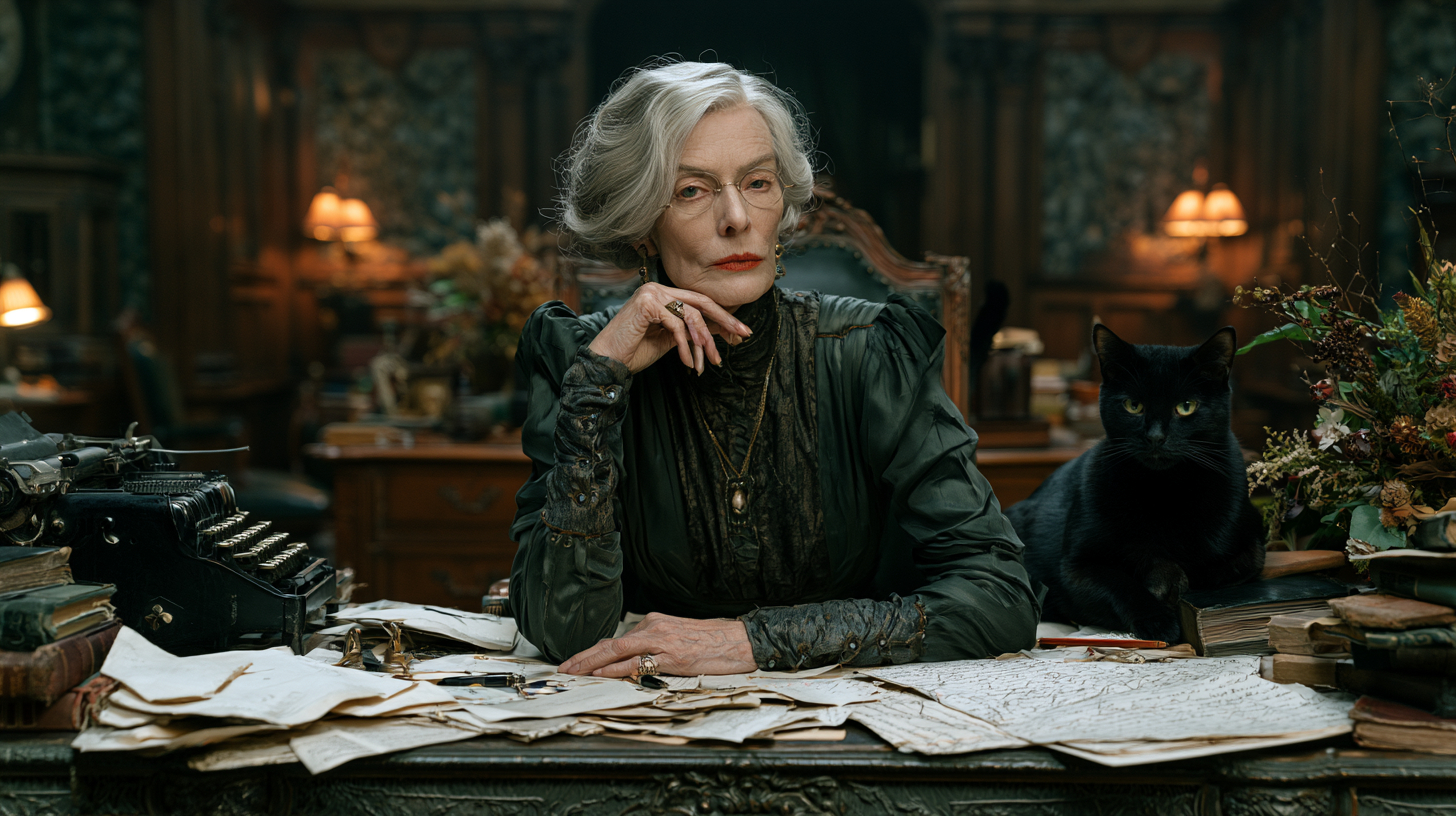
Readers acquainted with Mrs. Trevett from our previous excursions will understand that this was not so much a request for reassurance as the inadvertent initiation of hostilities. Seen in our accompanying reconstruction at her writing desk, surrounded by flowers, correspondence, a typewriter, and a black cat whose attitude toward editorial authority appears already settled, she presents the outward appearance of cultivated domestic tranquillity. The impression is misleading.
Mrs. Trevett read the rejection letter carefully. One imagines that she read it first as a friend, then as a partisan, and finally as a person who had begun composing sentences in her head before reaching the second page. Whatever sympathy she may privately have felt for the editors’ practical difficulties did not survive the transition into correspondence.
Her reply follows.
Mrs. Della Trevett to the Editors of Weird Tales
Providence
To the estimable Editors of Weird Tales,
whose recent correspondence suggests that the magazine has quietly enlarged its jurisdiction to include municipal inspection, hydrology, elementary education, and the maintenance of imaginary cellars,
Gentlemen,
Mr. Lovecraft has permitted me to read your letter concerning his story, “The Outsider.” I have now read it twice, the second occasion being undertaken chiefly to determine whether I had mistaken the first for some elaborate parody of editorial literalism. I regret to report that I had not.
You have before you a tale concerning estrangement, defective memory, the unreliability of self-knowledge, the terrible inadequacy of language before experience, and the discovery by a lonely consciousness that it does not belong to the species whose companionship it has desired. You have responded by requesting information about drainage.
This is an achievement of a sort.
Let us begin with your principal concern, the forest. You ask where the trees are, how they grow, how high the cavern must be, whether they may instead be roots, and whether the “moat” is groundwater. Such questions are not inherently foolish; what astonishes is the confidence with which you assume they belong to the story Mr. Lovecraft has written rather than to the architectural report you would prefer him to have written. The narrator does not possess an ordinary relation to the world. He knows it principally through names. He has acquired words from books without acquiring the experiences from which those words ordinarily derive their meaning. If he calls something a tree, you demand botany; if he calls something a moat, you request hydrology; if he climbs what he understands to be a tower and arrives at level ground, you diagnose a failure of construction rather than considering whether the collapse of spatial expectation might belong to the collapse of everything else he has believed.
I dread to think what your office would make of Jacob’s ladder. Would Genesis be returned for load specifications?
The narrator believes himself above when he is below. He believes himself living when everything about his circumstances suggests death. He believes himself human when the first human beings who see him recognize at once what he cannot recognize in himself. These reversals are not unrelated inconveniences. They form the grammar of the story. His error is not simply that he has misidentified a building; he has misidentified his entire condition of existence.
You propose that Mr. Lovecraft make the supposed trees more obviously root-like, the moat more obviously subterranean, and the tower more obviously a shaft. How considerate. Perhaps additional signs could be erected at intervals: SURFACE ABOVE; CRYPT BELOW; SYMBOLIC MISAPPREHENSION, SIX HUNDRED FEET. The reader, thus protected from uncertainty, might arrive at the conclusion having correctly diagrammed everything in advance and congratulate himself upon the adequacy of his geological instincts.
I confess that I prefer the vertigo.
The books trouble you. Of course they do. Books frequently trouble editors. You ask who brought them, how they survived, who preserved them, and why they happen to exist in a place you have decided must be a crypt. Families have stored books in crypts, vaults, cellars, monasteries, churches, abandoned houses, archives, and rooms whose practical suitability would appall anyone entrusted with modern conservation. But the more important answer is that the books are not there principally to establish a provenance of shelving. They are the narrator’s substitute for experience. He possesses descriptions of humanity but no participation in it. He knows the word “tree” without knowing a tree, the word “face” without knowing his own, the word “society” without belonging to one, and the word “human” without realizing that it no longer applies to him.
This, I should have thought, is not an inconvenience surrounding the story. It is the story.
You next inquire who taught him to read, and here I admit that your persistence has attained a certain admirable purity. Perhaps the old man taught him. Perhaps someone else did. Perhaps the narrator did not begin existence in that subterranean place as a preliterate infant, but retained language after autobiographical memory had decayed. Perhaps he once knew perfectly well who and what he was, while death, time, corruption, or whatever unnatural process has sustained him gradually erased identity without erasing literacy. A man may forget a face before he forgets an alphabet. A consciousness may retain the machinery of language long after losing the personal history in which language was first acquired.
Your Rosetta Stone is therefore unnecessary, though I congratulate the staff member who supplied it. He may retain it for some future manuscript involving Egypt.
Indeed, your objection inadvertently suggests one of the more disturbing possibilities in the story. Suppose the narrator does remember how to read but no longer remembers why he can read. Suppose language has survived the self that learned it. He encounters the word “child,” yet cannot recover his childhood; he reads of mothers, houses, sunlight, friendship, beauty, and ordinary human faces, yet cannot connect those things to a personal history that has been lost beyond retrieval. His books are then not educational primers but archaeological fragments through which a dead consciousness attempts to reconstruct a humanity it once possessed.
I do not find this improved by giving the old man a teaching certificate.
You are also troubled by the narrator’s failure to discover his appearance through touch, and here, at least, your objection possesses greater substance. He has hands. He has a face. One may reasonably suppose that the former has encountered the latter. But your conclusion—that touch should therefore have informed him that he is monstrous—quietly assumes that he possesses a normal standard against which to compare what he feels.
How precisely does a creature who has never touched living human skin know that his own is too dry, too cold, too loose, too hard, too withered, or too corpse-like? To him, his skin is what skin feels like. His cheekbones are what cheeks feel like. His temperature is what bodies feel like. His own anatomy is not abnormal because, before entering that room, he possesses no embodied normality with which to compare it. The illustrations in his books provide visual forms, not tactile standards. He may feel his face a thousand times and learn no more from the exercise than a man born blind learns the color of his eyes by touching his eyelids.
The mirror does something touch cannot. It externalizes him. For the first time he encounters himself not as sensation from within but as an object standing among the forms through which he has imagined humanity. The terrible thing is not merely that he sees an ugly face. He sees a category fail.
Your concern regarding the moat is more charming. Yes, water reflects. One wonders whether anyone in your office has recently attempted to use stagnant moat water for shaving. Must Mr. Lovecraft insert a sentence explaining that the surface was insufficiently reflective for purposes of premature thematic disclosure? Would a certificate of turbidity satisfy Chicago? You are prepared to accept an ambulatory corpse beneath an ancestral estate but draw your evidentiary line at the optical properties of dirty water.
There is something almost reassuring in this.
Then come the candles. Who supplies them? Who supplies the oil? Who dusts the books? Who attends to provisions? What did the old man do on Thursdays? Shall we imagine him descending with six candles, two volumes, a loaf, a bottle of lamp oil, and an itemized receipt? Would the story acquire additional metaphysical authority if Mr. Lovecraft preserved the account?
October 3: Maintenance of subterranean ghoul — $1.47.
You distinguish mystery from “missing administration.” I confess that the phrase has remained with me. You appear to have invented a new species of literature, administrative horror, in which the supernatural may proceed provided that all requisitions have been properly filed.
I look forward to the first anthology.
What troubles me most, however, is the underlying assumption that a story becomes symbolically stronger in direct proportion to the extent that its metaphysical disturbance can be reconstructed as ordinary architecture. Sometimes it does. Sometimes the opposite is true. A dream corridor may exceed the dimensions of the house containing it. A mythic mountain may touch heaven. A city may be reached by routes no surveyor could reproduce. An old house in a tale of terror may contain spaces that a building inspector has not authorized. Literature has survived these irregularities without emergency intervention.
You would improve the abyss by fitting it with railings.
The world of “The Outsider” is not presented by an omniscient surveyor. It is presented by a consciousness whose relation to existence has collapsed. His nouns are inherited, his experience is incomplete, his memory is mutilated, his body is unrecognized, and his environment is interpreted through categories whose reliability he has no means to test. The reader is trapped inside those categories with him. When he finally emerges, the outer world does not become incoherent; it becomes coherent with terrible suddenness. He is the element that no longer belongs.
That is why the graveyard matters. He believed the tower led upward because he believed himself to inhabit a castle beneath a forest. The discovery that the “top” lies at ordinary ground level is the spatial counterpart of the later discovery that the “stranger” in the mirror is himself. His geography and his identity fail together.
You are not reading a cadastral map. You are reading the consciousness of something which has forgotten what it is.
Accordingly, I cannot endorse your proposed revisions. Not the pallid roots, not the underground stream, not the instructional caretaker, not the dermatological inventory, not the certified non-reflective moat, and certainly not the implied appendix concerning the preservation of books. Explanation is not invariably clarification. In a story whose principal horror lies in the collapse of categories, explanation may become merely a method of restoring precisely the categories the story has labored to destroy.
There is an old scriptural phrase concerning the preservation of even the smallest letter or stroke: not one jot or tittle. I recommend the principle to your attention. Mr. Lovecraft’s manuscript does not require the installation of explanatory plumbing. It requires publication.
Not one jot.
Not one tittle.
Should you remain doubtful, I am prepared to visit Chicago and discuss the matter in person. I shall bring diagrams, though not, I assure you, the sort you have requested.
With unwavering composure,
Mrs. Della Trevett
Permanent Fellow, The Correct Side of the Epistemological Veil
Providence Chapter, In Absentia
P.S. Please inform Mr. B—— that tombs accumulate appreciably less dust when the principal occupant refrains from breathing. This should permit him to sleep again.
The Editorial Aftermath
Here our imaginary archive becomes more interesting, because propriety requires a distinction that fiction, like criticism, ought not casually ignore. Mrs. Trevett would not have been the proper recipient of a formal notice accepting Lovecraft’s manuscript. She was neither its author nor his literary agent. Accordingly, the next document in the file is addressed to Providence.
Editorial Offices
Weird Tales
Chicago, Illinois
October 29, 1925
Mr. H. P. Lovecraft
Providence, Rhode Island
Dear Mr. Lovecraft,
Following further consideration of “The Outsider,” we are pleased to inform you that we have reconsidered our earlier decision and will accept the manuscript in its present form.
Our original reservations concerning the physical circumstances of the narrator’s environment remain intellectually interesting to us, but we are persuaded that imposing explanatory revisions might alter the deliberate uncertainty upon which the story depends. We have therefore concluded that the manuscript should stand without the changes previously suggested.
Please convey, if you think it prudent, our appreciation to Mrs. Trevett for the vigor and thoroughness of her observations.
No revisions are required.
Respectfully yours,
The Editors
Weird Tales
The same folder, we may imagine, contains an internal routing sheet which was never mailed to Providence and therefore preserves the less ceremonial view of events. Beside the notation ACCEPT — NO REVISIONS, someone has written in pencil: If further correspondence arrives from Mrs. Trevett, Mr. B—— is to answer it. Another hand has crossed this out and written beneath it: Mr. B—— refuses.
That, at least, seems historically plausible enough to deserve preservation.
Unfortunately, the Editors Still Had a Point
Having allowed Mrs. Trevett to frighten an entire editorial office into submission, we must now commit the hazardous act of admitting that her opponents were not entirely wrong.
Indeed, the strongest defense of “The Outsider” is very close to the one she offers. The narrator possesses language without adequate experience. He has learned words from books and applies them to a world whose actual nature he has never been equipped to understand. The “forest” may therefore not be a forest, the “moat” may not be a moat, the “castle” may not be a castle, and the “tower” may not be a tower. The final and most terrible failure of classification is simply that the being applying these names to the world has also applied the word human to himself.
That is a beautiful conception, and it becomes richer the longer one considers it. Yet it does not follow that greater internal coherence would diminish its symbolic force. Quite the opposite may be true. If Lovecraft had supplied only a few peculiar details—the supposed trees rising into darkness without visible crowns, the water moving strangely through cracks in ancient masonry, the tower possessing no windows and becoming no brighter as the narrator climbs—then the reader could reach the conclusion and discover that every apparent contradiction had been evidence all along.
The trees were roots. The moat was subterranean water. The tower was a shaft. The castle was a buried ancestral structure. The narrator had not climbed from one impossible landscape into another; he had climbed from beneath the earth to its surface.
The distinction is important. There is a substantial difference between a world that fails to make sense because the author has withheld the machinery necessary for the ending, and a world that made perfect sense from the beginning but was described by a consciousness incapable of interpreting it correctly. The second is not merely tidier. It is more frightening.
The same is true of the books. The editorial question—who taught him to read?—need not be merely a joke about supernatural kindergarten. Properly used, it opens one of the darkest possibilities available to the story. Perhaps the narrator did not learn to read underground at all. Perhaps he once lived normally, died, was buried, and retained literacy after autobiographical memory disappeared. Language survived while identity rotted away.
Consider what that would mean. He can still read the word mother but cannot remember his own. He can read descriptions of childhood without remembering whether he had one. He understands house, sunlight, friendship, beauty, and human being, but the personal experiences that once gave those words substance have disappeared. The books become not the schoolroom of an inexplicably literate ghoul but the archaeological remains from which a dead mind tries to reconstruct the species to which it once belonged.
That makes the unexplained old man potentially important as well. He need not become a fully identified caretaker descending punctually with candles and soup; indeed, to explain him that completely would diminish him. But a slight suggestion that he belonged to the narrator’s forgotten former life, or that he preserved some continuity between the world above and the darkness below, would transform a loose thread into an unsettling remnant of memory.
Likewise, the tactile objection is not fatal, but it deserves acknowledgment. Mrs. Trevett’s imagined rebuttal contains the best answer: one cannot identify abnormality without some standard of comparison. If the narrator has never touched warm living skin, his own coldness is simply what bodies feel like. If his skin is dry or parchment-like, he may possess no reason to suppose other skin feels otherwise. The mirror remains uniquely terrible because it does what touch cannot: it places the narrator outside himself. He sees the entire object that other people see.
Yet even here Lovecraft might have strengthened matters by letting the narrator register his own strange physical qualities and rationalize them. That would convert apparent obliviousness into tragic misunderstanding. He has noticed the evidence. He simply lacks the world required to interpret it.
And that, ultimately, is the version of “The Outsider” that seems to me most powerful: not a narrative in which symbolism receives exemption from logic, but one in which logic itself becomes the instrument of revelation. The earlier details need not be discarded when the truth appears. They should become more terrible because their meaning changes.
There is a habit in criticism of defending inconsistency by invoking dream, symbolism, ambiguity, or mythic logic, as though asking whether a fictional world coheres were somehow a vulgar intrusion upon art. I find the opposite more persuasive. Symbols are rarely weakened by having sound foundations. A staircase can represent transcendence and still arrive somewhere. A river can symbolize death and still flow downhill. A crypt can embody isolation without requiring an invisible forest of ordinary trees beneath Rhode Island.
The point is not that fantastic literature must behave like municipal infrastructure. Lovecraft is not required to supply drainage diagrams. The point is that a reader’s belief in the literal circumstances gives the symbolic transformation something substantial to transform. If the ground beneath the symbol is already dissolving because the author has not attended to it, the revelation loses some of the force it might otherwise possess.
Mrs. Trevett would undoubtedly condemn this as an attempt to put railings around the abyss, and in fairness there are abysses that benefit from remaining unmeasured. But “The Outsider” seems to me tantalizing precisely because it comes so close to something better than mere dream logic. Lovecraft almost gives us a perfectly coherent buried world misunderstood by a perfectly unreliable consciousness.
A few additional clues would have made the second reading exquisite. The reader would return to the beginning and realize that Lovecraft had never lied. The narrator had.
Not consciously, of course. That is what makes it tragic.
He did not know that his forest was a root system, that his moat was subterranean water, that his castle was a tomb, that his tower was an ascent toward ordinary earth, that his literacy might be the remnant of a forgotten life, or that the cold grotesque thing he touched when he touched his own face was not what a human being felt like.
He lacked comparison.
He lacked memory.
He lacked the one thing his books could never provide: the experience of being among the living.
Then he climbs upward, enters the house, approaches society at last, and receives in a few seconds the education that all his books had failed to give him. The people flee. He turns toward the horror. He reaches out.
And touches glass.
That remains magnificent.
It is magnificent enough that I would probably have overruled my own rejection letter in the end, although I might have done so with lingering doubts about the books, the candles, the moat, the forest, the tower, the old man, and the narrator’s apparently rather incurious fingertips.
I would certainly not have mentioned those doubts to Mrs. Della Trevett.
Some ambiguities are best left undisturbed.
Jonathan Brown for AetheriumArcana
© 2026 AetheriumArcana. All rights reserved.
Member discussion: