H. P. Lovecraft and the Occult Reality of “The Dreams in the Witch House”
THE MATHEMATICS OF WITCHCRAFT
H. P. Lovecraft was an atheist and a materialist. He said so often, at length, and without apparent reservation. He rejected revealed religion, personal immortality, divine providence, and the sentimental idea that the universe had been arranged with humanity in mind. His mature intellectual allegiance lay with a mechanistic cosmos governed by impersonal forces, a cosmos in which human values possessed no authority beyond the nervous systems and societies that produced them. Any serious account of his fiction must begin by granting that conviction its sincerity. To turn Lovecraft into a clandestine Satanist, a practicing magician, or a frightened Christian would be to replace one simplification with a worse one.
Yet the declaration that Lovecraft was an atheist materialist does not finish the discussion. It only establishes the position from which the more interesting difficulty begins. His fiction repeatedly grants dreams, incantations, inherited legends, forbidden books, geometrical signs, ritual calendars, and apparently superstitious testimony access to truths that ordinary reason has missed. The educated skeptic is seldom vindicated. He is educated into terror. Folklore proves not literally accurate in every theological detail, but evidentially sound: something happened, something continues to happen, and the despised language of magic has preserved a working knowledge of it. Lovecraft’s universe may be godless, but it is by no means disenchanted.
No story exposes this complication more nakedly than “The Dreams in the Witch House.” Written early in 1932 and published in Weird Tales in July 1933, it is sometimes treated as an ingenious but disorderly attempt to splice witch folklore onto contemporary physics. Even Lovecraft’s circle did not unanimously admire it, and Lovecraft himself was badly discouraged by August Derleth’s unfavorable judgment. Its very awkwardness, however, makes it unusually revealing. In more controlled stories, the supernatural is streamlined into the rhetoric of cosmic horror. Here the joints remain visible. Seventeenth-century witchcraft, Puritan testimony, non-Euclidean geometry, quantum physics, dream experience, Catholic devotion, alien biology, and the mythology of the Necronomicon are not smoothly reduced to a single explanatory scheme. They coexist, interfere with one another, and finally corroborate one another. The result is not a triumph of science over superstition. It is a story in which science discovers that superstition has been conducting successful experiments for centuries.
Walter Gilman, the doomed mathematics student at its center, does not uncover a family curse or degenerate ancestry. His danger is intellectual susceptibility. He studies modern mathematics and physics while pursuing the surviving records of New England witchcraft, convinced that the two archives may describe the same hidden structure of reality. The witch Keziah Mason, who vanished from a Salem jail in 1692, becomes his impossible predecessor: an uneducated woman who somehow apprehended mathematical relations beyond the reach of the celebrated modern thinkers Gilman studies. Her witchcraft is neither debunked nor left safely mysterious. It works. The mathematics does not explain the magic away; it explains why the magic was effective.
This is the proposition at the heart of the story and of this essay. “The Dreams in the Witch House” reveals an occult dimension within Lovecraft’s materialism, not because it proves that he privately believed witches traveled through hyperspace, but because it grants occult tradition genuine epistemic authority. The story imagines magic as an older technology of nature: fragmentary, morally contaminated, concealed beneath religious language, but operationally valid. Its central terror is therefore not that science has been defeated by irrationality. It is that scientific inquiry and witchcraft converge upon the same reality—and that the witch arrived first.
The Student Who Takes Folklore Literally
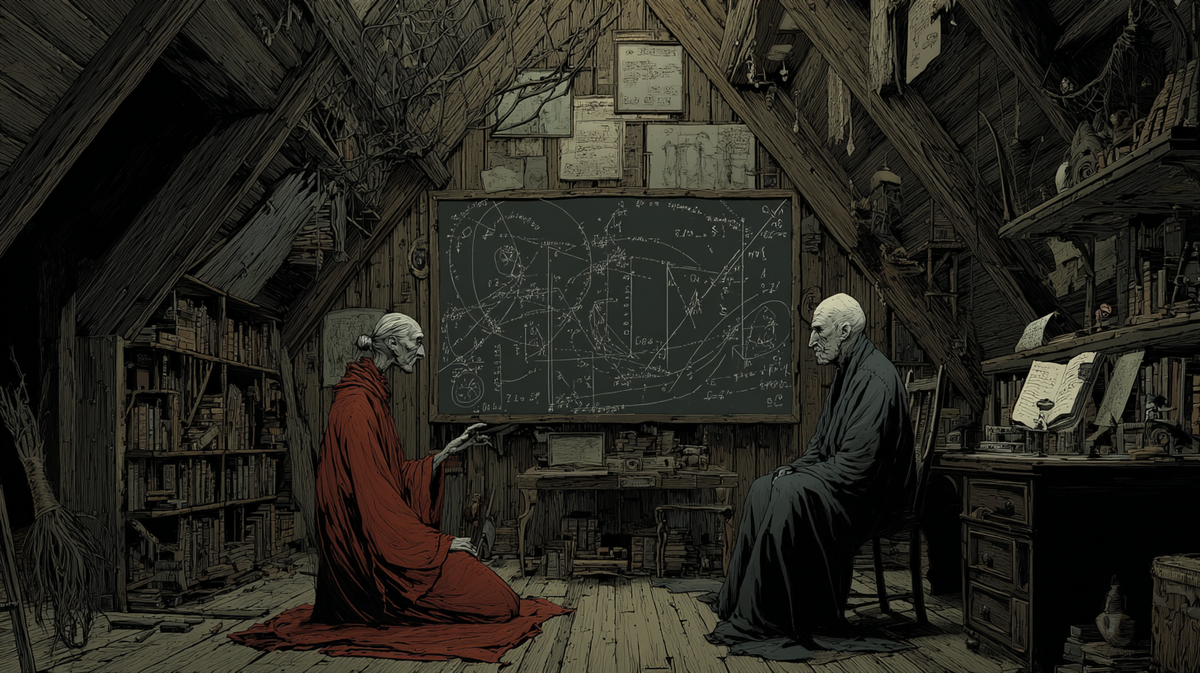
Gilman’s intellectual project is stated almost immediately. He is studying non-Euclidean calculus and quantum physics at Miskatonic University, but he is also investigating “the fantastic legends of elder magic.” The conjunction matters. He does not read the old accounts merely as historical curiosities or symptoms of collective delusion. He suspects that the traditional formulae of magic may encode intuitions about dimensions and transitions now becoming intelligible through mathematics. Certain properties of the Witch House itself—its abnormal angles, slanting surfaces, and sealed spaces—appear to him potentially related to his calculations. He chooses the notorious attic room because he wants to place his mind inside the evidence.
This already distinguishes him from the conventional rationalist who wanders accidentally into a haunted house. Gilman is not caught despite his learning. He is endangered through it. His error is not credulity in the ordinary sense, since the story eventually vindicates most of what he suspects. Nor is it simple intellectual pride, although pride is present. His fatal mistake is to imagine that knowledge can remain observational. He believes he can correlate witch testimony with advanced mathematics without entering the system those correspondences disclose. Lovecraft’s occult universe does not permit that distance. To understand the angles is to become available to them.
The Witch House is therefore more than an atmospheric setting. Its architecture is an instrument. The room’s irregular geometry does not merely suggest psychic disturbance, as crooked Gothic architecture often does; it participates in the events. Keziah’s old chamber is a spatial diagram built in timber and plaster. Gilman’s studies make him increasingly sensitive to it, until the distinction between solving an equation, inhabiting a room, and performing a rite begins to disappear. The traditional magical circle and the scientific diagram become variations upon the same act: both establish relations through which forces may pass.
Lovecraft places this inquiry in Arkham, a city where antiquarian memory and modern scholarship occupy the same streets. Miskatonic University possesses both laboratories and forbidden books. The Necronomicon, the Book of Eibon, and von Junzt’s Unaussprechlichen Kulten are available not in a sorcerer’s tower but in an academic library. The institution recognizes them as dangerous enough to restrict, even while treating them as objects of scholarship. This arrangement embodies the story’s intellectual tension. Modern knowledge has collected the occult past, catalogued it, and placed it under supervision, but has not rendered it inert. Gilman reads across categories that the institution prefers to keep separate. The result is not nonsense. It is synthesis.
The opening sentence establishes uncertainty about the direction of causation: did the dreams produce Gilman’s fever, or did the fever produce the dreams? That apparently modest medical question will govern the entire story. A materialist explanation remains constantly available in provisional form. Gilman is exhausted, overstimulated, feverish, sleepwalking, and mentally strained. His professors warn him against further study. His fellow lodgers hear him moving and speaking in his sleep. Every extraordinary experience may at first be assigned to physiological disturbance. Lovecraft does not exclude this reading; he carefully constructs it.
Then he destroys its sufficiency.
The story proceeds by converting subjective experiences into public evidence. Gilman dreams of unfamiliar spaces and awakens with sensations that correspond to them. He dreams of a balustrade in an alien city and later possesses a small manufactured object taken from that scene. He is seen at locations he cannot remember reaching. Mud and other traces accompany his nocturnal movements. The cries of a kidnapped child enter the shared world. After Gilman’s death and the eventual demolition of the house, human bones, occult objects, Keziah’s skeleton, and the anomalous skeleton of Brown Jenkin are recovered from the walls. The final structure of evidence makes the psychological interpretation untenable. Fever may alter Gilman’s receptivity, but it does not create the external agents with which he comes into contact.
The word dreams in the title is thus both accurate and misleading. Gilman’s experiences occur through conditions associated with sleep, but they are not private fantasies. Dreaming becomes a mode of access. Lovecraft preserves the altered consciousness of occult experience while granting it objective referents. The dreamer does not merely look inward. He travels.
Keziah Mason’s Impossible Knowledge
Keziah Mason is introduced through the documentary residue of the Salem witch trials. Under examination, she spoke of “lines and curves” that pointed through the walls of ordinary space toward other spaces beyond. She also spoke of the Black Man, of a new secret name, and of an oath. Before her execution, she disappeared from a locked cell, leaving inexplicable figures on the stone. The materials of the old witch narrative are all present: confession, diabolic compact, secret identity, nocturnal travel, and supernatural escape.
Ordinarily, a modern retelling might expose such testimony as the product of coercion, fantasy, hysteria, or judicial invention. Lovecraft does something stranger. He accepts the central report while revising its conceptual vocabulary. Keziah did escape. The figures mattered. The Black Man existed. The oath bound her to real powers. The Puritan authorities misunderstood the cosmology, but they were not wrong about the event.
Gilman is stunned by the possibility that a “mediocre old woman of the Seventeenth Century” possessed an insight reaching beyond Planck, Heisenberg, Einstein, and de Sitter. The phrase is condescending, but its function is to sharpen the scandal. Keziah lacks the intellectual credentials by which modernity authorizes knowledge. She has no university, no accepted notation, no laboratory, and no place in the official history of science. Nevertheless, she possesses technique. Her diagrams allow movement through dimensions; her familiar crosses spatial boundaries; her rites establish contact with powers beyond terrestrial life. Modern physics may eventually describe the system, but Keziah already knows how to use it.
This distinction between theory and operation is essential. People can discover that something works before they understand why it works. Metallurgy preceded atomic theory; navigation preceded modern geophysics; medicinal plants were employed before their active compounds could be isolated. In Lovecraft’s story, witchcraft occupies an analogous position. It is a body of practical knowledge accumulated under premodern conditions and interpreted through the available religious language. Its practitioners call an entity the Black Man, sign a book associated with Azathoth, use ritual sacrifice, and meet according to a traditional calendar. These features appear irrational only if their effects are assumed in advance to be impossible. Once the effects are demonstrated, the tradition must be reconsidered as a technology—even if it remains brutal, corrupt, and theoretically confused.
The story’s mathematics therefore performs an authenticating function. It gives the modern reader a reason to take the witch’s acts seriously without requiring acceptance of Christian demonology. But this is not a reduction of the occult to something comfortably ordinary. Saying that Keziah travels through higher dimensions does not make her disappearance less marvelous. It enlarges the domain of nature until it contains what had been called supernatural. Lovecraft’s materialism survives only by becoming hospitable to witches.
That expansion is characteristic of his cosmic imagination. He often removes supernatural beings from a moral theology and relocates them within natural history. Gods become ancient or extraterrestrial intelligences; possession becomes mental displacement; resurrection becomes reanimation; prophecy becomes perception across unfamiliar dimensions; ritual becomes a procedure for contact. The universe remains impersonal, but the old stories recover their factual core. Materialism is not used as a broom with which to sweep away superstition. It becomes an annexation program, absorbing the supernatural while preserving much of its terror and efficacy.
In “The Dreams in the Witch House,” however, the annexation remains incomplete. The story refuses to convert every occult element cleanly into scientific terms. Keziah’s mathematics coexists with ritual murder. Brown Jenkin is at once a biological creature, a witch’s familiar, and something capable of gnawing its way through the boundaries between worlds. Nyarlathotep is identified with the Black Man of witch tradition but retains the role of cosmic tempter and intermediary. The Book of Azathoth resembles both a legal compact and a grimoire. A crucifix appears to repel or terrify Keziah at a decisive moment. These elements cannot all be filed neatly under speculative physics. They produce friction because Lovecraft wants the authority of science without surrendering the accumulated charge of religious and magical tradition.
That friction is not simply a defect in construction. It is the place where his complex convictions become visible. A perfectly rationalized story would reassure us that the old vocabulary was only an error. Lovecraft does not provide that reassurance. He suggests instead that the error may be in assuming our vocabularies are mutually exclusive.
The Black Man Survives the Death of Satan
Lovecraft rejected the Christian Devil, yet “The Dreams in the Witch House” retains one of the most charged figures in New England witch lore: the Black Man who presides over the compact. The story identifies this figure with Nyarlathotep, the messenger or representative of hidden cosmic powers. The theological interpretation changes, but the encounter remains. What Puritan witnesses called Satan may have been a culturally conditioned recognition of a real, nonhuman intelligence.
This maneuver deserves attention because it is neither belief in Satan nor straightforward disbelief. The doctrinal proposition—an angel rebelled against God and became the personal source of evil—is discarded. The experiential proposition—a terrifying being appears, demands submission, receives signatures, and recruits human agents—is retained. Lovecraft denies the explanation while preserving the phenomenon.
That is precisely how occult traditions often survive intellectual modernization. Their symbolic language is reinterpreted while their reported experiences remain privileged. Spirits become forces, astral planes become dimensions, telepathy becomes an undiscovered property of mind, and ritual becomes psychotechnology. Lovecraft did not endorse modern occultism, which he commonly regarded with contempt, but his fictional procedure resembles this pattern. He naturalizes the impossible without neutralizing it.
Nyarlathotep’s presence also prevents the mathematics from becoming morally or emotionally sterile. Higher-dimensional travel is not merely a neutral discovery available to any competent geometer. It opens Gilman to a network of agency. Someone is waiting on the other side of the equation. The cosmos may lack human-centered morality, but it is populated by intelligences capable of intention, deception, command, and cruelty. Gilman’s calculations do not reveal empty space. They bring him into jurisdiction.
The signing of the Book of Azathoth makes this jurisdiction explicit. The scene resembles a diabolic compact, complete with the demand for a name and the submission of the individual to a greater power. Yet it also resembles bureaucratic enrollment into a cosmic order. The book records affiliation. Gilman is not asked merely to believe; he is required to participate. Knowledge culminates in obligation.
This is one reason the story exceeds the formula of “science fiction disguised as horror.” Its ultimate concern is not technological possibility but initiatory capture. Gilman crosses a threshold of knowledge and discovers that the threshold is controlled. The occult is not only a hidden body of facts. It is a system of relations among knowers, powers, intermediaries, victims, and recruits. Keziah is both an adept and a servant. Brown Jenkin is both familiar and enforcer. Nyarlathotep is both revelation and authority. Gilman’s increasing understanding reduces rather than enlarges his freedom.
Here Lovecraft approaches a genuinely magical ontology. In such an ontology, knowledge is participatory: to know a name, trace a figure, inhabit a charged place, or perceive a hidden being is to enter into relation with it. Modern secular knowledge ideally separates the observer from the observed. The experiment can be repeated without becoming a covenant. Lovecraft’s witchcraft abolishes that safety. The correct equation is also an invocation.
The terrifying sophistication of the story lies in this fusion. Gilman believes he is solving the universe as an intellectual problem. Keziah understands that the solution is a route, and Nyarlathotep understands that a route may be used in both directions.
Brown Jenkin and the Stubborn Body of Folklore
If Keziah’s geometrical knowledge can be assimilated to speculative physics, Brown Jenkin resists abstraction. He is obscenely corporeal: furry, ratlike, long-fanged, and equipped with disturbingly human hands and a humanlike face. He speaks or whispers, leaves tracks, drinks blood, carries messages, assists at abduction, and finally kills Gilman by tunneling through his body. His smallness intensifies rather than diminishes his horror. Cosmic distances terminate in scratching behind the wall.
Brown Jenkin is drawn directly from the logic of the witch’s familiar, but Lovecraft makes the folkloric figure physically discoverable. The eventual recovery of his anomalous skeleton matters more than a merely sensational ending. It establishes that the familiar was not a fever-image shared by frightened tenants. Something embodied lived within the structure. The final evidence does not translate Brown Jenkin into an ordinary animal; it confirms that the legendary description was substantially correct.
This confirmation reveals Lovecraft’s unusual relation to folklore. He is fascinated not simply by the beauty of old beliefs but by the possibility that they are damaged records of real encounters. Local tales preserve recurring details because witnesses have perceived something. The details become distorted by theology, fear, oral transmission, and cultural expectation, yet the distortion surrounds a durable object. Folklore functions as an imperfect archive.
Gilman’s tragedy begins in part because he reads that archive with more respect than his contemporaries do. The old accounts of Keziah, the neighborhood stories of Brown Jenkin, the May-Eve traditions, and the warnings of the other lodgers are not detachable atmosphere. Together they form a distributed body of testimony. No single witness understands the whole, but their fragments converge. Gilman adds mathematics; the house adds geometry; his dreams add experience; the stolen object adds physical proof. The story assembles an occult epistemology out of heterogeneous forms of evidence.
Brown Jenkin also brings the cosmic back into the domestic. Lovecraft’s enormous universe is often imagined through immensities—stellar gulfs, geological ages, cyclopean cities—but the Witch House compresses those immensities into a rented room. The alien does not remain magnificently remote. It occupies the wall beside the bed. The familiar is a perfect figure for this intimacy: a cosmic system reduced to a companion animal, an emissary of transdimensional power that can be mistaken for vermin.
This makes Gilman’s intellectual exposure bodily. He does not merely suffer a crisis of worldview. He develops fever, loses sleep, walks unconsciously, hears scratching, feels pressure, handles an alien object, struggles with Keziah, fails to save a child, and is penetrated from within. The story insists that occult knowledge ends in matter. Whatever travels through dimensions eventually leaves blood on the floor.
The manner of Gilman’s death is especially significant. Brown Jenkin does not attack him from an external distance; he emerges through Gilman’s body. The boundary between self and invading agency collapses just as the boundaries between room and hyperspace, dream and travel, science and magic have already collapsed. Gilman has become another architecture with an impossible passage inside it. The Witch House is repeated in the human body.
Dreams as Instruments of Knowledge
Lovecraft’s fascination with dreams long preceded this story. Dreams supplied landscapes, images, atmospheres, and at times nearly complete narrative situations for his fiction. He did not need to believe that dreams were supernatural messages in order to grant them unusual creative authority. They arrived involuntarily, carrying forms and emotions not consciously constructed. They demonstrated that the mind contained—or could simulate—worlds beyond the governance of the waking intellect.
“The Dreams in the Witch House” radicalizes this familiar creative experience. Gilman’s dreams are not merely inspirations later reshaped into art. They are perceptions of an external reality and vehicles of physical movement. Sleep alters the conditions under which his mind relates to space. His conscious mathematical labor prepares the way, but dreaming completes the operation.
The story therefore joins two kinds of knowledge normally kept apart. Mathematics represents abstraction, rigor, and conscious formal reasoning. Dreaming represents involuntary image, affect, association, and unstable identity. Gilman reaches the hidden world only when these faculties cooperate. His equations make him receptive to the structure; his dreams allow him to move through it.
This is more than a convenient plot device. It dramatizes a division within Lovecraft himself. His essays and letters frequently present a lucid philosophical materialist capable of systematic argument. His fiction proceeds through intuitions that his philosophy officially disallows: atmospheres seem to remember; architecture exerts intention; dreams coincide across minds; ancestral or cultural memory returns; symbols open actual doors. The conscious thinker polices belief, while the dreaming imagination constructs realities with their own evidentiary force.
Calling this process “suppressed belief” is tempting but imprecise. Suppression implies a proposition already accepted somewhere in the mind and forcibly denied. The available evidence does not require that conclusion. Lovecraft could sincerely disbelieve every supernatural claim while possessing an imagination organized by occult relations. A person’s imaginative ontology—the kinds of causes, connections, and agencies that feel compelling in art—need not match his declared metaphysics. Fiction may give form not to secret propositions but to modes of apprehension for which philosophy has no room.
Gilman’s situation offers a model for that divided mind. Awake, he calculates and doubts. Asleep, he experiences. Upon waking, he tries to treat the experience as illness until physical evidence makes doubt increasingly artificial. The story’s narrative method repeatedly places rational denial after experiential conviction. Gilman tells himself that nothing impossible has happened, but the reader has already inhabited the impossible with him.
Lovecraft’s famous theory of weird fiction emphasized the production of a particular atmosphere: the suspension or defeat of the natural laws that ordinarily protect us. The highest supernatural tale, in his account, is not defined by plot machinery but by a profound sense that unknown powers and dimensions press upon the known world. This aesthetic standard is itself epistemically suggestive. The successful weird tale does not merely display an impossible creature; it induces a temporary alteration in what the reader can feel to be possible.
“The Dreams in the Witch House” makes that alteration its subject. Gilman is a reader of occult documents whose sense of possibility changes under pressure. He becomes the reader of weird fiction carried to a fatal extreme: atmosphere becomes hypothesis, hypothesis becomes experiment, and experiment becomes contact.
Science Does Not Disenchant the House
A familiar account of modernity describes science as a force of disenchantment. Phenomena once attributed to gods, spirits, curses, and demons receive natural explanations. Lightning becomes electrical discharge; disease ceases to be possession; celestial motion no longer requires divine intention. Under this model, a scientific interpretation of witchcraft should deprive witchcraft of reality.
Lovecraft reverses the movement. The newer science makes the old magic more plausible. Non-Euclidean geometry loosens the apparent necessity of familiar space. relativity and modern cosmology displace the human scale. Quantum theory unsettles naive accounts of matter. Higher dimensions provide conceptual room for legendary acts of disappearance, flight, and apparition. The progress of knowledge does not close the haunted house. It explains how the door might work.
It is important not to mistake Lovecraft’s scientific references for rigorous scientific exposition. The story does not derive Keziah’s route or offer reproducible equations. “Non-Euclidean calculus” and “quantum physics” operate partly as signs of the frontier of contemporary understanding. The mathematics is imaginative, not demonstrative. Yet this does not weaken its literary function. Lovecraft invokes fields that had already revised common intuitions about space, time, matter, and observation. Their conceptual disturbance gives witchcraft a modern hospitality.
The scientific names in the story—Planck, Heisenberg, Einstein, de Sitter—form a counter-canon beside the grimoires. Gilman reads both. The books do not simply disagree; they illuminate one another. The Necronomicon supplies hints that his formal studies render newly intelligible, while physics supplies models through which an old witch’s testimony can be reclassified as observation. Miskatonic’s library becomes the place where two histories of knowledge secretly meet.
This convergence complicates the ordinary distinction between natural and supernatural. Lovecraft’s mature fictional universe often suggests that “supernatural” is merely the name humans give to natural realities outside their present comprehension. But the emotional and symbolic properties of the supernatural do not vanish when the category is renamed. The beings remain monstrous. The rites remain efficacious. Forbidden knowledge remains dangerous. The cosmos remains populated by powers approached through dreams, books, cults, and sacrifices.
The result might be called occult naturalism. Everything that occurs belongs to nature, but nature is vastly stranger, more densely inhabited, and less compatible with human sanity than conventional materialism assumes. Mind may travel apart from the body’s ordinary location. Space may contain shortcuts marked by ritual geometry. Ancient books may record contact with nonhuman intelligences. Calendrical rites may correspond to genuine openings or recurrent conditions. The supernatural is abolished as a separate realm only because the natural realm has expanded to include its functions.
This is why “Lovecraft was a materialist” can become misleading even when it is perfectly true. The word encourages the modern reader to imagine a universe of inert matter, closed causality, psychological dreams, fraudulent magic, and extinct gods. That is not the universe of “The Dreams in the Witch House.” Lovecraft’s cosmos lacks providence, but it contains agency. It lacks spiritual consolation, but it permits transbodily consciousness. It rejects Christian theology, but it validates the experiential substrate of demonology. It denies miracles by redefining them as undiscovered operations of nature.
The materialist boundary is saved linguistically and lost imaginatively.
The Crucifix Problem
One of the story’s most awkward and revealing moments occurs when Gilman’s cheap crucifix, given to him by the devout Joseph Mazurewicz, appears to provoke fear in Keziah. For a writer committed to atheism, the incident creates an obvious difficulty. If Keziah and Nyarlathotep are natural or extraterrestrial beings misunderstood through Christian categories, why should a Christian symbol possess protective force?
The easiest critical response is to call the episode an inconsistency—a remnant of conventional vampire and witch fiction that Lovecraft failed to integrate. That may be partly correct. The story is not perfectly coherent, and its crowded symbolic machinery sometimes exceeds its explanatory frame. But the inconsistency is valuable precisely because it marks the resistance of inherited supernatural imagery to complete rationalization.
The crucifix does not establish Christianity as true. It does not summon Christ, prove salvation, or defeat the cosmic powers. Gilman remains doomed, the child dies, and the universe offers no providential rescue. Yet the symbol has an effect within the encounter. One could invent a naturalistic explanation: Keziah retains a conditioned fear from her own cultural world; the object interrupts her concentration; Gilman’s belief in its protection gives him strength. None is confirmed. Lovecraft leaves the efficacy suspended.
That suspension reveals the story’s refusal to choose between symbolic, psychological, and objective causation. In magical thinking, a symbol is not merely a representation; under the correct conditions it participates in what it signifies. The cross may repel because Keziah believes, because Gilman momentarily believes, because centuries of use have charged it, or because the power behind it has some reality the story will not name. Lovecraft’s declared philosophy would reject the last possibilities. His fiction allows them to remain active.
Mazurewicz is treated through ethnic and religious caricature, as Lovecraft often treats immigrant Arkham, and the story never elevates Catholic doctrine into an authoritative explanation. Nevertheless, Mazurewicz perceives danger correctly. His prayers are directed against the Crawling Chaos; his fear is not absurd; his crucifix is useful. Once again, a culturally despised or intellectually subordinate witness preserves practical knowledge that the modern scholar lacks.
The pattern repeats Keziah’s relation to mathematics. She should not know what she knows, but she does. Mazurewicz should not understand the nature of the threat, but his devotional practice responds to it. Gilman possesses the most advanced intellectual equipment and is the least capable of protecting himself. Lovecraft distributes truth unequally across antagonistic systems. Science describes; folklore remembers; magic operates; religion defends; none provides a complete account.
This plural structure is more interesting than a simple conflict between belief and disbelief. The story imagines reality as overdetermined by vocabularies that partially overlap. Nyarlathotep is an alien or cosmic entity, the Black Man of the witch cult, and a figure carrying unmistakable diabolic resonance. Brown Jenkin is an organism, familiar, messenger, and nightmare. Keziah’s figures are equations, sigils, and routes. Gilman’s experiences are dreams, fever symptoms, initiations, and journeys. The story does not decide which description is metaphorical because each performs explanatory work.
Lovecraft’s complex conviction may lie precisely here. He does not assent to the doctrines, but he distrusts the confidence with which modern reason declares their objects unreal. The crucifix problem is therefore not an embarrassment to be solved and removed. It is a crack through which the story’s occult imagination becomes visible.
Calendar, Sacrifice, and the Return of Ritual
The events gather around Walpurgis Night, the traditional witches’ sabbath associated with the last night of April. The calendar is not decorative. It organizes the abduction and intended sacrifice of a child, the assembly of occult agents, and Gilman’s final movement from investigation into compelled participation. A date inherited from European folklore corresponds to a real recurrence in the story’s cosmos.
Again Lovecraft preserves the practical content of tradition while altering its theology. Walpurgis Night need not be a Christian inversion conducted by servants of the biblical Devil. It may mark a periodic configuration, an anniversary of cultic activity, or a condition favorable to passage and contact. But whatever its ultimate explanation, the old calendar is right. Something happens then.
Ritual time adds another dimension to the Witch House’s ritual space. Keziah’s room embodies the appropriate angles; the season supplies the appropriate moment; the book and signature establish the appropriate relation; the sacrifice completes the act. This is ceremonial magic reconstructed as a system of coordinates. Place, time, sign, victim, and officiant are variables in an operation.
Yet calling them variables does not drain them of horror. The child is not symbolic. The blood is not metaphorical. Lovecraft’s occult naturalism is distinguished by this refusal to spiritualize the rite. Cosmic contact requires or at least accompanies material violence. Gilman’s intellectual curiosity leads him into a sacrificial economy in which knowledge, allegiance, and blood are exchanged.
The murder also prevents a flattering identification between Lovecraft and the heroic seeker of forbidden knowledge. Gilman is intelligent and genuinely perceptive, but his insight does not ennoble him. He becomes confused, manipulated, and implicated. Even when he struggles against Keziah, he cannot prevent the sacrifice. The universe disclosed by his studies is not a sublime graduate seminar. It is already inhabited by ancient practices and predatory wills.
This matters for any attempt to describe Lovecraft’s occult fascination. Fascination is not approval. He is attracted to the imaginative structure of occultism—secret correspondences, initiatory texts, hidden masters, charged places, ritual transitions—while representing its practitioners as degraded, enslaved, or monstrous. The attraction may be strongest where the revulsion is greatest. Horror allows him to inhabit the forbidden ontology without endorsing its moral world.
The convention of the witches’ sabbath provides an especially useful imaginative form because it unites solitary nightmare with communal tradition. Gilman’s dreams are personal, but the rite is older than he is. His experience is not an isolated mental event; it recruits him into a historical continuity. Keziah survived from the seventeenth century, Brown Jenkin persisted in local memory, the house retained its geometry, the books preserved their hints, and the calendar returned. Occult reality is durable because it is transmitted through multiple media: architecture, story, manuscript, ritual, body, and dream.
The story’s documentary manner strengthens this durability. It is told retrospectively, with attention to testimony, dates, physical findings, institutional responses, and discrepancies among witnesses. The voice resembles a report assembled after catastrophe. This rhetoric does more than create verisimilitude. It imitates the process by which an anomalous event might become historical evidence. Lovecraft makes the reader perform the work Gilman attempted: correlating fragments until denial becomes less economical than belief.
Lovecraft’s Aesthetic Belief
In Supernatural Horror in Literature, Lovecraft argued that the true weird tale depends upon atmosphere and upon a profound apprehension that fixed natural laws may be suspended or violated by forces beyond our understanding. The important test was not the mechanical presence of a ghost or monster, but the production of cosmic fear: a sense of contact with unknown spheres and powers.
That theory describes more than a literary technique. It describes a temporary discipline of belief. The weird writer must make an impossible order felt as real, not merely asserted as a plot convention. The reader need not carry that belief beyond the story, but while the atmosphere holds, ordinary ontology weakens. Fiction becomes a controlled environment in which disbelief is not so much suspended as outflanked by sensation.
Lovecraft’s admiration for writers such as Arthur Machen and Algernon Blackwood rested heavily on their ability to produce this apprehension. What mattered was not a catalog of supernatural incidents but the intimation that visible reality formed only a thin surface over another order. Machen’s sacred and profane mysteries, Blackwood’s presences in landscape, Poe’s diseased intensities, and Lord Dunsany’s dream realms differed philosophically, but each demonstrated how style and atmosphere could grant the unreal a felt authority.
Lovecraft’s mentorship of younger weird writers likewise emphasized restraint, consistency of mood, indirect suggestion, and the avoidance of ordinary melodramatic reactions. The supernatural premise had to be treated seriously from within. An author who winked at the reader or piled up arbitrary marvels destroyed the effect. The impossible required causal dignity.
“The Dreams in the Witch House” is revealing because Lovecraft’s desire to supply that dignity becomes almost excessive. He does not rely upon atmosphere alone. He builds converging systems of authentication: historical testimony, architectural anomaly, mathematical speculation, physiological symptoms, shared observation, physical transport, ritual correspondence, and archaeological discovery. The story seems anxious not merely to frighten but to prove.
This evidentiary pressure can be interpreted as an artistic problem. Perhaps Lovecraft distrusted his material and overexplained it. Perhaps the mixture of witchcraft and physics required too much apparatus. Those judgments are reasonable, and they help explain why some early readers found the story inferior to his more unified work. But overexplanation is psychologically and intellectually interesting. It reveals the labor required to make the occult admissible to a mind trained against belief.
Lovecraft constructs a court in which witchcraft is retried. The original Salem court interpreted Keziah through Christian demonology and condemned her. The modern court of rational opinion would interpret the same evidence through delusion and dismiss her. Gilman reopens the case with mathematics. The final discoveries deliver the verdict: the historical framework was wrong, but the witch was real.
This is not ordinary belief, because Lovecraft did not claim that such a verdict applied outside fiction. It is aesthetic belief: the sustained imaginative consent by which a writer discovers what kinds of reality his mind can most fully inhabit. That qualification should not be used to trivialize the result. Art is one of the places where convictions unavailable to discursive philosophy acquire form. Aesthetic belief may reveal affinities, fears, intuitions, and structures of causation that explicit doctrine excludes.
In Lovecraft’s case, the occult imagination supplies what his materialist philosophy denies: secret depth, meaningful correspondence, initiatory danger, survival across centuries, consciousness loosened from the body, and a universe in which symbols and knowledge can act. It does not supply comfort. His occult reality is more terrible than his materialism. But it is also richer.
The Suspect Mind
Lovecraft’s biography should enter this argument carefully. Both of his parents were institutionalized, though for different illnesses, and retrospective speculation about Lovecraft’s own mental condition can quickly become irresponsible. He also maintained an extraordinary correspondence, traveled widely in his later years, participated in amateur journalism, cultivated friendships, revised the work of other writers, and sustained an active intellectual life. The picture of an isolated madman unconsciously transcribing hallucinations is both inaccurate and critically useless.
Nevertheless, the reliability of the mind was not an abstract issue in his imaginative world. Illness, dreams, nervous exhaustion, altered perception, and the fear of mental collapse recur throughout his life and fiction. Gilman’s feverish consciousness belongs to this larger concern. He is told, in effect, that his mind has become suspect at the very moment it begins perceiving the truth.
That conjunction is central to Lovecraftian horror. The signs of revelation resemble the signs of breakdown. Sleeplessness, obsession, sensory disturbance, disordered speech, and terror undermine the witness’s credibility. Yet the story repeatedly confirms what the compromised mind has seen. Madness may be an erroneous interpretation of genuine contact, or the consequence of receiving more reality than the human organism can integrate.
In “The Dreams in the Witch House,” the external evidence does not restore Gilman to sanity. Vindication arrives too late and cannot save him. The house is eventually demolished; the remains are found; the local stories are confirmed. But Gilman is dead, Elwood is traumatized, and the discovery becomes another episode for public curiosity. Knowledge does not cure the wound between experience and credibility.
The story thereby stages a fear more complex than “perhaps I am insane.” Its deeper question is: what if the mind becomes most socially suspect when it is most accurately responsive to realities excluded by the reigning worldview? Gilman’s professors are prudent to worry about him, and his health is plainly deteriorating. At the same time, his central intellectual intuition is correct. Pathology and perception coexist.
This possibility gives Lovecraft’s fictional madness its peculiar conviction. His protagonists are not simply unreliable narrators whose visions can be dismissed. They are often reliable about realities that destroy reliability. Contact damages the instrument of observation, and the damage is then cited as evidence that no contact occurred. The occult hides behind the psychological symptoms it produces.
Here the biographical subtext becomes relevant without turning the story into diagnosis. A writer marked by family experiences of institutionalization, recurrent nervous difficulty, and unusually vivid dreaming could understandably be fascinated by the border between imaginative apprehension and mental danger. Lovecraft’s disciplined intellectual and social life does not cancel that fascination; it makes the discipline itself significant. His voluminous letters show a mind continually defining, classifying, explaining, and controlling. The elaborate rational architecture of his cosmic horror may be read as containment as much as expression.
Gilman fails at containment. His mathematics, rather than securing the world, opens it. His dreams, rather than remaining creative material, acquire external force. His body, rather than anchoring identity, becomes vulnerable to passage. The story imagines the nightmare of an intellect discovering that its most forbidden intuitions are not symptoms but information.
The Limits of the Argument
None of this establishes that Lovecraft believed in literal witchcraft. He explicitly denied supernatural religion and mocked many occult claims. He openly explained that the Necronomicon was his invention when credulous readers treated it as a real book. His fictional gods were not objects of private worship but components of an evolving imaginative system, freely shared and modified among correspondents. Any argument that ignores this evidence mistakes literary seriousness for confession.
Nor should every scientific element be treated as a mask over magical belief. Lovecraft was genuinely excited by astronomy, physics, and the enlargement of cosmic scale. Modern science supported his anti-anthropocentrism and provided intellectual resources for horror. He did not introduce mathematics only to smuggle witches past his skepticism. The collision between old magic and new physics interested him because both destabilized ordinary human assurance.
The claim must therefore remain precise. Lovecraft’s explicit metaphysics was materialist. His imaginative ontology, however, repeatedly admitted occult structures of knowledge and causation. “The Dreams in the Witch House” is the clearest case because it does not merely borrow occult decoration. It validates the witch’s technique, the familiar’s body, the ritual calendar, the compact, the hidden book, the dream journey, and the testimony of frightened tradition. It then uses scientific speculation to strengthen rather than dissolve those validations.
The difference between belief and imaginative conviction is not evasive. Belief answers the question, “What propositions do you affirm as true in the shared world?” Imaginative conviction answers another: “What arrangement of reality can your mind render with deepest coherence, urgency, and emotional authority?” A writer may reject a proposition while remaining powerfully organized by its form.
Lovecraft’s occult form is recognizable. Reality is layered rather than exhausted by appearances. Knowledge is dangerous because it creates relations, not merely representations. Dreams can disclose what waking reason suppresses. Ancient testimony contains factual residues beneath theological error. Places and objects preserve operations across time. Symbols are potentially active. Nonhuman intelligences intervene through intermediaries. Initiation enlarges perception while diminishing freedom. These are not incidental Gothic ornaments. Together they constitute an ontology.
The ontology is not wholly magical in the traditional sense, because it lacks a benevolent hierarchy, spiritual ascent, or a human will capable of mastering cosmic forces. Lovecraft strips occultism of its consolations. His seekers do not become adepts; they become victims, servants, hybrids, or corpses. There is no promise that secret knowledge perfects the soul. The hidden order is real but not redemptive.
That may explain why the occult could flourish so intensely within his atheism. It offered depth without God, transcendence without salvation, survival without personal immortality, and ritual efficacy without moral providence. It returned mystery to matter while preserving his conviction that the universe was indifferent to human hopes. Cosmic horror is the emotional form of this synthesis.
The Witch Arrived First
At the beginning of “The Dreams in the Witch House,” Walter Gilman believes he has discovered a daring analogy between advanced mathematics and archaic magic. By the end, the analogy has become identity. Keziah’s lines and curves really do mark routes through space. Her disappearance was real. Brown Jenkin was real. The Black Man appeared. The book was offered. The sabbath returned on schedule. The dream transported matter. The walls contained bodies.
Nothing in this accumulation restores the universe of Christian orthodoxy. Lovecraft does not resurrect Satan, endorse Salem’s judges, or offer divine rescue. Yet neither does he restore the safely secular universe in which witchcraft is only delusion and dreams are sealed inside the skull. He constructs a third possibility: a godless cosmos containing the operational realities around which occult traditions formed.
The radical feature of this possibility is historical. Modern science does not discover an entirely new universe. It belatedly approaches knowledge already possessed, however incompletely, by a seventeenth-century witch. The official progress of reason turns out to have an underground predecessor. Keziah’s diagrams anticipate the modern frontier, and her practice exceeds it. Gilman can theorize the passage; she can make it.
This reversal challenges the self-image of modern rationality. The supposedly ignorant past may have encountered realities that the enlightened present has excluded. Its explanations may be wrong while its observations remain true. Superstition becomes not the opposite of knowledge but knowledge surviving in compromised form.
Lovecraft’s fiction repeatedly depends upon this possibility, but “The Dreams in the Witch House” makes it almost embarrassingly explicit. The story’s imperfections are the marks of pressure between incompatible commitments. Lovecraft wants an impersonal material universe, the intellectual authority of modern science, the documentary credibility of antiquarian scholarship, the emotional force of nightmare, and the concrete efficacy of witchcraft. Instead of choosing among them, he builds a house whose angles allow them to occupy the same room.
That room is the story’s governing image. It is a physical chamber, a mathematical configuration, a ritual diagram, a psychic amplifier, and a portal. Gilman believes he has rented a place in which to study the relation between reason and superstition. In fact, he has entered the relation itself. The room’s geometry performs what the essay’s categories cannot keep separate.
For that reason, Lovecraft’s materialism should neither be denied nor allowed the final word. It names his conscious philosophical allegiance, but it does not exhaust the realities his imagination found persuasive. “The Dreams in the Witch House” reveals a mind capable of inhabiting two convictions at once: that no supernatural order exists, and that the traditions called supernatural may contain dreadful knowledge of nature.
The contradiction does not require resolution. It is the source of the story’s power. Lovecraft’s rational intelligence insists that magic must become science before it can be admitted. His occult imagination replies that science is only beginning to rediscover what the witch already knew.
Selected Primary and Critical Sources
Lovecraft, H. P. “The Dreams in the Witch House.” Written 1932; first published in Weird Tales, July 1933. Electronic text and bibliographical data, H. P. Lovecraft Archive: https://www.hplovecraft.com/writings/texts/fiction/dwh.aspx
Lovecraft, H. P. Supernatural Horror in Literature. Electronic text, H. P. Lovecraft Archive: https://www.hplovecraft.com/writings/texts/essays/shil.aspx
Lovecraft, H. P. Selected Letters. Five volumes. Sauk City, Wisconsin: Arkham House, 1965–1976.
Joshi, S. T., ed. The Dreams in the Witch House and Other Weird Stories. New York: Penguin, 2004.
Joshi, S. T., and David E. Schultz. An H. P. Lovecraft Encyclopedia. Westport, Connecticut: Greenwood Press, 2001.
Leiber, Fritz. “Through Hyperspace with Brown Jenkin.” Reprinted in The Dreams in the Witch House, PS Publishing, 2014.
Member discussion: