
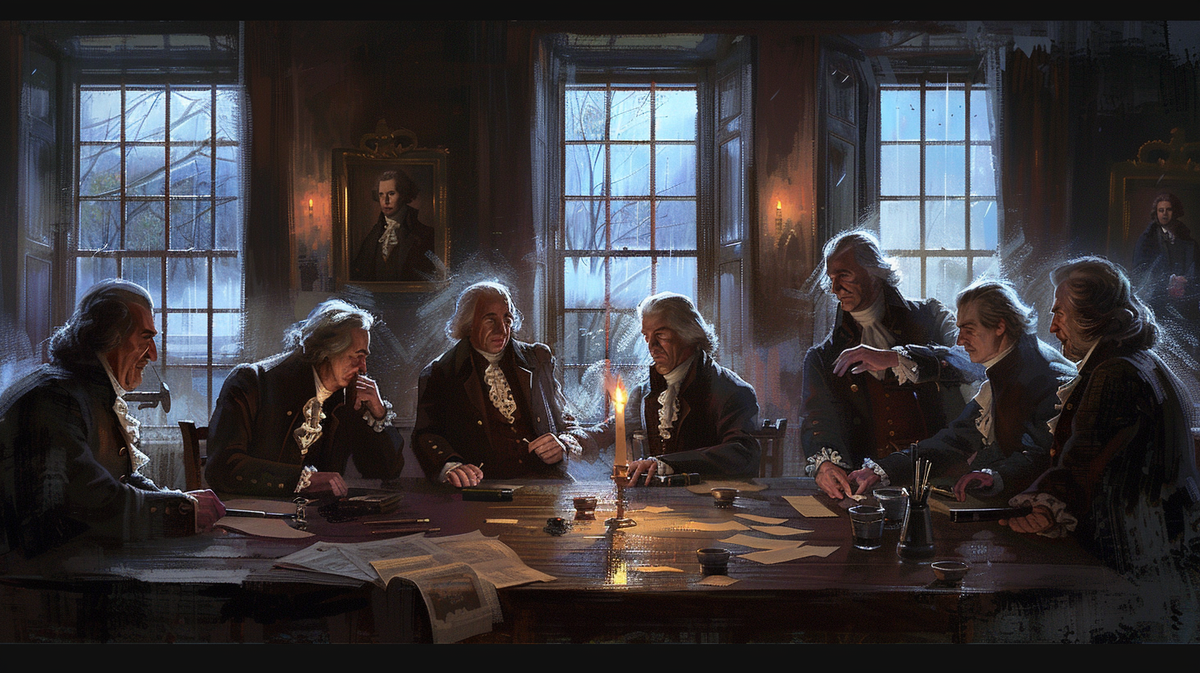
Every American schoolchild gets some version of the same story: brilliant men met in Philadelphia in the summer of 1787, argued through a sweltering season, and emerged with a Constitution so wise that the only remaining drama was getting the states to sign off on it. Ratification is treated as denouement — a formality, a victory lap. The Federalist Papers get excerpted in textbooks as if Hamilton, Madison, and Jay were dispassionate legal scholars rather than the propaganda arm of a political faction fighting for its life. The opposition gets a sentence, maybe a paragraph: there were "Anti-Federalists," they worried about a strong government, they lost, the Bill of Rights was the consolation prize, moving on.
What gets erased in that sentence is that the opposition very nearly won — not in some marginal, sentimental sense, but in the literal arithmetic of votes in the room. New York's ratifying convention, meeting at Poughkeepsie from June 17 to July 26, 1788, opened with Anti-Federalist delegates outnumbering Federalists roughly two to one.¹ The final tally, after six weeks of debate, was 30 to 27.² Had a handful of votes gone the other way, New York — the state holding the Hudson River, the port that would become the nation's financial capital, the geographic wedge separating New England from the South — does not join the Union under the new Constitution. What that does to the experiment is not knowable, but it is not nothing.
The man most responsible for nearly stopping it, and the man most responsible for ultimately letting it through on Anti-Federalist terms rather than Federalist ones, was Melancton Smith of Dutchess County: a merchant, a militia captain, a delegate to the Continental Congress, and very possibly — though the authorship question remains genuinely contested, a point worth sitting with rather than smoothing over — the author of the sixteen "Brutus" essays, the single most rigorous piece of constitutional criticism produced during the entire ratification fight.³ He is not in the textbooks. He should be.
A Government Failing on Paper, Not Just in Theory
The case for a stronger national government did not emerge from nowhere, and intellectual honesty requires saying so before saying anything else. The Articles of Confederation had produced a government that could not reliably tax, could not regulate interstate commerce, could not raise an army without begging the states for money they often declined to send, and had just watched an armed uprising of indebted Massachusetts farmers — Shays' Rebellion, 1786–87 — expose how little capacity existed to respond to internal unrest. A 1786 meeting at Annapolis, called to discuss interstate commerce, fizzled for lack of attendance but issued a call for a broader convention. That convention met in Philadelphia the following May, ostensibly to revise the Articles. It did not revise them. It replaced them, in closed session, with the doors guarded and the windows shut against the summer heat specifically so that no word of the proceedings would leak before the delegates had a finished product to present.⁴
This secrecy matters more than it's usually given credit for. The men who would later object that the Constitution had been imposed on the country with insufficient deliberation were not being paranoid — they were describing the actual sequence of events. Fifty-five delegates, meeting behind locked doors for four months, produced a wholesale replacement of the country's governing charter and then released it to the public as a finished document, take it or leave it, with no provision in the Articles themselves authorizing what had just been done. The Anti-Federalists' first and in some ways most fundamental objection was procedural: this was not amendment, it was usurpation, however benevolently intended.
New York's Particular Stakes
New York's Anti-Federalism was not simple provincialism, and reducing it to Governor George Clinton's personal ambition — a charge Federalists made constantly — flattens a real structural interest. Under the Articles, New York controlled its own customs duties on imports flowing through its port, a substantial and growing revenue stream that a national government with its own taxing power would absorb. New York had also resolved, more successfully than most states, the practical business of paying down its war debt and stabilizing its currency without federal help. From the vantage point of Albany or Poughkeepsie in 1787, the pitch for a stronger union sounded less like rescue and more like a request to surrender a working arrangement in exchange for subordination to a government that would be physically and politically distant from the people it governed.
That distance is the thread running through nearly every substantive Anti-Federalist objection, and it is worth naming as the organizing principle before getting into particulars: representation too thin to be accountable, a judiciary insulated from any meaningful check, a taxing and military power large enough to make state governments ornamental, and no bill of rights to constrain any of it. Strip away the specific clauses and what remains is a single coherent fear — that the new government would be powerful enough to act on the people and distant enough never to feel the consequences of acting badly.
The War of Pamphlets: Publius, Brutus, and the Federal Farmer
The ratification fight was fought, in the most immediate and literal sense, in newspapers. Beginning October 27, 1787, the essays signed "Publius" — Hamilton, Madison, and occasionally Jay — began appearing in New York papers, addressed explicitly "To the People of the State of New York," because New York's convention was understood from the outset to be one of the decisive battlegrounds.⁵ They are remembered today as a unified, almost scriptural text: The Federalist. At the time they were campaign literature, written under brutal deadline pressure, aimed at swaying a specific electorate in a specific state. Eighty-five essays in roughly six months is not the output of leisurely political philosophy; it is the output of a faction that understood it was losing the argument and needed volume to compensate.
It was losing the argument, at least in print, because the opposition was producing work of comparable sophistication. Two pseudonymous voices dominated the Anti-Federalist side in New York: the "Federal Farmer," whose Letters circulated as pamphlets beginning in autumn 1787, and "Brutus," whose sixteen essays ran in the New York Journal from October 1787 to April 1788 — chosen, like the name Publius, for its republican resonance, invoking either the Brutus who expelled Rome's last king or the one who helped kill a man accused of becoming one.⁶
The authorship of both remains unsettled, and it's worth resisting the temptation to overstate how settled it's become. Brutus has traditionally been attributed to Robert Yates, a New York judge and convention delegate who walked out of Philadelphia early in protest.⁷ The Federal Farmer was long credited to Richard Henry Lee of Virginia. Both attributions have been challenged for decades on stylistic and circumstantial grounds, and a 2025 cluster of research — built on manuscript comparison and stylometric analysis, circulated primarily through a single research project rather than peer-reviewed academic publication — argues that Elbridge Gerry was the Federal Farmer and that Melancton Smith himself was Brutus.⁸ That claim deserves to be treated as a serious and plausible thesis, not as established fact; the traditional attributions still have defenders, and the evidentiary bar for reassigning sixteen of the most important essays of the founding era to a new author should be high. What is much less contested is that Smith wrote a separate and influential pamphlet under the name "A Plebeian," published in April 1788, arguing against ratification on grounds nearly identical to Brutus's — and that whether or not he was Brutus, Smith was unquestionably the most formidable Anti-Federalist voice once the argument moved from newsprint into the Poughkeepsie convention hall itself, where the author of an essay could be outmaneuvered by Hamilton but the man standing in the room could not be dismissed as easily.⁹
Brutus's Indictment
Whoever wrote them, the Brutus essays remain the single most systematic Anti-Federalist case against the Constitution, and they read today less like a defeated minority position than like a list of grievances later vindicated by two centuries of constitutional development.
Brutus I, appearing two weeks before the first Federalist essay and addressed, like it, to the people of New York, opens with the essay's central thesis: that a republic spread across a territory as vast as the United States cannot sustain genuine representative government, because a legislature small enough to be workable will inevitably be too small to actually know the people it represents.¹⁰ This was not abstract anxiety. Brutus pointed to the classical precedent the framers themselves invoked — Montesquieu's warning that republics require small, compact territories to survive — and argued that the Constitution had inverted the lesson, building an "extensive republic" that history suggested could not remain free for long.
Brutus II turned to the absence of a bill of rights, rejecting in advance the argument James Wilson had already made in Philadelphia — that an enumeration of protected rights was unnecessary because the federal government possessed no powers beyond those expressly granted.¹¹ Brutus's response anticipated, almost word for word, the objection that would eventually force the First Congress's hand: a government "designed not for yourselves alone, but for generations yet unborn" deserved its boundaries stated plainly rather than inferred, because inference is exactly what expansive future governments would exploit.
Brutus V took aim at the Necessary and Proper Clause, predicting that this single phrase would function as a standing license for Congress to claim whatever power could be plausibly connected to an enumerated one — a prediction that the entire subsequent history of the Commerce Clause and federal spending power has done very little to disprove.¹² Brutus VIII and IX confronted the standing army question directly, arguing that a free republic governs through the willing obedience of citizens who respect it, not through a permanent military apparatus, and that the power to maintain such a force in peacetime was itself a marker of the kind of government the revolution had been fought against.¹³
And then there is Brutus XV, probably the single most prescient essay of the entire ratification debate, which turned to Article III and the federal judiciary. Brutus argued that judges appointed for life, answerable to no electorate and correctable by no higher authority, would not simply interpret the Constitution but would steadily expand it — reading the document's "spirit" rather than its words wherever the words proved inconvenient — and would do so with a power "independent of heaven itself," subject to no check that any other branch of government would have to live with.¹⁴ He predicted, specifically, that this unaccountable judiciary would use its position to erode state courts and absorb their jurisdiction over time, not through any single dramatic seizure of power but through the accumulated weight of case after case decided in the same direction. Two and a half centuries of expanding federal judicial review make this less a prophecy than a description, arriving early.
Poughkeepsie: Smith Against Hamilton
The convention itself, beginning June 17, 1788, was less a debate between abstractions than a sustained personal duel, six weeks long, between Hamilton and Smith specifically — described by one historian as a clash that "matched Publius against Brutus" even apart from the authorship question, because Smith was unmistakably the most capable and persistent Anti-Federalist voice in the room.¹⁵
The representation fight was the convention's central battleground, and it is the clearest place to see the structural critique stated in Smith's own words rather than reconstructed after the fact. The Constitution capped the House at no more than one representative for every thirty thousand people — itself a last-minute concession; the convention in Philadelphia had set the ratio at forty thousand until George Washington, in the only substantive remark he made during the entire four months, rose on the convention's final day to support Nathaniel Gorham's motion lowering it, on the grounds that the "smallness of the proportion" had troubled many delegates as an inadequate security for the people's rights.¹⁶ Even the framers, in other words, understood the ratio was thin. Smith argued it was thin to the point of uselessness, and his reasoning is worth quoting at some length because it states the problem with unusual clarity:
"The number of representatives should be so large, as that while it embraces men of the first class, it should admit those of the middling class of life."¹⁷
This was not a sentimental appeal to the common man. It was a structural argument about who wins elections under different rules. Smith contended that a small number of representatives, elected from large districts, would systematically favor what he called men of the "first class" — the wealthy, the well-known, the professionally connected — because only such men possessed the visibility and resources to campaign successfully across a sprawling constituency. Shrink the district, multiply the representatives, and ordinary farmers and tradesmen — men whose names were known to their neighbors but not across an entire region — would have a realistic path into the legislature. Widen it, as the Constitution did, and representation would quietly become the property of a class rather than a cross-section of the people.
Hamilton's rebuttal, delivered the same week, did not really dispute the empirical claim. Instead he reframed it as a virtue: society naturally produces what he and others of his circle called a "natural aristocracy" of talent and property, and a government wise enough to draw on that aristocracy's judgment, rather than diluting it across a mass of representatives too numerous to deliberate effectively, was a feature rather than a defect. The exchange is, in miniature, the entire ratification debate's deepest disagreement: whether concentrating decision-making in fewer, more capable hands produces better governance, or whether any such concentration inevitably drifts toward governing for the few at the expense of the many, regardless of the personal virtue of the individuals involved.
Smith pressed a parallel argument against the Senate. Hamilton had argued the upper chamber needed stability — long terms, insulated from the immediate passions of the electorate — to provide ballast against a more volatile House. Smith conceded the principle and then attacked the implementation: a Senate seat with no term limit and no mandatory rotation would not produce stability, it would produce a permanent class of officeholders who, in his words, would "of necessity lose their dependence and attachment to the people," exactly the danger the rest of the Constitution's structure was supposedly designed to prevent.¹⁸ He proposed mandatory rotation — ineligibility for re-election after a period of service — precisely so that senators would have to return, periodically, to ordinary life among the people whose laws they had been making. The proposal failed. The pattern it predicted — a Senate that increasingly resembles a closed professional class rather than a rotating body of citizen-legislators — is not difficult to recognize in any subsequent century of American politics.
Whose Constitution? The Property Question
It is not an accident, and it should not be treated as an incidental footnote, that the structural features Smith and Brutus objected to most — small, distant representation; a judiciary insulated from popular accountability; a Senate resistant to turnover; a national taxing and borrowing power unconstrained by any bill of rights — were also, as it happened, the features best calculated to protect a very specific set of interests: the interests of men holding public securities, men engaged in interstate and foreign commerce, men whose capital needed a government strong enough to enforce contracts and pay its debts reliably, and stable enough not to be subject to the kind of debtor-relief legislation that state assemblies — more directly answerable to indebted farmers — had been passing throughout the 1780s.
This is the argument historian Charles Beard made systematically in 1913, examining the financial records of the Philadelphia delegates and arguing that the Constitution was, in his words, "an economic document drawn with superb skill by men whose property interests were immediately at stake" — that the convention was less a disinterested deliberation than a meeting of bondholders, merchants, and large landholders constructing a government competent to secure what the Articles of Confederation could not: reliable repayment of public debt and protection of capital from state-level populism.¹⁹ Beard's thesis provoked decades of pushback — Forrest McDonald and Robert E. Brown, among others, produced substantial evidence that property holding among the framers was more economically diverse, and the line between "personalty" interests and the broader public good less clean, than Beard's framework allowed.²⁰ The thesis should not be treated as proven beyond dispute. But the underlying observation does not actually require Beard's full economic-determinist apparatus to land: suffrage in 1787 was itself property-restricted in most states, meaning the men voting to send delegates to ratifying conventions were disproportionately property holders to begin with, and the institutions those conventions were ratifying — a Senate elected by state legislatures rather than the people directly, a judiciary appointed rather than elected, a House apportioned thinly enough to favor established men of means — were not neutral with respect to class, whatever the framers' subjective intentions. Smith's "middling class" argument and Beard's economic interpretation are, in this sense, pointing at the same structural fact from different centuries: a government built by propertied men, ratified by a propertied electorate, will tend, absent deliberate counterweight, to keep working for propertied interests, and the specific design choices Anti-Federalists fought hardest against were precisely the ones that removed the counterweights.
The Express Rider and the Breaking of the Line
By June 1788, the arithmetic of ratification had narrowed to a genuine crisis for the Federalists. Eight states had ratified by late May. New Hampshire's convention, reconvening after an earlier adjournment in the face of strong opposition, provided the constitutionally necessary ninth ratification on June 21, 1788 — the very day, by historical coincidence, that this conversation began with Hannibal at Trasimene — making the Constitution technically the supreme law for the states that had adopted it, regardless of what New York or Virginia did next.²¹ But "technically the law for nine states" and "a functioning union" were not the same thing, and everyone in Poughkeepsie knew it. Without Virginia and New York, the country split into something closer to two or three separate confederacies, with New York occupying the single most strategically disastrous position to be left outside the new arrangement: a hostile or independent state controlling the Hudson corridor and one of the continent's best natural ports.
Hamilton understood this leverage and worked it deliberately. He had arranged in advance with Madison, present at the Virginia convention in Richmond, that news of any decisive vote there would be carried north by express rider — paid riders changing horses along the route specifically to outrun ordinary mail — so that Poughkeepsie would hear the outcome before its own debate concluded.²² Virginia ratified on June 25, 1788, by 89 to 79, narrowly defeating a delaying motion from Patrick Henry; the news reached Poughkeepsie by express on July 2.²³ The psychological effect on wavering Anti-Federalist delegates was immediate and, by most accounts, decisive: continued rejection no longer meant blocking the Constitution, since it would take effect regardless. It now meant New York choosing isolation from a union that was going to exist with or without it.
"In Full Confidence": The Turn and the Vote
What happened next is the part of the story where Smith's role becomes genuinely pivotal rather than merely eloquent. The hardline Anti-Federalist position, led by John Lansing and tacitly backed by Governor Clinton, was to ratify only conditionally — reserving New York's right to withdraw from the union if a list of demanded amendments were not adopted within a fixed period, effectively building a secession clause into the act of joining.²⁴ Hamilton, backed by a letter he produced from a "gentleman of high public distinction" — almost certainly Madison — argued that any such conditional ratification would not be recognized by Congress at all; New York would simply be treated as having rejected the Constitution outright, isolation without even the consolation of negotiating leverage.²⁵
Smith broke from the hardliners. On July 23, in what one historian of the convention calls its watershed moment, Smith threw his support behind ratifying unconditionally while recommending — rather than demanding — a slate of amendments, trusting that the same political pressure that had produced similar recommendations from Massachusetts and Virginia would eventually force a federal bill of rights through the new Congress.²⁶ The next day, Samuel Jones's motion to substitute the words "in full confidence" for "upon condition" carried by a vote of 31 to 29, with Smith among the votes in favor — the procedural hinge on which the entire ratification turned, since it meant New York's assent would not require the impossible: getting Congress to accept a state joining the union with a loaded gun pointed at the door.²⁷ Two days later, on July 26, 1788, the convention ratified the Constitution by the final, razor-thin margin of 30 to 27 — closer than any other state's vote — accompanied by a circular letter, agreed to unanimously, calling on the other states to support a second general convention to consider the amendments New York, like Virginia, was recommending rather than demanding.²⁸
It is worth being honest about what this means for Smith's legacy rather than smoothing it into uncomplicated heroism. He did not win. He switched sides at the decisive moment, and the switch is precisely what let the Constitution through New York rather than blocking it. Whether that makes him a statesman who recognized that holding out further would isolate his state for no achievable gain, or a man whose nerve broke at the moment that mattered most, is a judgment the sources do not settle definitively, and it is one his contemporaries argued about bitterly at the time. What is not in dispute is that the form of his concession — unconditional ratification paired with recommended rather than demanded amendments — is the exact template that produced the Bill of Rights, because New York's recommendations, layered onto Virginia's and Massachusetts's, gave Madison the political cover and the specific language he needed to draft the twelve amendments the First Congress sent to the states in 1789.
What Was Won, and What the Loss Still Costs
The consolation prize was real. Ten of Madison's twelve proposed amendments were ratified by December 1791 and stand today as the Bill of Rights — the single most durable legacy of an opposition movement that the textbooks otherwise treat as a footnote. Brutus II's argument that natural rights needed explicit enumeration, dismissed by Federalists in 1787 as unnecessary, is the reason the First Amendment exists in the form it does.
But the deeper structural critique — the part of the Anti-Federalist case that wasn't about adding a list of protected rights but about the underlying architecture of representation and power — simply lost, and lost in ways whose consequences have compounded for over two centuries rather than fading. Brutus's prediction about an unaccountable judiciary steadily expanding its own jurisdiction at the expense of the states reads, after Marbury v. Madison and everything that followed it, less like an Anti-Federalist's paranoid fantasy and more like an accurate forecast delivered a year before the Constitution even took effect. The Necessary and Proper Clause has done exactly the expansive work Brutus V warned it would. And the representation argument Smith made by name and in detail — that thin districts produce a representative class detached from the "middling" people it nominally serves — has not been vindicated by abstraction; it has been vindicated by arithmetic. The House of Representatives, apportioned at one member per thirty thousand people in 1789, was frozen at 435 total seats by statute in 1929 and has not grown since, even as the national population has multiplied roughly six-fold.²⁹ The result is a House where each member now represents, on average, well over seven hundred thousand constituents — more than twenty times the ratio the framers themselves considered the bare minimum for accountable representation, and a ratio Smith would have recognized instantly as exactly the failure mode he spent the summer of 1788 trying to prevent.³⁰
The Anti-Federalists did not lose the argument because the argument was wrong. They lost it because the Federalists controlled the timetable, controlled the convention sequencing, and ultimately controlled the narrative that has survived into the textbooks — Publius remembered as statesmanship, Brutus and the Federal Farmer remembered, when they are remembered at all, as the losing side of a debate already settled in the framers' favor before it even began. Melancton Smith spent six weeks in a hot courthouse in Poughkeepsie making the most rigorous case available that the document about to be ratified would, left unchecked, drift toward government by and for a propertied few, insulated by distance, by judicial permanence, and by representation too thin to be answerable to the people it claimed to represent. He did not stop it. He extracted a partial correction from it, in the form of ten amendments, and then watched the structural critique underneath those amendments get filed away as a historical curiosity. Two hundred and thirty-eight years later, the correction has held. The structural critique is still waiting for an answer.
Notes
¹ John Lansing and Robert Yates entered the convention with a working majority of roughly 46–19 against ratification. Teaching American History, "New York Ratifying Convention."
² Final vote, July 26, 1788: 30–27. Founders Online, Papers of Alexander Hamilton, vol. 5; corroborated across multiple convention sources.
³ Authorship of the Brutus essays remains disputed among historians; see Section V below for the traditional attribution to Robert Yates and the more recent, contested case for Melancton Smith.
⁴ The Philadelphia Convention met under rules of strict secrecy from May to September 1787; delegates were bound not to disclose proceedings, a fact frequently cited by Anti-Federalist writers as evidence of the document's illegitimate process.
⁵ Federalist No. 1, signed "Publius," appeared October 27, 1787, addressed "To the People of the State of New York."
⁶ Brutus essays ran in the New York Journal, October 18, 1787–April 10, 1788; "Federal Farmer" letters circulated as pamphlets beginning October 1787.
⁷ Traditional attribution of Brutus to Robert Yates; see Wikipedia, "Brutus (Antifederalist)," and Teaching American History's Brutus essay index.
⁸ The 2025 authorship reassignment (Gerry as Federal Farmer, Smith as Brutus) is argued chiefly through Statutesandstories.com's research series; treat as a contested, recent thesis rather than settled scholarly consensus.
⁹ Smith's "A Plebeian" pamphlet, An Address to the People of the State of New York, April 1788.
¹⁰ Brutus I, New York Journal, October 18, 1787.
¹¹ Brutus II, November 1, 1787.
¹² Brutus V, December 13, 1787.
¹³ Brutus VIII (January 10, 1788) and IX (January 17, 1788), responding in part to Federalist No. 24.
¹⁴ Brutus XV, March 20, 1788.
¹⁵ Statutesandstories.com, "Melancton Smith's Watershed Speech," characterizing the Hamilton–Smith dynamic at Poughkeepsie.
¹⁶ George Washington's intervention on the convention's final day, September 17, 1787, supporting Nathaniel Gorham's motion to reduce the apportionment ratio from one representative per forty thousand to one per thirty thousand.
¹⁷ Melancton Smith, speech of June 21, 1788, New York Ratifying Convention (Childs's version).
¹⁸ Melancton Smith, speech of June 25, 1788, on Senate term limits and rotation in office.
¹⁹ Charles A. Beard, An Economic Interpretation of the Constitution of the United States (New York: Macmillan, 1913).
²⁰ See Forrest McDonald, We the People: The Economic Origins of the Constitution (1958), and Robert E. Brown, Charles Beard and the Constitution (1956), both contesting Beard's methodology and conclusions.
²¹ New Hampshire ratified June 21, 1788, by a vote of 57–47, providing the ninth state required under Article VII.
²² Hamilton's arrangement with Madison for express-rider communication between the Virginia and New York conventions, documented in Hamilton's correspondence, summer 1788.
²³ Virginia ratified June 25, 1788, by 89–79; news reached Poughkeepsie by express July 2, 1788.
²⁴ Lansing's proposed conditional ratification with a reserved right of withdrawal, debated July 24, 1788.
²⁵ Hamilton's response, citing a letter understood to be from Madison, arguing Congress would not recognize a conditional ratification. Founders Online, "First Speech of July 24."
²⁶ Smith's July 23, 1788 speech endorsing unconditional ratification with recommended amendments.
²⁷ Samuel Jones's motion substituting "in full confidence" for "upon condition," carried 31–29, July 24, 1788. Founders Online.
²⁸ Final ratification vote, 30–27, July 26, 1788, accompanied by a unanimous circular letter calling for a second general convention.
²⁹ Permanent Apportionment Act of 1929, capping House membership at 435.
³⁰ Based on 2020 census apportionment figures; average House district population now exceeds 760,000.
Member discussion: