
Ancient critics could catch a liar — Ctesias was named a fraud in his own lifetime. But sincere revelation and fabricated witness look identical from the outside. That's the loophole religion has always had, and Hubbard walked straight through it.
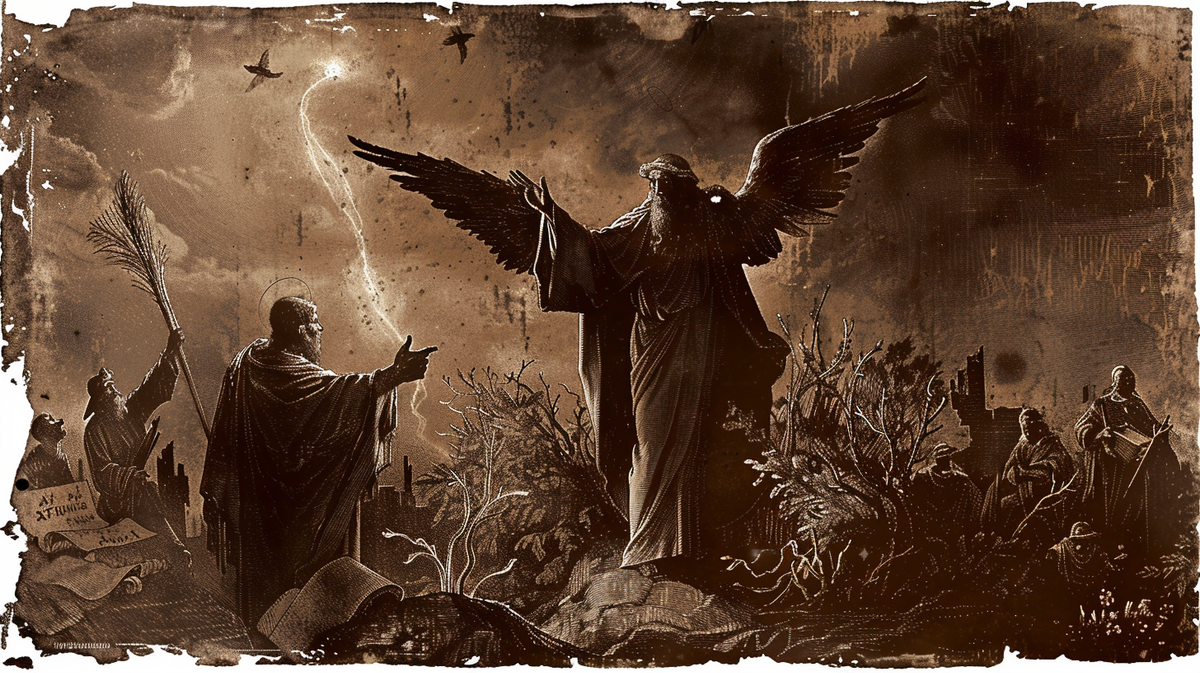
Look at the Book of the Watchers — angelic beings descending from the sky, intermarrying with human women, teaching forbidden technologies, fathering a race of giants — and it is genuinely difficult not to see a UFO encounter narrative wearing Bronze Age clothing. Look at Plato's Atlantis, with its advanced metallurgy, its concentric harbor-rings, its catastrophic destruction, and the pattern-matching part of the modern brain wants to file it next to Stargate and call it a day.
This is an illusion, and it is a recent one. The "ancient astronaut" reading of these texts is barely a century old — Ignatius Donnelly bolted Atlantis onto pseudo-archaeology in 1882; Erich von Däniken did the same to Enoch and a dozen other texts in the 1960s and 70s. Neither Enoch's authors nor Plato's contemporaries had any access to that interpretive frame, and — more importantly for the question this essay actually wants to answer — they didn't need one. They had their own, much older argument about which fantastic claims to trust, which to enjoy as art, and which to be furious about. That argument has almost nothing to do with content (gods, monsters, lost continents, journeys to the moon) and almost everything to do with a single procedural question: did the author hedge, or did the author claim to be a witness?
This essay is about that procedural question — what the ancient world's answer to it looked like, why it worked as well as it did, and why one category of human institution has always been structurally immune to it. That category is religion, and the immunity is not a moral failing unique to religious people. It's a design feature of unfalsifiable revelation itself, and it's been exploited by the sincere and the cynical alike, often in ways no outside observer — ancient or modern — can fully sort out.
Four Postures Toward the Fantastic
The ancient world did not have one relationship to the fantastic. It had at least four, and they are easy to tell apart once you stop sorting by content and start sorting by stance.
Sincere revelation. The Book of the Watchers, the oldest stratum of 1 Enoch (roughly third to second century BCE), describes the Watchers' descent, their illicit teaching, and the birth of monstrous offspring with no fictional self-awareness whatsoever. This was not entertainment with a wink attached. Second Temple Jewish communities treated it as genuine prophetic literature; the New Testament's Epistle of Jude quotes Enoch by name as an authority (Jude 1:14–15); the Ethiopian Orthodox Church still holds it as canonical scripture today. There is no ancient accusation, anywhere in the record, that its author was making it up. Whatever else this text is, it is not evidence that its audience knew they were reading fiction.
Fiction with an honest contract. Lucian's A True Story (second century CE) opens by telling the reader, in so many words, that everything that follows is a lie — a voyage to the Moon, a war between solar and lunar kings, creatures built from impossible anatomy. Lucian is not trying to fool anyone. He is mocking people who did try to fool people — Ctesias, Iambulus, even Homer, dressed-up marvel-writers who presented impossible travel narratives as eyewitness fact. Iambulus's own Island of the Sun (preserved only as a summary in Diodorus Siculus) and Euhemerus's Panchaea sit in the same lineage: utopian thought-experiments using a travelogue frame that both author and a sophisticated portion of the audience seem to have understood as a shared literary game, not a deception — something closer to a modern novel's "found manuscript" conceit than to fraud. Nobody who reads Dracula's diary entries believes they are reading an actual recovered diary.
Fabricated witness. Ctesias of Cnidus claimed personal presence at events in the Persian court and asserted his Indian marvels — giant ants mining gold, men with their feet pointed backward — as confirmed firsthand report. He did not get away with this in his own era. Plutarch, in the Life of Artaxerxes, accuses him directly of fabrication and self-aggrandizement. Strabo lumps his "histories" in with outright fable. This is the single most important data point in the whole question: ancient critics did not need modern epistemology to catch a liar. They caught one, by name, while his ink was still drying by historical standards, and the accusation survives intact in the record.
Sincere and self-aware at once. The Sanskrit itihasas — the Ramayana and Mahabharata — are the strangest and most instructive case of the four, because they refuse the other three categories entirely. Itihasa means something close to "thus indeed it happened." These were received as factually true. And yet the suta (bardic) transmission lineage that carried them is built into the texts themselves — everyone in the tradition knew these were epics that had been performed, edited, and elaborated across centuries by named lineages of reciters. The tradition produced its own explicitly allegorical retelling of the Ramayana (the Adhyatma Ramayana, which spiritualizes Valmiki's literal narrative) without anyone treating that retelling as heretical or competing. This is a culture that managed to hold "this happened" and "this has been continuously reshaped by human hands, and everyone knows it" at the same time, without the contradiction collapsing the tradition's authority. That combination does not show up anywhere in the Mediterranean material discussed above, and it deserves to be treated as its own category rather than folded into "myth" generally.
Plato's Atlantis is the boundary case that proves all four postures were contested in real time, not assigned by genre at birth. Aristotle — Plato's own student — is reported to have remarked that the man who invented Atlantis also destroyed it, treating the island's convenient sinking as the tell of an author disposing of a plot device. Strabo records live scholarly disagreement about whether it was real. Ancient readers were already split on whether they were looking at history or allegory, within a few generations of the text's composition. The "is this fiction" instinct readers bring to it today is not a modern import. It's the oldest reaction Atlantis ever got.
The Evidence of a Felt Norm
None of this happens by accident. The existence of the hedge — and the punishment for skipping it — is evidence of a working social mechanism, not a coincidence of individual temperament.
Herodotus is the clean case. Across the Histories he reports things he plainly finds preposterous — and tells you so. This is what was told to me; I do not believe it myself; I report it as I heard it. That formula recurs because it is doing real work: it lets him transmit a marvel without personally vouching for it, protecting both the reader from deception and Herodotus from the charge of having lied. Whether his primary motive was protecting the audience or protecting his own reputation is genuinely undecidable from the outside — and it may not matter. Self-interested epistemic hedging and audience-protective honesty produce the identical visible behavior and the identical beneficial norm. The norm is what survives; the motive behind it is unrecoverable.
What makes this a norm and not just one historian's personality is that violating it got you named. Ctesias didn't get caught by modern fact-checkers running a satellite survey of ancient India. He got caught by Plutarch and Strabo, writing in antiquity, using the same standard Herodotus had modeled by observing it: if you claim personal witness to the impossible and can't back it up, you forfeit credibility, publicly, by name. The hedge and the shaming are two halves of one mechanism. The ancient world had a working fraud-detection apparatus for the fantastic, and we have the casualty list to prove it.
The itihasa tradition shows a third version of the same impulse, working through a completely different lever. Instead of a personal hedge or a public shaming, it built provisionality into the medium itself — a living performance tradition that everyone understood to be continuously re-told and re-shaped, with allegorical retellings sitting comfortably alongside the literal version. You don't need Plutarch to call out a liar if the entire culture already understands that the text is the product of generations of hands and is still considered to be telling the truth.
Three different cultures, three different solutions to the same problem: how do you let people enjoy and transmit fantastic material without the fantastic material rotting the culture's relationship to truth? Hedge it personally (Herodotus). Shame the violators publicly (the Ctesias case). Build the provisionality into the transmission medium itself (itihasa). All three are functioning accountability systems. All three predate the printing press by a couple thousand years.
Where the Mechanism Breaks Down
Here is the place this essay's premise has to get more careful than its first draft, because the evidence doesn't support a clean equivalence between "religion" as a category and Ctesias's fraud.
It is tempting — and there's a real instinct behind the temptation — to say religion does the Ctesias move at civilizational scale: asserting the unverifiable as literal fact, to an audience with no way to check, for advantage. That's airtight for specific religious actors and episodes: medieval relic forgery, indulgence-selling, the modern prosperity gospel circuit. It does not fit Enoch. Nobody in antiquity accused Enoch's author of fabrication the way Plutarch accused Ctesias. The text reads, by every available marker, as the product of people who sincerely believed they were transmitting revealed truth.
And this is the actual structural problem, the one worth building the rest of the essay around: from the audience's side, sincere revelation and fabricated witness are indistinguishable. Ctesias claiming to have stood in the Persian court and Enoch's author claiming to have received a vision produce the identical artifact — an unfalsifiable claim of fantastic content, delivered with full confidence, to people with no mechanism to check it. The only thing that separates them is the author's private intent, which is exactly the one variable no outside observer, ancient or modern, can audit. Plutarch could catch Ctesias because Ctesias's claims touched a checkable world — geography, named courts, known peoples. Religious revelation, by its nature, claims access to a world that is definitionally uncheckable. There is no Plutarch for a vision.
This is not an accusation that religion is uniquely fraudulent. It's the opposite, in a sense — it's an account of why religion is uniquely exploitable, by people who don't even believe what they're saying, precisely because the category contains so many people who sincerely do. A bad-faith operator working the travelogue genre eventually runs into a Strabo, because travelogues touch a checkable world. A bad-faith operator working the revelation genre can hide indefinitely inside the same form sincere mystics have always used, because nothing about the form itself distinguishes them. The vulnerability isn't that religious claims are false. It's that the format makes fraud and faith wear the same clothes, with no seam for an outside critic to grab.
Ctesias's Heirs
This is what makes the twentieth century's entries into the genre so much sharper a case than "religion" treated as one undifferentiated mass — because some of them are, on close inspection, clean Ctesias cases rather than ambiguous Enoch cases.
Theodore Illion's Darkness Over Tibet presents itself as a first-person eyewitness account of secret occult schools and forbidden knowledge encountered during real travel — no hedge, a direct personal-witness claim of the marvelous, structurally identical to Ctesias's giant ants. Whether Illion sincerely believed elements of his own account or constructed it as a deliberate literary-occult hybrid is a live question — and it's the same undecidable-motive problem Herodotus raises, just transplanted into the twentieth century.
L. Ron Hubbard is the harder, cleaner case, and the one this essay can actually take a firm position on. Dianetics and the later OT cosmology were not presented as Enoch presents itself — visionary revelation, openly mystical in register, asking for faith on faith's own terms. They were presented as discovered scientific fact, with an institutional apparatus built specifically to prevent anything resembling Plutarch from getting close enough to check the claim: legal aggression against critics, internal information control, financial structures that punished doubt. This is the mutation that should worry a reader more than the ancient version ever could. Ctesias got named by Plutarch and the accusation survived in the open record forever — the fraud-detection mechanism worked, after the fact, completely unmolested. The modern equivalent doesn't just risk a Strabo. It builds the infrastructure to make sure no Strabo gets close enough to write the sentence — and that, not the cosmology itself, is the actual escalation from antiquity to now.
Why People Want to Believe, Not Just Imagine
None of the above is an argument against the fantastic. It's the opposite — it's the case for keeping the categories clean enough that the honest version can do its job.
The honest-contract tradition — Lucian's heirs — is not a lesser cousin of revelation. It is doing something revelation cannot do, and doing it without the coercive apparatus revelation tends to accumulate. Tolkien's On Fairy-Stories names this directly: well-made fantasy produces what he calls Secondary Belief — full imaginative immersion in an invented world, achieved through the craft of the "sub-creator," with no claim of literal truth attached and none required. Nobody who loses themselves in The Lord of the Rings believes Middle-earth is a real place one could book a flight to. The immersion is total and the truth-claim is zero, and that combination is the entire point. It's the same shared contract Lucian's audience operated under eighteen centuries earlier, refined into an art form.
What separates belief from imagination, psychologically, is what gets attached to belief: identity, belonging, and — in religion's coercive subtype — salvation and damnation. Pure imagination asks nothing of you but attention. Belief, especially weaponized belief, asks for membership, obedience, and stakes. That is the actual lever both fundamentalist religion and figures like Hubbard pull, and it is not a lever Tolkien, Lucian, or Iambulus ever needed, because honest fiction was never trying to recruit anyone. The hunger for wonder is constant across both categories — it is the same hunger in Enoch's audience, Lucian's audience, and a modern reader of speculative fiction. What differs is whether the institution feeding that hunger demands belief with consequences attached, or offers imagination with none.
It's worth noting, too, that the "literal word of God, believe-or-perish" framing this essay keeps circling back to is itself a comparatively recent strand within religion rather than religion's timeless default. Origen and Augustine — both foundational, both well before modernity — argued explicitly for allegorical and multi-layered scriptural reading and were openly suspicious of crude literalism. The rabbinic tradition's entire interpretive apparatus — midrash, the Talmud's argument-as-method, centuries of competing commentary held in productive tension — is arguably more self-consciously contested than anything secular fiction criticism does today. Flattened literalism with damnation as its enforcement mechanism is largely a nineteenth- and twentieth-century Protestant fundamentalist reaction to Darwin and historical-critical biblical scholarship — a modern strand, not the whole tree, and not even close to the itihasa model of sincere-but-openly-evolving transmission this essay has been holding up as a comparison point throughout.
Track the Hedge, Not the Content
The diagnostic this essay has been building toward isn't era, and it isn't genre. Atlantis and Enoch and the Mahabharata and A True Story and Darkness Over Tibet and Dianetics all share surface furniture — gods, monsters, lost worlds, secret knowledge, journeys past the edge of the map. None of that furniture tells you anything useful. What tells you something useful is whether the hedge survived: did the author mark the claim as invented, mark it as personally unverified, or build provisionality into the medium itself — or did the author claim to be a witness, with nothing behind the claim but the audience's inability to check?
Ctesias and Hubbard are the same move, two thousand three hundred years apart. Herodotus, Lucian, and the suta bards reciting the Mahabharata are the same move in the other direction, three different cultures, three different mechanisms, one shared instinct: protect the audience's relationship to truth even while feeding its appetite for wonder. Enoch sits outside both columns — not proof of fraud, not proof of honest fiction, just proof that sincere revelation and fabricated witness will always look identical from the audience's side, which is precisely why religion remains the one domain where Ctesias can always find a place to hide.
The appetite itself is not the problem, ancient or modern. It never was. The problem starts exactly where the hedge ends.
Sources and texts referenced: Plato, Timaeus and Critias; Aristotle's reported remark on Atlantis (via later doxography); Strabo, Geography; 1 Enoch (Book of the Watchers); Jude 1:14–15; Lucian, A True Story (Vera Historia); Herodotus, Histories; Plutarch, Life of Artaxerxes; Diodorus Siculus on Iambulus's Island of the Sun; the Ramayana, Mahabharata, and Adhyatma Ramayana; J.R.R. Tolkien, "On Fairy-Stories"; Theodore Illion, Darkness Over Tibet; L. Ron Hubbard, Dianetics and the OT materials.
Jonathan Brown writes on technology, security, and culture for bordercybergroup.com and aetheriumarcana.org.
We are reader-supported. If you enjoy our work... Subscribe or buy us a coffee! Thanks
Member discussion: