
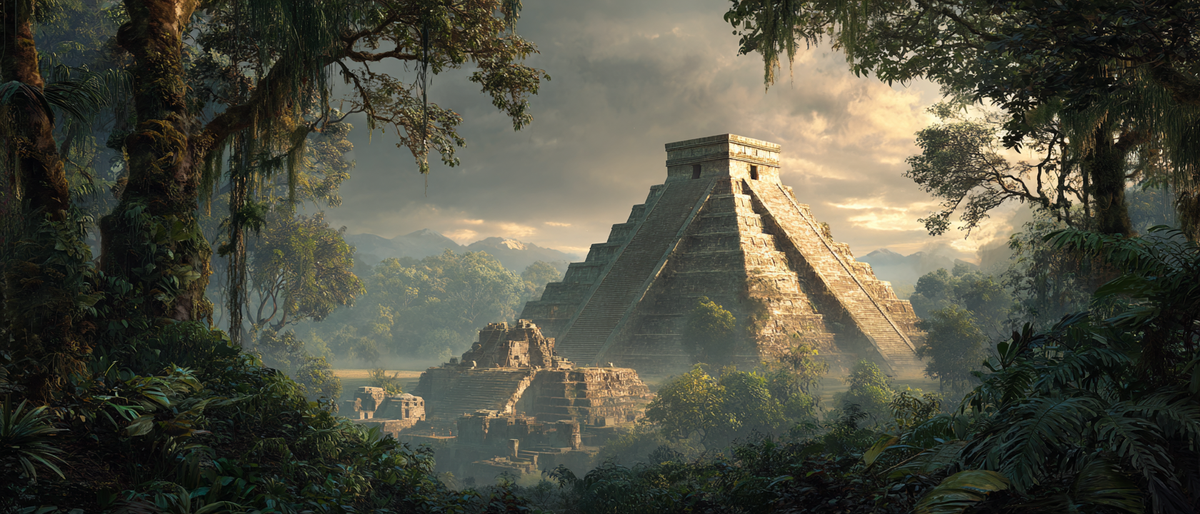
The Cartography of Consensus
Human history, as taught in the lecture halls of our most prestigious universities, is not a collection of settled truths, but a carefully curated map - one where the "terra incognita" of uncomfortable evidence is simply cropped out to preserve the frame. This process of "Knowledge Filtration" ensures that the academic establishment remains the sole arbiter of the past. When a student pays six figures for a degree in anthropology or history, they aren't just buying facts; they are buying into a "crowd-complicity" that rewards conformity and punishes heresy. If a discovery threatens the funding, the tenure, or the legacy of the "qualified speculators" at the top, it is not debated; it is ignored, labeled "pseudo-science," or buried in the archives of the "anomalous."
At the center of this filtered map lies the Bering Strait Monopoly. For nearly a century, the "Clovis First" model was treated as an unassailable dogma: the narrative that a single group of primitive hunters walked across a land bridge from Siberia into Alaska roughly 13,000 years ago, eventually becoming the ancestors of all Indigenous peoples in North and South America. This theory served a specific purpose: it kept the history of the Americas "neat" and relatively recent, positioning the New World as a pristine wilderness waiting for "discovery." It turned the Pacific and Atlantic oceans into impassable walls, effectively isolating the Americas from the grand, global currents of ancient maritime civilization.
However, the "official" textbooks are increasingly becoming expensive collections of soon-to-be-overturned ideas. The cracks in the Bering Strait dogma have become canyons that the Academy can no longer bridge with mere rhetoric. This essay will demonstrate that the settlement of the Americas was not a singular, primitive trek, but a complex, multi-directional mosaic of maritime migrations and ancient global trade. By weaving together the genetic "ghosts" found in the Amazon, the "impossible" seafaring capabilities of Mediterranean and Vedic cultures, and the physical evidence of "Out-of-Place Artifacts" (Ooparts), we will dismantle the isolationist narrative. We will move beyond the "official" history to recover a past where the oceans were highways and the ancient world was far more connected, and far older, than the gatekeepers of "bogus knowledge" dare to admit.
Genetic Ghost Stories
If the Bering Strait theory were the total truth, the DNA of Indigenous Americans would be a uniform reflection of North Asian ancestry. Instead, the genetic record is haunted by "ghosts" - signals that shouldn't exist according to the standard model. These anomalies suggest that the Americas were a melting pot of global populations long before the "Age of Discovery." The most haunting of these is Population Y. In the deep Amazon, tribes like the Suruí and Karitiana carry a genetic signature that shares more in common with Indigenous Australians, Papuans, and the inhabitants of the Andaman Islands than with any population in Siberia. Mainstream science has no explanation for how Australasian DNA reached the heart of South America without leaving a trace in North America, unless we admit to a trans-oceanic southern route that bypasses the land bridge entirely.
The mystery deepens when we look North to Haplogroup X. This specific mitochondrial lineage is found in high frequencies among the Ojibwe and other Algonquian-speaking tribes. Unlike the four major "Asian" haplogroups (A, B, C, and D), Haplogroup X is virtually non-existent in East Asia. Its highest concentrations are found in the Middle East, particularly among the Druze, and in parts of Europe. Rather than acknowledging a potential prehistoric crossing of the Atlantic, mainstream geneticists have been forced to invent a "now-extinct" Siberian population that conveniently carried this Mediterranean marker across the ice and then vanished without a trace. This is a classic example of "determination by crowd-complicity" - inventing a ghost population to avoid admitting that ancient Middle Eastern or European mariners might have hit the North American coast millennia ago.
The most damning piece of "forbidden" biological evidence, however, doesn't come from a cheek swab, but from the tombs of the Pharaohs. In the 1990s, forensic toxicologist Svetlana Balabanova discovered traces of nicotine and cocaine in the tissues of Egyptian mummies, including the priestess Henut Taui. These plants were native exclusively to the Americas at the time. The academic reaction was a masterclass in denial: critics suggested the mummies were "fake," "contaminated," or that "extinct Old World versions" of coca and tobacco must have existed. They would literally rather rewrite the botanical history of the entire planet than admit a simple truth: the ancient world was connected by trade. These genetic and toxicological "ghosts" prove that the Bering Strait was just one small gate in a global perimeter that was far more porous than our "official" textbooks dare to record.
The Sea is a Highway, Not a Wall
The central pillar of the "Isolationist" dogma is the belief that the Atlantic and Pacific oceans acted as insurmountable barriers to ancient man. This narrative portrays the pre-Columbian world as a collection of "silos," where civilizations developed in total vacuum until European sails appeared on the horizon. This is not just a historical claim; it is a psychological one, designed to frame ancient peoples as technologically "primitive." However, when we apply the scientific method instead of academic bias, we find that the oceans were never walls - they were highways. The trade winds and currents of the Atlantic and Pacific are not obstacles; they are conveyor belts that have been moving life and culture across the globe for eons.
Contemporary anthropology suffers from a profound double standard regarding seafaring capability. We are taught to marvel at the Polynesians for their "Kelp Highway" voyages and their ability to navigate thousands of miles of open water to settle tiny specks of land like Rapa Nui (Easter Island). Yet, the same scholars claim it was "impossible" for the Phoenicians, Egyptians, or Minoans - master shipbuilders with deep-hulled galleys and celestial charts - to cross the mere 3,000 miles of the Atlantic. This selective skepticism ignores the physical evidence: Phoenician artifacts in the Azores and the Ra II expedition, which proved that even a "primitive" Egyptian reed boat could cross from Africa to Barbados in under two months by simply following the natural "slipstream" of the North Equatorial Current.
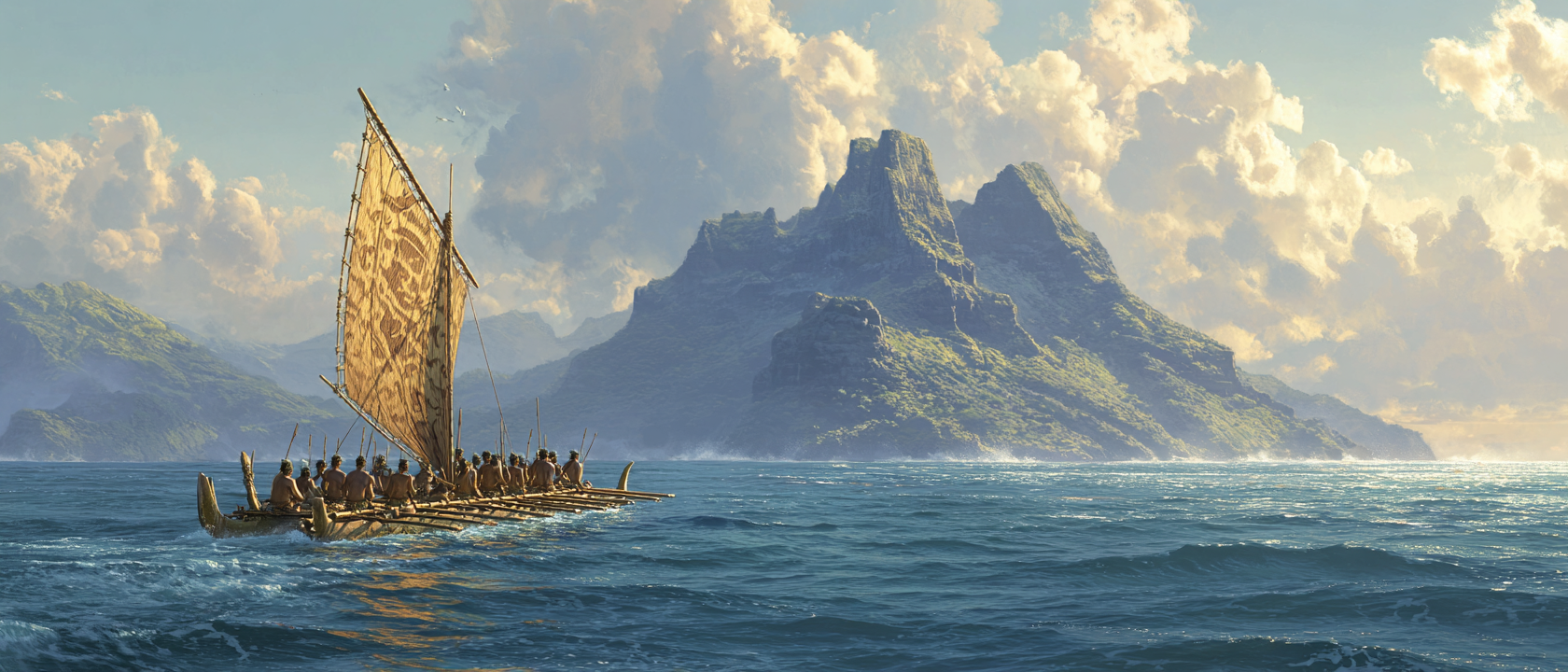
Perhaps the most compelling evidence for a global maritime "Silk Road" is the mystery of the Bronze Age Copper. Between 2400 and 1200 BCE, the Mediterranean world experienced a sudden, massive demand for copper and tin to produce bronze. While the source of the tin remains a debated "mystery" in official textbooks, the source of the copper is even more "suspicious." In the Lake Superior region of North America, there are thousands of ancient mining pits where an estimated 500 million pounds of high-grade copper were extracted during this exact period. This copper did not stay in the Americas; it is not found in local burials or tools of that era. It vanished from the "New World" at the precise moment it appeared in the "Old World."
The knowledge required for this global exchange was not "primitive" guesswork; it was a high-level science. The Piri Reis Map of 1513, compiled from "source maps" dating back to the Hellenistic period, shows the coastlines of the Americas and even the sub-glacial topography of Antarctica with a precision that requires spherical trigonometry. This map is a "fossil" of a lost maritime age - a time when the "Sea People" possessed a unified, global understanding of the Earth’s geography. To the modern "Academy," these maps and mines are anomalies to be filtered out; to the honest observer, they are the signatures of an era where the oceans did not divide humanity, but united it in a global web of trade and exploration.
Forbidden Archeology and the Timeline Problem
The primary defense of the Bering Strait theory is not based on what has been found, but on what has been "allowed" to remain in the record. As Michael Cremo and Richard Thompson meticulously documented in Forbidden Archeology, the academic establishment employs a "knowledge filter" that systematically discards any discovery suggesting humans were in the Americas earlier than the accepted timeline. This isn't just a matter of professional caution; it is an ideological gatekeeping that protects the linear "Stone Age to Space Age" narrative. When an artifact is found in a geological layer that is hundreds of thousands - or even millions - of years old, the Academy does not celebrate the find; they attack the finder, question the stratigraphy, or simply let the discovery rot in museum basements until it is forgotten.
A classic example of this filtration is the Hueyatlaco site in Mexico. In the 1960s, a team of archaeologists, including Cynthia Irwin-Williams, discovered sophisticated stone tools (bifacial projectile points) that were buried beneath layers of volcanic ash. When the team used four different geological dating methods - including uranium-series and fission-track dating - the results were unanimous: the tools were approximately 250,000 years old. This date was an absolute heresy. It suggested that modern humans (or a sophisticated ancestor) were hunting in Mexico nearly a quarter-million years before the "experts" said they had even evolved. Instead of expanding the history books, the U.S. Geological Survey was pressured to retract their findings, and the site was effectively shut down.
Even when the evidence is literally stepped on, the establishment resists. For decades, anyone suggesting humans were in North America before 13,000 years ago was laughed out of peer review. That changed recently with the White Sands Footprints in New Mexico. These are clear human tracks fossilized in an ancient lake bed, dated to between 21,000 and 23,000 years ago. This single discovery pushed the human presence in the Americas back by 10,000 years in an instant, proving that the "Clovis First" dogma was factually wrong for nearly a century. If the "experts" were off by 10,000 years on something as obvious as a footprint, it is scientifically dishonest to assume they aren't off by 100,000 years on the more controversial finds like the Calico Early Man Site or the Cerutti Mastodon site (dated to 130,000 years ago).
The reality is that "official" history is a curated highlight reel. By ignoring the Out-of-Place Artifacts (Ooparts) - such as modern human remains found in tertiary gold-bearing gravels in California - the Academy maintains a "clean" timeline at the expense of the truth. These finds suggest that the human story in the Americas isn't a recent expansion, but a deep, ancestral residency that stretches back into the distant mists of geological time. The "official" books are not written to tell us how old we are; they are written to tell us how "new" we are, ensuring that the mystery of our true origins remains "forbidden."
The Pyramid Science - Coincidence or Common Source?
To the traditional academic, the global distribution of pyramids is a classic case of "independent invention." They argue that a pyramid is simply the most stable way to stack heavy stones, and therefore, any primitive culture would eventually stumble upon the shape. This reductionist view is not only patronizing to ancient architects but scientifically dishonest. It ignores the fact that these structures are not just "piles of stone," but precision-engineered machines that demonstrate a unified, high-level understanding of mathematics, astronomy, and telluric energy. When the Great Pyramid of Giza and the Temple of the Sun at Teotihuacán share nearly identical base dimensions and are both aligned to the stars of Orion’s Belt, "coincidence" ceases to be a rational explanation.
The "Step Pyramid" blueprint, found from the jungles of the Yucatan to the Nile Valley and the temples of Indonesia, serves as a global architectural signature. These structures were built using "Sacred Geometry" - ratios that reflect the fundamental laws of the cosmos. For instance, the math encoded in the Mayan pyramids reflects the same astronomical constants found in the Vedic Surya Siddhanta. This suggests that the "Bering Strait" hunters weren't just carrying flint knives; they were carrying a sophisticated, pre-flood cosmological science. In the Vaisnava tradition, the figure of Maya Danava is known as the celestial architect who possessed the knowledge of Vastu Shastra (the science of construction). The striking linguistic and structural parallels between the Vedic Maya and the American Maya suggest a common source of knowledge that spanned the Pacific, long before the "official" dates for these civilizations.
Furthermore, the mainstream "tomb" theory for pyramids is a convenient fiction used to avoid explaining their actual functionality. In many cases, such as the Great Pyramid or the Sun Pyramid, no original burials were ever found. Instead, we find sophisticated acoustic chambers, use of insulating materials like mica (which, in the case of Teotihuacán, was sourced from thousands of miles away in Brazil), and alignments that mark the solstices and equinoxes with sub-degree precision. These were not stages for "primitive ritual"; they were cosmic observatories and energy resonators designed to align human consciousness with the movements of the heavens.
The refusal of the Academy to acknowledge these global parallels is a byproduct of their "Isolationist" filter. By claiming that each culture "invented" the pyramid in a vacuum, they avoid the terrifying possibility that a higher ancestral civilization - one with global reach and a unified science - once existed. To admit that the pyramids of the East and West are related is to admit that the history books are missing a massive, advanced chapter of human existence. The pyramids aren't monuments to death; they are monuments to a forgotten level of human achievement that the modern "crowd-complicity" simply cannot explain.
The Cosmological Crisis - As Above, So Below
The failure of the "Academy" to account for the deep history of the Americas is mirrored by its current crisis in the stars. Just as archaeologists moved the goalposts to protect the Bering Strait theory, modern cosmologists are frantically rewriting the rules of physics to save the Big Bang model. The recent data from the James Webb Space Telescope (JWST) has acted as a cosmic wrecking ball, revealing "Impossible Early Galaxies" that are too massive, too bright, and too mature to exist in a universe that is only 13.8 billion years old. According to the "official" textbooks, the early universe should have been a chaotic soup of gas; instead, we find perfectly formed spiral galaxies existing at the very dawn of time.
This refusal to question a fundamental timeline in the face of contradictory evidence is a systemic feature of modern scholarship. Whether it is a star like HD 140283 (The Methuselah Star) - which appears older than the universe itself - or 250,000-year-old tools in Mexico, the response is always the same: "refine" the data until it fits the narrative. In reality, the linear, "accidental" universe of the Big Bang is a relatively new and fragile concept. It stands in stark contrast to the Vaisnava and Puranic view of history, which describes time as cyclical (Yugas) and the universe as a manifestation of a conscious, underlying reality that breathes in and out over trillions of years.
From this cyclical perspective, the "anomalies" that keep scientists up at night are not problems to be solved, but expected features of a world that has seen countless rises and falls of advanced civilizations. The "Big Bang" may simply be one of many "breaths" of the Maha-Vishnu, and the "primitive" ancestors we are told walked across an ice bridge may actually be the descendants of a far more advanced maritime age that succumbed to a global cataclysm. The Academy’s obsession with a "Stone Age to Space Age" progression is a form of chronological snobbery that assumes we are currently at the peak of human intelligence, despite the fact that we can no longer replicate the precision engineering of the Great Pyramid or the astronomical accuracy of the Vedic calendars.

The "Cosmological Crisis" and the "Archaeological Crisis" are one and the same: they are the death rattles of a world-view that insists on a small, materialist, and recently populated reality. By clinging to these collapsing models, the establishment protects its tuitions and its prestige, but it loses the truth. To look at the stars or the ancient stones with an honest eye is to realize that we are part of a story that is vastly older, more connected, and more intentional than anything found in a peer-reviewed textbook.
The Price of "Peer-Reviewed" Ignorance
The "official" history of the human race is currently functioning as a closed-loop system, a billion-dollar industry of "bogus knowledge" sustained by high tuitions and the self-preservation of the "academy." By the time a student has spent a decade navigating the labyrinth of peer review, they have been thoroughly conditioned to ignore the very anomalies that the scientific method was designed to investigate. This "determination by crowd-complicity" has turned archaeology and cosmology into defensive disciplines - fields more concerned with protecting the tenure of the gatekeepers than with pursuing the truth of our origins. The result is a public that is kept intentionally in the dark about the deep, global, and sophisticated nature of the human story.
We are told that we are the pinnacle of progress, yet we stand in the shadow of pyramids we cannot explain and stars that are older than our theories of the universe. We are told that the Americas were a "virgin" land until a few hunters walked across the ice, yet the DNA of the Indigenous peoples and the stone tools found in the earth scream of a far more ancient and global residency. The "Isolationist" dogma that treats the oceans as walls is not a scientific conclusion; it is a failure of imagination. True intellectual honesty would require us to admit that the more we learn, the less we "know" for certain - and that "we just don't know" is a far more scientific answer than the "qualified speculation" that fills current textbooks.
The recovery of our true history requires us to stop reading the filtered highlights and start looking at the "forbidden" data. When we bring together the genetic ghosts of the Amazon, the seafaring mastery of the ancient Mediterranean, the precision engineering of the Vedic Maya, and the "impossible" timelines revealed by modern telescopes, a new picture emerges. We are not a young, accidental species that recently stumbled out of the Stone Age. We are the inheritors of a vast, cyclical history that involves global maritime trade, sophisticated celestial sciences, and a human presence in the Americas that likely stretches back hundreds of thousands, if not millions, of years.
The price of "official" knowledge is the loss of our true identity. To break the Bering Strait dogma is to realize that the world has always been connected, and that the human spirit has always been intrepid, traversing oceans and mapping stars long before the "Academy" was there to tell them it was impossible. It is time to retire the textbooks of the last century and embrace a history that is as deep, mysterious, and grand as the data actually suggests.
ओम् तत् सत्
Member discussion: