
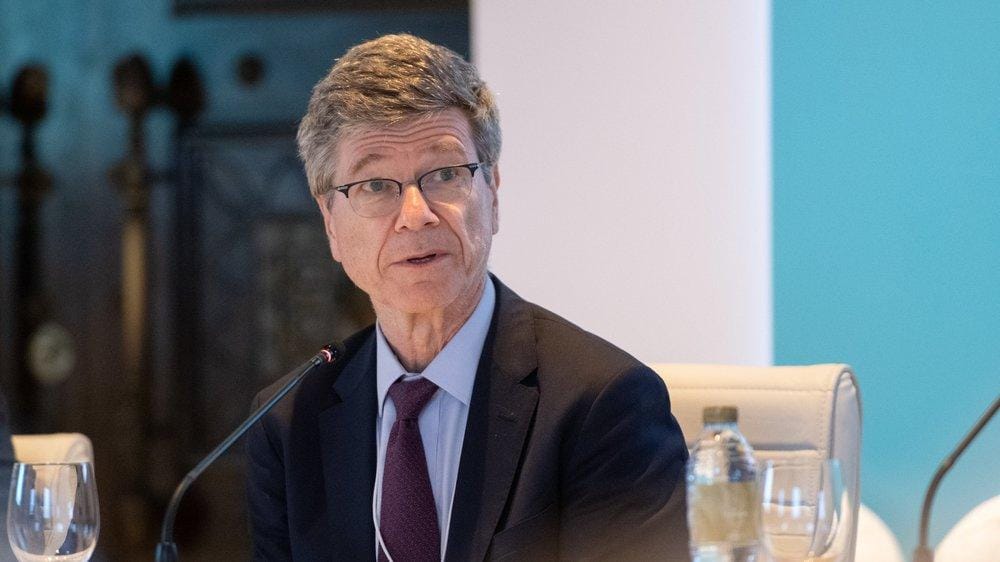
Jeffrey D. Sachs — economist, Columbia University professor, and one of the most prominent voices in international development — delivered a searing assessment of Donald Trump's trade policies at the Antalya Diplomacy Forum. What follows is a summary of his core arguments, supplemented by remarks from a Turkish finance minister who appeared on the same panel. Together, their statements constitute one of the most cogent and unsparing critiques of the current American economic posture to emerge from any major international gathering.
The Credit Card Analogy: Misunderstanding the Trade Deficit
Sachs opened with a disarmingly simple analogy that cut straight to what he regards as the foundational error in Trump's worldview. If you take your credit card and run up a large debt at various shops, he observed, it would be absurd to then accuse those shop owners of cheating you. You chose to spend beyond your means. The shops simply sold you what you wanted. Yet this, Sachs argued, is precisely the logic — or illogic — underlying Trump's framing of the US trade deficit as evidence of foreign exploitation.
The trade deficit, Sachs explained, is not a measure of trade policy fairness. It is an accounting identity taught on the second day of any introductory course in international monetary economics. The current account deficit equals the difference between what a nation spends and what it produces. National consumption, plus investment, plus government expenditure, minus gross national product — this arithmetic yields the current account deficit exactly, not approximately. The relationship is definitional. There is no room for interpretation, no margin for political spin. If a country spends more than it earns, it runs a trade deficit. Period.
The reason the United States runs a persistent and large current account deficit, Sachs stated plainly, is that it spends more than it produces — roughly $31 trillion in total spending against a national income of approximately $30 trillion. The principal driver of that gap is the federal government, which spends around $2 trillion per year more than it collects in revenues. This structural deficit exists, Sachs noted with pointed political observation, because the politicians who vote on the budget were put in office by wealthy donors who resist taxation. The result is a system that demands spending but refuses to pay for it — and then blames trading partners for the arithmetic consequences.
To blame Germany, Japan, Vietnam, or Lesotho for the US trade deficit, Sachs concluded, is to blame the shoe store for the fact that you bought shoes. Trump, in his estimation, never made it to the second day of the course.
$10 Trillion Destroyed: The Cost of Misunderstanding Trade
When the Trump administration announced its sweeping tariff regime — what Sachs called the product of "two days" of policy chaos — the world lost $10 trillion in market capitalization. Sachs paused on this figure to make a point that he regarded as equally fundamental and equally misunderstood by the administration: that wealth was not transferred from one country to another. It was destroyed.
This matters because it exposes the transactional, zero-sum worldview at the core of Trump's economic thinking. Trump, Sachs suggested, spent his career in New York real estate, a domain where one side typically wins and the other loses, where deals are adversarial by nature. He has imported that psychology wholesale into his understanding of international trade — and it is simply inapplicable.
Trade, as economists have understood since at least David Ricardo's formulation of comparative advantage in 1817, is mutually beneficial. When trade is disrupted, both parties lose. The global division of labor — whereby countries specialize in what they produce most efficiently and exchange with others — generates value that simply vanishes when nations try to go it alone. When Trump's tariff announcement effectively threatened to unwind significant portions of that system, markets around the world fell in unison. Not because the US gained at others' expense, but because the whole mechanism of value creation was being put at risk.
The market recovered approximately $4 trillion when Trump partially reversed course — pausing the higher tariffs for most countries for 90 days while maintaining a baseline 10% rate and dramatically escalating tariffs on China to 145%. Sachs noted dryly that anyone who had advance knowledge of the reversal by even five minutes would have made billions. He expressed no surprise that some people likely did, and suggested that members of Congress would be among the prime suspects.
The China Fixation and the Losing Trade War
The one major escalation Trump did not reverse was against China, where tariffs were raised rather than paused. Sachs offered a terse diagnosis: the United States has a "deep neurotic attachment" to China, rooted in resentment of its size and success. China is a rival, a competitor, and American political culture — across both parties, he implied — has decided that it hates China for those reasons.
The problem, Sachs argued, is that a trade war between the United States and China is one the United States loses. China's exports to the US represent only about 12% of its total export volume. China can absorb the blow, redirect trade flows, deepen relationships with other partners, and sustain its economy without the American market. The same cannot be said in reverse. US consumers and manufacturers are far more dependent on Chinese-produced goods — from electronics components to consumer products — than the political rhetoric acknowledges.
There is no sophisticated strategic logic at work here, in Sachs's assessment. It is simply bad policy. The 145% tariff rate does not serve any coherent negotiating objective, does not represent a principled response to specific trade abuses, and does not position the United States advantageously for any foreseeable diplomatic outcome. It is, he said bluntly, "just dumb."
One-Person Rule and the Constitutional Collapse
Perhaps Sachs's most politically charged argument concerned not economics but governance. Everything Trump has done in the trade domain — and much else besides — has been enacted through emergency decrees, executive orders premised on the declaration of an emergency that requires no proof, no Congressional authorization, and no judicial pre-approval.
Sachs read from the template: "With the powers invested in me as President of the United States, I hereby declare..." He noted that these powers are, in fact, not invested in the president under the US Constitution. Article I, Section 8 vests the power to set tariffs and duties in Congress — specifically, originating in the House of Representatives. This is not a technicality or a matter of interpretive dispute. It is the explicit text of the founding document.
The mechanism by which this constitutional arrangement has been circumvented is the proliferation of emergency authorities in US legislation since 1945, when the country reorganized itself substantially as a national security and military state. Decades of emergency provisions, layered into statute after statute, have accumulated into a reservoir of executive power that a sufficiently aggressive president can draw from without limit. Trump has declared the trade deficit a national emergency, and on that basis has imposed the most sweeping unilateral tariff regime in the modern era, without Congressional vote, without meaningful institutional check.
The result, Sachs said, is one-person rule. Even his own aides reportedly did not know what he was doing from one announcement to the next. The formula used to calculate the country-specific tariff rates — a formula so crude that Sachs said he would not accept it from a student in the third week of a first-year course — apparently emerged from the Office of the US Trade Representative after being commissioned overnight. The boss wanted numbers. Numbers were produced.
The Absurdity of Bilateral Balance
One of Sachs's most pointed passages concerned the underlying conceptual premise of the tariff formula: the idea that the United States should run a balanced trade account not in aggregate, but with every individual trading partner simultaneously.
Sachs illustrated the absurdity with personal analogy. He runs a large trade surplus with his employer — his university pays him — and he runs trade deficits with his grocery store, his shoe store, and every other vendor he patronizes. No one expects him to perform consulting work for the shoe store in exchange for footwear. The entire premise of a market economy is that you do not have to balance your trade with every individual counterparty. You earn money from one source and spend it across many. The system works precisely because multilateral exchange replaces the need for bilateral barter.
Trump's framework would require every country to perform some service for every other country it buys goods from — a vision of global commerce so primitive that it predates not just modern economics but most of recorded economic history. Yet the tariff rates announced on what the administration called "Liberation Day" were calculated precisely on this basis: if Country X sells more to the US than it buys from the US, it must be cheating, and should be taxed until bilateral balance is achieved.
The minister on the panel used Turkey as a practical illustration. Turkey is the world's second-largest exporter of white goods — washing machines, refrigerators, dishwashers. It requires semiconductor chips to manufacture them, not cutting-edge chips but mature-node components at 30, 40, or 70 nanometers. If supply chain disruption caused by a generalized trade war threatens Turkey's access to those chips, Turkey may be forced to invest massively in domestic chip production — not because it is efficient, not because it is the best use of capital, but because the international trading system has become too unreliable to depend on. This is capital misallocation on a global scale, replicated across hundreds of industries in dozens of countries simultaneously.
The Longer Arc: Poverty, Growth, and the Stakes
The second panelist placed Trump's policies in a longer historical frame. Since the 1990s, over one billion people have been lifted out of absolute poverty — predominantly in Asia, and largely through participation in global trade. The engine of that transformation was the expansion of international commerce: export-led growth, technology transfer, supply chain integration, and the disciplines imposed by competition in global markets.
That engine has already been slowing. Before the 2008 global financial crisis, global trade grew at roughly twice the rate of world GDP. After the crisis, trade growth barely kept pace with GDP growth. The trend toward protectionism has been building for years — annual trade restrictions have increased roughly elevenfold since the pre-crisis era, topping 3,200 separate measures in a recent year. What the Trump administration has now done is not an extension of that trend but a qualitative rupture: an all-out trade war that risks making protectionism not merely a drag on growth but an active destroyer of it.
The concern is not abstract. Global growth is already constrained by aging populations, high debt levels, and the looming costs of climate disruption. Protectionism at this scale could tip per capita GDP growth toward near-zero for an extended period. The billion people lifted from poverty are not yet secure. The gains are real but fragile, and the policies now being pursued in Washington threaten to reverse them.
The Obligation of the Rest of the World
Sachs closed with what amounted to a moral and political call to action. The world, he argued, cannot normalize what is happening. Two centuries of thinking about trade — from Ricardo's comparative advantage to the construction of the World Trade Organization, which the United States itself championed — cannot be discarded because one man issued emergency decrees that his own staff apparently could not anticipate or explain.
The United States, Sachs said without hedging, is behaving as a rogue nation — not only on trade, but across a range of international issues. The appropriate response for the rest of the world is not to scramble for bilateral deals, not to "kiss the ring" as Trump's own language suggested 60 nations were prepared to do, but to hold firm to the rule-based multilateral framework that has, for all its imperfections, underpinned the most successful period of human economic development in recorded history.
The cost of normalizing institutional destruction, Sachs argued, is that there is no way back. Craziness, once normalized, has no floor. The world's other governments, international institutions, and civil societies bear a responsibility to maintain the standards and frameworks that a single rogue actor is trying to dismantle — not because those institutions are perfect, but because the alternative, once embraced, cannot easily be undone.
Jeffrey Sachs spoke at the Antalya Diplomacy Forum in April 2025. His remarks were delivered as part of a panel discussion on protectionism, globalization, and the future of the rules-based international economic order.
Member discussion: