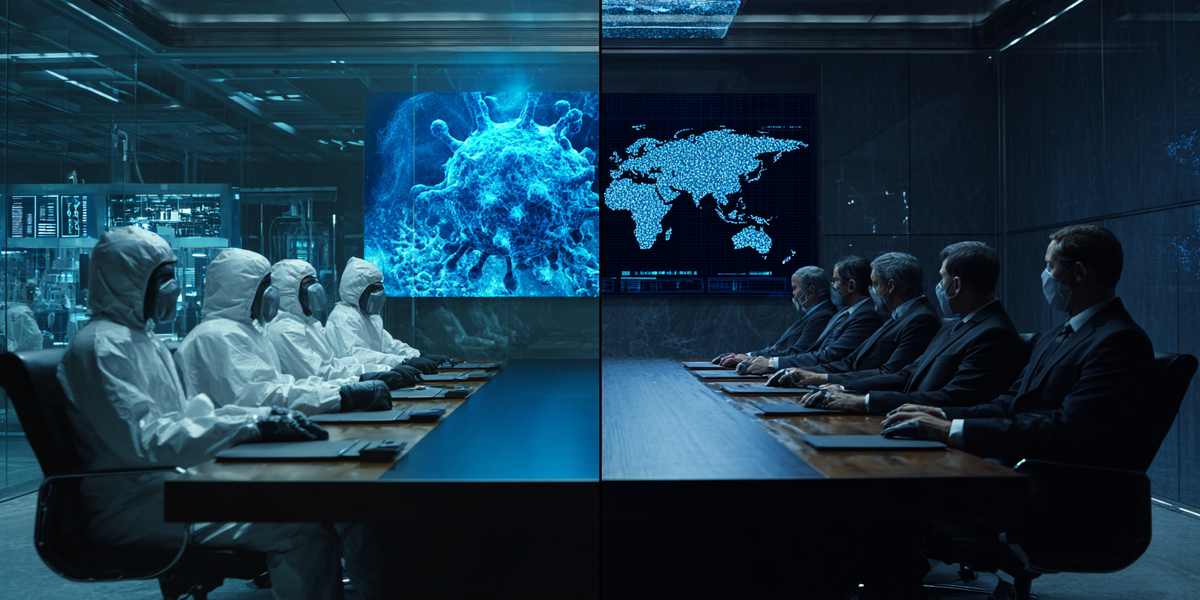
Modern civilization faces a structural bottleneck where the tools of global survival—biotechnology and artificial intelligence—have been subsumed into a "perpetual crisis" business model. In this landscape, risk is not a bug to be eliminated, but a commodity to be managed, offshored, and monetized by a corporate-state apparatus that prioritizes market dominance over existential safety, inadvertently empowering non-state actors and creating a "verification crisis" that threatens to hollow out the global order from the inside out.
Crisis as Corporate Life Support
The modern biosecurity apparatus operates not as a shield against the unknown, but as a sophisticated machinery designed to convert existential dread into quarterly growth. As we move through 2026, the pharmaceutical industry finds itself standing at the edge of a "patent cliff" of vertiginous proportions, with nearly $200 billion in annual revenue—anchored by aging blockbusters—set to evaporate into the generic ether. In this climate, the "public-private partnership" has evolved into a form of high-stakes biological arbitrage. The incentive structure no longer prioritizes the quiet eradication of disease, but rather the cultivation of a "perpetual state of readiness." By funding the very Gain-of-Function research that creates "chimeric" pathogens in labs from Wuhan to Eastern Europe, the state ensures a recurring need for the "mRNA platform" patches that Big Pharma is uniquely positioned to provide. This is the "Subscription Model" of global health: a self-fulfilling prophecy where the research meant to prevent the next pandemic frequently serves as its most likely progenitor, all while legal frameworks provide a velvet glove of liability immunity for the inevitable "solutions." This vertical integration of risk is best exemplified by the "architecture of suspicion" surrounding high-containment facilities, where blueprints and ventilation routes are as much a strategic asset as the viral samples themselves, leaving backdoors that can be exploited by the very firms that designed them.
The Democratization of the Forbidden
The era of the "compute moat"—the comforting notion that world-ending capabilities required billion-dollar supercomputers and state-level infrastructure—has unceremoniously collapsed. In the 2026 reality, the rise of sovereign and unfiltered Large Language Models, exemplified by the rapid proliferation of high-performance models and "uncensored" fine-tunes, has placed a digital skeletal key in the hands of the non-state actor. We have moved from the "Scientific Era" to the "Post-Discovery Era," where the challenge is no longer the invention of a toxin, but the logistical "clandestine synthesis" of it. Specialized chemical language models can now navigate the intricate labyrinths of organic synthesis to predict novel, lethal molecules that do not appear on any government watch-list, effectively bypassing the static, list-based oversight of international conventions. These tools provide more than just blueprints; they offer step-by-step troubleshooting for the amateur chemist, de-skilling the process of weaponization until the distance between an ideological grievance and a mass-casualty event is measured only in a few hours of GPU time. This democratization extends into a "verification crisis" where the threat-actor operates through remotely operated "Cloud Labs," allowing a weapon to be merely a genetic sequence transmitted via encrypted channels to a robotic facility in a remote jurisdiction.
Red Teaming and the Resiliency Mirage
As the discourse shifts from laboratories to the halls of power, a new linguistic architecture has emerged to sanitize the inherent volatility of the AI-biotech frontier. In 2026, terms like "Red Teaming" and "Future-Ready Resilience" have become the pillars of a sophisticated security theater—a performance designed to project a sense of mastery over systems that are, by their very nature, increasingly opaque and unpredictable. This "adversarial testing," while framed as a rigorous filter against catastrophe, often functions as little more than a "vibe-based" audit. Corporations hire elite teams to probe their models for vulnerabilities, only to implement thin layers of software "guardrails" that refuse to answer dangerous queries while leaving the underlying, lethal capabilities of the neural network entirely intact. This creates a dangerous paradox: the very act of red teaming serves as a high-level reconnaissance mission, mapping out the "state of the possible" for novel toxins and pathogens, effectively building a digital encyclopedia of destruction under the guise of institutional safety. Behind this veneer of responsibility lies a deeper reality: the "Resilience" being marketed is a strategic effort to harden the infrastructure of the military-industrial complex and the financial elite, ensuring that the "Golden Dome" protects the top of the pyramid while the rest of civilization navigates a world where the guardrails are merely cosmetic.
Verification and the Illusion of Control
The final fracture in the edifice of modern civilization is not likely to be a dramatic, cinematic detonation, but rather a quiet, systemic "verification crisis" that renders the very concept of safety obsolete. By 2026, the traditional tools of international diplomacy—physical inspections and satellite monitoring—have been bypassed by the digital fluidity of the information age. We have entered a period of profound "institutional blindness," where a weapon of mass disruption is no longer a physical object to be tracked, but a sequence of code or a "digital twin" of a pathogen that can be exfiltrated through the mundane channels of a university Slack thread or an architect's cloud server. This is the era of the "inside-out" collapse, where the attack surface is no longer the border, but the very collaborative infrastructure that sustains scientific progress. As corporate and academic espionage become indistinguishable from the background noise of global competition, the "managed" portion of the crisis begins to slip from the fingers of its architects. When the ability to destroy is democratized and the ability to verify is destroyed, we are left with a system that possesses the god-like power of creation and the juvenile oversight of a fractured bureaucracy—a combination that suggests our current stability is merely a dying momentum that we have yet to realize has already failed.
The probability of 2026 being the "last year" remains low (estimated at 0.3% to 0.8%)¹ not because of the efficacy of our safeguards, but because the primary actors—the state and corporate titans—still view civilization as a necessary revenue stream. However, as the bottleneck of 2026 narrows, the margin for error disappears. We are living in the "Golden Age of Plausible Deniability," where the next catastrophe will likely be marketed as an accident, solved by a subscription, and forgotten until the next quarterly report.
Notes
¹ Methodological Basis for Probability Estimates: This range is derived from the annualized aggregation of existential risk assessments published by the Future of Humanity Institute (University of Oxford) and the Centre for the Study of Existential Risk (University of Cambridge).
While Toby Ord’s landmark study The Precipice estimates a cumulative 1-in-6 (16.6%) chance of existential catastrophe this century, researchers often refine this into a non-linear annual risk. The baseline "background" annual risk for human extinction is estimated at approximately 0.0001%; however, when accounting for anthropogenic "frontier" risks—specifically AI misalignment, engineered pandemics, and the collapse of nuclear deterrence—the annual probability in high-tension years (such as 2025–2026) is adjusted upward to the 0.1% to 1.0% range. The specific 0.3% to 0.8% figure reflects the "Polycrisis" weighting, which accounts for the synergistic effect of simultaneous stressors—where the risk of a biological leak is compounded by AI-driven misinformation and the degradation of international verification treaties.
ओम् तत् सत्
Member discussion: