
Nationalism, Revolution, and the Manufacture of Consent
Restating the Claim
The claim on the table is this: the principles offered to ordinary people as reasons to kill, die, or simply obey — liberty, the nation, the proletariat, the people's will — are not the real causes of revolution and statecraft. They are produced, consciously or not, by an interested elite as a cheaper substitute for naked coercion, and every revolution examined closely — American, French, Russian, and the rest — reveals the same architecture underneath the rhetoric: violence and concentrated wealth doing the real work, principle doing the messaging.
That claim deserves to be taken further than "cabal" or "conspiracy" will carry it, because those words imply something the historical record mostly doesn't show: a small number of people consciously fabricating a story they know to be false. What the record shows instead, case after case, is colder and more total than a conspiracy — a convergence of separate, often mutually hostile interests on the same anti-majoritarian architecture, married to a genuine, documented sincerity among the very people building it. A conspiracy can be exposed and ended. What follows mostly can't be, because there is rarely a liar to expose. This essay tries to make that distinction precise, test it against the hardest cases — including the strongest class of counter-examples, movements that won real change from inside an existing democratic order rather than overthrowing it — and then turn the same instrument on itself, because a thesis that explains everything and can never lose a case stops being history and starts being a creed.
The American Founding: From Conspiracy to Structural Convergence
Charles Beard's 1913 An Economic Interpretation of the Constitution of the United States remains the foundational text of the cynical reading of 1787. Beard read the Constitutional Convention as a meeting of personalty — merchants, public bondholders, manufacturers, men holding paper wealth at risk from inflation and debtor relief — assembled to write a charter that would protect their holdings from the realty interests of small farmers and debtors who had dominated the more democratic state legislatures under the Articles of Confederation. He argued the system of checks and balances was designed expressly to break up popular majorities at their starting point, before they could legislate debt relief or land redistribution.¹
The framers themselves supply remarkably direct evidence for this reading. Madison's Federalist No. 10 names the unequal distribution of property as the most common and durable source of political faction, and treats the divide between those who hold property and those who do not as a fixed, permanent feature of any free society that a well-constructed government must be engineered to contain.² At the Convention itself, delegates worried openly about a "leveling spirit" emerging from a growing propertyless population, anxieties sharpened by Shays' Rebellion the previous year, in which indebted Massachusetts farmers had shut down courthouses to halt foreclosures.³ None of this is buried or inferred; it is in Madison's own notes, under his own name, stated as the explicit design problem the Constitution was meant to solve.
The fear ran in both directions, which is itself revealing. Gouverneur Morris pushed for property qualifications on officeholding because he worried that without them the wealthy would eventually establish their own dominion and reduce the rest of the country to dependency — he was as alarmed by future oligarchy as by future leveling.⁴ That two-sided anxiety doesn't soften the indictment; if anything it shows the delegates understood with some precision what kind of capture, in either direction, an unconstrained government could produce, and built a structure to make sure neither faction's worst-case scenario could be legislated easily — which, not incidentally, meant neither faction's hoped-for reform could be legislated easily either.
Where the "cabal" framing breaks down is in what happened next. Ratification was not a foregone conclusion rubber-stamped by an intellectual and physical minority, as a true conspiracy could arrange in advance. It was a near-run contest, fought in public, in pamphlets any literate colonist could buy, between Federalists and an Anti-Federalist opposition — Patrick Henry, George Mason, the writers behind "Brutus" and the "Federal Farmer" — who made exactly the elite-capture argument now being revived. Massachusetts ratified by a margin of 187 to 168.⁵ Virginia, where Henry and Mason fought the document for nearly a month, ratified 89 to 79 — and informal nose-counts going into that convention had it at an even 84 to 84.⁶ New York scraped through 30 to 27.⁷ A document engineered by a unified conspiracy to foreclose democratic outcomes should not need to survive votes this close, in the country's largest and most consequential states, after a public airing of precisely the charge being leveled against it.
Forrest McDonald's 1958 We the People put Beard's specific economic claims to the most exhaustive test they have received, reconstructing the financial biographies of all fifty-five Convention delegates and some 1,750 members of the state ratifying conventions.⁸ His finding complicates the cabal story further: only a small number of delegates voted in transparent service of personal financial interest; a comparable number voted on philosophical conviction even where it cut against their own economic position; the rest divided along loyalties — regional, ideological, factional — that didn't sort cleanly into rich versus poor at all.
The more defensible synthesis, then, isn't that a unified elite conspired to write Madison's fears into law. It's that several factions with conflicting material interests — Northern bondholders wanting federal power to honor war debt at face value, Southern planters wanting federal power kept away from slavery, large states wanting representation by population, small states wanting it by state — fought each other for four bitter months and settled on an anti-majoritarian structure because it was the only design that protected each of their separate stakes simultaneously, whatever else it did or didn't accomplish for everyone else. That is a structural convergence, not a plot. And it is arguably the more damning of the two readings, because a structural convergence requires no secret meeting to keep producing the same kind of outcome. It just needs the same kind of people, with the same kind of stakes, doing what comes naturally to people with stakes.
France: Where the Historians Themselves Split
The French case complicates the thesis in an instructive way, because the cynical, materialist account of 1789 — the Revolution as the bourgeoisie's seizure of state power from a feudal aristocracy blocking its economic ascent — was for most of the twentieth century the dominant scholarly orthodoxy, championed by historians like Albert Soboul.⁹ It is also the account that has come under the most serious and sustained challenge from within the historical profession itself, not from conservative apologists for the old regime but from François Furet, a historian who began as a Marxist and broke from that tradition explicitly. In Interpreting the French Revolution (1978), Furet rejected what he called the Marxist "catechism" of class struggle as the Revolution's hidden engine, arguing instead that the Revolution was driven substantially by political ideology, institutional contingency, and a centralizing logic already underway in the old absolutist state — a reading closer to Tocqueville's than to Marx's.¹⁰ Furet's "the revolution is over" claim, made in the 1970s, meant specifically that he considered the deterministic Marxist philosophy of history discredited as an explanation for what happened in France.¹¹
Furet's account draws heavily on Tocqueville's older observation that the Revolution largely completed, rather than reversed, a process of administrative centralization the French monarchy had already been pursuing for more than a century — meaning the revolutionaries were in some sense finishing the absolutist state's own project under a different banner, not overthrowing it. Revisionist historians outside France, notably Alfred Cobban and William Doyle, reached compatible conclusions from different angles, each chipping away at the idea that a rising bourgeois class straightforwardly explains who acted and why.¹²
This is not a settled question. Marxist historians have pushed back hard, and some of the most detailed empirical studies of the revolutionary clubs — Michael Kennedy's work on the Jacobin societies, for instance — concluded that the radical-class account still captures a great deal that Furet's framework misses.¹³ The honest summary is a genuine, ongoing dispute among serious historians, not a case where one side has been vindicated and the other debunked.
What this means for the present argument is worth being precise about. If Furet is substantially right that ideology and political contingency, not simply class economics, drove the French Revolution, that does not actually rescue the Revolution from the cynical reading — it relocates the stakes rather than dissolving them. The Jacobin leadership had no factories or bondholdings to protect, but they had something else worth protecting just as ruthlessly: political position, and during the Terror, bare physical survival. Robespierre's faction acted in defense of those stakes with at least as much violence as any planter defending a slave or any bondholder defending a debt. Widen "material interest" to include power and survival, not merely property, and Furet's political account becomes just as compatible with a structural-convergence reading as Beard's economic one — it simply names a different currency changing hands.
Russia: The Cleanest Confession
If any case supplies something closer to a clean test of the thesis, it is Russia, because the most devastating account of the Bolshevik Revolution's betrayal of its own stated principles comes not from a hostile outside critic but from one of the revolution's own architects. Leon Trotsky's The Revolution Betrayed (1936) describes how, as the exhausted Soviet working class that had made the October Revolution receded from active political life, a bureaucratic stratum that had been cowed during the revolutionary years reasserted itself, pushed the workers aside, and raised itself above society as a new privileged ruling caste.¹⁴ Trotsky describes Stalin not as an aberration but as the personification of that caste's interests, the figure each bureaucrat could most easily recognize himself in.¹⁵ The caste, on Trotsky's account, would not be satisfied with privilege and salary alone; it would move, over time, to convert its control of state property into private property and pass its position to its children — the precise dynamic that did, in fact, characterize the Soviet nomenklatura in the decades that followed.¹⁶
Notably, Lenin himself had flagged the danger before Trotsky did. In his last writings, dictated as illness confined him, Lenin warned about the swelling apparatus of state bureaucrats and worried specifically about Stalin's concentration of power inside the party machine — a warning his own colleagues mostly set aside after his death in 1924.¹⁷ The pattern Trotsky later diagnosed at length, in other words, had already been spotted from inside the leadership while it was still forming, which makes its eventual triumph look less like an unforeseeable betrayal and more like a foreseeable structural outcome that nobody with the power to stop it had sufficient interest in stopping.
What makes this the cleanest case is that it requires no external, ideologically hostile lens to reach the cynical conclusion. The man making the argument believed in the Revolution more fiercely than almost anyone alive in 1936, had helped build the apparatus he was now describing, and was using the very analytical tools — class formation, material interest disguised as ideology — that Marxism itself supplies to indict the people who had captured his own movement. If "they're all duped, period" is going to hold anywhere without serious qualification, it holds here: a revolution explicitly built to abolish class privilege produced, within two decades, a new privileged class defended by the identical rhetorical machinery — "the people," "the workers' state," "socialism" — that had been used to dismantle the old one.
Why Ideology Is Cheaper Than the Sword
The mechanism connecting all three cases is best named by Antonio Gramsci, writing in Mussolini's prisons in the 1930s. Gramsci described the modern state as composed of two intertwined elements: political society, meaning the coercive apparatus of police, courts, and army, and civil society, meaning the schools, churches, and press through which a ruling group secures the active consent of the governed to its own continued dominance.¹⁸ Hegemony, in his usage, is not a third force competing with violence and wealth for control of events. It is the technology that lets violence and wealth operate at a steep discount.¹⁹ A ruling order that must deploy troops on every corner to secure obedience is spending enormously; a ruling order that gets the governed to experience the arrangement as natural, sacred, or simply how a nation works gets the same compliance for a fraction of the cost, and gets it without having to display the violence at all except in moments when consent breaks down.
This reframing answers the conspiracy question more honestly than "cabal" does. Madison did not have to lie about factions to build a hegemonic structure; he had only to be sincerely convinced, as a Virginia planter, that what protected his class also protected liberty itself. Robespierre did not have to lie to send men to the guillotine in the name of the nation; the Terror's architects mostly seem to have believed in the nation they were terrorizing people on behalf of. The Bolshevik bureaucracy did not need a secret meeting to decide to become a new privileged caste; it only needed, as Trotsky describes it, to gradually stop noticing the gap between its language and its position. A pure lie collapses once it's exposed — the Anti-Federalists exposed the Constitution's anti-majoritarian design in 1788, in public, and it still won, because the people defending it weren't performing a con they knew to be false.
Testing the Real Exception: Movements Inside the System
Before turning the argument on itself, it is worth testing it against its strongest class of counter-examples: movements that won durable change without overthrowing the constitutional order they operated inside, using courts, legislatures, the press, and the ballot rather than seizing the state by force. Suffrage, organized labor, the Indian independence struggle, and the Black freedom movement in the United States are all routinely cited as proof that nonviolent pressure inside a democratic system produces better, more humane outcomes than revolution from outside it. The honest version of that claim has to include the violence that ran through all four of these movements, not just the violence done to them.
The suffrage movement is usually remembered through its most disciplined tactics — petitions, lobbying, the Silent Sentinels who picketed Wilson's White House and were beaten and force-fed after their arrest at the Occoquan Workhouse in November 1917, an episode that came to be called the Night of Terror.²⁰ But the British wing of the movement deliberately escalated beyond peaceful protest. After police brutalized suffragists on "Black Friday" in 1910, the Women's Social and Political Union under Emmeline and Christabel Pankhurst turned in 1912 to a sustained campaign of arson and bombing — postboxes, train stations, the half-built house of a sitting chancellor — that ran for two years and killed at least one person besides injuring others.²¹ Women won the vote in the United States in 1920 and in full in Britain by 1928. The right itself has never been rescinded; what lagged for decades afterward was the economic and political power that the franchise alone did not deliver.
Organized labor supplies the bluntest case, because it has, in the United States, been substantially crushed. Mine workers fought armed company guards and state militias for a generation — the 1914 Ludlow Massacre, where Colorado National Guardsmen and mine guards killed strikers' families in a burning tent colony, and the 1921 Battle of Blair Mountain, where some ten to fifteen thousand armed miners fought company forces for days until federal troops and a U.S. Army Air Service bombing run, the only known use of American air power against American civilians, ended the country's largest labor uprising since the Civil War.²² That violence, and the organizing it hardened, fed into the Wagner Act of 1935 and a union membership rate that peaked near a third of the American workforce in the mid-1950s. The 1947 Taft–Hartley Act began rolling that back almost immediately, and decades of deindustrialization, right-to-work statutes, and weakened labor law since have brought density down to roughly one worker in ten today, concentrated mostly in the public sector.²³ Here the institutional win was real, and it was substantially reversed.
Gandhi's satyagraha is the cleanest theorized case of deliberate nonviolence as strategy rather than tactic, and it ran the entire independence struggle alongside currents that rejected it outright. Bhagat Singh's Hindustan Socialist Republican Association bombed the colonial Legislative Assembly in 1929 and assassinated a police officer, and Singh was hanged in 1931 still arguing that armed revolution, not noncooperation, would free India.²⁴ A decade later Subhas Chandra Bose escaped house arrest, allied with the Axis powers, and led the armed Indian National Army against British forces — and Gandhi, who had publicly opposed Singh's methods, grew visibly more sympathetic to Bose's. Independence in 1947 arrived through some combination of Gandhi's moral pressure, Britain's wartime exhaustion, the INA's trials galvanizing Indian public opinion, and a mutiny in the Royal Indian Navy that showed London its own armed forces could no longer be relied on — alongside a Partition that killed between one and two million people. Gandhi himself was assassinated in January 1948 by Nathuram Godse, a Hindu nationalist who framed Gandhi's nonviolence and conciliation toward Muslims as a betrayal that had to be answered with exactly the force Gandhi had spent his life trying to make unnecessary.²⁵
The Black freedom struggle in the United States ran the same dual track. Martin Luther King's nonviolent direct action coexisted with Robert F. Williams organizing an armed rifle club to defend Monroe, North Carolina's Black community from the Klan, and with the Deacons for Defense and Justice, founded in Louisiana in 1964, providing armed protection for nonviolent demonstrators across the Deep South.²⁶ Williams's 1962 Negroes with Guns directly influenced Huey Newton's founding of the Black Panther Party, and the late 1960s saw both organized armed self-defense and unplanned uprisings in Watts, Newark, and Detroit. The nonviolent wing produced the Civil Rights Act of 1964 and the Voting Rights Act of 1965 — durable federal law. The armed wing was answered with disproportionate and often illegal force: the FBI's COINTELPRO program infiltrated the Black Panther Party with informants and, in collaboration with Chicago police, orchestrated the December 1969 killing of twenty-one-year-old Fred Hampton in his bed.²⁷ Decades later, the Supreme Court's 2013 ruling in Shelby County v. Holder gutted the Voting Rights Act's preclearance formula, and a wave of new voting restrictions followed within hours.²⁸ The legislative win has proven real and also, in part, reversible.
Passive Revolution: Why the Wins Are Real, and Also Reversible
Gramsci has a name for exactly this pattern, distinct from straightforward hegemony: passive revolution, and its companion mechanism, trasformismo — the process by which a dominant order absorbs oppositional pressure by granting selective reforms and pulling individual movement leaders into its own institutions, rather than either crushing the movement outright or genuinely redistributing power.²⁹ It is a more precise description of political brinksmanship and cultural co-opting than either "cabal" or pure repression would suggest: the order does not need to lie about the reform, and does not need to refuse it either. It only needs to grant enough to relieve the pressure while leaving the underlying distribution of power essentially where it was.
The four cases above show this mechanism operating along two distinct tracks, and the difference between the tracks matters. Movements that escalated to direct armed confrontation with the state were met with the state's coercive monopoly and lost disproportionately fast: Nat Turner's 1831 revolt killed some fifty-five to sixty-five people and was answered with reprisal killings of more than a hundred uninvolved Black Virginians and a regionwide tightening of slave codes;³⁰ the Blair Mountain miners were stopped by federal bombers; the Black Panther Party was dismantled by infiltration and assassination rather than by Congress changing its mind. Movements that stayed inside the register of consent — courts, statutes, the vote, the language of citizenship and natural rights the existing order already claimed to honor — won gains the dominant order found cheaper to grant than to be seen openly refusing.
But "cheaper to grant" is not the same as "permanent," and this is where the labor case has to be taken fully seriously rather than waved past. A right embedded in formal legal personhood — the vote, equal protection — is costly for a government to revoke outright, because revocation is itself a visible, delegitimizing act that the opposition can organize around; eroding it quietly through redistricting, ID laws, or a gutted preclearance formula is cheaper precisely because it avoids that visible repeal. A right embedded in administrative and economic structure — a federally protected bargaining process, a union's density inside a particular industry — has no equivalent floor. It can be unwound through ordinary legislation, court rulings, and economic restructuring with no single dramatic moment for anyone to organize against, and that is essentially what happened to organized labor in the United States across the eight decades since the Wagner Act. The form a win takes, not simply whether it was won violently or peacefully, determines how expensive it is for the existing order to take back.
None of this hands the thesis a clean victory. It refines it. These movements demonstrate that hegemony's cheaper, consent-based channel can produce real, hard-won, sometimes irreversible gains that direct force could not — the vote has never been taken back. But they also demonstrate that "irreversible" is doing a great deal of work in that sentence, and that the same channel which makes some gains durable makes others, like organized labor's, durable only as long as the coalition willing to defend them stays in power. The structural-convergence thesis survives this test in a colder form than it entered it: not every challenge to the existing order is crushed by force, but every challenge, violent or not, ultimately depends on a balance of organized power that the dominant order can eventually outlast, out-legislate, or quietly absorb.
The Reflexivity Problem, and Where the Thesis Should Lose
A thesis this total has to survive being turned on itself, and here it runs into real trouble that deserves to be named plainly rather than argued around.
First, the self-undermining regress. If every professed principle is, without exception, cover generated by material interest, then Marx's theory of ideology and Gramsci's theory of hegemony are themselves utterances produced by people occupying particular social positions — intellectuals competing for standing within their own institutions, a category Gramsci's own concept of the "organic intellectual" half-acknowledges.³¹ A claim that explains away the sincerity of every other belief as structurally determined, while quietly exempting its own claim to insight from that same treatment, is special pleading. Push the logic all the way down and either nothing — including the cynical thesis itself — can claim to be more than its holder's position talking, or some principled stopping point has to be found where belief really can track something other than whoever profits from it. The moment that exception is granted anywhere, "period" has to come off the end of the sentence.
Second, falsifiability. Karl Popper's central objection to deterministic historicist theories of this shape was that a framework able to reinterpret every disconfirming case as further proof of itself — the sincere believer was really serving interests he couldn't see; the costly reform was really securing interests in some less obvious register — has stopped functioning as a historical explanation and started functioning as an article of faith, because nothing could ever count as evidence against it.³²
Third, and most concretely, there is at least one major case where the materialist reading was made forcefully by a serious historian and then lost real ground to the evidence. Eric Williams's Capitalism and Slavery (1944) argued that Britain's abolition of the slave trade and slavery served the interests of a newly ascendant industrial capitalist class displacing an outmoded, slave-based mercantile planter aristocracy — another instance of moral principle as packaging for an economic transition already underway.³³ Seymour Drescher's Econocide (1977) mounted a sustained, data-driven challenge: British Caribbean slavery and the slave trade were near peak profitability, not in decline, when Parliament abolished them in 1807 and 1833, and abolition proceeded against the immediate economic interests of substantial capital, propelled by a genuinely mobilized popular and religious antislavery movement.³⁴ The Williams–Drescher debate has never been cleanly resolved in either direction, and serious historians still argue both sides.³⁵ But the survival of Drescher's case within respected scholarship matters for the present argument regardless of who eventually wins: it shows that "every claimed principle turns out to be cover for material interest" cannot simply be assumed true by analogy from one case to the next. It has to be demonstrated, case by case — and in at least one well-studied instance, the demonstration has been seriously, evidentially contested rather than confirmed.
There is also a more modest but important distinction the cynical reading sometimes erases: between conscious fraud and sincere belief that simply could not see past its own position. Madison and Jefferson both wrote about natural rights and the dangers of concentrated power in contexts where there was no audience left to dupe — private letters, late-life correspondence, moments with nothing to gain from performing conviction. Jefferson held people in slavery while writing some of the most uncompromising language about inherent human liberty ever produced by a head of state, and there is little evidence he experienced that as hypocrisy rather than as an unresolved problem he kept deferring. That is a different moral failure than lying, even if the practical result — a constitutional order that protected slaveholding alongside liberty — looks the same from outside. It is, in a sense, a more universal indictment, because it doesn't require finding a villain; it only requires noticing that almost nobody, in any era, can fully see around the edges of whatever position is paying their way.
None of this rescues Madison or Robespierre or Stalin's bureaucracy from the indictment built in the earlier sections; the documentary record there is too direct. But it should discipline the scope of the claim. The most defensible version of this thesis is not "every principle, everywhere, is provably a lie" — that version cannot survive its own logic and loses at least one real case when tested. The defensible version is narrower and, properly understood, bleaker: sincere belief and class or factional interest are not usually separable things that a cynic can pry apart to reveal the lie underneath. They are fused at the point of formation in the believer's own mind, which is exactly why the resulting structures are stable enough to survive public exposure, multiple revolutions, and two and a half centuries of historians trying to take them apart.
Conclusion
"Cabal" and "conspiracy" describe a problem that has a fix: find the liars, expose the lie, and the con collapses. What the American, French, and Russian cases actually show, and what Gramsci's account of hegemony names directly, is a problem with no equivalent fix, because in most of the load-bearing moments there is no liar to expose — only people whose sincere convictions happened to be inseparable from their own position, fused together so thoroughly that even revolutions built explicitly to escape the pattern, like the Bolsheviks', reproduced a version of it within a generation, confirmed by the revolution's own most committed internal critic. The strongest class of counter-examples — suffrage, organized labor, satyagraha, and the Black freedom struggle — confirms the same asymmetry from the inside: the flanks that picked up arms were answered with disproportionate force, and even the gains that never reached for arms survive only as long as the coalition willing to defend them does.
That is the colder and, I think, more honest form the cynicism should take: not a fixable scandal, but a structural feature of how durable power actually reproduces itself, robust enough to survive both sincere belief and full public exposure at once. Where it has to stop short of "period" is exactly where its own logic, turned back on itself, demands — it must risk losing real cases on the actual evidence, as it does at least once, with the abolition of the British slave trade, and it must apply its own account of ideology to its own account of ideology, rather than exempting itself. A thesis willing to do both of those things is more dangerous to comfortable patriotism than the conspiracy theory it replaces, not less — because there is no cabal left to blame, and nowhere left to put the responsibility except in the ordinary, well-documented human habit of believing most sincerely in whatever it is that happens to serve us.
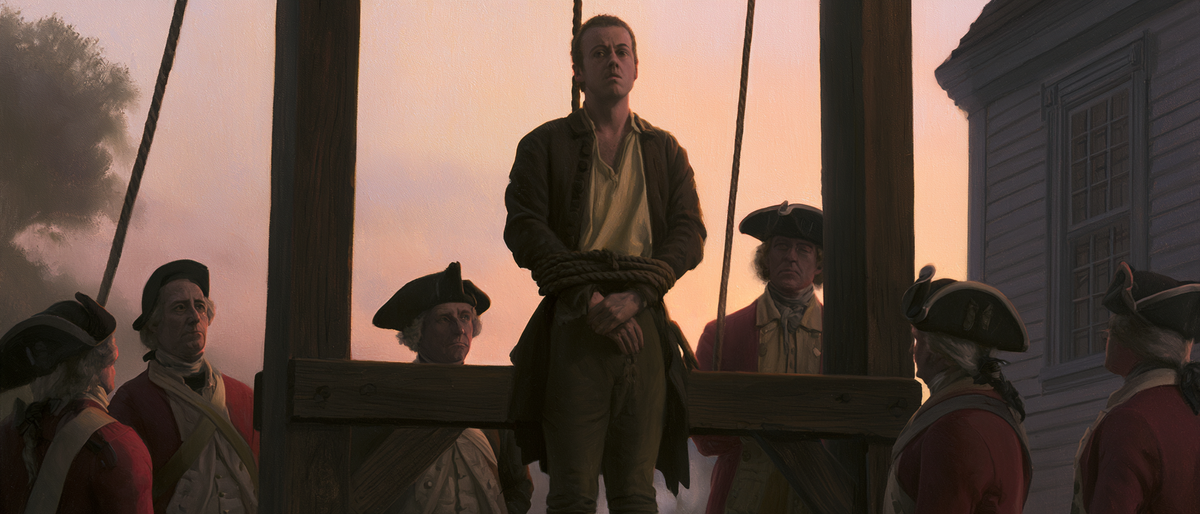
It is worth ending where this argument began. Nathan Hale's death belongs to this colder category too: not a stupid waste engineered by liars he never met, but a sincere death inside a structure that did not need anyone to lie in order to produce it — which, depending on temperament, is either a small mercy or the most damning verdict available.
Notes and Sources
¹ Charles A. Beard, An Economic Interpretation of the Constitution of the United States (New York: Macmillan, 1913).
² James Madison, "Federalist No. 10," in The Federalist Papers, first published in The Daily Advertiser (New York), November 22, 1787.
³ Records of the Federal Convention of 1787, ed. Max Farrand (New Haven: Yale University Press, 1911), on delegate anxieties over a "leveling spirit" and the influence of Shays' Rebellion (1786–87).
⁴ Records of the Federal Convention of 1787, ed. Max Farrand, on Gouverneur Morris's remarks regarding property qualifications for officeholding.
⁵ Massachusetts ratifying convention, February 6, 1788, vote of 187–168. See "Ratification Dates and Votes," U.S. Constitution Online, usconstitution.net.
⁶ Virginia ratifying convention, June 25, 1788, vote of 89–79; pre-convention estimate of 84–84 cited in Gordon Lloyd, "The Six Stages of Ratification," Teaching American History, teachingamericanhistory.org.
⁷ New York ratifying convention, July 26, 1788, vote of 30–27. See "Ratification Dates and Votes," U.S. Constitution Online.
⁸ Forrest McDonald, We the People: The Economic Origins of the Constitution (Chicago: University of Chicago Press, 1958).
⁹ Albert Soboul, Sur la Révolution française (Paris: Éditions sociales, 1970), representative of the Marxist social interpretation.
¹⁰ François Furet, Interpreting the French Revolution, trans. Elborg Forster (Cambridge: Cambridge University Press, 1981; orig. Penser la Révolution française, 1978).
¹¹ Discussed in Gary Kates, ed., The French Revolution: Recent Debates and New Controversies (London: Routledge, 1998).
¹² Alexis de Tocqueville, The Old Regime and the Revolution (1856); see also Alfred Cobban, The Social Interpretation of the French Revolution (Cambridge: Cambridge University Press, 1964), and William Doyle, Origins of the French Revolution (Oxford: Oxford University Press, 1980).
¹³ Michael Kennedy's research on the Jacobin clubs, discussed in Paul McGarr, "The French Revolution: Marxism versus Revisionism," International Socialism, no. 80 (September 1998).
¹⁴ Leon Trotsky, The Revolution Betrayed, trans. Max Eastman (1937; orig. 1936), ch. 5, "The Soviet Thermidor."
¹⁵ Trotsky, The Revolution Betrayed, ch. 11, "Whither the Soviet Union?"
¹⁶ Trotsky, The Revolution Betrayed, ch. 10.
¹⁷ V.I. Lenin, dictated notes of December 1922–January 1923, commonly known as Lenin's Testament.
¹⁸ Antonio Gramsci, Selections from the Prison Notebooks, ed. and trans. Quintin Hoare and Geoffrey Nowell-Smith (New York: International Publishers, 1971; written 1929–1935).
¹⁹ Perry Anderson, "The Antinomies of Antonio Gramsci," New Left Review I/100 (November–December 1976).
²⁰ On the Silent Sentinels and the Night of Terror at the Occoquan Workhouse, November 1917, see Doris Stevens, Jailed for Freedom: American Women Win the Vote (New York: Boni and Liveright, 1920); and Eleanor Clift, Founding Sisters and the Nineteenth Amendment (Hoboken: Wiley, 2003).
²¹ On the WSPU's 1912–1914 arson and bombing campaign, see Diane Atkinson, Rise Up, Women!: The Remarkable Lives of the Suffragettes (London: Bloomsbury, 2018).
²² On Ludlow and the Battle of Blair Mountain, see James Green, The Devil Is Here in These Hills: West Virginia's Coal Miners and Their Battle for Freedom (New York: Atlantic Monthly Press, 2015); and Charles B. Keeney, The Road to Blair Mountain: Saving a Mine Wars Battlefield from King Coal (Morgantown: West Virginia University Press, 2015).
²³ On union density and the Taft–Hartley rollback, see Congressional Research Service, A Brief Examination of Union Membership Data, Report R47596 (2023); and Economic Policy Institute, "Union Membership and Income Inequality" (2015).
²⁴ On Bhagat Singh and the Hindustan Socialist Republican Association, see "'Give Me Blood, and I Will Give You Freedom': Bhagat Singh, Subhas Chandra Bose, and the Uses of Violence in India's Independence Movement," Education About Asia, Association for Asian Studies.
²⁵ On Gandhi's assassination and Nathuram Godse's stated motives, see Ramachandra Guha, Gandhi: The Years That Changed the World, 1914–1948 (New York: Knopf, 2018).
²⁶ On Robert F. Williams and the Deacons for Defense, see Robert F. Williams, Negroes with Guns (1962; repr. Detroit: Wayne State University Press); and Lance Hill, The Deacons for Defense: Armed Resistance and the Civil Rights Movement (Chapel Hill: University of North Carolina Press, 2004).
²⁷ On COINTELPRO and the killing of Fred Hampton, see Jeffrey Haas, The Assassination of Fred Hampton: How the FBI and the Chicago Police Murdered a Black Panther (Chicago: Lawrence Hill Books, 2010).
²⁸ Shelby County v. Holder, 570 U.S. 529 (2013); see also Brennan Center for Justice, "Effects of Shelby County v. Holder on the Voting Rights Act" (2023).
²⁹ Gramsci, Selections from the Prison Notebooks, on "passive revolution" and trasformismo.
³⁰ On Nat Turner's Rebellion and its reprisals, see Patrick H. Breen, The Land Shall Be Deluged in Blood: A New History of the Nat Turner Revolt (New York: Oxford University Press, 2015).
³¹ Gramsci, Selections from the Prison Notebooks, section "The Intellectuals."
³² Karl Popper, The Poverty of Historicism (London: Routledge & Kegan Paul, 1957).
³³ Eric Williams, Capitalism and Slavery (Chapel Hill: University of North Carolina Press, 1944).
³⁴ Seymour Drescher, Econocide: British Slavery in the Era of Abolition (Pittsburgh: University of Pittsburgh Press, 1977; 2nd ed., Chapel Hill: University of North Carolina Press, 2010).
³⁵ See David Beck Ryden, West Indian Slavery and British Abolition, 1783–1807 (Cambridge: Cambridge University Press, 2010); and Gerald Horne, "Eric Williams and the Tangled History of Capitalism and Slavery," The Nation, October 2021.
Jonathan Brown writes on technology, security, and culture for bordercybergroup.com and aetheriumarcana.org.
To support our work, please subscribe or (look to your right)... Buy us a coffee! Thanks!
Member discussion: