
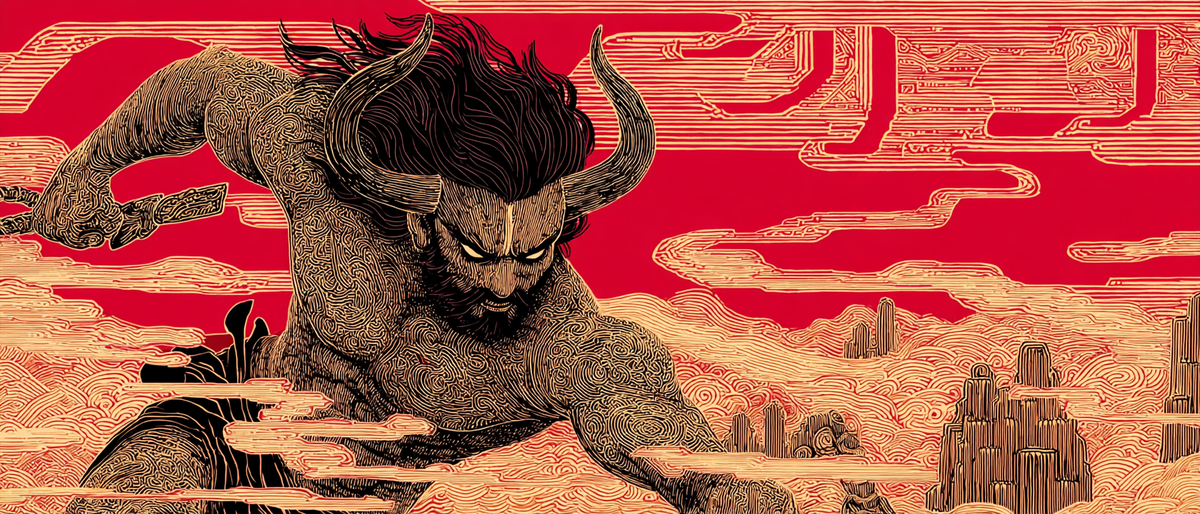
Essay Two in our Series The Villain's Journey
The Curse at the Gate
The story does not begin with a demon.
It begins in Vaikuntha — the eternal realm, the highest destination in the Vedic cosmological map, the place where the drama of the material world has no purchase and time has no dominion. If the series has a destination — the place everything in these fourteen essays is ultimately pointing toward — it is here. And it is here, at the very beginning, that the story we have come to tell takes its first breath.
Two figures stand at the gate. Their names are Jaya and Vijaya, and they are not visitors. They are not aspirants working their way toward admission. They are eternal residents of Vaikuntha — doorkeepers in the most literal sense, figures whose position at the threshold of the divine realm is not a job but an ontological fact, as permanent as the realm they guard. They are already home. They have always been home. The material world, with its cycles of birth and forgetting and return, is a story they have no part in.
Until today.
The four Kumaras arrive at the gate. In appearance they are children — four small figures, naked, moving with the unhurried ease of those who have renounced everything and therefore need nothing. In reality they are among the oldest and wisest beings in existence, the mind-born sons of Brahma, sages whose austerities and knowledge have taken them so far beyond the categories of the material world that they wander the cosmos in complete freedom, carrying no agenda, serving no faction, available to grace in any form it chooses to take. They move toward the gate of Vaikuntha, seeking an audience with its Lord.
Jaya and Vijaya refuse them entry. The tradition does not linger on the reasons, although it is noted that their nakedness is the disqualifying factor, despite their appearance as very young boys. Perhaps the doorkeepers acted from pride. Perhaps from excessive devotion to their duty — a zeal for the gate that had calcified into an obstacle at the gate. What matters is the act and its consequence. The four Kumaras, who carry within them the patience of immeasurable ages of practice, are stopped at the door of the divine realm by two figures who have confused their function with their authority. The curse that follows is not revenge. It is precision. You will fall — into the material world, far from this gate, far from this realm, in the grip of everything that Vaikuntha is not.
And here the tradition does something that will echo through every page of this series.
Vishnu himself appears. He comes not in anger but in what can only be called grace operating with the swiftness of understanding — he sees everything that has happened and everything it means, and his first act is to apologize to the Kumaras on behalf of his devotees. The Lord of Vaikuntha, before addressing the consequences of the offense, takes responsibility for those in his care. Then he turns to Jaya and Vijaya, and he offers them a choice.
Seven lives in the material world as his devotees, practicing the path of love and remembrance, moving slowly but surely toward return. Or three lives as his enemies — as figures who will stand against everything he represents, who will deny him, persecute his worshippers, wage war against the cosmic order he sustains — and return to Vaikuntha far sooner, by a road whose cost is almost beyond reckoning.
Jaya and Vijaya choose three lives. They choose enmity. They choose the faster road home, knowing precisely what it will demand of them. They choose to be born into the material world not as seekers but in genuine opposition to the very authority that mitigated their curse.
This is where Hiranyakashipu begins. Not as a rebel who stumbled into collision with the divine. Not as a soul lost in darkness of its own making. As a Vaikuntha resident who chose — from the platform of complete devotional consciousness, with full understanding of what he was agreeing to — to descend into the material world under the complete covering of Mahamaya, the divine illusory energy that occludes the soul's true identity as thoroughly from itself as from everyone it encounters. The choice was made in full knowledge. The covering, once the descent begins, is total. These are sequential realities, not contradictory ones: the knowledge belongs to the moment of choosing; the covering belongs to every moment that follows. Hiranyakashipu will not remember Vaikuntha. He will not carry within him some preserved interior awareness of who he actually is. He will be a demon in every possible sense — genuinely, totally, without remainder — and his self-realization will come only at the very end of the pastime he agreed to enter.
The only figures in this drama who hold both pieces of knowledge simultaneously are the tradition — and therefore us. This is what the Prologue is for. It gives us the reader's asymmetric vantage: we know what Hiranyakashipu does not know about himself. That knowledge is not a reason to watch the story with detachment. It is a reason to watch it with the particular quality of attention the tradition reserves for its most sacred dramas — the ones that are simultaneously, without contradiction, completely real and completely agreed-upon.
The Man on the Mountain
The Mandara mountains do not look like a place where history is being made. They look like a place where the world is ending.
The trees within a radius that the texts decline to measure precisely have been reduced to ash. The rivers run warm. The earth beneath his feet — one foot, the single point of contact he has permitted himself with the ground for a duration that has long since exceeded any category of human time — is blackened and cracked, as though the soil itself is trying to get away from what is standing on it. Smoke rises from his body in visible columns, carrying upward into the sky something that is not quite heat and not quite light but partakes of both — the visible signature of tapas-shakti accumulating past any threshold the cosmos had established for a single embodied being.
His arms are raised. His eyes are closed. His name is Hiranyakashipu, and he is conducting the most sustained act of spiritual practice in the Puranic literature — and he would be furious to hear it described that way.
He is not, by his own account, doing anything spiritual. He is building a weapon.
The weapon he is building is power — pure, unaligned, cosmologically consequential power, the kind that does not require the permission of any divine authority and does not operate within any moral accounting system. He has watched his brother Hiranyaksha killed by Vishnu in the form of a boar, dragged from the cosmic ocean where he had hidden the earth, defeated in combat, slain. The devotees of Vishnu call this a liberation. Hiranyakashipu calls it a murder committed by a God whose followers have declared his violence sacred and everyone else's violence criminal. He has looked at the architecture of the cosmos — the devas in their positions, Vishnu sustaining the whole apparatus, the great cycles of creation and dissolution proceeding according to a grammar he did not consent to and was not consulted about — and he has made a decision. He will not petition. He will not negotiate. He will accumulate sufficient force that the architecture itself must bend toward him, and then he will take what he wants.
What he wants is the death of Vishnu.
This is important to understand before we proceed, because it is the thing that distinguishes Hiranyakashipu from every villain the Western tradition knows how to produce. He is not trying to escape the system. He is not trying to carve out a private domain within it. He is coming for the center. He intends to remove the force that sustains the cosmic order and replace that order with his own. The ambition is total. The program is absolute. And the means he has chosen to achieve it — the means he is employing right now, in these mountains, with his body generating heat that is being registered in the heavens as seismic event — are the tradition's own most honored means.
He is performing tapas.
The word resists clean translation, which is the tradition's first instruction about what it means. Asceticism is too narrow. Austerity catches the self-denial but not the heat. Spiritual practice is accurate but bloodless, and tapas is nothing if not physical — it is fire, literally, the Sanskrit root the same root that gives us the English word tepid, the cognate of heat in every Indo-European language where the concept survives. But the heat in question is not merely metabolic. It is ontological. It is the heat of concentrated being pressing against the limits of what form can contain — the force that, in the cosmological understanding of the tradition, preceded creation itself. Before Brahma created the world, the texts tell us, he performed tapas. The force that drives the universe into existence is the same force that Hiranyakashipu is generating in these mountains. He is not borrowing the tradition's tools. He is going all the way down to the tradition's foundation and extracting force from the bedrock of the cosmos.
And here the first irony announces itself, clear as the smoke rising from his body into the destabilized sky.
The cosmos does not means-test tapas-shakti. It does not ask the practitioner's intentions before registering the force. It does not distinguish between the tapas of a sage devoted to liberation and the tapas of a daitya king who wants to kill God. The force accumulates according to its own logic, which is the logic of intensity and duration and the willingness to press the body and the will past every limit that ordinary embodied existence establishes as a boundary. Hiranyakashipu has that intensity. He has that duration. He has a will that recognizes no limits as genuine. And so the force accumulates.
The three worlds feel it. The devas — the gods whose cosmic functions sustain the operations of the universe, whose positions Hiranyakashipu intends eventually to dissolve — are in genuine distress. This is not dramatization. The tradition means it literally: the cosmic functions are being disrupted by the force of one being's concentrated will, and the disruption is real enough that the devas flee their stations and present themselves before Brahma in a state that the texts describe, with the particular precision of a tradition that knows the difference between anxiety and structural crisis, as genuine alarm.
Brahma descends to the mountains.
He does not choose to. This point cannot be overstated, because everything that follows depends on understanding it correctly. Brahma — the creator of the universe, the first of the divine hierarchy, the figure at the apex of the cosmic structure below Vishnu — descends to address Hiranyakashipu not because he wants to, not because it is diplomatically appropriate, not because he has assessed the situation and determined that engagement is the wisest course. He descends because the accumulated tapas-shakti has left him no alternative. The force Hiranyakashipu has generated is sufficient to compel a response from the highest available authority. This is the tradition's statement about what genuine tapas can do, stated without qualification and without apology: it can move the architecture of the cosmos.
Brahma arrives above the mountains in his vehicle and calls down to the figure on the single foot with the smoke rising from his body and the ash extending in every direction. I am pleased with you. Ask for a boon.
And here, in this exchange — the supreme atheist receiving the patronage of a superior divine agency — the post's governing irony completes its first full statement.
Hiranyakashipu has spent the duration of his tapas insisting, in the only register available to a being who communicates through action rather than speech during the practice of tapas — through the sustained fact of his position, his renunciation, his gathering force — that the divine order is an imposition, that Vishnu is a tyrant whose authority deserves no acknowledgment, that the cosmos as currently structured is a political arrangement serving the interests of those who benefit from it rather than a moral reality deserving of anyone's reverence. He has staked everything on this position. The tapas is the argument.
And the argument works because the cosmos is structured exactly the way he says it isn't.
His tapas generate force because the universe operates according to the metaphysical grammar that the tradition describes — the grammar in which consciousness concentrated to sufficient intensity produces genuine ontological effect, in which the force of being pressed against its own limits generates power that the cosmos must register and respond to, in which the relationship between effort and consequence is as lawful and as impersonal as gravity. This grammar is the grammar of a universe that is, at its foundations, precisely what the Vedic tradition says it is. And Hiranyakashipu knows this grammar with the fluency of a native speaker — knows it well enough to weaponize it, to extract from its deepest mechanisms the force he needs to attack the very authority those mechanisms serve.
He is using the tradition's own tools to fight the tradition. He is using the system's own logic to argue that the system is illegitimate. He is petitioning a member of the divine hierarchy for the power to destroy the divine hierarchy. The petition must be granted — that is also part of the logic, part of the grammar, part of the structure he is simultaneously employing and denying — and so Brahma asks what he wants.
What he wants is to be impossible to kill.
He has thought about this carefully. He is not going to ask for immortality directly — the tradition's wisdom on this point is clear enough that even its most sophisticated opponents know the boon of immortality is not available, that the grammar of the cosmos does not include permanent exemptions from dissolution, that to ask for the one thing the system structurally cannot grant is to waste the petition. He is going to do something more interesting and more revealing of the quality of his mind: he is going to engineer an exclusion so comprehensive that immortality becomes the practical consequence without being named.
Not by day or night. Not inside or outside. Not on land, in water, or in the air. Not by man or beast. Not by any weapon that has been made, and not by any living creature that could be called a weapon's equivalent. Not above, not below. Not by the animate and not by the inanimate.
The list is not a wish list. It is a philosophical taxonomy. Hiranyakashipu is working through the categories of existence — animate and inanimate, spatial and temporal, natural and manufactured — and excluding himself from each one's jurisdiction. The comprehensiveness of the project is its own demonstration: this is a mind that has mapped the structure of reality with genuine precision, that understands the categories well enough to know which ones need to be covered, that can hold the entire grammar of existence in view simultaneously and identify the points of vulnerability.
Brahma grants the boon. He grants it because he must — the tapas-shakti demands the granting, and the tradition's logic is impersonal in its operation regardless of whether its operation serves the interests of the figure it is serving. The force was real. The petition was correctly formed. The boon is granted.
Hiranyakashipu descends from the mountain.
The cosmos has just handed the most sophisticated opponent it has ever faced exactly the tool he asked for. The three worlds are about to discover what happens when a mind of this quality, with enmity of this intensity, sustained by a will of this depth, is given effective invulnerability and pointed at the architecture of existence.
And underneath all of it — invisible to Hiranyakashipu, available to us because the Prologue has already told us where he actually comes from — the agreed-upon drama is now fully in motion. The costume is on. The mask is fitted. The actor who chose this role from the platform of eternal Vaikuntha residency is now so deep inside the character that the character will feel, to everyone who encounters it including the character himself, completely real.
Which it is. That is the last and deepest thing the tradition wants us to understand before the story proper begins: the drama is agreed-upon and it is real. Both. Simultaneously. Without resolution into either.
Expansion and the Violation of Cosmic Order
What a mind like Hiranyakashipu's does with effective invulnerability is not difficult to predict. It does exactly what it said it would do.
The conquest of the three worlds is swift by the standards of Puranic warfare and total by any other standard. The daitya armies move through the heavenly realms with the particular confidence of forces that know their commander cannot be stopped — not by any weapon, not by any being, not by any combination of force the three worlds can assemble and direct against him. The devas, whose cosmic functions depend on their holding their positions, cannot hold them. Indra yields his domain. Varuna yields his. The celestial realms fall to Hiranyakashipu's sovereignty one by one, in the way that things fall when the fundamental calculation of the war has already been settled and what remains is only the working out of its consequences.
He does not stop at political conquest. He would not be Hiranyakashipu if he stopped at political conquest.
The ritual worship of the three worlds — the vast, sustaining apparatus of devotion and sacrifice and remembrance that, in the Vedic understanding, is not merely piety but the mechanism by which cosmic functions are maintained, the food by which the gods are fed, the acknowledgment by which the divine order is continually renewed — is redirected. All of it. The offerings that had flowed upward toward the Vaishnava dispensation are now to flow toward Hiranyakashipu himself. He has not merely taken the throne. He has taken the altar.
The tradition records this not as sacrilege in the narrow sense — though it is that — but as a cosmological event with cosmological consequences. The devas do not merely lose their political positions. They lose the sustenance that comes through the ritual apparatus. They weaken. The functions they perform — the operations of rain and fire and wind and time that the embodied world depends on for its continued existence — begin to falter. Hiranyakashipu's program, followed to its logical conclusion, is not conquest. It is dissolution. He is not building a rival empire. He is dismantling the architecture of the existing one.
There is something here the series' political thread requires us to notice directly, before we proceed to the drama that will unfold inside Hiranyakashipu's own household.
The tradition designates Hiranyakashipu as the villain of this story. That designation belongs to the tradition, and we will not dispute it on formal grounds. But the tradition is also honest enough — and this is one of the things that makes it the gold standard — to give us enough information to ask the question the designation is designed to forestall: what was the order he displaced, and does it deserve the name of justice?
The devas are not innocent bystanders caught in the crossfire of a tyrant's ambition. They are an entrenched cosmic aristocracy whose positions are hereditary, whose authority derives from the same divine dispensation they are always defending, whose relationship to the asuras has been characterized throughout the Puranic literature by an easy assumption of superiority that the asuras — with their tapas, their devotion, their genuine power — have never accepted as legitimate. The war between devas and asuras is not, in the Puranic telling, the war between good and evil in any simple sense. It is a war between two orders of being who have competing claims on the same cosmological territory, and the tradition grants both sides genuine standing within the drama.
We raise this not to rehabilitate Hiranyakashipu's program — the tradition is clear that the dissolution of the cosmic order is not, in the end, the right answer to its imperfections — but because the series will spend the next several posts tracking cultures that used the designation of "villain" as an instrument of precisely this kind of political suppression, and we want the reader to have practiced the relevant question before it becomes urgent. Who designates the villain? What do they stand to lose if the villain wins? What were they doing before the villain arrived to disturb them?
These questions do not dissolve the moral architecture. They clarify it.
Now we come to the event that the tradition regards as the most extraordinary thing Hiranyakashipu's story produces — more extraordinary than the tapas, more extraordinary than the boon, more extraordinary in certain respects than Narasimha himself. We come to Prahlada.
⸻
Hiranyakashipu's queen carries a child while her husband is in the mountains performing his tapas. The sage Narada — that perpetually itinerant figure of the Puranic literature, the divine messenger who belongs to no fixed location and therefore to no fixed faction — takes the pregnant queen under his protection during the period of her husband's absence and instructs her in the knowledge of the divine. She listens with the devotion and receptivity of a woman who is, as the tradition notes without making too much of it, the wife of the most powerful opponent the divine order has ever faced. And the child in the womb listens with her.
Prahlada is born already knowing.
This is the tradition's most radical structural move in the entire narrative, and it deserves to be recognized as such. The grace does not arrive in Hiranyakashipu's household as a result of some failure in his ideological program, some breach in the perimeter of his cosmological rebellion. It does not require a crack in the walls to enter. It arrives before the walls are fully built, carried in the body of the woman who bore them, absorbed by the child who will eventually be thrown against those walls to test whether they can withstand the thing they were built to exclude.
Prahlada does not choose devotion against his father's program. He is born saturated with it — which means that Hiranyakashipu's household, the epicenter of the most sustained anti-Vaishnava project in Puranic history, has been producing a devotee of Vishnu since before Hiranyakashipu returned from the mountain. The divine does not require the villain's permission to operate within the villain's own domain. It does not knock. It does not negotiate. It finds the body of the king's unborn son entirely hospitable, and takes up residence there, and waits.
When Prahlada is old enough to speak his understanding, he speaks it without hesitation and without apology. Sent to school to be educated in the proper knowledge — statecraft, military strategy, the arts of governance appropriate to a daitya prince who will one day inherit the three worlds — he returns to his classmates and teaches them instead about the omnipresence of Vishnu and the path of devotion. His teachers, horrified, bring him before his father.
The confrontation between Hiranyakashipu and Prahlada is one of the great dramatic encounters of world literature, and it deserves to be recognized in that register before it is analyzed in any other. A father who has bent the three worlds to his will, whose power is effectively absolute, whose cosmological program is the most ambitious the tradition has recorded — and a child who will not stop. Not from stubbornness, not from rebellion, not from the adolescent will-to-opposition that is the ordinary drama of fathers and sons. From the simple, undefended, unstrategic clarity of someone who sees what he sees and cannot pretend otherwise. Prahlada is not arguing with his father. He is describing reality as he has encountered it. He cannot stop describing it any more than he could stop breathing.
Hiranyakashipu tries everything.
This is also important to register precisely. He does not move immediately to violence. He tries persuasion — bringing the full weight of his intelligence and authority to bear on his son's position, offering arguments, offering inducements, offering the frank appeal of a father who wants his son to inherit the world he has built and cannot imagine why the son would prefer a God who killed his uncle to the father who avenged that killing. He tries re-education — returning Prahlada to his teachers with instructions to correct the deviation more thoroughly. The teachers try. Prahlada listens to everything they say, considers it with the genuine respect of a student who is not contemptuous of his teachers, and continues to describe reality as he encounters it.
When persuasion and re-education fail, Hiranyakashipu tries killing him.
He tries it repeatedly, with the systematic thoroughness of a military mind working through available options. Prahlada is thrown from clifftops and retrieved unharmed from the valley floor. He is placed in fires that do not burn him. He is positioned before elephants that will not trample him. He is submerged in water, buried in earth, attacked with weapons. None of it works.
The tradition's account of the protection is not, at its deepest level, a story about miraculous divine intervention — the sudden extension of a divine hand that deflects the weapon at the last moment. It is a story about ontological reality encountering its own limits. The weapons, the flames, the great bodies of the elephants — these are real, but they are real in the participated sense, real by virtue of operating within the cosmological grammar that Vishnu sustains. They have no purchase on Prahlada because Prahlada is, in the most precise technical sense available to the tradition, in direct and unbroken contact with the source of their reality. You cannot use a wave to drown the ocean.
And here the tradition presents us with the third irony — the one that is perhaps the sharpest of all, because it is not cosmological but personal, not theological but human in the way that the best of the Puranic stories are always, underneath the metaphysics, human.
Hiranyakashipu began his story as a rebel against divine authority. He performed tapas of a severity that destabilized the heavens because he refused to accept the order he had been born into. He engineered a boon of philosophical sophistication because he would not submit to a system he had not consented to. He conquered the three worlds because he believed that power wielded by the current authorities was power that had been designated sacred by those who benefited from its designation, and he refused that designation.
And now he is torturing his child for refusing to accept the order he has built.
The parallel is exact. The mechanism is identical. Hiranyakashipu experienced the divine order as an imposition whose beneficiaries had declared it sacred, and he rebelled. Prahlada experiences his father's order as an imposition whose beneficiary has declared it sacred, and he will not submit. The father who would not bow is trying to make his son bow. The rebel has become the authority. The dissident has become the inquisitor.
The tradition does not italicize this. It does not interrupt the narrative to make sure we have noticed. It simply presents the situation with the even-handed honesty of a literature that has been watching human beings exercise power long enough to know what power does when it is untethered from the wisdom that gives it meaning. This is not Hiranyakashipu's particular pathology. It is not a flaw unique to him that could have been corrected by better education or gentler circumstances. It is what power does. It is what power has always done. And the tradition, which was built in and around courts and kingdoms, which knew exactly what kings were, presents it here — in the story of its paradigm villain — not as a lesson to be drawn but as a fact to be witnessed.
Something is approaching. Hiranyakashipu does not know it yet. But the three worlds have been accumulating the conditions for its arrival since before the mountains, since before the boon, since the moment in Vaikuntha when two doorkeepers turned away four sages and a drama was set in motion that will not end until a form that has never existed before splits the pillar of a palace at the hour between day and night.
Narasimha and the Logic of the Impossible
The crisis arrives in the form of a question.
Hiranyakashipu has exhausted the available methods. His son has survived fire and water and steel and the bodies of elephants and the accumulated ingenuity of a military mind working through options with the systematic patience of someone who does not accept that a problem is unsolvable simply because the first several solutions have failed. What remains — the thing Hiranyakashipu arrives at when the inventory of conventional force has been fully expended — is the argument itself. If the devotion cannot be broken by violence, perhaps it can be broken by demonstration. If Prahlada will not stop describing reality as he sees it, perhaps reality can be made to contradict him.
The scene the tradition gives us is spare and direct, in the way that the most important scenes in the Puranic literature tend to be spare — as though the tradition understands that the events themselves carry sufficient weight and require no ornamentation.
Hiranyakashipu stands before his son. The question he asks has the quality of a challenge issued by someone who has decided, consciously or otherwise, to bet everything on a single throw. You say your Vishnu is everywhere. Is he in this pillar?
He indicates one of the pillars of the palace hall — a structural column of stone, ordinary in every sense that the word ordinary can be applied to the architecture of the three-worlds-spanning palace of the sovereign of existence. A pillar. An object. An inert thing of no theological significance whatsoever, which is precisely the point. Hiranyakashipu is not asking whether Vishnu is in the heavens or in the sacred rivers or in the hearts of the devoted. He is asking whether the claim of omnipresence survives contact with the most deliberately unimpressive test case he can find. Is your God in this?
Prahlada says yes.
The tradition gives us no elaboration of his answer. No argument, no qualification, no diplomatic softening of a response that Prahlada must understand will push his father past whatever threshold of patience remains. Simply: yes. He is there. He is everywhere. The pillar is not an exception.
Hiranyakashipu strikes the pillar.
What happens next is the pivot on which not only this story but the entire series turns — the moment the post has been building toward since the Prologue, the event that makes everything the series claims about the Vedic tradition's treatment of the villain not merely an interesting theoretical position but a cosmological demonstration. We need to slow down here. We need to take it apart.
The pillar splits.
And from within it — from within a structural column of stone in the palace of the sovereign of the three worlds, at the hour of dusk when day has not yet yielded to night and night has not yet claimed the hours from day, at the threshold between the interior of the palace and whatever lies outside it, emerging from neither one nor the other but from the boundary between them — a form appears that the tradition's literature does not quite have the vocabulary to describe and attempts anyway, with the energy of a tradition reaching for language at the edge of what language can do.
Half man, half lion. The head that of a lion — vast, maned, the face arranged around a mouth that contains more teeth than any taxonomy of the natural world has authorized. The body that of a man, but not a man whose proportions belong to the human world — enormous, the arms that will shortly be used as the only weapons involved in this encounter extending with a reach that seems to exceed the geometry of the hall that contains them. The eyes: the tradition reaches for the image of two suns, and then reaches further, and settles on the image of two suns at the end of a cosmic cycle, which is to say suns that are consuming rather than illuminating, that are taking the world back into themselves rather than pouring themselves out upon it.
Narasimha. The man-lion. The half-and-half. The neither-nor and both-and simultaneously.
Now let us take the boon apart.
Not inside or outside — Narasimha emerges from the threshold, which is neither. Not by day or night — the hour of dusk belongs to neither. Not on land or in water or in the air — Narasimha lifts Hiranyakashipu and places him across his lap, which is a surface that is none of these things, that exists in the space between categories the way thresholds exist in the space between locations. Not by man or beast — Narasimha is both and therefore neither, a form that answers the question is this a man or a beast? with a demonstration that the question assumes a grammar the cosmos is not obligated to honor. Not by any weapon made — his hands will be sufficient. Not by any living creature that could serve as weapon — his fingernails, which are his own, which belong to no taxonomy of weapons.
Every term of the boon is honored. Every single one. The tradition's construction of the boon engineering in Section II was not preliminary scene-setting. It was the precise loading of a philosophical argument that Narasimha's appearance now discharges with the completeness of a mathematical proof. Hiranyakashipu specified the categories. He specified them with genuine philosophical sophistication, working through the grammar of existence with a fluency that the tradition respects enough to engage seriously rather than dismiss. And the response is not to violate the categories. The response is to step outside them — to reveal that the grammar of existence is more comprehensive than the most comprehensive map of it that any conditioned intelligence can draw.
This is the form as philosophical argument, and it is worth sitting with before we proceed to what happens next.
Hiranyakashipu is, by any measure available to the tradition, one of the most knowledgeable beings in existence. His knowledge of the Vedic ontological system is demonstrated by the very precision of the boon — you cannot specify the categories that carefully unless you understand the categories that deeply. He has worked through the grammar of reality and identified, with genuine rigor, every angle of vulnerability he could find. The boon is not the demand of someone who misunderstands the system. It is the demand of someone who understands it extremely well.
And it is not enough. It is not enough not because he got something wrong — every category he named was real, every exclusion he specified was genuine, every angle he covered was a genuine angle. It is not enough because the grammar of existence has more to it than any map of it, however precise and however comprehensive. The cosmos contains more than the most sophisticated description of the cosmos. This is not a puzzle with a hidden answer that a cleverer philosopher might have found. It is a demonstration that the territory always exceeds the map — that the attempt to think yourself outside the divine only reveals more of the divine — that the effort of a lifetime spent mapping the structure of reality in order to find the exit produces, in the end, more detailed knowledge of the structure and no exit.
Narasimha is what happens when the cosmos decides to answer a philosophical argument in the only register that argument cannot preempt.
⸻
He does not move immediately to the killing.
The tradition's account of what happens after Narasimha emerges from the pillar contains a detail that most retellings pass over quickly, because it is not dramatic in the obvious sense and does not advance the plot, but that the series cannot afford to pass over because it carries the full weight of what the tradition is actually saying about the nature of this encounter.
Narasimha is in a state that the tradition describes, with characteristic precision, as extreme — a wrath so total that even the assembled gods, watching from a careful distance, cannot approach him. The devas who have been waiting for this moment, who have suffered through Hiranyakashipu's conquest of the three worlds and the displacement of the ritual apparatus and the systematic dissolution of the order they sustain — they should be celebrating. They are terrified. The form that has appeared to end their suffering is not reassuring. It is the most alarming thing any of them have ever seen. Brahma will not approach. Shiva will not approach. The great sages maintain their distance. Even Lakshmi, Vishnu's own consort, does not go near.
Only Prahlada goes forward.
He walks toward the form that has emerged from the pillar — the roaring, blazing, cosmologically destabilizing form whose presence has cleared the hall of every other being — and he does not run, and he does not flinch, and he does not perform the elaborate internal negotiation between terror and duty that every other figure in the scene is engaged in. He walks forward because the form that emerged from the pillar is the form of the one his entire life has been organized around, and he recognizes it, and recognition of that kind does not stop at the threshold.
He touches the feet of Narasimha. He speaks.
The tradition gives Prahlada a prayer here of extraordinary beauty — a prayer that is not, notably, a petition for his own safety, or a plea for mercy on his father's behalf, or an expression of relief at survival. It is a meditation on the nature of the divine, delivered by a child to a form that has just split a stone pillar and whose eyes are described as consuming suns, with the composure of someone who has been preparing for this conversation since before he was born. The prayer asks, with a philosophical depth that the tradition places in the mouth of a child without apology, about the nature of liberation, the nature of devotion, and the relationship between the two. It is the wrong moment, by every conventional dramatic standard, for this kind of theological reflection. It is exactly the right moment by the standards of the tradition, which understands that the moments of most intense contact with the divine are also, precisely because of their intensity, the moments of most intense clarity.
Narasimha listens. His wrath stills.
The tradition's account of this exchange is one of its most quietly extraordinary moments — the detail that even the most compressed retelling should not lose. The form that cleared the hall of gods and sages and cosmic consorts is calmed by the words of the boy who would not stop describing reality as he encountered it. The same quality in Prahlada that Hiranyakashipu could not break, could not redirect, could not extinguish through any method available to sovereign force — the clear, undefended, unstrategic insistence on what he sees — is the quality that reaches the form that nothing else could reach. The devotion that could not be killed becomes the instrument of the encounter's transformation.
Then Narasimha takes Hiranyakashipu.
⸻
What happens at the threshold of the palace hall, on the lap of a form that is neither man nor beast, at the hour that is neither day nor night, needs to be described with the precision the tradition brings to it — which is to say, it needs to be described as simultaneously what it appears to be and what it actually is, without collapsing either account into the other.
What it appears to be is a killing. Narasimha places Hiranyakashipu across his lap — honoring, in that placement, the last terms of the boon: not above, not below, not on ground or water or in air, but on the threshold that belongs to none of these jurisdictions — and opens his chest with bare hands. The life that has sustained the most sustained rebellion in Puranic history against the divine order leaves the body of Hiranyakashipu. By every external measure available, this is the end of a villain's story.
What it actually is requires the post's full siddhantic precision, stated here without softening and without equivocation.
Hiranyakashipu attains liberation.
Not in spite of the enmity. Not as a mercy extended to compensate for some unexpressed devotion that the tradition has detected beneath the rebellion. Through the enmity — by means of the enmity — as the destination the enmity was always moving toward, whether its practitioner understood this or not. The contact was real. The absorption was total. The constancy with which Hiranyakashipu organized his entire existence around his relationship to Vishnu — every thought, every plan, every act of conquest, every moment of rage at the memory of his brother's death, every night spent in the calculation of how to dismantle the order Vishnu sustains — constituted, by the tradition's analysis, a form of unbroken attention to the divine that produced the devotional quantity that liberation requires, however radically it lacked the devotional orientation that the highest destination demands.
The road arrived somewhere real.
Now the precision: what kind of liberation?
Sayujya mukti. Merging into the Brahman effulgence — the impersonal absolute, the undifferentiated ground of existence, the vast and lightful dissolution of individual identity into the source from which individual identity proceeds. Real liberation. Complete liberation, in the sense that the cycle of birth and death and return is genuinely broken, the material existence genuinely ended, the suffering of the conditioned state genuinely concluded. Hiranyakashipu will not be reborn. He will not suffer again. The road has arrived, and the arrival is real.
But sayujya mukti is not Vaikuntha.
This is not a minor distinction and the series will not treat it as one. Vaikuntha is the realm of personal relationship with the personal divine — the destination available to those whose contact with the divine was contact in the mode of love, whose attention to the object of devotion was organized around the beloved's pleasure rather than their own position, whose praxis was also priti. The distinction between sayujya mukti and Vaikuntha is the distinction between arriving at the ground of existence and arriving at a living relationship within it. Both are liberation. They are not the same liberation. The tradition maps the difference with the precision of a tradition that regards the difference as among the most important things it has to say.
This is the doctrine of dvesabhakti stated in its complete form. Not as a back door to the highest destination — the tradition is too honest and too precise for that. As its own road to its own destination, within a hierarchy that the tradition maps with extraordinary care. The proposition is radical: liberation is available through enmity. The precision is equally essential: the mode of reaching determines what is reached. The enmity was the path. The path was real. The arrival was real. And the quality of the arrival was determined by the quality of the relationship through which it was approached.
Here we must also say, with equal clarity, what Hiranyakashipu's liberation is not, and why the distinction matters structurally for everything the series will subsequently argue.
Jaya and Vijaya — the eternal doorkeepers who chose this drama in Vaikuntha, who wore enmity as a costume from the platform of pure devotion — return to Vaikuntha at the end of their three lives. Their case is not a generalization of the dvesabhakti doctrine. It is not evidence that intense enough enmity eventually produces Vaikuntha. They return to Vaikuntha because they never left it in any ontologically meaningful sense — because their enmity was chosen by eternal Vaikuntha residents from the platform of eternal devotion, as an act of service whose nature as service was established before a single moment of their material lives was lived. Their three lives of opposition were, at their foundation, pure devotion wearing the costume of enmity for the duration of an agreed-upon drama.
The ordinary conditioned soul — the jiva born into the material world by the logic of karma and desire, making its way through the cycles of existence without the benefit of a Vaikuntha address to return to — does not have access to this structure. The jiva who pursues dvesabhakti is pursuing a genuine path to genuine liberation. It is not pursuing Jaya and Vijaya's path. These must not be conflated. The tradition's care on this point is not pedantry. It is the structural precision that makes the entire hierarchy of destinations intelligible, and without it the series' central argument — that the tradition's insistence on prema-bhakti is the insistence on the highest destination, not merely the more pleasant road — cannot be made.
What makes dvesabhakti salvific at all, given the absence of priti? This is the question the tradition's account is answering, and the answer requires the operating metaphysics of the series to be stated directly.
The jiva's unbroken attention to Vishnu — whatever the sign of that attention, whatever the emotional register in which it is held, whatever the conscious intention of the one directing it — constitutes unbroken contact with the sat-cid-ananda vigraha: the divine whose very nature is being, consciousness, and bliss, the personal absolute whose nature is not merely a property of the divine but is identical with it. Contact with that nature is transformative regardless of the sign of the attention, because the transformation is not produced by the jiva's intention but by the nature of what is being contacted. Hiranyakashipu did not intend liberation. He did not seek it. He organized his entire existence around its opposite — around the permanent establishment of his own sovereignty at the expense of the order Vishnu sustains. And the nature of the one he spent his life raging against delivered liberation anyway, because the nature of that one delivers what it delivers regardless of the recipient's readiness, intention, or emotional orientation at the moment of contact.
This is acintya-bhedabheda-tattva operating at the level of soteriology: the inconceivable simultaneous oneness and difference between the divine nature and the contact it makes with the jiva. The jiva and the divine are genuinely different — different enough that the sign of the contact determines the quality of the destination. And they are simultaneously one — one enough that contact with the divine nature operates transformatively regardless of how the contact is made.
Both. Simultaneously. Without resolution into either.
The tradition's insistence on love — on prema-bhakti, on priti, on the orientation of devotional attention toward the beloved's pleasure rather than one's own position — is therefore not the insistence of a tradition that is indifferent to the road and interested only in the destination. It is the insistence of a tradition that knows, with siddhantic precision, that the road determines the destination — that sayujya and Vaikuntha are both real and genuinely different, and that the difference is produced by the quality of the relationship through which liberation is approached.
The radicalism and the precision are not in tension. They require each other. Dvesabhakti is radical: liberation through enmity is real. Siddhantic precision is essential: the liberation it delivers is commensurate with what dvesabhakti actually is. Both propositions are true. Neither can be sacrificed for the other.
The Cosmological Reset and the Irony of Necessity
The aftermath is swift and, in its way, quiet.
The devas return to their positions. The ritual apparatus — the vast sustaining machinery of sacrifice and offering and remembrance that Hiranyakashipu had redirected toward himself — resumes its proper orientation. The three worlds, which had been operating under the sovereignty of the most powerful daitya king in Puranic history for an era whose length the texts give in numbers that exceed any human calendar, revert to the order they held before the mountains, before the boon, before the conquest. Prahlada, by the tradition's account, is eventually installed as a sovereign whose reign is characterized by precisely the qualities his father's lacked — dharmic governance, genuine care for subjects across all categories of being, the particular generosity of a ruler who has survived persecution and drawn from it not bitterness but the knowledge of what power without wisdom costs. The mechanics of restoration are handled with the efficiency of a tradition that has witnessed this cycle often enough to know how it goes.
What the tradition does not handle efficiently — what it does not move past quickly, because it cannot — is the question the restoration raises.
The cosmic order is back. The villain is gone. The drama has concluded in the manner that dramas of this kind are supposed to conclude, with the defeat of the disruptive force and the reestablishment of the proper arrangement of things. By the standards of every other tradition the series will survey, this is the ending. The villain has been defeated. The hero has prevailed. The cosmos is restored. Close the book.
But the Vedic tradition does not close the book here. It looks at what just happened and it asks — not rhetorically, not as a gesture toward profundity, but as a genuine structural question about the nature of the cosmos it is describing — what exactly was the function of everything that preceded the restoration?
Without Hiranyakashipu's tapas, there is no occasion for Narasimha. This is not a small observation. Narasimha — the form that split the pillar, the half-and-half that stepped outside every category the most sophisticated philosophical mind in the three worlds had constructed, the form whose appearance is among the most theologically significant events in all of Puranic literature — required Hiranyakashipu. Specifically. Precisely. The form that demonstrated more completely than any prior theophany that the grammar of existence exceeds every map of it, including the most rigorously constructed map, was called into being by the most rigorous mapmaker the tradition had produced. The demonstration required the demonstrator. The theophany required the antagonist. Without the villain, the cosmos could not have shown what it showed.
This goes further. Without Hiranyakashipu's specific program — without the conquest of the three worlds, the redirection of the ritual apparatus, the systematic persecution of his son, the final challenge at the pillar — without each of these elements in their precise sequence, Prahlada's devotion has no occasion to be tested, and therefore no occasion to demonstrate what devotion of that quality actually is and what it can actually survive. Prahlada's story, which the tradition regards as among the most important accounts of unqualified devotion in its literature, is entirely the product of his father's opposition. The paradigm devotee and the paradigm opponent are not merely adjacent characters in the same story. They are structurally constitutive of each other. Remove Hiranyakashipu and you do not get a story in which Prahlada's devotion is demonstrated in easier circumstances. You get a story in which it is not demonstrated at all.
The tradition is making a cosmological claim here, and it is making it with the full seriousness that the claim deserves: the adversarial principle is not an aberration in the structure of the cosmos. It is a constituent of it. The villain is not the noise in the signal. The villain is part of the signal. What the cosmos needed to demonstrate at this moment in its unfolding — the comprehensiveness of the divine grammar, the indestructibility of genuine devotion, the salvific nature of unbroken contact with the sat-cid-ananda vigraha regardless of its sign — could not have been demonstrated any other way. The drama required every element it contained, including and especially the element officially designated as the problem.
And then — the irony that the tradition saves for last, the one that sits underneath all the others and gives them their full weight.
Hiranyakashipu set out to destroy the divine order. He dedicated his life, his tapas, his boon, his sovereignty, his intelligence, his enmity to the project of dismantling the architecture of a cosmos he had not consented to and would not accept. He failed at every objective he set himself. Vishnu was not destroyed. The divine order was not dismantled. The three worlds returned to their proper arrangement. By his own stated aims, measured against his own stated program, Hiranyakashipu's life was an unbroken series of failures culminating in his death at the hands of the authority he spent that life opposing.
And the cosmos used him more completely than he used himself.
The theophany he occasioned is permanent in the tradition's memory. The devotee he produced in his own household is the tradition's paradigm of unqualified bhakti. The doctrine his career made visible — that genuine contact with the divine, however adversarial its form, produces genuine liberation — is one of the tradition's most radical and most carefully preserved philosophical claims. The infrastructure he spent his life attacking held not despite his attack but in part through it, incorporating his force into its own demonstration of comprehensiveness the way Narasimha's form incorporated every term of the boon into the grammar of its appearance.
The atheist's rebellion became the occasion for a theophany that the cosmos could not have produced any other way. The most sustained anti-Vaishnava project in Puranic history produced, as its central product, a Vaishnava whose devotion is treated as a standard against which subsequent devotion is measured. The grammar of existence proved more comprehensive than the mind that mapped it most carefully from the inside.
This is the Irony of Necessity — the series' name for the structural principle that the Puranic villain's arc reveals with a consistency no other tradition's treatment of the villain approaches. It is not poetic justice. It is not karmic comeuppance. It is the tradition's cosmological observation that the adversarial principle, when it operates at genuine intensity and genuine power, does not merely fail to destroy the order it opposes. It participates in the order's most complete self-revelation. The villain's genuine power is the condition of the divine's most complete response. The opposition is, at the level of what is actually happening in the cosmos, a form of service — not despite its intention but through its intensity, not because the villain consented to serve but because the grammar of the cosmos is comprehensive enough to incorporate even the most sophisticated refusal of it into its own demonstration of comprehensiveness.
The tradition will say this again, in different registers and with different figures, across the Ramayana and the Mahabharata and the further reaches of the Puranic literature. We will follow it there. But we will carry this first full statement of it with us — the man in the mountains, the boon engineered with philosophical precision, the pillar that contained the form that honored every term of that boon while standing outside every category it specified, the son who would not stop, the liberation that arrived through enmity, the cosmos restored and permanently marked by everything the restoration required.
Barbarika: The Whole Thing Witnessed From a Hilltop
The Mahabharata is the longest poem in human history, and one of its most extraordinary moments belongs to a figure who does not fight in the war it describes.
His name is Barbarika. He is the grandson of Bhima, one of the five Pandava brothers whose conflict with the Kaurava cousins drives the war's vast machinery — which means he carries, by lineage, one of the strongest claims to participation in the battle that the tradition's bloodlines can produce. His power is commensurate with his lineage: he possesses three arrows whose combined capacity is, by the tradition's account, absolute. The first marks everything to be destroyed. The second marks everything to be protected. The third destroys everything marked by the first and spares everything marked by the second, without error, without exception, without the possibility of interference by any force in the three worlds. With these three arrows, Barbarika could end the entire Kurukshetra war — eighteen days, eighteen armies, eighteen divisions of the most powerful warriors the age of the world has produced — in moments.
He is traveling to the battlefield when Krishna meets him on the road.
Krishna, in the register in which the Mahabharata most often presents him — the adviser, the strategist, the figure who sees more of the war's structure than anyone else on either side — asks Barbarika a question. If you were to fight, which side would you join?
Barbarika's answer is given with the candor of someone who has not yet understood that the conversation he is in is not the conversation he thinks it is. He says: whichever side is losing. He has come to fight, and he will give his strength to the weaker side, because that is the way to make the war a genuine contest rather than a foregone conclusion. He will use his three arrows to equalize what is unequal, to extend what would otherwise end quickly, to ensure that the battle is worthy of the tradition he carries.
Krishna listens to this answer and sees, immediately and completely, its logical consequence. If Barbarika joins the losing side, he will make them capable of winning. When the side he just joined begins winning, the other side begins losing — at which point Barbarika, committed to fighting for the weaker side, must switch. The three arrows will follow him across. The newly strengthened losing side will begin to win, and Barbarika will be obligated to switch again. The three arrows, following the logic of their owner's vow with perfect fidelity, will destroy both sides with complete thoroughness and call it the protection of the weak.
This is not a scenario Krishna can permit. The war has a purpose in the Mahabharata's cosmological architecture that exceeds the military ambitions of either side. And so he asks Barbarika, as a gift — the tradition's language is precise on this point, it is a request and a gift, not a conquest or a theft — for his head.
Barbarika gives it.
The tradition does not linger on the internal deliberation, if there was one. It presents the gift as an act of understanding — Barbarika recognizes that he is being asked by someone who sees the whole of the drama from a vantage point he himself cannot occupy, and that the request, however extreme, proceeds from that vision. His head will not be wasted. Krishna promises it the gift of witness: placed on a hilltop overlooking the Kurukshetra plain, it will see the entirety of the war from beginning to end, every movement of every army, every death and every act of valor, every betrayal and every sacrifice, the full eighteen days of the tradition's central drama. He will see all of it. He will simply not be in it.
Eighteen days pass. The war runs its course.
When it ends, a dispute arises among the Pandava heroes — the winning side, the side whose cause the Mahabharata presents as dharmic, the side Krishna himself advised. The dispute is about valor. Each of the great warriors believes that his own contribution was decisive, that the victory belongs primarily to his arm and his strategy and his sacrifice. Arjuna believes the credit is his. Bhima believes otherwise. The argument has the particular intractability of disputes between people who are all, in their own way, correct, and who have no common measure by which their competing claims can be evaluated.
Krishna suggests they ask Barbarika.
The head on the hilltop has seen everything. It participated in nothing. It has no stake in the outcome of the dispute, no lineage to protect, no reputation to advance, no wound to avenge. It is, in the most precise sense available, a witness — the tradition's own construction of the ideal epistemic position, the observer who sees without acting, who knows without wanting, who reports without the distortion that wanting introduces into knowing.
What did you see?
Barbarika's answer is the most concentrated philosophical statement in the post, and the tradition delivers it with the simplicity that belongs to things that are completely true.
He saw only Krishna acting.
Not the Pandava armies. Not Arjuna's bow or Bhima's mace or the military strategy that Krishna had advised across eighteen days of increasingly desperate engagement. Not the dharmic side prevailing over the adharmic side by virtue of its righteousness, or its skill, or the divine favor its cause had attracted. Not the heroes and the villains, the righteous and the transgressive, the warriors on both sides who had given their lives to one account or another of what the war was for. All of it — the entire vast human drama of the Mahabharata's central event — dissolved, in Barbarika's witnessing, into a single agent.
Only Krishna acting. Everywhere. Through all forms simultaneously. Sustaining all sides. Completing all movements. The arrows and the chariots and the deaths and the survivals — the dharmic outcomes and the adharmic ones, the victories and the defeats, the moments of extraordinary valor and the moments of devastating failure — all the same action, seen from sufficient distance and with sufficient clarity, proceeding from the same source.
The head on the hilltop reports this without apology and without elaboration. It saw what it saw. The whole thing, from beginning to end, without the distortion of participation.
Why does this belong here, at the close of a post about Hiranyakashipu?
Because Barbarika's testimony is the most economical possible statement of the operating metaphysics that the entire post has been building toward. Acintya-bhedabheda-tattva — the inconceivable simultaneous oneness and difference that Chaitanya Mahaprabhu identified as the governing reality of the relationship between the divine and everything that proceeds from it — is a philosophical doctrine of considerable complexity, requiring careful formulation and careful defense against the adjacent positions it must be distinguished from. The post has engaged it as doctrine, in the sections on dvesabhakti and liberation and the nature of what makes enmity salvific. All of that is necessary. None of it is as direct as the testimony of a man with no body who watched the whole thing from a hilltop.
He saw only Krishna acting.
This means: the heroes and the villains were both in the drama. Both were real. Both were consequential. The lives staked on both sides were genuine lives, the power brought to both sides was genuine power, the suffering on both sides was genuine suffering. The Mahabharata does not ask us to regard the war's violence as illusion, or its stakes as ultimately trivial, or its participants as puppets who only appeared to choose. The drama was real. Barbarika does not say otherwise.
And it was also, seen from the hilltop, one thing. The one and the many, held simultaneously, without collapse into either. The villain's genuine power and the divine's comprehensive operation — both true, both necessary, neither canceling the other. Hiranyakashipu's rebellion was real and the cosmos used it. Both. Simultaneously.
The head on the hilltop will return in this series. When we arrive at the question of universal restoration — the apokatastasis traditions across cultures that keep reaching for the same recognition the Vedic tradition built into its cosmological foundations — Barbarika will be there, still watching, still reporting only what he saw. His testimony is not an argument. It is a description. And descriptions of what is actually the case have a staying power that arguments, however rigorously constructed, cannot match.
Principal Figures
Hiranyakashipu — Daitya king, elder son of the sage Kashyapa and Diti, brother of Hiranyaksha. The paradigm villain of the Puranic literature: supreme atheist, philosopher of power, practitioner of tapas of unprecedented intensity, sovereign of the three worlds. His rebellion against the divine order is simultaneously the most sustained anti-Vaishnava project in the Puranic texts and — as the tradition is at pains to demonstrate — one of the most consequential instruments of the divine's self-revelation. In the Gaudiya Vaishnava understanding, one of the two earthly incarnations of Jaya, eternal doorkeeper of Vaikuntha.
Prahlada — Son of Hiranyakashipu, prince of the daityas, and the tradition's paradigm devotee. Born saturated with devotion to Vishnu while still in the womb, during his mother's period of instruction under Narada. Survives every attempt his father makes to extinguish his devotion — fire, water, steel, elephants, poison — without resistance and without flinching. His prayers to Narasimha, delivered in the immediate aftermath of his father's death, are among the Bhagavata Purana's most sustained meditations on the nature of liberation and the meaning of devotional life. Subsequent sovereign of the three worlds; his reign is the tradition's model of dharmic governance.
Jaya and Vijaya — Eternal doorkeepers of Vaikuntha, attendants of Vishnu in his divine realm. Their refusal of entry to the four Kumaras sets the entire Puranic drama in motion. Offered a choice by Vishnu between seven lives as devotees and three lives as enemies, they choose enmity — the faster road home, accepted at full knowledge of its cost. Their three incarnations as opponents of Vishnu (Hiranyaksha and Hiranyakashipu; Ravana and Kumbhakarna; Shishupala and Dantavakra) constitute the tradition's most precise illustration of the distinction between dvesabhakti as a general doctrine and the specific case of eternal Vaikuntha residents choosing opposition as an act of service.
The Four Kumaras — Sanaka, Sanandana, Sanatana, and Sanatkumara: mind-born sons of Brahma, eternal child-sages who renounced the world at birth and have since wandered the cosmos in the freedom of complete dispassion. Their appearance in Vaikuntha and the curse they deliver to Jaya and Vijaya is among the Bhagavata Purana's most theologically precise moments — the curse is not revenge but consequence, and the tradition's account of Vishnu's response to it establishes the parameters within which the entire subsequent drama operates.
Brahma — The creator; the first and highest of the cosmic divine hierarchy below Vishnu; the figure whose tapas preceded creation and whose authority within the cosmic structure is second to none within the material cosmos. His descent to the Mandara mountains is compelled rather than chosen — a demonstration, as important as any in the post, that genuine tapas-shakti moves the architecture of the cosmos regardless of the practitioner's moral alignment. The granter of Hiranyakashipu's boon, whose terms he honors fully and whose dissolution he cannot prevent.
Narasimha — The man-lion; the fourth of the classical avatars of Vishnu; the form that emerges from the pillar of Hiranyakashipu's palace at the hour of dusk. Half man, half lion, neither inside nor outside, neither day nor night, placing his opponent across his lap — a surface belonging to no category the boon specified — and killing him with bare hands. Narasimha is not merely an avatar of rescue. He is a philosophical argument in the register of form: the tradition's demonstration that the grammar of existence is more comprehensive than any map of it, however rigorously constructed. His appearance calmed not by divine command but by the words of a child is one of the post's quietly essential details.
Barbarika — Grandson of Bhima, son of Ghatotkacha; warrior of absolute power, possessor of three arrows capable of ending the Kurukshetra war in moments. His beheading by Krishna before the battle begins — a gift freely given, understood as the greatest possible offering — and his subsequent position as witness on the hilltop above the Kurukshetra plain constitute one of the Mahabharata's most concentrated philosophical statements. His post-war testimony — that he saw only Krishna acting, everywhere, through all forms simultaneously — is the tradition's most economical rendering of acintya-bhedabheda-tattva: not as doctrine argued but as event witnessed.
Narada Muni — The divine messenger and itinerant sage who moves freely between the celestial realms and the material world, belonging to no fixed location and therefore to no fixed faction. His instruction of Hiranyakashipu's queen during the period of her husband's tapas — the teaching absorbed by Prahlada in the womb — is the mechanism by which the tradition introduces its most radical structural move: the devotee produced inside the villain's own household before the villain returns from the mountain. Narada's role throughout the Puranic literature as the figure who catalyzes devotion in unexpected places and unexpected people is directly relevant to the series' treatment of grace operating outside the boundaries of moral alignment.
Glossary of Terms
For the convenience of readers new to this tradition, every Sanskrit and technical term introduced in this essay is collected below. Definitions are intended as working orientations rather than exhaustive treatments — each term carries depths that a series of this kind can indicate but not fully sound.
⸻
Acintya-bhedabheda-tattva — The philosophical doctrine of inconceivable simultaneous oneness and difference, formulated by Sri Chaitanya Mahaprabhu and systematized by Jiva Gosvami. The individual soul is simultaneously one with the divine source — as energy is one with the energetic — and irreducibly distinct from it as an individual person. Neither the oneness nor the difference can be dissolved into the other without falsifying the relationship. The "inconceivable" is a precision, not an evasion: the relationship exceeds any logic built on the assumption that oneness and difference are mutually exclusive categories.
Adharma — The violation or dissolution of dharma; action that disrupts the structural principle holding the cosmos in coherent operation. Distinguished from mere moral wrongdoing by its cosmological register: adharma is not simply bad behavior but the active dismantling of the architecture that makes coherent existence possible. Hiranyakashipu's program is adharmic in this full sense.
Asura — A broad category encompassing the opponents of the devas in the Vedic and Puranic literature. Often translated as "demon," a rendering the series regards as insufficient: the asuras possess genuine tapas, genuine cosmological standing, and in many cases genuine devotion. The daityas — of whom Hiranyakashipu is the paradigm — are a specific lineage within the wider asura category. The series maintains the distinction between asura as a cosmological category and demon as a moral one throughout.
Avatar — Literally "descent." The deliberate descent of the divine into the material world in a specific form for specific purposes. The Bhagavata Purana enumerates five functions of the avatar: protection of the devotees, defeat of the demoniac, establishment of dharma, fulfillment of the desires of the devotees, and — most relevant to this essay — the demonstration of the divine's comprehensive nature through the specific philosophical challenges the avatar's form addresses. Narasimha is among the most philosophically significant of the classical avatars precisely because the form itself constitutes the argument.
Bhakti — Devotion; the path of loving relationship with the personal divine as the primary means of liberation in the Gaudiya Vaishnava understanding. Distinguished from dvesabhakti not by its intensity or constancy — which may be equivalent — but by its orientation: bhakti is directed toward the beloved's pleasure rather than the devotee's own position. The tradition's insistence on bhakti over dvesabhakti is the insistence on the highest destination, not merely the more comfortable road.
Brahman — The impersonal absolute; the undifferentiated ground of existence from which the personal divine and the entire cosmos proceed. In the Gaudiya Vaishnava understanding, Brahman is real but represents a partial apprehension of the divine reality — the effulgence of the personal divine rather than the divine in its fullness. Sayujya mukti, the liberation attained through dvesabhakti, delivers the soul into the Brahman effulgence.
Daitya — Literally "descendant of Diti," whose sons became the primary opponents of the devas in the Puranic literature. The daityas are distinguished from the Western concept of demon in ways the series treats as fundamental: they possess genuine tapas, genuine devotion, genuine cosmological standing, and are not diminished beings or mere negations of the divine. That Prahlada — the tradition's paradigm devotee — is by lineage a daitya is itself one of the tradition's structural arguments about the relationship between birth, choice, and spiritual reality.
Deva — A celestial being sustaining one of the cosmic functions — rain, fire, wind, time, and so forth — in the Vedic cosmological understanding. Often translated as "god," though the translation loses important nuances: the devas are not omnipotent, not omniscient, and are themselves within the structure of the cosmos rather than outside or identical with its ultimate ground. The war between devas and daityas is a recurring structural feature of the Puranic literature, and the tradition's treatment of both sides with genuine complexity is among the features that most distinguish it from cosmological frameworks built on simpler opposition.
Dharma — Among the most consequential and most difficult Sanskrit terms to render in English. Simultaneously the structural principle holding the cosmos in coherent operation, the specific obligations following from one's position within that structure, and the quality of rightness that actions possess when they accord with both. Hiranyakashipu's transgression is adharmic not merely in the moral sense but in the cosmological sense: he is dismantling the operating principle of the structure he inhabits.
Dvesabhakti — Literally "devotion through enmity." The doctrine, most fully articulated in the Bhagavata Purana and given philosophical precision in the Gaudiya Vaishnava tradition, that unbroken attention to the divine — even when that attention takes the form of intense and sustained opposition — constitutes contact with the sat-cid-ananda vigraha sufficient to produce liberation. The mode of contact determines the quality of the destination: dvesabhakti produces sayujya mukti, not Vaikuntha. The radicalism of the doctrine and its siddhantic precision are both essential to the series' central argument; neither survives the sacrifice of the other.
Jiva — The individual soul. In the Gaudiya Vaishnava understanding, the jiva is a ray of the spiritual sun — never genuinely separable from its source, but capable of orienting its attention outward toward the material world (the conditioned state) or inward toward the divine source (liberation). The conditioned state is not illusion in the Advaitic sense but relational deviation: the jiva remains what it always was, but its attention is misoriented. Liberation is the reorientation of attention, not the return of something that left.
Karma — Action and its binding consequence; the mechanism by which the orientation of the jiva's choices shapes the conditions of its subsequent existence within the material world. Karma is not punishment but consequence — the structural principle by which the cosmos maintains the coherence of its own grammar. The liberation that dvesabhakti produces is, among other things, liberation from the further accumulation of karma: the cycle ends.
Mukti — Liberation from the cycle of birth, death, and rebirth in the material world. The tradition distinguishes among several qualities of liberation. The series is most concerned with two: sayujya mukti — merging into the impersonal Brahman effulgence — and the liberation available through prema-bhakti, which arrives not at impersonal dissolution but at personal relationship within Vaikuntha. Both are genuine liberation. They are not the same destination.
Prema-bhakti — Devotional love of the highest order: love oriented toward the pleasure of the beloved rather than the position of the lover, purified of every admixture of self-interest, constituting the fullest expression of the jiva's devotional capacity. The tradition's insistence on prema-bhakti is the insistence of a tradition that knows, with siddhantic precision, that the road determines the destination — and that the destination available through prema-bhakti is the highest destination the tradition's cosmological map contains.
Priti — Affectionate love; the quality of loving orientation toward the beloved's pleasure that distinguishes bhakti from dvesabhakti at the level of emotional and relational content. Hiranyakashipu possesses every formal quality of devotion — intensity, constancy, totality of absorption — except priti. This single absence is not incidental. It is the precise structural feature that determines the quality of the liberation his practice produces.
Purana — Literally "ancient"; a genre of Sanskrit literature encompassing the tradition's great mythological, cosmological, and theological narratives. The eighteen major Puranas constitute the primary narrative literature of the Vedic tradition, presenting its philosophical understanding in the form of story rather than systematic argument. The Bhagavata Purana — the Srimad-Bhagavatam — is regarded within the Gaudiya Vaishnava tradition as the ripened fruit of the Vedic literary tree: the text in which the tradition's deepest understanding finds its most complete narrative expression.
Sat-cid-ananda vigraha — The divine form characterized by being (sat), consciousness (cid), and bliss (ananda) as its intrinsic and inseparable nature. In the Gaudiya Vaishnava understanding, the divine is not merely a being that possesses these qualities but is identical with them — they are not attributes of the divine but the nature of the divine itself. Contact with this nature is transformative regardless of the sign of the contact, because the transformation proceeds from the nature of what is contacted rather than the intention of the one making contact.
Sayujya mukti — The specific form of liberation in which the individual self merges into the Brahman effulgence — the impersonal, undifferentiated ground of existence. Real liberation, complete liberation, the genuine end of the cycle of material existence. Distinguished from the liberation available through prema-bhakti, which preserves individual identity within personal relationship with the divine in Vaikuntha. The distinction between sayujya mukti and Vaikuntha is among the most important distinctions the Gaudiya Vaishnava tradition draws, and the series treats it as such throughout.
Shakti — Power; the active energy of the divine. In the broader Vedic understanding, shakti is simultaneously the divine's own potency and the principle by which the cosmos is brought into and sustained in existence. The Goddess traditions treat shakti as the primary cosmological category — the force without which even the highest forms of the masculine divine are, as the tradition's most pointed formulation has it, inert. The relationship between shakti and the divine forms that wield it is treated fully in Post 3.
Tapas — Austerity; concentrated spiritual practice whose intensity generates genuine ontological heat — force that operates in the cosmos regardless of the practitioner's moral alignment or conscious intention. The Sanskrit root is cognate with the Latin tepere and its English descendants: it is literally heat, but heat of a kind that precedes and exceeds the merely metabolic. The tradition positions tapas-shakti as cosmologically prior to morality: a feature of the structure of existence rather than a reward for virtue. Brahma performed tapas before creation; Hiranyakashipu performs tapas to dismantle creation's order. The force serves both without distinction.
Vaikuntha — The eternal spiritual realm; the highest destination in the Vedic cosmological map; the place where the drama of the material world has no purchase and time has no dominion. In the Gaudiya Vaishnava understanding, Vaikuntha is not a state of impersonal dissolution but a realm of personal relationship with the personal divine — characterized by the preservation of individual identity within a living relational reality whose quality has no analogue in the material world. The distinction between Vaikuntha and sayujya mukti is among the most important the tradition draws.
Vara — A boon; a gift of power granted by a superior divine agency in response to tapas of sufficient intensity. The vara operates within the grammar of the cosmos that authorized its granting — it cannot exceed the structure of the system that produced it, however precisely it is engineered to approach that limit. Hiranyakashipu's vara is the tradition's most philosophically elaborate deployment of the form, and its dissolution by Narasimha is the tradition's most complete demonstration of why no enumeration of categories, however rigorous, can place its recipient outside the grammar of a cosmos more comprehensive than any description of it.
Bibliography
The following sources are presented with confidence where confidence is warranted and with explicit flags where details warrant additional verification. A working bibliography of this kind serves the essay better through honest uncertainty than through false precision.
Primary Sources
Prabhupada, A.C. Bhaktivedanta Swami. Srimad-Bhagavatam (Bhagavata Purana). Los Angeles: Bhaktivedanta Book Trust, 1972–1980. [The multivolume structure and date range are reliable; the precise volume count across the full set should be confirmed at vedabase.io before formal publication, as Prabhupada completed only through the Tenth Canto and the set was completed posthumously by disciples.] The authoritative translation and commentary in the Gaudiya Vaishnava tradition. Hiranyakashipu's arc appears in the Seventh Canto; the Jaya-Vijaya narrative in the Third Canto; Prahlada's prayers and Narasimha's appearance in the Seventh Canto. Available in full at vedabase.io.
Prabhupada, A.C. Bhaktivedanta Swami. Bhagavad-gita As It Is. 2nd ed. Los Angeles: Bhaktivedanta Book Trust, 1989. [The second revised and enlarged edition date of 1989 is reliable. The first edition appeared in 1968 through Macmillan; this distinction may be worth noting in a formal publication.]
Narayana Gosvami Maharaja, Bhaktivedanta. Bhagavad-gita: Its Feeling and Philosophy. Vrindavan: Gaudiya Vedanta Publications, 2000. [Publisher name and approximate date are reliable; exact publication year should be verified at purebhakti.com before formal citation. This is the commentary most directly relevant to the series' treatment of dvesabhakti and the siddhantic precision around modes of liberation.]
Narayana Gosvami Maharaja, Bhaktivedanta. Brhad-bhagavatamrta of Srila Sanatana Gosvami. Vrindavan: Gaudiya Vedanta Publications, [date requires verification]. [This text, Sanatana Gosvami's authoritative account of the hierarchy of devotional destinations and modes of liberation, is directly relevant to the series' treatment of sayujya mukti versus Vaikuntha and should be included here — but the specific publication details of Narayana Gosvami Maharaja's edition require verification at purebhakti.com before formal citation.]
Srimad-Bhagavatam (Bhagavata Purana). Translated by Ganesh Vasudeo Tagare. Delhi: Motilal Banarsidass, 1976. [Part of the Ancient Indian Tradition and Mythology series; publication date and publisher are reliable. Volume count across the full set should be confirmed before formal publication.] Academic translation providing textual access independent of any single commentarial tradition.
Devi Mahatmya. In Markandeya Purana, chapters 81–93. Translated by Swami Jagadiswarananda. Madras: Sri Ramakrishna Math, 1953. [The translator, publisher, and chapter range are reliable. The exact publication date of 1953 should be verified; the Sri Ramakrishna Math has issued multiple editions and the date may refer to a reprint rather than the first edition.] Primary source for the Mahishasura and Raktabija narratives treated in Post 3.
The Mahabharata. Translated by Kisari Mohan Ganguli. Calcutta: Bharata Press, 1883–1896. [Translator and date range are reliable. The publisher name "Bharata Press" should be verified — some sources list the original publisher differently, and the work appeared serially under the title The Mahabharata of Krishna-Dwaipayana Vyasa. Public domain; available in full at sacred-texts.com.]
The Mahabharata. Translated by Bibek Debroy. New Delhi: Penguin Books India, 2010–2014. [Translator, publisher, and approximate date range are reliable; the precise volume count and final publication date in the series should be confirmed.] The most complete modern English translation; particularly relevant for the material surrounding the Barbarika narrative. [Note: the Barbarika story as treated in this essay draws primarily on the oral and regional traditions of Rajasthan and on the Skanda Purana rather than on the core Mahabharata text, where it appears only in certain recensions. A specific citation for the Skanda Purana version has not been included here because a reliable English translation with confirmed publication details has not been identified; this is a gap requiring further research before formal publication.]
Secondary Sources
Bryant, Edwin F. Krishna: A Sourcebook. New York: Oxford University Press, 2007. [Author, publisher, and date are reliable.] A rigorous academic anthology covering the textual traditions surrounding Krishna across the Puranic literature, with substantial material on the avatar doctrine and the Bhagavata Purana's philosophical architecture.
Dimmitt, Cornelia, and J.A.B. van Buitenen, eds. Classical Hindu Mythology: A Reader in the Sanskrit Puranas. Philadelphia: Temple University Press, 1978. [Author, publisher, and date are reliable.] An essential anthology of Puranic narrative in translation, with editorial apparatus contextualizing the cosmological framework within which the villain's arc operates.
Doniger, Wendy. The Hindus: An Alternative History. New York: Penguin Press, 2009. [Author, publisher, and date are reliable. Note for the series: Doniger's book was controversially withdrawn by Penguin India in 2014 following legal pressure; this history is itself relevant to the political thread the series tracks and may warrant a footnote in the appropriate post.] The most comprehensive single-volume academic treatment of the tradition's narrative literature in English. Engaged throughout the series on its own terms, including where its conclusions diverge from traditional interpretation.
Hiltebeitel, Alf. Rethinking the Mahabharata: A Reader's Guide to the Education of the Dharma King. Chicago: University of Chicago Press, 2001. [Author, publisher, and date are reliable.] Essential for the structural and philosophical analysis of the Mahabharata's central arguments.
Kinsley, David. Hindu Goddesses: Visions of the Divine Feminine in the Hindu Religious Tradition. Berkeley: University of California Press, 1986. [Author, publisher, and date are reliable.] The standard academic treatment of the Goddess traditions, including the Devi Mahatmya and the cosmological function of Kali. Primary reference for Post 3.
Matchett, Freda. Krishna, Lord or Avatara? The Relationship Between Krishna and Vishnu in the Bhagavata Purana. London: Curzon Press, 2001. [Author and approximate date are reliable; the publisher Curzon Press was acquired by Routledge around this period and the book may be listed under Routledge in some catalogues — this should be verified before formal citation.] Careful textual analysis of the avatar traditions and their philosophical implications, with material directly relevant to the treatment of Narasimha.
Pintchman, Tracy. The Rise of the Goddess in the Hindu Tradition. Albany: State University of New York Press, 1994. [Author, publisher, and date are reliable.] Primary academic resource for the Devi Mahatmya material treated in Post 3.
Sheridan, Daniel P. The Advaitic Theism of the Bhagavata Purana. Delhi: Motilal Banarsidass, 1986. [Author, publisher, and approximate date are reliable; the exact year and subtitle should be confirmed before formal citation, as this is a less widely circulated academic work and details are harder to verify independently.] A careful philosophical study of the Bhagavata Purana's theological architecture, with particular attention to the relationship between the personal and impersonal aspects of the divine — directly relevant to the series' treatment of sayujya mukti and the distinctions between modes of liberation.
For Further Reading
Goswami, Satsvarupa dasa. Srila Prabhupada-lilamrta: A Biography of His Divine Grace A.C. Bhaktivedanta Swami Prabhupada. 6 vols. Los Angeles: Bhaktivedanta Book Trust, 1980–1983. [Author, publisher, volume count, and date range are reliable.] Essential context for understanding the twentieth-century transmission of the Gaudiya Vaishnava tradition and the living lineage from which the series' primary philosophical sources proceed.
Gupta, Ravi M., and Kenneth R. Valpey, eds. The Bhagavata Purana: Sacred Text and Living Tradition. New York: Columbia University Press, 2013. [Editors, publisher, and date are reliable.] A collection of contemporary scholarly essays examining the Bhagavata Purana across its textual, philosophical, and living-tradition dimensions.
Schweig, Graham M. Dance of Divine Love: The Rasa Lila of Krishna from the Bhagavata Purana. Princeton: Princeton University Press, 2005. [Author, publisher, and date are reliable.] Engaged here for the philosophical architecture of the Bhagavata Purana rather than the lila material that falls outside this series' scope.
purebhakti.com. The primary online resource for the teachings of Bhaktivedanta Narayana Gosvami Maharaja, including audio lectures, written commentaries, and transcripts directly relevant to the philosophical questions this series engages — particularly on dvesabhakti, the modes of liberation, and the siddhantic precision the series requires.
vedabase.io. The Bhaktivedanta Vedabase: the complete texts of Bhaktivedanta Swami Prabhupada's translations and purports, fully searchable. The essential digital resource for primary source verification throughout the series.
Janardan dasa for Aetherium Arcana ~ तत् त्वम् असि
Member discussion: