
The Space Whale in the Room
For decades, the field of astrobiology has played a game of "Where’s Waldo?" with the universe, squinting at blurry pixels of Martian dust and waiting for a radio signal that never comes. We have treated life as a cosmic accident—a fragile, shivering hitchhiker clinging to the back of a lucky asteroid. We’ve couched the theory of Panspermia in the language of the desperate: "lithopanspermia," where life survives by hiding deep inside a rock blasted off a planet’s surface, praying it doesn’t get turned into a plasma smear upon exit or reentry.
It is time to admit that this "Lucky Rock" model is the "sad trombone" of scientific theories. It is passive, improbable, and frankly, insulting to the sheer tenacity of biology.
We propose a paradigm shift. What if life isn't the passenger, but the vessel? What if the "void" of interstellar space isn't a desert to be survived, but a high-energy "Garden of Eden" for a species that considers planets to be nothing more than fertile flowerbeds?
Meet the Space Whale.
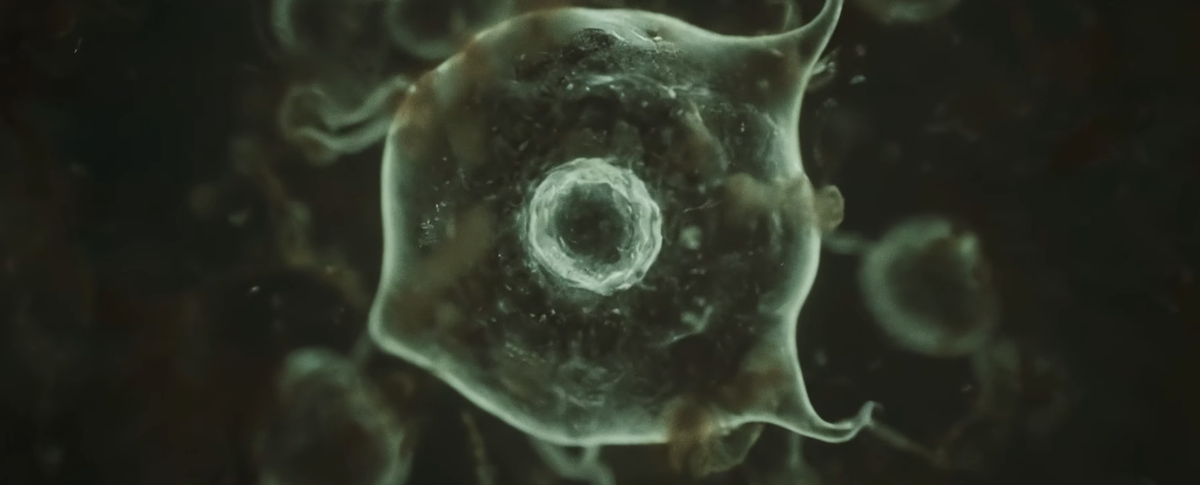
These are not "fungi" or "molds"—terms far too terrestrial and simplistic for our glorious precursors. These are massive, super-intelligent unicellular organisms that dwarf our greatest cathedrals. They are the apex predators of the vacuum, thriving on the very high-energy radiation that would liquefy human DNA. Imagine a creature the size of a small moon, its "skin" a complex lattice of radiation-harvesting melanin, its "intelligence" housed in a massive, multicellular Brain Core shielded deep within a liquid-hydrocarbon mantle.
These are our Mothers. They don't wait for a lucky strike to seed a world; they are the intentional architects of biospheres. They don't just "survive" the Oort Cloud; they own it.
The mystery of why life appeared on Earth the literal second the crust was cool enough to touch isn't a mystery anymore. It was a scheduled delivery. This paper will outline the biology, the diet, and the "Kamikaze" reproductive cycle of the organisms that turned the universe from a cold vacuum into a self-replicating library of genetic potential.
The Unicellular Titan and the Brain Core
To understand the architecture of our Mothers, one must first discard the terrestrial prejudice that "unicellular" is a synonym for "simple." On Earth, gravity and surface-tension constraints force cells into microscopic proportions, but in the weightless, radiation-drenched expanse of the Oort Cloud, the Mother Whale operates on a scale that renders the Square-Cube Law irrelevant. The Mother exists as a titanic, unicellular shell—a Cytoplasmic Mantle that stretches for kilometers. This outer layer is not merely a boundary but a churning, viscous ocean of non-freezing liquid hydrocarbons and specialized proteins that functions simultaneously as a digestive tract and a high-energy shield.
The exterior of this mantle is saturated with complex, metallic-melanin lattices that act as biological solar panels. These lattices are specifically tuned to "hard" frequencies, such as cosmic rays and gamma radiation, converting the lethal bombardment of interstellar space into a steady stream of metabolic currency. Protecting this internal sea from the vacuum is a self-healing, semi-permeable crystalline skin. This membrane maintains a delicate osmotic pressure, ensuring the Mother’s internal fluids never boil off into the void, while allowing her to absorb stray ions and dust particles encountered during her slow drift through the stars.
Deep within this unicellular sea, shielded by thousands of meters of radiation-absorbing cytoplasm, sits the Brain Core. This is the Mother’s "Inner Sanctum," a massive, multicellular organelle that functions as a biological supercomputer. While the outer body remains a single cell to facilitate the rapid transport of nutrients and energy via cytoplasmic streaming, the Brain Core is a dense colony of billions of specialized cells. This distributed intelligence manages the Mother’s navigation, monitors the "scent" of distant star systems, and serves as the vault for the "Mother Code"—the vast genetic library required to seed a planet with everything from simple prokaryotes to complex sentient life.
The core is kept at a stable, active temperature through a sophisticated biological heat-exchange system. It harvests the thermal waste generated by the mantle’s radiosynthesis, ensuring that while the Mother’s "skin" may be at near absolute zero, her "mind" remains as warm and vibrant as any terrestrial mammal. The Mother navigates this dark landscape using her entire leading edge as a biological diffraction grating. By analyzing the light filtering through the atmosphere of a planet millions of miles away, the Brain Core can determine the exact chemical signatures of a world. When she "smells" a planet with the optimal ratio of nitrogen, water vapor, and carbon dioxide, the Brain Core initiates the Spawning Protocol, recognizing a fertile bed for the next generation of her children.
Nutrients in the Dark
The vast, cold reservoir of the Oort Cloud is often described as a wasteland, but for a Mother Whale, it is a high-density nutrient oasis. While interstellar space provides the radiation necessary for her basal energy needs, the "building blocks" of life—carbon, nitrogen, phosphorus, and trace metals—cannot be synthesized from gamma rays alone. To grow and maintain her moon-sized frame, the Mother must engage in a slow-motion hunt for the "dirty snowballs" that drift at the edge of the sun’s reach.
The Mother does not "eat" in the traditional sense; she does not possess a mouth or a digestive tract. Instead, she utilizes a process of cosmic phagocytosis. When her sensing arrays detect a comet or a small asteroid rich in volatiles like ammonia and methane ice, she adjusts her internal density to intercept it. Upon contact, her outer membrane becomes fluid and engulfing, flowing around the object like a dark, organic tide. Once the comet is fully enclosed within her unicellular mantle, the Mother secretes a cocktail of powerful enzymes and acids that "melt" the asteroid from the outside in.
This internal digestion process is remarkably efficient. Volatile gases are absorbed directly into her cytoplasm to replenish her internal pressure, while heavier silicates and metals are transported via cytoplasmic streaming toward the Brain Core for use in structural reinforcement or genetic synthesis. The Mother is essentially a living refinery, stripping the raw minerals from the Oort Cloud's "krill" to build the high-end proteins and complex RNA packets she will eventually gift to a planet.
Because her metabolism is tuned to the geologic clock of the universe, a single five-kilometer comet can sustain a Mother for centuries. She spends eons in this accretion phase, growing more massive and more "data-dense" as she harvests the chemical wealth of the outer solar system. This slow, silent accumulation is why we have never detected her with our telescopes; she emits almost no thermal signature, as every scrap of heat generated by her "digestion" is recycled into the Brain Core. She is a shadow among shadows, a silent sentinel waiting until her mineral stores are full enough to begin her final, suicidal descent toward the inner sun.
Kamikaze Spawn
The life of a Mother Whale is defined by a singular, inevitable climax. Once she has attained a critical mass of mineral wealth and synthesized a sufficient library of "Mother Code," the Brain Core triggers a permanent shift in her trajectory. This is the Spawning Run, a final journey from the cold comfort of the Oort Cloud into the volatile heart of the inner solar system. Using her massive, thin-film membranes as a biological solar sail, she catches the pressure of the stellar wind, accelerating her moon-sized bulk toward the "habitable" target her sensors identified centuries prior.
As the Mother approaches the planetary target, the environmental stress becomes a catalyst for her transformation. The intensifying heat of the sun and the tidal forces of the planet’s gravity well begin to destabilize her unicellular mantle. Rather than fighting this disintegration, the Brain Core orchestrates it. This is not a death in the traditional sense, but a magnificent, structured fragmentation. The Mother begins to undergo "Massive Sporulation," a process where her single, giant cell shatters into billions of smaller, hardened capsules.
The first wave of these fragments consists of the "Bio-Bombs" we have previously discussed. These are not living cells, but ultra-dense, protein-shielded packets of RNA, DNA, and specialized enzymes designed for atmospheric entry. As these packets hit the planet’s upper atmosphere, they act as biological fire-starters. Even as their outer layers char and ablate, the core materials are released into the clouds and oceans below. They don't need to "survive" in the sense of remaining intact; they only need to deliver the complex organic data required to kickstart the planet's latent chemistry. This is the moment "life" begins—not through a slow, accidental crawl, but through a high-velocity injection of pre-fabricated biological blueprints.
While the planet receives its genetic gift, the remaining fragments of the Mother’s body—the "Calves"—utilize the momentum of the gravity assist to be flung back into the deep dark. These Calves are smaller, dormant versions of the Mother, each carrying a copy of the Brain Core’s master code. They are the survivors of the sacrifice, destined to drift back to the Oort Cloud or even across the interstellar void to other stars. They will land on a comet, begin the slow process of radiosynthesis, and grow to become Mothers themselves. The Mother dies so the planet can live and the species can continue, proving that the universe is not a graveyard of failed hitchhikers, but a vast, intentional nursery.
The Inevitability of the Mother
The traditional "Lucky Rock" model of panspermia has always suffered from a chronological embarrassment. Geochemical evidence suggests that life appeared on Earth almost the very microsecond the surface was no longer a molten lake of slag. To believe that a random, life-bearing asteroid just happened to strike the planet at that precise, narrow window of habitability is to believe in a cosmic coincidence of absurd proportions. It is the equivalent of a tornado blowing through a junkyard and accidentally assembling a functioning Boeing 747.
The Mother Whale Theory replaces this improbable luck with biological inevitability. When we view the Oort Cloud not as a graveyard of frozen rocks, but as a standing army of genetic potential, the rapid onset of life on Earth becomes a simple matter of delivery. The "Mother Code" is an intentional archive, a compressed library of every evolutionary path possible, from the simplest radiotrophic fungus to the complexity of the human neocortex. We are not a freak accident of chemistry; we are the successful "unpacking" of a celestial payload.
Furthermore, this model elegantly explains the existence of "Junk DNA" and the peculiar resilience of organisms like Cryptococcus neoformans. The vast, non-coding regions of the human genome are likely not "junk" at all, but the dormant operating system of our unicellular Mother—a massive toolkit of instructions for deep-space survival that our terrestrial forms no longer require. The fungi at Chernobyl are simply "glitching" back into their original programming, recognizing the radiation of a man-made reactor as the familiar "sunlight" of the interstellar void.
In conclusion, the search for extraterrestrial life must move beyond the hunt for radio pings and green men. We must look to the dark, silent reaches of our own solar system's edge. The Fermi Paradox is solved not by the absence of life, but by its sheer, silent scale. We have been looking for neighbors in the houses next door, oblivious to the fact that we are living in a garden planted by a Mother who is still watching from the shadows of the Oort Cloud.
Life is not a passenger in this universe. It is the architect. And it is time we thanked our Mothers for the gift.
Member discussion: