
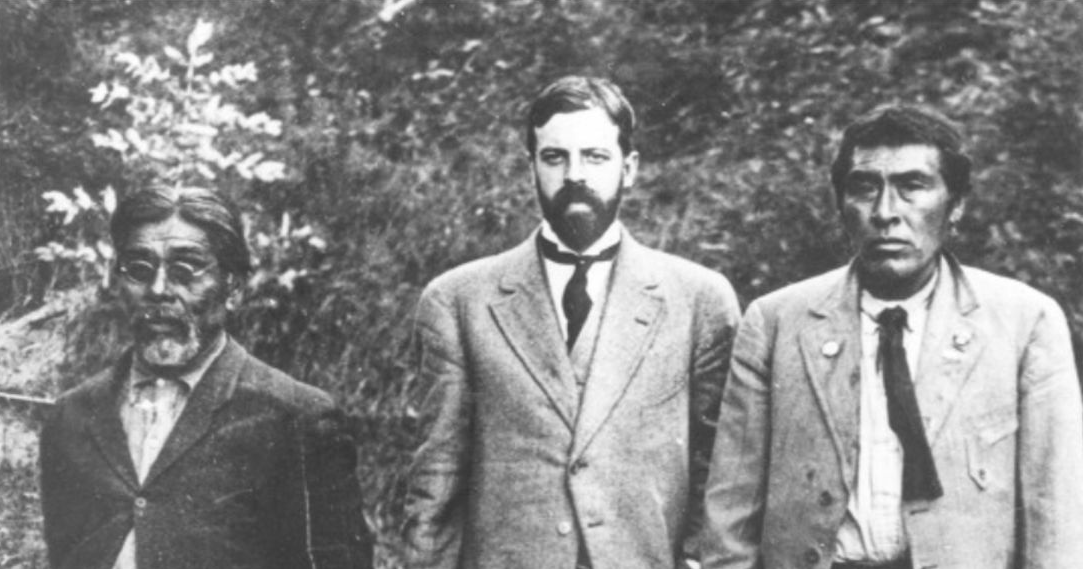
The following essay by Alfred L. Kroeber was published in 1940 in the journal "Character & Personality: A Quarterly for Psychodiagnostic & Allied Studies"
Biographical Sketch
Alfred L. Kroeber (1876–1960) was one of the foundational figures in American anthropology, a longtime University of California, Berkeley professor whose work helped establish the study of Native Californian languages, cultures, and ethnography as a major academic field. A student of Franz Boas, he became an influential advocate of cultural relativism and wrote extensively on culture, personality, language, and Indigenous societies, though aspects of his legacy—especially his association with Ishi—have since been critically reexamined. He was also the father of the celebrated science-fiction and fantasy author Ursula K. Le Guin, whose fiction often reflected anthropological themes shaped in part by the intellectual world in which she was raised.
We are pleased to reprint this important essay in full.
PSYCHOSIS OR SOCIAL SANCTION
Psychotic Factors in Shamanism
On a chance, I said to an old Lassik Indian woman: “I bet you are a doctor.” “Well, I nearly was,” she answered. “My baby died. I was sitting around the next afternoon. All at once I heard a baby cry overhead, and fell over unconscious. My sister brought me back; but from time to time I heard the crying again, and became more and more sick. I gave an old doctor twenty dollars to cure me, and he said it was my baby’s shadow coming to tell me to become a doctor. But I did not want to; and when the shadow began to talk, urging me, I told him, ‘No, I would not,’ and urged him to go away. So at last he left off, and I got well, and did not become a doctor.”
In our civilization this happening would be diagnosed as a psychosis. It manifests recurrent hallucinations, fits of loss of contact with the sensory world, distress and worry, and a sense of illness. Twenty dollars was a considerable amount for a backwoods Indian woman to pay in a lump sixty years ago.
From the native point of view, one may at once suspect the functioning of a cultural pattern, because all through native northern California the onset of shamanistic power is marked by a seizure in which the candidate experiences an hallucination—always auditory and usually visual also—in which objectively he is unconscious, or unaware of his surroundings, and acutely ill. To his family and village mates he seems actually stricken with disease. But the older shaman who is consulted, promptly diagnoses the disease as the onset of shamanistic power, predicts cure as soon as the patient adjusts himself to his new power, and, with other shamans, helps to “train” the novice, that is, to find the adjustment. In most cases, apparently, the novice accepts the power which has come upon him: considerable prestige attaches, in a simple society, to one who can cure or exercise other special faculties.
Usually the spirit in the hallucination appears from nature: of the woods or mountains, of the sky, of a pool, of an animal or monster. In the present instance the spirit was the patient’s own child. Here is a superadded pattern; the appearance is that of a dead relative. That this is a genuinely social pattern in the region is shown by a Wailaki episode recorded by Loeb. A dead woman came back one night, grunted outdoors, slid into the house, put her hand on her sister’s head, and said: “I love you, I have come back.” In the morning the woman was found lying covered with blood from her mouth and singing. She announced: “My sister came, but I shall not die. I shall be a doctor, I think.” She did become one, with her sister as her helping spirit, who talked to her and aided her in curing.[1]
These cases raise several theoretical points. First, in some cultures one of the most respected and rewarded statuses known to the society is acquired only by experience of a condition which in our culture we could not label anything else than psychotic. This is part of a wider situation which I have treated elsewhere,[2] namely: that one consistent criterion of distinction between primitive or folk cultures and advanced or high ones, other than quantity of cultural content, is the fact that the former in their magic, shamanism, animistic ritual, and the like, recognize as objectively effective certain phenomena which the latter regard as not only subjectively but as objectively unreal and therefore as more or less psychotic or deranged. In short, the limits of relation of personality and world are differently drawn. What high cultures stigmatize as purely personal, nonreal and nonsocial, abnormal and pathological, lower cultures treat as objective, socially useful, and conducive to special ability; or at least relatively so. The primary importance of this difference is perhaps for the student of culture, whom it may help to understand somewhat more clearly the “high and low” ratings which he tries to avoid, but never wholly succeeds in avoiding, when he compares cultures explicitly and implicitly.
A side problem is this. If the native recognizes certain psychotic or pathological experiences as partaking of objective reality, the question arises whether we in our civilization do not do the same in certain other areas, being however as blind to the fact as the primitive is. (Logically, of course, the question could be turned around into an inquiry as to the nature of the limits of objectivity, the individual psychic experience being regarded as primary in reality; but this would, of course, be scientifically profitless.) What, in other words, may there be in our own lives that does not participate in reality but which we accept as so participating? Reference is not to group attitudes characteristic of the uneducated or socially disadvantaged, which the sophisticated and detached members of the same population can discern as affectively warped away from reality; but to other attitudes on the part of the sophisticates themselves, of whose nonparticipation in reality they are equally unaware. Obviously, it would be very hard to give even a tentative answer to this question. But the problem is certainly worth being kept in mind.
Next, there is the old question of deception. Probably most shamans or medicine men, the world over, help along with sleight-of-hand in curing and especially in exhibitions of power. This sleight-of-hand is sometimes deliberate; in many cases awareness is perhaps not deeper than the foreconscious. The attitude, whether there has been repression or not, seems to be as toward a pious fraud. Field ethnographers seem quite generally convinced that even shamans who know that they add fraud nevertheless also believe in their powers, and especially in those of other shamans: they consult them when they themselves or their children are ill. When it comes to the cardinal experience with spirits, on which power is based, this almost always occurs in solitude, or inwardly as in dreams, so that objective demonstration is precluded. While consciously false claims would therefore be easier, there would also be less immediate pressure to make them. The Lassik old woman, at any rate, was genuine; she did not want to be a shaman, and resisted the urgings of the spirit. There can be no doubt that she really heard her dead child’s crying and talking, and was troubled by it.
In fact, she felt herself ill in the same sense as among us a psychotic patient generally feels ill. This is the normal description by most Californian tribes of the onset of shamanistic power: The prospective shaman is not only out of his mind and behaving strangely, but also actually sick; he lies down; his relatives are afraid he will die, and call a shaman for treatment; the patient will not eat, wastes away, and remains for weeks or months in this condition. This point seems of some importance; the experience is not a merely subjective one of a moment or a day, but a profound organic disturbance. In this sense it is the more genuinely psychotic.
Two other features are typical. The first is the repetition of the experience. The hallucination, or among other tribes the dream, comes again and again. (Many tribes say definitely that their shamans “dream” their power; but their word for “dream” may include or connote much more than a normal sleep-dream.)
Second, this individual’s hallucination was primarily, or perhaps wholly, auditory. Here tribal custom varies somewhat, and no doubt personal experience also; but it is clear from a mass of data gradually accumulated that among all the Indians of California and Nevada the crucial shamanistic experience is normally auditory, whether or not it is also visual or tactile. Almost always there is a song learned, or several. A shaman who did not have an individual spirit-given song would not be a shaman, in prevailing native opinion in this part of the world. Differences exist between tribes who say little about seeing while hearing, and those who give a clear account of seeing, or seeing and feeling, in addition. The Mohave of southern California are in this latter category. But their standard way is to “dream” parts of myths which are already known.[3] But they do this dreaming mostly without seizure or illness. In fact, they profess to begin their dreaming in their mother’s womb, and to recall these dreams and to continue them later in life. Incidentally, it is also standard with the Mohave to assert that these dreams, or many of them, relate to the creation of the world. They project themselves backward into the beginning of time, where they insist they were really present to hear, see, and feel what was happening. This is a Mohave specialty—a somewhat unusual addition to the usual beliefs entertained. I do not know how often such an affirmed projection into the past is characteristic of our psychotics.
The difference between these primitives and ourselves may be expressed in two different ways. The first is formulated in terms of reality. The primitive assumes as actual and real certain phenomena which we hold to have only a mental or subjective existence, and in that sense to be unreal in the sense in which stones and houses and birds are real. Or, perhaps, it would be more accurate to say that the primitive is also aware of a distinction, but inverts his emphasis. To him a stone or a bird seen or heard in a certain kind of dream is far more important than a physical stone or bird which one can pick up or eat, because it is the potential source of infinitely more power and control. Certain things which we classify as unreal are to him super-real—“surrealistic.”
The second difference is formulated in terms of socialisation or social acceptability. To us a person that hears the dead speak, or proclaims that he sometimes turns into a bear, is socially abnormal, at best useless, and likely to be a burden or menace. To the Indians he is a personality of enhanced powers, which he may indeed abuse malevolently in witchcraft, but which primarily result in benefits to the community: enhanced health, food supply, triumph over enemies.
This difference of social attitude or pattern of culture is as important as the difference in attitude toward reality. It is perhaps, in fact, a cause of the latter. At first thought, indeed, one might be inclined to assume the contrary: as enlightenment increases, dreams, visions, and the voices of the dead are more and more recognized as being internal to individuals and unrelated to objective reality as defined by the everyday experience of the mass of mankind. Thereupon society withdraws recognition and prestige value from them; they become dubious assets, and finally stigmata and disabilities. This is how we ordinarily assume the change from primitive attitudes to our own to have come about: there is a progressive increase in our understanding of reality. However, it may be doubted whether anything so rational is the efficient cause of the change. Abstractly, it seems at least equally probable that the greater rationality or enlightenment is a by-product of the change in attitudes, and that these in turn are nonrationally social or cultural.
On this view, certain societies gradually attach fewer approval or premium values to dreams and voices, until they may come, like ourselves, to look upon them as socially useless if not harmful—abnormal, unfortunate, and to be dreaded. The influences bringing about such a shift of values might be various: increases of the size of the social group, technological or economic factors, a greater sense of security. Enlightenment, in the sense of a better discrimination of objective reality, need not be among them. It may be, for all one knows, an effect rather than a cause—a flattering name bestowed on the change after it has occurred.
Obviously, this theoretical interpretation may not be pressed too dogmatically. But it may serve as a counterbalance to the current assumption, which is certainly also dogmatic. And there is one specific point in its favor. The primitive, as has just been pointed out, does not really fail to discriminate the objective from the subjective, the normally natural from the supernatural. He distinguishes them much as we do. He merely weights or favors the supernatural, as we disfavor and try to exclude it. The voice of the dead, the dream, and the magic act stand out for him from the run of commonplace experience of reality much as they do for us; but he endows them with a quality of special super-reality and desirability, we of unreality and undesirability. The values have changed rather than the perception. And values are cultural things, and therefore social.
To put it in another form, certain of what one calls psychotic phenomena are socially channeled by primitives—standardized, recognized, approved, rewarded—but regarded as wholly outside the approved sociocultural channel by ourselves.
Homosexuality
To this there is at least one parallel in the institutional field: the transvestite, in American ethnology often called the berdache (French from Arabic bardaj, “slave”). In most of primitive Northern Asia and North America, men of homosexual trends adopted women’s dress, work, and status, and were accepted as nonphysiological, but institutionalized, women. In Siberia the transformation was generally associated with shamanistic power, control of spirits or possession by them; in America, usually not. In both areas, choice of status was left to the individual; if he decided to transform his sex, he was socially accepted as a woman. How far invert erotic practice accompanied the status, is not always clear from the data, and probably varied. It is conceivable that in some cases there occurred a partial sublimation of specific erotic urges into feminine occupation, dress, and association. The berdaches are usually spoken of as willing as well as skilful and strong workers at female tasks. At any rate, the North American Indian attitude toward the berdache stresses not his erotic life but his social status; born a male, he became accepted as a woman socially.[4]
Here, accordingly, we have another set of psychiatric phenomena, those of sexual inversion, which our culture regards as abnormal, asocial if not antisocial, and in general views with considerable affect of repugnance, but which certain primitives[5] accept with equanimity and provide a definite social channel for. The case is not wholly parallel to shamanism, but is definitely like it in the point of socio-cultural acceptance instead of rejection. Furthermore, in this matter of transvestitism it cannot be said that the difference between the Indian and ourselves is one of greater enlightenment on our part. It is only since eighteenth-century enlightenment that homosexuality has begun to be regarded in Occidental civilization as somewhat less than the ultimate abomination and offense. Our tolerance toward it has increased in proportion with what we call our enlightenment. And certainly the American Indian system seems to work well from the angle of human happiness: the invert is free to work out his inner satisfactions as he can, without persecution from without; and society does not feel itself injured or endangered. A status of adjustment is achieved instead of one of conflict and tension.
At any rate, we have here a second case in which primitives meet a condition stigmatized by us as psychologically pathological, with social tolerance and acceptance if not rewards. Like ourselves, they regard both conditions as not normal, in the sense of not being common, everyday in character, or in line with the majority of experienced events. But their social affects toward these conditions are positive or neutral; ours are negative. This appears to be a better description of the facts than to say that we have come to exceed them in intelligent enlightenment. Undoubtedly we possess on the whole a far greater body of knowledge, criticism, and understanding than the primitives. But it is doubtful how far this increase is responsible for similarly constituted individuals being accorded respect and influence among many primitives and being classed as dements and social liabilities by ourselves. Fundamentally the difference seems rather to lie in institutions, which in turn express the emotional attitudes of society toward its parts and itself.
Animal Identifications
An old Kato woman narrated the following as having happened before her birth. A young woman, pregnant, went with her husband and a group of fellow-initiates for a stay in the woods, presumably to cook for the party. There she saw them perform their “tricks” and performances, and was made to jump a trench and was pelted with pine cones. All this apparently had some reference to bears. When her child was born, he had a tuft of hair on each shoulder. He grew up apparently stupid and sluggish, not participating much in ordinary activities. Once, when he was being teased, he grew angry, growled, turned into a bear, scattered the coals of the fire, and began to cuff people around. After this incident he was carefully let alone, except when his anger could be directed against the enemy Yuki. He continued generally peaceable but solitary, or at least aloof. He was nearly useless for hunting or ordinary work, but if a trail was to be broken through the snow, he was sent ahead, and with his bearlike strength performed this task easily and cheerfully.
This tale, which the informant evidently believed to be true as implicitly as her parents had believed it, possesses some of the qualities of a dream among ourselves. However, it is recounted here primarily to introduce the matter of what may be called bear men—a concept similar to the European one of werewolves.
In this case we have a human being with bear nature and shape potential in him, showing only partially most of the time, but under special stimulus temporarily supplanting his human form and character. The stimulus, however, was everyday and realistic, even though the cause of his latent nature was evidently considered to be something magico-religious or supernatural.
An allied but distinct concept in the area is what the Yuki call the wanshit lamshiimi, literally grizzly bear doctor. (All the concepts seem to relate to the grizzly bear, much the more dangerous of the two species.) The bear doctor might become so by first dreaming of bears. Then young female bears took him into the woods and lived with him; one of them might be reported as having physically carried off the future doctor’s person. Other men sought bear power, swimming in forest holes, and dancing toward, clawing, and growling at a tree or stump until hair grew out of their body. The bear doctor cured bear bites and gave demonstrations of strength.
A third type of bear person was what the Yuki called aumol, “chewer” or “biter.” He was a man trained by older aumol to walk about on all fours completely disguised in a bearskin, but carrying a bone dagger with which he stabbed the personal or tribal enemies he encountered, and then disemboweled and scattered their bodies. No doubt his community stood in awe of the aumol, but they also considered him valuable for the damage he could singlehanded inflict on their enemies without exposing them to the reprisals of open warfare. It is much to be doubted whether going out to murder from ambush encased in a clumsy bearskin would be physically possible; but the Indians elaborate the tale, speaking of strings of shell beads worn around the body to afford an armor inside the bear hide; of baskets worn in it containing a stone or water to simulate growling or the rumbling of the viscera; and so on. It looks very much as if the whole thing were only an elaborated phantasy never actually acted out. But it was certainly believed in as a reality by the overwhelming majority of the members of a whole series of tribes. Quite likely some men let it be known that they were aumol, and perhaps kept a bearskin and some of the accessory paraphernalia. What is of interest is the elaborateness of the physical apparatus insisted on.[6]
A fourth type of person associated with bears was the initiated dancer who, wearing a bearhide, performed as a bear at gatherings, just as others impersonated spirits, ghosts of the dead, or eagles. For this office one was trained, and while it had much of the esoteric and dangerous about it, the community knew who the recognized bear dancer or dancers were.[7]
These then are the varieties of men resembling bears. They can be arranged in the following order, according to the degree of their participation in the supernatural: (1) the true bear shaman who in virtue of power personally received from bears in his manhood can turn himself into a bear; (2) the man who, as a result of prenatal influencing, occasionally and involuntarily turns into a bear; (3) the man who secretly disguises himself as a bear, but manifests preternatural strength, endurance, and ferocity; (4) the bear dancer, who holds the religious office of impersonating a bear as one part of a cult system magically serving the public welfare. Occurring side by side in a limited area—the southerly part of the Northern Coast Ranges of California—there can be no doubt that the four beliefs or practices are historically associated. It is, however, of interest that the four variations on the one theme differ so much in strength of supernatural participation. In other words, mystic and rational, emotional and objective, aspects of one phenomenon coexist. Or again, it might be said that suggestion and autosuggestion ranged from a maximum in type 1 to a minimum in type 4. The Pomo and the Patwin, whose culture was on the whole slightly the most elaborate and systematized in the region, adhered to types 3 and 4; the Yuki, poorer, backwoodsmen, to 1 and 3; type 2, along with 3, is recorded from the Kato, who are more or less transitional.
There are similar gradations in regard to the method of curing supernaturally. (There was also curing with household remedies of roots or herbs, for headaches, constipation, bruises, and other minor ills; but these hardly count in the present connection because in any serious or alarming illness only the specialist in the supernatural could help.) The Yuki distinguished three kinds of treatment of disease. Perhaps the most generally effective was by the lamshiimi, the shaman or doctor proper, who had in his own person received power from some kind of spiritual being, and after “going into a trance,” sucked out the disease (hanchmi). He used no rattle, sang little, if any, and in modern Indian vernacular is a “sucking doctor.” The “singing doctor” was called moli by the Yuki, and held a public office: he was caretaker and firetender of the religious assembly house. In addition, however, he sang with a rattle, and thereby was able to see and diagnose illness. He “investigated and prophesied.” The third type of treatment was named hilyulit and used cult ritual. Songs pertaining to the various spirits impersonated by the cult initiates—the Creator and the ghosts—were sung until the patient trembled violently. Thereby it was known which kind of spirit had “frightened” him into illness. Then the cure was arranged by having the corresponding spirit impersonation—singing, dancing, and touching—made for him. This worked homoeopathically.
The Pomo cure in two ways. The madu corresponds to the first Yuki type: he has himself dreamed or encountered spirits, and he sucks. However he is, in contrast with the Yuki, considered the less powerful practitioner. Grave illness comes from k’o’o, “poison,” that is, bewitching, and is handled by the k’o’o-bakiyahale, or performer for the poisoned. This type of doctor operated by means of a sack of fetishes, which he used with elaborate rattling, singing, and ritual motions. These paraphernalia and the knowledge associated with them he mostly did not claim to have been given to him by spirits or supernatural beings in a dream or trance, but to have received, with careful teaching, from a previous shaman, ordinarily an older relative. Again the Pomo differ from the Yuki in giving a higher valuation to the more rational (or pseudo-rational), orderly, tangible, formal procedure, whereas the Yuki pin their faith in the person who has had a powerful abnormal experience and more or less repeats it in curing.
Since the general culture of the tribes is closely similar, this variation of predilection toward and away from what should be called psychopathological manifestations, within the primitive level, is of some interest.[8]
Suggestibility
Through all these practices and beliefs there evidently runs a very strong strain of suggestion and autosuggestion. My own conviction is that this factor is decidedly more important than the deliberate deception which undoubtedly also occurs. The audience certainly does not deceive, and it does see miracles. The shamans may know that they deceive, but many of them certainly believe that other shamans do real miracles. Beyond that, we do not know how far, in performing, they use deception consciously or under autosuggestion. When shamans recount how they received their powers, experienced ethnologists pretty unanimously feel that the overwhelming majority of them believe sincerely that they have really had such an experience. Moreover, this experience is of a kind which in our civilization would be diagnosed as psychotic. I do not wish to rule out the question of “deception,” which undoubtedly occurs and is relevant. But of more cardinal importance to an understanding of the shamanism of primitives are the two factors of psychosis-like symptoms and of suggestion. When psychologists as a whole return seriously to the problem of suggestion and suggestibility, striking at aspects of it that go deeper than conscious propaganda, salesmanship, and advertising, it is likely that anthropologists may be better able to interpret shamanistic performances.
Summary
Among many unsophisticated people, socially sanctioned and distinguished individuals who exercise special powers, especially of curing, acquire their capacity through experiences which in our culture would be stigmatized as psychotic. How far the hallucinations and other symptoms are simulated, auto-suggested, or compulsive, is not clear; but it is certain that deception will not account for all of them. This means that manifestations which are pathological, or at any rate are so regarded by us, are accepted and socially channeled in many primitive societies. Most of the more backward Siberian and North American natives similarly accept and institutionalize passive homosexuality. At the same time, societies of nearly the same general cultural level may differ considerably in the degree to which they rationalize or ceremonialize their curing or other shamanistic practices away from the psychotic or induced psychotic experience: some put a premium on certain frankly abnormal experiences, others on more nearly normal ones. The situation thus is far from simple; but it evidences the strong bearing which cultural patterns have on the problem of the nature of psychosis.
Notes
[1] Loeb, E. M., The Western Kuksu culture, Univ. Calif. Publ. American Arch. Ethnol., 1932, 33, 77. The Wailaki adjoin the Lassik.
[2] “Cultural Anthropology,” chap. xix of M. Bentley, ed., The problem of mental disorder, 1934.
[3] Chap. 11: “The Mohave: Dream Life,” of my Handbook of the Indians of California, Bureau Amer. Ethnol. Bull., 1925, 78.
[4] The time is ready for a synthetic work on this subject. The cultural data are numerous. On the involved psychology the information is less satisfactory. While the institution was in full bloom, the Caucasian attitude was one of repugnance and condemnation. This attitude quickly became communicated to the Indians, and made subsequent personality inquiry difficult, the later berdaches leading repressed or disguised lives. The fullest account is by G. Devereux, Institutionalized homosexuality of the Mohave Indians, Human Biology, 1937, 9, 498–527. The Mohave are unusually uninhibited both in sex activity and in speech about it. They even recognized women inverts, active female homosexuals, who are rare elsewhere. I suspect that many Indian men understood the phenomenon imperfectly, or misunderstood it. An old Yokuts, born about 1840, who knew the social functions of the transvestites quite well—they were corpse-handlers or “undertakers” among his people—told me that in his opinion they were men who took on female dress and occupation in order to have free association with women and special opportunities for secret heterosexual activity with them. While this may have occurred now and then, it is obviously in the main a rationalized misconstruction by an unimaginatively normal heterosexual.
[5] That the peoples who accept transvestitism are essentially those of Northern Asia and America, a continuous area, suggests that the institution is a single historic growth. If it were something characteristic of a certain “stage of advancement” it ought to occur much more scatteringly over the world. The ancient Near Eastern development was different: it was associated with specific cults and with mutilation. The pederasty which was more or less openly tolerated in certain advanced civilizations—Greece, later Islam, China in connection with the theater—is also not the same, the emphasis being on sexual practice rather than on transvestite “sublimation,” and scarcely leading to a lifelong status.
[6] In the Handbook of the Indians of California (Bureau Amer. Ethn., 1925, 78) I have described these customs for the Yuki (p. 200), Pomo (p. 259), Maidu (p. 427), Yokuts (p. 517). The Yuki account there given, however, runs the wanshit lamshiimi and the awmol into one: the inconsistency is noted, but attributed to Yuki mentality. Additional information, secured in 1938 in co-operation with F. Essene, makes it clear that the Yuki distinguished the two types by name, as set forth above.
[7] The Patwin distinguish the cult bear dancer, sika, from the bear-disguised murderer, napa. The latter has become the name of a California county and city.
[8] Margaret Mead (in A lapse of animism among a primitive people, Psyche, 1928, 8, 72–77) has pointed out a similar difference between Samoans and other Polynesians. “Contacts with the supernatural were accidental, trivial, uninstitutionalized” in Samoa. Religious and unstable individuals were “given no accepted place in a pattern.”
Originally published as Alfred L. Kroeber, “Psychosis or Social Sanction,” Character & Personality: A Quarterly for Psychodiagnostic & Allied Studies 8, no. 3 (1940): 204–215, DOI: 10.1111/j.1467-6494.1940.tb02176.x.
This Lecture is in the public domain.
Member discussion: