
We begin our enquiry by studying the following verses.
Bhagavad-gita 4.11
ये यथा मां प्रपद्यन्ते तांस्तथैव भजाम्यहम् ।
मम वर्त्मानुवर्तन्ते मनुष्याः पार्थ सर्वशः ॥
ye yathā māṃ prapadyante tāṃs tathaiva bhajāmy aham
mama vartmānuvartante manuṣyāḥ pārtha sarvaśaḥ
“O Partha, in whichever way a person renders service to Me I reciprocate with him accordingly. Everyone follows My path in all respects.”
Bhagavad-gita 18.66
सर्वधर्मान्परित्यज्य मामेकं शरणं व्रज ।
अहं त्वां सर्वपापेभ्यो मोक्षयिष्यामि मा शुचः ॥
sarva-dharmān parityajya mām ekaṃ śaraṇaṃ vraja
ahaṃ tvāṃ sarva-pāpebhyo mokṣayiṣyāmi mā śucaḥ
“Completely abandoning all bodily and mental dharma, such as varna and asrama, fully surrender unto Me alone. I shall liberate you from all reactions to your sins. Do not grieve.”
—Trans. Srila Bhaktivedanta Narayan Goswami Maharaja
What is the Good News of Bhagavad-gita?
There is a particular kind of question that defeats itself by being answered too quickly, and the question of which verse of the Bhagavad-gita most succinctly delivers the Good News of Lord Krishna is precisely such a question. The instinct to reach immediately for 18.66 — the carama-sloka, the verse of final refuge, the verse Gaudiya Vaishnava acharyas have consistently identified as the crown of the entire Gita — is not wrong, but if it causes us to pass over 4.11 without genuine attention, something important is lost. These two verses are not simply alternatives competing for the same title. They stand in a relationship of theological depth to one another, and understanding why 18.66 ultimately supersedes 4.11 requires understanding first what 4.11 actually accomplishes — which is considerable.
The Universal Principle of Divine Reciprocity
Verse 4.11 arrives in the middle of Krishna’s self-disclosure regarding the nature of his descent into the world. He has just explained the doctrine of avatara — that he appears age after age to restore dharma, protect the pious, and annihilate the impious (BG 4.7-8) — and verse 4.11 functions as the metaphysical foundation underlying all of that activity. The principle it articulates is one of perfect, non-arbitrary divine responsiveness: ye yatha mam prapadyante tams tathaiva bhajamy aham — “in whichever way a person renders service to Me, I reciprocate with him accordingly.” The Sanskrit yatha…tatha construction is quietly elegant: “in whatever manner…in that same manner.” There is no gap between the quality of approach and the quality of response. The divine mirrors the devotee with absolute fidelity.
What this establishes is nothing less than the universal availability of the divine. Krishna withholds nothing that is sincerely sought, and no seeker — regardless of path — is abandoned. This is genuinely good news in the largest possible sense: the cosmos is not organized around scarcity of divine mercy. The second line of the verse — mama vartmanuvartante manusyah partha sarvasah, “everyone follows My path in all respects” — extends this still further: whatever path any human being walks, they are walking a path that falls within Krishna’s sovereign domain. Nothing exists outside Him.
The Limit Within the Universalism
And yet — and this is where 4.11 begins to reveal its own incompleteness — the verse must be understood with great theological precision. Srila Bhaktivedanta Narayan Goswami Maharaja, following the acharyas of the Gaudiya parampara, is emphatic on this point: the destinations received by different seekers are emphatically not equivalent. The impersonalist who approaches Krishna as the formless Brahman receives the annihilation of individual identity in the nirvisesa brahman — the Lord’s impersonal effulgence. The worshiper of the demigods attains the planets of the demigods. The materialist receives the fruits of material nature. All of these are His paths — nothing in existence falls outside His sovereignty — but only exclusive devotion to His eternal sat-chit-ananda vigraha, His personal reality as the supreme object of love, leads to Him as He actually is.
This is a crucial distinction. Each seeker receives precisely what they approach with — but what is available to be sought varies infinitely in depth and finality. The tradition is unambiguous that the lifestyle of the karmi, the jnani, and the yogi may superficially resemble that of the bhakta, but their method of worship, their sadhana, and their ultimate destination are vastly different. To flatten these into an easy universalism — as if all paths lead equally to the same summit — is to misread 4.11 entirely. Its universalism is one of sovereign inclusion, not of equivalence.
Srila Visvanatha Cakravarti Thakura, in his Sarartha-varsini commentary on this verse, observes that the verse is simultaneously an affirmation of divine generosity and a quiet elegy for what is being left on the table. The impersonalist receives the impersonal absolute. The fruitive worker receives the fruit. But what neither receives — what the verse does not yet name — is prema, the love that is categorically different in kind from all the other gifts available. The Caitanya-caritamrta articulates this with remarkable clarity in the dialogue between Sri Caitanya Mahaprabhu and Ramananda Raya, in which successive levels of spiritual attainment are proposed and each in turn is set aside by Mahaprabhu as insufficient (CC Madhya 8.57-100): eho bahya — “this is external.” The conversation continues to ascend until it arrives at prema, at madhura-rasa, at the love of the gopis — and Mahaprabhu falls silent in a silence that signals arrival. What 4.11 describes, in the Gaudiya reading, is the full range of what Krishna distributes below that final silence. It is vast. It is generous beyond measure. But it is not yet the whole truth.
The Bhagavata Purana draws this distinction explicitly: the pure devotee desires neither lordship over the heavenly planets, nor the liberation of Brahman, nor even the miraculous powers of yoga, nor freedom from rebirth (SB 3.25.36). These are precisely the gifts 4.11 describes being distributed to those who approach Krishna seeking them. The pure devotee approaches asking for none of these things, and therefore receives what cannot be listed among them.
The Carama-Sloka as Arrival
Verse 18.66 operates in a completely different register. By the time it arrives, eighteen chapters of teaching have been offered: karma-yoga, jnana-yoga, bhakti-yoga, raja-guhya, cosmic vision, the analysis of gunas, the tree of samsara, the nature of the divine and demoniac temperaments, the three kinds of faith, sacrifice, austerity, and charity. The student has been given every tool the tradition possesses. And then, after all of it, a final verse arrives not as a summary but as a dissolution: sarva-dharman parityajya — “completely abandoning all bodily and mental dharma.” Not selecting the best one. Abandoning all of them.
This is structurally startling. Everything that has been taught is now, in a sense, released — not invalidated, but released, the way one releases a raft upon arriving at the far shore. And into the space opened by that release, Krishna delivers three things simultaneously: a command (vraja — “surrender unto Me alone”), a promise (moksayisyami — “I shall liberate”), and a consolation (ma sucah — “do not grieve”). The promise is in the future tense but with the certainty of a completed fact. The consolation addresses the anxiety that the enormity of sarva-dharman parityajya inevitably produces: what will happen to me if I let go of everything I have built? Krishna’s answer arrives before the question can fully form.
It is significant that 18.66 follows immediately upon 18.65 — man-mana bhava mad-bhakto mad-yaji mam namaskuru, “Always think of Me, become My devotee, worship Me and offer your homage unto Me” — the verse of pure bhakti. The carama-sloka does not stand alone. It grants the qualification to realize what the preceding verse describes. Gurudeva observes that verse 18.66 is the door through which the practitioner enters the devotional life described in 18.65 — and that the burden of successful completion is assumed by the speaker, not the listener. Srila Baladeva Vidyabhusana, in his Gita-bhusana commentary, emphasizes that moksayisyami carries the weight of a personal guarantee spoken by the one who possesses the absolute capacity to fulfill it. This is not conditional — it does not say “I will liberate you if you succeed in surrendering perfectly.” It says: I will liberate you.
The Relationship Between the Two Verses
The relationship between 4.11 and 18.66 is therefore not one of contradiction but of progressive intimacy. Verse 4.11 reveals a God who is universally responsive, who meets every seeker on the seeker’s own terms, who withholds nothing that is asked for — while simultaneously revealing that what is asked for varies infinitely in depth, and that the highest gift is precisely the one no conditioned soul yet knows to request. Verse 18.66 reveals something further: a God who does not wait for perfect approach, who steps across the gap between the seeker’s capacity and the gift’s fullness and says: I will manage this. Come as you are. Do not grieve.
Srila Rupa Goswami defines uttama bhakti — the highest devotion — in the Bhakti-rasamrita-sindhu as service rendered without interruption, without desire for anything except Krishna, and without the covering of jnana or karma (BRS 1.1.11). What 4.11 describes is Krishna faithfully honoring devotion that does not yet meet that definition. What 18.66 points toward is devotion that has released all of that — and the extraordinary promise that Krishna will be the one to carry the devotee to the place where such release becomes natural. The verse is addressed not to those who have already achieved uttama bhakti, but to those who desire to desire it — which is precisely where most sincere seekers find themselves, and precisely why it is, for them, the best possible news.
In this light, 4.11 and 18.66 together constitute a single arc: the revelation that no one is turned away, followed by the revelation of what awaits those who are willing to receive everything rather than settling for what they came to ask for. The first verse says: whatever you bring, I will meet it. The second says: bring nothing. I will provide what you did not know to ask for. And then: do not grieve.
Vipralambha (Love in Separation)
There is a paradox at the heart of the devotional tradition that cannot be resolved by argument and refuses to be dissolved by explanation. It can only be witnessed — or better, experienced — and then recognized for what it is. The paradox is this: that the most beloved pastimes in the entire treasury of Vaishnava literature are pastimes of separation, of loss, of inconsolable grief; and that those who hear them weep without restraint, and return the next day, and weep again. No one compels this return. No theological obligation requires it. The heart simply goes back, the way water finds its level, the way a plant turns without choosing toward light. And in that voluntary return — in the quiet testimony of feet that carry the devotee back to the place of weeping — the entire doctrine of vipralambha-bhakti is proven without a single further word being necessary.
Defining the Terms
Before the doctrine can be appreciated, its vocabulary requires careful introduction, particularly for the reader approaching Gaudiya Vaishnava theology for the first time. The word bhakti designates loving devotion to the Supreme Person — not sentiment alone, not ritual performance alone, but the full orientation of the self toward the divine in a relationship of love. Within bhakti, the tradition distinguishes many stages and flavors — rasas, literally “tastes” or “aesthetic essences” — that characterize different modes of loving relationship with Krishna: the peaceful (santa), the servile (dasya), the friendly (sakhya), the parental (vatsalya), and the conjugal (madhura), which the Gaudiya tradition regards as the highest and most complete (CC Adi 3.9-11).
Within each of these rasas, a further and crucial distinction is drawn between sambhoga and vipralambha — between love in union and love in separation. This distinction is not merely situational. It is constitutive of the very nature of love itself. Srila Rupa Goswami, the pre-eminent theologian of rasa in the Gaudiya tradition, establishes in the Bhakti-rasamrita-sindhu that vipralambha is not a deficiency of sambhoga but its intensification — the form that love takes when it has grown too full to be contained in the ordinary transaction of presence (BRS 3.1.3-5). Union is sweet. Separation is the fire in which union becomes infinitely desirable, and therefore, paradoxically, infinitely present.
Srila Rupa Goswami elaborates this analysis with remarkable psychological precision in the Ujjvala-nilamani, his definitive treatise on madhura-rasa. He identifies four aspects of vipralambha — purva-raga (the longing that arises before the lovers have met), mana (the loving pique that arises within relationship), pravasa (the grief of physical separation when the beloved has gone elsewhere), and prema-vaicittya (the anguish of apparent separation even when the beloved is present, arising from the very intensity of love itself) — and demonstrates that each carries a particular rasa, a distinctive taste, irreducible and incapable of being replaced by union (UN 14-15). The devotee who has tasted vipralambha does not graduate from it into sambhoga as though it were a lesser degree of the same thing. The two are different in kind, not merely in intensity.
The Empirical Argument
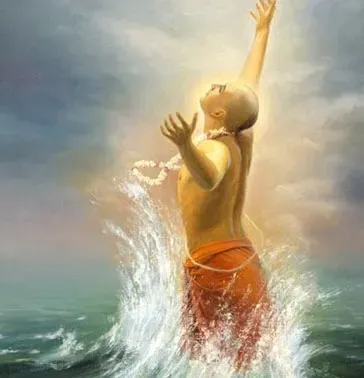
The most accessible entry into the doctrine comes not through philosophical analysis but through the simplest of observations. The great recitations of Vaishnava scripture — Rama-katha, Krishna-katha, the pastimes of Sri Caitanya Mahaprabhu — are populated above all with moments of separation. Rama searching for Sita in the forest, speaking to the trees and the rivers and the unresponsive wilderness. The gopis of Vrindavan after Krishna’s departure for Mathura, their condition described in the Srimad Bhagavatam in verses of such extremity that Srila Visvanatha Cakravarti Thakura wept as he wrote his commentary upon them (SB 10.47). Sri Caitanya Mahaprabhu in Jagannatha Puri, overcome at the sight of the sea, mistaking it for the Yamuna, collapsing in the darkness of mahabhava (CC Madhya 2.1-79).
These are not the incidental episodes of the tradition. They are its center of gravity. And the devotees who hear them do not endure them politely before waiting for a happier conclusion. They are drawn to them. They seek them out. They weep, and they return. This is not masochism. It is connoisseurship of the highest order — the recognition that what is moving in these moments is not sorrow as the world understands sorrow, but love at its most transparent. When union is present, love is clothed. When separation opens its wound, love stands nakedly visible. And the devotee who has any taste — even the most nascent — recognizes that nakedness and is drawn toward it the way all recognition draws us toward itself.
Srila Bhaktivedanta Narayan Goswami Maharaja spoke to this directly and with characteristic sweetness in his recorded lectures on vipralambha, noting that the question is not whether one should relish separation pastimes but whether one is qualified to do so — and that the evidence of one’s own heart, of one’s own tears and one’s own willing return to the place of hearing, is precisely the measure of that qualification. The neophyte who weeps without fully understanding why is already, in that moment, more advanced than the scholar who analyzes without weeping. The tear that falls without intellectual permission is the grace already operating.
The Ascending Stages of Love
Rupa Goswami’s analysis in the Ujjvala-nilamani and Bhakti-rasamrita-sindhu traces an ascending sequence within love itself: sneha (affection), mana (loving pride), pranaya (intimacy), raga (deep attachment), anuraga (passionate love), bhava (ecstatic emotion), and finally mahabhava — the highest and most extreme intensity of love, of which only Srimati Radharani and certain of the most elevated gopis are described as permanent repositories (BRS 3.2.84-85; UN 14.154-157). What is notable is the directionality of this sequence: each ascending stage is characterized not by the resolution of longing but by its deepening. At mahabhava, the distinction between sambhoga and vipralambha dissolves entirely. Separation and union have become one experience — and it is vipralambha that carries the pilgrim to that summit.
Understanding The Relishability of Grief
A careful distinction must be drawn here, lest the doctrine of vipralambha be misunderstood as a glorification of suffering for its own sake. The grief of vipralambha is not ordinary grief. Ordinary grief is caused by the absence of something desired, and it persists because the desired thing remains absent. The vipralambha of the devotee is the form that love takes when it overflows the container of meeting. It is, in the precise language of the tradition, a svarupananda — a bliss belonging to the very nature of the relationship itself — wearing the garment of grief for the sake of intensification.
The Caitanya-caritamrta describes how Mahaprabhu, immersed in the mood of Srimati Radharani’s separation from Krishna, did not seek relief from that immersion (CC Madhya 2.52-78). He dove deeper. The grief was not an obstacle to his relationship with Krishna. It was the relationship, at its most alive. And the tradition’s insistence on this point is not a counsel of despair but the most radical possible affirmation: that even in the apparent absence of the divine, love has not been diminished. If anything, it has been clarified — stripped of the comfort of presence, left with nothing but itself, and discovered to be inexhaustible.
This is the good news hidden within the doctrine of vipralambha, and it speaks with particular urgency to the sincere seeker who has known seasons of devotional dryness, of feeling spiritually distant, of wondering whether the path is still there underfoot. The tradition answers: the ache of that wondering is itself the evidence that love has not left. Separation is not the failure of devotion. In the hands of Krishna, who in verse 18.66 takes full responsibility for the liberation of the surrendered soul, it is one of devotion’s most powerful instruments.
Sita, Prthivi Devi, and the Theology of Vindication
There are moments in sacred literature that exceed the capacity of theology to contain them — moments where the narrative itself becomes the argument, where the events described carry a weight of meaning that analysis can approach but never fully exhaust. The appearance of Prthivi Devi to receive Sita into the earth is one such moment. It arrives at the end of a long and devastating sequence of events, and it arrives not as comfort exactly, but as something more final and more strange than comfort: as cosmic ratification, the universe itself stepping forward to bear witness when all human witnessing has failed.
The Structure of Sita’s Trial
Sita Devi is not merely a character in the Ramayana. She is, in the Vaishnava understanding, the shakti of the Lord — the divine energy, para-prakrti, inseparable from Rama as Lakshmi is inseparable from Narayana. Her presence in the world is not accidental but purposeful: she descends to participate in the Lord’s lila, to be the object and the mirror of his love, and in doing so to demonstrate, for all time and for the upliftment of all souls, what unconditional fidelity looks like when it is tested to its absolute limit.
The testing is relentless. The abduction by Ravana. The ordeal of Lanka. The agni-pariksa — the trial by fire — which Sita passes without question, Agni himself rising to deliver her back to Rama untouched (Valmiki Ramayana, Yuddha Kanda 116). And yet this vindication proves insufficient. Rama, bound by the dharma of kingship, bound by the whisper of public doubt among his subjects, exiles Sita a second time — not for any failure of her own but for the irreducible fact that his kingdom requires an unimpeachable queen and the people are not satisfied. She is pregnant. She goes without protest.
This second exile is the most theologically challenging event in the Ramayana precisely because it cannot be resolved at the human level. The first exile — the abduction — had a villain, a war, a rescue. The second exile has no villain in the ordinary sense. It has a king doing what his role demands of him, and a wife accepting what her love demands of her, and between these two impeccable commitments a wound opens that neither philosophy nor dharma-sastra can close. Valmiki shelters Sita. Lava and Kusha are born and raised in the forest. Years pass. And then Rama, performing the Asvamedha sacrifice, is reunited in ceremony with his sons — who recite the Ramayana in his presence, not knowing they are singing their own father’s story to their own father’s face.
The Appearance of Prthivi Devi
Sita’s response to the summons carries within it the full weight of everything she has endured. She does not refuse. She does not protest. She speaks with the quiet authority of one who has already passed through every test the world can devise and has nothing further to prove to any human assembly. Her declaration before the court is not a defense. It is a statement of nature: “As I have never, in thought, word, or deed, known any man other than Rama, so may the Earth Mother receive me” (Valmiki Ramayana, Uttara Kanda 88.11-13).
And Prthivi Devi comes.
The earth opens. A throne of gold rises. The goddess herself appears — and she receives Sita. Not as one receiving the dead. As one receiving a daughter coming home. The image is one of absolute, unimpeachable vindication — not the vindication of a court, not the vindication of public opinion, not even the vindication of the agni-pariksa. This is the vindication of the cosmos itself. The ground of all existence opens to affirm what it has always known, and what no human institution proved capable of honoring.
Sita Devi, as the shakti of the Lord, is not being taken away from Rama by the earth. She is withdrawing her manifest presence from the lila — returning to the eternal realm from which she descended, her participation in the earthly pastime complete. The golden throne is not a burial but a departure in glory. The Adhyatma Ramayana deepens this understanding: Rama, prior to the events of Lanka, had asked Maya-Sita — an illusory form — to serve as Sita’s stand-in during the abduction, preserving the real Sita from even the shadow of Ravana’s touch (Adhyatma Ramayana, Aranya Kanda 6). What weeps at the loss of Sita is therefore not merely a husband who has lost his wife. It is the Lord, who has fully entered into the experience of human love and human loss for the sake of demonstrating what that love contains when it is lived with absolute fidelity.
Rama’s Grief and the Inversion of the Carama-Sloka
Rama weeps. The Lord — the one who in the Bhagavad-gita delivers the consolation ma sucah, “do not grieve,” the one who promises aham tvam sarva-papebhyo moksayisyami — stands at the wound in the earth and weeps inconsolably. He must be approached by Brahma, and by the guru of his own sons, and told that his earthly pastimes are complete, that it is time to return (Valmiki Ramayana, Uttara Kanda 89-110).
The theological inversion is not accidental. It is the very point of the pastime. The one who gives the consolation stands in need of consolation. This is acintya-bhedabheda — the inconceivable simultaneous difference and non-difference of the divine and human dimensions of the Lord’s existence — expressed not as philosophical proposition but as lived narrative. Krishna-Rama is simultaneously the cause of all causes and a husband weeping for his wife. Both are equally real. Neither cancels the other.
And there is something further. Rama raised his own comforters unknowingly. Lava and Kusha, born in Valmiki’s ashrama, raised in the forest, trained in the recitation of the Ramayana — they contain within themselves the entire narrative of their parents’ love and separation. The resolution was always already present, embedded in the very lila that appeared to have no resolution. Grace had prepared everything in advance. This is the ma sucah of the Ramayana — not a verse, but a structural fact. The consolation was written into the pastime before the grief began.
The Narrative Frame: Shiva, Parvati, and the Soteriological Power of Katha
The Adhyatma Ramayana is itself embedded within the Brahmanda Purana as a discourse delivered by Mahadeva to his beloved Parvati. This narrative frame is not incidental decoration. It is a theological statement about the nature of katha — sacred recitation — and its power to transmit the divine reality it describes.
Shiva is Mahajana — one of the twelve great authorities on devotional life (SB 6.3.20) — and simultaneously the greatest Vaishnava: vaishnavanam yatha sambhuh, “among Vaishnavas, Shiva is the greatest” (SB 12.13.16). When he recites Rama-katha to Parvati, he transmits rasa — the living taste of divine love — from the fullness of his own realization into the receptive heart of his beloved. The dynamic between them is not lecture and student. It is rasa flowing between poles of love — the same rasa, in different form, as flows between Rama and Sita, between Krishna and Radha, between Guru and disciple.
The Srimad Bhagavatam establishes that the power of katha is not located merely in its informational content but in the relationship through which it flows and the bhava of the one who speaks it (SB 1.2.17-20). This is what the Shiva-Parvati frame affirms: that the recitation of Rama-katha at its highest is an act of loving transmission between united hearts, and that the soteriological power — the actual capacity to liberate those who hear — is located not in the words alone but in the bhava of the recitation and the receptivity of the heart that receives it. When a pure devotee recites the pastimes of Sita and Rama and the assembled devotees weep, what is flowing in that moment is not merely narrative or theology. It is the same current that flowed from Shiva’s lips to Parvati’s heart — preserved across vast ages, carrying its full potency intact, arriving precisely in the chest of the one who is ready to receive it. The Srimad Bhagavatam confirms: srinvatam sva-kathah krsnah punya-sravana-kirtanah hrdy antah-stho hy abhadrani vidhunoti suhrt satam — “Sri Krishna, the Personality of Godhead, who is the Supersoul in everyone’s heart and the benefactor of the truthful devotee, cleanses desire for material enjoyment from the heart of the devotee who relishes His messages, which are in themselves virtuous when properly heard and chanted” (SB 1.2.17).
The Earth opens and Sita descends. Rama weeps. The guru of his sons approaches. And in a gathering of devotees who have come to hear this pastime recited by one who loves it, someone weeps without knowing why — grace arriving ahead of understanding, their heart subsumed in an inexplicable sorrow. Of all who have ever wept in that way, none shows more completely what becomes possible when the heart’s breaking becomes the only ground there is than Sri Caitanya Mahaprabhu, in whose life the overflow of divine love found at last a form equal to its own immensity.
The Upwelling of Love
There is a question that the tradition does not ask directly but that the life of Sri Caitanya Mahaprabhu forces upon any sincere observer: what happens when love becomes too large for the container that holds it? What happens when the devotion of a householder, the tenderness of a husband, the warmth of a son, the electricity of a teacher among students — when all of these, operating simultaneously at an intensity the world has rarely witnessed, nevertheless prove insufficient to the fullness of what is moving within? The answer the tradition gives is not philosophical. It is biographical. It is the image of a young man of extraordinary beauty and presence, in the predawn hours, leaving his home in Navadvipa forever — and his wife Vishnupriya, who will spend the remaining decades of her life counting his names on grains of rice, one name, one grain, one meal, day after day, until she dies.
This is the form love takes when it overflows.
The Theological Identity of Sri Caitanya Mahaprabhu
Before the biographical facts can be understood in their full depth, the theological identity of Mahaprabhu must be established — not as a preliminary formality but as the very key without which the events of his life remain opaque. The opening verses of the Caitanya-caritamrta state the matter with the directness that Krishnadasa Kaviraja Goswami characteristically brings to the most vertiginous theological claims:
radha krsna-pranaya-vikrtir hladini-saktir asmad
ekatmanav api bhuvi pura deha-bhedam gatau tau
caitanyakhyam prakatam adhuna tad-dvayam caikyam aptam
radha-bhava-dyuti-suvalitam naumi krsna-svarupam
“The loving affairs of Sri Radha and Krishna are transcendental manifestations of the Lord’s internal pleasure-giving potency. Although Radha and Krishna are one in their identity, they separated themselves eternally. Now these two transcendental identities have again united, in the form of Sri Krishna Caitanya. I bow down to Him, who has manifested Himself with the sentiment and complexion of Srimati Radharani although He is Krishna Himself.” (CC Adi 1.5)
This verse is the theological axis around which everything else in the life and teaching of Mahaprabhu rotates. He is not an avatara in the conventional sense. He is Krishna himself, in the unprecedented condition of having assumed the subjective position of Radharani — experiencing from the inside what it is to love Krishna with Radha’s love, tasting through her heart the sweetness of what she feels for him. The Caitanya-caritamrta identifies three motivations for this descent: the desire to taste Radha’s love, the desire to understand the unique quality of her experience of himself, and the desire to distribute the prema that is the fruit of that love to the entire world (CC Adi 4.15-20). He does not live an ordinary human life that is subsequently interpreted through a theological lens. The theology is the life.
Navadvipa: The Fullness Before the Overflow
The years in Navadvipa — the years of scholarship, of teaching, of the great outpouring of sankirtana that the Caitanya-caritamrta and Caitanya-bhagavata describe with barely contained ecstasy — are years of extraordinary richness and apparent completeness. And yet something is building that cannot be contained within the form of householder life, however extraordinary that life has become. Srila Bhaktivedanta Narayan Goswami Maharaja observed that Mahaprabhu’s mission — the global distribution of nama-sankirtana and prema-bhakti — required a form that transcended the natural boundaries of domestic and regional life. The sannyasi is, by the ancient definition, lokasangraha — one who has taken the whole world as his home and therefore belongs to no part of it exclusively. The mission could not be accomplished within the container of Navadvipa. The container had to break.
But the breaking was not without cost. And the tradition insists that the cost be seen clearly, without sentimentality and without minimization, because it is precisely in the magnitude of the cost that the magnitude of the love becomes visible.
Vishnupriya: The Embodiment of Separation
Srimati Vishnupriya Devi is, in the understanding of the Gaudiya sampradaya, one of the most theologically significant presences in the drama of Mahaprabhu’s life. She is Bhumi-devi — the Earth goddess herself, Prthivi Devi — manifested as Mahaprabhu’s second wife, and her acceptance of his sannyasa represents perhaps the most extreme instance of vipralambha-bhakti in the entire tradition of his direct associates.
The parallel with Sita is not incidental. It is structural and intentional. Just as Prthivi Devi descended to vindicate and receive Sita — her daughter, the one born of earth — so Vishnupriya, who is that same Prthivi Devi in another form, remains in Navadvipa to embody the earth’s patient, unprotesting, unconditional love for the Lord who has departed. She does not follow him. She counts his names on grains of rice, eating only what those grains provide, living only in the nama, which is the one form of his presence available to her.
This is vipralambha at its most austere and most complete. There is no Uttara Kanda in which the earth opens and Vishnupriya returns to Mahaprabhu on a golden throne. The separation simply continues, and within that continuation she makes of it a sadhana so total that the name and the beloved become indistinguishable. She does not mourn him. She lives in him, through the name, in his absence, more completely perhaps than union could have provided. Srila Bhaktivedanta Narayan Goswami Maharaja honored Vishnupriya Devi with particular tenderness in his lectures, noting that her example speaks directly to the practitioner who feels the distance of the divine and wonders how to inhabit that distance without being destroyed by it. She found that the name, which is non-different from the named, was sufficient — and more than sufficient. The separation became the fullest possible form of the relationship.
Sannyasa as the Form Prema Takes in the World
The choice of the Sita-Rama separation pastime to contextualize Mahaprabhu’s sannyasa reveals its full depth precisely here. The recitation of Sita’s exile and vindication, and of Rama’s inconsolable grief, is not offered as a parallel or an analogy. It is offered as a revelation of the same reality in another form. Rama weeping for Sita and Mahaprabhu leaving Vishnupriya are not two different events that happen to resemble one another. They are the same divine love, descending into the world in different ages and different forms, demonstrating the same truth: that the love of the Lord is so complete, so full, so inexhaustible, that even its grief overflows into something that can only be called beautiful.
This is why the assembled devotees who hear the Sita-Rama pastime weep — and return the next day to weep again. They are not weeping for Sita and Rama as though they were unfortunate characters in a sad story. They are weeping in the presence of love so large that separation cannot diminish it, and their tears are the response of the heart to something it recognizes as more real than the ordinary texture of daily experience. The weeping is not sorrow. It is recognition — and recognition, in the devotional context, is already a form of reunion.
A final and crucial point must be made about the nature of Mahaprabhu’s sannyasa itself, lest it be misunderstood as renunciation of love rather than the form love takes when it refuses to be contained. Mahaprabhu does not accept sannyasa in order to transcend attachment. He accepts it because the love that moves within him — Radha’s love for Krishna, experienced from the inside — demands an outward form commensurate with its inward intensity. Having released the particular — his home, his wife, his mother, his students, his city — he becomes available to the universal. The whole world becomes Vrindavan. Every river becomes the Yamuna. Every devotee becomes a companion in the search.
And in this we hear again the resonance of 18.66 — sarva-dharman parityajya — not as a counsel of indifference but as the invitation to a love so total that it cannot be organized within any particular duty or obligation. Mahaprabhu’s life is the carama-sloka, enacted. He abandoned all dharmas and surrendered to the single imperative of prema-sankirtana. And from that surrender, everything flowed. Ma sucah. Do not grieve. The mission had already been accomplished in the moment of renunciation, because the renunciation was itself the highest act of love.
Vishnupriya knew this. That is why she counted the names.
The Eternal Reciprocity of Love
There is a temptation, when approaching the subject of the spiritual master in the Vaishnava tradition, to reach immediately for the language of authority and hierarchy — to describe the Guru in terms of his position, his qualifications, his role in the transmission of scripture and initiation. These things are real and important. But they do not reach the deepest truth about what the Guru actually is — and what the relationship between Guru and disciple actually contains. To reach that truth requires approaching the subject from the direction of rasa rather than the direction of institution, and it requires taking seriously the proposition — radical, vertiginous, and yet confirmed by the highest scriptural authority — that the loving exchanges of Guru and disciple are not a human approximation of a divine original. They are the divine original, appearing in this world in the form most accessible to the conditioned soul.
The Non-Difference of Guru and Krishna: The Scriptural Foundation
The foundational scriptural statement on the nature of the Guru is perhaps most precisely given in the first verse of the Gurv-astaka composed by Srila Visvanatha Cakravarti Thakura: saksad-dharitvena samasta-sastrair uktas tatha bhavyata eva sadbhih kintu prabhor yah priya eva tasya vande guroh sri-caranaravindam — “The spiritual master is to be honored as much as the Supreme Lord because he is the most confidential servitor of the Lord. This is acknowledged in all revealed scriptures and followed by all authorities. Therefore I offer my respectful obeisances unto the lotus feet of such a spiritual master, who is a bona fide representative of Sri Hari.” This is not a statement about institutional authority. It is a statement about ontological identity — the Guru is to be honored as the Lord because, in the specific context of delivering the mercy of the Lord to the conditioned soul, there is no functional distinction between them.
The Caitanya-caritamrta deepens this understanding considerably. In the famous verse guru-krsna-prasade paya bhakti-lata-bija — “by the mercy of the Guru and Krishna one receives the seed of the creeper of devotion” (CC Madhya 19.151) — the two mercies are grammatically parallel and functionally inseparable. The mercy of the Guru is the mercy of Krishna, arriving in the form most accessible to a heart that is not yet capable of receiving it directly. Srila Bhaktivedanta Narayan Goswami Maharaja was particularly insistent on this point: the Guru is not a stepping stone to be left behind when direct perception becomes possible. He is the form in which the divine relationship first becomes real for the practitioner — and that form, once established, is never superseded.
This is confirmed in the Svetasvatara Upanisad: yasya deve para bhaktir yatha deve tatha gurau tasyaite kathita hy arthah prakasante mahatmanah — “Only unto those great souls who have implicit faith in both the Lord and the spiritual master are all the imports of Vedic knowledge automatically revealed” (SU 6.23). Faith in the Lord and faith in the Guru are not two faiths but one faith with two objects that are ultimately non-different.
The Guru as the Living Form of Parampara
The Gaudiya sampradaya traces its descending line of teachers from Krishna himself through Brahma, Narada, Vyasa, Madhvacharya, and the subsequent acharyas, arriving at the six Goswamis of Vrindavan, Narottama Dasa Thakura, Visvanatha Cakravarti Thakura, Jagannatha Dasa Babaji, Bhaktivinoda Thakura, Gaurakisora Dasa Babaji, Srila Bhaktisiddhanta Sarasvati Thakura, and from him to Srila A.C. Bhaktivedanta Swami Prabhupada and Srila Bhaktivedanta Narayan Goswami Maharaja. This is not merely a list of teachers. It is the map of a living current through which the original transmission of divine love from Krishna to his first devotees flows uninterrupted into the present moment.
The Srimad Bhagavatam provides the theoretical framework for understanding how this current retains its potency across vast stretches of time. In the dialogue between Narada and Vyasa that opens the first canto, Narada describes how his own realization was transmitted not through extensive formal instruction but through a single season of intimate proximity to realized souls, drinking in their katha, absorbing their bhava (SB 1.5.25-30). The transmission was not informational. It was ontological — a change in the very constitution of the recipient’s consciousness, effected by proximity to the current of divine love flowing through the realized speaker.
Transparent Medium of an Unbroken Current
It is in the preaching activity of the disciple that the theology of the guru-disciple relationship reaches its most subtle and profound expression. The pure disciple who preaches in the name of his Guru is not representing something absent. The Guru is present in that preaching — not as a memory, not as an influence in the psychological sense, but as a living reality operating through the disciple’s transparency. This is possible because the realized disciple has undergone the ontological transformation that genuine sravana and seva produce: the ahankara that interposes itself between the soul and the divine reality has been sufficiently dissolved that the current of the parampara can flow through without significant obstruction. The words that arise in that state are not the disciple’s own. They carry the fragrance of the Guru’s bhava — all the way back, through the unbroken chain — to Krishna’s own self-revelation in the Bhagavatam and the Gita.
Srila Visvanatha Cakravarti Thakura articulates the theological basis for this in his Madhurya-kadambini, where he describes how the devotee in the stage of bhajana-kriya begins to experience the guru’s presence not as an external authority to be consulted but as an internal reality that increasingly informs every thought, word, and action. The guru is not behind the disciple, pointing the way. He is, in a sense that becomes progressively more literal as realization deepens, within the disciple — not in the sense of absorption or loss of identity, but in the sense of the presence of love that has become the organizing principle of the disciple’s inner life.
An Eternal Stream
The Adhyatma Ramayana — and more broadly, the vast Puranic tradition of placing sacred narrative within the dialogue of Mahadeva and Parvati — is not a literary convention. It is a theological statement about the nature of katha itself. When Shiva recites Rama-katha to Parvati, he is not transmitting historical information. He is transmitting rasa from the fullness of his own realization into the receptive heart of his beloved. The recitation is an act of love. The hearing is an act of love. And the liberation that the tradition promises to those who hear Rama-katha from the lips of a realized devotee flows directly from this: it is not the information that liberates, but the love in which the information is carried.
And ages consecrate themselves to shelter this exchange. This is the tradition’s way of saying that the Shiva-Parvati transmission is not a historical event that occurred once and was then recorded. It is an eternal event — eternally occurring, eternally potent, eternally capable of being entered by the sincere seeker who comes with even a small portion of Parvati’s receptivity. Every time a pure Vaishnava recites the pastimes of the Lord and a devotee hears with genuine longing — every time a Guru speaks from within the rasa and a disciple’s heart breaks open in recognition — that eternal event is occurring again. The current has not diminished. The transmission has not degraded. Shiva is still speaking. Parvati is still listening.
The Pure Disciple as Guru: The Non-Difference Completed
Just as Mahaprabhu is simultaneously devotee and Lord — Radha and Krishna unified — so the pure disciple of the Guru is, in a specific and theologically precise sense, non-different from the Guru. Not identical in terms of realization, adhikara, or formal standing — but non-different in the sense that the current flowing through the Guru is the same current flowing through the pure disciple, and the loving exchanges between them — the direct interactions of katha and seva, and the indirect exchanges of the disciple’s preaching on the Guru’s behalf — partake of the same eternal rasa that flows between Mahadeva and Parvati, between Krishna and his devotees, between the Lord and his shakti in every form and age.
The Caitanya-caritamrta provides the scriptural basis for this in the instruction of Mahaprabhu to Srila Rupa Goswami at Prayaga, where Mahaprabhu poured the entirety of rasa-tattva into Rupa Goswami’s heart in a transmission the text describes as beyond ordinary comprehension (CC Madhya 19.1-9). Rupa Goswami subsequently unpacked what he received in the Bhakti-rasamrita-sindhu and Ujjvala-nilamani — works whose depth and precision have not been exhausted in five centuries of commentary. What flowed from Mahaprabhu to Rupa Goswami in that encounter at Prayaga was not a teaching. It was a transmission of bhava, of the living inner experience, that subsequently clothed itself in the language of theology and poetics for the benefit of all who came after.
This is the model — and the miracle — of the parampara. What began as a direct outpouring of divine love from the Lord himself has passed, without essential diminishment, through generation after generation of pure Vaishnavas, each one receiving from his Guru the seed of bhava, cultivating it in the soil of sadhana and seva, and passing it forward in the fullness of his own realization. The form changes. The names change. The languages and centuries and cultural contexts change. The current does not change.
And the disciple who receives this current — who hears the katha, who serves the Guru, who goes out and speaks in the Guru’s name and finds that words arise that surprise him with their depth, words that he recognizes as coming from somewhere other than his own limited understanding — that disciple is not separate from the eternal recitation. He is its newest voice. Shiva is speaking through him. Parvati is listening, in the form of everyone who has come to hear.
Ma sucah. Do not grieve. Grace moves first. The story was always already complete. And it is still being told.
Bibliography
Primary Sources
Goswami, Srila Rupa. Bhakti-rasamrita-sindhu. Translated by David L. Haberman as The Bhaktirasasmritasindhu of Rupa Gosvamin. New Delhi: Indira Gandhi National Centre for the Arts / Motilal Banarsidass, 2003.
Goswami, Srila Rupa. Ujjvala-nilamani. Translated by Swami B.H. Bon Maharaj. Vrindavan: Institute of Oriental Philosophy, 1934.
Kaviraja Goswami, Krishnadasa. Sri Caitanya-caritamrta. Translated by A.C. Bhaktivedanta Swami Prabhupada (9 vols.). Los Angeles: Bhaktivedanta Book Trust, 1975.
Narayan Goswami Maharaja, Srila Bhaktivedanta. Srimad Bhagavad-gita, with the Sarartha-varsini commentary of Srila Visvanatha Cakravarti Thakura. Mathura: Gaudiya Vedanta Publications, 2015.
Prabhupada, A.C. Bhaktivedanta Swami. Bhagavad-gita As It Is. Los Angeles: Bhaktivedanta Book Trust, 1972; revised edition 1983.
Prabhupada, A.C. Bhaktivedanta Swami. Srimad Bhagavatam (18 vols.). Los Angeles: Bhaktivedanta Book Trust, 1972–1977.
Prabhupada, A.C. Bhaktivedanta Swami. The Nectar of Devotion. Los Angeles: Bhaktivedanta Book Trust, 1970. [Contains Sri Gurv-astaka of Srila Visvanatha Cakravarti Thakura.]
Valmiki. The Ramayana of Valmiki: An Epic of Ancient India. Translated by Robert P. Goldman et al. 7 vols. Princeton: Princeton University Press, 1984–2017.
Adhyatma Ramayana (embedded in Brahmanda Purana). Translated by Baij Nath. Allahabad: The Indian Press, 1913.
Secondary Sources
Sridhara, Bhakti Raksaka. Sri Guru and His Grace. San Jose: Guardian of Devotion Press, 1983.
Visvanatha Cakravarti Thakura. Madhurya-kadambini. Translated by Srila Bhaktivedanta Narayan Goswami Maharaja. Mathura: Gaudiya Vedanta Publications, 1992.
Image Credit
Cover image: © Bhaktivedanta Book Trust International. Used with permission.
ओम् तत् सत्
Member discussion: