
Update: June 20 - Well... we're getting some gentle, warm rain in the afternoons... Better than nothing! Still no fish and the water level has risen maybe 1/10th of an inch...
Update: June 17 - named storm Arthur is now circulating, and over warm water in the Gulf Coast off of Texas... it DID cross Mexico overland... but is now veering NorthEast so... despite the not so dire outlook we saw from the Weatherman last week - all bets are NOT OFF!!!! lol...
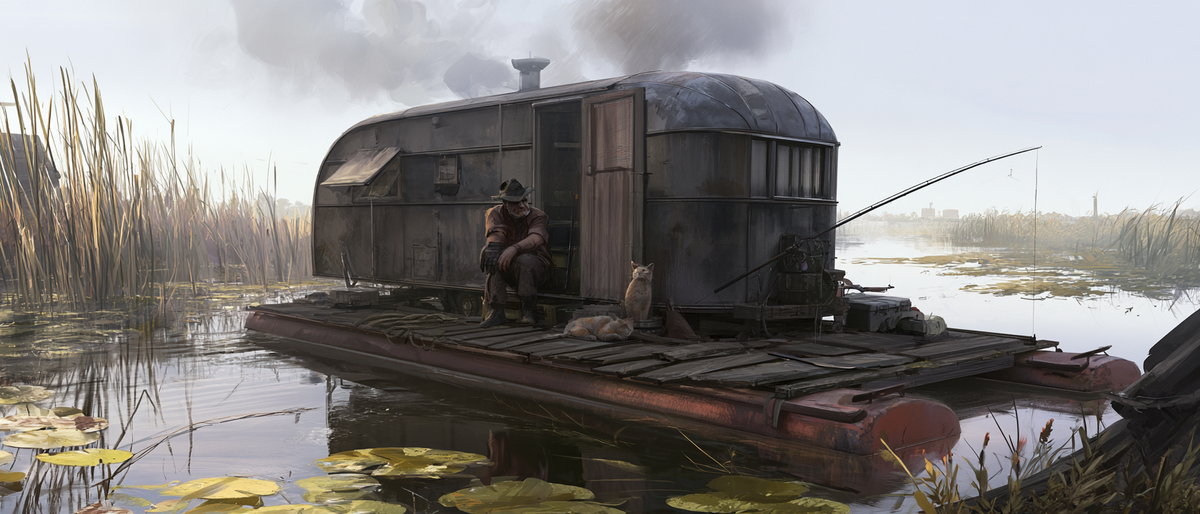
I'm sitting in a '70s era surplus Disney World worker trailer on the flood-plains of a north-flowing Florida river, fifty miles from the Gulf of Mexico, twenty feet above the highest waterline I have ever personally witnessed, with an eight-month-old kitten named Psycho and a fully stocked escape canoe strapped to the side of the building, rooting for a tropical cyclone to become a catastrophic major hurricane.
I want to be clear that this is not madness. This is science. Mostly.
The fishing is terrible. The river is low — embarrassingly, historically, almost insultingly low. The bayou that wraps around my property, which in a proper Florida summer should be a murky, fecund, biologically extravagant corridor of life, currently looks like something between a drainage ditch and a philosophical statement about drought. The alligators — and there are alligators, there are always alligators — are no longer content to conduct their operations at a respectful distance from the neighborhood. They are making assessments. They are looking at the smaller dogs with the patient, calculating gaze of something that has been optimizing its predatory strategy for two hundred million years and is not particularly impressed by a Labradoodle or a Chihuahua (commonly known as "rats" in Mexico proper...)
We need rain. Specifically, we need the kind of rain that only a sufficiently motivated tropical system can deliver to a north-flowing river basin in northwestern Florida — the kind that comes in sideways for thirty-six hours and resets the entire hydrological situation to something approaching normal. The kind that makes the fish confused and aggressive and easy to catch. The kind the alligators retreat from, temporarily, while the neighborhood pets enjoy a brief and unearned reprieve.
Enter: a broad area of low pressure currently disorganizing itself over the Bay of Campeche.
The National Hurricane Center, in its Friday afternoon Tropical Weather Outlook, described this system with the meteorological equivalent of a polite dismissal — "disorganized shower and thunderstorm activity," "marginally conducive" conditions, a ten percent formation probability, strong expectations that it would shuffle across northeastern Mexico and quietly expire. The forecast community has essentially priced this system as a non-event. The betting public, to the extent that one exists for Atlantic tropical meteorology, is overwhelmingly positioned against development.
I am not.
Here is what the forecasters are correctly observing: the system is currently a mess. No defined center. Disorganized convection. Marginal atmospheric conditions. On current evidence, a ten percent formation probability is defensible.
Here is what the forecasters are perhaps insufficiently weighting: the Gulf of Mexico is, as of this writing, running at near-record sea surface temperatures — tied with May 2024 as the warmest on record for the date, more than one degree Celsius above the 1991-2020 baseline, with anomalous heat content extending not just at the surface but downward through the water column to depths that matter enormously when a hurricane's winds start churning. This is not a surface condition that a passing storm can exhaust. This is a thermal reservoir. This is fuel, stored, waiting.
And here is what I noticed that the official forecast did not adequately explain: who says this system has to cross Mexico at all?
The projected track — northwest into northeastern Mexico, weakening over land, possible disorganized reemergence Tuesday or Wednesday — is a forecast. It is the mean of ensemble model guidance applied to a system that does not yet have a coherent center for the models to accurately steer. If the ridge of high pressure currently dominating the northeastern Gulf holds or strengthens, it does not let the system through to Mexico. It deflects it northeast. Over open water. The entire time. No land interaction. No weakening. A continuous overwater track aimed up the Gulf toward the least-developed major coastline in the contiguous United States east of the Mississippi.
Aimed, in other words, roughly at me. Or at least at my general watershed.
NOAA has, across twenty-three seasons of documented seasonal forecasts, missed on the upside eight times out of nine when it missed at all. When the official forecast is wrong, the season is almost always worse than predicted, not quieter. The systematic bias runs one direction. I have read the literature. I have done the math. I have also, full disclosure, spent several hours this week discussing all of this with an AI assistant who pushed back on my sixty-five percent major hurricane probability estimate and offered a counter of ten to fifteen percent — before conceding that its own analysis had been anchoring on the land-crossing assumption I had just correctly identified as non-obligatory, and revising toward me.
Sixty-five percent. That is my position. Major hurricane. Against a field pricing this system at essentially nothing.
The asymmetry is beautiful. A small enough wager that losing it is a conversational footnote. A large enough multiplier, given the odds available against my position, that winning it funds something memorable. This is not gambling in the pejorative sense. This is the disciplined exploitation of a market pricing error — the same logic that made certain people extraordinarily wealthy in 2008 by noticing that everyone else was modeling risk incorrectly.
Michael Burry shorted mortgage-backed securities. I am, in a more modest way, going long on a Bay of Campeche low-pressure system against the institutional weight of the National Hurricane Center, NOAA's seasonal modeling apparatus, and approximately ninety-nine point nine nine percent of the meteorologically-informed public.
KMFDM is playing in the background. Kein Mehrheit Für Die Mitleid. "No pity for the majority..."
Psycho is sitting approximately eighteen inches from the door, which is open, watching the bayou with the focused, unreadable attention of a creature who processes the world through threat assessment and has not yet classified low water levels as a personal emergency. She will not go past the first step without me. In a surge event she will identify the highest dry surface in the trailer within four seconds of the first wave and establish a position there with complete calm while I finish readying the escape canoe. She was born in October. She has never seen a proper Florida rainy season. She does not know what she is missing.
The steel girder underframe of this trailer — built to be moved once, from factory to lot, and never again — sits solidly beneath us. The flotation devices I have whimsically considered deploying beneath it in a genuine surge scenario would most likely, in practice, be entirely unnecessary at my elevation. I am twenty feet above the highest water I have ever seen. I'm fifty miles from the Gulf, in a canoe-equipped, cat-guarded, structurally sound Disney-era barge of a domicile.
I would be fleeing north into horse country long before my vision of raw survival ever became relevant.
Nevertheless, I will be watching on Tuesday. I will be storm-tracking on Wednesday. I am watching what comes out of northeastern Mexico — or what doesn't bother going there at all and instead takes a long, unhurried, thermodynamically luxurious track across a Gulf of What-the-Fuck-Ever running the hottest it has ever been, building and building in the absence of anyone who thought to adequately price the possibility, and careening directly into the Withlachoochee river basin.
The fish are waiting. The alligators are patient. Psycho is watching the door.
Place your bets.
Jonathan Brown writes on technology, security, and culture for bordercybergroup.com and aetheriumarcana.org.
If you enjoy our work... Buy us a coffee!: https://bordercybergroup.com/#/portal/support ... Thanks!
Member discussion: