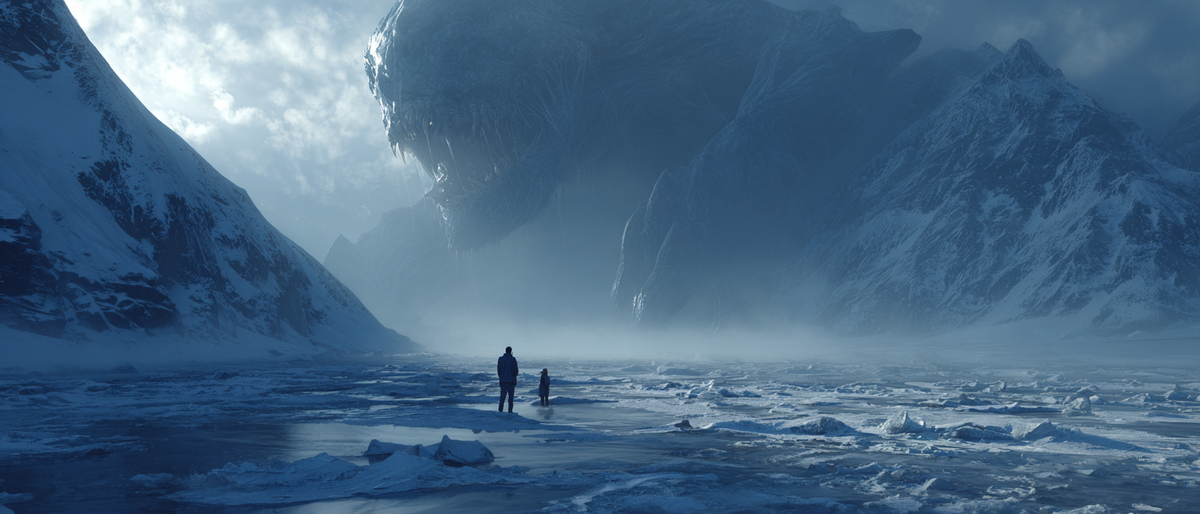
Beyond sea-level rise lies a darker reality: the great "unsealing." From 50,000-year-old viruses to radioactive Cold War ghosts and ice-eating algae, discover why the melting cryosphere is the ultimate "Black Swan" of the climate crisis.
The False Silence of the Ice
The cryosphere is the Earth’s most honest historian. It is a world composed of pressurized silence and monochromatic stillness, a two-mile-thick vault of "deep time." From the air, the great ice sheets of Greenland and Antarctica look like static, topographical maps of a dead world. But the ice is anything but dead. It is a colossal, crystalline storage unit currently being unzipped from the top down.
For decades, the public narrative surrounding global warming has been one of volume: How much water will the melt add to the tides? Which coastal cities will be erased by the creeping blue line? These are vital, terrifying questions. However, they treat the ice as if it were merely frozen tap water. In reality, the ice is a "legacy cocktail" - a high-pressure archive of every atmospheric mistake, every viral mutation, and every radioactive ghost of the last several hundred thousand years.
We are entering the era of The Exhumation.
As the "active layer" of the Arctic permafrost deepens and the great glaciers retreat, the planet is breathing out things we thought were buried forever. We aren't just losing a cooling system; we are witnessing a biological and chemical homecoming. From 50,000-year-old "zombie" viruses reawakening in the Siberian sludge to the sudden pulse of mid-century industrial toxins like DDT and mercury being dumped into the modern food chain, the melting cryosphere is proving that nothing is ever truly gone.
The "Black Swan" of the climate crisis isn't just a storm or a surge. It is the invisible invasion of a past we have outgrown, re-entering a world that no longer has the immunological or systemic defenses to face it. To understand what is coming, we have to stop looking at the ice as a victim of warming and start seeing it for what it truly is: a biological time machine that has just been set to "reverse."
The Biological Time Machine
To understand the biological risk of the thaw, you have to stop thinking of the ice as a tomb and start thinking of it as a stasis chamber. In microbiology, we use the term cryptobiosis - a state where an organism’s metabolic engine grinds to a total halt, but the blueprint remains intact. When the permafrost "unzips," it isn't just releasing organic matter; it is hitting the "resume" button on life that hasn't seen the sun since the Pleistocene.
The Resurrection of the Giants
The most cinematic of these "zombie" inhabitants are the Giant Viruses. Discovered in the Siberian permafrost, species like Pithovirus and Pandoravirus challenge our very definition of a virus. While a modern flu virus might have a handful of genes, these ancient giants carry over 2,000. They are large enough to be seen under a standard light microscope, appearing like dark, amphora-shaped shadows.
In 2024 and 2025, researchers successfully "baited" these viruses out of 50,000-year-old samples using amoebae. Once thawed, the viruses recognized their prey, invaded, and began replicating as if the last fifty millennia had never happened. While these specific giants don't target humans, they serve as a proof of concept: the "biological expiration date" for a virus is a myth if the freezer is deep enough.
The "Horizontal" Threat
The greater risk to our modern infrastructure, however, isn't a single "zombie" plague. It is Horizontal Gene Transfer (HGT). Bacteria are remarkably social; they don't just pass genes to their offspring, they trade them like playing cards with their neighbors.
As ancient bacteria - some dating back a million years - reanimate in the meltwater, they bring with them "ancestral" antibiotic resistance genes. These microbes evolved in a world of natural soil fungi and ancient competitors, developing defenses long before Alexander Fleming discovered penicillin. When these ancient genes leach into modern river systems, they can be picked up by current pathogens. We are effectively introducing "new" old tactics into the arms race of modern medicine, potentially arming today's superbugs with a prehistoric arsenal.
The Host-Jump Lottery
Finally, there is the matter of immunological naïveté. Our immune systems are the product of a constant, generational dialogue with the environment. We have "memory" of the pathogens our grandparents fought. But we have no memory of the microbes that co-existed with the woolly mammoth.
As the Arctic warms, it isn't just the microbes moving; it’s the hosts. Species are migrating north into newly thawed territories, creating a "spillover lottery." Every time a migratory bird or a thawing rodent comes into contact with a reanimated ancient microbe, a new evolutionary experiment begins. Most of these experiments fail, but in the math of a global thaw, the "Black Swan" only needs to win once.
The Chemical Pulse
If the biological threat of the thaw is an unpredictable "Black Swan," the chemical threat is a mathematical certainty. For the better part of a century, the Earth’s cryosphere acted as a global "sink" for the side effects of the Industrial Revolution. Through a process called the Grasshopper Effect, volatile chemicals used in the tropics and temperate zones evaporated into the atmosphere, hitched a ride on global air currents toward the poles, and condensed in the frigid air, eventually becoming entombed in layers of snow and ice.
Now, the "sink" is overflowing.
The Ghost of the 1960s: Nuclear Fallout
During the height of the Cold War, atmospheric nuclear testing peppered the stratosphere with radioactive isotopes. While much of this fallout decayed or dispersed, a significant concentration was "scrubbed" from the sky by Arctic snow. As glaciers in places like Greenland and the Alps retreat, they are hitting "nuclear horizons" - layers of ice where isotopes like Cesium-137 and Americium-241 are concentrated at levels far higher than current atmospheric backgrounds. When these layers melt, they don't just add water to the sea; they release a radioactive pulse into the local meltwater and soil, re-introducing mid-century debris into the 21st-century biosphere.
The Mercury Surge
Mercury is perhaps the most insidious "gift" the ice is returning. It is a potent neurotoxin that accumulates in the tissue of fish and mammals (biomagnification). The Northern Hemisphere’s permafrost is estimated to hold nearly twice as much mercury as all other soils, the ocean, and the atmosphere combined.
- The Mechanism: This mercury, largely from volcanic activity and coal-burning, was trapped by organic matter that froze before it could decay.
- The Release: As this organic "slush" thaws, microbes convert the mercury into methylmercury, its most toxic form. This enters the Arctic runoff, moving from plankton to fish to the apex predators - including the indigenous communities for whom these waters are a primary food source. We are witnessing a localized "Minamata" effect driven not by a single factory pipe, but by the soil itself.
Legacy Pollutants: The Persistent Organic Poison
Finally, there are the POPs (Persistent Organic Pollutants) - chemicals like DDT, PCBs, and dioxins. We banned many of these decades ago because they don't break down; they simply move. For fifty years, the Arctic served as a graveyard for these chemicals.
However, recent studies of the Greenland Ice Sheet have shown that meltwater is now a primary source of "fresh" DDT entering the North Atlantic. We are essentially being haunted by the agricultural and industrial ghosts of our grandparents. This creates a cruel irony: even as a nation achieves "net-zero" or cleans its own backyard, the melting ice is delivering a shipment of toxins from a previous generation's negligence.
The Bioalbedo Effect—When Life Eats the Ice
In the traditional climate model, ice is a passive victim - a static white sheet reflecting the sun’s anger back into space. In reality, the ice is becoming a medium for a massive, self-sustaining biological bloom. We are moving from a world of "White Ice" to a world of "Dark Ice," and the catalyst is a phenomenon known as Bioalbedo.
The Purple Frontier
If you were to stand on the Greenland Ice Sheet today, you might notice vast stretches of the surface tinged with a deep, bruised purple or a soot-like grey. This isn't dirt or pollution; it is an explosion of life. Glacier algae (Ancylonema nordenskioeldii) have lived in the ice for millennia, but the increasing presence of liquid meltwater and atmospheric nutrients has turned a survival struggle into a feast.
These algae produce dark-colored pigments - essentially a biological sunscreen - to protect their delicate internal machinery from the intense Arctic UV rays. However, there is a catastrophic side effect: dark surfaces absorb heat. While pure white snow reflects about 90% of solar radiation, ice darkened by these blooms might reflect as little as 30%. The microbes are effectively "cooking" the ice they live on to create more liquid water, their primary life-support system.
The Feedback Loop of the Microscopic
This is a "biological feedback loop" that most global climate models are only just beginning to quantify.
- Warming creates more surface meltwater.
- Meltwater allows algae to bloom across larger areas.
- Algae darken the ice (lowering albedo).
- Dark Ice absorbs more solar energy, leading to even more warming.
We are no longer just dealing with a thermometer problem; we are dealing with an ecosystem that has its foot on the accelerator. In 2025, satellite data confirmed that these biological "hotspots" are expanding toward the poles faster than predicted, turning the ice into a giant solar collector.
Deep Life: The Subglacial Leak
The "eating" of the ice isn't just happening on the surface. Miles beneath the Antarctic ice sheet lie hundreds of subglacial lakes, like Lake Vostok, which have been sealed for millions of years. These are high-pressure, pitch-black environments inhabited by chemolithotrophs - organisms that "eat" minerals and sulfur instead of sunlight.
As the ice sheet thins and shifts due to oceanic warming from below, the "plumbing" of Antarctica is changing. This ancient, mineral-rich water is starting to leak into the Southern Ocean. When this "rock-juice" hits the open sea, it acts like a massive dose of fertilizer. While this might sound positive, it risks triggering colossal, oxygen-depleting plankton blooms that could fundamentally shift the nutrient balance of the global ocean. The "monsters" under the ice aren't just viruses; they are chemical and biological catalysts capable of re-engineering the sea's chemistry.
The Geopolitical and Cultural Melt
The melting of the cryosphere is often discussed in the future tense, but for the people who live at the edges of the world, the "unsealing" is a present-day crisis of sovereignty and survival. As the ice retreats, it isn't just revealing bare rock and ancient microbes; it is revealing a new, high-stakes theater for human conflict and the heartbreaking erasure of a civilization’s "highway."
The Shattered Highway
For Arctic indigenous communities, such as the Inuit and the Nenets, ice is not an obstacle - it is infrastructure. It is the "Ice Highway" that connects isolated villages, allows for the migration of subsistence food sources like caribou and seals, and maintains a cultural link to the land.
As the ice thins and the "freeze-up" happens later each year, this highway is shattering. We are witnessing the death of traditional ecological knowledge. When the ice becomes unpredictable, the wisdom passed down through generations about where to hunt and how to travel safely becomes obsolete. This is a "cultural melt" that cannot be recovered by technology; it is the loss of a human-environment relationship that has existed since the end of the last Ice Age.
The New Maritime Wild West
While local cultures lose their footing, global powers are racing to find theirs. The retreat of the Arctic sea ice is opening the Northwest Passage and the Northern Sea Route, potentially shaving weeks off global shipping times between Asia and Europe. What was once a frozen barrier is now becoming the most contested shortcut on Earth.
This "gold rush" isn't just about shipping; it’s about what lies beneath. The U.S. Geological Survey estimates that the Arctic holds roughly 13% of the world’s undiscovered oil and 30% of its undiscovered natural gas. We are faced with a dark irony: the melting caused by fossil fuel consumption has granted us access to even more fossil fuels. This has sparked a "Cold War 2.0," with nations like Russia, China, and the U.S. scrambling to build icebreakers and establish military outposts in a region that has no established "border patrol."
The Archaeological Emergency
Finally, there is the race against rot. The ice has been a perfect preservative for human history - from perfectly intact 500-year-old Inca mummies in the Andes to 10,000-year-old hunting tools in the Yukon.
As these artifacts are exhumed by the melt, they are hitting the oxygen-rich air for the first time in millennia. Without the protective seal of the ice, organic materials - wood, leather, and bone - begin to decay within days. Archaeologists are currently in a frantic "salvage" mode, trying to recover the physical record of our ancestors before it turns to dust. We are losing the evidence of where we came from at the exact moment we are most confused about where we are going.
Preparing for the Unseen
The collapse of the cryosphere is often framed as a tragedy of loss - less ice, less habitat, less stability. But as we have explored, the greater challenge may lie in what we are gaining. We are witnessing the end of the Earth’s great "quarantine." The ice is no longer a silent bystander to the climate crisis; it has become an active participant, exhaling the biological, chemical, and radioactive ghosts of our collective past.
The Shift to Cryo-Vigilance
Our current global response to climate change is largely focused on the "Macro" - sea walls to hold back the tides and carbon credits to slow the warming. While essential, these measures do little to address the "Micro" threats we’ve discussed. We need a fundamental shift toward Cryo-Vigilance. This means:
- Enhanced Biomonitoring: Establishing early-warning systems at the "thaw-front" to detect re-emergent pathogens before they reach populated centers.
- Toxicological Preparedness: Integrating the release of legacy pollutants (like mercury and DDT) into global food safety standards and water management protocols.
- Redefining Risk: Moving away from the idea that a "Black Swan" event is an impossibility. In a melting world, the improbable becomes inevitable over a long enough timeline.
The Irony of the Archive
There is a profound irony in our current moment. We are using modern technology to peer into the "time capsule" of the ice, desperately trying to read the climatic history written in its layers before the pages melt away. Yet, even as we lose the data that could help us save the future, the ice is returning the physical evidence of our past negligence. It is a mirror we can no longer afford to ignore.
A Final Thought
The "monsters" in the ice aren't mythical creatures; they are the tangible consequences of a planet out of balance. Whether it is a 50,000-year-old virus, a pulse of Cold War radiation, or a microbial bloom that eats the very ground it stands on, the message is the same: Earth has a long memory. As we unseal these ancient archives, our success as a species will depend not on our ability to refreeze the past, but on our courage to face what we have exhumed and our wisdom to build a system resilient enough to survive it.
The silence of the ice is over. It’s time we started listening to what it’s saying.
ओम् तत् सत्
Member discussion: