
A "protected female" in Whitechapel, 1888 | By Jonathan Brown
One cold night in October 1888, a young woman dressed herself in the darkest, least conspicuous clothing she possessed and waited outside London’s Royal Courts of Justice. The Strand around her blazed with theatre lights. Carriages discharged fashionably dressed couples; cafés overflowed; newsboys shouted rumors of an arrest in the Whitechapel murder case. Women wrapped in furs passed beneath the lamps, each respectably escorted by a man.
The woman waiting outside the courts was twenty-five-year-old journalist Lillie Harris. She had come to London determined to see Whitechapel for herself.
A tall, muscular plainclothes police officer—identified in her subsequent articles only as “Mr. B—”—arrived to accompany her. Together they boarded an omnibus and travelled east, away from the theatres, perfume and polished respectability of the Strand. They disembarked near Leadenhall Street and entered Mitre Square, where Catherine Eddowes had been murdered and mutilated less than a month earlier.
Harris and the officer deliberately stood in the darkest corner. Passing pedestrians failed to notice them. For perhaps seven or ten minutes they remained concealed in what Harris called the square’s “murderous shade.” Only when a policeman approached and flashed a lantern upon them was their presence detected.
The experiment unnerved her. A person really could be attacked there without anyone seeing.
Over the following hours, Harris inspected the sites associated with the murders of Eddowes, Elizabeth Stride, Mary Ann Nichols and Annie Chapman. She entered dark passageways, questioned residents, watched plainclothes detectives, spoke with vulnerable women and examined the social machinery of the common lodging houses. Her published narrative combined crime reporting, urban exploration, social investigation and gothic travel writing.
The resulting series, “Slumming in Whitechapel,” appeared in four installments in Sheffield’s Weekly Telegraph between October 27 and November 17, 1888. The first two were signed “A Protected Female.” In the final two, Harris gave herself a more assertive designation: “An Amateur Detective.”
Her readers did not know her name. Indeed, for most of the next 130 years, neither did historians.
The young woman behind the disguise
Lillie Harris was the familiar name of Elizabeth Rebecca Sarah Harris, born near Ventnor on the Isle of Wight on October 19, 1863. Modern researchers Marianne Van Remoortel and Fien Demarée identified her as the only child of Samuel Harris, a Jewish carver and gilder, and his wife Caroline, née Goldsmid.
Writing was not simply a genteel accomplishment for Harris. It became a means of assisting her family after changes in trade reduced her father’s income. She began extraordinarily young. Mama’s Fairy Tales, her first book, appeared in 1878, when she was reportedly thirteen. In the 1881 census, while still in her teens, she gave her occupation as “authoress.”
She contributed to the children’s periodical Little Folks and, after moving north, began writing columns and stories for the Newcastle Weekly Chronicle. Her satirical series “Our Young Ladies,” published during the mid-1880s, helped establish her reputation. She was also becoming a public lecturer, addressing such subjects as cruelty to animals and the future of women.
This was an important transitional moment in British journalism. Women had long written fiction, advice columns, fashion material and anonymous contributions for newspapers, but the figure of the professional female reporter was still sufficiently novel to be treated as a distinct social type—the “lady journalist.” Women faced resistance inside newspaper offices, exclusion from professional networks and a presumption that difficult reporting belonged to men.
Harris pushed directly against that boundary. In May 1888 she became, according to contemporary accounts, the first woman admitted to the National Association of Journalists, the organization that subsequently became the Institute of Journalists and received a royal charter in 1890. Her admission did not merely recognize her as a writer. It asserted that she belonged to journalism as a profession.
By the autumn of that year she was poised between positions. She was still associated with the Newcastle Weekly Chronicle but appears to have been considering new opportunities. Her Whitechapel expedition would become the assignment that decisively introduced her to readers of the Sheffield press.
The publishers who sent Whitechapel north
The newspaper carrying Harris’s dispatches belonged to the publishing world built around the Sheffield Daily Telegraph. Founded in 1855, the Daily Telegraph had struggled until William Christopher Leng became its managing editor and joint proprietor in 1864. Leng developed it into an influential Conservative newspaper and expanded the business into a family of publications.
A Saturday literary supplement had existed since the 1860s. On January 13, 1883, it was renamed the Sheffield Weekly Telegraph and sold for one penny. After 1887 its title was shortened to the Weekly Telegraph. It offered the mixture expected of a mass-market Victorian weekly: serialized novels, short fiction, features, household material and accounts of extraordinary events. Its fiction included work by some of the century’s best-known popular writers. A surviving periodical history shows that in 1888 it was serializing both Mary Elizabeth Braddon and Hawley Smart.
This was not a minor distinction. Harris’s reporting did not appear in a specialist criminological journal or an exclusively London newspaper. It was delivered to a large provincial readership as part of a package combining information and entertainment. Whitechapel became an experience that a reader in Sheffield could enter imaginatively without leaving the sitting room.
Victorian publishers understood the commercial power of the murders. The Whitechapel crimes coincided with expanding literacy, inexpensive newspapers, improved printing technology and fierce competition for readers. The unidentified killer became one of the first criminals transformed into an international media phenomenon. The London Museum’s account emphasizes both the fear spread by the crimes and the frenzy of newspaper attention surrounding them.
Much of that journalism was irresponsible. Rumor became news; speculation hardened into apparent fact; descriptions of mutilation were sold as entertainment. Antisemitic suspicions threatened Whitechapel’s immigrant population. Journalists and private citizens flooded the district, searching for clues, atmosphere or simply excitement. The murderer’s enduring nickname almost certainly derived from a letter sent to a news agency and widely reproduced by the press, although the letter’s authenticity has never been established.
Harris participated in this economy of sensation. She did not pretend otherwise. Her series was designed to attract readers by promising entry into a supposedly forbidden world. Yet her work also differed from conventional Ripper reporting in an essential respect: she was less interested in manufacturing another suspect than in examining the physical and social conditions surrounding the crimes.
Her opening question was not “Who is the murderer?” It was, in effect, What kind of neighborhood makes these murders possible?
From the Strand into darkness
Harris already knew Whitechapel Road, the busy commercial artery running through the district. She had walked there before and observed its mixture of people. What she did not know were the courts, alleys and lodging-house streets branching away from it.
Following the murders of Stride and Eddowes on September 30, she decided to investigate. Night was the obvious time, but entering alone would have been dangerous and, for a middle-class woman, socially compromising. She consulted a City of London police inspector, disguised in print as “Inspector R—.” He could not accompany her but introduced her to Mr. B—, whom she presented as observant, physically imposing and thoroughly acquainted with the district.
Her choice of the signature “A Protected Female” was simultaneously candid and strategic. It acknowledged that her movement depended upon male protection, but it also made her sex part of the story. The reader was invited to experience Whitechapel through the nerves and senses of a woman who might, without her escort, resemble the murderer’s prospective prey.
In the first installment, Harris constructed the journey through contrast. The West End possessed light, perfume, food, warmth, fashionable clothing and sanctioned pleasure. The East End, though geographically close, occupied another moral and sensory universe in the Victorian imagination.
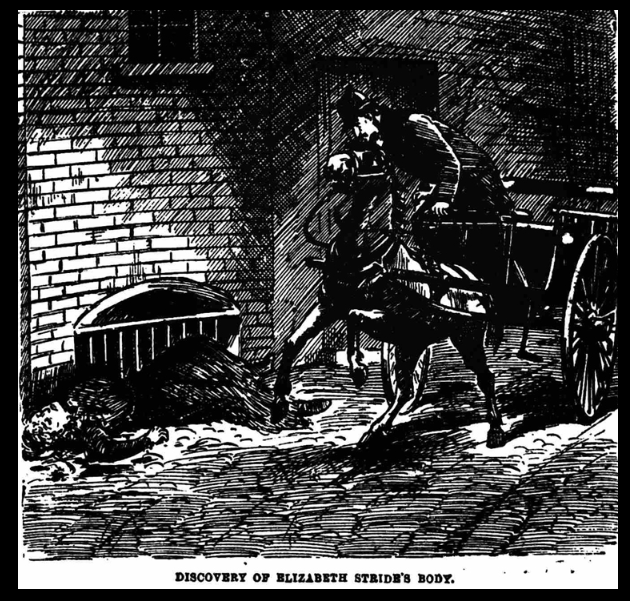
After examining Mitre Square, Harris and Mr. B— crossed toward Berner Street, now Henriques Street. Here Elizabeth Stride had been killed inside the entrance to Dutfield’s Yard. The gas lamps were infrequent and weak. Doors that appeared to open into houses instead revealed narrow courts crowded with deteriorating cottages. Broken windows were stuffed with rags. Wastewater and decaying matter collected in passages with little or no artificial light.
Mr. B— explained the practical policing problem. Constables might patrol the principal street, but properly inspecting every court would require far more officers than were available. A killer could retreat into an unlit passage, wait for the immediate alarm to pass and then disappear into the gathering crowd.
Harris’s reporting was strongest when it connected environment with opportunity. Darkness was not merely a gothic decoration. It was infrastructure—or, more accurately, failed infrastructure. Insufficient lighting, overcrowded housing and absent sanitation created real concealment and vulnerability.
Inside Dutfield’s Yard, Harris met a barefoot girl of about fourteen. The child, whom someone called “Lizer,” described where Stride’s head and legs had rested and pointed toward the blood. When Harris’s companion asked whether she had heard anything, the girl said that neither she nor the other residents had heard a sound. She appeared ready to offer her own theory, but someone called her back into a cottage before she could finish.
The encounter is tantalizing. It represents one of the few moments in the series when a female resident begins to become something more than scenery. Yet even here the girl vanishes before her thought can be recorded.
The second installment continues through scenes of drinking, fighting and domestic hardship. Harris watched two women come to blows outside a public house while children and men treated the violence as entertainment. She encountered married teenage mothers carrying babies, groups of detectives disguised as laborers and a young woman visibly shaken when her companion joked about being Jack the Ripper.
Harris then entered Buck’s Row, now Durward Street, where Mary Ann Nichols had been found on August 31. The location contradicted her expectations. It was wider, cleaner and more adequately illuminated than Berner Street. Some houses appeared respectable, and the residents seemed to belong to the working poor rather than the population Harris classified as criminal.
The relative openness of Buck’s Row made the Nichols murder more mysterious to her. How could someone kill and mutilate a woman there without being observed? Harris did not solve the problem, but she did something journalistically valuable: she allowed direct observation to disrupt the picture she had formed in advance.
Hanbury Street and the people beneath the headlines
In the third installment, the pair left Buck’s Row for Hanbury Street, where Annie Chapman had been murdered behind number 29 on September 8.
Harris’s account became increasingly physical. She described uneven paving, narrow streets, overcrowded buildings, greasy food wrappers, public urination, fried-fish odors, faces damaged by violence and men emerging unexpectedly from dark entries. She also recorded hostility toward the murderer among people who were themselves familiar with assault and crime. One man suggested that beating a woman was understandable but mutilating her was beyond the boundaries even of his violent morality.
The observation is horrifying, but important. Harris discovered that opposition to the Ripper did not necessarily imply opposition to violence against women. The murders were perceived as exceptional partly because mutilation exceeded forms of brutality that had become ordinary.
Her escort described thieves, pickpockets, predatory men living upon women’s earnings and “professional loafers” who emerged at night. Harris sometimes accepted these police classifications uncritically. At other moments she noticed complications. Immigrant residents, she wrote, were regarded with suspicion, but she also believed many were quiet and inoffensive. Mr. B— warned that if the murderer proved to be foreign, the innocent immigrant population might be violently driven from Whitechapel.
This fear was well founded. Eastern European Jewish migration had already become a focus of resentment. Harris herself used ugly national stereotypes while simultaneously recognizing the danger of collective persecution. That contradiction runs throughout her work: observation and prejudice, sympathy and revulsion, social criticism and social distance.
Her descriptions of prostituted women are especially severe. She wrote of painted faces, damaged bodies, matted hair, illness and fear, often questioning whether anything recognizably “womanly” remained in them. Such language did not restore individuality to women whom the press had reduced to a social category. It transformed them into evidence of Whitechapel’s degradation.
Yet Harris also recorded circumstances that undermined purely moral condemnation. Some women had stopped going out after the murders. Without earnings, they could not purchase a bed. One woman told Harris that she was afraid to seek money in the streets. Harris gave her a coin and asked whether she suspected anyone. The woman looked around fearfully before denying any knowledge.
Harris concluded that women like her might know something but were unwilling or unable to speak. That interpretation may contain a reporter’s desire to discover hidden knowledge where none existed. Nevertheless, it recognized the atmosphere of coercion surrounding potential witnesses. A woman dependent upon lodging-house residents, customers, male partners and street earnings could not speak with the freedom available to a visiting journalist protected by police.
The installment also contains a long story told by Mr. B— about entering a women’s lodging house to arrest a wanted person. The women mocked his modesty, and the suspect allegedly had no clothing available. He finally wrapped her in his own coat and handcuffed her to prevent its removal.
Later biographical profiles claimed that Harris herself went through notorious lodging houses. The surviving series provides no clear confirmation of that claim. She unquestionably observed lodging houses and their residents at close range, but the principal interior description comes from her escort’s earlier experience. The distinction is worth preserving: Harris was courageous enough without improving her itinerary after the fact.
The price of a bed
The fourth and concluding installment appeared on November 17, eight days after Mary Jane Kelly was murdered in Miller’s Court. Yet Kelly is never mentioned. Van Remoortel and Demarée reasonably suggest that Harris completed the full account in October and that the newspaper divided it into four installments. The omission therefore helps date the expedition: it almost certainly occurred after the September 30 murders and before Kelly’s death on November 9.
In the final article, Harris witnessed a disabled and starving youth retrieve discarded bread from the gutter. A woman seized it from him. When Harris learned that the thief was his mother, the episode overwhelmed her tidy distinctions between victim and aggressor. Hunger had made everyone cruel.
Near the Chapman murder site, Mr. B— explained how women might earn enough during the day to pay for lodging but spend the money on alcohol. As midnight approached, those who could not produce fourpence became desperate. Being turned away meant sleeping outside—or returning to sex work while a murderer was believed to be hunting women in precisely that position.
Harris then watched a young woman plead with a lodging-house deputy for credit. The woman offered almost anything for admission. When the door closed, she struck it, tore at her clothing, beat herself and called upon Christ. Eventually another woman arrived, counted her own meager money and apparently paid for them both to enter.
The episode is among the most powerful in Harris’s series because it reveals both institutional brutality and mutual aid. The lodging-house rule exposed a woman to mortal danger; another impoverished woman rescued her. Harris’s police escort, despite his harsh generalizations, acknowledged a kind of clan loyalty among the women.
As Harris and Mr. B— returned toward Whitechapel Road, the atmosphere changed. The broad thoroughfare was bright and noisy. Vendors sold potatoes, fish, meat, shellfish, jewelry and dubious medicines. Children danced around an organ grinder. A little girl with long golden hair performed with such grace that Harris stopped to watch. The people appeared better dressed; the men looked like laborers resting after work rather than predators waiting in alleys.
This passage complicates the descent-into-hell structure of her narrative. Whitechapel was not one undifferentiated abyss. The same district contained hunger, commerce, violence, humor, beauty, family life and pleasure. Harris could recognize those distinctions because she had walked through it rather than constructing it entirely from other newspapers.
Her final diagnosis was strikingly material. Visits by benevolent ladies and gentlemen would accomplish little while the lighting remained deficient, sanitation inadequate and dark, overcrowded alleys intact. However moralistic her vocabulary, she had discovered that sermons could not substitute for infrastructure.
She parted from Mr. B— at Aldgate Station and returned to her hotel, carrying what she described as a profound physical disgust at what she had seen and heard.
Courage, spectacle and the ethics of “slumming”
“Slumming” was already an established Victorian practice. Wealthy or educated visitors entered impoverished districts for charitable work, religious missions, sociological inquiry, political advocacy or voyeuristic entertainment. Journalists turned these expeditions into a recognizable literary form: a respectable observer crossed into a forbidden urban underworld and returned to describe its inhabitants.
Harris inherited nearly all the form’s moral problems. Whitechapel’s residents rarely control her narrative. She inspects their clothing, skin, hair, smell, wounds and gestures. Their bodies become a public exhibition for readers who possess the penny required to buy the newspaper, the literacy to read it and the leisure to contemplate it.
Van Remoortel and Demarée make this imbalance central to their open-access study of Harris. The woman journalist gains a public body and professional authority through the text, while the working-class women she observes are denied comparable subjectivity. Harris escaped one form of silencing without necessarily freeing the women beneath her gaze.
Her attitudes should not be sanitized. She repeatedly equated poverty with moral failure, described people in animalistic terms and treated prostitution as a bodily mark of degradation. Her descriptions of immigrants could be xenophobic. Even her compassion was frequently paternalistic.
But simply dismissing her as a privileged voyeur would also be inadequate. Harris placed herself physically inside the landscape she described. She compared competing claims with observable conditions. She questioned residents and police. She tested the concealment offered by a murder site. She noticed distinctions between streets. She recognized that women’s fear had economic consequences, that inadequate lighting assisted violence, that lodging rules pushed women back into danger and that police deployment could not compensate for a built environment riddled with unmonitored spaces.
Her writing was therefore neither modern ethnography nor mere sensation. It occupied the unstable ground from which investigative journalism was emerging.
Did readers embrace the series?
The most dramatic account of its reception appeared three years later in Hearth and Home. A September 10, 1891 profile titled “A Popular Lady Journalist: Miss Lillie Harris” identified her as the author and claimed that demand had exhausted the newspaper editions containing her articles.
The claim is plausible. Public appetite for Whitechapel material was enormous, and the series offered the added novelty of a woman entering the murder district at midnight. But it should be treated cautiously. No independently verified issue-by-issue circulation figures, contemporary reader letters or substantial reviews of the series have yet come to light. The 1891 article was an admiring profile intended to celebrate Harris’s career, not an audited history of the Weekly Telegraph.
A more concrete measure of professional response followed quickly. On December 27, 1888, the Sheffield Evening Telegraph announced that it had secured Harris’s services as lady editor of the Weekly Telegraph. She took responsibility for its Ladies’ Page and Children’s Column while contributing fiction, travel writing and articles on social questions. She also founded the Kind Hearted Brigade, a children’s organization that eventually claimed tens of thousands of members.
The timing strongly suggests that the Whitechapel series enhanced her value to the paper, although surviving evidence does not prove that it alone won her appointment. What can be said safely is that within weeks of the series ending, its anonymous author became a named editor inside the same publishing organization.
A profile in the Lady’s Pictorial in 1893 again praised her Whitechapel expedition and described her as the first woman admitted to the Institute of Journalists. Its account mistakenly dates her visit to October 1887, a year before the murders. That obvious error offers a small warning about relying too heavily upon Victorian personality profiles—even when those profiles preserve information unavailable anywhere else. A free transcription of the 1893 feature survives through the Victorian Web.
A life scattered through archives
Harris married accountant John Charles Cozens Williams in January 1890. In October 1891, he died in a railway accident. Evidence that their son was born less than three months later indicates that Harris was approximately six months pregnant when her husband was killed.
Financial trouble followed. Her name appeared in reports of debt-recovery proceedings, where she explained that liabilities contracted before her husband’s death had fallen upon her. She continued trying to support herself and her child through writing.
By 1896 she was in London and briefly associated with Woman’s Life, a periodical published by George Newnes. She later travelled to South Africa with her son and married William Eugene Chapman, a journalist and mining manager who worked as a war correspondent during the South African War. Harris continued writing about women’s prospects and English life in South Africa.
Chapman died in 1905 after a prolonged illness. Harris returned to Britain widowed for a second time.
The most intimate surviving documents from her later life are not triumphant articles but applications for assistance. In 1914 and 1915, ill and unable to find sufficient literary work during the First World War, she appealed to the Royal Literary Fund. The Institute of Women Journalists supplied limited aid, but her application to the fund was rejected after reviewers judged her submitted work insufficiently distinguished.
Her final years remain obscure. She died on March 26, 1921, aged fifty-seven, from cerebral embolism and cardiovascular disease. The address on her death certificate belonged to the Wandsworth and Clapham Union Infirmary rather than a private home.
The ending lends a painful retrospective dimension to her Whitechapel reporting. In 1888 she entered poverty as a visitor who could return to a hotel. By the end of her life, sickness, widowhood and financial insecurity had carried her much closer to the precarious world she once crossed London to investigate.
How an author disappeared from her own work
The disappearance of Harris’s authorship was not mysterious in the manner of the Ripper murders. It was produced by ordinary archival forces.
The articles carried no personal name. “A Protected Female” and “An Amateur Detective” described journalistic characters, not searchable identities. A reader looking for work by Lillie Harris would not find them. A researcher encountering the articles could establish that the writer was a woman but had little means of proceeding further.
The later Hearth and Home profile presented the opposite problem. It named Harris and mentioned a sensational series about the Whitechapel murder sites, but did not give the series title. It referred generally to the Sheffield Telegraph, while the articles had appeared in the Weekly Telegraph. Searching digitized collections for the exact phrase “Slumming in Whitechapel” would not locate the profile; searching for “Lillie Harris” would not locate the anonymous articles.
The text and the author survived—but in separate compartments.
In December 2017, historian and tour guide Richard Jones placed transcriptions of all four installments on the Jack the Ripper Tour website. The pieces were divided under modern titles concerning Mitre Square, Berner Street, Buck’s Row and Hanbury Street. They were recognized as the work of an unnamed female journalist, but Harris had not yet been publicly restored to them.
The decisive rediscovery came through a project studying female editorship in nineteenth-century Europe. Ghent University researchers Marianne Van Remoortel and Fien Demarée were searching a periodical database for the phrase “lady editor” when they encountered the 1891 profile of Harris. Its description of her Whitechapel expedition was not what they had been looking for.
That accidental discovery supplied the missing clue. Using the digitized British Newspaper Archive, they located the four Weekly Telegraph installments published on October 27, November 3, November 10 and November 17, 1888. They then reconstructed Harris’s life from census material, newspapers, civil records, passenger lists and her Royal Literary Fund correspondence.
Their findings appeared in the winter 2020 issue of Victorian Periodicals Review as “‘Slumming in Whitechapel’ with Lillie Harris (1863–1921): Disembodiment, Power, and the Female Investigative Journalist.”
It was a remarkable act of archival reunification. One digital search recovered the woman; another recovered the writing. Neither search alone would have solved the problem.
Remembering the witness rather than glorifying the killer
Lillie Harris did not identify Jack the Ripper. She uncovered no decisive clue, named no credible suspect and offered no theory capable of resolving the murders. That is precisely why her work deserves attention.
The cultural industry built around the Whitechapel murders has traditionally rewarded speculation about the killer. Book after book turns another doctor, immigrant, artist, royal, butcher or policeman into the solution. The women who died become supporting evidence in someone else’s detective story.
Harris’s articles direct us elsewhere. They lead into the darkness of Mitre Square, but also into the economics of a fourpenny bed. They show detectives hidden among laborers, children carrying alcohol from public houses, women frightened away from their usual means of survival, neighbors pooling money, families crowded into rooms and a young girl dancing beside an organ grinder.
Her account remains compromised by its language and perspective. She could see Whitechapel’s residents without always recognizing their full humanity. Yet she also preserved moments that official records were unlikely to retain: the unfinished theory of a barefoot fourteen-year-old girl; a woman paying for another woman’s bed; the terror caused by a man’s Ripper joke; a clean domestic interior beside a murder site; the way footsteps sounded on a badly illuminated street.
And behind those observations stood a journalist almost erased from the history of journalism: a twenty-five-year-old woman who entered one of London’s most feared districts while the killer remained unidentified, compared rumor with place, questioned what she saw and returned with four long dispatches.
She began the series as “A Protected Female.” By its third installment, she had renamed herself “An Amateur Detective.”
History might improve that title one final time.
Lillie Harris was an investigative journalist.
Jonathan Brown for AetheriumArcana
© 2026 AetheriumArcana. All rights reserved.
Member discussion: