
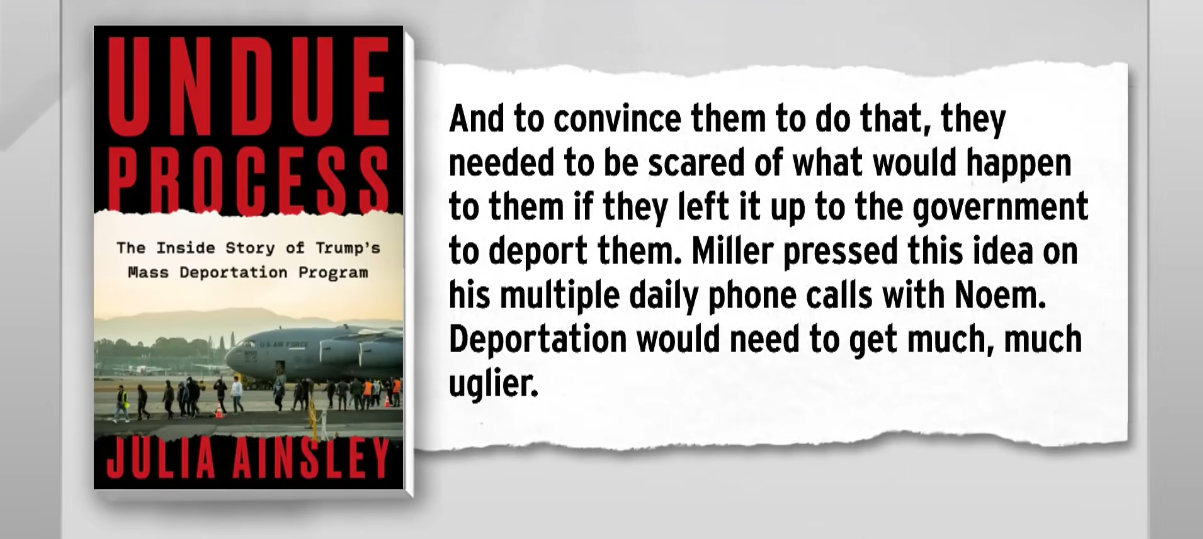
A Book Review ~ On the Catastrophe of Trump's Mass Deportation Program
On the evening Rachel Maddow sat down on MSNBC to interview NBC News Senior Homeland Security Correspondent Julia Ainsley about her new book, Undue Process: The Inside Story of Trump's Mass Deportation Program, the most recent casualty was still fresh: two teenage brothers, Israel and Max Makoka — student-visa holders from the Republic of Congo, star players on the Hancock High School basketball team in Diamondhead, Mississippi — had been zip-tied in front of their host father and their classmates at their school bus stop, placed in separate ICE vehicles, and transported to detention facilities in Louisiana and Texas, respectively, just days before the interview aired. Israel was eighteen years old and weeks away from graduation. He had already earned an athletic scholarship to college. Their alleged infraction: a paperwork lapse, unknown to their guardians, when they transferred from one Mississippi school to another. No criminal charge of any kind had been filed against either of them.¹
This is the world that Ainsley's book documents from the inside. And this is the political catastrophe — moral, constitutional, and electoral — that Maddow argues Donald Trump has made of what was supposed to be his strongest issue.
Undue Process: What the Book Is and Why It Matters
Julia Ainsley has covered immigration and the Department of Homeland Security since 2014, first for Reuters, then for NBC News, where she now serves as Senior Homeland Security Correspondent. Undue Process: The Inside Story of Trump's Mass Deportation Program (HarperCollins, 2026) is not a long book — under 200 pages — but it is dense with original reporting drawn from sources inside ICE and DHS, from government contractors, and from officials who were fired, demoted, or forced out for refusing to fully comply with what the administration demanded of them.² The book is, as Ainsley described to Maddow, a deliberate act of contemporaneous accountability journalism — a refusal to bank the good material for a post-administration retrospective while the machine is still running.
The book's central argument, supported by internal data, contemporaneous sourcing, and a remarkable collection of on-the-record and off-the-record testimony, is straightforward: the Trump administration's mass deportation program was never a coherent plan. It was an improvisation — a cascade of escalating improvisations driven by political ego, a bottomless appetite for cruelty as messaging, the financial self-interest of contractors and power-brokers, and the ideological obsessions of a small number of people, foremost among them Stephen Miller, who believed that raw terror — the fear of arrest, of separation, of indefinite detention — could substitute for an enforceable policy. When the numbers didn't add up, they made the methods uglier. When the ugliness generated backlash, they made the methods uglier still.
The result has been what Ainsley and the data both describe: a program that arrested more people with no criminal record than with one, that deported children specifically because their addresses were the easiest to find, that sent a man to a Salvadoran mega-prison by admitted administrative error in violation of a standing court order, that built the largest immigration detention facility in American history on a military base in El Paso and filled it so recklessly that three detainees died in six weeks — one of them ruled a homicide by the county medical examiner — and that ultimately killed two American citizens on the streets of Minneapolis.
The Numbers That Started the Cascade
The foundational failure, as Ainsley reconstructs it, was numerical. In the first full month of Trump's second term, February 2025, ICE deported approximately 11,000 immigrants. The Trump administration never publicly acknowledged this figure. The reason is embarrassing: under President Biden in February 2024, ICE had deported 12,000.³ The administration that had promised the largest mass deportation operation in American history was, in its opening months, deporting fewer people than its predecessor.
Part of the reason for this was a structural problem the administration had apparently not seriously gamed out in advance: there simply are not enough criminals among America's undocumented immigrant population to meet the quotas Miller was demanding. Ainsley reports that ICE field office directors were setting daily arrest targets of 1,200 and then 2,000, targets that Miller then escalated to 3,000 per day at a May 2025 meeting where he reportedly threatened to fire the bottom ten percent of field office directors by performance. The administration's stated rationale — "worst of the worst," violent criminals and gang members — was operationally impossible to fulfill at scale. As Tom Homan, Trump's border czar, told Ainsley on the record: finding criminals was harder and more expensive than finding non-criminal immigrants going about their daily lives, working and taking their kids to school.
So the program pivoted. Law-abiding immigrants became the easiest targets precisely because they were the most findable. People who had been dutifully checking in with immigration authorities, complying with monitoring requirements, following every procedural instruction they had been given — these people had legible addresses in government databases. And one particular group had addresses that were even easier: the unaccompanied children who had previously crossed the border and been placed with adult sponsors. The address of the sponsoring adult was in a federal database. Ainsley reports that by early February 2025, ICE field office directors had been instructed to begin targeting families and unaccompanied minors for arrest and deportation — populations that had previously been considered the lowest enforcement priority.⁴
The Logic of Terror
The math never improved. Even with expanded targeting parameters, with children added to the sweep, with field offices pushing toward 3,000 arrests a day, Miller had to acknowledge internally, Ainsley reports, that the administration would never actually arrest one million immigrants in a year. But if you couldn't arrest your way to the numbers, there was another option: terror. If immigrants were sufficiently frightened, they might self-deport. And those self-deportations could be counted in the totals.
This is where Ainsley's reporting becomes most disturbing. She describes Miller pressing the point on his multiple daily phone calls with then-DHS Secretary Kristi Noem: deportation would need to become much uglier. The goal was not to enforce the law in a manner proportionate to public safety. The goal was to generate enough visible brutality that people would flee rather than wait to be taken. Masked agents in unmarked vehicles. Smashed car windows. Children pulled from bus stops and zip-tied. Parents separated from infants. The performances of power that became the daily visual vocabulary of the crackdown were not incidental — they were the policy.
This reframes what the American public has been watching. The cruelty was not a side effect. The cruelty was the mechanism.
The Kilmar Abrego Garcia Case and the Failure of Big Law
Among the most consequential individual cases documented in the book is that of Kilmar Abrego Garcia, a Salvadoran man who had been living in Maryland with his American wife and child and who, in March 2025, was deported to El Salvador's CECOT mega-prison — the Terrorism Confinement Centre — despite a 2019 immigration court order explicitly barring his deportation to that country on the basis of credible fear of persecution.⁵ The Trump administration's own lawyers admitted in federal court that the deportation was an "administrative error."
Garcia was beaten repeatedly upon arrival at CECOT. Court filings by his lawyers describe severe physical abuse, sleep deprivation, and psychological torture.⁶ The Supreme Court ruled unanimously that the government was required to work to bring him back. He was eventually returned to the United States — but only after the Justice Department, according to a subsequently unsealed court order, scrambled to build a criminal case against him, charging him with human smuggling based on a 2022 traffic stop in Tennessee that had resulted in nothing more than a warning. Federal prosecutors called the case a "top priority" within days of the Supreme Court's ruling, in what Garcia's attorneys have called textbook vindictive prosecution.⁷
Ainsley's book adds a particularly sharp detail to this story: when Garcia's immigration lawyer sought help from major law firms, the response was almost universally one of institutional cowardice. Firms that had previously worked with him told him they couldn't take the case. One of Washington's largest law firms offered to ghostwrite briefs, but refused to put its name on the filing. Another partner told the lawyer he would have to quit his job to take the case. Trump's intimidation campaign against big law — the executive orders, the demands, the threats — had produced precisely the chilling effect intended. The people with the most resources and the most professional ability to push back had, for the most part, chosen not to.
This is worth noting: other firms that did push back against Trump's demands won in court and kept their reputations intact. The capitulation was a choice, not a necessity.
The Guantanamo Gambit and Caleb Vatello's Quiet Resistance
One of the more remarkable episodes in the book concerns the administration's early desire to send detainees to Guantanamo Bay. Trump had publicly announced a goal of transferring 30,000 immigrants to the facility. The problem: Guantanamo's existing migrant holding area, used historically for people interdicted at sea, held roughly 200 people and was in need of repair. The administration responded by building tent facilities outside the existing terrorist detention complex — in conditions Ainsley, who visited the site, describes as extreme heat with no running water and no air conditioning.
The plan was substantially disrupted by Caleb Vatello, who was then the ICE director. When a message arrived from Tony Salsbury, an official close to Miller, directing Vatello to immediately send a thousand detainees to Guantanamo to make good on the president's promise, Vatello's response was to send a small handful of detainees — people requiring extensive medication and speaking languages rarely encountered in Caribbean detention settings — essentially engineering the conditions for the plan's own failure. Complaints from military personnel at Guantanamo followed. The plan stalled. Vatello's quiet obstruction was one of the first strikes against him that eventually cost him his position.
Ainsley recounts a similar pattern with a lawyer who was training ICE recruits in Georgia and told his class, accurately, that smashing a car window to arrest someone required reasonable suspicion that the occupant was undocumented and a warrant before entering someone's personal space — because the courts had said so, and because it kept happening in Chicago. He was reassigned the same day.
The pattern Ainsley documents is of an institution systematically purging everyone who asked the question: What if we're wrong?
Corey Lewandowski: The Pay-to-Play Dimension
The book also covers what Ainsley describes as one of the most underreported dimensions of the DHS scandal: the role of Corey Lewandowski, Trump's 2016 campaign manager, who arrived at DHS as a "special government employee" — nominally working only 130 days a year — and functioned as Noem's de facto chief of staff and the gatekeeper to billions of dollars in federal contracts.
Ainsley's seven-month investigation into Lewandowski's contracting activities, which NBC News reported in March 2026, found that multiple DHS contractors had told White House officials that they had been asked to pay Lewandowski as a condition of doing business with the department.⁸ George Zoley, the founder of GEO Group — the world's largest private prison operator, with over a billion dollars in annual DHS contracts — sought a meeting with Lewandowski during the presidential transition. Two industry sources told NBC that Lewandowski stated he wanted payment to protect and grow GEO Group's DHS contracts. When Zoley ultimately declined, two of GEO Group's federal contracts were shortened, and several of its facilities that could house migrants sat idle even as Congress was pouring money into the deportation machine. "He wanted payments — what some people would call a success fee," one person with knowledge of the meetings told NBC.⁹
One marketing firm with no prior federal contracting experience abandoned plans to pursue two lucrative DHS contracts after being told, by a contractor connected to Lewandowski, that they would need to "properly thank the person who gave it to us" by hiring one of several consulting firms connected to Lewandowski.
House Oversight Democrats launched formal investigations in March and April 2026, calling the alleged scheme "deep-rooted corruption" and "a clear violation of the law."¹⁰ Noem was fired by Trump on March 31, 2026. Lewandowski confirmed he had left DHS shortly thereafter.¹¹ Both have denied wrongdoing.
Gregory Bovino and Operation Metro Surge
The operational face of the crackdown during its most aggressive phase was Gregory Bovino, the Border Patrol commander who became a kind of folk hero in the administration's telling — the tough, performatively violent field commander who oversaw immigration sweeps in Los Angeles, Chicago, Charlotte, New Orleans, and finally Minneapolis.
In Minneapolis, it went catastrophically wrong. Operation Metro Surge, announced by DHS in December 2025 and expanded in January 2026 into what the department called the largest immigration enforcement operation ever conducted, sent 2,000 federal agents into the Minneapolis–Saint Paul metropolitan area.¹² What followed was a series of escalating confrontations, videos of agents dragging people from vehicles, smashing windows, firing tear gas and pepper balls at crowds of bystanders.
On January 7, 2026, ICE agent Jonathan Ross shot and killed Renée Good, a 37-year-old American citizen and mother of three, as she sat in her car. On January 24, 2026, Border Patrol agents shot and killed Alex Pretti, a 37-year-old ICU nurse and American citizen, who had been filming agents when they tackled him and then fired multiple times.¹³ Both were Minneapolis residents. Both were unarmed in any threatening sense. Video evidence in both cases substantially contradicted the initial DHS narratives.
Bovino was stripped of his commander-at-large title and returned to his prior role as Border Patrol sector chief in El Centro, California. He announced his retirement in March 2026, coinciding with Noem's firing.¹⁴ In a parting interview, he called his DHS superiors "status quo bureaucrats" — a remarkable epitaph for the man who had been the public emblem of the administration's most aggressive period.
Fort Bliss: The Detention Catastrophe
Among the most damning sections of Ainsley's analysis — and the most thoroughly documented by independent reporting — concerns the administration's detention infrastructure. The One Big Beautiful Bill Act, signed into law in July 2025, appropriated $75 billion to ICE over four years in supplemental funding on top of its existing base budget of approximately $10 billion annually.¹⁵ Of that supplemental amount, $45 billion was earmarked for detention capacity expansion. To put this in scale: the entire Federal Bureau of Prisons' annual budget is approximately $8.6 billion. ICE's new detention budget, annually averaged, exceeds it by more than 60 percent.¹⁶
The flagship facility of this expansion was Camp East Montana at Fort Bliss, an Army base outside El Paso, Texas. The facility, built as a sprawling tent complex, opened in August 2025. The contract to run it — worth between $1.3 billion and $2.7 billion — was awarded to Acquisition Logistics LLC, a Virginia-based firm with no prior detention management experience. Problems began almost immediately: a subcontractor employee died in an industrial accident two days after work started. Within the first 50 days, an internal ICE review found 60 violations of detention standards. Between December 2025 and January 2026, three detainees died at the facility. One death was ruled a homicide by the El Paso County Medical Examiner — death by asphyxia due to neck and torso compression, contradicting ICE's claim that the detainee had died during a suicide attempt. Witnesses reported guards had held the man down while choking him.¹⁷ When the medical examiner ruled the death a homicide, ICE sent the next body to a military hospital that does not release autopsy reports to the public.
The facility has also seen outbreaks of both tuberculosis and measles, documented physical and sexual abuse of detainees by guards, and medical neglect so severe that detainees with cancer and diabetes were denied treatment. An ICE inspection in February 2026 documented more than 40 separate violations — and then, remarkably, declared the facility compliant.¹⁸
As of the time of this writing, at least 17 people have died in ICE custody in 2026. The 2025 total of approximately 33 deaths was the highest recorded in two decades.¹⁹
The Eric Prince Proposal
Perhaps the most dystopian chapter in Ainsley's book concerns a proposal from Erik Prince, the founder of Blackwater, for a "special purpose vehicle" he called 2USV. The proposal, which Ainsley held in her hands and confirmed independently, called for Prince to assemble a private paramilitary force of 10,000 civilian deputies — largely untrained — along with 2,000 lawyers and paralegals, to arrest and deport 6 million people per year. To generate interest from the Trump administration, the proposal framed mass immigration as part of a secret Biden administration plot to collapse the welfare state, coerce a "significant curtailment of public services," and thereby "coalesce a voting block which favors socialism or communism."
Neither the White House nor Prince commented on Ainsley's reporting. But the document illustrates the entrepreneurial atmosphere the administration's policies created: with ICE's budget growing from under $10 billion annually to what would become, with the Big Beautiful Bill's supplemental funding, roughly $29 billion available per year, the prospect of tapping into defense-style indefinite contracts — the LOGCAP and WEX-MAX contracting mechanisms that provide pre-vetted contractors billions for military operations — attracted exactly the kind of people who built private armies for the post-9/11 wars. The administration had created an open invitation for exploitation, and plenty of people accepted.
The Political Miscalculation
Maddow's framing of all this — and it is a fair framing — is that the administration took its most potent political issue and, through a combination of ideological maximalism, operational incompetence, financial corruption, and deliberate cruelty, converted it into a liability. The protests that followed the LA raids in June 2025, and that spread to Chicago, Charlotte, New Orleans, and Minneapolis, constitute several of the largest days of mass civic action in American history. The warehouse prison camps have, without exception, faced sustained protests and legal challenges; as of this writing, not one has opened. The killings of Renée Good and Alex Pretti — American citizens, filmed, on public streets — produced a political crisis that cost Bovino his command, Noem her cabinet position, and the administration a measurable collapse in public support for its immigration policies.
Tom Homan told Ainsley, on the record, in June 2025, that he worried the direction they were going — arresting non-criminals indiscriminately — could cause them to "lose the faith of the American people." He was right. The polling was clear by the fall of 2025. And the administration's response was to keep escalating.
Ainsley suggests that the real test of whether the political lesson has been internalized will come after the midterms. Her source within ICE told her, at the time of publication, that agents were still arresting 1,600 to 1,700 people a day — a rate still dramatically higher than anything under prior administrations. And if the midterms go well for Republicans, the source said, the machine will surge back to full capacity.
The Machine That Was Built
The final note Ainsley sounds — and the one that justifies the book even for readers exhausted by daily immigration news — is structural. Whatever happens politically in the next cycle, the infrastructure now exists. The budget is allocated. The detention beds are expanding. The legal frameworks have been tested and, in many cases, held. The personnel systems have been rebuilt around compliance and loyalty rather than professional or ethical standards. The culture of "what if we're wrong?" has been systematically eliminated from DHS.
What was improvised in the first year is now institutionalized. That is the real subject of Undue Process — not just what happened, but what was constructed while it was happening, and what it will mean when whoever comes next inherits it.
Undue Process: The Inside Story of Trump's Mass Deportation Program by Julia Ainsley is available now from HarperCollins. The Rachel Maddow interview referenced in this piece aired on MSNBC and is available on YouTube.
Sources and Notes
- Israel and Max Makoka's arrest at their Diamondhead, Mississippi school bus stop on April 21, 2026, and their subsequent detention in Louisiana and Texas, was first reported by the Mississippi Free Press and extensively covered by Mississippi Today, the New Orleans Times-Picayune/Advocate, and the New York Times. The brothers were released April 30, 2026. See: Mississippi Today, "ICE releases brothers as Mississippi Coast community rallies support," April 30, 2026; NYT, "They left for the school bus. ICE picked them up instead," April 2026.
- Julia Ainsley, Undue Process: The Inside Story of Trump's Mass Deportation Program (HarperCollins, 2026). Publisher description confirmed via Amazon, Barnes & Noble, and Bookshop.org.
- February 2025 vs. February 2024 deportation figures are cited by Ainsley in the book from internal ICE data, as described in the Maddow interview.
- Ainsley's account of the ICE field officer directive to target families and unaccompanied children, and the reasoning that their sponsor addresses were easily accessible in government databases, is from Undue Process, as described in the Maddow interview.
- The deportation of Kilmar Abrego Garcia is extensively documented. See: Wikipedia, "Deportation of Kilmar Abrego Garcia"; ABC News timeline, April 2026; PBS NewsHour, multiple reports. The U.S. government acknowledged in a court filing that the deportation occurred despite ICE's awareness of the 2019 protection order and attributed it to "administrative error."
- Al Jazeera, "Kilmar Abrego Garcia was 'tortured' in El Salvador prison, his lawyers say," July 3, 2025. Court filings describe beatings, nine-hour kneeling sessions as sleep deprivation, and psychological abuse at CECOT.
- PBS NewsHour, "Justice Department pushed to prosecute Kilmar Abrego Garcia only after deportation mistake, judge's order says," December 30, 2025. A newly unsealed court order found that DOJ officials called the prosecution a "top priority" within days of the Supreme Court ruling requiring Garcia's return.
- Julia Ainsley, Matt Dixon, and Jonathan Allen, "Some DHS contractors told White House officials they were asked to pay Corey Lewandowski," NBC News, March 19, 2026. The report was based on a seven-month investigation and interviews with nearly two dozen people.
- Raw Story, citing NBC News, "Corey Lewandowski accused of demanding payments from major DHS contractors," March 2026. GEO Group declined to pay; two of its contracts were subsequently shortened. Lewandowski denied all allegations.
- House Committee on Oversight and Reform (Democrats), press releases, March 23, 2026 and April 2, 2026. Ranking Member Robert Garcia wrote directly to GEO Group and Salus Worldwide Solutions requesting documents.
- NBC News, "DHS says Corey Lewandowski left department following Noem's ouster," March 29, 2026. A DHS spokesperson confirmed "Mr. Lewandowski no longer has a role at DHS."
- Britannica, "2025–26 Minnesota ICE Deployment / Operation Metro Surge"; Wikipedia, "Operation Metro Surge." DHS announced the operation December 4, 2025, and expanded it January 6, 2026, sending 2,000 agents to the Twin Cities metro area.
- NBC News, "Trump's DHS immigration enforcement officers shot 14 people from September 2025 to February 2026," February 2026; Wikipedia, "Killing of Renée Good"; Wikipedia, "Killing of Alex Pretti." Both victims were confirmed U.S. citizens, both 37 years old. Video evidence in both cases contradicted initial DHS narratives.
- NBC News, "Border Patrol's Gregory Bovino to retire, sources say," March 17, 2026; CBS News, same date. Bovino was removed from the commander-at-large role in late January 2026 and returned to his sector chief position in El Centro, California.
- NPR, "How ICE became the highest-funded U.S. law enforcement agency," January 21, 2026; Brennan Center for Justice, "Big Budget Act Creates a 'Deportation-Industrial Complex'"; Snopes fact-check, July 2, 2025. The One Big Beautiful Bill Act, signed July 4, 2025, appropriated approximately $74.85 billion to ICE over four years, on top of its existing ~$10 billion annual base budget.
- American Immigration Council, "What's in the Big Beautiful Bill? Immigration & Border Security Unpacked." The bill's $45 billion detention allocation, annualized, exceeds the entire Federal Bureau of Prisons budget (approximately $8.6 billion in FY2025) by more than 60 percent.
- WOLA, "U.S.-Mexico Border Update: Detention deaths, DHS appropriations, ICE warrants, December data," January 25, 2026; Bloomberg Law/bgov.com, "ICE Contractor Swap Draws Scrutiny After Deaths, Safety Lapses," April 2026; Texas Tribune, "ICE bypasses El Paso medical examiner for autopsy on migrant," February 3, 2026; ACLU, "Detained Immigrants Detail Physical Abuse and Inhumane Conditions at Largest Immigration Detention Center in the U.S."
- ACLU, ibid. ICE's Office of Professional Responsibility documented more than 40 violations at Fort Bliss in its February 2026 inspection and then declared the facility compliant.
- NBC News, "14 ICE detainees have died so far in 2026," March 31, 2026; ACLU, "Deaths in Detention: ICE Is Rapidly Expanding Detention Camps into Warehouses Despite Record Deaths." ICE reported 33 in-custody deaths in 2025, the highest in more than 20 years.
Jonathan Brown, (A.A.Sc., Computer Science, and B.Sc., Religious Studies) writes about cybersecurity infrastructure, privacy systems, the politics of AI development, religion, magic, philosophy and many other topics at bordercybergroup.com and aetheriumarcana.org. Border Cyber Group maintains a cybersecurity resource portal at borderelliptic.com
If you wish to support our work, feel free to buy us a coffee! https://bordercybergroup.com/#/portal/support
Member discussion: