Sure... Provided You Bring a Large Camera and Redefine “Visible”
There are facts everyone knows because someone, somewhere, once checked them. Water boils at a predictable temperature. The Earth orbits the Sun. Dropping a bowling ball on your foot is generally regarded as a tactical error.
Then there are facts everyone knows because they appeared in a schoolbook, a newspaper filler column, or Ripley’s Believe It or Not! The Great Wall of China, we have long been assured, is the only human-made object visible from space—or, in the deluxe version of the story, from the Moon.
It is a magnificent claim. It is memorable, flattering to human ambition, and almost entirely wrong.
The short answer is that astronauts generally cannot identify the Great Wall with the unaided eye from ordinary low Earth orbit. Under exceptional conditions, a few astronauts have said that portions can just barely be perceived if the observer knows exactly where to look. Other astronauts have looked and seen nothing. Cameras with long lenses can photograph it, but this proves roughly what photographing a distant bird with an 800-millimetre lens proves: that the bird is visible through an 800-millimetre lens.
From the Moon, meanwhile, the Great Wall is not visible to the naked eye at all. Neither is the Hoover Dam, the Empire State Building, the Great Pyramid, the world’s largest motorway interchange, or that aggressively illuminated petrol station down the road. At lunar distance, no individual human construction is distinguishable without optical assistance.
So how did a wall that astronauts struggle to locate from a few hundred kilometres away acquire a reputation for being obvious from roughly 384,400 kilometres away?
For that, we must identify the rascal.
The Reverend Who Saw the Future—and Misplaced His Telescope
The earliest known written culprit is the Reverend William Stukeley, an English clergyman, physician, antiquarian, Freemason, and enthusiastic investigator of ancient monuments. Stukeley was an important early student of Stonehenge and Avebury. He also believed Druids had built Stonehenge, which gives us some indication of the batting average we are dealing with.
In a private letter written in 1754, Stukeley was discussing Hadrian’s Wall when he compared it with the far greater Chinese Wall, which, he wrote, made “a considerable figure upon the terrestrial globe” and “may be discerned at the Moon.”
This was 207 years before Yuri Gagarin became the first human to orbit Earth and 215 years before human beings reached the Moon. Stukeley did not possess satellite photographs, astronaut testimony, orbital calculations, or even a friend who had gone up in a balloon far enough to conduct a preliminary squint. He was speculating. Confidently, elegantly, and from the safety of a planet whose atmosphere prevented anyone from checking his work.
Calling him the man who “started” the rumor requires one small qualification. His letter is the earliest known surviving expression of the idea, not proof that he invented it. He may have heard some version elsewhere. Historical rumors rarely arrive with a signed certificate of manufacture. Still, until an earlier offender is produced, Stukeley must wear the ceremonial hat.
The intriguing thing is that Stukeley’s remark was not quite the modern claim. He did not explicitly say the Great Wall was the only human construction visible from the Moon. That embellishment appears later, as folklore steadily improves itself by becoming more specific, more astonishing, and less true.
The Victorian Relay Team
In 1895, British journalist and politician Henry Norman published The Peoples and Politics of the Far East. Norman wrote that the Great Wall enjoyed the reputation of being “the only work of human hands on the globe visible from the Moon.”
Notice the useful grammatical maneuver: “enjoys the reputation.” Norman could pass along an extraordinary claim without personally marrying it. This is the nineteenth-century ancestor of “people are saying.” Nevertheless, publication gave the idea fresh legs.
The era was unusually hospitable to such speculation. Telescopes had revealed striking details on the Moon, and reports of supposed “canals” on Mars encouraged the public to imagine enormous works of engineering visible across interplanetary distances. If Martians could apparently construct continent-spanning waterways for our telescopes to admire, perhaps Chinese builders had left a similarly conspicuous calling card.
There was, however, an elementary flaw: length is not the same as visibility.
A piece of thread can be very long and still disappear when viewed from across a field. The Great Wall is not a single broad, straight, brilliantly colored line. It is a network of walls, trenches, and natural barriers built and rebuilt across centuries. Many surviving wall sections are only several metres wide. They twist through mountains and deserts and are commonly made from materials resembling the land around them. From above, the Wall is less like a stripe painted across China than a dusty shoelace laid on a dusty carpet—except that the carpet is a continent and the shoelace keeps crumbling.
Ripley’s Gives the Myth a Passport
The rumor’s great popularizer was Ripley’s Believe It or Not! In 1932, the syndicated feature described the Great Wall as the mightiest work of man and the only one visible to the human eye from the Moon.
This was perfect Ripley material: brief, visual, astonishing, and nearly impossible for the average reader to test before breakfast. It circulated to a mass audience with the authority peculiar to printed trivia. Once a claim has been typeset beneath an illustration, it acquires a necktie and begins applying for teaching positions.
Explorer and bestselling travel writer Richard Halliburton then helped carry it into children’s literature. His 1938 Second Book of Marvels: The Orient stated that astronomers said the Great Wall was the only man-made thing on Earth visible from the Moon. Which astronomers? The famously talkative anonymous ones, apparently.
Halliburton was a gifted storyteller, and his books reached generations of young readers. Between Ripley’s mass circulation and Halliburton’s confident prose, a speculative eighteenth-century remark became educational “knowledge.” The myth was particularly durable because it sounded reasonable if one knew that the Wall was extremely long but had never considered how narrow it was.
What Astronauts Actually See
“Visible from space” is a wonderfully slippery phrase. Space is not a single observation deck. Low Earth orbit begins a few hundred kilometres above the surface; the Moon is about a thousand times farther away than the International Space Station. Saying something can be seen “from space” is like saying it can be seen “from outside”: outside the front door, or outside the Solar System?
Astronauts in low Earth orbit can see many traces of civilization. Large cities, illuminated road networks, airports, reservoirs, bridges, agricultural patterns, mines, contrails, and ship wakes can all stand out under favorable conditions. Size matters, but contrast often matters more. A straight road across a pale desert may be easier to recognize than a much longer stone wall that matches the mountains beneath it. At night, metropolitan areas advertise themselves shamelessly, while the Great Wall—having neglected to install continuous floodlighting along thousands of kilometres—remains discreet.
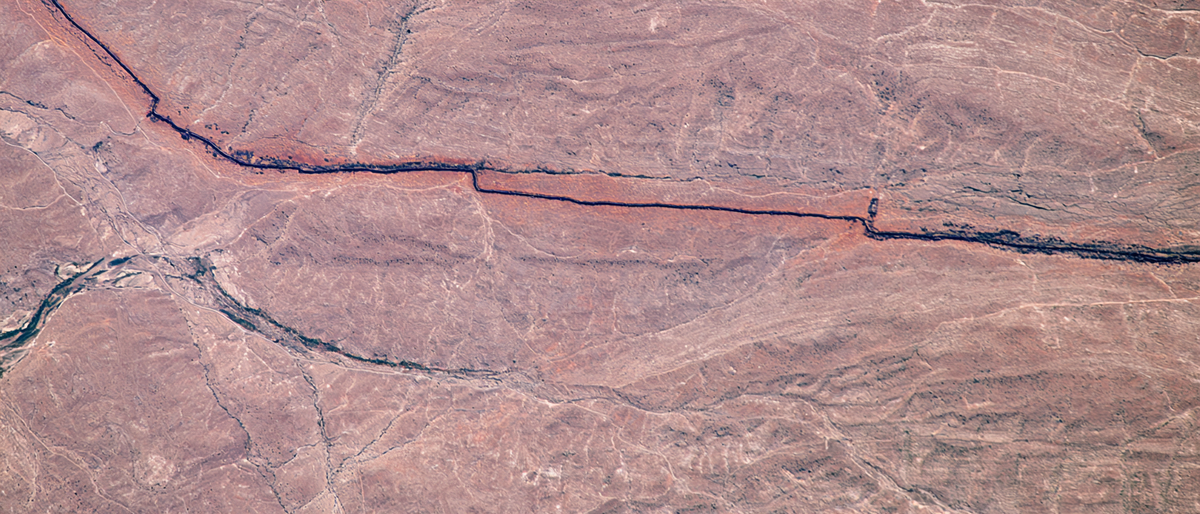
China’s first astronaut, Yang Liwei, reported after his 2003 flight that he could not see the Wall. NASA astronaut Leroy Chiao photographed a section from the International Space Station in 2004, but only with a telephoto lens and favorable lighting; even then, identifying it was difficult. NASA’s own summary says the Wall is not visible from the Moon and is difficult or impossible to see from Earth orbit without the high-powered lenses used for Chiao’s photograph.
Other astronauts, including Eugene Cernan and Ed Lu, have said it can be seen from lower orbital altitudes in unusually favorable conditions. These reports need not be dismissed. A long, narrow feature below the eye’s nominal resolution can occasionally become perceptible because of shadow, alignment, contrast, prior knowledge, and the eye’s ability to detect a continuous line without resolving its full width.
But “an expert observer may barely glimpse part of it under nearly perfect conditions while knowing precisely where to stare” is not the claim generations were taught. It is certainly not “the only man-made object visible from space.” If anything, the Wall is less conspicuous than many modern works.
European Space Agency astronaut Alexander Gerst supplied a splendid practical demonstration in 2018. Using an 800-millimetre telephoto lens aboard the International Space Station, he managed to photograph the area and described the Wall as still tough to spot. When an astronaut equipped with professional optics essentially says, “There it is—no, slightly left—beside that ridge—trust me,” the naked-eye-from-the-Moon theory may be considered to have encountered difficulties.
The Moon Version Is Not Merely Wrong; It Is Heroically Wrong
From the Moon, Earth appears as a globe roughly two degrees wide—about four times the apparent diameter of our Moon as seen from Earth, but still small enough to cover with a thumb at arm’s length. Continents and major weather systems can be distinguished. Individual buildings cannot.
A scientific analysis of the question calculated that seeing the Wall from lunar distance would require visual acuity about 17,000 times better than normal human eyesight. This is not a matter of eating more carrots. It is a matter of replacing the eye with an observatory.
Apollo 12 astronaut Alan Bean described seeing Earth’s broad colors and natural features from the Moon, but no human-made object. That is precisely what scale predicts. If the Great Wall were visible from the Moon, then sufficiently long motorways, railways, canals, and urban corridors should also be visible. The Wall possesses no special optical dispensation granted by UNESCO.
Nor does being “the largest” or “longest” human construction solve the problem. Visibility depends on angular size, width, contrast, lighting, and atmospheric conditions—not on cultural importance or the number of tourists photographed upon it.
Why the Story Refuses to Die
The Great Wall myth survives because it is a superb piece of narrative engineering. It compresses history, scale, national achievement, and cosmic perspective into one sentence. It tells us that humanity built something so immense that the universe itself had to notice.
The correction is less cooperative. It begins with “What altitude do you mean?” proceeds through angular resolution and atmospheric contrast, and ends with several astronauts disagreeing slightly about rare low-orbit conditions. Myths arrive on horseback; qualifications miss the connecting bus.
The phrase “only human-made object” also flatters our appetite for superlatives. We like the biggest, oldest, first, last, and only. “One of many structures that may sometimes be perceived depending on viewing geometry” will never sell as many postcards.
There may also be an innocent confusion between something being detectable in an image and visible to an unaided person. Modern satellites can resolve astonishing detail, and astronauts use powerful cameras. But a feature recorded by orbital optics is not necessarily visible to the naked eye, just as Saturn’s rings appearing through a telescope does not mean they are visible during a casual glance at the night sky.
Final Verdict—and the Proper Distribution of Blame
Is the Great Wall of China visible from space? With cameras, certainly. With the unaided eye from low Earth orbit, the responsible answer is: generally no, although portions may be barely perceptible under exceptional conditions to an observer who knows where to look. From the Moon: absolutely not.
And who was the rascal?
The Reverend William Stukeley is our earliest known suspect, having written in 1754 that the Chinese Wall might be discerned from the Moon. Henry Norman repeated and sharpened the story in 1895. Ripley’s Believe It or Not! broadcast it to the masses in 1932, and Richard Halliburton helped lodge it in young minds in 1938.
Stukeley planted—or at least preserved—the seed. Norman watered it. Ripley’s installed an irrigation system. Halliburton handed the resulting foliage to schoolchildren.
The Wall itself bears no responsibility. It has spent centuries performing the difficult and dignified work of being a wall. It never claimed to be visible from the Moon. That was the work of writers, publishers, and the ancient human conviction that a pleasing fact should never be subjected to an inconvenient measurement.
The real wonder is not that the Great Wall can be seen from space. It is that a sentence written by a clergyman before the invention of the steam locomotive traveled through books, newspapers, classrooms, and generations—until it became far more visible around the world than the Wall ever was from above it.
Jonathan Brown for AetheriumArcana
© 2026 AetheriumArcana. All rights reserved.
Member discussion: