
The Paradox
Recently, astrophysicist David Kipping attended an emergency meeting at the Institute for Advanced Study in Princeton—the institution where Einstein worked, where Oppenheimer directed.¹ What he witnessed shook him: senior faculty at one of Earth's most elite intellectual institutions openly conceding that AI has achieved 'complete coding supremacy' over humans. The lead faculty member estimated these systems can do roughly sixty to ninety percent of what he does intellectually... Not a single hand objected. These weren't tech entrepreneurs hyping products. These were people whose careers depend on being right about complex technical claims, making sober assessments based on extensive testing.
Here's what's remarkable: the people most trained to detect fraudulent reasoning are embracing AI enthusiastically, while many in the (so-called) "liberal arts" fields are experiencing moral panic, throwing around "AI-slop" accusations with an intensity wildly disproportionate to any actual threat.
This contrast demands explanation.
The McCarthy Parallel
"AI-slop" functions exactly like "Communist sympathizer" functioned in 1950s America—a conversation-ending accusation requiring no evidence and permitting no defense. The mechanism is identical: gesture vaguely at something that feels off, and the work can be dismissed without engaging its substance.
The prose is too smooth? AI. The structure too organized? AI. Minor errors that might be protective coloration? Probably AI trying to hide itself. The accusation becomes unfalsifiable, requiring no proof to assert.
This creates chilling effects. Writers deliberately introduce awkwardness. Students fear submitting well-edited work. People avoid AI assistance not because it would make their work worse but because they fear the stigma. Quality becomes secondary to proving traditional production methods.
We've seen this pattern before. Photography wasn't "real art"—too mechanically captured. Synthesizers weren't "real music"—too electronic. Wikipedia wasn't "real research"—wrong process. Each time, gatekeepers insisted the new tool produced only inferior simulacra. Each time, culture eventually absorbed the tool and forgot the panic.
The pattern reveals that "slop" discourse has never been about quality. It's about control, about preserving hierarchies of cultural authority against democratizing forces.
The Output Reflects Human Intelligence, Not the Tool's
Let's be clear: AI-slop is real. So is non-AI slop. Slop is slop—lazy recycled content, thoughtless regurgitation, low-effort garbage produced for quick profit or attention. Anyone producing actual slop with AI assistance should be embarrassed, but the result reflects their stupidity, moral ambiguity, or straight-up economic greed, not the tool they used. The good news? They're producing slop for slop-lickers who wouldn't recognize quality work anyway. To equate the output of intelligent, thoughtful creators—work unlikely to appeal to slop consumers in the first place—with slop-licious garbage is intellectually dishonest. One suspects that those who leap to such conclusions are simply envious that the strenuous effort they invested staring at blank pages has allegedly been bypassed by someone whose work ethic and workflow are neither visible to their inspection nor any of their business. The quality of the output is their business. The process is not.
The confusion at the heart of the "AI-slop" discourse is this: people are attributing intelligence (or lack thereof) to the tool rather than recognizing intelligence in the human who directed it and produced the output.
A calculator is not intelligent. It performs arithmetic operations through mechanical processes, no awareness, no understanding, no consciousness. But when a physicist uses a calculator to solve equations, the resulting physics paper reflects the physicist's intelligence, not the calculator's. No one dismisses the paper as "calculator slop" because we understand the calculator is just a tool. The intelligence is in knowing what to calculate, why it matters, and what the results mean.
LLMs work the same way. They are profoundly stupid—pattern-matching systems with no understanding, no consciousness, no awareness of what they're doing. They know nothing. Calling an LLM "intelligent" is exactly like calling a calculator "intelligent." It's a category error.
But here's what matters: when a human uses an LLM to help articulate ideas, organize arguments, or refine expression, the resulting work can be intelligent. Not because the LLM is intelligent, but because the human directing it is intelligent. The intelligence is reflected in the output—in what questions were asked, what outputs were selected, how material was organized, what judgments were made throughout the process.
The "AI-slop" critics make the reverse error of AI enthusiasts. The enthusiasts claim the LLM is intelligent and therefore threatens to replace humans. The critics claim the LLM is stupid and therefore anything it touches becomes stupid. Both are wrong because both are attributing properties to the tool rather than to the human using it.
A well-crafted argument assisted by an LLM is still a well-crafted argument. The logical structure, the evidence selection, the rhetorical choices, the meaningful insights—these reflect human intelligence applied to the problem. The LLM provided technical assistance with language generation the same way a calculator provides technical assistance with arithmetic. The intelligence is in the human who knew what to ask for and how to use what the tool provided.
This is why evaluating work based on whether AI was involved is absurd. You're asking about the tool instead of asking about the intelligence reflected in the output. Does the argument hold together? Is the reasoning sound? Does it demonstrate understanding of the subject? These questions assess whether intelligence was applied, and they can be answered by examining the work itself.
When scientists at IAS say AI can do ninety percent of their intellectual work, they're not claiming the AI is intelligent. They're observing that many tasks requiring human intelligence to direct can now be executed by stupid tools that follow patterns. But the direction still requires intelligence. The verification still requires intelligence. The interpretation still requires intelligence. The judgment about what's worth doing still requires intelligence.
The output reflects the intelligence that went into producing it—which is human intelligence, exercised through tool use. Just as a brilliant equation solved with a calculator reflects the mathematician's intelligence, a well-reasoned essay developed with LLM assistance reflects the writer's intelligence.
The tool is stupid. The human is intelligent. The output reflects the human's intelligence. This is what the "AI-slop" discourse misses entirely.
The Competitive Pressure—And Its Limits
Understanding that outputs reflect human intelligence rather than tool capability clarifies why competitive pressures operate so differently across fields—and why we should think carefully about what those pressures are optimizing for.
The IAS scientists acknowledged a genuine dilemma. In competitive research environments with objective performance metrics, early adopters of productivity-enhancing tools gain measurable advantages. If your competitors use AI and produce three times as many papers with enhanced sophistication, abstaining on principle means accepting professional disadvantage. This pressure is real in technical fields where "better" and "faster" have clear meanings, where being first matters professionally, where work involves tasks AI demonstrably excels at—mathematical reasoning, coding, data analysis.
But we should be honest about what this optimization produces. An arms race in paper quantity doesn't necessarily advance understanding. If everyone can produce more papers more quickly, the result isn't necessarily more knowledge—it might just be more noise. The currency that matters in science is insight, not output volume. When productivity tools make output cheaper, we risk devaluing the careful thought that generates genuine breakthroughs in favor of incremental publications that advance careers without advancing fields.
There's also the skill atrophy question. When scientists delegate increasingly complex tasks to AI systems, are they maintaining the deep expertise needed to recognize when outputs are wrong? Cross-checking between AI models, as scientists at IAS described doing, only works if you have sufficient domain knowledge to spot errors. If an entire generation trains primarily as AI directors rather than as practitioners of the underlying skills, what happens when the tools fail or produce subtly incorrect results that match expectations closely enough to pass casual inspection?
These are legitimate concerns that don't justify rejecting the tools but do justify thoughtfulness about how they're used. The goal should be using AI to handle execution while maintaining—perhaps even deepening—human expertise in the domains being studied. The physicist using AI to solve integrals should still understand integration well enough to recognize nonsensical results. The researcher using AI to analyze data should still understand statistics well enough to catch methodological errors.
But here's the crucial distinction: these concerns apply specifically to fields with objective truth standards and competitive racing structures. In creative fields, the competitive pressure simply doesn't exist in the same form. There's no objective standard for poetry being "correct." No race where the second novel becomes worthless. No finite pool of poetry value where AI-assisted poems consume space human poems might occupy.
A poet who never touches AI doesn't become obsolete. They remain a poet working in traditional methods, perfectly viable because poetry has no objective performance standard AI could surpass. The painter working in oils isn't disadvantaged by other painters using AI tools. The novelist writing longhand isn't racing against AI-assisted novelists in some competition where fastest wins.
The competitive framework that creates genuine dilemmas in science—where it might drive overproduction, risk skill atrophy, and reward speed over depth—simply doesn't apply to creative work. Creative fields are freed from these pressures precisely because they lack objective metrics. This should be liberating, not threatening. Artists can use AI if it serves their creative vision. They can ignore it if it doesn't. Neither choice affects whether their work succeeds on its own terms.
The irony is that artists are experiencing anxiety about pressures that don't actually apply to them, while scientists facing real competitive dilemmas are responding pragmatically. The scientists understand they need to navigate tradeoffs thoughtfully. The artists are panicking about tradeoffs that don't exist in their domains.
The Final Irony
Despite these real challenges in scientific fields, scientists whose work can be objectively wrong—whose skills face genuine, measurable obsolescence—are calmly adapting. Artists whose work cannot be objectively wrong—whose skills face no comparable objective threat—are panicking.
The explanation is simple: scientists understand that tools don't determine legitimacy, only outcomes do. A proof is valid if the logic is sound, regardless of what tools assisted its derivation. A discovery is real if the finding is true, regardless of what tools helped make it.
Artists have made process sacred, confusing execution with value. But art was never about process. It was about vision, meaning, emotional resonance, cultural significance. The process was just means to those ends.
When artists insist that only unassisted human work is legitimate, they're not protecting art. They're protecting professional arrangements based on scarce technical skills. Those arrangements will change regardless. The question is whether artists will be part of shaping what emerges.
The Choice
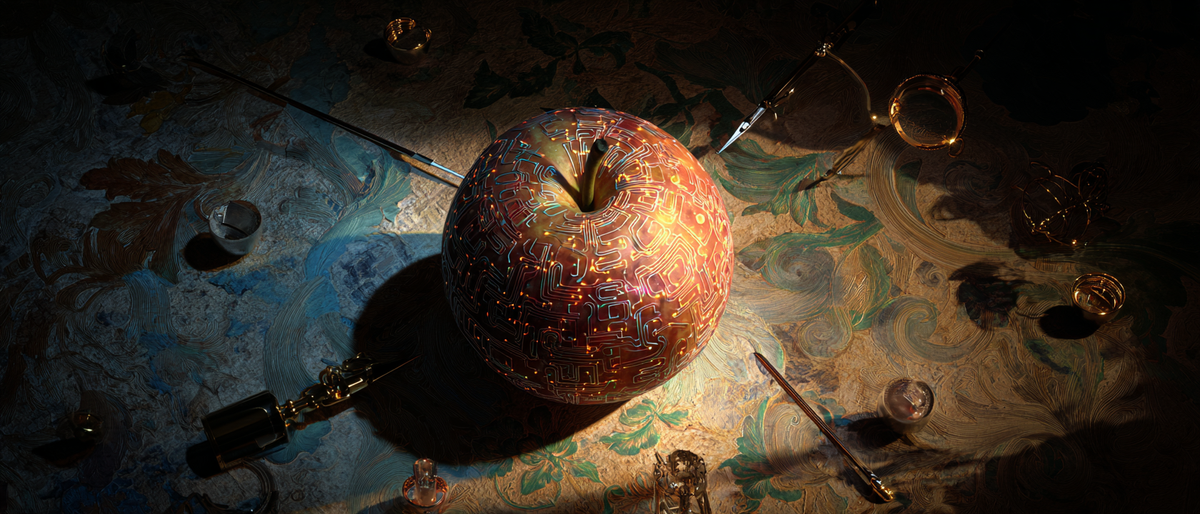
We're at a genuine threshold. The forbidden fruit has been tasted. The scientists at the Institute for Advanced Study have made their choice: engage directly, test extensively, adopt pragmatically while maintaining verification. This preserves human agency while leveraging new capabilities.
The alternative—insisting only unassisted work is legitimate—leads to self-imposed limitation. You can make this choice personally. But demanding everyone else abstain, treating AI assistance as disqualifying regardless of output quality—that's not maintaining standards, that's enforcing orthodoxy.
Standards are about outcomes. Orthodoxy is about process. Scientists maintain standards while abandoning orthodoxy. The "AI-slop" discourse maintains orthodoxy while abandoning standards.
The tools don't determine authenticity. Agency does. The intelligence reflected in outputs is human intelligence, exercised through tools. Quality is a property of outcomes, not origins. These truths are validated by how we assign responsibility, demonstrated by how scientists work, confirmed by historical parallels.
The current is here. The transformation is happening. The only question is whether we'll be participants shaping outcomes or bystanders declaring them illegitimate while practice evolves beyond our objections.
The scientists are swimming. The rest of us can join them or drown insisting the water isn't real.
Choose wisely.
NOTES
¹ David Kipping, "We Need to Talk About AI," Cool Worlds (YouTube), January 28, 2025, https://www.youtube.com/watch?v=PctlBxRh0p4.
ओम् तत् सत्
Member discussion: