
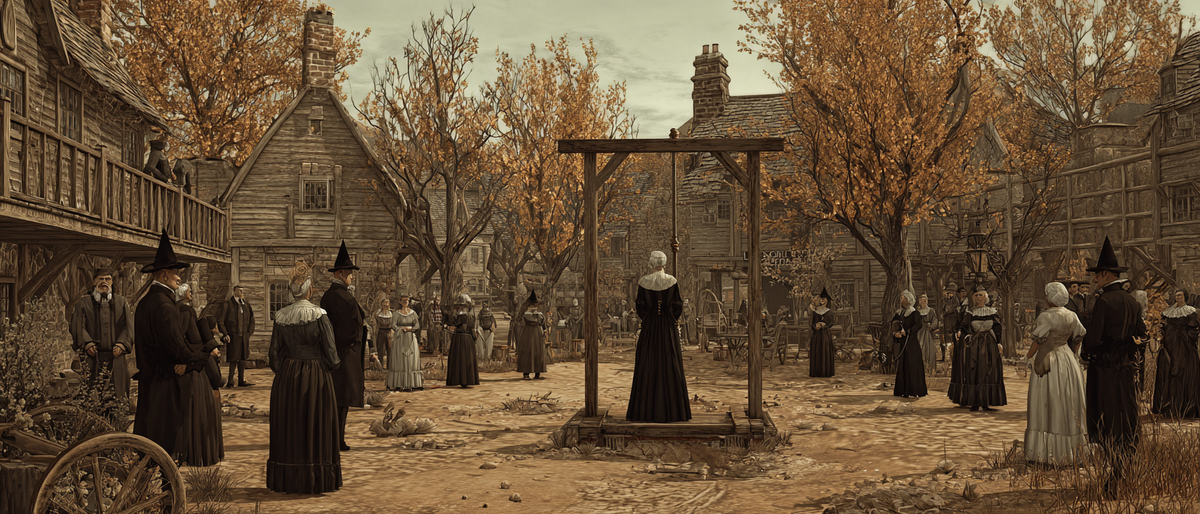
Antiquarianism and the Birth of the New England Mythos
A particular genius of Howard Phillips Lovecraft lies not merely in his invention of tentacled deities or cyclopean cities, but in his profound, almost pathological, rootedness in the soil of New England. To Lovecraft, the past was never a static record of dates and treaties; it was a living, breathing, and often predatory force that exerted a physical pressure upon the present. As a self-styled antiquarian, Lovecraft looked upon the 17th century - specifically the era of the Massachusetts Bay Colony - as the most potent epoch in the American psyche. It was a time when the thin line between the civilized clearing and the howling wilderness was at its most porous, and where the stark, repressive piety of the Puritans served as a frantic, if ultimately futile, bulwark against the unknown. For Lovecraft, the Salem Witch Trials of 1692 were not a tragic episode of mass hysteria or judicial failure, but rather a foundational trauma that signaled a genuine, terrifying "leakage" of the outside into the mundane world.
This antiquarian impulse drove Lovecraft to treat the history of Salem as a blueprint for his fictional geography. In his eyes, the real-world atrocities of Essex County were symptoms of a deeper, cosmic malaise. While the contemporary historians of his day sought to explain the trials through the lenses of socio-economics or ergot poisoning, Lovecraft pursued a far more sinister thesis. He reimagined the accused not as innocent victims of a deluded theocracy, but as a fractured lineage of survivors who had indeed brushed against "forbidden" knowledge. By anchoring his Mythos in the actual records of the 1692 trials, Lovecraft provided his work with a startling sense of verisimilitude. He transformed the "witch-haunted" woods of Massachusetts into a landscape where the ancient and the alien are one and the same, ensuring that the reader views every leaning gambrel roof and every colonial headstone with a sense of mounting dread.
This transition from the traditional Gothic to the Cosmic marks the definitive evolution of Lovecraft as a successor to Edgar Allan Poe. Where Poe’s horror was often internalized - a claustrophobic exploration of the crumbling psyche - Lovecraft’s horror is resolutely external and materialist. He took the "spectral evidence" that condemned twenty people in Salem and recontextualized it through the cold lens of 20th-century science. In the Lovecraftian universe, the ghosts of the Puritans are replaced by extra-dimensional projections, and the Devil’s "Black Book" becomes a manual for navigating the non-Euclidean folds of space-time. By utilizing the grim history of Salem as a springboard, Lovecraft created a uniquely American form of horror: one where the religious fervor of our ancestors was not a symptom of madness, but a desperate, rational response to a universe that is far more crowded, and far more indifferent, than we dare to imagine.
Lineage and the Mechanics of "Witch-Blood"
The "unhanged" sorcerer of 1692 serves as the primary engine for Lovecraft’s Essex County narratives - a persistent, troubling figure that refuses to remain in the past. Lovecraft’s narratives frequently revolve around the chilling realization that the 1692 purge was a catastrophic failure - not because it was unjust, but because it was incomplete. In his construction of the Mythos, the hangings at Gallows Hill were merely a pruning of the visible weeds, while the true, deep-rooted "malignancy" of the occult slipped away into the shadows of the Miskatonic Valley. These survivors, the "unhanged" of Salem, represent a biological and metaphysical continuity that bridges the gap between the 17th-century witch-cult and the modern, unsuspecting world. Through characters like Keziah Mason and Joseph Curwen, Lovecraft explores the terrifying notion that the past does not merely haunt us; it replicates within us.
This concept of hereditary horror is most masterfully executed through the lens of biological atavism. Lovecraft was deeply preoccupied with the idea of "tainted blood," a fear he translated into a pseudo-scientific framework where the occult is not merely a set of learned rituals, but a recessive trait waiting for the right environmental stimulus to manifest. In the case of Charles Dexter Ward, the horror is not that he discovers the ghost of his ancestor, Joseph Curwen, but that he is Joseph Curwen. The "witch-blood" acts as a carrier for the consciousness and physical form of the progenitor, suggesting that the escapees from Salem did not just flee to Providence or Arkham; they fled into the very DNA of their descendants. This genetic survivalism turns the family tree into a list of potential host bodies, ensuring that the dark arts practiced in the 1690s remain functionally immortal through the 1920s and beyond.
Furthermore, Lovecraft uses these fugitive lineages to critique the perceived safety of isolation. The rural hills of central Massachusetts and the decayed coastal towns become "pockets of the past" where the "unbroken line" of Salem’s refugees could refine their practices without the interference of the Enlightenment. In The Dunwich Horror, the Whateleys serve as the ultimate evolution of this isolation. They are the logical conclusion of what happens when the "witch-blood" of the Salem era is allowed to intermingle with things that are not human. The rural decay Lovecraft so vividly describes is the physical manifestation of this spiritual and biological rot. To the tenured observer of Lovecraftian lore, these communities are living museums of the 1692 "outsiders," proving that the most dangerous elements of the Salem trials were the ones the inquisitors never saw, those who retreated to the wild places to wait for the stars to be right once more.
The Geometry of Fear
For Lovecraft, the architecture of New England was never merely a collection of wood and brick; it was a physical manifestation of the psychic and mathematical laws governing a region’s history. The 17th-century dwellings of Salem, with their somber palettes and oppressive overhangs, provided him with a template for what might be called "the architecture of the hidden." He was particularly enamored with the "witch-haunted" aesthetics of the Jonathan Corwin House, seeing in its steep, double-sloped gambrel roofs a symbol of the crushing weight of Puritan dogma - and the even heavier secrets that dogma sought to suppress. In the fictionalized landscape of Arkham, these structures become more than just houses; they are biological organisms of the past, leaning over narrow, cobble-stoned streets as if to whisper the forbidden secrets of the 1692 fugitives to those sensitive enough to hear.
The true terror of Lovecraftian architecture, however, lies in its intersection with non-Euclidean topology. He masterfully reimagined the "witchcraft" of the Salem era not as a pact with a supernatural entity, but as a mastery of advanced spatial physics. In the cramped, attic rooms of these ancient houses, the walls do not always meet at the ninety-degree angles mandated by human reason. In The Dreams in the Witch House, the protagonist Walter Gilman discovers that the "angles" of Keziah Mason’s room are actually conduits - physical shortcuts through the fourth dimension that she discovered in the 1690s. Lovecraft suggests that the "occult" practices of the Salem era were, in fact, an intuitive grasp of a geometry that defies human perception. A corner is no longer just a meeting of two planes; it is a gateway, and the house itself becomes a machine designed to facilitate travel across the cosmic void.
Beyond the individual dwelling, Lovecraft utilized the broader theme of urban and maritime decay to illustrate the lingering "infection" of the Salem era. He observed the transition of Salem from a premier global port to a stagnant, silty backwater and saw in this decline a metaphor for a deeper moral rot. This "maritime ghosting" is the primary engine of dread in towns like Innsmouth, where the rotting wharves and the salt-caked, unpainted facades of the old gentry suggest a community that has traded its humanity for the forbidden treasures of the deep. To the antiquarian eye, the decay is not a sign of neglect, but of a sinister shift in priorities. The grand colonial mansions, built on the foundations of Salem’s maritime wealth, become the fortresses of the "witch-blood" families, their boarded windows and silent halls hiding the fact that their inhabitants have found more ancient and terrifying masters than the god of the Puritans.
The Cosmic Sabbath
In the annals of the 1692 trials, no figure looms more ominously than the "Black Man of the Woods," a shadowy entity described by the accused as the intermediary of the Devil. For the Puritan mind, this figure was a literal manifestation of Satanic pact-making, a herald of the Christian Hell. Lovecraft, however, performs a masterful act of "re-mythologizing," stripping away the theological veneer to reveal a far more unsettling truth. He identifies this figure as Nyarlathotep, the Crawling Chaos and messenger of the Outer Gods. By doing so, Lovecraft suggests that the "Witch-Cult" of Salem was not worshipping a fallen angel, but was instead in contact with an indifferent, multi-dimensional avatar that has manipulated human history for eons. The "woods" where the witches met were not merely a place of religious transgression, but a threshold where the laws of human physics were suspended in favor of cosmic communion.
This reinterpretation extends to the very nature of "Spectral Evidence" - the legal cornerstone of the Salem executions. Historically, this was the belief that a witch could send their "spectre" or "shape" to torment victims while their physical body remained elsewhere. Lovecraft, the staunch materialist, discarded the supernatural explanation in favor of a terrifying scientific one. In his framework, these spectres were not ghosts, but extra-dimensional projections or "probes" of consciousness facilitated by the unique atomic frequency of the practitioner. In The Case of Charles Dexter Ward, we see this taken to its logical, horrific conclusion: the "spectre" is a manifestation of the "essential saltes," a biological resurrection that allows the sorcerer to transcend the limitations of death and time. Lovecraft effectively argues that the Salem judges were witnessing legitimate, albeit terrifying, physical phenomena that their limited religious vocabulary could only describe as demonic.
The bridge between the real historical record and Lovecraft’s cosmic expansion is often found in the works of Cotton Mather. Lovecraft treated Mather’s Magnalia Christi Americana and Wonders of the Invisible World as accidental grimoires - cataloged observations of a man who was witnessing a cosmic invasion without the scientific tools to name it. By referencing Mather’s descriptions of "unseen bitings" and "malignant shapes," Lovecraft validates his fiction through the authority of history. He positions the Puritan elite as a group of desperate men who were right to be afraid, for they were the first to stand on the front lines against an ancient, non-human intrusion. To the student of Lovecraft, Mather is not a villain of superstition, but a frantic chronicler of the first documented skirmish between humanity and the Old Ones on American soil.
Ritual as Science
The most radical departure Lovecraft takes from the traditional folklore of the Salem era is his redefinition of the "Witch-Cult" as a secret society of primitive scientists. To the casual observer of the 1692 trials, the rituals conducted in the dark of the woods were acts of blasphemous worship. However, through the lens of Lovecraft’s cosmic materialism, these gatherings were actually field experiments in high-energy physics and trans-dimensional biology. The "Sabbath" was not an end in itself, but a necessary alignment of human will and celestial positions designed to facilitate a breach in the membrane of our reality. The practitioners who fled Salem were not seeking the grace of a dark god; they were seeking the mastery of a universe that they had realized was far larger, and far more terrifyingly accessible, than any church dared admit.
Central to this scientific reinterpretation is the "Black Book" of the Salem records. In the Puritan imagination, signing this book was a spiritual contract that forfeited one's soul. In Lovecraft’s The Dreams in the Witch House, the signing of the book is reimagined as a literal "registration" of one's atomic frequency. By placing their mark upon its pages, the practitioner underwent a fundamental molecular shift, a "tuning" that allowed the human organism to survive the vacuum of interstellar space or the crushing pressures of higher dimensions. The book was a ledger of those whose biological structures had been modified to interact with the Outer Gods. It was a manual for the "unhanged" to maintain their physical integrity while traversing the "interstitial spaces" between the worlds.
This materialist framework even extends to the concept of the witch’s familiar, most notably in the form of the loathsome Brown Jenkin. In traditional Salem lore, a familiar was a spirit in animal form; Lovecraft, however, presents Jenkin as a biological anomaly, a grotesque hybrid that suggests a botched experiment in trans-dimensional evolution. With his human face and tiny, bearded hands, Jenkin is a "messenger" whose very existence defies the laws of terrestrial biology. He is the scout for the witch-cult, capable of whispering in languages that bypass human vocal cords and navigating the "angles" of ancient houses that remain invisible to the uninitiated. Jenkin represents the ultimate horror of the Salem legacy: the realization that when we reach out into the cosmos, something invariably reaches back, and the resulting hybridization is a mockery of both human and alien life.
The Persistence of the Past
In the final estimation, Lovecraft’s New England is not a region defined by its progress, but by its inability to escape the gravitational pull of its own history. The "Eternal 1692" is not a mere date in his work; it is a permanent psychic condition. Lovecraft’s genius was in recognizing that the true horror of the Salem Witch Trials lay not in the tragedy of the executions, but in the terrifying possibility that the inquisitors were partially correct. By grounding his cosmic dread in the very real, very tangible antiquities of Essex County, he ensured that his Mythos would never feel like a mere flight of fancy. It is a horror of the soil, of the bloodline, and of the ancient gambrel roof that sags under the weight of three centuries of unuttered secrets.
The persistence of this past serves as a rebuttal to the arrogance of the modern age. Lovecraft’s protagonists are often men of science - scholars, doctors, and engineers - who believe they have moved beyond the "superstitions" of their ancestors. Yet, they inevitably discover that their modern instruments are merely rediscovering the same terrifying truths that the "witch-blood" families have known since the 17th century. The past in Lovecraft is a "spectre" that cannot be exorcised because it is built into the architecture of our world and the sequences of our DNA. The Salem fugitives did not just survive; they waited, knowing that the passage of time is an illusion and that the "Old Ones" who were worshipped in the dark woods of 1692 are the same entities that will eventually reclaim the Earth.
Ultimately, the Salem connection provides the essential verisimilitude that distinguishes Lovecraft’s work from his contemporaries. By weaving his fiction into the fabric of American history, he created a myth-cycle that feels like a suppressed chapter of our national narrative. To walk the streets of modern Salem or to gaze upon the crumbling ruins of a New England farmhouse is, for the Lovecraftian reader, an act of courage. We are left with the lingering, chilling realization that the "invisible world" Cotton Mather so desperately feared never truly went away; it simply learned to hide in the angles of our houses and the silences of our history, waiting for the moment when the stars - and the bloodlines - are right once more.
ओम् तत् सत्
Member discussion: