
Isolation, Mortality, and Life Beyond the Graveyard
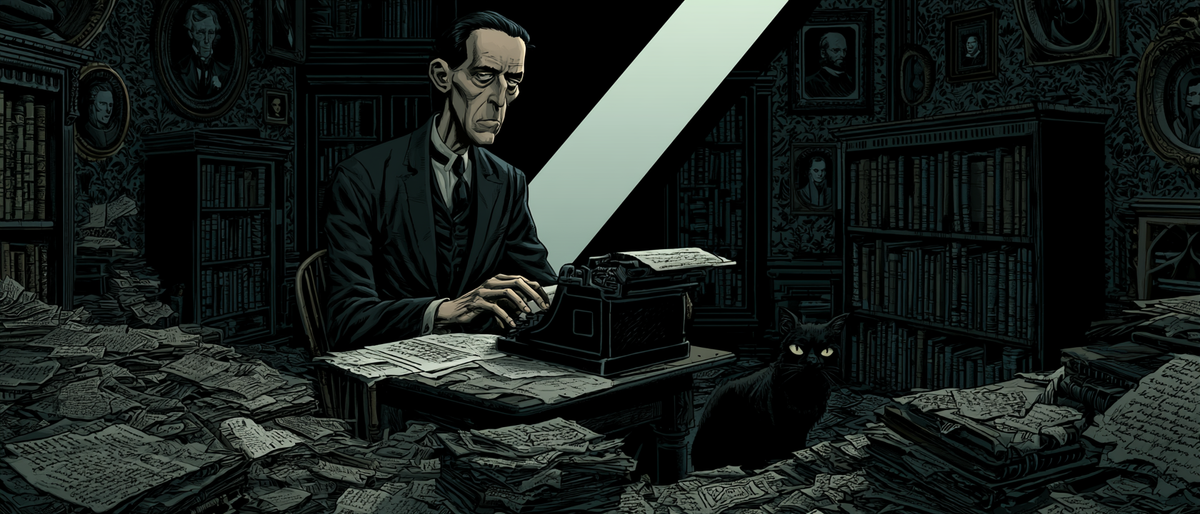
H. P. Lovecraft’s “The Outsider” invites autobiography with unusual insistence. The lonely childhood, the antique books, the ancestral house, the dimly remembered old caretaker, the inability to participate in ordinary society, the consuming desire to reach other human beings, and finally the revelation that those other people perceive the narrator as something hideous all correspond too readily with recognizable elements of Lovecraft’s early life to be dismissed as mere coincidence. Dirk W. Mosig made this the first of his “Four Faces” of the story, before proceeding through psychological, metaphysical, and philosophical interpretations; he connected the tale’s “lone hours,” ancient books, social longing, and climactic horror directly with Lovecraft’s childhood circumstances. S. T. Joshi’s biography supplies the factual architecture behind that reading: paternal disappearance into Butler Hospital when Lovecraft was three, an intensely bookish childhood under the influence of his maternal grandfather Whipple Van Buren Phillips, recurrent illness, the loss of the family home after Whipple’s death, the failure to complete high school, and the extraordinary withdrawal of 1908–1913, when Lovecraft became what Joshi calls a “virtual hermit.”
Yet “The Outsider” is more than a fictionalized childhood, and its narrator is not Lovecraft in ghoul makeup. The deeper autobiographical correspondence lies in a pattern: an isolated consciousness constructs its idea of itself largely from books and inherited memory, longs for entry into a larger human world, and fears that actual contact with other people will disclose some intolerable truth about what it is. Around that psychological structure Lovecraft builds a philosophical one. The narrator attempts an ascent from darkness toward light and discovers, at the summit of what he believes to be an impossibly high tower, not heaven, freedom, or even open sky, but a graveyard. From there he reaches the illuminated society he has dreamed about, only to discover that he belongs not among the revelers but among the dead.
That structure becomes especially revealing when placed against Lovecraft’s materialism. He rejected supernatural immortality, providence, and the consolations of traditional religion, yet his writing continually seeks experiences of wonder, enlargement, escape, and transcendence. “The Outsider” dramatizes the limit imposed upon that desire by mortality: one may climb beyond confinement, beyond ignorance, beyond the known world, but one does not thereby climb beyond death. What makes Lovecraft’s life so much more interesting than his pessimism, however, is that he ultimately discovered forms of transcendence that required no supernatural escape at all. Friendship, correspondence, intellectual curiosity, art, travel, astronomy, antiquarianism, marriage, mentorship, affection, and service to other writers did not abolish the graveyard. They made a human life extraordinarily rich before it reached one. The most profound autobiographical significance of “The Outsider,” therefore, may be that Lovecraft eventually disproved its most despairing implication. The corpse was the nightmare. Lovecraft remained very much alive.
The Ancestral World
The story begins with childhood already transformed into an archaeology of sorrow. “Unhappy is he,” the narrator tells us, whose childhood recalls “fear and sadness,” before describing immense rooms, antique books, shadows, grotesque trees, damp stone, and a castle so old that generations seem almost physically accumulated within it. He cannot remember his birth, a teacher, or even another ordinary human voice. “From such books I learned all that I know,” he says; his idea of his own appearance comes similarly from the youthful figures illustrated in them.
Lovecraft’s childhood was not so utterly solitary, and it is important not to let the story overwrite the biography. Joshi notes that Lovecraft did make friends at school and found congenial teachers and peers when his health permitted regular attendance. But books did occupy an extraordinary place in his development. He read at three, discovered mythology and weird fiction very early, became absorbed in chemistry and astronomy, produced his own scientific journals, and received active encouragement from Whipple Phillips, who entertained him with improvised Gothic stories. Whipple was not simply a beloved grandfather but a central figure in the cultural world of Lovecraft’s childhood: the head of the large household, a link to family history, and an enabler of the antiquarian and imaginative temperament that would remain with Lovecraft throughout life.
Whipple’s death in 1904 therefore constituted much more than bereavement. Financial decline forced Lovecraft and his mother from the spacious Angell Street house into smaller quarters, an event Joshi describes as devastating enough that Lovecraft apparently contemplated suicide. The breakdown of 1908 then ended his schooling and his hope of entering Brown University, a failure that remained a source of shame. The years of virtual hermitry followed.
Read against these circumstances, the castle in “The Outsider” becomes less interesting as a one-to-one representation of a Providence address than as a psychic form: the ancestral world after the people who gave it life have disappeared. The narrator inhabits inherited structures, inherited language, inherited books, and fragmentary memories. Some ancient being “must have cared for my needs,” but the caretaker is inaccessible to memory, simultaneously foundational and absent. The temptation to identify that vague figure simply as Whipple should be resisted; the correspondence is richer if it remains structural. The grandfather belongs to the world of security, story, lineage, books, and childhood. He dies, but the environment he helped create continues to inhabit Lovecraft. So too the old caretaker of “The Outsider”: gone from ordinary experience, yet strangely still present in the architecture of the self.
Mosig’s autobiographical reading emphasizes precisely this relation between solitude and books, seeing Lovecraft’s grandfather’s library behind the story’s “maddening rows of antique books.” His analysis becomes overly psychoanalytic in places, especially when it confidently diagnoses motives in Sarah Lovecraft for which the evidence is much less secure. Yet on the basic point he is persuasive: “The Outsider” transforms autobiographical materials because they were emotionally available to Lovecraft, not because the story should be decoded as disguised memoir.
The Face Others See
The most painful correspondence concerns appearance. A persistent biographical tradition, preserved most prominently through later testimony, holds that Lovecraft’s mother told him that he was “grotesque” and discouraged him from appearing outside for fear of frightening others. The evidence is retrospective and must be treated cautiously; it does not justify reconstructing every detail of Lovecraft’s childhood psychology as settled fact. But the testimony is too relevant to “The Outsider” to ignore, particularly when combined with what is independently known about the unusually close, anxious relationship between Lovecraft and his mother during his period of withdrawal.
The decisive psychological fact in the story is not simply that the narrator discovers himself to be hideous. It is the order in which that knowledge arrives. He enters the brightly illuminated room believing that he has finally reached the companionship he has imagined through books. The inhabitants see him and react with immediate terror. Only after they have fled does he approach the thing he assumes has frightened them, extend his hand, and discover the polished glass. Society renders its judgment before the narrator possesses the evidence with which to judge himself.
That sequence transforms a conventional monster revelation into a nightmare of shame. The narrator does not reason, I am horrible, therefore they reject me. He learns, they reject me, therefore there must be something horrible about me. His identity is first mediated by the gaze of others and only afterward confirmed by the mirror.
For a child whose appearance had been presented to him by an intimate authority as somehow objectionable, the emotional logic is painfully apt. A child does not begin with an objective visual assessment of himself and then compare it against parental opinion. Other people help create the categories through which the child understands himself. If a trusted parent repeatedly implies that others will find one strange or ugly, the terror is not merely I dislike my face. It is more fundamental: what can everyone else see that I cannot?
The story’s curious absence of bodily self-knowledge belongs here as well. The narrator has apparently never reflected upon his appearance, and the lack of mirrors makes the eventual revelation possible. Yet the creature is not merely unattractive; Lovecraft describes exposed bone, decay, decomposition, and something “no longer of this world.” Surely he has touched his own face. Surely his hands have encountered the texture of his body.
Taken literally, this is one of the story’s mechanical weaknesses. Psychologically, however, it yields an interesting answer: self-knowledge requires comparison. A being who has never touched warm living skin may not understand its own coldness as abnormal. A creature without embodied human companionship has no tactile standard against which its own flesh can be measured. The mirror does what touch cannot because it externalizes the self. For the first time the narrator encounters himself as an object occupying the same visual world as the human forms he learned from books.
This is where the apparent lack of ordinary physical affection in the story becomes symbolically important, even though we cannot simply project such an absence onto Lovecraft’s childhood as documented fact. Nobody embraces the Outsider, holds his hand, touches his face, or confirms bodily kinship. His humanity is textual rather than reciprocal. The story therefore makes a profound point almost accidentally: one cannot learn fully what a human being is from a picture of one. The self is partly constructed between bodies, between faces, and between consciousnesses.
The corpse becomes the perfect figure for the failure of that reciprocity. A corpse looks recognizably human yet is excluded from human participation. It retains form while losing relationship, presence while losing exchange. The ghoul of “The Outsider” is therefore more than a dead body. It is the isolated psyche represented as already dead.
A Note on Cotard: The Narrator, Not Lovecraft
Cotard syndrome offers a limited but illuminating comparison here, provided its limits are made explicit. There is no evidence whatsoever that Lovecraft suffered from Cotard syndrome, nor does the autobiographical reading require anything resembling a retrospective psychiatric diagnosis. Cotard syndrome is a rare clinical phenomenon involving nihilistic delusions concerning the self or body, including beliefs that one is dead, does not exist, has lost organs, or has ceased to possess some essential bodily reality. Modern reviews emphasize that its clinical manifestations are much broader than the familiar shorthand “I am dead,” and that it occurs in association with several psychiatric and neurological conditions rather than constituting a simple personality type.
Its relevance is phenomenological. Cotard demonstrates with unusual starkness that perception and reasoning can continue while the interpretive model relating the self to reality becomes catastrophically distorted. “The Outsider” gives us a fictional inversion of that problem: the narrator believes himself ordinarily alive and human while the surrounding evidence points toward something corpse-like, buried, and disconnected from human life. This similarity illuminates the story’s collapse of self-apprehension; it tells us nothing diagnostic about Lovecraft. The useful question is not whether Lovecraft secretly possessed a delusion of death, but why the possibility that a consciousness might fundamentally misapprehend its own condition fascinated him so deeply.
That question leads directly from psychology into philosophy.
The Graveyard at the Top of the Tower
Lovecraft’s materialism was explicit and intellectually serious. His philosophical writings defend atheism, mechanistic materialism, skepticism toward teleology, and what later critics have described as cosmic indifferentism. Joshi has made this philosophical foundation central to modern Lovecraft scholarship: human interests possess meaning locally, but no evidence suggests that the cosmos privileges them.
Yet Lovecraft was temperamentally anything but satisfied with the merely commonplace. His fiction is saturated with the desire to enlarge consciousness beyond familiar limits. In “Notes on Writing Weird Fiction,” he explains that one of his “strongest and most persistent wishes” was to achieve momentarily an illusion of escape from “the galling limitations of time, space, and natural law.” The wording is crucial. He wants the experience of transcendence without pretending that the transcendence is literally true.
Astronomy offered the same experience without fiction. Lovecraft’s engagement with it began in childhood, became sufficiently serious to produce journals and newspaper columns, and remained a lifelong intellectual passion. The telescope did not remove him from material reality; it altered the scale upon which he experienced it. Providence became small, Earth became small, human history became small, and consciousness could travel imaginatively across distances the body could never cross.
“The Outsider” stages this desire through one of humanity’s oldest metaphors: ascent. Darkness is below; light is above. Confinement is below; freedom is above. Ignorance is below; revelation is above. The narrator reaches desperately toward the black tower because “it were better to glimpse the sky and perish, than to live without ever beholding day.” He climbs through extraordinary darkness, expects to emerge at a prodigious height, and finds solid ground surrounding an old church and cemetery.
For a religious imagination, ascent readily becomes a metaphor of spiritual transcendence: resurrection, heaven, liberation from mortality. Lovecraft’s materialist imagination gives us something harsher. At the summit is the graveyard.
This does not mean that transcendence has failed. It means that one particular conception of transcendence—the escape of personal existence from mortality—has reached the boundary Lovecraft’s philosophy will not allow it to cross. The tower can take the narrator beyond his known world, but it cannot take him beyond the material condition of life. Knowledge may enlarge experience; imagination may suspend ordinary limits; art may transport consciousness; none of these makes death unreal.
There is a grim symmetry here. From the perspective of an individual consciousness, life is everything. From the temporal scale Lovecraft habitually contemplated, an individual life is an almost impossibly brief event between vast periods in which that individual does not exist. Traditional religion frequently reverses that asymmetry by treating embodied life as the temporary condition and personal continuation as the deeper reality. Lovecraft could not accept that solution.
The graveyard therefore becomes the limit not of transcendence itself but of imaginary transcendence from mortality. The narrator climbs to escape death and discovers that death is already the condition toward which every living person in the illuminated mansion is moving. He envies their vitality; they recoil from his corpse. Yet temporally his condition is the more durable one. The party ends. The graveyard remains.
Maurice Lévy’s influential study of Lovecraft emphasizes the tension between the writer’s materialist philosophy and a fantastic literature that repeatedly seeks release from it, describing the fiction as a way of confronting a universe that supplies no human-centered meaning. Mosig similarly treats “The Outsider” as simultaneously autobiographical and philosophical rather than forcing a choice between the two. These readings become strongest, however, when the two levels are allowed to converge: the child’s fear of personal exclusion and the philosopher’s recognition of cosmic exclusion become versions of the same question. What if the category in which I have placed myself—human, important, living, belonging—is not guaranteed by reality?
The Man Who Found Other People
Had Lovecraft’s life remained confined to the years of hermitry, “The Outsider” might appear almost prophetic. Instead, his biography offers a remarkable contradiction.
Amateur journalism brought him out.
Joshi describes his entrance into the United Amateur Press Association in 1914 as the decisive end of his most isolated period. Lovecraft himself used much stronger language. Looking back, he wrote that before amateurdom he had been “close to the state of vegetation” and concluded his account with the extraordinary sentence: “What Amateur Journalism has given me is—life itself.”
Few quotations could answer “The Outsider” more directly.
The fictional creature believes life exists somewhere beyond the tower, among other people. Lovecraft discovered that in an important sense it did—but he reached it not by escaping material existence but by participating in human relationship. Amateur journalism gave him correspondents, controversies, audiences, collaborators, friends, reasons to write, invitations to travel, and eventually a vast intellectual network. The man remembered primarily as a recluse became one of the century’s most prolific correspondents. Joshi describes his return to Providence in 1926 not as renewed retreat but as “his greatest flowering, both as a writer and as a human being.”
The generosity embedded in those relationships is especially important because it contradicts the notion of Lovecraft as merely a brilliant ego communicating outward from isolation. He invested enormous time in other writers. Robert Bloch began corresponding with him as a teenager and later summed up Lovecraft’s influence in four famous words: “Lovecraft was my university.” The surviving correspondence shows Lovecraft advising, encouraging, recommending reading, discussing technique, and taking the ambitions of a sixteen-year-old seriously.
The marriage to Sonia Greene complicates the story further. It ultimately failed, and neither sentimentality nor biographical revision can turn Lovecraft into an easy husband. Yet the marriage was real, affectionate, and initially congenial. Joshi notes that Lovecraft continued to profess affection for Sonia even as finances, separation, his attachment to Providence, and his family’s resistance destroyed the practical possibility of their life together. Sonia’s later recollections describe severe inhibition, which she attributed partly to his “Puritanical bringing up,” but they also make clear that the marriage was physically and emotionally more than an empty arrangement.
That matters because the nightmare of “The Outsider” says that intimacy will reveal monstrosity and make companionship impossible. Lovecraft’s actual life says something far less absolute. People did approach him. Sonia did not flee. Friends visited, correspondents trusted him, younger writers sought his judgment, and people who knew him remembered not merely eccentricity but kindness, humor, learning, and generosity.
His scientific and antiquarian passions belonged to the same widening of life. Astronomy extended him spatially; antiquarianism extended him historically. He could not literally escape his century, so he studied the surviving structures of earlier ones. He could not cross interstellar distance, so he observed, calculated, read, and imagined. He could not suspend natural law, so he wrote stories that gave him, in his own phrase, the momentary illusion of doing so. None of this required false belief.
The Triumph of the Ordinary
This is where the philosophical importance of Lovecraft’s life exceeds the philosophy he sometimes articulated.
There is a seductive mistake available to cosmic pessimism: if nothing human is eternal, then nothing human is important. If friendship ends, it is futile; if consciousness dies, consciousness has failed; if the cosmos contains no objective concern for us, human concern becomes somehow counterfeit. None of these conclusions follows from materialism.
Duration is not value. A symphony may last an hour while silence precedes and follows it indefinitely; the silence does not thereby acquire greater musical significance. A friendship does not become unreal because one friend dies. A beautiful building does not become worthless because it will eventually collapse. The absence of eternal certification does not erase temporary fact.
Lovecraft’s life demonstrates this almost embarrassingly well. What actually sustained and enlarged him was not supernatural deliverance but ordinary things: correspondence, books, cats, architecture, old streets, travel, meals with friends, arguments, jokes, scientific questions, historical discoveries, manuscripts sent by younger writers, and long letters written because somebody else existed at the other end. His life became exceptional through an extraordinary intensity of engagement with ordinary reality.
This might be called immanent transcendence: not transcendence out of the material world but transcendence of the isolated self within it. A consciousness exceeds its solitude through relationship, knowledge, art, influence, teaching, memory, and service. Nothing supernatural is required for one mind to become consequential inside another.
“Lovecraft was my university” is therefore more than a charming tribute. Part of Lovecraft’s intellectual life entered Bloch’s intellectual life. Bloch then carried it elsewhere. Causal continuity is not personal immortality, but neither is it nothing.
The same principle governs Lovecraft’s legacy. At his death in 1937 he had never seen his major fiction securely established in substantial book form. Yet the friendships created largely through correspondence became the mechanism of preservation. August Derleth and Donald Wandrei founded Arkham House initially to issue Lovecraft’s work properly, publishing The Outsider and Others in 1939. Joshi explicitly attributes Lovecraft’s survival both to the intrinsic quality of the work and to “the diligence of his associates and supporters.”
There is exquisite irony in this. No divine intervention rescued Lovecraft from oblivion. His friends did.
They could not save the man from death, and nothing in Lovecraft’s philosophy suggested that they could. What they could preserve were effects: stories, essays, letters, ideas, memories, influence. The graveyard kept the body. It did not retroactively cancel the relationships that had existed before it.
Living Before the Graveyard
The deepest autobiographical reading of “The Outsider” is therefore not that Lovecraft secretly believed himself dead, monstrous, or psychotically estranged from reality. The story takes real vulnerabilities—isolation, loss, maternal judgment, bodily inhibition, social anxiety, dependence upon books, the destruction of an ancestral childhood world—and projects them into a nightmare proposition: perhaps exclusion is the truth about me; perhaps I am already fundamentally outside life; perhaps when I finally reach humanity, humanity will confirm it.
Lovecraft’s subsequent life answered that proposition without theology.
Amateur journalism gave him “life itself.” Bloch called him a university. Sonia married him. Friends corresponded with him for years. Young writers trusted him with their work. He traveled, studied old architecture, observed the sky, argued about science and philosophy, loved cats, cultivated intellectual friendships, revised his political views, wrote masterpieces, wrote failures, encouraged other artists, and produced a correspondence whose scale itself testifies to sustained interest in other human beings. The very people whom he reached through that ordinary activity later ensured that his work survived him.
“The Outsider” climbs vertically. He imagines life as something above and beyond his present condition, and at the limit of that ascent stands the cemetery. Lovecraft’s actual life increasingly moved laterally. He did not transcend mortality; he transcended isolation. He did not escape the human condition; he entered it more completely.
That is the triumph of the ordinary.
A religious reader may reject Lovecraft’s materialist premises and hold that the graveyard is not the final boundary of personal existence. Lovecraft himself did not believe that, and our argument does not require deciding the theological question for him. What matters is that within his own materialist understanding of reality, despair was not logically compulsory. He found forms of meaning that did not depend upon eternity.
The universe might be indifferent. Other people were not.
Mortality might be inevitable. Friendship was still real.
Civilizations might vanish. An old house could still be beautiful.
Consciousness might end. A night at the telescope could still enlarge it while it lasted.
There might be no metaphysical realm in which art survived forever. A sixteen-year-old Robert Bloch could still receive a letter from Providence and become a better writer because of it.
The graveyard remains. Lovecraft never defeated it, and neither “The Outsider” nor the life of its author gives us reason, on Lovecraft’s premises, to pretend otherwise. But death does not acquire retrospective ownership of everything that precedes it merely because it comes last.
This may finally be why Lovecraft’s life is more moving than the bleakest interpretation of his philosophy. The man who understood with unusual clarity how tiny a human lifetime appears against cosmic duration nevertheless filled his own with curiosity, affection, imagination, argument, craftsmanship, friendship, and generosity. He did not discover a supernatural ladder beyond mortality. He discovered that one need not possess such a ladder in order to live magnificently.
The Outsider reaches the world of living people and discovers himself already among the dead. Lovecraft, after years of genuine isolation, reached outward and discovered other living people reaching back.
He wrote the nightmare.
Then he lived the rebuttal.
Jonathan Brown for AetheriumArcana
© 2026 AetheriumArcana. All rights reserved.
Member discussion: