
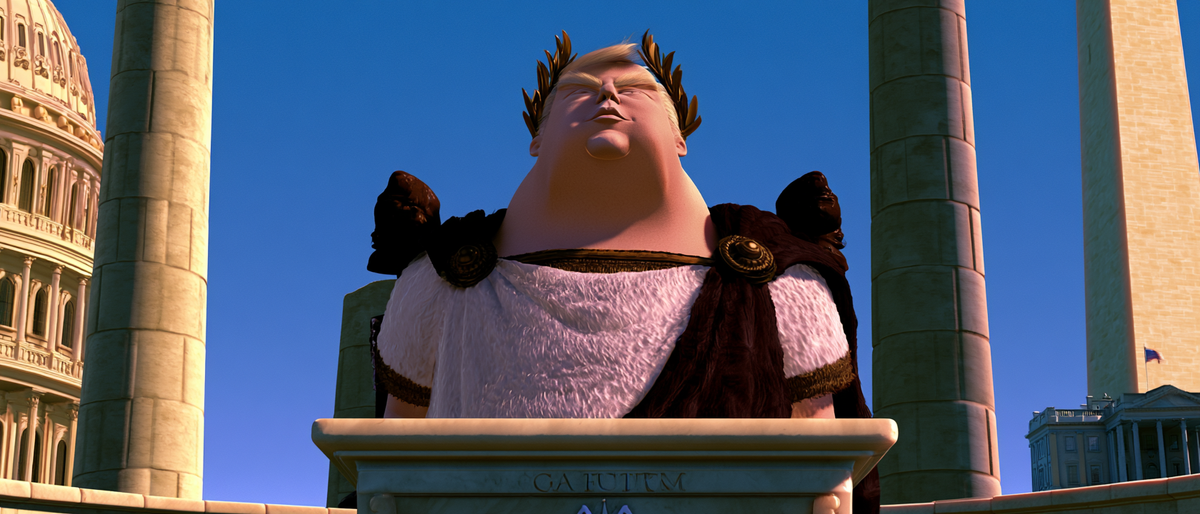
Cage fighters on the White House lawn, racing cars around the monumental core, a colossal ballroom and a proposed triumphal arch: the politics of spectacle has found its American capital.
By Jonathan Brown
On the afternoon of August twenty-third, 2026, the presidential limousine rolled onto a temporary racing circuit in the center of Washington. Donald Trump and the first lady rode ceremonially around the course before the president took his place to wave the green flag. An Air Force One flyover crossed the sky. A bald eagle was released. Below, IndyCars accelerated into a 250-mile race threaded through the monumental landscape of the republic, past the Mall and the architectural memory of an older American conception of power.
The event was officially the Freedom 250 Grand Prix, a privately financed celebration of the nation’s 250th anniversary. It was not, as it has sometimes been called conversationally, the Indianapolis 500 transplanted to Washington. Yet the mistaken name captures something about its scale and psychological effect. This was not merely a race that happened to occur in the capital. It was the temporary conversion of the capital into an arena, complete with an imperial arrival, military imagery, corporate patronage, a presidential box and an immense public assembled to witness speed, danger and national power fused into a single spectacle.
Anyone who has seen Ridley Scott’s Gladiator could be forgiven for feeling that the scene had already been filmed. The association becomes harder to dismiss when one remembers that, only two months earlier, an octagonal fighting cage had stood on the South Lawn of the White House. Professional fighters bloodied one another a short distance from the Oval Office while the president watched. The event coincided with Trump’s eightieth birthday as well as Flag Day and the national anniversary season. It was followed by the televised Patriot Games, a competition among young Americans bearing a name that seems to have escaped from dystopian fiction. Meanwhile, the demolished East Wing is being replaced by an immense ballroom; plans have advanced for a 250-foot triumphal arch; the Kennedy Center is being remade; the Rose Garden has been altered; gilding has spread through the presidential interior; and a National Garden of American Heroes promises a state-curated company of monumental figures.
Each project has its own rationale. A country may celebrate an anniversary. A president may attend a prizefight. Washington can host a motor race. The White House has long needed more space for large state dinners, and capitals have always built monuments. Considered separately, every item can be made to sound merely unusual, energetic or extravagant. Considered together, however, they reveal a governing aesthetic. The administration is not simply staging entertainments and undertaking construction. It is relocating the emotional center of American government from deliberation to spectacle, from the institution to the personality, and from the restrained symbolism of republican office to the overwhelming imagery of personal rule.
That is why Gladiator keeps coming to mind. The resemblance is not primarily between Donald Trump and the historical Commodus, nor between a regulated mixed martial arts contest and men forced to kill one another in the Colosseum. It lies in a theory of politics articulated in the film by Senator Gracchus: “Rome is the mob. Conjure magic for them and they’ll be distracted.” His fellow senators imagine that Roman legitimacy still resides in the Senate, the law and the inherited structure of the republic. Gracchus recognizes that Commodus has discovered another source of power. The emperor can bypass the reasoning citizen and appeal directly to the exhilarated crowd. He can make people feel their participation in his spectacle as though it were participation in government itself.
The Beating Heart of Rome
The most famous ancient formulation of this idea did not come from Commodus. The Roman poet Juvenal, writing in the early second century, complained that a people who had once bestowed commands, offices and political authority now desired only panem et circenses: bread and games. The phrase is usually translated as “bread and circuses,” although circenses referred more immediately to the games, particularly the racing of the circus. Juvenal was not drafting a political science textbook. He was a satirist, an elite moralist with his own prejudices, and his sneer at the Roman populace should not be mistaken for a neutral description of ordinary life.
Nor was the grain supply simply a cynical bribe. Rome was an enormous preindustrial city whose survival depended upon the movement and distribution of food. Providing grain was a legitimate obligation of government, just as maintaining water, sanitation and transportation is now. The games likewise contained religious, communal and civic meanings that cannot be reduced to manipulation. Romans attended because they enjoyed them, because the events belonged to their culture, and because an arena could become one of the few places where an emperor encountered the collective voice of the people. A crowd might praise him, petition him, mock an unpopular official or make its displeasure dangerously audible.
These qualifications do not weaken the analogy. They improve it. “Bread and circuses” was never merely a matter of hypnotizing foolish people with shiny objects. It described a political exchange in which the provision of necessities and experiences substituted for the exercise of durable civic power. The ruler displayed abundance, generosity and command. The public responded with acclamation. Between them arose a theater of legitimacy: the emperor appeared to give Rome to the people, while the people returned Rome to the emperor in the form of applause.
Public games were therefore inseparable from Roman power. They advertised conquest through exotic animals and captive enemies. They demonstrated the ruler’s ability to spend, organize and command. They ordered society visibly, seating Romans by status while gathering the entire hierarchy beneath the gaze of the presiding authority. They transformed death into ceremony and domination into pleasure. Above all, they made the emperor present. The ruler did not remain an administrator concealed behind documents. He appeared before the people as the source from which excitement, violence, mercy and reward seemed to flow.
Commodus carried that identification to an extreme by entering the arena himself. The emperor did not merely sponsor the spectacle; he became its protagonist. This was scandalous partly because public performance was considered beneath the dignity of his office. Yet it was politically intoxicating for precisely the same reason. The distinction between the ruler and the entertainer collapsed. Imperial authority became celebrity, muscularity, danger and personal theater. The affairs of state could no longer be separated cleanly from the emotional drama of the man who embodied it.
This is the insight that Gladiator converts into its opposition between the marble of the Senate and the sand of the Colosseum. One represents a republic’s claim that power should be impersonal, procedural and constrained. The other represents the immediate sovereignty of the crowd’s emotion. Marble is slow. Law is tedious. Procedure rarely produces a transcendent image. Sand supplies a victor and a victim before nightfall.
The Cage on the Lawn
The UFC event on June fourteenth was not ancient savagery. Its fighters were highly trained professional athletes who entered voluntarily, competed under rules and survived to collect payment. To call them gladiators in the literal sense would be both historically careless and unfair to the sport. Yet political imagery does not depend upon literal equivalence. A cage containing bloodied combatants was constructed on the grounds of the executive residence, and the president sat at its center as host, patron and privileged spectator. The White House—the symbolic household of constitutional government—became the setting for a commercial combat spectacle organized around presidential presence.
The scale was extraordinary. Court filings described more than sixty million dollars in expenditure by the UFC and affiliated groups, tens of thousands of hours of work, hundreds of workers and the participation of more than seven federal agencies. About four thousand spectators occupied the arena, while a much larger ticketed crowd watched from the Ellipse. Tickets to the intimate arena were not offered to the general public. Military personnel filled some seats; the administration controlled others; and Reuters reported that certain UFC guests who contributed more than one million dollars received access.
The commercial and political relationships were equally revealing. Reuters reported that Trump had disclosed purchasing as much as fifty thousand dollars in stock in TKO Group Holdings, the UFC’s parent company. Closed captioning for the broadcast was sponsored by Trump Coin, while a cryptocurrency company associated with two of the president’s sons contributed to fighter bonuses. The White House rejected conflict-of-interest allegations and maintained that the Trump family separately managed the president’s business affairs. Even so, the scene produced a peculiarly modern form of court politics: public property, presidential celebrity, commercial promotion, family-linked financial products, military participation and elite access assembled inside one glowing cage.
The fact that private organizations bore the principal production costs does not resolve the public question. Indeed, it reveals a deeper transformation. The currency of political spectacle is not only taxpayer money. It is access to national space, the prestige of presidential association, the labor and security capacity of the state, and the ability to turn the symbols belonging to everyone into assets within a leader-centered production. An emperor did not need to own every gladiator in order to own the meaning of the games. A modern administration need not write the largest check in order to receive the political value of the show.
The event also exposed the difference between public participation and the manufacture of a public. A free viewing area may be broadly accessible, and military invitees may sincerely enjoy themselves. Yet the arrangement of access establishes a hierarchy: the general population watches on screens outside, while donors, officials, celebrities and selected guests occupy the arena near the ruler. This is not the democratic town square. It is the architecture of a court, reproduced temporarily beneath television lights.
Violence contributes a particular kind of authority to such a scene. Combat sports can be technically sophisticated, disciplined and honorable. They can also communicate dominance without requiring explanation. One body prevails; another falls. No committee report is needed. No compromise clouds the result. For a political movement fascinated by winners and losers, strength and humiliation, the cage supplies a nearly perfect moral diagram. By placing that diagram at the White House, the administration did more than borrow the popularity of a sport. It drew the presidency into the sport’s grammar of conquest.
The Circus Comes to Washington
The Freedom 250 translated the same grammar from the arena to the city. An executive order issued in January directed the rapid creation of the race and presented American motor racing as a display of national greatness. Penske and corporate sponsors largely financed the infrastructure, and general admission was free, while premium packages reportedly reached five thousand dollars. Approximately two hundred thousand people attended. The race may well have been thrilling; its drivers unquestionably performed at a level of skill and courage that deserves admiration.
Yet the political meaning of the event lay not simply in the cars but in the route, framing and presidential choreography. Roads surrounding the nation’s monumental core became a racetrack. Military aircraft passed overhead. The presidential limousine performed its lap. Trump gave the starting signal from his box. The assembled imagery said that industry, speed, armed power, historic memory and mass excitement converged naturally in the person of the president.
Even the official vocabulary is instructive. “Freedom 250.” “Patriot Games.” “American Greatness.” These are not descriptions so much as compulsory interpretations. The audience is told what the spectacle means before it begins. To admire the machinery is to experience freedom; to watch the contest is to participate in patriotism; to behold the scale is to witness greatness. Political concepts that once required argument are converted into branding. Freedom becomes a logo attached to an enclosure. Patriotism becomes a broadcast package. Greatness becomes the sensation produced when engines are loud enough to shake the stone memorials.
None of this means that the spectators were dupes. People can love automobile racing without endorsing the president, just as Romans could admire a charioteer while despising a magistrate. Enjoyment is real and need not be politically pure. The problem lies not in the audience’s pleasure but in the state’s appropriation of that pleasure. The administration positions itself as the provider of the experience and then folds the experience into its own mythology. The citizen arrives to see a race and is placed inside an image of presidential magnificence.
The modern arena is more powerful than its Roman predecessor because it is no longer bounded by stone. Commodus had to gather tens of thousands of bodies inside the Colosseum. The contemporary spectacle moves simultaneously through broadcast television, streaming platforms, news clips, memes and algorithmic feeds. Millions encounter the presidential lap without smelling fuel or hearing an engine directly. Each phone becomes a seat in the amphitheater; each repeated image extends the arena beyond Washington. The crowd is distributed, continuous and measurable in real time.
The camera has therefore assumed part of the function once claimed by the Senate. It determines what can become politically real. A complicated economic condition, a constitutional dispute or a distant war struggles to produce a single commanding image. A president beneath a military flyover produces one effortlessly. Governance disappears into abstraction, while performance becomes immediate fact.
Building the Imperial Backdrop
The entertainments would appear less ominous if they were not accompanied by an architectural campaign. The White House ballroom alone occupies approximately 90,000 square feet and is expected to seat about 650 guests. Its estimated cost has risen to roughly four hundred million dollars, and the historic East Wing was demolished to make room for the project. The administration argues that the existing White House cannot properly accommodate major state occasions and that the new structure incorporates necessary security facilities. Preservationists have challenged the project, and courts have wrestled with whether construction of this scale required congressional approval. On August twenty-first, the Supreme Court allowed work to continue temporarily while the litigation proceeds.
Beyond the ballroom stands the proposal for a 250-foot triumphal arch, more than twice the height of the nearby Lincoln Memorial, along with the remaking of the Kennedy Center and plans for a National Garden of American Heroes. A triumphal arch is not an accidental Roman echo. It belongs to an architectural tradition in which military victory and sovereign power are rendered permanent in stone. Washington already speaks that language selectively, but its most powerful monuments generally commemorate a founding act, a national sacrifice, an office or a dead leader judged across time. A new arch conceived and promoted by a sitting president introduces a different relationship between personality and permanence.
Architecture matters because spectacle vanishes. The cage is dismantled; the cars leave; the broadcast ends. A ballroom and an arch remain as claims upon the future. They alter the scale by which subsequent occupants must understand themselves. They also allow a temporary officeholder to impress his personal taste upon the shared physical inheritance of the country. The more enormous the structure, the more difficult it becomes to distinguish national commemoration from self-commemoration.
Trump’s aesthetic has always treated restraint as evidence of weakness. Gold, size, height, crowds and superlatives promise to make value visible. The result is a politics of material exaggeration in which the country must continually be shown an enlarged image of itself. The irony is that genuine confidence rarely requires such insistence. A republic secure in its legitimacy does not need every civic surface to shout. Its authority can survive an unadorned room, a quiet transfer of power and the tedious dignity of procedure.
The proposed transformations of Washington offer the opposite proposition. Power must be seen, and to be seen it must become monumental. The executive residence expands into a palace of reception; the capital acquires a triumphal gateway; cultural institutions bend toward the ruler’s preferences; the grounds become available for private spectacle. This is not fascism merely because columns, arches and mass events are involved; democratic societies also build grandly and celebrate together. It is, however, the aesthetic soil in which personal rule grows comfortably. It trains the eye to associate the state with one man’s scale, appetites and imagination.
Bread Without Security, Games Without Rest
The timing sharpens the effect. A Reuters/Ipsos poll released six days before the race placed Trump’s approval at 33 percent, the lowest level of his presidency. Americans expressed anxiety about the continuing conflict with Iran, higher fuel costs and the economy. The spectacle unfolded not during a period of uncomplicated national confidence but amid war, economic unease and declining public faith in the administration.
This does not establish that the race, fight or construction projects were secretly devised to conceal a specific poll or price increase. The anniversary planning preceded the latest figures, and large events require long preparation. Political criticism becomes lazy when it labels every celebration a calculated distraction. People and governments sometimes stage festivals because anniversaries are real, sports are enjoyable and public celebration has legitimate civic value.
But distraction does not require a conspiracy. It can be a structural function of spectacle regardless of the organizer’s private intention. An administration saturated in performance continually offers experiences that are easier to feel than conditions are to understand. The roar of engines does not lower the price of gasoline; it temporarily overwhelms the conversation about it. A cage fight does not end a war; it replaces ambiguous geopolitical danger with a clean sequence of visible victories and defeats. A ballroom does not restore confidence in institutions; it materializes an illusion of abundance and command.
This is where Juvenal’s ancient complaint returns in altered form. Rome’s bargain included bread because the imperial capital understood that spectacle alone could not stabilize a hungry population. The American version increasingly risks providing the games while leaving the bread insecure. Housing, medical care, debt, employment and energy costs remain stubbornly material. They cannot be solved by patriotic nomenclature. Yet the political image insists upon inexhaustible national wealth: sixty million dollars of combat production here, hundreds of millions in ceremonial construction there, military flyovers, gold ornament and a monumental arch conceived at the scale of an emperor’s dream.
The obscenity lies less in any single price tag than in the contrast between theatrical abundance and ordinary precarity. A citizen may be told that public resources are scarce, that programs must be reduced, that individual hardship reflects necessity and discipline. At the same time, the capital performs limitless capacity whenever power wishes to celebrate itself. Even when sponsors pay the direct bill, the message of abundance attaches to the administration. Austerity is for private life; magnificence belongs to the court.
America Is Not Rome—Unless It Chooses to Be
Historical analogy can become its own form of spectacle, and the differences must be stated plainly. The United States in 2026 is not the Roman Empire of the second century. Americans retain elections, constitutional protections, an independent civil society, adversarial journalism and courts capable of obstructing executive plans. A president is neither a hereditary monarch nor a legal god. Professional athletes are not enslaved gladiators. A corporate motor race is not a chariot contest celebrating conquered peoples.
Rome itself was also more complicated than the film. Commodus did not simply discover games as a solution to “economic woes,” nor did every Roman cheer obediently. The people could be volatile and politically expressive; the Senate was hardly a pure guardian of liberty; and imperial government performed real administrative work beneath its ceremonial surface. Gladiator condenses centuries of Roman political tension into a compelling moral fable.
Yet fables endure because they expose patterns that factual differences do not erase. The relevant pattern is the transfer of legitimacy from rules to experiences. A republic asks citizens to trust a system that frequently frustrates them. Personal power asks them to trust the man who can make them feel victorious. A republic distributes authority among offices and procedures. Spectacular power gathers symbols around a single body. A republic belongs to people who may never agree about what the nation means. Spectacular power supplies one enormous image and calls it unity.
The danger is therefore not that Americans will attend a race and wake the next morning as Roman subjects. It is habituation. Each transformation teaches the public to accept another merger: public and private, office and personality, patriotism and brand, military power and entertainment, national memory and present leadership. The exceptional becomes familiar. The White House lawn can host a commercial cage. The monumental core can become a sponsored circuit. A president can plan an arch grander than established memorials. The capital ceases to be inherited space held temporarily in trust and becomes scenery available to the current producer.
This habituation also changes the standard by which leadership is judged. Administrative competence is difficult to see, while spectacle is designed to be unforgettable. The leader who governs carefully may appear smaller than the leader who commands the screen. Failure in policy can coexist with mastery of attention, and mastery of attention can be mistaken for mastery of events. In that confusion lies the enduring political utility of the games.
Gracchus’s insight in Gladiator is not simply that the mob can be bribed. It is that Commodus understands the location of political emotion better than his institutional opponents do. They possess arguments; he possesses the arena. They appeal to Rome as an idea; he makes Rome feel itself through noise, danger and collective excitement. By the time the senators recognize that the contest has moved, they are already speaking from the wrong stage.
The American constitutional order will not be defended by scorning the people who enjoy races, fights, festivals or patriotic ceremonies. Contempt for popular pleasure was one of Juvenal’s limitations, and it would be a grave political mistake now. The answer to manipulative spectacle cannot be a republic stripped of beauty, celebration and shared experience. Democratic life requires ceremonies of its own—ones that commemorate common sacrifice without turning citizens into an audience for a ruler, and ones that create participation without demanding adoration.
What must be resisted is the monopolization of wonder. No president should become the implied source of the nation’s grandeur. No administration should be permitted to confuse temporary custody of public symbols with personal ownership. The White House does not belong to the man who occupies it, the Mall is not a studio lot, the military is not a production company, and national history is not intellectual property licensed to a political brand.
The final warning of Gladiator is consequently more subtle than “do not become Rome.” Rome is already embedded in the architecture and imagination of Washington. The warning is to notice when the beating heart of government is deliberately moved—when the marble floor of deliberation is abandoned for the sand of the arena, and when citizenship is reduced to watching, cheering and selecting among spectacles prepared by others.
On August twenty-third, racing machines circled the monuments while the president presided beneath aircraft and cameras. In June, men fought in a cage on the White House lawn. Beyond them, the ballroom rises, and an immense triumphal arch waits in the plans. None of these things alone abolishes a republic. Together, however, they describe the fantasy with which a republic can be persuaded to forget itself: the ruler provides the image, the crowd supplies the roar, and the roar is offered back to the crowd as proof that it is free.
That is Gladiator 2026. The arena is no longer one building. It is the capital, the broadcast and the screen in every hand. Rome is not yet the mob—but the production is already underway.
Jonathan Brown for AetheriumArcana
Member discussion: