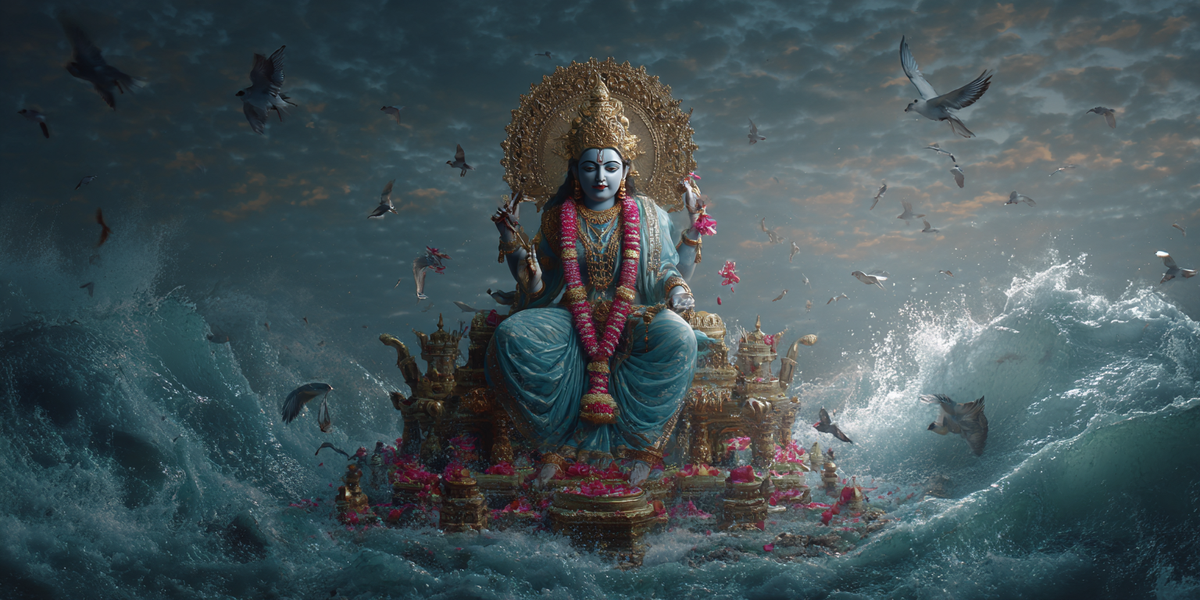
In the rigorous pursuit of a first principle that grounds the phenomenal world, Western rationalism has long found its intellectual ceiling in Aristotle’s conception of the Unmoved Mover (Kinéton Akinéton). For the modern observer—particularly the secularist who seeks to avoid the perceived "irrationality" of revealed religion—this Aristotelian Prime Cause offers a uniquely tolerable metaphysics. It provides a "logical skeleton" for the universe, stripped of the anthropomorphic demands of theism and reduced to a functional necessity of a coherent reality. By examining the Unmoved Mover, we encounter the highest reach of a philosophy that seeks the Absolute through the lens of pure logic, establishing a deity that is less a Shepherd and more a cold, ontological anchor.
Aristotle’s point of departure in both the Physics and the Metaphysics is the undeniable reality of motion and change. He argues that every object in a state of flux must be moved by another, a premise that risks an infinite regress which would render the entire chain of causality—and by extension, our understanding of the universe—radically incoherent. To resolve this, Aristotle posits the necessity of a Prime Mover: a first efficient cause that initiates the sequence of motion without itself being subject to prior influence. This entity must be Pure Actuality (Energeia); for if it possessed any latent potentiality (Dynamis), it would require a further cause to realize that potential, thereby forfeiting its status as the "first."
The internal life of this Prime Cause is characterized by Aristotle as Noēsis Noēseōs, or "Thought of Thought." In its state of eternal, unchanging perfection, the Mover can only contemplate the most perfect object in existence, which is itself. This is a cosmic intellect that is aware of the immutable laws of logic but remains fundamentally indifferent to the sublunary realm of human history, suffering, and particularity. It does not "intervene" or "care" in any recognizable sense; its very perfection necessitates a total self-absorption.
This "God of the Philosophers" holds a profound appeal for the post-Enlightenment mind. It satisfies the requirement for a primordial beginning—a metaphysical placeholder for the "Big Bang"—while ensuring moral and existential autonomy for the human subject. Because the Unmoved Mover is indifferent, it issues no commandments and demands no surrender. It is a First Cause that grants the universe its initial push and then recedes into the shadows of abstraction, leaving a clockwork world for science to decode. Yet, this elegance is bought at a high price: it leaves a void where beauty, bliss, and personal relationship reside. While it may explain the "how" of the machine’s inception, it remains silent on the "why" of the life within it, leaving the modern rationalist with a coherent system that is nonetheless devoid of heart.
While Aristotle’s Unmoved Mover provides the structural necessity for a first principle, the Brahma-Saṁhitā challenges the notion that the Absolute must remain a cold, indifferent abstraction. If Western rationalism reaches its zenith in the "logical skeleton" of a self-thinking intellect, the Sanskrit tradition offers what might be termed the "ontological heart" of the First Cause. The opening declaration, īśvaraḥ paramaḥ kṛṣṇaḥ, immediately shifts the discourse from a mechanical law to a sovereign subject. Here, the First Cause is not merely an object of logical deduction but a Supreme Controller possessing intentionality. This transition from a "what" to a "who" does not abandon the rigor of causality; rather, it expands it to include the very qualities of personality and will that define the highest complexities of human experience.
The text provides a sophisticated metaphysical definition of this Absolute through the compound sac-cid-ānanda-vigrahaḥ. This term serves as a direct expansion of the Aristotelian requirements for a First Cause. The element of sat (eternity) satisfies the necessity for the Prime Mover to be "unmoved" and eternal, while cit (consciousness or knowledge) aligns with the concept of Noēsis—an intellect aware of its own existence. However, it is the introduction of ānanda (bliss) and vigraha (form) that represents a radical departure from Western abstraction. By asserting that the nature of the Absolute is ecstatic joy, the Brahma-Saṁhitā posits that the universe is not the byproduct of an indifferent calculation, but the overflow of a self-existent delight.
Furthermore, the claim of vigraha, or spiritual form, addresses a significant logical gap in the materialist worldview. In a universe where personality, desire, and relationship are observed as the most sophisticated expressions of being, a purely impersonal First Cause creates an effect that is ostensibly greater than its cause—a violation of the fundamental principle of sufficient reason. By defining the Absolute as the "Cause of all Causes" (sarva-kāraṇa-kāraṇam) and identifying that cause as a Person, the text suggests that personality is not a primitive anthropomorphism but a foundational metaphysical requirement.
This personalist assertion creates a bridge between the "How" of the machine and the "Why" of existence. While Aristotle’s Mover can explain the initiation of motion, it cannot explain the human impulse toward beauty or the universal search for meaning. By positing a First Cause that is "All-Attractive" (Kṛṣṇa), the Brahma-Saṁhitā ensures that the Absolute is not just a placeholder for a physics equation, but the source of the very qualities—bliss and beauty—that make existence worth contemplating. In this framework, the Absolute is not an isolated thought thinking itself, but a Supreme Person whose very nature invites the participation and attraction of the entire cosmos.
The synthesis between the Aristotelian "God of the Philosophers" and the Vedic "Supreme Person" is found in the mechanism of motion itself. Aristotle’s most brilliant, yet often overlooked, Masterstroke was the realization that an Unmoved Mover cannot initiate action through physical contact or mechanical pushing, as that would subject the Mover to a reactionary force and thus to change. Instead, he argued that the First Cause moves the universe as an "object of desire" (os eromenon). In this model, the cosmos is not pushed from behind by a mechanical force but is pulled forward by the sheer excellence of the Prime Mover. The outermost celestial spheres, and by extension all subsequent life, move in a perpetual attempt to imitate or reach the perfection of the First Principle.
This Aristotelian insight provides a profound logical opening for the "All-Attractive" nature of the Supreme Person described in the Brahma-Saṁhitā. If the universe moves because it "desires" the Prime Cause, then for the system to be ontologically coherent, the Prime Cause must be inherently desirable. A cold, indifferent, and formless abstraction can be intellectually acknowledged, but it cannot be "loved" or "desired" in a way that generates cosmic motion. By identifying the First Cause as Kṛṣṇa—a name that literally translates to "The All-Attractive"—the Sanskrit tradition provides the necessary substance to Aristotle’s functional framework. The "Object of Desire" requires personality and beauty to be a coherent motivator for the soul and the stars alike.
This convergence reframes the entire debate regarding the "irrationality" of theism. When the New Atheist dismisses the personal God as a psychological projection, they often fail to account for the teleological necessity of attraction. If the fundamental drive of consciousness is toward meaning, beauty, and relationship, these qualities must reside in the Source of that consciousness. To suggest that the universe is governed by a purely mathematical or indifferent law is to leave the most significant data point of human existence—the capacity for attraction—without a sufficient cause. The Brahma-Saṁhitā’s assertion of sac-cid-ānanda (eternal-knowledge-bliss) ensures that the "Object of Desire" possesses the very qualities that evoke a response from the living being.
Thus, the "Bridge" between Western rationalism and Eastern personalism is the recognition that the Prime Mover and the Supreme Person are not competing concepts, but different depths of the same Absolute Truth. Aristotle’s logic brings us to the threshold of a First Cause that moves the world through attraction; the Brahma-Saṁhitā steps through that door to reveal the features of the One who attracts. In this light, the Absolute is not merely the "Thought of Thought," but the "Beauty of Beauty"—the ultimate Final Cause that solves the mechanical problem of motion by revealing the existential purpose of the journey.
The critique of theism as an "irrational" relic often hinges on the assumption that ascribing personality to the Absolute is a primitive form of anthropomorphism—a projection of human traits onto the vast, indifferent vacuum of the cosmos. However, when one applies the same rigorous standards of causality that the atheist uses to defend naturalism, this assumption begins to unravel. If we accept the foundational principle that the effect cannot contain essential properties that are entirely absent in its cause, then the existence of "personality" in human beings becomes a significant ontological problem for the materialist. By dismissing the personal feature of the First Cause, the skeptic is forced to argue that consciousness, emotion, and the capacity for relationship emerged from a source that is fundamentally devoid of these qualities, thereby violating the principle of sufficient reason.
The "New Atheist" insistence on the priority of secular values and instrumental reason implicitly treats human personality as a biological accident rather than a metaphysical clue. Yet, if we pursue the logic of the Brahma-Saṁhitā, personality is not a "human" trait projected onto God, but a "divine" trait reflected in humanity. In this framework, personality is the most sophisticated and complex expression of being. To suggest that the source of the universe is an impersonal force—a cosmic math equation or a blind energy—is to suggest that the "First Cause" is less complex than the "Effect" (the human person). This is a logical inversion that the rationalist should find untenable. Rather than a "primitive" step, the move toward a Personal Absolute is a sophisticated recognition that for the universe to be coherent, its source must be at least as "personal" as the subjects it produced.
This perspective directly challenges the "Pyrrhic victory" of the atheist mentioned in earlier discussions. If the atheist successfully strips the universe of its personal foundation, they are left with a culture that, while nominally rational, eventually descends into the irrationality of the consumerist monoculture. Without a personal Final Cause to ground human values, "reason" becomes merely a tool for instrumental gain—a way to calculate the most efficient path toward the destruction of the biosphere or the exploitation of the "other." The absence of a personal Absolute leads to a crisis of meaning where the "human" is eventually domesticated into a unit of production. In this light, the defense of a Personal God is not a defense of superstition, but a defense of the only metaphysical structure capable of sustaining human dignity against the cold indifference of a purely mechanical worldview.
Ultimately, the axiom of personality provides a more robust and "rational" foundation for culture than the void of atheism. While Aristotle gave us the "Unmoved Mover" to satisfy the intellect's need for a beginning, the Brahma-Saṁhitā provides the "Supreme Person" to satisfy the heart’s need for an end. To recognize the Absolute as a person is to align one’s internal experience of desire and relationship with the external structure of reality. It is to move from a universe of "it" to a universe of "thou," transforming the exercise of logic from a lonely contemplation of abstractions into a participation in the bliss of the Original Cause.
The culmination of this inquiry suggests that the "Post-Secular" path forward is not a retreat into blind faith, but an advancement toward a more comprehensive rationality—one that unites the mechanical precision of the West with the ontological depth of the East. We have seen that the "God of the Philosophers" is a necessary but insufficient conclusion. Aristotle’s logic provides the scaffolding of a First Cause, yet it remains a skeletal structure, an Unmoved Mover that can initiate motion but cannot explain why that motion matters to the sentient observer. To remain at this level of abstraction is to accept a universe that is intellectually coherent but existentially hollow, a state that inevitably gives way to the soul-deadening pragmatism of the modern monoculture.
The resolution of the "Apples to Oranges" dilemma lies in the recognition that a truly rational culture must be grounded in a Substantive Absolute. If the atheist’s critique of religion as "irrational" is to be answered, it must be through a theology that is not only logically sound but also culturally generative. By identifying the Prime Mover of Aristotle with the Govinda of the Brahma-Saṁhitā, we move from a universe of "dead" matter and indifferent laws to a living cosmos of purpose and beauty. In this synthesis, logic and science are not discarded; rather, they are seen as the methods by which we study the "instrumental" workings of a Person’s will. The "scientific revolution" and the "age of reason" thus find their proper place as the discovery of the Lawgiver’s consistent habits, rather than a discovery of a universe without a Lawgiver.
The deep truth expressed by all parties in this dialogue is that the Absolute must be both the Law and the Love. Without the Law (the Unmoved Mover), the universe is a chaos of superstition; without the Love (the Supreme Person), the universe is a prison of cold mechanics. A "noble, enlightened culture" can only emerge when the human person recognizes their own reflection in the Divine Person. By moving beyond the "indifferent abstraction" and embracing the "All-Attractive" Prime Cause, we solve the crisis of the modern age. We find a foundation for values that is not arbitrary, a standard for beauty that is not subjective, and a reason for existence that satisfies both the most rigorous logical inquiry and the deepest yearnings of the human heart. The journey from the Unmoved Mover to the Cause of All Causes is the journey from the machine to the Beloved.
ओम् तत् सत्
Member discussion: