
Essay Three in our Series A History of the Hero's Journey
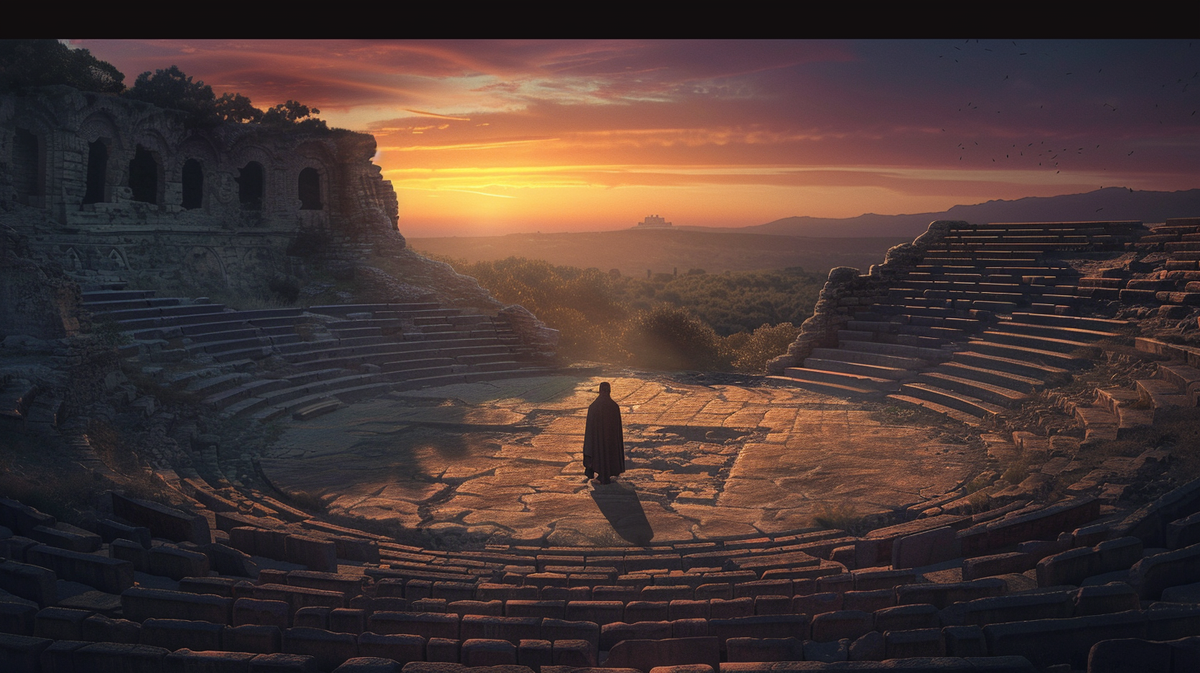
Near the end of Sophocles' Oedipus Tyrannos, a shepherd is brought before the king of Thebes for questioning. The king believes he is close to solving a murder — his own investigation, conducted with the single-minded intensity of a man who cannot rest until he knows the truth. What he does not yet know, what the audience has known since they took their seats, is that the shepherd's testimony will not solve a crime. It will disclose one. The man who summoned the witness in order to prove his innocence is about to prove his guilt, and in doing so prove something far more devastating: that the life he has been living, the identity he has been inhabiting, the city he rules and the wife he loves and the parents he believes he has left safely behind in Corinth — all of it is built on a foundation of unknowing so total that the knowledge, when it comes, does not merely change his circumstances. It unmakes him.
The shepherd speaks. Oedipus asks his final question. The answer arrives in a single line, and the man who arrived on stage as a king who had solved the riddle of the Sphinx — whose claim to identity rested on his exceptional capacity to understand — discovers that the one thing he could not understand was himself.
Aristotle witnessed performances of this kind. He watched the chorus and the audience both, and he came away asking a question that no one before him had thought to press with philosophical precision: not what the tragedy meant, not whether its depiction of the gods was morally acceptable, not even whether it was beautiful — but why this particular shape of events, this particular sequence from stability through catastrophe to recognition, produced the effect it produced. Why did watching a great man destroyed feel, against all reasonable expectation, like a form of completion?
The series has established, in the two preceding essays, that the pattern Aristotle is watching was already ancient before Sophocles staged it. Van Gennep's tripartite structure — separation, liminal ordeal, reintegration — maps onto ritual practices that predate Greek drama by millennia; the journey-shape was encoded in initiation rites before anyone thought to put it on a stage. What Aristotle adds is something no initiation rite required: a systematic philosophical account of why the pattern works and what it does to the people who witness it. Plato, from an opposite and initially hostile direction, will add something further: the claim that the journey is not merely a narrative structure that satisfies some deep human appetite, but a description of the soul's actual metaphysical condition. A third account, given by a figure Plato places at the center of his most philosophically ambitious dialogue, will organize transformation around neither dramatic necessity nor the soul's metaphysical map, but around desire — the lover's progressive recognition that what they want exceeds what any particular object can provide. And alongside all three, from the same cultural moment and the same island civilization, a lyric poet will record experience that none of these frameworks fully contains. Between them, these four figures hand the tradition its first analytical vocabulary for structured transformation — one that will still be doing work, mostly unacknowledged, when Joseph Campbell assembles his synthesis twenty-three centuries later.
✦
Aristotle's Project and the Poetics
Aristotle was not, by temperament or by method, a man interested in what things meant before he had established what they were. His approach to drama is consistent with his approach to everything else — the natural world, the constitutions of Greek city-states, the behavior of bees, the proper structure of a political argument. Observe first. Categorize with precision. Then, and only then, ask what the underlying principle might be. The Poetics, probably composed in the mid-fourth century BCE and most likely surviving in the form of lecture notes rather than a finished treatise, is philosophy doing what Aristotle most characteristically does: taking something that exists and working out, from first principles, why it is the way it is.
This matters because the Poetics has been misread, with remarkable persistence, as a prescriptive document — a set of rules for correct dramatic composition, violations of which constitute artistic failure. The neoclassical critics of seventeenth-century France did the most damage here, deriving from Aristotle's observations a rigid doctrine of the three unities — time, place, action — that the text itself does not actually mandate, and treating what was a naturalist's account of how successful drama tends to work as a legislator's code for how drama must be written. This misreading has obscured something important: Aristotle is not prescribing. He is explaining. The Poetics is an inquiry into the nature of mimetic art, conducted in the same empirical spirit as the History of Animals — a philosopher watching things that have already succeeded, and asking what made them succeed.
What Aristotle is watching, primarily, is Athenian tragedy: the plays of Sophocles, Euripides, and Aeschylus, performed at the festival of Dionysus before audiences of thousands, in a civic context that modern readers may underestimate. Athenian tragedy was not a minority art form for the cultivated; it was a public event, underwritten by the city, participated in by citizens across social strata. When Aristotle theorizes about the effect of tragedy on an audience, he is theorizing about something that had demonstrably worked, repeatedly, at a considerable scale. His question is not whether good drama is possible but why this particular kind of drama, in this particular shape, does what it does.
His answer begins with a deceptively simple claim: the primary element of tragedy is not character, not spectacle, not the music of the choral odes, and not even the language — it is plot (mythos), the arrangement of events. Character matters insofar as it drives action; a tragedy without character is conceivable, Aristotle thinks, but a tragedy without plot is not. The soul of tragedy is the synthesis — the putting-together — of what happens. This is already a structural claim of the first importance. What makes a drama work is not who the characters are in themselves but what they do, in what sequence, under what necessities.
And not just any arrangement. The claim that will occupy the rest of the Poetics, and that gives the work its enduring philosophical significance, is that a specific arrangement of events — one that moves through reversal, recognition, and the transformation they produce — achieves an effect that no other arrangement produces. Aristotle has no theory of the unconscious, no framework of ritual initiation, no cross-cultural comparative mythology to draw on. He has the plays, and his own rigorously attentive intelligence. What he sees, by looking carefully at the works that most reliably achieve their effect on audiences, is a pattern. And he wants to know why it works.
✦
The Structural Vocabulary
To read the Poetics carefully is to watch a philosopher building a set of analytical tools in real time — naming things that existed before he named them, and in naming them, making them available for thought in a new way. Aristotle's vocabulary is not a taxonomy imposed from outside; it emerges from sustained attention to what the plays actually do. Each term is an answer to a question about dramatic mechanism, and each answer, followed far enough, opens onto something larger than dramatic technique.
Mimesis is the concept from which everything else follows, and it requires rescuing from the imprecision that centuries of translation have deposited around it. "Imitation" — the standard rendering — suggests copying, reproduction, a secondary relationship to an original. This is not what Aristotle means. Mimesis is representation in the sense of capturing essential form: the painter who renders a human figure is not duplicating a particular person but giving shape to what a human figure essentially is. The poet who represents an action is not transcribing historical events but arranging the essential shape of what that kind of action essentially is. Aristotle makes the point directly in comparing poetry to history: the historian records what Alcibiades did; the poet represents what a man like Alcibiades would do, given the logic of his situation and character. Poetry, Aristotle writes, is therefore more philosophical than history — it deals in universals rather than particulars. Mimesis is abstraction toward essence, not reproduction of accident.
This has an immediate implication for the journey-pattern. If drama operates by representing the essential shape of action rather than the contingent details of specific events, then a pattern that recurs across widely different dramatic works is not coincidence — it is evidence that the works are converging on the same essential shape. Aristotle does not draw this conclusion explicitly; he is interested in what tragedy does, not in why the same structural features appear in myths from cultures he has never encountered. But the logic of his account points there.
Mythos — plot, in the standard translation, though the Greek carries a richer weight — is the arrangement (synthesis) of events into a unified whole. The well-formed plot has what Aristotle calls a beginning, middle, and end: not in the trivial sense that events occur in sequence, but in the philosophical sense that each element is necessary, that nothing could be removed without damaging the whole, and that the ending follows from what precedes it by a logic of probability or necessity rather than mere temporal succession. The plot is a constructed object, and its construction is the central art of the dramatist.
Peripeteia names what happens at the plot's hinge: the reversal of fortune, the change from one condition to its opposite. The reversal must occur, Aristotle specifies, contrary to expectation but in accordance with probability or necessity. This qualification is everything. The reversal that arrives from nowhere — the deus ex machina, the coincidence that solves the plot's problem — is not peripeteia in Aristotle's sense; it is a mechanical contrivance, a failure of craft. The reversal that feels both surprising and inevitable simultaneously — that makes the audience think, in the moment of its arrival, of course, it could not have been otherwise — is the structural achievement Aristotle is pointing at. Oedipus calling for witnesses to establish his innocence and thereby establishing his guilt is the paradigm case: the very act of seeking the truth is the act that destroys him.
Anagnorisis — recognition — is the movement from ignorance to knowledge, and it is most powerful when it arises directly from the plot's events rather than from external tokens or the playwright's contrivance. In its fullest form, recognition and reversal coincide: the protagonist does not first experience the reversal and then understand what has happened, but understands and is reversed in the same instant. The dramatic and philosophical implications of this simultaneity are considerable. Knowledge here is not consoling — it is the thing that makes the reversal complete. Oedipus does not suffer less for knowing. He suffers more precisely, more fully, more finally.
Together, these terms describe an architecture. A protagonist of genuine weight encounters a situation in which a specific error of judgment initiates a chain of consequences that follows, with the logic of probability and necessity, through escalating complications toward a reversal of fortune and a recognition of what was not previously known. The audience undergoes something through witnessing this arc — something Aristotle calls catharsis, a term whose contested interpretation is itself philosophically instructive.
✦
Catharsis: The Contested Heart
There is a single sentence in the Poetics that has generated more scholarly argument than almost any other sentence in the Western critical tradition. It appears in Aristotle's formal definition of tragedy, in the sixth chapter: tragedy is a representation of an action that is serious, complete, and of a certain magnitude, in language embellished in distinct ways in its different parts, presented dramatically rather than narrated, and achieving, through pity and fear, the catharsis of such emotions.
The word catharsis appears here, and essentially nowhere else in the Poetics — the text that survives, at any rate. Aristotle apparently intended to discuss it further in a second book, which almost certainly existed and has not come down to us. What remains is this single, unelaborated deployment of a term that carries several possible meanings simultaneously, none of which Aristotle pauses to specify. Two and a half millennia of readers have been arguing about which meaning he intended ever since, and the argument has not been resolved. What is remarkable — and what matters most for the present inquiry — is that the two dominant interpretations, for all their apparent incompatibility, converge on the same structural insight.
The first reading, given its most influential formulation by the nineteenth-century German philologist Jacob Bernays, draws on the medical sense of the word. In ancient Greek medicine, catharsis means purgation: the evacuation of harmful substances from the body, the release of what has built up under pressure. On this reading, tragedy works as a kind of emotional hygiene. The audience arrives carrying accumulated pity and fear — responses to the vulnerability and danger inherent in human life, emotions that ordinary existence generates but does not adequately discharge. The play provides a controlled occasion for those emotions to be expressed and released. The spectator leaves the theater relieved, stabilized, the pressure dissipated. Drama is, in this account, a therapeutic technology. Its explanatory appeal is genuine: it accounts for the sense of emotional completion that audiences consistently report after successful tragedy, the feeling of having been wrung out and in some obscure way restored.
Its weakness is equally genuine. If catharsis is simply the evacuation of built-up emotion, then drama is finally a palliative — a management tool for feelings that the structure of human life produces and that art helps to disperse. This does not explain why audiences feel, after a great tragedy, that they have understood something — that Oedipus's recognition illuminates their own condition in a way that mere emotional release would not account for. The purgative reading drains the cognitive content from the experience.
The second reading, developed with particular force by Martha Nussbaum and Stephen Halliwell, among others, draws on a different sense of catharsis — clarification, purification in the sense of making clear rather than making empty. On this account, tragedy does not expel pity and fear from the audience; it organizes them, refines them, educates them in what their proper objects are. We arrive at the theater with emotions that are, in the ordinary run of life, somewhat indiscriminate: we fear things that do not merit fear, we pity where pity is inappropriate. The play, by directing those emotions toward carefully constructed objects — a protagonist whose situation is universal in its essential shape, whose error is intelligible, whose suffering follows from comprehensible causes — teaches us something about what pity and fear are appropriate responses to. We leave not emptied but clarified: our emotions have been brought into a more accurate relationship with their proper objects.
Both interpretations, however, share a structural implication more important than either reading alone. Whether catharsis means purgation or clarification, the claim is the same: the audience undergoes a transformation through witnessing the transformation of the protagonist. Drama does not merely represent change — it produces it. The spectator who has experienced genuine catharsis is not in the same state as the spectator who arrived. Something has occurred that required the specific arrangement of events Aristotle's structural vocabulary describes: the hamartia that set the arc in motion, the reversals and recognitions through which it moved, the suffering that made the recognition possible. Remove any element of that arrangement and the effect diminishes or disappears. The structure is not decorative; it is causally necessary for the psychological event that is the point of the whole exercise.
This is the first philosophical account in Western thought of why the journey-pattern is not merely aesthetically satisfying but psychologically necessary — why the human psyche requires this particular shape of experience, in art if not always in life, in order to process certain fundamental truths about its own condition. Aristotle does not put it in these terms; he is describing tragedy, not theorizing about myth. But the logic of his account reaches beyond his occasion. A pattern that is causally necessary for a specific psychological transformation — a pattern without which that transformation does not occur — is a pattern that any culture interested in producing that transformation will tend to generate.
✦
Hamartia: Error, Not Sin
The word that has caused more mischief in the history of Aristotle's reception than any other is not catharsis, whose difficulty is at least openly acknowledged, but hamartia — a term whose mistranslation has been so thoroughly absorbed into the critical tradition that correcting it can feel, to those who have grown up with the error, like pedantry. It is not pedantry. The difference between what hamartia means and what it has been taken to mean is the difference between a philosophically precise account of how the journey-pattern works and a moralized fairy tale about the wages of pride.
The standard translation — "tragic flaw" — is a Victorian confection, and it carries the full weight of the Victorian moral universe within it. On this reading, the tragic protagonist falls because they are defective in some specifiable way: Oedipus is arrogant, Macbeth is ambitious, Hamlet is indecisive, Lear is vain. The flaw is identified, the downfall follows as its consequence, and the structure of the tragedy is essentially retributive — a cosmic balance-sheet in which excess is corrected, pride brought low, the moral order restored. This reading has the considerable advantage of being simple and the considerable disadvantage of being wrong, both as a description of what Aristotle says and as an account of what the great tragedies actually do.
Hamartia derives from the verb hamartanein — to miss the mark, to fall short of a target. The image is from archery, and it is technical before it is moral. The archer who misses is not wicked; they have misjudged the distance, misjudged the wind, failed to account for some variable that the situation required accounting for. The error is cognitive before it is ethical: a failure of knowledge, of perception, of the information available at the moment of action. When Oedipus investigates the murder of Laius with such relentless, admirable thoroughness, he is not exhibiting a moral vice — he is exhibiting precisely the qualities that made him great enough to solve the Sphinx's riddle and govern Thebes. His hamartia is not that he is arrogant; it is that he does not know what the audience, with dramatic irony, already knows. He acts, and acts well, on incomplete information. The error is structural before it is personal.
This distinction has direct consequences for how we understand the journey-pattern. The figure whose limitation sets the transformative arc in motion is not a sinner being corrected by a just cosmos. Aristotle is explicit that the protagonist must be neither wholly good nor wholly bad, but someone the audience can recognize as meaningfully like themselves — a person of genuine stature whose particular excellence is precisely what makes their particular error possible. The quality that makes Oedipus capable of solving riddles is the quality that makes him incapable of leaving this one unsolved. The greatness and the limitation are the same thing, operating in different registers. The journey begins not because the protagonist is morally insufficient but because they are humanly incomplete — which is to say, because they are human. This is what makes the pattern universal rather than cautionary. It is not warning us against specific vices. It is describing a condition.
The Hebrew chet, often translated as "sin" in the tradition that shaped Christian moral vocabulary, carries the same etymological root — to miss the mark, to fall short of what was aimed at. The convergence is suggestive, though the theological weight each tradition places on the image differs enormously. What it reveals is that the recognition of error as a structural condition of human action — not a moral catastrophe but an epistemic limitation — appears independently in traditions that have no direct contact with each other. The archer who misses is a figure that recurs because the condition it names recurs. And the journey the miss sets in motion is the attempt, often costly and sometimes fatal, to understand what went wrong and why.
✦
The Tragic Arc Mapped Against the Journey-Pattern
The comparison that follows is not an argument that Aristotle anticipated Campbell, or that the Poetics is a disguised theory of the monomyth. The series has insisted from its opening essay that Campbell's achievement was synthesis — the gathering of independently constructed strands into a single schema — and the purpose here is to demonstrate that one of those strands, arguably the most philosophically rigorous, was already in place in Athens in the fourth century BCE. What the structural parallel reveals is not influence but convergence: two accounts of the same underlying pattern, arrived at by entirely different routes, finding the same load-bearing elements indispensable.
Both accounts begin with an established condition — a protagonist whose world is coherent, whose position is legible, whose identity is stable. Campbell calls this the ordinary world; Aristotle does not name it, but its presence is structurally required by the plot's logic, since the reversal must reverse something, and the recognition must displace a prior state of not-knowing. The beginning is not merely a temporal starting point; it is the condition of completeness from which the arc departs.
Both accounts require a departure from that condition initiated by something other than the protagonist's free choice in the fullest sense. Campbell's hero is called — often reluctantly, often with an initial refusal. Aristotle's protagonist is set in motion by hamartia: not a deliberate choice toward evil but an error whose consequences exceed what the chooser could have foreseen. In both cases, the departure is not fully voluntary. This is structurally important. A journey freely chosen toward a known destination is not the pattern either account is describing. What the pattern requires is that the protagonist be drawn into territory whose nature they do not yet understand, by forces that their existing self is not equipped to navigate.
Both accounts then require ordeal: a middle section of escalating complication, difficulty, and stakes. Aristotle insists on the unity and necessity of the middle — each complication must follow from what precedes it by probability or necessity, not by the playwright's convenience. Campbell's road of trials operates on the same principle of narrative necessity. The ordeals are not arbitrary obstacles; they are the specific resistances required to produce the specific transformation the arc is building toward.
Both accounts locate their decisive moment at the convergence of reversal and recognition. Campbell's supreme ordeal is not merely the hero's most dangerous test; it is the moment of deepest self-knowledge, the point at which the hero discovers what the journey has actually been about. Aristotle's simultaneous peripeteia and anagnorisis — the reversal of fortune occurring at the exact instant of recognition — achieves the same structural function: the outer catastrophe and the inner illumination are not sequential but identical. The fall and the understanding are the same event, experienced from different angles.
Both accounts require, at least formally, a return to the world from which the journey departed. Here, however, a difference emerges that is philosophically consequential and should not be smoothed over. Campbell's hero characteristically returns with something: a boon, a wisdom, an elixir that benefits the community left behind. The return is integrative; the ordinary world is restored and elevated. Aristotle's tragic protagonist frequently does not return in this sense. Oedipus does not bring Thebes the wisdom of his recognition — he is blinded and expelled. Lear does not return transformed and useful; he dies holding a dead daughter. The protagonist undergoes the transformation, and the audience receives its benefit. The journey's fruits, in tragedy, accrue to the witness rather than the traveler.
This is not a flaw in the pattern but a clarification of it. What tragedy insists on — and what Campbell's more integrative account risks softening — is that the transformation is costly at the level of the self that existed before the journey began. Whatever survives the ordeal is not the same entity that entered it. Aristotle's tragic arc holds this cost visible. It does not promise that the journey delivers a version of the protagonist better equipped for the life they previously led. It promises only that the journey, completed, delivers something — and that something is the recognition, however devastating, of what was not known before.
✦
Plato as Counter-Voice: The Republic's Charge
The argument between Plato and Aristotle about what mimetic art does to the people who experience it is the founding debate of Western aesthetics, and it has never been fully resolved. It is also, for the present inquiry, something more than a historical curiosity: it is the first serious philosophical confrontation with the question of whether the journey-pattern is a resource for human understanding or a danger to it. Plato's answer, stated with considerable force across several books of the Republic, is that it is a danger — and the care with which Aristotle constructs his counter-account in the Poetics suggests that he understood exactly what he was arguing against.
Plato's case against mimetic poetry operates on three levels that reinforce each other. The metaphysical objection comes first. Reality, in Plato's account, is organized hierarchically: the Forms are fully real, particular objects participate in the Forms and are therefore real in a secondary sense, and representations of particular objects — paintings, dramatic performances, poems — are at a third remove from reality, imitations of imitations. The poet who represents a bed has never studied the Form of Bed; he has merely observed particular beds and reproduced their appearance. He is, Plato writes with a precision that carries a certain forensic pleasure, like a man carrying a mirror around and reflecting whatever the mirror happens to face. The image is real as an image. It is not real as knowledge.
The psychological objection follows from the metaphysical one, but it is the charge that will prove most consequential. The tripartite soul — reason, spirit, and appetite — is, in Plato's ideal ordering, governed by reason. Mimetic poetry works in precisely the opposite direction. It appeals to the appetitive and emotional parts of the soul, gratifies them, gives them an occasion for expression that reason would, if properly in control, suppress or redirect. Tragedy, specifically, invites the audience to indulge the very responses — weeping, lamentation, the public expression of grief — that a person of proper self-governance would be ashamed to display. The theater, on this account, is not a space of illumination but a school for incontinence: it trains the audience to feel freely what reason requires them to feel carefully.
The political objection completes the structure. In the ideal city that the Republic is constructing, citizens must be brave, rational, and capable of subordinating private emotion to civic duty. Stories in which the gods behave scandalously, in which heroes weep and beg and express terror of death, in which the moral order appears capricious and the just man suffers without redemption — such stories are incompatible with the formation of citizens capable of sustaining a well-ordered polity. Homer must go. The tragedians must go. Not because beauty is worthless but because this particular kind of beauty does a particular kind of damage to the souls that need, above all, to be reliably governed by reason.
Stated in this compressed form, the position sounds like a philosopher's bad dream of censorship, and its political legacy has not been unblemished. But the philosophical seriousness beneath it deserves acknowledgment before it is argued against. Plato is not afraid of strong emotion in the abstract; the dialogues are full of it. He is afraid of strong emotion that has been detached from its proper rational governance — emotion that has been given, by art, a permission structure that ordinary life does not provide and that the well-formed soul should not require. The theater, for Plato, offers the pleasures of uninhibited feeling without the consequences. And pleasures without consequences are, in his account, precisely what corrupt.
It is a formidable case. And it sets up a paradox that the Republic itself cannot escape — because Plato, having made it, immediately reaches for myth.
✦
Plato's Own Myths: The Journey as Metaphysical Map
The philosopher who banishes the poets in Book III of the Republic and prosecutes his case against mimetic art with renewed force in Book X cannot, it turns out, complete his own philosophical work without becoming something very close to a poet himself. This is not inconsistency, though it has sometimes been read as such. It is a recognition — operating at the level of practice if not always acknowledged at the level of theory — that certain philosophical content resists propositional statement. There are truths, Plato seems to understand, that cannot be argued toward directly; they must be approached through narrative, through image, through the journey form itself. The tension between these two moves — the banishment of the poets, the immediate return to myth — is one of the most productive contradictions in the history of thought.
The Allegory of the Cave, which appears in Book VII — after the poets have already been sent away — is the most structurally complete instantiation of the journey-pattern in ancient philosophy, and it would be recognizable as such even if Aristotle had never written a word about peripeteia or Campbell had never assembled his monomyth. Its architecture is the architecture the pattern always produces: an ordinary world that is not what it appears to be, a forced departure from that world, an ordeal in the transition between conditions, a transformative vision, and a return that costs the returner something the world below cannot easily forgive.
The prisoners chained in the cave, watching shadows on a wall and taking those shadows for the whole of reality, are not stupid. They are, Plato is careful to specify, like us: people in the normal condition of embodied human consciousness, in which the most vivid and immediately compelling things are the ones closest to the senses, and the Forms — the realities that make sensory appearances possible — are invisible precisely because they are more real than what the senses can register. This is not a story about ignorant people who need to be educated by a philosopher. It is a structural description of what it means to be a conscious being embedded in a world of appearances, mistaking the appearances for the whole of what is.
The prisoner who is released — and Plato's verb here is worth attending to: the prisoner is dragged out, not invited, not persuaded, not gently encouraged — undergoes an ordeal whose physical unpleasantness Plato describes with some care. The light hurts. The eyes, accustomed to shadows, cannot initially resolve the objects of the upper world into anything coherent. The ascent is disorienting, painful, and for a considerable time produces less clarity than the cave did. This is not incidental atmosphere. It is a structural claim about the nature of genuine transformation: the movement toward a truer condition passes through a period of greater confusion than the false condition provided. The ordeal is not a temporary discomfort before the illumination; it is the mechanism of the illumination.
Then the return. Plato insists on it, and the insistence is philosophically significant in a way that distinguishes his account from any merely contemplative ideal. The philosopher who has seen the sun must go back into the cave. Not because the cave is good or because the shadows have become more real in his absence, but because the community of cave-dwellers has a claim on him that the vision does not cancel. The return is described, with a precision that makes it unmistakably personal — Plato is thinking of Socrates — as genuinely dangerous. The returned philosopher cannot see clearly in the dark; he stumbles, he makes mistakes that the unreleased prisoners do not make, and they mock him for it. More than that: if he tells them what he has seen, if he tries to describe the sun to people whose eyes have never left the wall, he risks being killed. The journey's return is not a triumph. It is an obligation undertaken at cost, against the resistance of those who have not made the journey and cannot understand why anyone would want to.
The Myth of Er, at the very end of the Republic — placed with deliberate irony in Book X, immediately following the argument that has most forcefully expelled the poets — is a katabasis: a descent to the realm of the dead, a period of liminal ordeal, and a return bearing knowledge that the living world requires. Er, a soldier killed in battle, is permitted to watch the underworld's workings and return to report what he has seen. What he witnesses is the mechanism of soul-choice: between incarnations, souls select their next lives from an array of possibilities, and the quality of that choice depends entirely on the wisdom acquired in the life just completed. The unexamined life chooses badly. The examined life chooses with knowledge of what actually constitutes a good human existence. The Republic's founding question — what is justice, and why should the just person choose justice even when injustice would go unpunished? — is answered, finally, not by the book's elaborate philosophical architecture but by this myth. The philosophical arguments have done their necessary work; they have cleared the ground, established the terms, made the case as far as argument can make it. But the final answer cannot be stated propositionally. It must be given the shape of a journey.
The Charioteer myth in the Phaedrus extends the pattern inward to the point where the journey has no geography at all. The soul is a charioteer driving two winged horses — one noble and responsive to reason, one base and responsive to appetite — and the journey is the soul's perpetual struggle to ascend toward the vision of the Forms against the resistance of its own divided nature. There is no external road here, no cave to escape, no underworld to visit. The landscape is entirely interior, and the ordeal is the permanent condition of embodied consciousness: the ceaseless effort of the rational faculty to govern what the appetitive faculty perpetually resists. The journey is not an episode in the soul's history. It is the soul's history.
What Plato has done, across these three myths, is something Aristotle's structural account does not do and does not attempt: he has claimed that the journey is not merely a satisfying narrative shape, or even a psychologically necessary form of experience. It is a map of the soul's actual metaphysical situation. The prisoner in the cave is not a character in a story. The prisoner in the cave is what we are. The pattern recurs not because audiences find it satisfying, though they do, and not because ritual cultures have encoded it in their initiatory practices, though they have. It recurs because it is true — because existence, for a conscious being, actually is structured as departure from a condition of incomplete understanding, ordeal in the movement toward clarity, and the difficult, costly, necessary return.
✦
Diotima's Ladder: A Different Interior
The Symposium stages a sequence of speeches about eros — desire, love in its broadest sense — delivered at a drinking party in Athens. The speeches accumulate. Phaedrus argues that Eros is the oldest of the gods. Pausanias distinguishes common love from heavenly love. Aristophanes delivers the myth of the original rounded humans, split apart and forever seeking their other halves. Each speech is eloquent; each is, in some precise way, insufficient. Then Socrates rises to speak — and declines to speak in his own voice. Instead, he reports a conversation he claims to have had, years before, with a woman named Diotima of Mantinea, who taught him everything he knows about eros.
The speech that follows is the most formally complete account of transformative ascent in the Platonic corpus. It is also, structurally, distinct from the journey-maps Plato deploys elsewhere. The Cave, the Myth of Er, the Charioteer — all are organized around a protagonist who undergoes something: the prisoner is dragged out, Er witnesses and returns, the charioteer struggles. Agency, however constrained, is the engine of movement. Diotima's ladder is organized around something different: not what the lover does but what the lover is drawn toward. Desire is the motive force, and the transformation it produces is not the result of endurance or effort but of successive revelations, each of which makes the previous object of desire appear partial — a step toward something more fully real.
The ascent begins in the particular. The lover drawn toward a single beautiful body has, Diotima argues, begun the journey whether they know it or not. But a person who thinks carefully about this will perceive that the beauty of any one body is akin to the beauty of any other — and with this perception, the object of desire expands. The lover who has seen this moves to love the beauty of all bodies rather than being enslaved to one; from there to the beauty of souls, which exceeds the beauty of bodies; from there to the beauty of activities and institutions and fields of knowledge; and so on, rising, until the lover who has conducted the ascent correctly arrives at something Diotima names with deliberate awe: beauty itself, existing alone, always, by itself and with itself, unchanging — the Form of Beauty, which is not beautiful in any particular way but is that in virtue of which all beautiful things are beautiful.
The structure of this ascent is the journey-pattern operating by entirely different means. What drives it is not error and its consequences, not a cosmic drama of departure and return, not even the philosopher's determined effort to escape the cave. It is eros — desire understood as the soul's recognition of what it lacks and its movement toward what would complete it. Each rung of the ladder is not an obstacle but an inadequacy made visible: the lover realizes that what they wanted was not quite what they wanted, that the object which satisfied them was pointing toward something it could not itself provide, and this realization — not forced, but drawn forth by the object's own partial beauty — is the mechanism of ascent. Transformation here is not accomplished by the protagonist. It is elicited by what the protagonist encounters.
This distinction matters enormously for the series' governing argument. Plato gives this account to a woman, and the account she gives is organized around receptivity rather than agency. The speech's structure — transformation driven by desire rather than action, proceeding through successive reorientations of attention rather than dramatic reversal — is different from the journey-shapes Plato deploys under his own authority. The choice, whatever the historical status of Diotima, is deliberate in the sense that Plato clearly constructed it. The most philosophically precise journey-map in ancient philosophy — the one that comes closest to describing what genuine transformation requires at the level of desire itself — is articulated in a woman's voice and organized around a principle of movement that the dominant tradition, arranged around agency and ordeal, does not fully accommodate. Whether Diotima was a historical person is a question the evidence cannot resolve. What the text preserves is something stranger and more durable: the argument that the deepest account of how the soul ascends belongs, in Plato's considered construction, to a woman who taught it to a man — and that the form of the ascent she describes is not the heroic journey but something that runs alongside it, philosophically irreducible to it.
Against this — and from the same island civilization, the same cultural moment — stands Sappho, offering evidence that neither Aristotle's account nor Diotima's fully contains.
She does not appear in the Symposium, and the omission is telling: the symposium was a male institution, and the greatest lyric poet of the preceding century has no place among the speakers. What she gives the tradition is available only in fragments, and even fragments are enough to show that the experience she records does not fit the ascent Diotima maps, nor the tragic arc Aristotle theorizes, nor any other account organized around sequence and culmination. Fragment 31 — arguably the oldest complete lyric poem in the Western tradition — describes the experience of watching the beloved speak to someone else across a room. The man who sits beside her, who hears her laugh, seems to the speaker like the equal of the gods. And then: the speaker's heart beats with sudden violence. Her tongue freezes. A delicate fire races under her skin. Her eyes see nothing. Her ears ring. Cold sweat covers her. She trembles. She says she is a little short of death.
No departure. No ordeal in sequence. No recognition arriving after complication. The transformation — if transformation is even the right word — happens in the present, to a body, in a moment that does not resolve but simply is. The intensity that Aristotle would organize into a causal arc, that Diotima would situate on a ladder ascending toward the Form, Sappho inhabits without ascending anywhere. This is not a failed version of one of these accounts. It is the evidence, from within the same cultural moment as the Greek philosophical tradition, that there was always more than one structural form available for what the self undergoes in its encounters with extremity. The philosophical and epic traditions privileged one form. Their privileging of it was, from the beginning, a choice.
✦
The Two Necessities: Synthesis
Aristotle and Plato are not, in the end, saying the same thing. The temptation to reconcile them — to find a unified Greek philosophical position on the journey-pattern and present it as the foundation on which everything subsequent was built — should be resisted, because the difference between their accounts is as illuminating as what they share.
Aristotle's account is formal and functional. The journey-structure is aesthetically necessary: the well-formed plot requires this arrangement of events because this arrangement, and no other, produces the specific psychological effect that tragedy exists to produce. The necessity is causal and verifiable — you can test it, as Aristotle implicitly does, by observing what happens to dramatic works that lack the essential elements. Plots without recognition feel merely eventful. Reversals without the simultaneous convergence of understanding feel arbitrary. Remove hamartia and replace it with pure malice, and the protagonist becomes a villain rather than a tragic figure, and the audience's response shifts from catharsis to satisfaction at a punishment deserved. The structure is not decorative; it is the mechanism. Aristotle's account explains why the pattern works on us, and it does so without any metaphysical commitment to what the pattern might reflect beyond its own aesthetic and psychological operations.
Plato's account is ontological. The journey-structure is not merely satisfying; it is true. It recurs in myth and philosophical allegory not because human psychology has certain needs that this structure reliably meets, but because the structure accurately represents the soul's actual condition: embedded in appearances, capable of ascent toward reality, obligated by knowledge to return. For Plato, the pattern's universality is not evidence of a shared psychological architecture — it is evidence that the pattern is a description of something real. The Cave is not a useful metaphor for enlightenment. It is what enlightenment actually requires, because it is what the soul actually is.
Diotima's account, delivered through Plato's construction, introduces a third possibility that neither the functional nor the ontological account fully anticipates: transformation whose engine is not dramatic necessity or the soul's metaphysical situation, but the soul's own desire — its progressive recognition that the object it seeks exceeds any particular form in which that object has so far appeared. The ascent is organized around a principle of perpetual inadequacy, not crisis and reversal. It does not culminate in devastation and understanding simultaneously, as Aristotle's tragic arc does. It does not require the ordeal of being dragged from familiar darkness into unfamiliar light. It proceeds, rung by rung, through the deepening of what was already wanted.
And alongside all three, Sappho's fragment holds a form that none of them accommodates: experience of extremity without movement, transformation without sequence, the self undone by a moment rather than by an arc.
These two accounts — Aristotle's aesthetic necessity and Plato's ontological map — are the primary foundations on which every subsequent theoretical engagement with the Hero's Journey will stand, whether its author knows it or not. The anthropologists who map the pattern onto ritual initiation are working, broadly, in Aristotle's mode: accounting for why the structure appears and what social function it serves, without committing to its metaphysical truth. The psychologists who find the pattern in the structure of the unconscious are working in a mode that partakes of both: the pattern is psychologically necessary in a way that feels closer to Aristotle, but the claim that it reflects something about the deep structure of conscious existence reaches toward Plato. Campbell himself hovers between the two positions throughout his career — his language is consistently psychological, but his tone frequently suggests something more, a universalism that exceeds what psychology alone can ground.
What the Greeks gave the Western tradition, then, is not a theory of the Hero's Journey but something more durable: a vocabulary for describing the pattern's structure, and two incompatible but equally serious accounts of why the structure matters — alongside, from the beginning, evidence that the accounts were always partial. Every theorist who comes after them — Frazer, Rank, Jung, van Gennep, Campbell — inherits this unresolved tension, usually without knowing its source. That the tension has never been resolved is not a failure of the tradition. It is the honest shape of the question.
✦
Both Aristotle and Plato were drawing on the same inherited archive — the dramatic and epic traditions of Greek poetry, centuries old before either philosopher committed a word to papyrus — and arriving, by entirely different philosophical routes, at accounts of why a particular shape of narrative experience does something that no other shape quite does. Neither was theorizing the Hero's Journey. Both were providing the conceptual infrastructure that makes it possible, two and a half millennia later, to theorize it at all. The vocabulary is Aristotle's. The metaphysical seriousness is Plato's. Every subsequent thinker who engages the pattern seriously — whether they know it or not, whether they acknowledge the debt or not — is drawing on one or both.
What neither philosopher fully addresses is the pattern as it actually exists in the literary works that preceded them both. The Odyssey had been performed for centuries before Aristotle observed that reversal and recognition are the soul of tragedy. The katabasis was a dramatic convention before Plato elevated it into philosophical allegory. The next essay turns to the poems themselves — to Homer and Virgil — and to a question that Aristotle's aesthetic necessity and Plato's ontological map together leave open: what is the journey doing when it operates not at the level of philosophical argument, or even theatrical catharsis, but at the level of civilizational myth? The answer, it turns out, involves something neither the Poetics nor the Republic quite prepares us for — the hero's suffering, in the epic tradition, is not primarily a vehicle for individual transformation. It is the foundation on which a culture's claim to order rests.
Principal Figures
Aristotle (384–322 BCE) arrived in Athens at seventeen to study at Plato's Academy, where he remained for twenty years — first as student, eventually as a thinker whose empirical temperament placed him in permanent productive tension with his teacher's metaphysical idealism. After Plato's death he founded his own school, the Lyceum, and spent the remainder of his career systematically surveying the full range of human knowledge: logic, biology, physics, ethics, politics, rhetoric, and poetics. The Poetics, probably surviving in the form of lecture notes rather than a finished treatise, is the most consequential document in the history of literary theory precisely because it refuses to treat literature as decoration or moral instruction. Aristotle watched the plays that worked on audiences — the tragedies of Sophocles and Euripides — and asked, with the same empirical discipline he brought to the study of bees, why they worked. The vocabulary he built to answer that question — mimesis, peripeteia, anagnorisis, catharsis, hamartia — became the analytical infrastructure through which every subsequent theorist of narrative transformation, including Joseph Campbell, would think, usually without knowing the debt. He did not theorize the Hero's Journey; he explained, with a precision that has never been fully superseded, why it keeps appearing.
Plato (428–348 BCE) was, by his own account, a man who had intended to become a politician and found himself, through the influence of Socrates and the shock of Socrates' execution, a philosopher instead. He founded the Academy in Athens around 387 BCE — the first institution of higher learning in the Western world — and spent his career constructing a philosophical system of extraordinary range and ambition, centered on the claim that the world available to the senses is a domain of appearances, and that reality proper consists of the unchanging Forms of which particular things are imperfect reflections. His relationship to the journey-pattern is the most interesting paradox in this essay: the philosopher who expels the poets from his ideal city on the grounds that mimetic art corrupts the soul is the philosopher who reaches, at the most philosophically ambitious moments of his own work, for myth — the Cave, the Charioteer, the Myth of Er — to convey what argument cannot convey. Plato does not use the journey as a literary device. He uses it as a map: of what consciousness is, of what transformation requires, of what knowledge costs.
Diotima of Mantinea (fl. fifth century BCE) is introduced in Plato's Symposium as a priestess and philosopher from whom Socrates says he learned everything he knows about Eros. Whether she was a historical figure or a literary invention — and the question remains genuinely open, with serious scholars on both sides — is less significant, for the present inquiry, than what Plato chose to do with her: he placed his most formally complete and philosophically precise account of the transformative ascent in her mouth. The speech Socrates attributes to Diotima describes the ladder of beauty — the soul's progression from love of particular bodies to love of beautiful souls to love of beautiful practices to love of beautiful knowledge and, finally, to the contemplation of beauty itself, which is eternal, unchanging, and the ground of all the beautiful things the soul encountered on the way up. This is the most sustained account in ancient philosophy of the journey as a structure of desire rather than action — an ascent accomplished not by heroic agency but by a discipline of attention that requires the traveler to relinquish each rung in order to reach the next. That Plato chose a woman's voice for this account, in a dialogue otherwise organized around male competition for philosophical authority, is a fact the tradition has consistently underweighted.
Sappho of Lesbos (c. 630–570 BCE) was ranked by ancient tradition alongside Homer and called by Plato the tenth Muse — a recognition of her stature that coexisted, without apparent tension, with the fact that she was doing something structurally different from anything Homer had done. She wrote from the island of Lesbos in the early sixth century BCE, in an Aeolic dialect, for audiences that may have included the young women her poems address as well as the wider Aegean literary culture that preserved and celebrated her work. What survives is largely fragments — enough to establish the unmistakable register of her voice, not enough to reconstruct its full range — and the fragments are sufficient to make the structural point this essay requires. Where the epic tradition organizes experience around departure, agency, and return — the hero acts on the world and is changed in the acting — Sappho's lyric organizes experience around the body's present encounter with extremity: desire, loss, the nearness of death, the almost insupportable perception of beauty. Her speaker does not depart and return. She undergoes, and the undergoing is complete in itself. Sappho is the earliest surviving witness to a structurally different account of transformation — one the hero's journey, as the canonical tradition constructed it, cannot accommodate without distorting beyond recognition.
GLOSSARY OF TERMS
Anagnorisis From the Greek, meaning recognition or discovery. In Aristotle's Poetics, the moment in a dramatic plot at which a character moves from ignorance to knowledge — typically the protagonist's discovery of a crucial truth about their situation, identity, or relationships. Aristotle considers anagnorisis most effective when it arises organically from the plot's events rather than from external devices such as tokens or signs, and most powerful when it coincides simultaneously with peripeteia (reversal of fortune). In Sophocles' Oedipus Tyrannos — Aristotle's paradigm case — the recognition of Oedipus's true identity and the reversal of his fortune from prosperity to ruin occur in a single, indivisible dramatic instant.
Catharsis From the Greek, carrying overlapping senses of purification, purgation, and clarification. In Aristotle's Poetics, the effect that tragedy achieves through pity and fear upon its audience — the term appears in the formal definition of tragedy and is nowhere elaborated in the surviving text. Two dominant interpretations have structured the critical tradition: the purgative reading (associated with the nineteenth-century scholar Jacob Bernays) understands catharsis as the discharge of accumulated emotion, leaving the audience relieved and stabilized; the clarificatory reading (associated with Martha Nussbaum and Stephen Halliwell, among others) understands it as the education and proper ordering of emotional response, bringing pity and fear into a more accurate relationship with their appropriate objects. Both interpretations agree that catharsis designates a transformation in the audience produced by witnessing the plot's action — that drama does something to its audience rather than merely for it.
Eros (Greek: ἔρως, erōs — desire, love, longing) In Greek thought, the force of desire that draws a being toward what it lacks or perceives as beautiful. Distinguished in ancient usage from philia (affectionate love, friendship) and agapē (unconditional or charitable love): eros is specifically the love that reaches, that is propelled by absence toward an object not yet possessed. In Plato's Symposium, Diotima redefines eros not as a god but as a daimōn — an intermediary spirit — whose nature is precisely this condition of being between: between ignorance and knowledge, between mortality and immortality, between the beautiful particular and beauty itself. This redefinition is philosophically decisive: eros becomes the engine of the transformative ascent, the force that makes the ladder of beauty navigable, because it is constitutively oriented toward what lies beyond its present condition. Plato's account of eros in the Symposium and Phaedrus is the point at which the journey-pattern and the philosophy of desire become, in Western thought, the same thing.
Hamartia From the Greek verb hamartanein, meaning to miss the mark, to fall short of a target. In Aristotle's Poetics, the error of judgment that initiates the tragic protagonist's arc — an error of knowledge or perception rather than a moral failing. The standard rendering as "tragic flaw" reflects a Victorian moralization foreign to Aristotle's text: the term implies not a defect of character deserving punishment but a cognitive limitation, a miscalculation made under conditions of incomplete knowledge. The tragic protagonist acts on what information is available to them; the hamartia is that this information is not sufficient to the situation. The term's root is technical before it is ethical — the image is from archery — and the same etymological family appears in the Hebrew chet, often rendered as "sin" in the traditions that shaped Western moral vocabulary, carrying the same sense of falling short of what was aimed at.
Katabasis From the Greek, meaning descent or going down. In classical literature, the journey of a living figure into the realm of the dead — typically undertaken to gain knowledge unavailable to the living, followed by a return bearing that knowledge to the world above. Major instances include the visit of Odysseus to the dead in Odyssey Book XI, the descent of Aeneas in Aeneid Book VI, and Plato's Myth of Er in Republic Book X, in which a soldier killed in battle is permitted to witness the underworld's workings and return to report them to the living. The katabasis is among the oldest and structurally most consistent elements of the journey-pattern across literary and mythological traditions, and Plato's philosophical appropriation of it in the Myth of Er represents the decisive step in its transformation from narrative convention into metaphysical argument.
Mimesis From the Greek, conventionally translated as imitation, though the translation inadequately captures the term's philosophical weight as Aristotle deploys it. In the Poetics, mimesis designates the representation of action in its essential form — abstracted from the particular accidents of specific historical events and rendered in terms of what would or could happen given the logic of character and situation. Aristotle distinguishes poetry's mimesis from historical recording by arguing that poetry deals in universals (what a person of a certain kind would do) rather than particulars (what Alcibiades did). Mimesis is therefore a form of philosophical abstraction toward essence rather than reproduction of surface appearances, which is why Aristotle — against the intuitive expectation — considers poetry more philosophical than history.
Mythos In Aristotle's Poetics, the arrangement or synthesis (synthesis) of events that constitutes the plot of a dramatic work. Distinguished from the general English sense of "myth" (a traditional narrative) and from the broader Greek sense of speech or story: in Aristotle's technical usage, mythos names the specific constructed ordering of what happens, which he identifies as the soul (psychē) of tragedy — more fundamental to dramatic success than character, diction, thought, spectacle, or song. The well-formed mythos has a beginning, middle, and end in a philosophically precise sense: each element is necessary, nothing is removable without damaging the whole, and the ending follows from what precedes it by probability or necessity rather than by mere temporal succession or authorial convenience.
Peripeteia From the Greek, meaning reversal or turning around. In Aristotle's Poetics, the change of fortune to its opposite within a dramatic plot — the movement from prosperity to adversity (in tragedy) or from adversity to prosperity (in comedy). The reversal must occur, Aristotle specifies, contrary to expectation but in accordance with probability or necessity: its characteristic effect is the simultaneous experience of surprise and inevitability, the sense that events could not, given the logic of what preceded them, have gone otherwise. Aristotle considers peripeteia most powerful when it coincides with anagnorisis (recognition) in a single dramatic moment — as in Oedipus Tyrannos, where the act of seeking the truth is itself the act that produces the ruin.
Psychomachia From the Greek, meaning battle of the soul. A literary and theological tradition in which the soul's moral and spiritual condition is represented as an interior conflict between personified forces — most fully developed in the early Christian period, where the term derives from the allegorical poem Psychomachia by the Latin poet Prudentius (c. 405 CE), in which virtues and vices wage literal battle for possession of the soul. The tradition extends the journey-pattern inward, transforming the external landscape of ordeal into a topology of consciousness: the hero's trials become the mind's own divisions, and the antagonist is located not in the world but in the self. The psychomachia tradition is discussed in the context of medieval Christian allegory and its influence on Dante's Divine Comedy in Essay 5.
Scala amoris (Latin: scala, ladder + amoris, of love — ladder of love) The Neoplatonist designation for the ascent described by Diotima in Plato's Symposium, in which the soul moves by stages from love of a particular beautiful body through love of beautiful souls, practices, and knowledge to the contemplation of beauty itself — eternal, unchanging, the ground of all the beautiful things encountered on the way up. The term is not Plato's own but was applied by later interpreters, particularly in the Neoplatonist tradition of Plotinus and Ficino, who systematized Diotima's account into a formal hierarchy of ascent. The scala amoris represents the journey-pattern organized around desire and relinquishment rather than action and return: the traveler does not accomplish or overcome but releases each stage in order to become capable of the next. As such it stands as the most formally complete alternative, within the Greek philosophical tradition itself, to the Aristotelian tragic arc — and the one Plato chose to voice through a woman.
Tripartite soul Plato's account, developed most fully in the Republic and dramatized mythologically in the Phaedrus, of the soul as composed of three distinct but interrelated faculties: reason (logistikon), the spirited or passionate element (thymoeides), and appetite (epithymetikon). In the well-ordered soul, reason governs, with the spirited element as its natural ally in disciplining appetite; in the disordered soul, appetite or passion overrides reason's governance. The Charioteer myth in the Phaedrus gives this structure narrative form: reason is the charioteer, the spirited element a noble and responsive horse, appetite a base and resistant one, and the soul's condition is the permanent, effortful struggle to maintain direction against the downward pull. The tripartite soul provides the psychological framework within which Plato's charge against mimetic poetry — that it gratifies appetite and emotion at reason's expense — carries its full philosophical force.
The following sources are presented with confidence where confidence is warranted and with explicit flags where details warrant additional verification. A working bibliography of this kind serves the essay better through honest uncertainty than through false precision.
PRIMARY SOURCES
Aristotle. 1987. Poetics. Translated by Richard Janko. Indianapolis: Hackett.
Aristotle. 1995. Poetics. Edited and translated by Stephen Halliwell. Loeb Classical Library 199. Cambridge, MA: Harvard University Press.
Editorial note: Both translations are listed because they serve different purposes. Janko's Hackett edition offers the most philosophically precise modern English rendering and includes a substantial introduction; it is the recommended working text. Halliwell's Loeb presents the Greek facing the English translation, making it the preferred edition for any reader who wishes to check the original against the argument — particularly useful for the contested terms catharsis and hamartia. Where the two translations diverge on key passages, the divergence is itself instructive.
Plato. 1989. Symposium. Translated by Alexander Nehamas and Paul Woodruff. Indianapolis: Hackett.
Plato. 1992. Republic. Translated by G.M.A. Grube. Revised by C.D.C. Reeve. Indianapolis: Hackett.
Plato. 1995. Phaedrus. Translated by Alexander Nehamas and Paul Woodruff. Indianapolis: Hackett.
Sappho. 2002. If Not, Winter: Fragments of Sappho. Translated by Anne Carson. New York: Alfred A. Knopf.
Sophocles. 1984. The Three Theban Plays: Antigone, Oedipus the King, Oedipus at Colonus. Translated by Robert Fagles. New York: Penguin.
SECONDARY SOURCES
Bernays, Jacob. 1857. Grundzüge der verlorenen Abhandlung des Aristoteles über Wirkung der Tragödie. Breslau: Eduard Trewendt. Reprinted in Zwei Abhandlungen über die aristotelische Theorie des Drama. Berlin: Wilhelm Hertz, 1885.
Editorial note: The foundational statement of the purgative interpretation of catharsis, available in its original German only. Readers without German will find Bernays's argument summarized and critically evaluated in Halliwell 1998 (see below), which is the most reliable English-language access point. The 1885 reprinting in Bernays's collected essays is the more widely held library edition.
Else, Gerald F. 1957. Aristotle's Poetics*: The Argument*. Cambridge, MA: Harvard University Press.
Golden, Leon. 1976. "The Clarification Theory of Katharsis." Hermes 104 (4): 437–452.
Halliwell, Stephen. 1998. Aristotle's Poetics. 2nd ed. Chicago: University of Chicago Press. First published 1986 by Duckworth, London.
Halperin, David M. 1990. "Why Is Diotima a Woman? Platonic Eros and the Figuration of Gender." In Before Sexuality: The Construction of Erotic Experience in the Ancient Greek World, edited by Froma I. Zeitlin, John J. Winkler, and David M. Halperin, 257–308. Princeton: Princeton University Press.
Murdoch, Iris. 1977. The Fire and the Sun: Why Plato Banished the Artists. Oxford: Oxford University Press.
Nussbaum, Martha C. 1986. The Fragility of Goodness: Luck and Ethics in Greek Tragedy and Philosophy. Cambridge: Cambridge University Press.
Stinton, T.C.W. 1975. "Hamartia in Aristotle and Greek Tragedy." Classical Quarterly 25 (2): 221–254.
FOR FURTHER READING
The following works extend the essay's argument in productive directions.
Annas, Julia. 1981. An Introduction to Plato's Republic. Oxford: Oxford University Press. The most lucid and philosophically rigorous guide to the Republic in English, covering the arguments against mimetic poetry and the major myths with equal care. Indispensable for readers who find Plato's aesthetic position genuinely puzzling and want the full philosophical context before accepting either the dismissal of it or the standard defense.
Carson, Anne. 1986. Eros the Bittersweet: An Essay. Princeton: Princeton University Press. Carson's study of eros in Greek lyric and philosophy — part classical scholarship, part philosophical essay — provides the richest available account of the structural difference between the lyric tradition's relationship to desire and the epic and philosophical traditions this essay primarily addresses; essential background for understanding what Sappho represents in the broader Greek intellectual world.
Nussbaum, Martha C. 1995. Poetic Justice: The Literary Imagination and Public Life. Boston: Beacon Press. Develops the clarificatory account of catharsis into a broader argument about the cognitive and moral work that literary narrative performs — that the emotions engaged by fiction are instruments of ethical understanding rather than distractions from it. The most accessible entry point into Nussbaum's larger project, and directly continuous with the arguments of The Fragility of Goodness.
Silk, M.S., and J.P. Stern. 1981. Nietzsche on Tragedy. Cambridge: Cambridge University Press. The definitive scholarly treatment of Nietzsche's engagement with Greek tragedy and his Apollo/Dionysus dialectic — material taken up directly in Essay 6. Reading it alongside this essay establishes the philosophical distance between Aristotle's structural account of tragic form and Nietzsche's metaphysical revaluation of it, a distance that the Romantic revival will have to cross.
Vernant, Jean-Pierre, and Pierre Vidal-Naquet. 1988. Myth and Tragedy in Ancient Greece. Translated by Janet Lloyd. New York: Zone Books. Originally published in two volumes as Mythe et tragédie en Grèce ancienne. Paris: Maspero, 1972 and 1986. Relocates Athenian tragedy within its full social, ritual, and political context — the civic festival, the theatre as democratic institution, the plays as public events rather than literary texts for private reading. An essential corrective to any purely formalist account of what the tragic structure is doing, and a bridge toward the anthropological approaches treated in Essay 7.
Zeitlin, Froma I. 1996. Playing the Other: Gender and Society in Classical Greek Literature. Chicago: University of Chicago Press. Zeitlin's collected essays on gender and representation in classical Greek literature provide the most rigorous available account of how the category of the feminine operates in texts — including Plato's — that formally exclude women from the intellectual and civic spheres in which those texts were produced and read; essential context for the Diotima discussion and for the series' broader argument about whose voices shaped the canonical intellectual tradition.
Jonathan Brown for Aetherium Arcana
ओम् तत् सत्
Member discussion: