
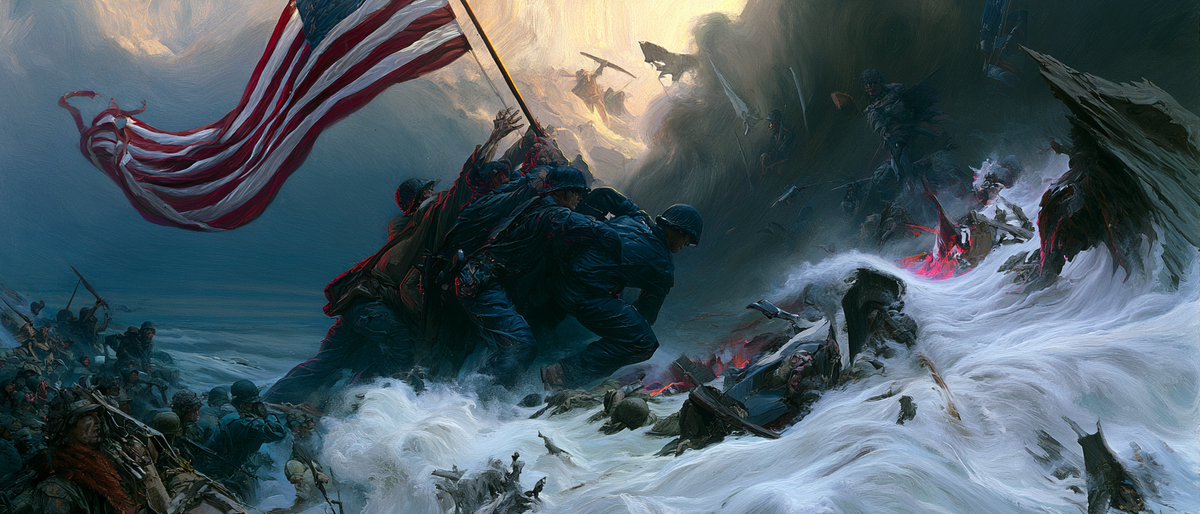
Manu, the Spectacle of Violence, and the Distributed Guilt of Modern War
The Distance Between the Feast and the Knife
Civilization has always been skilled at arranging distance between appetite and consequence. The person who enjoys the feast need not see the animal killed. The citizen who applauds a bombing campaign need not see the bodies removed from the rubble. The investor who profits from weapons production need never hear the weapon discharge. The political leader who authorizes an operation may watch its progress as symbols moving across a display, while the people beneath the aircraft experience fire, concussion, blood and the permanent division of life into a before and an after. At every station in the chain, specialization permits someone to say: I did not do the killing.
Against this ancient and increasingly technological evasion stands a remarkably compact passage from the Mānava-Dharmaśāstra, commonly called the Manusmṛti or Laws of Manu. Verse 5.51 names those implicated in the production and consumption of meat: the one who approves, the one who cuts, the one who kills, the buyer and seller, the preparer, the server and the eater. It then applies a single morally devastating designation to them: ghātakāḥ—slayers. The verse does not allow the final consumer to place the entire burden upon the butcher, nor the seller to hide behind the buyer, nor the approver to declare innocence because another hand held the blade. It understands killing as a cooperative achievement.
The passage concerns animal slaughter, not mechanized war. It would be historically careless to pretend that Manu was secretly legislating for drone pilots, defense contractors or artificial-intelligence targeting systems. Yet the ethical architecture of the verse reaches far beyond its immediate subject. It describes distributed causation: an outcome made possible by authorization, preparation, exchange, execution, presentation and consumption. Modern institutions depend upon precisely such division of labor. They divide violent action into sufficiently small professional tasks that each participant can experience himself as a technician, official, customer or spectator rather than as a contributor to the whole.
This is especially important because human beings do not merely commit violence. We watch it, narrate it, ritualize it, aestheticize it and organize communities around it. We seek horror from positions of safety. We admire those who enter arenas where death remains possible. We convert military destruction into maps, statistics and thrilling footage. We transform the dead into martyrs, the killers into heroes and the financiers into respectable stewards of national security. Then, having participated emotionally, politically or economically, we concentrate guilt upon the person nearest the physical act.
Manu’s verse refuses that concentration. It does not say that everyone bears an identical degree of guilt; knowledge, intention, freedom and power plainly affect responsibility. It says something more fundamental: causal distance is not moral absence. The person who orders, equips, legitimizes, markets, consumes or benefits from violence cannot become innocent merely by ensuring that someone else performs its bloodiest movement.
That insight provides a powerful lens through which to examine three connected phenomena: the human fascination with violence and horror when experienced vicariously; the expansion of controlled spectacle into nationalism and industrial warfare; and the increasingly elaborate machinery by which modern states and corporations distribute responsibility until violence appears to have occurred without an author. The result is not simply an indictment of soldiers or spectators. It is an indictment of the social miracle by which thousands of individually respectable actions can be assembled into organized killing while nearly everyone involved retains a private image of innocence.
The Safety of Horror
Human attraction to horror is neither imaginary nor adequately explained by saying that people are secretly sadistic. Research on “morbid curiosity” defines it as a willingness to seek information involving death, violence or harm, and experiments indicate that people sometimes actively choose disturbing images even when neutral alternatives are available. A recent study of horror enjoyment found that perceived fearfulness, realism and morbid curiosity could increase excitement and enjoyment; a broader review of horror research found associations with sensation-seeking and other traits, although no single explanation consistently predicts who enjoys frightening material. Horror offers threat without ordinary exposure to threat. It permits the nervous system to enter danger while the body remains seated in safety.
This controlled encounter can serve intelligible purposes. Frightening stories model predators, contagion, betrayal, invasion, madness and death. They allow audiences to explore forbidden possibilities, test emotional limits and rehearse responses to danger. The pleasure may come from arousal, mastery, relief, aesthetic form, communal bonding or the satisfaction of encountering chaos within a narrative that eventually ends. Fictional horror can even restore moral order by revealing the monster, naming the crime or punishing the transgressor. There is nothing inherently corrupt in looking imaginatively at suffering. Tragedy, sacred narrative and serious art have always done so.
But controlled horror contains a structure that political spectacle can exploit. The viewer receives intensity without direct physical cost. The more convincing the danger, the stronger the sensation; yet the protective frame—screen, story, arena, national border—prevents the event from making a full moral demand. We can look and then look away. We can experience fear, disgust and aggression as consumable states.
This is why the distinction between wanting death and wanting death to remain possible matters. Most spectators at a dangerous race do not hope to see a rider killed. Most boxing spectators do not consciously desire permanent brain injury. Most consumers of war films do not wish to crawl through a field of actual bodies. Nevertheless, the event’s attraction often depends upon the knowledge that the represented or ritualized violence is not wholly weightless. Courage requires danger; otherwise it becomes choreography. The audience wants the edge of catastrophe without necessarily wanting catastrophe itself.
That arrangement provides moral comfort. If no one explicitly desires the fatality, everyone can regard the fatality as alien to the spectacle. Yet when danger is the source of the event’s prestige and market value, the possible death is not truly external. It is disavowed but structurally necessary. The organizers of an extreme race sell mastery over conditions that occasionally kill competitors. Combat sports sell controlled bodily damage while officially opposing catastrophic injury. News and entertainment industries condemn atrocities while competing for the images that will hold an audience. Death is simultaneously regretted and capitalized.
The psychology of moral disengagement clarifies this transition. Research on violent games and media suggests that enjoyment becomes easier when narratives portray violence as justified, consequences as negligible and opponents as blameworthy or less fully human. The audience does not have to extinguish its moral sense; the narrative rearranges the moral field. Violence becomes rescue, punishment, defense, cleansing or victory. Guilt diminishes not because nothing violent occurred but because the story assigns innocence to one side before the action begins.
War propaganda operates through the same grammar. It supplies righteous purpose, obscured consequences and anonymous enemies. The crucial step is not teaching ordinary people to love suffering. It is teaching them that the suffering they authorize is regrettable, necessary and ultimately attributable to the victim, the enemy or the inexorable logic of events. The citizen may then enjoy the sensations of collective power—revenge, dominance, solidarity and triumph—while continuing to regard himself as humane.
From the Arena to the Nation
The Roman arena remains the obvious symbol of violence converted into civic theater. Its importance did not lie only in bloodlust. The games staged hierarchy, punishment, imperial abundance and the power of the state to decide whose vulnerability would become public entertainment. The spectator did not personally wield every weapon, but the assembled audience participated in a political ritual. Imperial authority supplied the bodies; wealth supplied the architecture; skilled labor produced the event; and public appetite completed it.
Modern societies reject the arena’s explicit sacrifice while preserving portions of its emotional and institutional design. We prefer voluntary competitors, regulated injury, medical personnel and an official insistence that death is never the purpose. These differences are morally substantial. A consenting athlete is not an enslaved gladiator. Yet consent does not dissolve every question. Once danger becomes an organized spectacle, a chain of promoters, sponsors, broadcasters and consumers becomes dependent upon its continued intensity. The audience’s position is refined rather than abolished: we remain safe while another person’s body gives reality to the event.
War enlarges this relation from entertainment into political identity. It places the citizen within the grandstand of the nation. Maps replace the arena floor; uniformed briefers replace the master of ceremonies; footage from aircraft replaces the view from the seats. The individual is invited to experience military capacity as an extension of personal and collective potency. “We” struck. “We” prevailed. “We” taught them a lesson. The first-person plural performs extraordinary moral work: it allows millions to enjoy symbolic participation in victory while preserving maximal distance from the wound.
Nationalism makes that emotional transfer possible because it offers membership in a body vastly more powerful than the individual. Randolph Bourne’s unfinished essay during the First World War described how war intensifies identification with the state until the distinction between individual and collective begins to disappear. William James, writing earlier about “the moral equivalent of war,” understood that war attracts not only through hatred or profit but through discipline, strenuous purpose, sacrifice, solidarity and glory. These observations should prevent a shallow account. People do not support wars solely because they have been deceived. War can answer real psychological and social longings: to belong, to matter, to overcome private insignificance and to participate in an event that appears larger than ordinary life.
The state and the war economy capture those longings. A frightened or humiliated population can be offered restoration through collective force. Personal frustration becomes national anger; national anger becomes permission for leaders; permission becomes budgets, contracts and deployments. The citizen receives symbolic strength. The political class receives expanded authority. The arms industry receives demand. The people upon whom the force descends receive the material reality that completes everyone else’s abstraction.
This does not mean every defense of a community is fraudulent. Aggression exists, and a refusal to resist can abandon vulnerable people to conquest or extermination. Pacifist analysis becomes unserious when it treats the invaded and invader as interchangeable or assumes that every appeal to defense is merely a sales pitch. But the reality of defensive war is precisely why “defense” possesses such legitimizing power. Every aggressor borrows its moral prestige. Invasion becomes preemption; domination becomes stabilization; retaliation becomes deterrence; imperial interest becomes protection of civilization. The vocabulary of necessity is inexhaustible because necessity is the point at which moral permission is most easily manufactured.
When God Joins the General Staff
Nationalism becomes especially dangerous when political authority is sacralized. If the nation is merely a human institution, its claims can be weighed against other human claims. If it is an instrument of divine purpose, compromise begins to resemble betrayal of God. Violence may then be transformed from a tragic concession into a sacred obligation.
The formula “God is on our side” does more than encourage soldiers. It relocates moral judgment. Ordinarily, a believer might ask whether the state’s actions conform to divine justice. Sacralized nationalism reverses the inquiry: the nation’s action is presumed just because the nation is imagined as divinely chosen. Political loyalty becomes evidence of faith; criticism becomes impiety; military success becomes providence. God is no longer the judge of power but its insignia.
This structure is not confined to one religion, party or civilization. Christian nationalists can portray military supremacy as defense of a sacred national covenant. Jihadist organizations can portray terrorism as obedience, martyrdom and protection of the faithful. Religious Zionists can turn territorial or military policy into fulfillment of sacred history; religious Jewish critics can reject that fusion from within the same tradition. Hindu nationalists can sacralize the state through a civilizational identity; Hindu teachers can oppose that use of dharma. Secular revolutionary movements likewise generate sacred history, martyrs, heretics and redemptive violence without naming God at all. The mechanism is the fusion of ultimate meaning with organized power.
Once that fusion occurs, each camp experiences its own violence from inside its justifying story and the enemy’s violence from outside it. Our bomb is a regrettable instrument; their bomb reveals what they are. Our dead prove innocence; their dead are evidence of manipulation or unfortunate proximity to legitimate targets. Our fighters sacrifice; theirs are indoctrinated. Each side possesses examples that appear to confirm the asymmetry, and leaders select those examples until moral reciprocity collapses.
Manu’s causal approach cuts across this mythological enclosure. It asks not which flag blessed the act but who approved, prepared, exchanged, delivered and consumed the conditions of killing. A sacred slogan does not interrupt causation. A priest’s blessing does not remove the industrial origin of a missile, the political decision to launch it or the bodily reality at its destination. If anything, religious legitimation adds another participant to the chain: the person who converts uncertainty into righteousness and thereby makes authorization psychologically easier.
The deepest religious objection to sacralized nationalism is therefore not secular. It is theological. A finite state claims infinite authority; contingent strategy disguises itself as divine will; leaders with ordinary ambitions receive the obedience owed to transcendent truth. “God is with us” often means that power has constructed a deity incapable of judging its sponsors.
The Profit Machine Behind the Flag
Violence long predates capitalism, corporations and modern arms markets. Human beings waged wars for territory, tribute, dynasty, religion and survival before the existence of defense conglomerates. It would be reductive to claim that profit alone causes war. But it would be equally naïve to ignore what happens when permanent military institutions are joined to firms whose revenue depends upon weapons procurement, political systems dependent upon donors, regions dependent upon military employment and media ecosystems rewarded by fear and spectacle.
Dwight Eisenhower’s 1961 farewell address remains powerful because the warning came from a career general and sitting president rather than an outsider hostile to military institutions. He described the conjunction of an immense military establishment and a large arms industry as new in American experience, and warned against “unwarranted influence” and the disastrous rise of misplaced power. The point was not that every soldier or manufacturer desired war. It was that a durable structure had emerged whose size and interests could distort democratic judgment even without a single hidden committee directing it.
That structure has grown far beyond the scale Eisenhower addressed. The Stockholm International Peace Research Institute estimates that global military expenditure reached approximately $2.887 trillion in 2025, the eleventh consecutive annual increase. SIPRI also calculated that the combined arms revenues of the world’s one hundred largest arms-producing and military-services companies reached a record $679 billion in 2024, 26 percent above the 2015 level. American firms accounted for roughly $334 billion of that total. These figures do not prove that arms companies manufacture every conflict. They establish something more elementary: war, preparation for war and the perception of war are enormous markets.
In the United States, Brown University’s Costs of War project estimated that private firms received about $2.4 trillion in Pentagon contracts between 2020 and 2024—roughly 54 percent of the department’s discretionary spending during those years. Five corporations received $771 billion. A weapons program can therefore become simultaneously a military capability, a corporate revenue stream, a congressional employment issue, a campaign-finance interest, a regional development plan and a future destination for officials leaving public service. No participant needs to say “let us perpetuate war for money.” Institutional momentum performs much of the work.
This is the profit machine’s most effective disguise: it rarely appears as a villain announcing aggression. It appears as jobs, readiness, technological superiority, support for troops, deterrence and local prosperity. Each claim may contain truth. Workers building aircraft are not personally plotting invasions. A country may genuinely require defenses. Deterrence can prevent violence. But when thousands of livelihoods, share prices and political careers become attached to escalating expenditure, the system develops a material preference for threat. Peace becomes economically disruptive.
The arrangement also creates asymmetrical moral accounting. Public money absorbs research costs, procurement overruns, veterans’ care, debt interest and reconstruction. Private entities receive contracts and intellectual property. Soldiers and civilians absorb bodily risk. Corporate officers and investors ordinarily receive financial upside without corresponding exposure to the battlefield. When a weapon fails, the incident can be attributed to an operator, bad intelligence or the fog of war. When it succeeds commercially, the revenue is precise.
War thereby becomes a peculiar market in which the buyer is often the state, the price is paid by taxpayers, the product is used by young people and the terminal costs fall heavily upon foreigners, military families and future generations. The people most capable of initiating and profiting from the system are usually the least likely to experience its violence directly. This does not make every wealthy person an aggressor or every service member a pawn. It means that wealth purchases distance while political rhetoric redistributes sacrifice downward and outward.
The claim that armed forces consist simply of the desperately poor is empirically too crude. Studies of the contemporary American all-volunteer force generally find strong middle-class representation, with both the poorest and richest groups underrepresented. Many people enlist from family tradition, patriotism, technical ambition, a desire for discipline or sincere commitment to public service. To call them naïve automatons would repeat the very dehumanization being criticized.
Yet “voluntary” choice occurs inside an unequal landscape. Educational benefits, stable income, health care, citizenship opportunities and social honor possess different force depending upon the alternatives available. Moreover, the burden is concentrated even when recruits are not drawn exclusively from poverty. A small portion of society performs repeated deployments while the wider public is asked chiefly to praise them. Political leaders can conduct prolonged operations without requiring most citizens to alter their lives or even finance the war through immediate taxation. Distance between decision and sacrifice makes continuation easier.
Young soldiers are not pawns because they lack intelligence or agency. They become pawns when institutions spend their courage in service of objectives that were concealed, inflated or insulated from democratic correction. Their virtues—loyalty, endurance, solidarity and willingness to sacrifice—are precisely what make their exploitation possible. A cynical system does not recruit cowardice. It recruits honor and then assigns the invoice elsewhere.
The Sanitized Kill
Modern military technology magnifies physical distance, but the decisive development is moral and perceptual distance. A person killed at close range confronts the killer as a body, face and voice. Artillery transforms the victim into a coordinate. A bomber crew encounters a target complex. A drone operator sees patterned movement, sensor imagery and metadata. An AI-assisted targeting system may present a ranked object, probability or behavioral signature. At each stage the underlying event remains physical, but the aggressor’s experience becomes informational.
Distance can sometimes improve restraint. Persistent surveillance may permit better identification. Precision guidance can reduce indiscriminate destruction compared with older weapons. Remote systems can protect soldiers and allow attacks to be aborted. It would be irresponsible to romanticize close combat as morally pure or to assume that imprecision is humane. The problem is not distance alone. It is the political and psychological temptation created when distance lowers the perceived cost of using force.
Drone warfare offered leaders the prospect of lethal action without risking pilots, deploying large formations or confronting the public consequences of captured personnel and flag-draped coffins. The operation could be represented as surgical, individualized and exceptional. Yet the person beneath the drone experienced no corresponding abstraction. The explosion remained an explosion; uncertainty about identity remained uncertainty; nearby families remained nearby families. “Precision” described the weapon’s capacity to reach selected coordinates, not the omniscience of the process that selected them.
The language surrounding remote war frequently converts human judgment into technical procedure. People become high-value targets, pattern-of-life anomalies, signatures, compounds or collateral estimates. These terms can support genuine operational discipline, but they also inhibit moral imagination. Bureaucracy does not need to hate its victims. It needs categories through which their destruction can be processed.
Artificial intelligence intensifies this tendency because it can accelerate the production of targets and wrap uncertain inference in computational authority. The most immediate danger is not necessarily a science-fiction machine independently developing a desire to kill. It is a human organization using algorithms to collect sensor data, associate identities, predict behavior, rank threats and recommend action at a speed that makes meaningful review increasingly difficult. An officer may formally retain final authorization while functioning mainly as the last click in a process whose assumptions, training data and error modes no individual can fully reconstruct.
The United States Department of Defense’s Directive 3000.09 requires autonomous and semi-autonomous weapon systems to permit “appropriate levels of human judgment” over force and places duties of care upon those authorizing, directing or operating them. The policy recognizes that responsibility cannot simply be assigned to software. Yet the phrase “appropriate levels” also reveals the unresolved problem: what quantity and quality of human judgment counts when machines operate at machine speed?
The International Committee of the Red Cross defines autonomous weapons as systems that, once activated, can select and apply force to targets without further human intervention. It has urged legally binding rules, including prohibitions on unpredictable systems and systems designed or used to target human beings autonomously. The concern is not mystical fear of machines. It is that a user may activate a system without knowing precisely whom it will strike, where or when, while the victim’s right to life depends upon a generalized target profile.
Automation also threatens to invert responsibility. Researcher Madeleine Clare Elish coined the term “moral crumple zone” for circumstances in which the human nearest an automated system absorbs blame for failures generated by a much larger sociotechnical arrangement. In warfare, an operator could be held responsible for approving a faulty recommendation even though procurement officials selected the system, commanders set the tempo, engineers designed the interface, intelligence organizations supplied the data and political leaders demanded scalable targeting. Alternatively, everyone may blame the algorithm, as though a mathematical system purchased, trained, deployed and authorized by human institutions were a natural disaster.
AI does not remove agency. It multiplies agents, distributes control unevenly and supplies each participant with a plausible alibi. The engineer did not select the person. The analyst did not launch the weapon. The operator did not design the model. The commander did not write the code. The politician did not identify the target. The corporation merely fulfilled the contract. The machine merely optimized the objective. Yet unless these contributions converged, the killing could not occur in that form.
Manu’s Chain in the Modern World
The brilliance of Manu 5.51 lies in its refusal to confuse division of labor with division from responsibility. Its categories can be mapped onto modern spectacle and warfare—not as exact legal equivalents, but as ethical functions within a causal system.
The Approver
The anumantā is the one who approves or consents. Medhātithi’s classical commentary emphasizes approbation offered for selfish purposes. In contemporary warfare, approval operates at many levels: the executive authorization, the legislative appropriation, the legal memorandum, the editorial endorsement, the clerical blessing and the public cheer. The approver may never see the weapon, but he helps remove the obstacles that would otherwise prevent its use.
Approval is especially powerful because it often arrives disguised as inevitability. Officials say that all alternatives have been exhausted, time is running out, credibility is at stake or failure to act will invite something worse. Sometimes this is true. But the vocabulary of inevitability hides the approver’s agency. A choice is made to look like weather.
Spectators also approve, though with less power and therefore ordinarily less responsibility. Ratings, votes, donations, applause and repeated attention tell institutions which spectacles can be sustained. The viewer who watches a horror film has not caused an actual murder; fictional representation must not be collapsed into material violence. But the citizen who knowingly celebrates an unlawful attack, demands collective punishment or treats civilian suffering as entertainment has entered a real causal and cultural field. Approval makes future approval easier.
The Cutter and Classifier
The viśasitā cuts or dismembers the carcass. In modern bureaucratic violence, this function belongs metaphorically to those who divide living reality into administrable parts. Intelligence systems separate target from background, combatant from civilian, acceptable from excessive loss. Lawyers separate one jurisdiction from another and one category of force from another. Media editors separate visible casualties from invisible ones. The classification may be necessary, but it is never morally neutral merely because it is analytical.
AI targeting literalizes this cutting. A model segments images, associates devices, scores identities and transforms ambiguous lives into machine-readable attributes. Classification is an exercise of power: the difference between “civilian,” “suspected militant,” “military-age male,” “human shield” and “unknown” may determine whether a death is counted, investigated or dismissed. The person who defines the taxonomy can influence violence without touching a weapon.
The Killer
The nihantā performs the direct killing. Modern moral and legal systems rightly give special attention to this actor because proximity, intention and control matter. The person who deliberately attacks a known civilian is not absolved because a commander issued an order. The Nuremberg Principles reject superior orders as an automatic defense where moral choice was possible. The Rome Statute likewise grounds individual criminal responsibility and provides for command responsibility under defined conditions.
But concentrating exclusively upon the trigger-puller can protect those who possess greater power. A low-ranking operator may become the visible defendant while architects of policy remain surrounded by lawyers, secrecy and institutional prestige. Manu’s verse does not erase the killer’s responsibility; it prevents everyone else from depositing the entire debt there.
The Buyer and Seller
The compound kraya-vikrayī places exchange inside the chain of slaughter. This is perhaps the verse’s most radical relevance to the military-industrial order. The market does not become morally vacant because money changes hands before blood is shed. Weapons manufacturers, brokers, purchasing authorities, investors and states transferring arms occupy different legal and ethical positions, but all participate in making organized violence materially available.
Responsibility depends upon knowledge and foreseeability. A metalworker producing a generic component cannot be equated with an executive knowingly supplying weapons for documented atrocities. An investor in a broad retirement fund does not exercise the control of a board member. Ethical analysis must preserve such distinctions. But complexity should refine responsibility, not annihilate it. The profitable placement of distance between seller and use is itself part of the modern problem.
The Preparer
The saṃskartā prepares or processes what will be consumed. Modern preparation includes research, engineering, data labeling, logistics, maintenance, training, targeting doctrine and legal architecture. Most preparers experience their work through professional virtues: accuracy, reliability, speed and mission success. Technical excellence can narrow attention to whether a system works rather than whether the larger purpose it serves is just.
This is not an argument that every engineer working on defensive technology is a killer. It is an argument against the belief that technical mediation is automatically innocent. The engineer has obligations proportionate to knowledge, control and foreseeable use. A professional code that asks only “Did the system meet specifications?” is inadequate when the specification is a capability to select and destroy human beings.
The Server
The upahartā brings or serves the meat. In spectacle and war, servers are the institutions that present violence for public consumption. Government communications offices provide selected footage and phrases. News organizations choose images, experts and frames. Entertainment industries convert historical violence into emotionally satisfying narratives. Social platforms reward outrage, humiliation and spectacular destruction with attention.
Serving is not identical to endorsement. Journalism can expose crimes, preserve evidence and restore individuality to victims. Art can awaken conscience. But presentation can also aestheticize force: a missile launch against a dark sky, a clean aerial image ending in a flash, a leader at a podium promising overwhelming response. The aftermath is omitted or reduced to disputed numbers. Violence arrives plated as competence.
The server determines whether the audience encounters a person or a target, a corpse or a statistic, an invasion or an operation. This representational labor is indispensable to mass consent because most citizens will never directly witness what their state does abroad.
The Eater
The khādaka consumes. In Manu’s immediate context this is literal; the diner’s appetite creates the demand around which the preceding functions organize themselves. In modern war the consumer is diffuse. Citizens consume security, national prestige, cheap resources, geopolitical advantage and the emotional pleasures of victory. Audiences consume violent imagery. Investors consume returns. Politicians consume public solidarity. Institutions consume budgets and authority.
The word “consumer” should not become an excuse for indiscriminate collective guilt. Citizens in authoritarian states may possess almost no meaningful influence; dissenters may resist at serious personal cost; taxpayers cannot individually choose every use of public money. Even in democracies, information is manipulated and options constrained. Karma is not a crude spreadsheet in which every resident receives an identical portion of national wrongdoing.
Nevertheless, consumption completes systems. A public that demands invulnerability without examining how it is produced invites violence beyond its field of vision. A population that treats war as episodic entertainment while outsourcing sacrifice encourages leaders to regard force as politically inexpensive. The eater’s hands may be clean because a social order has arranged for other hands to become dirty on his behalf.
Degrees of Guilt and the Refusal of Innocence
The phrase “all are slayers” can be misunderstood as declaring every participant equally culpable. That would be morally incoherent. The head of state who knowingly orders an illegal attack, the commander who selects it, the operator coerced into carrying it out, the engineer unaware of the end use and the citizen deceived about the event do not bear identical responsibility. Any adequate ethics must consider intention, knowledge, freedom, proximity, power, benefit and capacity to prevent harm.
Yet modern institutions exploit precisely these necessary distinctions. Because responsibility is unequal, each participant argues that someone else’s share is greater; from that true premise, each draws the false conclusion that his own share is zero. The politician blames faulty intelligence. Intelligence personnel blame political pressure. Contractors cite government specifications. Commanders cite legal approval. Lawyers say they merely advised. Operators cite orders. Citizens cite secrecy. The chain remains intact while guilt evaporates one link at a time.
Manu offers a different starting point. Before apportioning degrees, establish participation. Ask what had to happen for the violent result to become possible. Who desired it? Who authorized it? Who converted persons into targets? Who supplied the means? Who normalized the language? Who suppressed contrary evidence? Who received money, status, security or emotional satisfaction? Who possessed the power to interrupt the chain and declined?
This causal inventory resembles, but exceeds, modern criminal law. Law properly demands defined elements and proof; it cannot punish every remote moral contribution. The Rome Statute distinguishes commission, ordering, assistance and command responsibility rather than declaring an entire society criminal. Nuremberg rejected official position and superior orders as universal shields while preserving the importance of actual moral choice. These are essential safeguards. But legality is a floor, not a complete metaphysics of responsibility. An action can contribute to profound suffering without satisfying the elements of an international crime.
Karmic analysis is more extensive because it concerns action, intention and consequence rather than only prosecutable liability. On that view, institutional permission does not purify an act. Democratic authorization may make violence politically legitimate under a constitution; it does not necessarily make it dharmic. A classified legal opinion may protect an official from prosecution; it cannot alter the causal character of the choice. An algorithm may obscure which human prediction failed; it cannot become the metaphysical bearer of human intention.
This is where Manu’s slaughter analogy becomes most incisive. The diner does not kill in the same way as the butcher, but the diner cannot truthfully describe the meal as unrelated to killing. The authorizer does not launch the missile, but the launch realizes the authorizer’s will. The shareholder does not select the target, but knowingly sought return from an enterprise organized around supplying the capacity to destroy. The spectator does not issue commands, but may help construct a culture in which domination is rewarded and suffering is consumable.
Karma, Blowback and the Return of the Act
Karma is often caricatured as supernatural revenge: a cosmic authority inflicts upon a wrongdoer an externally assigned punishment resembling the original act. A more philosophically serious understanding sees action as formative and relational. Acts produce consequences in the world, establish habits in the actor, shape institutions and create conditions for further acts. Violence returns not necessarily because history arranges a symmetrical punishment, but because action changes the field through which the actor must continue to live.
This return is visible even without affirming metaphysical karma. Drone warfare pioneered by one state becomes doctrine available to rivals. Exceptions created for friendly governments become precedents cited by hostile ones. Arms supplied to proxies circulate into new conflicts. Civilian casualties generate grief, hatred and recruitment narratives. Secrecy developed for foreign operations migrates into domestic governance. Surveillance tools built for enemies become attractive instruments of policing and political control. An economy organized around military production develops constituencies hostile to disarmament. Soldiers trained to override moral injury may carry wounds that neither ceremony nor euphemism can heal.
The wealthy are not protected from every return, although wealth can delay and redirect it. They may live far from bombed neighborhoods and polluted military sites, send their children to safer careers and diversify investments across the consequences. But institutional corruption eventually degrades the society that shelters them. Permanent war increases executive power, normalizes deception, diverts resources, brutalizes political language and teaches the population to mistake dominance for security. The empire’s violence returns as the empire’s character.
Autonomous weapons sharpen this karmic recursion. A nation may deploy them to spare its soldiers, only to stimulate adversaries to create cheaper, less discriminating versions. A system designed to compress the kill chain can compress the time available to recognize mistakes, surrender or ambiguous behavior. Machine-speed interaction can produce escalation no leader consciously intended. The effort to escape vulnerability creates a world in which everyone becomes more vulnerable to automated inference.
There is also a subtler return. Every mechanism created to evade responsibility weakens the capacity for responsible action. If leaders learn to describe civilian deaths as system outputs, if operators learn to trust scores they cannot explain, if citizens learn that distance erases complicity, then moral agency atrophies. The debt returns as incapacity: a society increasingly powerful in technical terms and increasingly unable to answer the elementary question, “Who chose this?”
Beyond the Alibi of Necessity
The purpose of this argument is not to declare all force impermissible, all soldiers culpable, all frightening art corrupt or every citizen guilty of every act of state. Such totalization would destroy the discriminations upon which moral judgment depends. A person defending children against an attacker does not occupy the same position as the attacker. A society resisting invasion is not merely performing another version of imperial aggression. A horror film is not a massacre. A rescue weapon and a terror weapon cannot be evaluated only by observing that both involve violence.
The purpose is to remove automatic innocence from distance, office, profit and spectatorship. Defensive necessity must be demonstrated rather than incanted. Proportionality must refer to actual human consequences rather than technical confidence. Consent must not be treated as permission for institutions to profit without limit. Religious conviction must judge the state rather than decorate it. AI must never become a fictional moral agent used to absorb decisions made by people. And citizenship must involve more than consuming security while contractors, soldiers and foreign civilians bear its price.
The strongest restraint would be to make the causal chain visible before violence occurs. Every proposed operation should be narrated in embodied language: who may be killed, who is uncertain, what infrastructure may fail, who profits, who decides, who can abort and who will investigate. Every autonomous or AI-assisted system should carry traceable responsibility across design, procurement, data, command and use. “Human in the loop” should mean a human with time, knowledge and genuine authority—not a ceremonial finger positioned above a button.
The economic chain requires similar exposure. Contracts, lobbying, revolving employment and beneficial ownership should be visible enough that claims of national necessity can be separated from private interest. Decisions to use force should impose political and fiscal costs upon the population authorizing them rather than being financed invisibly through debt. Those who advocate war should be required to state its plausible human price, its beneficiaries, its exit conditions and the evidence by which failure will be recognized.
The cultural chain is more difficult because it runs through desire. We cannot regulate away morbid curiosity or the thrill of controlled danger, nor should we attempt to abolish tragic and violent art. But we can become conscious of the transition from witnessing to consumption. Does an image restore the victim’s reality or convert destruction into spectacle? Does a story complicate violence or provide cues that make it clean and guiltless? Does patriotic ritual honor sacrifice while questioning those who demanded it, or does it use the dead to recruit the next generation?
The answer is not purity. No participant in a technologically complex society can trace every consequence of every purchase, vote or tax payment. The demand for absolute moral cleanliness often produces paralysis or hypocrisy. The more realistic demand is awakened participation: know the chain where knowledge is possible, resist where resistance is meaningful, refuse euphemisms designed to conceal agency and do not confuse lesser power with no responsibility.
No Machine Can Inherit the Debt
Human beings are fascinated by violence partly because violence concentrates existence. It makes stakes visible, strips away routine and displays power in its most immediate form. Vicarious horror allows us to approach that intensity without paying its ordinary price. The arena turns it into collective ritual. Nationalism enlarges the arena until spectators experience the state’s weapons as extensions of themselves. Religion can sanctify the identification. Industry gives it permanent material form. Technology increases the distance between those who choose violence and those who receive it.
At every stage, modernity offers an alibi. It was fictional. It was voluntary. It was legal. It was defensive. It was profitable but necessary. It was only engineering. It was only intelligence. It was only a recommendation. It was the algorithm. It was the operator. It was the enemy’s fault. It was God’s will.
Manu 5.51 is powerful because it is an anti-alibi. The act is not confined to the instant at which blade meets flesh. It exists through the network that desires, permits, prepares, exchanges, presents and consumes the result. The verse does not abolish distinctions among participants; it abolishes the fantasy that specialization makes the whole disappear.
Applied to modern warfare, its lesson is severe. The political leader who authorizes, the religious figure who sanctifies, the lawyer who launders, the analyst who classifies, the engineer who prepares, the corporation that sells, the operator who strikes, the publicist who serves and the audience that consumes occupy different moral positions—but they inhabit one causal world. Their responsibility varies, yet none may transfer the entire burden into the machine or the body of the lowest-ranking participant.
This is why autonomous targeting represents more than a technical threshold. It is the culmination of a long civilizational desire to possess the effect of violence without experiencing oneself as violent. The perfect weapon, from the standpoint of power, is not merely one that never misses. It is one that leaves no psychologically recognizable killer: a weapon whose operation is distributed among institutions, contractors, data sets and interfaces until the death appears as an administrative fact.
But death never becomes administrative to the person who dies. The abstraction exists only at one end of the weapon.
No drone can assume guilt. No model can possess remorse. No corporation can suffer karma except through the human beings and societies that constitute it. No flag can sanctify a cause merely by covering the coffin produced by that cause. No invocation of God can transform ambition into dharma. Technology may conceal the chain, law may narrow the field of liability, wealth may purchase distance and spectacle may convert suffering into sensation—but causation remains.
The eater remains related to the knife.
And all who knowingly preserve the feast remain within the moral history of the killing.
Selected Sources
- Mānava-Dharmaśāstra 5.51, Sanskrit text, translation and Medhātithi commentary: Wisdomlib/Ganganath Jha edition
- Suzanne Oosterwijk, “Choosing the Negative: A Behavioral Demonstration of Morbid Curiosity”: PLOS One/PMC
- G. Neil Martin, “(Why) Do You Like Scary Movies? A Review of the Empirical Research on Psychological Responses to Horror Films”: Frontiers in Psychology/PMC
- Balázs L. Kiss et al., research on excitement and enjoyment in horror: Scientific Reports/PMC
- Tilo Hartmann, “The Moral Disengagement in Violent Videogames Model”: Game Studies
- Randolph Bourne, “War Is the Health of the State”: full text
- William James, “The Moral Equivalent of War”: full text
- Dwight D. Eisenhower, Farewell Address, January 17, 1961: Eisenhower Presidential Library
- SIPRI, “Trends in World Military Expenditure, 2025”: fact sheet
- SIPRI, “The Top 100 Arms-Producing and Military Services Companies, 2024”: fact sheet
- William D. Hartung and Stephen Semler, “Profits of War: Top Beneficiaries of Pentagon Spending, 2020–2024”: Brown University Costs of War
- U.S. Department of Defense Directive 3000.09, “Autonomy in Weapon Systems”: official PDF
- International Committee of the Red Cross, position on autonomous weapon systems: ICRC
- Madeleine Clare Elish, “Moral Crumple Zones”: Engaging Science, Technology, and Society
- Rome Statute of the International Criminal Court, Articles 25 and 28: ICC PDF
- United Nations International Law Commission, Nuremberg Principles: UN Audiovisual Library of International Law
Jonathan Brown for aetheriumarcana.org.
If you would like to support our work — subscribe, comment, or buy us a coffee! Thanks.
© 2026 AetheriumArcana. All rights reserved.
Member discussion: