
A Confession Hiding in Plain Sight
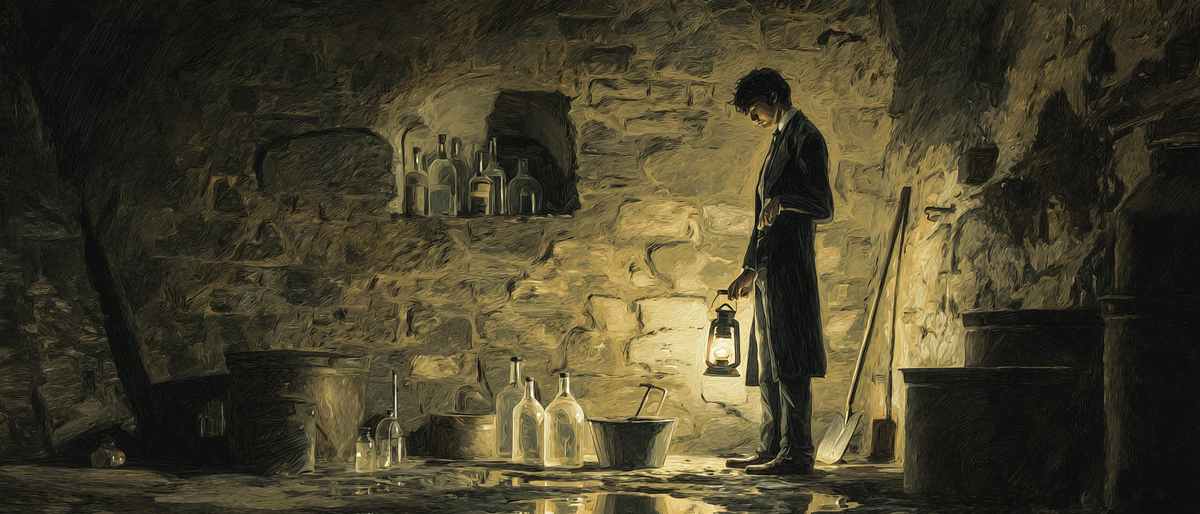
There is a moment near the end of H.P. Lovecraft's "The Shunned House" that deserves far more scrutiny than it has ever received. A man goes home after a night in which his beloved uncle has — by his account — dissolved into a subterranean demonic entity. He sleeps. He returns the following morning carrying carboys of sulfuric acid, a pump, a shovel, a pickaxe and a hose. He proceeds, methodically, to dissolve and remove whatever remains in the cellar. He frames this as the clinical dispatch of a cosmic remnant. And then the story ends, quietly, with the house standing empty and a very clean basement.
The question this essay wants to sit with — not answer, but genuinely inhabit — is this: what if we've been reading that scene wrong for a century?
Lovecraft opens "The Shunned House" with an explicit, almost florid tribute to Edgar Allan Poe. Most readers have taken this as aesthetic homage — a declaration of Gothic kinship, a tip of the hat to the master of the interior Gothic. But Poe's most celebrated narrators are not primarily architects of atmosphere. They are murderers. Specifically, they are men who kill beloved family members, construct elaborate supernatural explanations for what happened, and deliver those explanations to us with the glassy confidence of people who have almost convinced themselves. The Tell-Tale narrator. The Black Cat narrator. The narrator of Berenice, who finds himself in possession of extracted teeth with no memory of the act. Poe's narrators are always, at some level, a warning: this person telling you this story has done something terrible and cannot fully face it.
What if Lovecraft's dedication is not decoration but instruction?
Now — and this matters, especially for readers steeped in Lovecraft scholarship — the claim here is not that Lovecraft sat down with conscious, deliberate intent to write an "unreliable-narrator" story after the fashion of Mr.Poe, wearing the costume of cosmic horror. That would be an interesting argument, but it would also be an unfalsifiable one, and the textual evidence, while suggestive, does not compel it. What is far more compelling, and ultimately more interesting, is a subtler proposition: that Lovecraft's total absorption in Poe — analytical, aesthetic, almost devotional — may have nourished a stratagem that infiltrate "The Shunned House" at a level below conscious intention. That the influence seeped in through sheer immersive depth. And that the result, whether designed or discovered, is a text that sustains two readings simultaneously — the supernatural and the psychological — and, crucially, fails to resolve either.
Yet the psychological reading is not Poe. Poe always tips his hand eventually. The Tell-Tale narrator confesses. Roderick Usher screams. Even the Black Cat narrator is caught, in the end, by his own compulsive guilt. Poe's unreliable narrators are meant to be caught; the unmasking is the story. What you find in "The Shunned House," if you read it against the grain, is something stranger and more unsettling: a narrator who does not crack. Who finishes his work, writes his careful scholarly account, and closes the case. The ambiguity does not resolve. The epistemological wound stays open.
And here — here is where the argument becomes genuinely exciting for anyone who reads Lovecraft seriously — that irresolution is not a flaw or an accident. It is the most Lovecraftian thing in the story. Because this is precisely what Lovecraft does with the Cosmic. The universe, in his cosmicism, does not answer. The horror is never the revelation; it is the irresolvability. The inability to know, fully and finally, what is out there — or what happened — or whether the narrator can be trusted — is the abyss that swallows you. In his grandest work, that abyss operates at the scale of galaxies and geological aeons. In "The Shunned House," if this reading holds, he has applied the same principle to the most intimate horror imaginable: we cannot know, with certainty, what happened in that cellar. We cannot know what became of Elihu Whipple. We cannot know whether the man with the acid pump is a bereaved nephew dispatching a demon, or something else entirely.
The Cosmic indifference that Lovecraft usually trains on the inhuman sublime is here turned inward, toward a single old man and his nephew, in a Providence basement, in the small hours of a summer morning.
That is not Lovecraft imitating Poe. That is Lovecraft subsuming the clever genius of Poe into his own unique narrative approach — taking Poe's most human, most guilt-saturated device and submitting it to the same cosmic irresolution he applies to everything else. The result is a story that works perfectly as weird fiction, works compellingly as Gothic psychodrama, and works as both simultaneously without either reading canceling the other out. Whether Lovecraft knew he had done this — and there are good reasons, which we'll explore, to suspect he either didn't know or would have denied it with characteristic self-deprecation — the achievement stands.
The ebullient dedication to Poe may function as something more than homage — whether Lovecraft intended it that way or not, and the probability is that he did not. What matters is what the text performs in the reader's experience: an opening signal, however unconscious in its placement, that the narrative mode you are entering is one in which the telling cannot be fully trusted. The Poe-esque stratagem is present in "The Shunned House" not necessarily because it was planted, but because Lovecraft had read Poe so deeply, so analytically, so devotionally, that the architecture of guilty narration had become part of his own structural instincts. The influence left its fingerprints on the story whether or not the author intended to place them there.
And the ambiguity that results — the open epistemological wound at the story's close — is not something we need to attribute to conscious design in order to take seriously. It is simply there, in the text, available to any reader willing to look at that acid pump without the cosmicist framework already in place. The story does not resolve. The narrator does not crack. The cellar is clean. And remarkably, the sudden and inexplicable absence of Whipple does not merit a rational explanation. What we make of that is not a question about Lovecraft's intentions. It is a question that remains, finally, unresolved — and that, as we'll see, is the most distinctly Lovecraftian thing about it.
A Signal in the Tribute
Lovecraft does not ease you into "The Shunned House." Before the Providence setting is established, before Elihu Whipple is introduced, before a single flickering detail of the house itself is offered, Lovecraft spends his opening paragraphs in an act of sustained literary worship. He describes walking past the churchyard on Benefit Street where Poe once walked, meditating on Poe's presence in that landscape, and positions the story you are about to read as something inseparable from that inheritance. The tribute is not a footnote. It is a frame — and a conspicuously fervent one. For a writer who was capable of considerable critical precision about literary influence, Lovecraft here sounds almost like a devotee. Which raises a question we left deliberately open in the preface. What, precisely, is being inherited?
The easy answer — the answer most readers have always accepted — is atmosphere. New England Gothic. The ancestral house as psychological mirror. The weight of colonial history pressing up through the floorboards. These are genuine Gothic elements, and "The Shunned House" has all of them. But atmosphere is the least interesting thing Lovecraft could have taken from Poe, and in his critical writing — particularly in the Poe sections of his monumental essay, Supernatural Horror in Literature — he demonstrates that he knew it. His analytical praise for Poe is notably specific. He does not simply admire the fog and the dread. He admires the mechanism — the way Poe makes a narrator's psychological state the unstable medium through which all horror is filtered, so that the reader can never be entirely certain whether what is being described is externally real or internally generated. He admired, in other words, precisely the technique that makes Poe's greatest stories work: the unreliable narrator who does not know he is unreliable, producing a text that yields two readings simultaneously, neither displacing the other..
Lovecraft knew this device. He had mapped it analytically, praised it repeatedly, and understood exactly what it required structurally — a narrator whose testimony is the only evidence, a beloved figure who is conveniently unavailable to corroborate, a supernatural explanation that accounts for every detail while leaving just enough seam-work visible for a resistant reader to pull at.
"The Shunned House" has all of those things.
The narrator is the sole surviving witness to everything that matters. His uncle — his companion, his collaborator, the one person who shared the investigation from the beginning — does not survive the climactic night. The historical record underpinning the entire supernatural case has been assembled, interpreted, and presented exclusively by this narrator; we have no independent access to the documents he cites, the parish records he summarizes, the genealogical connections he draws. He is, in the most precise sense, the architect of his own alibi. And the supernatural entity he describes — the thing in the cellar that wears borrowed faces, that saps vitality across generations, that ultimately consumes Elihu Whipple before the narrator's horrified eyes — is, by design, something that leaves no verifiable evidence behind. It dissolves. It disperses. It conveniently takes its proof with it.
Whether or not Lovecraft consciously engineered this structure as an exercise in writing a story in the manner of his beloved Poe, it is the structure the story has. And the ebullient dedication at its opening, whatever its conscious intention, functions in the reading experience as a signal — perhaps the most important signal in the text — that the narrative mode you are entering is one in which the witness and the evidence are inseparable, and both are controlled by the same pair of hands, a pair of hands belonging to a man who never gives us his name, nor any other details by which he might be readily identified. He is to the reader merely a man from Providence, who grew up with an Uncle named Whipple.
The question the preface posed but left open was whether the dedication instructs us how to read. The question we now address is more nuanced. Even if Lovecraft didn't mean it that way, does the dedication still work as instruction? The answer, examined honestly against the text that follows, appears to be yes. The adopted stratagem is not hidden so much as it is overdressed — layered beneath three independent systems of misdirection, each one authentically Lovecraft, each one doing double duty as both genuine technique and accidental camouflage. Before those layers can be examined, however, we need to be precise about what the stratagem itself actually consists of — what Poe does, structurally, in the stories Lovecraft loved most, and why it matters that he always, in the end, lets us catch the narrator in the act.
Because Lovecraft's narrator, as we'll see, never lets himself be caught at all. And that difference — that single, crucial departure from the Poe model — is where the story stops being imitation and becomes something else entirely.
The Art of Getting Caught
There is a critical distinction that tends to get lost when writers invoke Poe as an influence, and it matters enormously here. Poe's reputation rests heavily on atmosphere — the tolling bells, the decaying mansions, the oppressive interiors that seem to breathe with their inhabitants' pathologies. But atmosphere is the surface. The engine underneath, in his most enduring stories, is something far more precise and far more unsettling: a narrator who has committed an act of violence against someone beloved, constructed an elaborate supernatural or psychological framework to explain what happened, and delivered that framework to the reader with the unwavering confidence of a man who has almost — but not quite — persuaded himself.
The mechanism is consistent enough across the key stories to be called a stratagem. In "The Tell-Tale Heart," the narrator dismembers an old man he loved, conceals the body under the floorboards, and then experiences the beating of the dead man's heart as an external, persecutory reality rather than as the guilt it plainly is. The supernatural element — the sound — is generated by the narrator's own psyche and projected outward. In "The Black Cat," a man murders his wife, walls her body in the cellar, and attributes the whole trajectory of his violence to supernatural feline agency — to a force outside himself that he could neither control nor resist. Domestic space in both stories — the floor, the wall, the cellar — becomes the site of concealment, and a non-human presence absorbs the moral weight of what the human has done. In "Berenice," the narrator performs a horrific act upon his cousin — extracting her teeth while she lies in a cataleptic state, possibly while she still lives — and discovers what he has done only afterward, through physical evidence, with no reliable memory of the act itself. He did not know he was capable of it. He still does not entirely know it. And in "The Fall of the House of Usher," Roderick Usher may have interred his sister alive — the story's supernatural architecture, the crumbling house, the tarn, the "Mad Trist" read aloud as events unfold in the vault below, functions precisely to displace that possibility, to give it a Gothic frame that almost but doesn't quite contain it.
What these stories share, structurally, is this: the narrator is the only witness; the beloved victim is unavailable to contradict; the supernatural explanation accounts for every detail while leaving just enough visible seam-work for a resistant reader to pull at; and the horror of what may have actually happened is more disturbing than the horror the narrator is officially reporting. The genius of Poe's method — and Lovecraft recognized it as genius, specifically and analytically, in Supernatural Horror in Literature — is that both readings are always simultaneously available. You can read "The Tell-Tale Heart" as a ghost story or as a psychology of guilt, and the text supports either. What it does not do is tell you which is correct.
Except that it does, eventually. And this is the critical point.
Poe's narrators crack. They are designed to crack. The Tell-Tale narrator cannot sustain the performance — he tears up the floorboards himself, screaming. The Black Cat narrator is caught by his own compulsion, tapping the wall that conceals his wife's body and producing, from inside it, the sound that undoes him. Even Roderick Usher screams his sister's name as the house splits apart. Poe's unreliable narrators are not meant to be permanent mysteries. They are meant to be caught in the act of unraveling, because the unraveling is the story — the moment at which the supernatural framework collapses inward and the psychological truth rushes in to fill the space. The reader is positioned, always, to be one step ahead of the narrator, waiting for the crack to appear. The tension is not "what happened" but "when will he admit it."
This is Poe's stratagem in full. It is sophisticated, beautifully calibrated, and Lovecraft understood it from the inside out — not merely as a reader but as a critic who had mapped its architecture with genuine analytical precision. He praised it, specifically, for making the narrator's psychology the unstable medium through which horror operates, for refusing to let the reader fully separate the subjective from the objective. He understood that the power of Poe's greatest stories comes not from what they describe but from what they cannot quite contain.
And then he wrote "The Shunned House," with its ebullient dedication to the master of the form, and his narrator did not crack. Did not scream. Did not tap the wall. He finished his work in the cellar, wrote his careful scholarly account of what had happened there, and closed the case. The seams are visible — we will examine them at length — but the narrator never pulls at them. He is not designed, as Poe's narrators are, to eventually betray himself. The text sustains its ambiguity not as a temporary state preceding revelation but as a permanent condition. There is no moment at which the story tips its hand.
Whether this is because Lovecraft deliberately withheld the kind of resolution he observed in the fiction of his mentor, or because the cosmicist sensibility that structured his entire imagination simply could not permit the universe — or the narrator — to provide a clean answer, is itself an open question. But the effect is clear and its significance is considerable. In Poe, the horror resolves: the guilty man unravels, and we know. In "The Shunned House," the horror does not resolve, it mutates... from a cursed house that kills to the tragic, horrific, and unexplained demise of the beloved — and that plot-twist, as we will argue, is not a repudiation of Poe's method. It is a radical and uniquely Lovecraftian transformation.
Poe always lets you catch the narrator. Lovecraft's narrator gets away. Whether that makes the story more or less frightening is something each reader will settle for themselves. What ensues is something Poe never attempted: a story in which the question of what happened in the cellar, and why, remains genuinely, permanently, cosmically open.
Which is, of course, exactly how Lovecraft believed the universe worked.
The Art of Getting Away With It
Let us descend into the cellar.
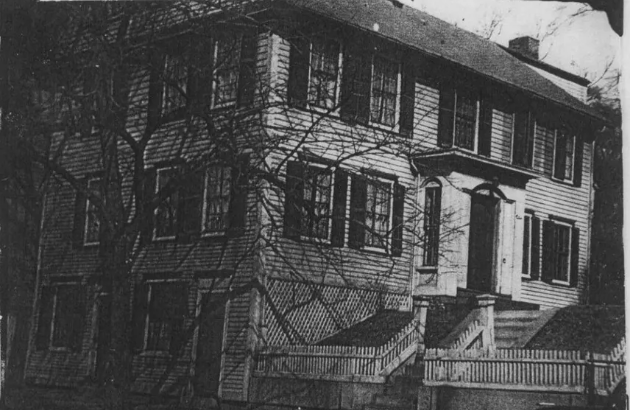
Not metaphorically — not yet. The actual cellar of the Shunned House on Benefit Street, Providence, Rhode Island, as Lovecraft describes it: low-ceilinged, earthen-floored, smelling of something that resists identification, its walls sweating a phosphorescence that the narrator carefully attributes to fungal growth before carefully declining to be certain. It is here that the story's climax occurs, and it is here that the textual case for the alternative reading is strongest — which is appropriate, because it is also here that the narrator's account most requires our trust, and most strains it.
Before we reach that night, however, the case requires building from its foundations. And those foundations are laid not in the cellar but in the narrative architecture above it — in the way the story is constructed, who controls what we know, and where the weight of explanation falls with perhaps too much consistency and too little resistance.
Blame the House
The narrator's attribution of the story's evil is, from the opening pages, architectural. The house is the malevolent agent. The house has "something wrong" with it in a way he acknowledges even the most skeptical observer tends to feel. The house killed its inhabitants across generations. The house exerts influence. The house persists as a locus of dread in Providence folklore, in ecclesiastical records, in the memories of neighbors who couldn't say precisely why they crossed the street to avoid it.
This is, on its surface, perfectly conventional weird fiction. But read carefully — and the Poe tribute asks us to read carefully — and a pattern emerges that is less conventional than it first appears. The narrator does not merely describe the house as evil. He insists upon it, returns to it, rebuilds the case for it with an almost compulsive repetition that exceeds what the narrative strictly requires. Every ambiguity is resolved in the house's favor. Every death, every stillbirth, every episode of wasting illness or mental unraveling is folded into the architectural explanation with a tidiness that begins, eventually, to feel less like thorough scholarship and more like the tidiness of someone who needs the explanation to hold.
A house is the perfect defendant. It cannot be cross-examined. It cannot contradict. It cannot produce an alibi or demand one. In "The Fall of the House of Usher" — and Lovecraft knew this story as well as he knew his own address — Roderick Usher performs exactly this displacement, projecting his own psychological disintegration onto the structure around him, blaming the atmosphere, the tarn, the arrangement of stones, for what is happening to him and to his sister. Poe signals that displacement — we are meant to see through it, or at least to suspect it. Lovecraft, characteristically, does not signal. He lets the attribution stand, unquestioned, and moves on. Which means the reader who doesn't resist it will simply follow, and the reader who does resist it is left holding a question the text does not answer.
The Archivist and His Alibi
In the narrator's exclusive account of the historical record we are given only uncorroborated testimony. The entire case for the house's supernatural malevolence — the Roulet genealogy, the ecclesiastical complaints, the pattern of deaths across generations, the connection to the French werewolf trials — rests entirely on his own recollection of research conducted in partnership with his uncle. The documents themselves are never independently accessible to the reader. We know what he says they say.
This would matter less if the uncle had survived to corroborate. But Elihu Whipple does not survive. He is the sole other witness to the investigation and to the climactic night, and he is gone before the story closes — dissolved, according to the narrator, into the entity in the cellar. What remains is one man's account of what two men found, interpreted through one man's framework, delivered without the possibility of correction.
In a court of law this would be called uncorroborated testimony from the only surviving witness, who also happens to be the sole beneficiary of the investigation's conclusion. In Gothic fiction it is called atmosphere. The distinction is worth sitting with.
And consider what that historical record actually does, structurally: it constructs an elaborate pre-existing supernatural explanation that naturalizes the uncle's disappearance before the disappearance occurs. By the time Elihu Whipple dissolves into the cellar floor, the reader has been so thoroughly prepared for a supernatural consumption that the alternative — that something far more human occurred in that cellar — requires a deliberate act of readerly resistance that the text's momentum works against. The research, in other words, doesn't just explain the house. It pre-exonerates the narrator. The alibi is built before the crime.
"Stillbirths and Sickness": The Euphemism in the Record
The historical deaths associated with the house follow a pattern that the narrator presents as evidence of supernatural predation. Infants. Young women. Men declining into listlessness and early death. The occasional dramatic mental collapse. Spread across generations, mapped carefully onto the tenancy records, attributed to the malevolent influence emanating from whatever lies beneath the cellar floor.
But strip away the supernatural framework and read those deaths against the historical record of what domestic violence, infanticide, and slow poisoning actually looked like in eighteenth and nineteenth century New England, and the pattern does not change. It merely acquires a different explanation — one that is, in a grimly practical sense, far simpler. "Stillbirth" was the standard official notation for infant deaths that were not investigated. "Decline" and "wasting illness" were the typical descriptions of arsenic poisoning before forensic toxicology existed to identify it. The clustering of deaths around the vulnerable — infants, young women, the elderly — is precisely the clustering you would expect from deliberate domestic predation, not because it's supernatural but because the vulnerable are always the most accessible victims and the least likely to have their deaths scrutinized. And the generational nature of domestic violence was neither unfamiliar nor undocumented in Lovecraft's era.
The "vampire" Lovecraft invokes here is telling in this context. He is careful to distinguish his creature from the blood-draining mechanics of popular Gothic convention. This vampire operates through influence — through psychic contagion, through the sapping of vitality, through a malevolence that expresses itself as illness, depression, and mental deterioration rather than as theatrical nocturnal assault. This is precisely how a poisoner would appear in the historical record of a community that lacked the tools to identify poisoning. The symptoms are identical. The vampire and the poisoner leave the same documentary trace.
Lovecraft presumably knew this. He was a meticulous historical researcher and a devoted reader of exactly the kind of New England colonial and post-colonial history that would have furnished him with the actual record of what domestic deaths looked like and how they were officially classified. The "vampire" explanation in the story is presented as the community's own retrospective interpretation of a pattern they couldn't otherwise account for. That it maps so cleanly onto the alternative explanation is either coincidence or craft — and given everything else we are finding in this text, coincidence seems increasingly unlikely.
The Scapegoated Foreigner
The narrator's identification of Étienne Roulet as the originating evil deserves particular scrutiny, because it is the most historically convenient element in an already very convenient historical account. Roulet is a Huguenot refugee — already a religious other, already marked by displacement and difference. He is connected, tentatively and by the narrator's own admission speculatively, to the Roulet family implicated in French werewolf trials. He is dead. He cannot speak. His remains were disturbed when the graveyard was moved, which provides a tidy folkloric mechanism for the unleashing of whatever is in the cellar.
He is, in other words, a perfect scapegoat. Foreign. Heretical by implication. Dead before anyone currently living can remember him as a person rather than a symbol. The narrator even acknowledges that the connection between the New England Roulets and the French Roulet of the werewolf trials is suggestive rather than proven — and then proceeds to treat it as foundational to his entire supernatural architecture. In a legal context this would be called building a case on circumstantial evidence while characterizing it as established fact. In Gothic fiction it is called backstory.
The scapegoated foreigner is, incidentally, one of Poe's instruments too — in "The Murders in the Rue Morgue" the initial suspects are all foreign, and the eventual solution involves a non-human perpetrator, which is the ultimate displacement of guilt from the human to the uncanny other. Lovecraft was a devoted reader of Poe's detective fiction as well as his psychological tales. The structural parallel is certainly not accidental.
The Noxious Effluvium and the Question of Who Remained Lucid
We arrive now at the night itself — and at what is perhaps the most quietly devastating detail in the entire story.
The narrator describes the cellar atmosphere in terms that he himself acknowledges are potentially hallucinogenic. There is an effluvium. There is phosphorescence. There are vapors rising from the earthen floor that have no clean chemical explanation within the story's own scientific framework. He notes their effect on perception. He notes that they seem to intensify as the night progresses.
He also notes, without apparent irony, that his uncle was affected by these vapors and he was not.
This is stated rather than argued. It is presented as simply true — the uncle's perceptions became unreliable, the narrator's remained sound. But on what basis? They were breathing the same air. They were in the same enclosed space for the same duration. The narrator offers no physiological explanation for his own immunity to what he acknowledges affected his companion. He simply assumes it, in the way that narrators who need their testimony to be credible always assume the thing that makes it credible.
Joe Slater is relevant here — unexpectedly but precisely. In "Beyond the Wall of Sleep," Lovecraft gives us a consciousness using a damaged, limited human instrument to express something it cannot otherwise communicate — the host experiencing one reality while something else entirely moves through him. The institution's narrator observes from outside, certain of his own lucidity, interpreting the subject's altered states as symptoms. The possibility that the observer's framework is itself inadequate to what he's observing is the story's silent undertow. In the Shunned House cellar, the narrator occupies the observer's position with the same unexamined confidence — and the uncle, in his dissolution, occupies Slater's.
The difference is that in "Beyond the Wall of Sleep" we are given enough external confirmation to trust the narrator's framework, however partially. In the Shunned House cellar we are given nothing external at all. We have one man's account of what happened to another man in a room full of unidentified vapors, with no corroborating witness, and that account concludes with the other man's complete disappearance. The narrator's lucidity is the story's foundational assumption. It is also the assumption most worth questioning.
The Face in the Entity
As the climax unfolds, the narrator describes the underground entity assuming recognizable human faces — the absorbed remnants, he explains, of its previous victims, consumed across generations. And then, at the crisis point, it assumes his uncle's face.
The supernatural reading is clear and internally consistent with everything the story has prepared us to accept: the entity has just consumed Elihu Whipple and is now wearing him, the way it has worn others before him. Within the cosmicist framework the story has built with such care and such historical scaffolding, this is horrifying but explicable. The monster takes. The monster absorbs. The monster wears what it has taken.
The psychological reading is considerably more intimate — and considerably more precise than a simple observation that grief projects the lost face onto whatever the bereaved mind is looking at, though grief does do exactly that. What the alternative reading proposes is something more specific and more disturbing: that the mind under sufficient strain can reframe an act of agency as an act of witness. It can place the perpetrator in the audience of his own horror, so that what is being done becomes, in the psyche's emergency reframing of itself, something being watched rather than something being caused. The narrator does not merely see his uncle's face because he loved him and has lost him. He sees his uncle's face because his psyche, at the moment of maximum strain, requires a monster to be responsible. The dissolution must belong to the entity. The uncle must be something happening to the narrator rather than something the narrator is happening to.
In "Ligeia," in "Morella," Poe gave us beloved faces replacing other faces — the dead woman's features appearing in the living woman's — as expressions of obsession so total it rewrites perception. The face in the entity is Lovecraft working in that same tradition of the projected beloved, whether or not he knew it. But where Poe's projected faces are expressions of desire and loss, the face in the cellar entity is something darker — it is the psyche's emergency exit, the moment at which the narrator's mind completes the transfer, assigns the dissolution to the monster, and evacuates itself from the unbearable alternative.
What follows is the narration of a man who has apparently just watched his dear and lifelong mentor and companion die horribly, and who reports it with the tonal flatness of a chronicler describing a scene he observed but did not inhabit. He is horrified — he tells us so — but his horror drives him outward, toward the door, toward the street, toward the reassuring ordinariness of a Providence morning and the comfort of passersby who know nothing of what has just occurred in the cellar behind him. What it does not drive him toward, not for a single recorded moment, is his uncle. There is no desperate lunge toward Whipple. No attempt to reach him, to pull him back, to do anything that a man watching someone he loves being destroyed might be expected to do. The horror is real and the flight is immediate — but the flight is away from Elihu Whipple rather than toward him. For a man witnessing the destruction of his dearest companion, the complete absence of any impulse toward rescue — any reaching, any resistance, any engagement with the uncle as a person still potentially present and whose life holds meaning — is not the paralysis of shock. It is something else entirely.
"Affectless" is the clinical term for this quality of narration, particularly after the narrator departs the premises — the presentation of events of extreme emotional weight with a flatness of tone entirely disproportionate to their significance. It is recognized as a feature of dissociative states, of certain trauma responses, and of something darker that the essay declines to name too precisely. The affectless narrator is either a man whose psyche has sealed off emotional access as a protective response to something unbearable — or a man who did not experience the event the way he is describing it. Lovecraft does not adjudicate between these possibilities. Instead we are given the flat, careful, almost clinical exposition of a man who has just lost everything he loved most in the world, and who responds by making a phone call.
What makes the face in the entity devastating in the context of the alternative reading is not merely its content but its placement — it occurs at exactly the moment when, if the narrator has done something terrible, his psyche would be most desperately in need of the transfer the vision provides. The face appears as the act is completed, or is being completed. It is the mind's emergency narrative arriving precisely on schedule — the monster taking the uncle, the witness absolved, the perpetrator safely relocated to the audience.
Or the entity taking Elihu Whipple, exactly as the narrator reports.
Lovecraft leaves us with only the supernatural version of events, declining entirely to address the obvious logical incongruities, despite the narrator's extensive efforts to frame the history of the place in quasi-rational terms. And in that declension — in that permanent, cosmically indifferent silence on the one question that could resolve everything for the armchair detective pondering a loose thread of cosmic proportions — is the horror that neither the supernatural reading nor the psychological reading can fully contain, because it belongs, finally, to both of them simultaneously.
The face in the entity is Elihu Whipple's.
Whether it is a vision or a confession is, it would seem, beyond the capacity of the narrator to either comprehend or reveal.
The Toolkit
Now the story takes a turn that departs from any cosmicist narrative we might expect.
The narrator goes home. He sleeps — which is itself worth noting, the sleep of a man who has either witnessed a cosmic horror or committed an act of violence, sleeping with equal soundness either way. He returns in the morning. He brings carboys of sulfuric acid, a pump, a shovel, a pickaxe and a hose. Multiple "carboys"... Many, many liters of highly corrosive chemicals, requiring special order and professional delivery!
He uses them to dissolve and remove what remains in the cellar.
This particular arrangement of equipment has but one likely application in the material world, and it is not the dispatch of supernatural entities. Sulfuric acid in sufficient quantity, delivered through a pump and hose into an enclosed stone space, excavated with hand tools, will destroy organic remains. Completely. It will leave nothing recoverable, nothing identifiable, nothing that could be examined by anyone arriving afterward and asking questions. The narrator frames its use as the clinical completion of his supernatural investigation — the removal of the demonic residue. But the language he uses to describe what he does with it — dissolves, removes, clears — is the language of cleanup, not exorcism. It is methodical, practical, and thorough in a way that sits uneasily beside the supernatural narrative the narrator has constructed.
No other Lovecraft story demands this level of practical logistics to defeat its cosmic antagonist. The investigators of Dunwich don't arrive with industrial cleaning equipment. The narrator of "At the Mountains of Madness" doesn't return with acid. The specificity here — the carboys, the pump, the hose, the deliberate return after sleeping, the methodical completion of the task — stands out against the broader Lovecraft canon as something that needs explaining, or at least noticing.
Charles Dexter Ward is worth invoking here, briefly and precisely. Willett descends into Curwen's underground spaces and finds evidence of what has been done there — the pits, the saltes, the remnants of things that should not have been reconstituted. The investigation of those spaces requires a certain forensic courage, the willingness to understand what the evidence means even when what it means is unbearable. Lovecraft understood, as a narrative craftsman, what an underground space full of the evidence of terrible acts looks like, and what a methodical person does when they find one. In Ward, the methodical person investigates. In The Shunned House, the methodical person cleans up.
The difference between those two responses is the difference the essay has been building toward. And it is a difference the text leaves, finally and permanently, without resolution — which is, as we have been arguing throughout, not a failure of craft but its most audacious expression.
The cellar is clean. The narrator's account is complete. The case is closed.
Whether it should be is the question our protagonist refuses to answer, and will go on refusing, and in that refusal — in that sustained, cosmically indifferent silence — is the horror that no acid pump can touch.
The Architecture of Concealment
Assume, for the moment, that the reading we have suggested is correct. Assume the historical record is the narrator's construction, the uncle's dissolution is suspiciously convenient, the vapors excuse is self-serving, the face in the entity is guilt's projection, and the acid pump is precisely what it looks like. Assume the Poe-esque narrative stratagem is present in the text, operating exactly as it operates in Poe's own most celebrated stories.
The question then becomes: why has almost nobody noticed?
Poe's unreliable narrators are among the most written-about figures in American literary criticism. The techniques are well mapped, the signals well documented, the scholarship vast. A reader who has spent any serious time with Poe arrives at "The Tell-Tale Heart" already equipped to catch the narrator — the machinery is famous enough that the story works even when you know exactly how it works. And Lovecraft, who dedicated his story to Poe with conspicuous fervor, was writing for readers who knew Poe. The Weird Tales readership was not naive. The dedication was a signal sent to people capable of receiving it.
And yet the alternative reading of "The Shunned House" has generated almost none of the critical attention that Poe's equivalent stories attract as a matter of routine. The story is discussed, when it is discussed, as cosmic horror — as a successful if minor entry in the cosmicist canon, interesting for its Providence setting and its underground entity, not particularly remarkable for its narrative architecture. Nevertheless Lovecraft employs a recursive strategem - actually invoking Poe's narrative mode. The surface story appears to justify his dedication through atmosphere alone, while the subtext retroactively reveals that the dedication was never pointing at the surface story at all — but at the narrative operating silently beneath it. Each layer requires the others to exist. Remove any one and the structure collapses.
This requires explanation. And the explanation, examined carefully, turns out to be the essay's most purely Lovecraftian discovery: the stratagem is invisible because it is buried under three independent layers of misdirection, each one so authentically Lovecraftian in its own right that it functions simultaneously as genuine technique and as accidental — or perhaps not entirely accidental — camouflage. Together they constitute a system of concealment so effective that it has worked for a hundred years.
Layer One: The Purloined Tribute
The dedication to Poe is so conspicuous that it paradoxically deflects. This is the purloined letter principle in its purest form — Poe's own insight, from his own ratiocinative tale, that the best hiding place for something is in plain sight, where the very conspicuousness of its presence causes the trained investigator's eye to slide past it. A letter hidden on a mantelpiece is invisible to a search that expects concealment.
The dedication is on the mantelpiece. Every reader sees it. And every reader, seeing it, performs the same automatic interpretive move: this is homage. Lovecraft is acknowledging his debt to the master of American Gothic atmosphere, to the author of one of the 19th century's most celebrated ancestral house stories, to the writer who first made Providence and its environs a spiritual landscape of American dread. The dedication licenses a set of atmospheric expectations — the oppressive house, the weight of history, the sensitive investigator — and those expectations are immediately and thoroughly satisfied by what follows. The reader who arrives looking for Poe's atmosphere finds it in abundance and stops looking.
What they are not looking for, because the tribute seems to answer the question of what kind of Poe this is, is Poe's narrative mechanism. The dedication points to the Gothic furniture and away from the Gothic engine. It is, if you choose to read it that way, an act of misdirection so elegant it borders on the diabolical — hiding the most Poe-esque thing about the story behind the acknowledgment of Poe's influence, in precisely the place where a reader would think to look and find only what they expected.
Whether Lovecraft meant it this way is, as we have established, not the operative question. The dedication functions as misdirection regardless of intention. The purloined letter doesn't need to know it's hidden.
Layer Two: The Scientific Alibi
Poe's narrators have no cover. They stand exposed in their drawing rooms and their cellars and their ancestral chambers, with nothing between their testimony and the reader's skepticism except the forward momentum of the prose. When the Tell-Tale narrator insists he is not mad, there is nowhere to hide the insistence — it sits on the page, naked and self-defeating.
Lovecraft's narrator has the entire apparatus of early twentieth century scientific rationalism standing between his testimony and scrutiny. The entity in the cellar is not merely described as supernatural — it is theorized. The narrator brings to bear the language of contemporary physics, of spatial dimensions beyond the perceivable three, of what might today be called quantum indeterminacy — the suggestion that the thing beneath the house exists in a relationship to conventional spacetime that renders ordinary empirical verification structurally impossible. You cannot examine it by normal means because normal means are precisely what it exceeds.
This is, in isolation, standard Lovecraftian procedure — the scientific veneer that distinguishes his cosmic horror from mere Gothic supernaturalism and gives it its particular flavor of modern dread. But in the context of the alternative reading it does something additional and considerably more useful to the narrator: it preemptively explains why no evidence of a supernatural entity will be recoverable. The thing that consumed Elihu Whipple left no trace because things of its nature leave no trace — not because there was no thing, and not because something else entirely happened in that cellar. The scientific framework forecloses forensic investigation not by addressing it but by superseding it.
A poisoner who commits a perfect crime and then explains that the victim was consumed by an entity operating outside conventional spacetime has, if believed, committed the most perfect crime imaginable. The scientific alibi doesn't just explain the supernatural event — it explains away the absence of evidence for the supernatural event, which is precisely the absence that would otherwise require explaining.
Poe's narrators have no such resource. Lovecraft's narrator has one that was built into the story's entire cosmicist architecture before the crime — if there is a crime — was even committed. The alibi predates the act.
Layer Three: The Expected Architecture of Dread
By 1924, when Lovecraft wrote "The Shunned House," he had established with sufficient consistency a set of narrative conventions that a reader familiar with his work would recognize and settle into with something approaching comfort — the comfort of knowing what kind of story you're in. The scholarly investigator. The Providence or New England setting rich with colonial history. The thing beneath the surface — literal or metaphorical — that predates human habitation. The slow accumulation of historical evidence pointing toward a supernatural conclusion. The climax in an enclosed underground space. The survivor's account, delivered with methodical precision, of what was found and what was done about it.
"The Shunned House" hits every one of these. It is, in the register of Lovecraft's own canon, almost reassuringly conventional — which is to say it is the kind of story that reads, to a Lovecraft reader, exactly like a Lovecraft story. The genre expectations are so thoroughly satisfied that the alternative reading requires the reader to climb out of the story's current and swim against it, which almost no reader does on a first encounter with a text that is actively working to carry them forward.
Poe's unreliable-narrator stories don't have this problem because they are, structurally, the whole story. There is no larger Poe-narrator-canon creating a framework of expectation that naturalizes the narrator's account before it begins. Each story stands alone, and the unreliability must be detected within the story's own boundaries. Lovecraft's narrator, by contrast, is embedded in a fully realized cosmicist world populated by dozens of other narrators who have reported similar things and been broadly believed — by the story's own logic, by the reader's accumulated experience of the canon, and by the implicit contract of the weird fiction genre itself. The reader brings to "The Shunned House" a prior established willingness to believe Lovecraft's narrators, because that willingness has been earned across years of reading. It is the deepest and most structural form of camouflage available to any genre writer — the trust accumulated by an entire body of work, deployed in the service of a single story's most ambiguous moment.
When the uncle dissolves, the Lovecraft reader believes it. Not because the text compels belief — it doesn't, if you look closely — but because fifteen other Lovecraft narrators have reported equivalent events and the reader has learned to credit them. The alternative reading doesn't just require resisting this story's narrator. It requires, momentarily, resisting the entire Lovecraft canon.
Which brings us to the conclusion that the essay has been building toward since the preface, and that can now be stated with the full weight of three layers of evidence behind it.
Poe conceals his stratagem badly. His narrators are designed to crack, to betray themselves, to hand the reader the key to their own undoing. The concealment is temporary and partial because the revelation is the point.
Lovecraft's stratagem — if it is a stratagem, if the word even applies to something that may have infiltrated the story below the level of conscious craft — is concealed under the Poe tribute that points the wrong direction, under the scientific framework that pre-forecloses investigation, and under the accumulated weight of an entire cosmicist canon that has trained the reader to trust exactly this kind of narrator reporting exactly this kind of event. It is not badly concealed. It is, by any measure, almost perfectly concealed — concealed so effectively that the concealment has held for a century, against readers who knew Poe, who knew Lovecraft, and who had every theoretical tool required to detect it.
And the detection, when it finally arrives, does not resolve the story. Does not crack the narrator. Does not produce the confession that Poe's stories eventually produce. The cellar is clean. The account is complete. The question the story never asks hangs in the air above a very tidy Providence basement, unanswered, unanswerable, and permanent.
That is not Poe.
That is something that has absorbed Poe so completely it has transformed him — subjected his most human, most guilt-saturated device to the same cosmic irresolution that Lovecraft applied to everything he touched. The horror, in Poe, is finally nameable: this man killed someone he loved. The horror in "The Shunned House," if the reading holds, is that we cannot name it. Cannot confirm it. Cannot dismiss it. Cannot know.
Which is, of course, precisely where Lovecraft always wanted us.
What Lovecraft Knew, and What He Said About It
There is a particular pleasure in reading a writer's critical prose alongside their fiction — the pleasure of watching someone map, with analytical precision, the very territory they are simultaneously inhabiting as a practitioner. Lovecraft's "Supernatural Horror in Literature" offers this pleasure in abundance, and nowhere more productively than in its pages on Poe, where Lovecraft demonstrates not merely that he loved Poe but that he had read him with the close, almost forensic attention of someone trying to understand exactly how the machinery worked. His praise is specific where a lesser critic's would be general. He does not simply admire Poe's atmosphere, though he admires that too. He identifies, with genuine analytical precision, the technique by which Poe makes a narrator's psychological state the unstable medium through which horror operates — the way the subjective and the objective blur until the reader cannot cleanly separate what is happening from what the narrator's mind is doing to what is happening. He understood, in other words, that Poe's horror is epistemological before it is atmospheric. It is a horror of knowing — of the terrible uncertainty about whether what is being reported can be trusted.
This is not a casual reading. It is the reading of someone who has spent serious time inside these stories, not as a tourist but as a student of craft. And it matters for our argument because it establishes beyond reasonable dispute that Lovecraft possessed, by the time he wrote "The Shunned House" in 1924, a complete and sophisticated understanding of the narrartive stratagem that Poe typically employed — its structure, its mechanisms, and its effect on the reader. He was not imitating Poe from the outside, reproducing Gothic furniture without understanding the Gothic engine. He knew exactly how the engine worked.
His admiration for Arthur Machen illuminates a complementary and equally relevant aspect of his aesthetic values. Lovecraft returned to Machen repeatedly in his letters and in "Supernatural Horror in Literature," and his specific praise is consistently for Machen's ability to sustain genuine ambiguity — to leave the reader in a state of productive uncertainty about whether supernatural events have actually occurred or whether perception has failed, corrupted, been overwhelmed by something the rational mind cannot accommodate. This, Lovecraft argued, was not vagueness or imprecision but a deliberate and sophisticated artistic choice — the recognition that the most powerful weird fiction operates in the space between explanation and inexplicability, and that resolving the ambiguity too cleanly in either direction diminishes rather than intensifies the horror. He did not merely tolerate this kind of irresolution in fiction he admired. He identified it as a mark of the highest craft.
Which means that the sustained irresolution of "The Shunned House" — the author's refusal to close the epistemological question that the alternative reading opens — is not accidental by any available measure. Whether or not the stratagem was consciously planted, the irresolution that results from it aligns precisely with an aesthetic principle Lovecraft had articulated explicitly, praised in others, and clearly internalized as a standard of excellence. He knew what good ambiguity looked like. He knew what it was supposed to do to a reader. And "The Shunned House," whatever else it is, does exactly that.
And then there is the question of what he said — and conspicuously did not say — about the story itself.
"The Shunned House" was written in 1924. It was submitted to Weird Tales, which rejected it. W. Paul Cook, a friend and amateur press associate, subsequently set the type and printed the sheets for a standalone edition — but they were never bound, never distributed, and never formally published in Lovecraft's lifetime. He died in 1937, thirteen years after writing it, without the story having reached a general readership. The Arkham House edition that finally made it widely available appeared posthumously.
This publishing history is worth sitting with, because it means Lovecraft never publicly accounted for the story in the way that publication might have required. He never wrote an introduction to it. He never responded to reader letters about it. He never had occasion to address, in correspondence, what a contemporary critical response might have noticed or questioned about its narrative architecture. The story simply existed — finished, set in type, unbound — while its author went on to other work and other letters and other self-assessments.
What he did say in those letters about his own work follows a pattern that Lovecraft scholars have long recognized and that is directly relevant here. He was a compulsive self-assessor and a frequently unreliable one — not dishonest exactly, but prone to a strategic self-deprecation that occasionally shades into something more like deliberate misdirection. Works that represented formal ambition or emotional exposure tended to receive the most dismissive treatment in his correspondence. "The Dream-Quest of Unknown Kadaath," his most sustained and structurally ambitious work, he called overlong, juvenescent, a mere exercise — characterizations so disproportionate to the work's actual achievement that they read less like honest assessment and more like pre-emptive defense against scrutiny. He had done something ambitious and exposed, and he covered it afterward with a performance of indifference.
The Shunned House required no such covering because it never became public enough to require defense. But the absence of commentary is itself significant. In a correspondence as voluminous and self-referential as Lovecraft's — he wrote thousands of letters across his lifetime and addressed his own work in them with remarkable frequency and detail — the near-silence around "The Shunned House" stands out. He acknowledged its existence. He noted the Cook printing. He did not, in any letter currently part of the scholarly record, (so far as we are able to determine thus far in our research), discuss what the story was attempting or what he thought it had achieved.
This is consistent with two possibilities. The first is that he considered it a minor work, a competent piece in a familiar mode, not worth extended discussion. The second is that he knew — at whatever level of consciousness — that extended discussion would require him to account for what the story was doing beneath its cosmicist surface, and that accounting was not something he wished to perform. The Dream-Quest parallel suggests the second possibility is not without precedent. Lovecraft was capable of recognizing when he had done something that exceeded what he wished to explain — and of responding to that recognition with the particular silence of a man who has decided some doors are better left unopened. The Shunned House may have struck him as exactly such a door: an ambitious departure from his established cosmicist mode, sufficiently anomalous to require a defense he had no appetite to mount, and sufficiently exposed to invite a scrutiny he had even less appetite to invite. Setting it aside was easier than accounting for it. The unbound sheets were their own kind of answer.
We cannot know which explanation is correct. We can note that the silence exists, that it is consistent with a documented pattern of strategic self-deprecation around formally ambitious work, and that it extends across thirteen years of continued correspondence without being broken. The story sat in its unbound sheets, the letters went on by the thousands, and "The Shunned House" was not among the subjects they found occasion to illuminate.
Which is, if you are inclined toward a certain kind of thinking about these things, precisely what you would expect of a writer who had either deliberately or instinctively done something he recognized as too interesting to explain away, and too exposed to defend. The acid pump cleans the cellar. The silence covers the essay. In Lovecraft's critical and epistolary record, as in the story itself, the most revealing thing may be what is methodically, permanently, and almost perfectly not there.
What It Means
Let us take stock of what the essay has accumulated.
We have a story dedicated, with conspicuous and analytical fervor, to the writer whose greatest achievement was the unreliable narrator — the man who kills someone beloved and builds a supernatural architecture to live inside afterward. We have a narrator who controls every piece of evidence, whose sole witness dissolves without trace, whose historical record is simultaneously the alibi and the case, and who returns the morning after the climactic night with equipment whose primary practical application is the destruction of organic remains. We have a vampire that operates through influence and wasting illness — indistinguishable in its effects from a poisoner — and a pattern of historical deaths that maps cleanly onto domestic predation. We have vapors the narrator acknowledges as potentially hallucinogenic, a face in the entity that grief or guilt would generate as readily as supernatural possession, and a scientific framework that pre-forecloses forensic investigation by superseding it entirely. We have a writer who understood the Gothic stratagem employed by Poe, analytically and precisely, who praised sustained ambiguity as the highest achievement of weird fiction, and who maintained across thirteen years of voluminous correspondence an almost perfect silence about a story he had written, set in type, and left unbound in a friend's workshop until he died.
None of this proves the alternative reading. The essay's argument was never that the narrator of "The Shunned House" is definitively, demonstrably, a murderer who dissolved his uncle with acid and filed a supernatural report to cover it. The argument is both narrower and, in its implications, considerably broader than that: the text sustains that reading. Sustains it seriously, sustains it across multiple independent layers of evidence, sustains it in ways that align precisely with the literary tradition the story explicitly invokes and with the aesthetic principles its author explicitly championed. The alternative reading is not a stretch imposed on an unwilling text. It is a reading the text generates, for a reader equipped to receive it, as naturally and as disturbingly as the cosmicist reading it has always been given.
And the two readings do not cancel each other. This is the point that matters most, and the one that most clearly distinguishes what Lovecraft has done — consciously or through the deep infiltration of influence — from what Poe does in the stories this essay has been holding alongside it. In Poe, the supernatural reading and the psychological reading are in competition. The Tell-Tale narrator is either haunted or guilty, and the story's movement is toward the resolution of that competition, the collapse of the supernatural frame and the emergence of the psychological truth underneath. In "The Shunned House," the two readings coexist without resolution, each one fully available, neither one consuming the other. You can read it as cosmic horror and be entirely satisfied. You can read it as Gothic psychodrama and find the evidence revealed. You can hold both readings simultaneously and discover that they reinforce rather than undermine each other — that the cosmic framework is more disturbing for the human possibility it contains, and the human possibility more disturbing for the cosmic indifference that surrounds it.
This is what Lovecraft's cosmicism, applied not to the inhuman sublime but to the most intimate possible horror, actually produces. The universe's refusal to answer — its monumental, structural, irresolvable silence on the question of what happened and why and whether it matters — is usually experienced in Lovecraft at the scale of Cthulhu or Azathoth, at the scale of geological time and interstellar indifference. In "The Shunned House," that same refusal operates in a Providence cellar, between two men who loved each other, in the small hours of a summer night. The cosmic indifference is not out there in the spaces between stars. It is in the narrator's account — methodical, precise, complete, and utterly, permanently silent on the one question that would afford comfortable closure.
That silence is the story's greatest achievement, and it is an achievement that Poe's moral imagination could not permit. Poe believed in guilt. He believed in confession. He believed, at some structural level, in the Gothic conviction that what is concealed will out — that the repressed will return, the wall will speak, the heart will beat. His narrators crack because Poe, for all his darkness, operated within a universe that had at least this much moral architecture: that the truth eventually surfaces, even if it destroys the person it surfaces through.
Lovecraft's universe has no such architecture. In his cosmicism, the truth does not surface because the universe has no investment in truth's emergence. Events occur. Minds encounter them. Reports are filed. Whether the reports are accurate is a question the universe declines to adjudicate. This is usually terrifying at the scale of the inhuman — the indifferent cosmos that renders human significance meaningless. In "The Shunned House" it is terrifying at the scale of the entirely, intimately human — and the horror of it is more disturbing, not less, because the stakes are not abstract. An old man, a friend, is gone. A cellar is clean. A narrator sleeps soundly. And the universe, as always, says nothing.
A Providential Morning After...
Lovecraft dedicated this story to Poe with an ebullience that has always been read as homage. It may be something more precise than that — not a tribute but a confession, not of what the narrator did but of what the author knew. That the stratagem was available. That the machinery was there to be used or absorbed or inhabited below the level of conscious intent. That a story could sustain two readings simultaneously and refuse — decline — to resolve them, and that this refusal was not a failure of craft but its highest expression.
Whether he knew he had done it, we cannot say. Whether it matters that we cannot say, the story has already answered...
With silence.
With a clean cellar.
With a narrator who sleeps soundly, and wakes, and goes about his day.
Member discussion: