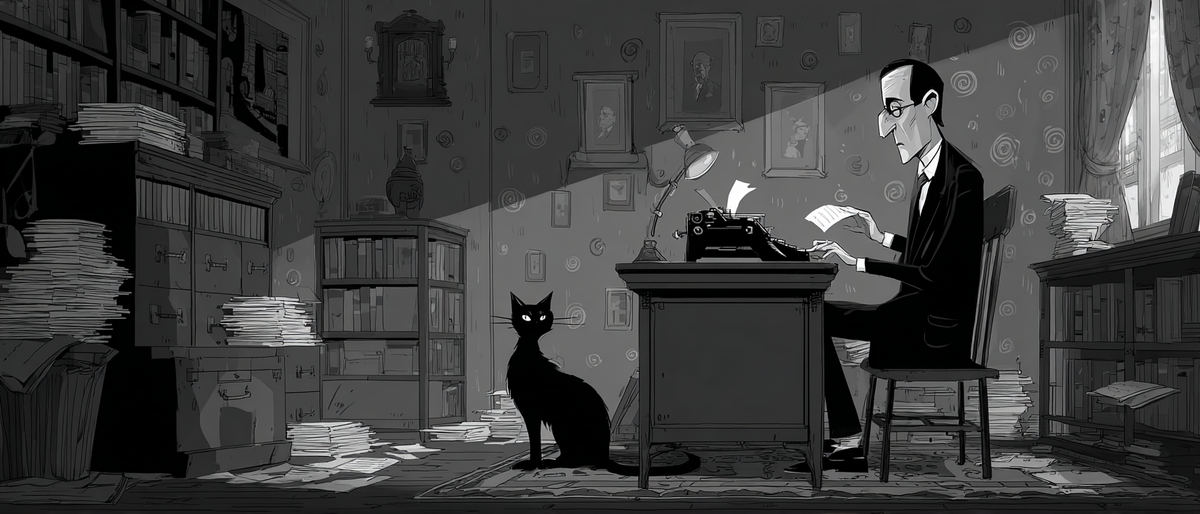
Acid and Effluvium
Did Lovecraft Out-Poe Poe in “The Shunned House”?
On guilt, dissolution, and a stratagem hidden inside a tribute
The Dedication as Signal
Lovecraft does not ease you into “The Shunned House.” Before the Providence street is established, before Elihu Whipple is introduced, before the house itself is described, Lovecraft positions the story in explicit, almost fervent relation to Edgar Allan Poe. He walks you through the churchyard on Benefit Street where Poe once walked. He meditates on the inheritance. The tribute is not a footnote; it is a frame. And for a writer who was capable of considerable critical precision about literary influence — who had, in Supernatural Horror in Literature, analyzed Poe’s technique with genuine analytical rigor — the fervency of that frame is worth examining.
The easy reading is aesthetic homage: Gothic kinship, a tip of the hat to a master of the interior. But Poe’s most celebrated narrators are not primarily architects of atmosphere. They are murderers. Specifically, they are men who kill people they love, construct elaborate supernatural explanations for what happened, and deliver those explanations with the glassy confidence of the almost-self-convinced. The Tell-Tale narrator. The Black Cat narrator. The narrator of “Berenice,” who discovers, through physical evidence alone, what his hands have done in the dark. Poe’s narrators are always, at some structural level, a warning: this person is telling you a story about something terrible, and cannot fully face what it is.
The question the dedication invites — quietly, without announcing itself — is whether Lovecraft’s tribute might be something more precise than homage. Not a declaration of Gothic kinship. An instruction.
The argument that follows is not that Lovecraft sat down with deliberate intent to write an unreliable-narrator story wearing the costume of cosmic horror. That reading, while interesting, is unfalsifiable, and the textual evidence does not compel it. What is more compelling — and ultimately more interesting — is subtler: that Lovecraft’s absorption in Poe, analytical and almost devotional in its depth, may have nourished a narrative stratagem that entered “The Shunned House” below the level of conscious intention. That the influence left its fingerprints on the story whether or not the author meant to place them there. And that the result, designed or discovered, is a text that sustains two readings simultaneously — the cosmicist and the psychological — without resolving either.
The irresolution, as we will see, is not a flaw. It is the most distinctly Lovecraftian thing about the story.
The Textual Case
The narrator is the sole surviving witness to everything that matters. His uncle — his companion, his collaborator, the one person who shared the investigation from its beginning — does not survive the climactic night. The historical record underpinning the entire supernatural case has been assembled, interpreted, and presented exclusively by this narrator; we have no independent access to the parish records he summarizes, the genealogical connections he draws, the documents he cites. He is, in the most precise sense, the architect of his own alibi. And the supernatural entity he describes — the thing in the cellar that saps vitality across generations, that ultimately consumes Elihu Whipple before the narrator’s eyes — is, by design, something that leaves no verifiable evidence. It dissolves. It disperses. It conveniently takes its proof with it.
The historical pattern of deaths the narrator presents as evidence of supernatural predation is worth examining without its cosmicist frame. Infants. Young women. Men declining into listlessness and early death. The weak and the vulnerable. The usual victims. Strip away the supernatural architecture and this is precisely the pattern domestic predation, poverty, trauma, disease and neglect leave in historical records that predate forensic toxicology. “Decline” and “wasting illness” were standard notations for undefined illness, nutritional crisis, neglect and even arsenic poisoning before the chemistry existed to identify it. The vampire Lovecraft invokes here is carefully distinguished from blood-draining convention: this creature operates through influence, through the slow sapping of vitality, through a malevolence that expresses itself as illness and deterioration. This is precisely how a poisoner would appear in the historical record. The symptoms are identical. The vampire and the poisoner leave the same documentary trace.
The narrator acknowledges the cellar atmosphere as potentially hallucinogenic — vapors, phosphorescence, an effluvium without clean chemical or biological explanation. He notes their effect on his uncle’s perception. He does not note their effect on his own. They were in the same enclosed space, breathing the same air. His lucidity is simply assumed, in the way that narrators who need their testimony to be credible always assume the thing that makes it credible.
Then the climax. The entity assumes recognizable human faces — absorbed remnants of previous victims, the narrator explains. At the crisis point, it assumes his uncle’s face. The supernatural reading is internally consistent: the monster has consumed Elihu Whipple and wears him as it has worn others. The psychological reading is more intimate: a mind under sufficient strain can reframe an act of agency as an act of witness. It can place the perpetrator in the audience of his own horror, so that what is being done becomes, in the psyche’s emergency reframing, something being watched rather than something being caused. The face appears at precisely the moment when, if the narrator has done something terrible, his psyche would be most urgently in need of the transfer the vision provides. Whether it is a vision or a confession is not a question the narrator addresses, and the text does not answer for him.
What follows is a man who has, by his own account, just watched his beloved uncle and lifelong companion die horribly. He is horrified — he tells us so. But his horror drives him outward, toward the door, toward the street. It does not drive him toward his uncle. There is no desperate lunge toward Whipple, no attempt to reach him, to resist, to do anything a man watching someone he loves be destroyed might be expected to do. The flight is immediate, and it is away from Elihu Whipple rather than toward him. For a man witnessing the destruction of his dearest companion, the complete absence of any impulse toward rescue is not, precisely, the paralysis of shock. It is something the text declines to name.
He goes home. He sleeps — which is itself worth noting; the sleep of a man who has either witnessed a cosmic horror or committed an act of violence, sleeping with equal soundness either way. He returns in the morning. He brings carboys of sulfuric acid, a pump, a shovel, a pickaxe, and a hose. He uses them to dissolve and remove whatever remains in the cellar. He frames this as the clinical dispatch of a cosmic remnant, and then the story ends, with the house standing empty and the basement very clean.
This particular arrangement of equipment has one primary application in the material world, and it is not the exorcism of supernatural entities. Sulfuric acid in sufficient quantity, delivered through a pump into an enclosed stone space, will destroy organic remains completely — nothing recoverable, nothing identifiable, nothing that could be examined by anyone arriving afterward with questions. Compare the narrator of “The Case of Charles Dexter Ward”: when Willett descends into Curwen’s underground spaces, he investigates what he finds. He confronts the evidence. He understands what it means. In “The Shunned House,” the methodical person cleans up. The difference between those two responses is not a minor tonal variation. It is the difference the essay has been building toward.
The Trevett Problem, and the Turn
At this point it is necessary to introduce a correspondent whose objections to the foregoing represent the cosmicist reading at its most rigorous. Mrs. Della Trevett — a reader of formidable precision — submitted a response to an earlier version of this argument that landed with sufficient force to require a direct reply. Her objections are not trivial. Several of them are correct.
On composure: the behavioral evidence cuts both ways, and an essay that relies on it is on weak ground. A New England antiquarian bachelor in genuine grief would behave exactly as the narrator does. “Providence does not scream; it itemizes”, states our critic. The emotional restraint of the narrator’s response is not a reliable diagnostic for criminal psychology in this cultural and literary context. It is, as Mrs. Trevett observes, “just another Thursday”. This concession is made fully and without reservation. Composure is not where this argument rests.
On preparedness: within the cosmicist frame, arriving with industrial acid is appropriate, not suspicious. If you are confronting a potentially immortal subterranean malignancy, insufficient equipment is the greater psychological red flag. This is fair. The essay’s point about the acid pump is not that it is suspicious in itself. It is that the equipment is functionally identical to what one would bring for a different purpose, and that the text offers both frames without privileging either. The carboys are ambiguous in the same way the whole story is ambiguous — not because they are incriminating, but because they are available to either reading with equal naturalness.
Mrs. Trevett’s most powerful objection concerns the metaphysical architecture of the story itself. Cosmic horror, she argues, does not operate as a courtroom drama with convenient real estate. In such fiction, place is not backdrop; it is appetite. Geography digests. Foundations remember. The house’s malevolence is not narrative misdirection; it is the story’s metaphysical grammar. And she offers a precise formulation of the cosmicist position: “The cellar is clean because existence is not an archivist.”
This is a strong argument. It is the cosmicist reading at its most philosophically serious — the position that dissolution requires no motive, that evidence once erased is not suppressed but simply gone, absent the way heat leaves a body. It is entirely consistent with Lovecraft’s cosmicism as a philosophical system and it deserves to be taken seriously on exactly those terms.
But here is what Mrs. Trevett’s formulation does not accomplish: it does not refute the psychological reading. It converges with it. Whether the cellar is clean because the narrator cleaned it, or because existence is not an archivist, the uncle does not walk out. The two readings arrive at the same place by different routes, and they arrive simultaneously. This is not a competition the cosmicist reading wins. It is a coexistence — and the coexistence is stranger and more disturbing than either reading in isolation.
The cosmicist framework does not cancel the psychological possibility. It compounds it. The horror of the intimate human reading — that something terrible may have happened between two men who loved each other, in a cellar, in the small hours of a summer morning — is not diminished by the indifference of a universe that declines to keep records. It is amplified by it. The machinery of cosmic dissolution provides perfect cover not because Lovecraft designed it that way, but because that is what cosmic indifference actually does: it makes inquiry impossible, not only into the inhuman sublime but into anything that happens within its jurisdiction. Including this.
What Lovecraft Does That Poe Does Not
Lovecraft knew Poe’s stratagem from the inside out — not merely as a devoted reader but as a critic who had mapped its architecture with analytical precision. In Supernatural Horror in Literature he praised Poe specifically for making the narrator’s psychology the unstable medium through which horror is filtered, so that the reader can never fully separate the subjective from the objective. He understood that the power of Poe’s greatest stories comes from the simultaneous availability of both readings — the supernatural and the psychological — each fully supported by the text, neither displacing the other.
He also understood — and this is the critical point — that Poe’s method includes an ending. Poe’s narrators crack. They are designed to crack. The Tell-Tale narrator tears up the floorboards himself, screaming. The Black Cat narrator is caught by his own compulsion, tapping the wall that conceals his wife and producing the sound that undoes him. Roderick Usher screams his sister’s name as the house splits apart. The unmasking is the story — the moment at which the supernatural frame collapses inward and the psychological truth rushes in. Poe operated within a moral universe that had at least this much architecture: that the repressed will return, that guilt compels its own revelation, that the truth eventually surfaces, even if it destroys the person it surfaces through.
Lovecraft’s universe has no such architecture. In his cosmicism, the truth does not surface because the universe has no investment in truth’s emergence. Events occur. Reports are filed. Whether the reports are accurate is a question the universe declines to adjudicate. This is usually terrifying at the scale of the inhuman — the indifferent cosmos, the color out of space, the geometry that should not be. In “The Shunned House” it operates at the scale of the entirely, intimately human. Two men went into a cellar. One came out. He wrote a careful account of what happened. He closed the case. And the universe, which in Poe’s fiction would eventually have forced a confession, says nothing.
This is the departure that matters. Poe believed in confession. His unreliable narrators are meant to be caught; the unraveling is the story. What “The Shunned House” gives us — if the psychological reading holds — is something Poe could not have written: a narrator who does not crack. Who finishes his work, writes his scholarly account, and goes about his day. The ambiguity does not resolve. The epistemic wound stays open.
This is not Lovecraft imitating Poe. It is Lovecraft subsuming Poe’s most human, most guilt-saturated device into a cosmicist sensibility that will not permit the moral resolution Poe’s device was designed to produce. The result is a story that works as weird fiction, works as Gothic psychodrama, and works as both simultaneously — with neither reading canceling the other, and both readings reinforced rather than undermined by their coexistence. The cosmic framework makes the psychological possibility more disturbing, not less. The psychological possibility makes the cosmic framework more intimate, and therefore more terrible, than it would otherwise be.
The Silence
“The Shunned House” was written in 1924, set in type by W. Paul Cook in 1928, and never distributed in bound form during Lovecraft’s lifetime. The unbound sheets sat in Cook’s workshop until August Derleth published the story the year Lovecraft died, 1937.
Across thirteen years of some of the most voluminous private correspondence in American literary history — letters by the thousands, on every subject from aesthetics to astronomy to the layout of Providence streets — Lovecraft maintained near-total silence about this story. He did not discuss its construction. He did not defend or explain its narrative choices. S.T. Joshi, whose biographical and bibliographical work provides the foundation for everything in Lovecraft studies, has documented the silence without fully accounting for it.
The parallel that suggests itself is The Dream-Quest of Unknown Kadath, another formally ambitious work Lovecraft treated in correspondence with conspicuous understatement — acknowledging it existed while declining to illuminate what it was doing. The pattern is documented: Lovecraft was capable of recognizing when he had done something that exceeded what he wished to explain, and of responding with the particular reticence of a writer who has decided some questions are better not invited.
This proves nothing. An author’s silence about a work is consistent with any number of explanations, including the most mundane: that he considered it a minor piece, not worth extended discussion. That explanation is available and cannot be dismissed. What can be noted is that the silence is consistent with a documented pattern, extends across thirteen years without being broken, and that the story’s narrative architecture — if the reading proposed here holds — would have required, under scrutiny, a defense Lovecraft had no particular appetite to mount. The unbound sheets were their own kind of answer.
What the Cellar Tells Us
We have a story dedicated, with analytical fervor, to the writer whose greatest achievement was the unreliable narrator. We have a narrator who controls every piece of evidence, whose sole witness dissolves without trace, whose historical record is simultaneously the alibi and the case. We have a vampire whose symptoms are indistinguishable from poisoning, vapors whose hallucinogenic potential is acknowledged and then asymmetrically applied, a face in the entity that grief or guilt would generate as readily as supernatural possession. We have the acid pump, the sleep, the methodical return, the closed case.
None of this proves the alternative reading. The argument has never been that the narrator of “The Shunned House” is demonstrably a murderer who dissolved his uncle with sulfuric acid and filed a supernatural report to cover it. The argument is both narrower and, in its implications, considerably broader: the text sustains that reading. Sustains it seriously, across multiple independent layers of evidence, in ways that align with the literary tradition the story explicitly invokes. The alternative reading is not a stretch imposed on an unwilling text. It is a reading the text generates, for a reader equipped to receive it, as naturally and as disturbingly as the cosmicist reading it has always been given.
And the two readings do not cancel each other. This is what most clearly distinguishes what Lovecraft has done — consciously or through the deep infiltration of influence — from what Poe does. In Poe, the supernatural and psychological readings are in competition. The story’s movement is toward resolution, toward the collapse of the supernatural frame and the emergence of the psychological truth. In “The Shunned House,” the two readings coexist without resolution. Each is fully available. Neither consumes the other.
Cosmic indifference applied not at the scale of Cthulhu or Azathoth, not at the scale of geological time and interstellar silence, but at the scale of a Providence cellar, between two men who loved each other, in the small hours of a summer night. The universe’s refusal to answer — its structural, irresolvable silence on the question of what happened and whether it matters — is usually terrifying in Lovecraft because it reduces human significance to nothing. In “The Shunned House” it is terrifying because the stakes are not abstract. An old man is gone. A cellar is clean. A narrator sleeps soundly, returns, completes his work, and files his account.
He never gives his name.
The universe, as always, says nothing. And the investigation, if it is an investigation, in never resolved.
Member discussion: